Texas
Democratic Rep. Beto O'Rourke emulated President Trump's attacks in his
final, fiery debate with incumbent Sen. Ted Cruz on Tuesday night,
openly calling Cruz "Lyin' Ted" and charging that he was "all talk and
no action" in the Senate.
The newly aggressive strategy came as
polls show that O'Rourke, despite raising a record-setting $38 million
in campaign funds last quarter, is lagging significantly behind Cruz with just three weeks to go until Election Day.
O'Rourke announced Monday he would not share portions of that fundraising haul with other Democratic candidates, even as polls show that Republicans are starting to pull away in several key races as the GOP looks to expand its slim 51-49 majority in the Senate.
“Senator
Cruz is not going to be honest with you," O'Rourke said during the
debate Tuesday, after Cruz described O'Rourke's voting record on
environmental issues.
"He’s dishonest," O'Rourke continued. "It’s
why the president called him Lyin’ Ted, and it’s why the nickname stuck.
Because it’s true.” (A leading fact-checker, citing police reports, has challenged the accuracy of a claim made by O'Rourke at an earlier debate that he never left the scene of a DUI incident in 1998.)
Cruz
fired back, telling the 46-year-old O'Rourke his universal health care
plans didn't make sense using even "elementary school math" and alluding
to his declining odds at the polls.
Cruz cited studies like the one released in July by the left-leaning Mercatus Center at George Mason University,
which said prominent "Medicare for all" solutions advocated by
Democrats would increase government health care spending by $32.6
trillion over 10 years, and require historic tax increases.
“It’s
clear Congressman O’Rourke’s pollsters have told him to come out on the
attack," Cruz said. "So if he wants to insult me and call me a liar,
that’s fine.”
The debate included some lighter moments, with the
candidates pausing their broadsides to describe some personal anecdotes.
Cruz mentioned that he tries to stay in touch with his family while
he's in Washington using Facetime calls, and O'Rourke discussed nursing a
seemingly hopeless blind squirrel and sneaking in jam sessions on a
basement drum kit that he had ostensibly purchased for his son.
However,
the tone was predominately sharp and testy. Cruz repeatedly told the
debate moderator, local reporter Jason Whitely, to stop interrupting him
-- most forcefully when he was condemning what he called the rise of
liberal partisan incivility.
The two later sparred over Cruz's
role in the 2013 shutdown of the federal government, which he largely
spearheaded as a means of opposing the Affordable Care Act, known as
ObamaCare.
"You want to talk about a shutdown?" Cruz asked. "With
Congressman O'Rourke leading the way, [there'll be] two years of a
partisan circus and a witch hunt on the president." DEMS POISED TO MAKE HISTORIC IMPEACHMENT PUSH IF THEY RETAKE THE HOUSE, AS GOP PULLS AWAY IN SENATE POLLS
That
was a reference to O'Rourke's stated support for impeaching President
Trump, which top Democratic leaders have said would be premature. Cruz
noted O'Rourke is “the only Democratic Senate nominee in the country who
has explicitly come out for impeaching President Trump.”
"He’s dishonest. It’s why the president called him 'Lyin’ Ted,' and it’s why the nickname stuck." — Rep. Beto O'Rourke, D-Texas
Cruz predicted "utter chaos" if O'Rourke's proposal became a reality.
"Washington
would be consumed by partisan investigations. That's not civility,"
Cruz said, noting that he and his wife had been chased out of a
Washington, D.C. restaurant recently by liberal protesters chanting, "We
believe women." WATCH: RADICAL PROTESTERS CONFRONT, HARASS CRUZ AND HIS WIFE AS THEY EAT DINNER
O'Rourke's
position on impeaching the president apparently has changed during the
campaign. “Impeachment, much like an indictment, shows that there is
enough there for the case to proceed,” O’Rourke has said, “and at this point there is certainly enough there for the case to proceed.” However, the 46-year-old has clarified that although he would vote for impeaching Trump, he hasn't been in favor of actually initiating impeachment proceedings.
During
the debate, O'Rourke pushed back, telling Cruz it was "really
interesting to hear you talk about a partisan circus after your last six
years in the Senate." Laughter broke out in the debate room, which had a
live audience. WAPO FACT-CHECK DISPUTES O'ROURKE'S CLAIM DURING PREVIOUS DEBATE ABOUT LEAVING DUI CRASH SCENE
The
upstart Texas representative asked, "If you have such a special
relationship with the president, where is the result of that? You are
all talk and no action." Cruz pointed to his role in the passage of
Trump's historic tax package last year as one of his signature
achievements in the Senate.
O'Rourke's language again mirrored one of the president's favored lines. In speeches, interviews, and rallies, Trump has often derided politicians as being typically "all talk and no action."
Trump,
once Cruz's bitter rival during the 2016 presidential campaign, has
endorsed Cruz. He is poised to become a bigger factor in the race: On
Monday, Trump will hold a rally for Cruz at the 8,000-seat NRG Arena in
Houston.
Less
than a month after the confirmation of Associate Justice Brett
Kavanaugh entrenched a 5-4 conservative majority on the Supreme Court,
leading law professors are urging Democrats to expand the size of all of
the nation's federal courts and pack them with liberals.
Far-left
Harvard professors Mark Tushnet and Laurence Tribe are lending their
support to the so-called "1.20.21 Project," which was launched by
political science professor Aaron Belkin on Wednesday to counter
"Republican obstruction, theft and procedural abuse" of the federal
judiciary.
That rhetoric reflects the professors' apparent
surprise after Democrats lost the 2016 presidential election, which they
had hoped would allow the party to continue appointing liberal judges
and justices. In 2016, when Hillary Clinton was leading in all major
polls in her bid for the presidency, Tushnet definitively declared in a blog post that conservatives were the "losers in the culture wars."
He
wrote that liberal judges who "no longer have to be worried about
reversal by the Supreme Court" could be useful in marginalizing those
Republican "losers," whom he compared to the defeated Japanese in World
War II or the Confederacy in the Civil War. WATCH: TUCKER SAYS DEMS' PLAN TO PACK THE COURT WOULD 'DELEGITIMIZE' THE SUPREME COURT FOREVER, LEAD TO RETALIATION
The
heated language also highlights what liberals have characterized as the
unfair treatment of President Obama's failed nominee to the Supreme
Court, Merrick Garland. In 2016, Senate Majority Leader Mitch McConnell,
R-Ky, refused to hold a hearing or vote on Garland, saying a lame-duck
president shouldn't be able to appoint a justice in an election year.
Garland didn't have enough support in the GOP-held Senate to win
confirmation.
At Kavanaugh's ceremonial swearing-in ceremony earlier this month, President Trump led a standing ovation
for McConnell, whom he called a "great" leader who has done an
"incredible job for the American people." Under McConnell and
Trump, Republicans have now confirmed 26 federal appellate judges and
two Supreme Court justices. (Kavanaugh's rise to the Supreme Court
creates a new vacancy on the influential D.C. Circuit Court of Appeals,
where he had served for 12 years.)
That fast pace of conservative
judicial appointments has upended and frustrated some of the assumptions
of liberal law professors like Tushnet, who wrote just two years ago:
"Right now more than half of the judges sitting on the courts of appeals
were appointed by Democratic presidents, and – though I wasn’t able to
locate up-to-date numbers – the same appears to be true of the district
courts."
Liberal academics have long floated the possibility of
flooding the bench with Democrats, although the 1.20.21 Project is their
most organized effort to date. For example, another far-left law
professor, Indiana Unversity's Ian Samuel, wrote on Twitter as soon as
then-Associate Justice Anthony Kennedy announced his retirement in June
that Democrats should "[p]ack the courts" as urgently as they should
"abolish ICE."
Still, this latest effort also underscored the
intensely left-leaning politics of most of the nation's academia. During
Kavanaugh's confirmation process, thousands of progressive law professors
signed a letter saying Kavanaugh's temperament during Senate Judiciary
Commitee hearings in September was disqualifying. Kavanaugh forcefully
denied the uncorrobroated attempted rape and other sexual misconduct
accusations against him.
And Tribe, who has accused President Trump of "orchestrating a massive cover-up"
that is "worse" than anything done by former President Richard Nixon,
is himself no stranger to partisan politics. In 2015, a piece in The New
Yorker by law professor Tim Wu asked, "Did Laurence Tribe Sell Out?"
The article noted that "it would ... be foolish to ignore the inherent
tension in searching for truth while also working for paying clients,"
as Tribe does.
While there is no constitutionally fixed number of
federal appellate or Supreme Court justices, the plan to pack the courts
would require changes to federal law, meaning that Democrats would have
to retake Congress and the presidency to see it through. DEMS ALSO PREPPING HISTORIC TRUMP IMPEACHMENT PUSH AFTER MIDTERMS, AS FOX POLLS SHOW GOP GAINS
The
proposal is not without precedent. In 1937, then-President Franklin D.
Roosevelt, frustrated by the Supreme Court's objections to his New Deal
policies, threatened to pack the Supreme Court -- a proposal that failed
after Associate Justice Owen Roberts bowed to the White House's
pressure and began supporting its initiatives.
But Tribe
insisted this new plan is different. Roosevelt was unhappy with high
court decisions that were blocking New Deal legislation, but the new
push for a larger court stems from Republican actions, not the court's
decisions, Tribe said.
"The time is overdue for a seriously
considered plan of action by those of us who believe that McConnell
Republicans, abetted by and abetting the Trump Movement, have
prioritized the expansion of their own power over the safeguarding of
American democracy and the protection of the most vulnerable among us,"
Tribe said. KAVANAUGH COPING MECHANISMS: 5 WILD DEM SCHEMES TO COUNTER TRUMP'S SCOTUS WIN
Belkin, who launched the 1.20.21 Project, did not immediately respond to Fox News' request for comment.
The
size of the Supreme Court varied during its first 80 years from a low
of six at the time the Constitution took effect in 1789 to a high of 10
during the Civil War. The current tally of nine justices was set in an
1869 law. The Associated Press contributed to this report.
A
Minnesota appeals court on Tuesday ruled against Rep. Keith Ellison and
his ex-wife's attempt to delay the release of their divorce records to
allow them a chance to redact 'confidential information.'
Ellison, who holds one of the top positions in the Democratic National Committee, is near the end of a tight race for Minnesota attorney general and has recently seen his lead slip after allegations of domestic abuse by a former girlfriend.
The Star Tribune reported that the divorce files will likely be unsealed on Wednesday.
Kim
Ellison, his ex-wife, told reporters on Tuesday that it was her hope to
keep the divorce record away from public scrutiny due to her medical
records. The file reportedly touches on her depression and a multiple
sclerosis diagnosis. She said there was never "any abuse of any kind in
our relationship."
They were married for 25 years.
The focus
on Ellison's divorce began after Karen Monahan alleged that he tried to
drag her off a bed by her feet in 2016. She said she had video of the
incident, which she has refused to provide.
Ellison has denied all
the allegations and allowed the party to review Monahan’s allegations.
The state Democratic Party hired Democratic Party-affiliated lawyer
Susan Ellingstad whose draft report cleared him of wrongdoing.
The
Minneapolis Star Tribune and conservative news site Alpha News sued to
unseal the divorce record, arguing it's a matter of public interest as
he vies for the state's top law enforcement position.
His wife accused the outlets of using their "personal tragedy for personal gain or political gain or to boost circulation."
"It’s
not fair that my life's work should be reduced to the two years that I
suffered a mental illness," Kim Ellison, a teacher, said.
Recent polls indicate that Ellison in a dead heat race with Doug Wardlow, the Republican opponent, according to the New York Times.
The
poll also found that 40 percent surveyed voters said the domestic abuse
allegations “are a factor” in whether to vote for the Democrat. Another
poll shows the congressman leading by five points. Fox News' Lukas Mikelionis and The Associated Press contributed to this report
With three weeks to go in what should be a strong midterm election for them, here's what the Democrats don't need:
Hillary Clinton justifying her husband's sexual affair with a White House intern because she was over 21.
Elizabeth
Warren doing a DNA test that shows she has a minuscule fraction of
Native American ancestry and getting denounced by the Cherokee Nation.
Heidi Heitkamp having to apologize for putting out a letter naming sexual assault victims without their permission.
These are, to put it mildly, all self-inflicted wounds.
The
plain fact is that there's only so much media oxygen out there in an
election that Donald Trump has clearly nationalized. When one of the
name-brand Democrats steps in it, the media pile on, and that means the
party's message is obscured — especially important with less than three
weeks until the election.
Of course, some GOP candidates have
screwed up as well. And Trump drew enormous criticism yesterday for
tweeting, after a federal judge tossed Stormy Daniels' defamation suit
against him, "Great. Now I can go after Horseface and her 3rd rate
lawyer," White House wannabe Michael Avenatti.
This of course
reminded Trump critics of a series of comments about women's faces, and
why go there after winning the lawsuit? While it created a media storm,
voters have already made up their minds about the president's penchant
for personal insults. And he's got the huge megaphone, which he is
using, on many other issues.
That's not true of the Democrats, who
seem to lack a unified message other than Trump is awful so we should
take over the House. It's always a challenge for a minority party
without a national leader and in this case, a zillion people positioning
themselves to run in 2020. But that underscores why these ancillary
controversies are a wasted opportunity.
Clinton drew flak for her
comments about Monica Lewinsky in a "CBS Sunday Morning" interview. She
said, not surprisingly, that her husband should not have resigned two
decades ago, when he was being impeached, and that she's only
responsible for her own behavior.
But when correspondent Tony
Dokoupil said Bill couldn't possibly have had a consensual relationship
with Lewinsky because of the huge power imbalance, Hillary retreated to
saying "she was an adult." That angered many in the #Me-Too movement and
made her sound tone-deaf.
Come on. Lewinsky was a very young
woman in an extramarital relationship with the most powerful man on the
planet. You might think, after all this time, that Clinton would have
crafted a better answer.
Warren, obviously stung by Trump's
"Pocahontas" attacks, completely botched her rollout of DNA evidence
purporting to show she did have a distant Native American ancestor. All
you need to know is that the Cherokee Nation's secretary of state said:
"It
makes a mockery out of DNA tests and its legitimate uses while also
dishonoring legitimate tribal governments and their citizens, whose
ancestors are well documented and whose heritage is proven. Senator
Warren is undermining tribal interests with her continued claims of
tribal heritage."
How could she not have sounded out the group first?
The
Boston Globe has issued two corrections on the story. The first one
said that under the test Warren "would be 1/1024 Native American, not
1/512."
The second said that the senator had "misstated the ancestry percentage of a potential 6th to 10th-generation relative." Ouch.
I
understand that Warren wanted to put the Native American controversy
behind her and send a clear smoke signal that she's running for
president. But while the ensuing back and forth with Trump might help
her, it does nothing for her fellow Democrats who are up in November.
One
of those is Heitkamp, who is running about 10 points behind Republican
Kevin Cramer in the North Dakota Senate race. She made an extraordinary
blunder in issuing an open letter to him that was published in several
newspapers.
That letter named some sexual assault survivors who
say they are not victims of assault, and others, expressing their
outrage on Facebook, who say they never gave permission to be publicly
identified.
The senator said in a statement: "I deeply regret this
mistake and we are in the process of issuing a retraction, personally
apologizing to each of the people impacted by this and taking the
necessary steps to ensure this never happens again."
That was
political malpractice by Heitkamp's campaign that obviously hurts her
candidacy, but also achieved story-of-the-day status that drew attention
from other Democrats.
None of these mistakes was dreamed up by a
hostile conservative media, and have actually drawn sharp criticism from
liberal pundits. Together they amount to an unintended gift to the GOP.
U.S. Secretary of State Mike Pompeo, second right in front,
walks with Saudi Foreign Minister Adel al-Jubeir after arriving in
Riyadh, Saudi Arabia, Tuesday, Oct. 16, 2018.
(AP)
U.S. Secretary of State
Mike Pompeo landed Tuesday in Saudi Arabia to meet with King Salman over
the disappearance of Saudi writer Jamal Khashoggi, who is believed to
be dead.
Pompeo landed in Riyadh and was to speak Salman over the
crisis surrounding Khashoggi and his alleged slaying. Pompeo was greeted
by Saudi Foreign Minister Adel al-Jubeir.
Khashoggi vanished two
weeks ago during a visit to the Saudi Consulate in Istanbul. Pompeo is
set to also visit the place where Khashoggi was last seen.
"The
effort behind the scenes is focused on avoiding a diplomatic crisis
between the two countries and has succeeded in finding a pathway to
de-escalate tensions," said Ayham Kamel, the head of the Eurasia Group's
Mideast and North African practice. "Riyadh will have to provide some
explanation of the journalist's disappearance, but in a manner that
distances the leadership from any claim that a decision was made at
senior levels to assassinate the prominent journalist."
Turkish
officials said they fear Khashoggi was killed and dismembered inside the
consulate. Saudis have called the allegations “baseless.”
Media reports indicate that the Kingdom may acknowledge the writer was killed in the consulate.
Meanwhile, Turkish investigators were allowed to search the consulate on Monday, according to The Washington Post.
But hours before the Turkish forensic team arrived, journalists
photographed a cleaning crew entering the consulate, the paper reported.
The
crew hauled buckets, mops and what appeared to be bottles of cleaning
solution, The Post reported. Turkish investigators said they “smelled
chemicals had been used,” two officials in contact with the
investigators said, according to the paper.
“They are trying to make fun of us and our willingness to cooperate,” one of the officials said.
Forensics
tests like spraying luminol, a chemical mixture, can expose blood left
behind, said Mechthild Prinz, an associate professor at the John Jay
College of Criminal Justice who previously worked at the New York City's
Office of the Chief Medical Examiner.
"It depends on how well
they cleaned it up," Prinz told the AP. "Obviously, you don't want
anybody to have a chance to clean it up, but very often people do miss
blood."
President Donald Trump, after speaking with King Salman,
had dispatched Pompeo on Monday to speak to the monarch of the world's
top oil exporter over Khashoggi's disappearance.
“I am immediately sending our Secretary of State to meet with King!” Trump tweeted Monday.
Khashoggi
had written critically about Saudi Crown Prince Mohammed bin Salman,
son of King Salman, for The Washington Post. The prince is next in the
line to the throne, and his rise to power prompted the writer’s
self-imposed exile in the U.S.
Khashoggi has criticized Saudi
Arabia’s war in Yemen, its recent diplomatic spat with Canada and its
arrest of women's rights activists after the lifting of a driving ban
for women—policies seen as initiatives of the crown prince. The Associated Press contributed to this report.
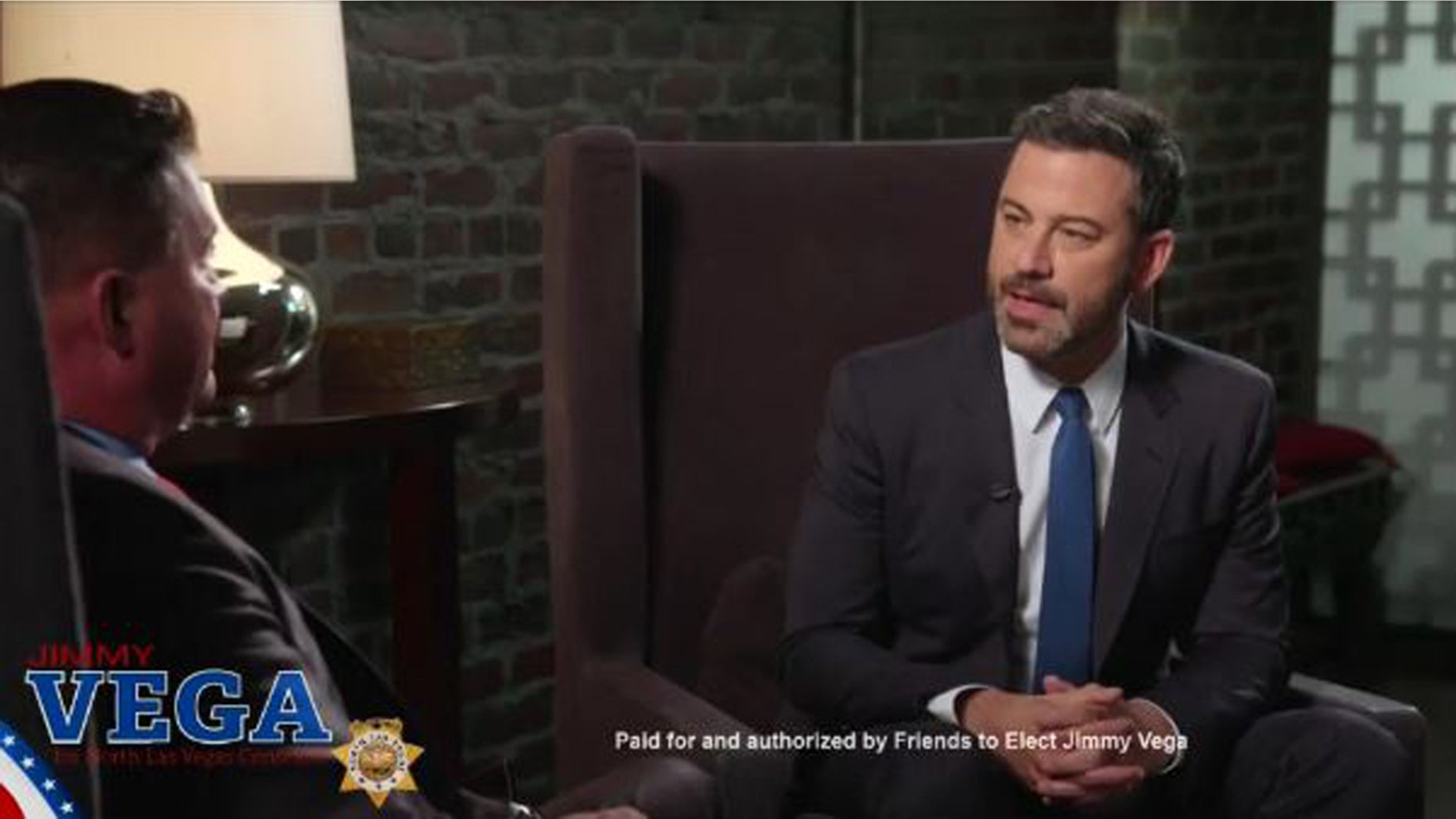
Jimmy Kimmel appears in a campaign video to support his longtime friend Jimmy Vega for North Las Vegas constable.
(Jimmy Vega for North Las Vegas Constable)
Who says Jimmy Kimmel doesn't support Republicans?
Late
night talk show host Jimmy Kimmel announced his support for a
Republican (a lifelong friend) who is running for constable in North Las
Vegas.
Kimmel appeared in a campaign video endorsing Jimmy Vega,
who he's known since they were 12 years old. The host of “Jimmy Kimmel
Live!” said he was proud of Vega for running.
Vega, 51, had been in the military for 25 years, and is currently in the naval reserves, he said.
“For
me it was an integrity issue, is that, you know, you work hard, not
everybody is meant to be a cop, not everybody is meant to be a
firefighter, not everybody is meant to be in the military. You have to
go through your prospective boot camps or academies to earn it, and
that’s how I feel, I feel you just have to earn everything in life,”
Vega said.
Kimmel has been vocal about his criticism of President
Donald Trump and many Republican policies. But Vega said it’s not about
partisanship.
“It’s just doing the right thing and helping the
people, and that’s what I plan to do,” he said. “This race shouldn’t be a
partisan race anyway. We’re law enforcement, we don’t create law, we
just enforce law.”
North Las Vegas is “saturated” with veterans,
according to Vega, and he has a passion to support veterans, he said.
Vega said he wants to grow the department.
“There’s a lot of things that the current constable is not doing that I intend to do,” he said.
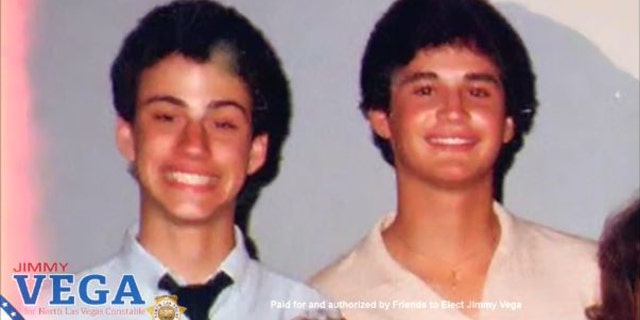
Jimmy Kimmel and longtime friend Jimmy Vega.
(Jimmy Vega for North Las Vegas Constable)
According to Nevada law, Constables are considered peace officers, according to Nevada law. Their duties include evictions and summoning juries for justices of the peace.
Kimmel
and Vega chuckle throughout the video, with the comedian throwing in a
few jokes, including some about the eviction part of the constable job.
They both graduated from Clark High School, according to the Las Vegas Review-Journal.
Amazon founder and CEO Jeff Bezos, speaking at the Economic Club of Washington's Milestone Celebration in Washington.
(AP)
Amazon founder Jeff Bezos
has distinguished his company from other big tech firms in declaring its
willingness to work with the United States Department of Defense.
“If
big tech companies are going to turn their back on the US Department of
Defense, this country is going to be in trouble,” Bezos cautioned in
San Francisco Monday at an event celebrating the 25th anniversary of the
tech magazine Wired. AMAZON FOUNDER JEFF BEZOS GIVES $10 MILLION TO SUPER PAC IN FIRST MAJOR POLITICAL CONTRIBUTION
Amazon
is bidding for a 10-year contract with the Defense Department known as
the Joint Enterprise Defense Infrastructure project, JEDI, to offer
cloud computing services worth up to $10 billion.
“We are going to continue to support the DoD, and I think we should,” Bezos said.
This is a great country and it does need to be defended. — Jeff Bezos
Earlier this month, Google said it had removed its bid for JEDI because the contract went against the company's "A.I. Principles." On Friday, Microsoft employees published an open letter on Medium, urging the company not to take the contract.
"Many Microsoft employees don't believe that what we build should be used for waging war," the letter read. AMAZON’S JEFF BEZOS TOUTS BLUE ORIGIN ROCKETS, WEB SERVICES AT AIR FORCE EVENT
Bezos acknowledged his unpopular stance.
“One
of the jobs of the senior leadership team is to make the right
decision, even when it’s unpopular,” Bezos said. "This is a great
country and it does need to be defended."
"I know everybody is very conflicted about the current politics and so on,” he said, but, “This country is a gem.”
Attorney
General Jeff Sessions on Monday lit into federal judges for what he
called a dramatic uptick in "outrageous" decisions threatening to
interfere with the separation of powers by exposing internal White House
deliberations.
In a fiery speech to the conservative Heritage
Foundation in Washington, Sessions warned that "once we go down this
road in American government, there is no turning back." He vowed to take
"these discovery fights to the Supreme Court in emergency postures. ...
We intend to fight this, and we intend to win."
Sessions
specifically singled out New York district court judge Jesse M. Furman,
who ruled that Commerce Secretary Wilbur Ross could be questioned in an
ongoing lawsuit concerning the legality of the Trump administration's
decision to add a citizenship question to the 2020 census.
Furman's
decision, Sessions said, contradicts longstanding statutory provisions
that protect certain executive branch discussions from disclosure, in
order to encourage free and open deliberations by executive branch
officials. The plaintiffs in the lawsuit, including several liberal
states, are arguing in part that the White House added the citizenship
question for political reasons.
The judge wants "to hold a trial
over the inner workings of a Cabinet secretary’s mind," and
inappropriately allow inquiry into the motivations for the Trump
administration's decisions, Sessions said.
Furman's order, which
was upheld by a New York federal appellate court, has been stayed by
Supreme Court Justice Ruth Bader Ginsburg. The full Supreme Court is
expected to decide the issue soon.
"Once we go down this road in American government, there is no turning back." — Attorney General Jeff Sessions
The
pending court challenges against the Trump administration's decision to
add a citizenship question, legal experts tell Fox News, face an uphill
battle not only because conservatives now command a 5-4 majority on the
Supreme Court, but also because traditionally it's been the White
House's prerogative to decide whether to inquire about citizenship on
the census.
Former President Barack Obama's administration didn't ask the question in the 2010 census amid
fears it would cause illegal immigrants to avoid answering their census
questions -- and thus not count toward population totals used to
determine the number of seats each state receives in the House of
Representatives. (The citizenship question was last asked on the census
in 1950, but beginning in 1970, a citizenship question was asked in a
long-form questionnaire sent to a relatively small number of households,
alongside the main census. In 2010, there was no long-form
questionnaire.)
Democrats would lose out because the citizenship
question would affect predominately liberal districts, but that's not a
legally sufficient objection, legal analysts say. TRUMP CENSUS BUREAU NOMINEE QUIZZED BY SENATORS ON CITIZENSHIP QUESTION
"There
is no credible argument to be made that asking about citizenship
subverts the Constitution and federal law," Chapman University law
professor and constitutional law expert John Eastman told Fox News. "The
recent move is simply to restore what had long been the case."
Nevertheless,
Sessions said Monday, liberal states and nonprofits have continued to
push even longshot legal challenges in order to dig around in executive
branch deliberations.
"This is not the first time we’ve had to
seek emergency appellate intervention to stop outrageous discovery,"
Sessions said. Last year, the government filed a successful emergency
motion to stop a district court's ruling that permitted plaintiffs to
question a Department of Homeland Security counselor about advice
relating to the contentious Deferred Action for Childhood Arrivals
(DACA) program.
Sessions called that lower court ruling a "blatant
violation of deliberative process and attorney-client privileges" and
warned that it would have a "chilling effect" on deliberations in the
White House.
He added, "Too many judges believe it is their right, their duty, to act upon their sympathies and policy preferences."
The
attorney general blamed Obama for encouraging that approach. "One
argument for activism was advocated openly by President Obama when he
declared his judicial nominees must judge with 'empathy.' It is a
seductive argument. But whatever empathy is, it’s more akin to emotion,
bias, and politics than law," Sessions said.
"In the recent DACA litigation, for example, a judge last year told one of our DOJ litigators, 'You can’t come into court to espouse a position that is heartless,'"
Sessions continued. "Not illegal. Not unlawful. Heartless. And later,
after I responded in a speech that it isn’t a judge’s job to decide
whether a policy is 'heartless,' the judge again scolded the DOJ lawyer
by stating that I 'seem to think the courts cannot have an opinion.'"
Judge Nicholas Garaufis denied the government's motion to dismiss a
DACA lawsuit, citing President Trump's "bigoted" comments.
(Reuters, FIle)
That judge, U.S. District
Judge Nicholas Garaufis, was appointed to the bench by former President
Bill Clinton. He ruled in March that a lawsuit seeking to preserve the
federal DACA program can continue -- citing candidate Donald Trump's
"racial slurs" and "epithets."
“One might reasonably infer,”
Garaufis said in his politically charged ruling, “that a candidate who
makes overtly bigoted statements on the campaign trail might be more
likely to engage in similarly bigoted action in office.”
Separately,
Sessions also said the 27 nationwide federal injunctions issued by
individual judges during the Trump administration so far -- which
brought temporary halts to high-profile policies like his ban on travel from Muslim-majority nations -- constitute an unprecedented "judicial encroachment."
"It
is emphatically not the duty of the courts to manage the government or
to pass judgment on every policy action the Executive branch takes,"
Sessions said. "In the first 175 years of this Republic, not a single
judge issued one of these orders."
In his confirmation hearings
for the Supreme Court in September, then-nominee Brett Kavanaugh was
asked by Louisiana Republican Sen. John Kennedy about the
constitutionality of individual federal judges issuing nationwide
injunctions against presidential action, a recent phenomenon. Kavanaugh
demurred, saying he could not discuss potential pending issues before
the Supreme Court.
Sessions noted that Associate Justice Clarence
Thomas, who concurred in the high court's decision earlier this year to
reinstate Trump's travel ban, wrote that such injunctions “take a toll
on the federal court system—preventing legal questions from percolating
through the federal courts, encouraging forum shopping, and making every
case a national emergency for the courts and for the executive branch.”
He
added: "Executive branch officers do not work for the judiciary. We
work for the president of the United States. Respect runs both ways."