A
former executive editor of the New York Times says the paper’s news
pages, the home of its straight-news coverage, have become “unmistakably
anti-Trump.”
Jill Abramson, the veteran journalist who led the
newspaper from 2011 to 2014, says the Times has a financial incentive to
bash the president and that the imbalance is helping to erode its
credibility.
In a soon-to-be published book, “Merchants of Truth,”
that casts a skeptical eye on the news business, Abramson defends the
Times in some ways but offers some harsh words for her successor, Dean
Baquet. And Abramson, who was the paper’s only female executive editor
until her firing, invoked Steve Bannon’s slam that in the Trump era the
mainstream media have become the “opposition party.”
“Though
Baquet said publicly he didn’t want the Times to be the opposition
party, his news pages were unmistakably anti-Trump,” Abramson writes,
adding that she believes the same is true of the Washington Post. “Some
headlines contained raw opinion, as did some of the stories that were
labeled as news analysis.”
What’s more, she says, citing legendary
20th century publisher Adolph Ochs, “the more anti-Trump the Times was
perceived to be, the more it was mistrusted for being biased. Ochs’s vow
to cover the news without fear or favor sounded like an impossible
promise in such a polarized environment.”
Abramson describes a
generational split at the Times, with younger staffers, many of them in
digital jobs, favoring an unrestrained assault on the presidency. “The
more ‘woke’ staff thought that urgent times called for urgent measures;
the dangers of Trump’s presidency obviated the old standards,” she
writes.
Trump claims he is keeping the “failing” Times in
business—an obvious exaggeration—but the former editor acknowledges a
“Trump bump” that saw digital subscriptions during his first six months
in office jump by 600,000, to more than 2 million.
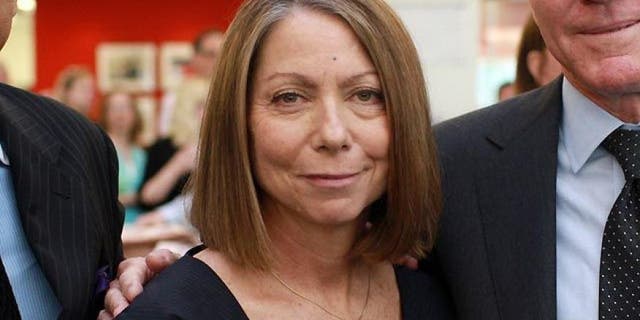
Former executive editor of the New York Times Jill Abramson.
Dean
Baquet 2019 New York Times Editor
“Given its mostly liberal audience, there was an
implicit financial reward for the Times in running lots of Trump
stories, almost all of them negative: they drove big traffic numbers
and, despite the blip of cancellations after the election, inflated
subscription orders to levels no one anticipated.”
The Times has
long faced accusations of liberal bias, even before Trump got into
politics and became its harshest critic. But Abramson’s words carry
special weight because she is also a former Times Washington bureau
chief and Wall Street Journal correspondent specializing in
investigative reporting.
Baquet has said that Trump’s attacks on
the press are “out of control” and that it is important to use the word
“lie” when the president tells a clear untruth.
In “Merchants of
Truth: The Business of News and the Fight for Facts,” Abramson praised
as “brave and right” Baquet’s decision to run this headline when Trump
abandoned his birtherism attacks on Barack Obama: “Trump Gives Up a Lie
But Refuses to Repent.”
Abramson, who had her share of clashes
with Baquet when he was her managing editor, sheds light on a 2016
episode when Baquet held off on publishing a story that would have
linked the Trump campaign with Russian attempts to influence the
election.
Liz Spayd, then the Times public editor, wrote that the
paper, which concluded that more evidence was needed, appeared “too
timid” in not running the piece, produced by a team that included
reporter Eric Lichtblau.
Baquet “seethed” at this scolding, Abramson says, and emailed Lichtblau: “I hope your colleagues rip you a new a*****e.”
Baquet
wrote that “the most disturbing thing” about Spayd’s column “was that
there was information in it that came from very confidential, really
difficult conversations we had about whether or not to publish the back
channel information. I guess I’m disappointed that this ended up in
print.
“It is hard for a journalist to complain when confidential
information goes public. That’s what we do for a living, after all. But
I’ll admit that you may find me less than open, less willing to invite
debate, the next time we have a hard decision to make.”
Lichtblau
soon left the Times for CNN, where he was one of three journalists fired
when the network retracted and apologized for a story making
uncorroborated accusations against Trump confidante Anthony Scaramucci.
And the Times soon abolished the public editor’s column.
Abramson
is critical of Trump as well. She calls his “fake news” attacks a “cheap
way of trying to undermine the credibility of the Times’s reporting as
something to be accepted as truth only by liberals in urban,
cosmopolitan areas.”
The Times, which broke the story of Hillary
Clinton’s private email server, also “made some bad judgment calls and
blew its Clinton coverage out of proportion,” Abramson writes. She says
Clinton “was wary of me,” mishandled the scandal and “was secretive to
the point of being paranoid.”
Abramson is candid in acknowledging
her faults. When then-publisher Arthur Sulzberger Jr. was considering
promoting her to the top job, he told her over lunch at Le Bernadin:
“Everyone knows there’s a good Jill and a bad Jill. The big question for
me is which one we’ll see if you become executive editor.”
She admitted to him that “I could be self-righteous when I felt unheard, I interrupted, I didn’t listen enough.”
It
was a heated battle with Baquet that led to her ouster in 2014. He was
furious upon learning that she was trying to trying to recruit another
top journalist—Abramson says an executive ordered her to keep it
secret—who would share the managing editor’s title.
Sulzberger called her in, fired her, and handed her a press release announcing her resignation.
Abramson
says she replied: “Arthur, I’ve devoted my entire career to telling the
truth, and I won’t agree to this press release. I’m going to say I’ve
been fired.”
Her final judgment: “I was a less than stellar
manager, but I also had been judged by an unfair double standard applied
to many women leaders.”
Rep. Walter Jones, R-N.C., ranks 48th out of 435 congress members for missed votes.
(ivn.us)
A congressman who last
week suggested that President Trump ought to fork over his "own funds"
to help fund the border wall, reportedly has a history of missing votes
on Capitol Hill.
U.S. Rep. Walter Jones, a Republican who
represents North Carolina’s 3rd Congressional District, missed a total
of 7.7 percent of House votes in 2017 – ranking him 48th among 435
members in missed votes, according to statistics cited by the News & Observer of Raleigh.
More
recently, an illness has prevented Jones from voting since late
September. He has missed at least 27 roll call votes since then, through
the House's reconvening in November, the report said. He is expected to
Capitol Hill when Congress reconvenes in January, the News &
Observer reported.
Jones,
75, won an easy victory in the November midterms. During the primary,
he said it would be his final term in office if he was elected.
The lawmaker's statement that Trump should contribute his own money was said amid a partial government shutdown, stemming in part from Congress' inability to reach a deal on Trump's request for $5 billion for a border wall.
Jones also suggested slashing federal aid or funding the war in Afghanistan as ways to come up with the extra money.
Since
the federal government partially shut down Dec. 22, Republicans and
Democrats have been at a seeming impasse over Trump’s demands for $5
billion for a border wall. Trump continued to press Democrats to "give
us the votes necessary for border security" in a series of tweets on New
Year's Eve.
House Democrats said they plan to introduce a
legislative package later Monday to re-open the government, including a
bill that would fund the Department of Homeland Security at current
levels through Feb. 8 with $1.3 billion for border security, but it's
unclear what kind of support it will get from Republicans. It did not
include money for the wall.
U.S.
Sen. Elizabeth Warren has her eyes set on the 2020 presidential race,
but the controversy surrounding her claims of Native American ancestry
may have cost her political future, RealClearPolitics associate editor
A.B. Stoddard argued Monday night on the "Special Report" All-Star
panel.
On Monday morning, Warren announced she was forming an
exploratory committee in preparation of what will likely be a
presidential run in 2020. The Massachusetts Democrat is the third member
of her party to declare such ambitions -- following former Housing and
Urban Development Secretary Julián Castro and U.S. Rep. John Delaney of
Maryland.
In October, Warren released the findings of a DNA test
that show that she may be 1/1,024th Native American, in a bid to quiet
her critics. She had been accused of claiming she had Native American
heritage to advance her career, something President Trump has repeatedly
suggested.
Stoddard,
who appeared with the Federalist senior editor Mollie Hemingway and
Washington Examiner editorial director Hugo Gurdon, expressed that
Warren’s deflection from the ancestry controversy isn’t good enough
since it was “truly a debacle.”
“It showed what her political
judgment is really like. And it’s one thing to just be on the Senate
floor or the campaign trail in 2016, have a national network of support,
have a good message. It’s another to make a huge blunder, sort of
taking Trump’s bait ... but yeah, she has a bad story on this issue,”
Stoddard told the panel. “She brings the video out in late October, two
weeks before the midterms, steps on the Democrats’ message. It’s
completely selfish and sort of self-absorbed and tone-deaf, and then she
gets dissed by the Cherokee Nation. It was a disaster and Democrats
were furious. And they believe that it was a fatal blow.”
“She
brings the video out in late October, two weeks before the midterms,
steps on the Democrats’ message. ... It was a disaster and Democrats
were furious. And they believe that it was a fatal blow.” — A.B. Stoddard, RealClearPolitics associate editor
“Instead
of sort of just stepping aside and using what she has, which is some
national support and kind of being a kingmaker, she’s gonna step into
this race and it’s gonna be the end of her,” Stoddard continued. “It’s a
wide-open race and I expect that this primary run to really go into
late spring of 2020, so a year-and-a-half of a Democratic Party
freak-out. They are very divided, but Elizabeth Warren, even after 2016
I’m going to deposit is not going to be the nominee. Look at the
polling, no one is excited about her.”
Hemingway agreed with
Stoddard, calling Warren’s rollout of her DNA results was “horrifically
done.” She also drew attention to Warren’s “vibe,” which she described
as a “hectoring middle school principal” and suggested that her policies
would be “more challenging” for the senator since a general election
candidate tends to be more moderate.
Meanwhile, Gurdon asserted
that President Trump wasn’t going to “get his wish” in running against
Warren in 2020 since many already see her as “yesterday’s woman.”
“The
fact is that the party has already moved to adopt most of her
positions. She doesn’t stand out and there are younger guns in the
field,” Gurdon said. “Her announcement today was pretty drab, it was
very formulaic. She, you know, emphasized her roots in Oklahoma and her
links to the military and the middle class. And it was just ho-hum kind
of -- I just think that she’s already yesterday’s woman. There will be
somebody else who gets the nomination.”
Expect to hear the words “free,” “guaranteed” and “for all” a whole
lot more in the new year as Democrats prepare an arsenal of
big-government bills that could actually see a floor vote once they take
control of the House.
Come January, proposals like “Medicare for
all” and a host of other generous-but-costly welfare programs that were
little more than talking points in recent years could have a shot at
passing a chamber of Congress.
“There are dozens of measures like
this that have been languishing with Republicans at the helm for years,
and I expect to see many of them finally come to the floor under
Democratic leadership,” Rep. Bonnie Watson Coleman, D-N.J., told Fox
News.
With
the GOP’s expanded majority in the Senate, it’s unlikely these measures
would make it to President Trump’s desk. But their consideration on the
House side would mark a first step in formally considering major
government expansions – concerning everything from education to health
care – that Democrats increasingly favor. And with “Medicare for all”
and similar proposals amounting to litmus tests for modern progressives,
roll-call votes on any of these issues would reveal just how broad
their support is.
At the same time, floor votes putting Democrats
on record for multi-trillion-dollar policies could embolden Republicans
working to recover from their midterm losses.
House GOP Leader Kevin McCarthy, shortly before the November elections, told Breitbart News Daily
that Democrats are moving “toward clear socialism,” and suggested
Republicans need to make the case for “unleashing the great powers of
liberty and freedom.”
Some of the Democratic Party’s agenda, likely to be spearheaded by Speaker-designate Nancy Pelosi, was spelled out in their “A Better Deal” campaign platform.
The set of proposals claims nearly every item could be paid for by
rolling back the Trump tax cuts. The most liberal bills have emerged
from the Congressional Progressive Caucus.
This, however, does not include “Medicare for all,” which according to one estimate could cost nearly $33 trillion over 10 years.
And
“Medicare for all” is just one component of the much broader “Green New
Deal” platform being pushed by progressives like Rep.-elect Alexandria
Ocasio-Cortez – which also calls for a tuition-free and federally funded
education system, guaranteed jobs with an emphasis on “green” jobs, and
more.
The Daily Caller reported
that more than 40 Democratic lawmakers back the plan – though it’s
unclear whether the plan would ever be translated into a bill, let alone
come to a vote.
Still, Democratic members, while in the minority,
sponsored individual bills calling for “college for all,” “debt-free
college,” “child care for all,” and a “jobs guarantee” during the last
two years, which could now be voted on along with climate legislation,
pro-labor union bills and attempts to roll back the tax reform bill that
passed in late 2017.
“The American people picked Democrats in
November because they were tired of watching Republicans ignore working
families and pass laws lining the pockets of big corporations,
millionaires and billionaires,” Watson Coleman said.
Watson
Coleman introduced the Federal Jobs Guarantee Development Act in 2018,
and said she expects the bill to reach a vote in 2019. Under the bill,
the Labor Department would establish job-guarantee test sites in 15
high-unemployment areas across the country. The federal government would
match those seeking employment with jobs in understaffed fields.
Watson
Coleman argued that the measure would build “economic security for
working families and grows our country’s middle class while placing
workers in industries with real need.”
There is one area of “A Better Deal” that could see bipartisan cooperation and support from President Trump -- a $1 trillion infrastructure package.
“A
Better Deal” also calls for spending $50 billion to increase public
school teacher pay, and another $50 billion for school infrastructure.
Rep.
Bobby Scott, D-Va., likely the incoming chairman of the Education and
Workforce Committee, also introduced a “Worker’s Freedom to Negotiate
Act” that bans state laws that allow employees to opt not to join a
union and pay union dues. Currently, 28 states have some form of a
“right-to-work” law.
The Democratic campaign plan also calls for spending $40 billion on “universal high speed Internet.” A similar bill was promoted by Rep. Cheri Bustos, D-Ill., who pushed to expand Internet into rural areas.
Rep.
David Cicilline, D-R.I., has been a leading advocate of the Child Care
for Working Families Act, a concept promoted in the party’s campaign
plan. The legislation would ensure that no family under 150 percent of a
state’s median income pays more than 7 percent of their income for
child care. The legislation also would establish a federal-state
partnership to provide child care from birth through age 13.
Rep.
Ro Khanna, D-Calif., said he anticipates his Job Opportunities for All
Act—with 22 Democratic co-sponsors—will make it to the floor in the new
Congress.
The legislation, which Khanna, elected the first vice
chairman of the Congressional Progressive Caucus, has said fulfills part
of President Franklin Roosevelt’s proposed “economic bill of rights,” would provide federal funding to put people to work immediately in both the public and the private sector.
“The
Job Opportunities for All Act, H.R. 6485, will help create good paying
private sector and public sector job opportunities for people in places
left behind,” Khanna told Fox News. “I expect my bill, along with
innovative thinking from my colleagues, to be considered as Democrats
work to build a jobs agenda.”
Rep. Pramila Jayapal D-Wash., could
play a prominent role in such legislative proposals. She is a
co-chairwoman of the Medicare For All Caucus, which has nearly 80
members committed to a complete government-run health care system. She
was also elected co-chairwoman of the Congressional Progressive Caucus
set to have more than 90 members after the election.
Jayapal was
also the sponsor of the College for All Act in 2017, which would
eliminate tuition and fees at public colleges and universities for
families earning up to $125,000, and make community college free for
everyone. Sen. Bernie Sanders, I-Vt., introduced the Senate version.
Rep. Mark Pocan, D-Wis., the other progressive caucus co-chairman,
introduced a similar bill, the Debt-Free College Act, which would provide more federal funding to states to alleviate student loan debt.
Billboards welcome in the new year in New York's Times Square, Monday, Dec. 31, 2018. (Associated Press)
NBC's New Year's Eve show left many viewers
appalled by a co-host and baffled by its last-second omission of the
countdown clock.
During and after the broadcast, negative comments poured in on social media, with some calling the program a "complete disaster" and "trainwreck" for an evening of blunders.
"NBC this is the worst New Years Show ever!!!" wrote one user.
"NBC Is AWFUL!!!! What a horrible New Years program. They literally ruin everything they broadcast!" wrote another.
The
show's lineup featured co-hosts Carson Daly, Chrissy Teigen, Leslie
Jones, and Keith Urban. Criticism was particularly directed at Teigen,
who devoted a segment to discussing "vaginal steaming."
"I'm
embarrassed for America watching @chrissyteigen talk about vaginal
steaming. Way to help me ring in the new year with family. Turning it to
Fox now," wrote one user.
The program was also mocked for cutting
away just minutes before midnight "to show local celebration at a hotel
with maybe 12 in attendance," wrote a Twitter user.
And
in yet another forgettable moment, Teigen's face was crushed by an
umbrella after a failed attempt to hug guest Leslie Jones after the
clock struck midnight.
The Office of Personnel Management apologizes after giving bizarre advice to furloughed workers.
The OPM told the Washington Post on Sunday in “inadvertently” sent a
tweet last week suggesting workers “barter” with creditors during the
government shutdown.
It claims it was a “Legacy Document from 2013 that was intended to provide a set of templates for workers.”
The federal government has been in a partial shutdown since Saturday, December 22nd.
The OPM says while most federal employees have yet to miss a
paycheck, they recognize the fact furloughed employees are concerned
about the financial implications of a shutdown.
FILE 2018, photo, Sen. Bernie Sanders, I-Vt., speaks about his
new book, 'Where We Go From Here: Two Years in the Resistance' in
Washington. (AP)
More than two dozen people who worked on
Bernie Sanders’ 2016 campaign have called for a meeting with the senator
and his top aides — saying there’s been talk in recent weeks about a
“predatory culture” that developed while he was running.
The former staff members sent Sanders and his principal campaign committee a letter, which was published online Sunday by POLITICO, citing an “untenable and dangerous dynamic” that they hope to “pre-empt” in the “upcoming presidential cycle.”
The
men and women requested a meeting in person “to discuss the issue of
sexual violence and harassment” — but didn’t describe any specific
incidents or accusations.
“In recent weeks there has been an
ongoing conversation on social media, in texts, and in person, about the
untenable and dangerous dynamic that developed during our campaign,”
their letter says. “We the undersigned request a meeting with Senator
Sanders and his leadership team … for the purpose of planning to
mitigate the issue in the upcoming presidential cycle — both in the
primary and potential general election campaigns for 2019 and 2020.”
Specifically,
the staffers said they hope to establish “a follow-up plan for
implementing concrete sexual harassment policies and procedures.”
“It
is critically important that Senator Sanders attend this meeting to
understand the full scope of the issue from 2016 and how the campaign
plans to move forward,” their letter continues.
Some of the
signers told POLITICO that they hope the proposed meeting wouldn’t
bolster the longstanding “Bernie Bro” argument, but instead serve as a
leading example of what campaigns should do in the wake of the #MeToo
movement.
“This letter is just a start,” explained one organizer.
“We are addressing what happened on the Bernie campaign but as people
that work in this space we see that all campaigns are extremely
dangerous to women and marginalized people and we are attempting to fix
that.”
The signers who spoke to POLITICO insisted that their call
for action wasn’t just about Sanders, but the senator’s campaign
committee welcomed it anyway.
“We thank the signers of the letter
for their willingness to engage in this incredibly important
discussion,” they said in response. “We always welcome hearing the
experiences and views of our former staff. We also value their right to
come to us in a private way so their confidences and privacy are
respected. And we will honor this principle with respect to this private
letter.”
Ken
Paxton, Texas' Republican attorney general considered the architect of
the lawsuit to defeat Obamacare, said on Sunday that his office is
"eager to defend" last month’s federal judge's ruling that declared the
2010 law unconstitutional.
Judge Reed O’Connor's Dec. 14 ruling is
being challenged by 16 states. He said that the states are "unlikely to
succeed" in court.
The Federal District Court in Fort Worth on Sunday issued a final judgment and granted a stay
of the ruling. O’Connor reportedly said that the ruling should not go
into full effect since many Americans would "face great uncertainty"
during the appeal process.
Paxton said in the statement that the
stay will give states a chance to develop plans "to address the health
care needs of their residents for the day the ruling is ultimately
upheld."
O'Connor, who was appointed by President George W. Bush,
ruled that last year's tax cut bill knocked the constitutional
foundation from under Obamacare by eliminating a penalty for not having
coverage. The rest of the law cannot be separated from that provision
and is therefore invalid, he wrote.
The New York Times reported
that O’Connor—at the time of his original ruling—did not issue an
injunction, so individuals were still able to sign up for the coverage.
Currently,
about 10 million have subsidized private insurance through the health
law's insurance markets, while an estimated 12 million low-income people
are covered through its Medicaid expansion.
The White House said
last month that it expects the ruling to be appealed to the Supreme
Court. The five justices who upheld the health law in 2012 in the first
major case -- Chief Justice John Roberts and the court's four liberals
-- are all still serving.