The
calendar has flipped to 2019, and that means presidential politics are
kicking into high gear. Senator Elizabeth Warren, D-Mass., got the fun
started, triggering an avalanche of fellow White House wannabes in the
coming days.
Last week, an analysis from Bloomberg News likened
the forming field of contenders to the start of the March Madness
college basketball bracket. It’s an appropriate analogy, not only
because of the vast number of names, but also the unpredictability of
the outcome. The Democratic nominating process is quite literally a jump
ball.
Another worthwhile comparison to the Democrats in 2020 is
looking back at the Republican nominating process in 2016. Four years
ago, the 17-person GOP field boasted the brightest stars from Congress
and statehouses across the country. United in their opposition to
President Barack Obama, they all offered a change of direction. They all
struggled to understand the undercurrents in their party that, driven
by pitchfork populism, had shifted many of its bedrock principles on
trade and America’s role in the world. One candidate recognized the
changing political winds, and he now sits in the Oval Office.
It
is a similar story now on the other side. There could be as many as 40
household names vying for the Democratic prize. A recent CNN headline
stated “Democrats head into 2019 split on everything but Trump.”
Populism has hijacked the left-of-center policy debate, with polls
showing socialism more popular than capitalism. Ideological purity and
litmus tests on energy, health care and immigration are driving the
discussion. The center-left governing days of the Obama era championing
global trade deals are a distant memory.
Speaking of debates,
Democratic bigwigs tried to head off headaches by announcing they will
hold at least a dozen, beginning in June 2019. Last time, the debate
over debates consumed attention in both parties. Supporters of Bernie
Sanders accused the Democratic National Committee of rigging the process
for Hillary Clinton, while Republicans argued about the qualifying
threshold to make the primetime contests.
How
the party infrastructure accommodates the immense number of candidates
is an open question and promises to be messy process. In this age of
cable news sound bites and viral social media videos, one thing is
certain: being on the big debate stage matters. It made and broke
candidates in 2016 and will again in 2020.
Ultimately, the
successful Democratic nominee will be able to do two things: win over at
least two of the competing factions of the party – establishment,
liberal, diverse and outsider – and articulate an authentic economic
vision that goes beyond reflexive opposition to Trump. The actions of
the 44th and 45th occupants of the White House offer clues on how that
process will play out.
Trump is presiding over an
economy that remains healthy. The Democrats have yet to find a
compelling alternative economic message.
Not content
to fade into retirement, Barack Obama’s post-presidential life has
broken from tradition. A vocal critic of his successor, Obama actively
campaigned for Democrats in last year’s midterms, endorsing more than
300 candidates. His blessing remains highly coveted, and the public
comments from his former staff and advisers are parsed for clues about
his thinking.
While the party he once presided over is divided on
most everything, they are united in their reverence to Obama. Should he
throw his support behind a candidate down the road, he could be the only
prayer the party has of a semblance of unity.
That brings us to
President Trump. Despite the recent turmoil, the nomination is his for
the taking as long as he runs again. It’s difficult to unseat a sitting
president, and you can’t beat someone with no one – a lesson the
anti-Nancy Pelosi House Democrat insurgents just learned.
Beyond
incumbency, Trump is presiding over an economy that remains healthy. The
Democrats have yet to find a compelling alternative economic message.
Speaking
of breaking from tradition, Trump is not going to take the route of
focusing on being a president and ignoring the noise from his
competition. Hours after Warren made her news, Trump was questioning her
mental health in a media interview, reminding voters of her Native
American scandal and denying her valuable news oxygen.
Trump’s
megaphone and ability to disqualify his opponents are unmatched. Unlike
last year’s midterms, next year’s presidential race will be a choice
between two candidates and not a referendum on one. That’s a fight that
favors Trump, regardless of what Democrat ends up facing him.
DNA is irrelevant — Elizabeth Warren is simply not Cherokee
Elizabeth Warren has repeatedly identified herself as Cherokee.
From 1986 to 1995 she listed herself as Native American in
the Association of American Law Schools directory of law professors.
After gaining tenure, she insisted University of Pennsylvania categorize
her as Native American, too. She then identified herself as Native
American to Harvard — in her application and hiring materials and in
other forms beyond.
Harvard has
insisted that Warren’s Native American ancestry made no impact on their
hiring decisions. Yet, the university immediately held up the recruitment of Warren,
a “Native American woman,” to push back against claims that they were
insufficiently diverse and diffuse pressure to hire more people of
color. Warren was described as Harvard Law’s “first woman of color” in a
1997 Fordham Law Review article. She even published multiple recipes to a cookbook, Pow Wow Chow: A Collection of Recipes from Families of the Five Civilized Tribes — all signed, “Elizabeth Warren, Cherokee.”
Warren has consistently struggled to substantiate her claims to Native American ancestry (beyond her grandfather’s “high cheekbones”). Warren asserts her mother was “part Cherokee and part Delaware,” yet a prominent Cherokee genealogist who traced Warren’s maternal ancestry all the way back to the Revolutionary War era found no evidence of any Native American heritage. Some relatives have publicly disputed Warren’s narrative about their family. And, of course, Warren phenotypically presents as white.
For
these reasons, she has faced consistent accusations that her claims to
Native American ancestry were either mistaken or cynical. The president
of the United States mockingly refers to her as “Pocahontas” — and told
Warren he would pay $1 million dollars to
a charity of her choice “if you take the test and it shows you’re an
Indian.” He precited Warren would decline this challenge. It would have
been better for her if she had.
What the test shows (and doesn’t)
According
to the test, Warren’s DNA is between 1/64 and 1/1032 Columbian, Mexican
and/or Peruvian (used as proxies for measuring Cherokee heritage for
reasons described in the report);
between 0.1 percent and 1.5 percent of her DNA may be Native American
in origin; she may have had a Native American ancestor between six to 10
generations back.
Warren depicted this as “slam dunk” proof that she really is of Native American ancestry. This is a base-rate fallacy. In fact, the average white person in
America has 0.18 percent Native American DNA — meaning they could be
described as about 1/ 556 Native American or as having a Native American
ancestor nine to10 generations back. Warren does not seem to have a
unique claim to Native American heritage over and above the typical
white American.
For comparison: the
average U.S. white also has about 0.19 percent African DNA; they can be
said to be 1/ 526 black or to have a black ancestor nine to10
generations back. Rachel Dolezal might
have about the same genetic claim to being black as Elizabeth Warren
does to being Cherokee. Already, memes are circulating comparing the two.
Of course, Warren and supporters can make arguments explaining how the
two cases are not similar, but this is beside the point. If it has to be
explained why or how Warren is substantively different from Dolezal,
the war is already lost.
Non sequitur
Rather
than acknowledging she has no meaningful claim to Cherokee / Native
American heritage or identity, Warren has doubled down. She claims to
have “won” the bet, and has demanded Trump donate $1 million to the National Indigenous Women’s Resource Center.
The president has refused, insisting he won the wager. Unfortunately,
he is correct: although Warren did take the test it did not prove she is
“an Indian.”
Genes, race and ethnicity are non-identical and the relationship between them is complicated.
Warren is phenotypically white. She has no identifiable Native American
ancestor, no clan affiliation, and no meaningful connection to Cherokee
language, customs or culture. As a result, even if the DNA test had
suggested she could meet the 1/16 blood quantum required by Cherokee for
a federally recognized Certificate of Degree of Indian Blood(she was nowhere near this) — it would still not have established Warren is “an Indian.”
It
was actually impossible for Warren to actually win Trump’s bet:
Cherokee do not decide who is (or is not) one of them the basis of DNA;
what matters are clan ancestry, tracing one’s genealogy to an ancestor
on the “Dawes Rolls,”
or being adopted into a clan by a Clan Mother. Elizabeth Warren fails
to meet any of these criteria. As a result, she is simply not Cherokee
— not even a little. DNA is irrelevant.
This point was powerfully driven home by the Cherokee Nation’s Secretary of State,
who described Warren’s attempt as wrong-headed and insulting. He went
on to say that Warren is “undermining tribal interests with her
continued claims of tribal heritage” (neither Warren nor her team consulted with Cherokee leadership before conducting the test or releasing the results).
And so, rather than neutralizing Trump’s attacks, it is now has made it far easier to portray Warren as a phony: She appropriated Native American heritage for years in both private and professional settings.
Confronted
with evidence that her claims were illegitimate (her DNA is comparable
to the average white; she has no other empirical proof of heritage) —
Warren nonetheless claimed vindication, emulating Trump’s “post-truth politics.”
Throughout, she failed to challenge (and in fact, reinforced) Trump’s false narratives about race, Affirmative Action and the quality of the minority applicants who benefit from it.
Rather
than using her platforms and energies to discuss her own agenda, hold
Trump accountable for his record and proposals, or speak to
constituents’ priorities — we are instead discussing Warren’s (lack of)
Native American ancestry because she herself dragged the issue into the
spotlight.
The
Oscar for the biggest bluff of 2018 goes to Chuck Schumer and Nancy
Pelosi for almost having us convinced they’re opposed to immigration
reform from high atop the fabricated moral high ground they’ve staked
out.
In reality, they weren’t always opposed to illegal immigrants
being forced to follow the law and come here through legal channels.
How do we know this? They told us.
In
2009, while speaking at Georgetown University, Sen. Schumer, D-NY, said
“illegal immigration is wrong, plain and simple.” Indirectly
referencing over 600 miles of border fence that had already been built,
he literally claimed it was a “significant barrier to illegal
immigration.” This is exactly President Trump’s position about
completing the border wall, almost word for word.
Schumer is also
on record, and on video, as having said, "One of the most effective
things we do on the border is turn people back … they get up to the
border and we find them and say, 'go home!’" Again, this is President
Trump’s position, almost word for word.
House
Minority Leader and incoming Speaker of the House Nancy Pelosi,
D-Calif., also had a different position on borders. In 2008 she said,
“Because we do need to address the issue of immigration and the
challenge we have of undocumented people in our country. We certainly do
not want any more coming in.”
Even Hillary Clinton, the
Democratic frontrunner for president took a hard line on illegal
immigration as late as 2014 saying, “We have to send a clear message
that just because your child gets across the border, that doesn’t mean
your child gets to stay. We don’t want to send a message that is
contrary to our laws or encourage more children to make that dangerous
journey.”
Nancy and Hillary sound a lot like President Trump, again almost verbatim.
In
2013 every single Democrat in the Senate — all 54 of them — voted for
$46 billion in border security, which included 700 miles in border
fencing. Yet today, the Democrats are willing to shut down the
government over just $5 billion dollars.
To most people $5 billion is an inconceivable amount of money. To Congress it’s lunch money.
To
put it in perspective, in 2009 when Democrats controlled both Houses of
Congress and the White House, they passed a $787 billion stimulus bill,
a $410 billion Omnibus Appropriations bill. Then in 2015 they
overwhelmingly voted for President Obama’s Iran Nuclear Deal, which gave
that nation — the world’s most foremost sponsor of terrorism —$150
billion in the hope that would keep the Iranians from developing a
nuclear weapon.
President Trump rightly extracted the U.S. from
that deal, which Iran had no intention of honoring, but the money is
gone and we can’t get it back.
To show just how principled they
are in their spending, they’ve also thrown money at swine odor and
manure management research to the tune of $1.8 million.
When you
look at it in these terms, why would Democrats shut down the government
over a measly $5 billion, halt government employee paychecks and, in the
case of Pelosi, jet off to Hawaii to figure it all out later when
they’ve voted for almost 10 times that amount in border security?
Because
a border wall isn’t just a win for America, it’s a win for President
Trump. If America gets the wall, the president will have made good on
his biggest campaign promise, and it will likely mean he’s headed toward
a second term in 2020.
And Democrats can’t let President Trump win. This is what flexible morals look like.
They
are so consumed with contempt for the president they’re willing to
gamble on our country’s security — gangs, drug cartels and possibly even
terrorists crossing the border. In their mind, it’s better than the
likely alternative — another four years of Trump in the White House.
It’s Trump Derangement Syndrome at its worst.
While
Pelosi packed up and went on a Hawaiian vacation amidst the government
shutdown, President Trump canceled his Christmas plans at Mar-a-Lago.
Except for his trip to Iraq to visit U.S. troops he stayed at the White
House ready work with Democrats and reopen the government.
Of
course that wasn’t the headline the media reported. Many mainstream
outlets ignored Pelosi’s Christmas vacation at a Hawaiian resort, where
rooms go from $489 to $3,499 a night, ignored the fact that the
president was sticking around and willing to work, ignored that he went
to Iraq to support our soldiers, and ignored that for the first time in a
very long time a first lady went to a war zone with the president.
Instead,
they went full blown Scrooge on the military for daring to bring MAGA
hats for the president to sign during his visit to Iraq, accused the
president of turning the visit into a campaign rally, and made fun of
the first lady’s shoes.
Has anyone else noticed that the media has
a borderline creepy obsession with the first lady’s feet? The president
could broker a peace agreement in the Middle East and the headline
would mock what Melania wore on her feet.
The $5 billion President
Trump is asking for is less than one percent of the federal budget.
Considering the billions of dollars the Democrats have been more than
willing to spend, they look ridiculous digging their heels in over $5
billion — to secure our border nonetheless.
Walls work. Just ask
our ally Israel which has a wall along its border; a wall the Israelis
have found to be over 99 percent effective.
Democrats aren’t used
to Republicans not caving to them. For the first time in a long time we
have a president who’s working hard to deliver everything he promised.
For
the President Trump this is a national security fight, but for the
Democrats this is just another case of anti-Trump resistance. If he
didn’t want any funding for border security, Democrats would probably
insist on it. It’s all a game to them.
The president needs to stay the course. It’s the right thing for the country, and it’s why he was elected.
If
congressional Democrats won’t provide the $5 billion President Trump
has asked for to fund a wall or other physical barrier along the U.S.
border with Mexico and end the partial government shutdown, then
Republicans should offer an alternative proposal: $25 billion – five
times as much – for border security.
To properly protect the
integrity of our borders without a wall, the government will need at
least an additional $25 billion. That should be the message to the
Democrats.
Here’s how the $25 billion should be spent: CLICK
HERE TO READ MORE FROM JASON CHAFFETZ: TRUMP'S BORDER WALL MAY GET
FUNDING AFTER ALL (THANKS TO THIS DIRTY LITTLE WASHINGTON SECRET) Repairs to existing barriers
Congress
should agree with the Customs and Border Patrol that certain sections
of the nearly 2,000 miles of border with Mexico need a physical
impediment to curb the flow of human trafficking, drugs, weapons and
other illegal activity.
Use $5 billion to simply fix and improve
current border walls and fencing. Democrats should be able to live with
this because it would enables them to keep their commitment to oppose a
new wall. More officers at higher pay
Days
after he took office, President Trump signed an executive order to hire
5,000 additional Customs and Border Patrol officers, and 10,000
additional Immigration and Customs Enforcement (ICE) officers.
Two
years later there are fewer people at the Customs and Border Patrol and
only a negligible increase in ICE officers. There are currently roughly
4,800 ICE officers and 60,000 Transportation Security Administration
personnel.
Let’s give Customs and Border Patrol and ICE officers a
20 percent pay increase to attract the highest quality employees and to
diminish longstanding retention issues. Money will also be needed to
dramatically staff up as promised. Democrats should have no difficulty
justifying support for federal workers to their base.
Let’s
give Customs and Border Patrol and ICE officers a 20 percent pay
increase to attract the highest quality employees and to diminish
longstanding retention issues. Money will also be needed to dramatically
staff up as promised. Democrats should have no difficulty justifying
support for federal workers to their base.
Tracking entry and exit
For
decades, the law has required an entry and exit system to track
movement across the border. But that system is still not operational. It
remains in development.
President Trump has done more to move
this effort forward than any other president, but let’s take this
opportunity to get it across the finish line.
Properly funding the
entry and exit tracking system will provide the tools to address the
fundamental problem of visa overstays. If you don’t know who is coming
in and leaving the country, you can’t consistently enforce the law.
Further,
we should track the millions of people who use a border crossing card
to enter the U.S. The card is intended to be used for short trips – a
maximum of 72 hours.
We have no reliable method to track the abuse
of this system. Border crossing cards are valuable to criminals, drug
mules, or human traffickers who might use them to travel undetected to
our country’s interior. The cards are a convenience for those who live
near the border, but we must have the ability to track when those cards
are being abused. Holding illegal immigrants
With
large numbers of people crossing our border illegally, we must allocate
more money to detain, house, transport and deport illegal immigrants.
This is especially true with criminals and those who have previously
been deported but illegally returned to the United States.
The
Homeland Security Department needs to be able to increase the
contracting with county facilities and live with their standards of
incarceration. The county facilities should be compensated to hold
people while the feds process them for potential deportation. Cargo inspections
Current law requires 100 percent of all inbound cargo to the U.S. to be inspected. However, we inspect less than 2 percent.
Previously,
I worked with incoming House Judiciary Chairman Jerry Nadler, D-N.Y.,
on this topic. Improving inspections requires more funding. The Chinese
are the worst offenders.
Our customs officials have great working
relationships with South Korean and Pakistan, for instance, where we can
inspect cargo as it goes into the containers.
Not true with
China. The Chinese are the most secretive and difficult, from my
experience. Let’s do as the law requires and inspect 100 percent of the
cargo. Democrats such as Nadler have supported this previously and
should do so now. Sanctuary cities
In just
the last few weeks we have seen the devastation of the sanctuary
policies play out in the San Joaquin Valley of California as the
criminal element of the illegal immigrant population was able to evade
ICE officers.
It’s time to force the issue and allow local law
enforcement officers to appropriately cooperate with their federal law
enforcement partners. This may be a tough pill to swallow for Democrats,
but remember, in return there will be no new wall, which is just as
tough for Republicans.
In just the last few weeks we
have seen the devastation of the sanctuary policies play out in the San
Joaquin Valley of California as the criminal element of the illegal
immigrant population was able to evade ICE officers. It’s time to force
the issue and allow local law enforcement officers to appropriately
cooperate with their federal law enforcement partners.
DACA
DACA
stands for Deferred Action for Childhood Arrivals. Action should take
place now to help the illegal immigrants brought here by their parents
as children who are protected by this program.
Citizenship should
not be automatic, but this population should receive legal documentation
to be in the U.S. and an ability to get in line, like those who came
here legally, for citizenship if they choose.
Should a DACA
designee be convicted of a serious crime, then that person should be
subject to deportation just like any other non-citizen immigrant. Tunnel Task Force
When
many members of our military were being killed by Improvised Explosive
Devices in Iraq and Afghanistan, the Pentagon stood up the Joint
Improvised Explosive Device Defeat Organization (JIEDDO). We spent more
than $20 billion.
Let’s do the same to detect and destroy the
tunnels used by drug cartels and human traffickers to enter our country.
We can call it Tunnel Recognition Underground Military Program (TRUMP).
The
Democrats say they support “border security,” but they can’t back up
the claim. Many of them have advocated for abolishing ICE, supporting
sanctuary cities, and opposing an “immoral” wall on our southern border.
Perhaps
the steps outlined here strike the right balance for both parties to
solve the impasse and improve the integrity of our borders.
But then again, it is Washington, where delay, blame, and inaction usually prevail. #SAD.
A
former executive editor of the New York Times says the paper’s news
pages, the home of its straight-news coverage, have become “unmistakably
anti-Trump.”
Jill Abramson, the veteran journalist who led the
newspaper from 2011 to 2014, says the Times has a financial incentive to
bash the president and that the imbalance is helping to erode its
credibility.
In a soon-to-be published book, “Merchants of Truth,”
that casts a skeptical eye on the news business, Abramson defends the
Times in some ways but offers some harsh words for her successor, Dean
Baquet. And Abramson, who was the paper’s only female executive editor
until her firing, invoked Steve Bannon’s slam that in the Trump era the
mainstream media have become the “opposition party.”
“Though
Baquet said publicly he didn’t want the Times to be the opposition
party, his news pages were unmistakably anti-Trump,” Abramson writes,
adding that she believes the same is true of the Washington Post. “Some
headlines contained raw opinion, as did some of the stories that were
labeled as news analysis.”
What’s more, she says, citing legendary
20th century publisher Adolph Ochs, “the more anti-Trump the Times was
perceived to be, the more it was mistrusted for being biased. Ochs’s vow
to cover the news without fear or favor sounded like an impossible
promise in such a polarized environment.”
Abramson describes a
generational split at the Times, with younger staffers, many of them in
digital jobs, favoring an unrestrained assault on the presidency. “The
more ‘woke’ staff thought that urgent times called for urgent measures;
the dangers of Trump’s presidency obviated the old standards,” she
writes.
Trump claims he is keeping the “failing” Times in
business—an obvious exaggeration—but the former editor acknowledges a
“Trump bump” that saw digital subscriptions during his first six months
in office jump by 600,000, to more than 2 million.
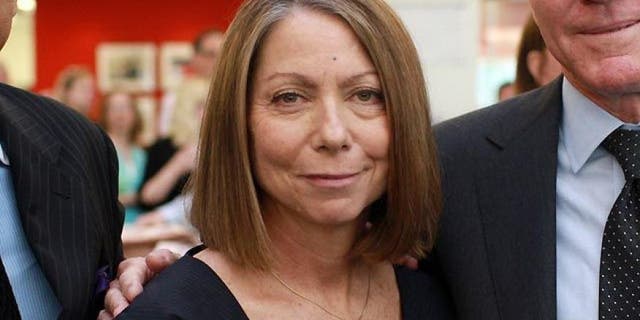
Former executive editor of the New York Times Jill Abramson.
Dean
Baquet 2019 New York Times Editor
“Given its mostly liberal audience, there was an
implicit financial reward for the Times in running lots of Trump
stories, almost all of them negative: they drove big traffic numbers
and, despite the blip of cancellations after the election, inflated
subscription orders to levels no one anticipated.”
The Times has
long faced accusations of liberal bias, even before Trump got into
politics and became its harshest critic. But Abramson’s words carry
special weight because she is also a former Times Washington bureau
chief and Wall Street Journal correspondent specializing in
investigative reporting.
Baquet has said that Trump’s attacks on
the press are “out of control” and that it is important to use the word
“lie” when the president tells a clear untruth.
In “Merchants of
Truth: The Business of News and the Fight for Facts,” Abramson praised
as “brave and right” Baquet’s decision to run this headline when Trump
abandoned his birtherism attacks on Barack Obama: “Trump Gives Up a Lie
But Refuses to Repent.”
Abramson, who had her share of clashes
with Baquet when he was her managing editor, sheds light on a 2016
episode when Baquet held off on publishing a story that would have
linked the Trump campaign with Russian attempts to influence the
election.
Liz Spayd, then the Times public editor, wrote that the
paper, which concluded that more evidence was needed, appeared “too
timid” in not running the piece, produced by a team that included
reporter Eric Lichtblau.
Baquet “seethed” at this scolding, Abramson says, and emailed Lichtblau: “I hope your colleagues rip you a new a*****e.”
Baquet
wrote that “the most disturbing thing” about Spayd’s column “was that
there was information in it that came from very confidential, really
difficult conversations we had about whether or not to publish the back
channel information. I guess I’m disappointed that this ended up in
print.
“It is hard for a journalist to complain when confidential
information goes public. That’s what we do for a living, after all. But
I’ll admit that you may find me less than open, less willing to invite
debate, the next time we have a hard decision to make.”
Lichtblau
soon left the Times for CNN, where he was one of three journalists fired
when the network retracted and apologized for a story making
uncorroborated accusations against Trump confidante Anthony Scaramucci.
And the Times soon abolished the public editor’s column.
Abramson
is critical of Trump as well. She calls his “fake news” attacks a “cheap
way of trying to undermine the credibility of the Times’s reporting as
something to be accepted as truth only by liberals in urban,
cosmopolitan areas.”
The Times, which broke the story of Hillary
Clinton’s private email server, also “made some bad judgment calls and
blew its Clinton coverage out of proportion,” Abramson writes. She says
Clinton “was wary of me,” mishandled the scandal and “was secretive to
the point of being paranoid.”
Abramson is candid in acknowledging
her faults. When then-publisher Arthur Sulzberger Jr. was considering
promoting her to the top job, he told her over lunch at Le Bernadin:
“Everyone knows there’s a good Jill and a bad Jill. The big question for
me is which one we’ll see if you become executive editor.”
She admitted to him that “I could be self-righteous when I felt unheard, I interrupted, I didn’t listen enough.”
It
was a heated battle with Baquet that led to her ouster in 2014. He was
furious upon learning that she was trying to trying to recruit another
top journalist—Abramson says an executive ordered her to keep it
secret—who would share the managing editor’s title.
Sulzberger called her in, fired her, and handed her a press release announcing her resignation.
Abramson
says she replied: “Arthur, I’ve devoted my entire career to telling the
truth, and I won’t agree to this press release. I’m going to say I’ve
been fired.”
Her final judgment: “I was a less than stellar
manager, but I also had been judged by an unfair double standard applied
to many women leaders.”
Rep. Walter Jones, R-N.C., ranks 48th out of 435 congress members for missed votes.
(ivn.us)
A congressman who last
week suggested that President Trump ought to fork over his "own funds"
to help fund the border wall, reportedly has a history of missing votes
on Capitol Hill.
U.S. Rep. Walter Jones, a Republican who
represents North Carolina’s 3rd Congressional District, missed a total
of 7.7 percent of House votes in 2017 – ranking him 48th among 435
members in missed votes, according to statistics cited by the News & Observer of Raleigh.
More
recently, an illness has prevented Jones from voting since late
September. He has missed at least 27 roll call votes since then, through
the House's reconvening in November, the report said. He is expected to
Capitol Hill when Congress reconvenes in January, the News &
Observer reported.
Jones,
75, won an easy victory in the November midterms. During the primary,
he said it would be his final term in office if he was elected.
The lawmaker's statement that Trump should contribute his own money was said amid a partial government shutdown, stemming in part from Congress' inability to reach a deal on Trump's request for $5 billion for a border wall.
Jones also suggested slashing federal aid or funding the war in Afghanistan as ways to come up with the extra money.
Since
the federal government partially shut down Dec. 22, Republicans and
Democrats have been at a seeming impasse over Trump’s demands for $5
billion for a border wall. Trump continued to press Democrats to "give
us the votes necessary for border security" in a series of tweets on New
Year's Eve.
House Democrats said they plan to introduce a
legislative package later Monday to re-open the government, including a
bill that would fund the Department of Homeland Security at current
levels through Feb. 8 with $1.3 billion for border security, but it's
unclear what kind of support it will get from Republicans. It did not
include money for the wall.
U.S.
Sen. Elizabeth Warren has her eyes set on the 2020 presidential race,
but the controversy surrounding her claims of Native American ancestry
may have cost her political future, RealClearPolitics associate editor
A.B. Stoddard argued Monday night on the "Special Report" All-Star
panel.
On Monday morning, Warren announced she was forming an
exploratory committee in preparation of what will likely be a
presidential run in 2020. The Massachusetts Democrat is the third member
of her party to declare such ambitions -- following former Housing and
Urban Development Secretary Julián Castro and U.S. Rep. John Delaney of
Maryland.
In October, Warren released the findings of a DNA test
that show that she may be 1/1,024th Native American, in a bid to quiet
her critics. She had been accused of claiming she had Native American
heritage to advance her career, something President Trump has repeatedly
suggested.
Stoddard,
who appeared with the Federalist senior editor Mollie Hemingway and
Washington Examiner editorial director Hugo Gurdon, expressed that
Warren’s deflection from the ancestry controversy isn’t good enough
since it was “truly a debacle.”
“It showed what her political
judgment is really like. And it’s one thing to just be on the Senate
floor or the campaign trail in 2016, have a national network of support,
have a good message. It’s another to make a huge blunder, sort of
taking Trump’s bait ... but yeah, she has a bad story on this issue,”
Stoddard told the panel. “She brings the video out in late October, two
weeks before the midterms, steps on the Democrats’ message. It’s
completely selfish and sort of self-absorbed and tone-deaf, and then she
gets dissed by the Cherokee Nation. It was a disaster and Democrats
were furious. And they believe that it was a fatal blow.”
“She
brings the video out in late October, two weeks before the midterms,
steps on the Democrats’ message. ... It was a disaster and Democrats
were furious. And they believe that it was a fatal blow.” — A.B. Stoddard, RealClearPolitics associate editor
“Instead
of sort of just stepping aside and using what she has, which is some
national support and kind of being a kingmaker, she’s gonna step into
this race and it’s gonna be the end of her,” Stoddard continued. “It’s a
wide-open race and I expect that this primary run to really go into
late spring of 2020, so a year-and-a-half of a Democratic Party
freak-out. They are very divided, but Elizabeth Warren, even after 2016
I’m going to deposit is not going to be the nominee. Look at the
polling, no one is excited about her.”
Hemingway agreed with
Stoddard, calling Warren’s rollout of her DNA results was “horrifically
done.” She also drew attention to Warren’s “vibe,” which she described
as a “hectoring middle school principal” and suggested that her policies
would be “more challenging” for the senator since a general election
candidate tends to be more moderate.
Meanwhile, Gurdon asserted
that President Trump wasn’t going to “get his wish” in running against
Warren in 2020 since many already see her as “yesterday’s woman.”
“The
fact is that the party has already moved to adopt most of her
positions. She doesn’t stand out and there are younger guns in the
field,” Gurdon said. “Her announcement today was pretty drab, it was
very formulaic. She, you know, emphasized her roots in Oklahoma and her
links to the military and the middle class. And it was just ho-hum kind
of -- I just think that she’s already yesterday’s woman. There will be
somebody else who gets the nomination.”
Expect to hear the words “free,” “guaranteed” and “for all” a whole
lot more in the new year as Democrats prepare an arsenal of
big-government bills that could actually see a floor vote once they take
control of the House.
Come January, proposals like “Medicare for
all” and a host of other generous-but-costly welfare programs that were
little more than talking points in recent years could have a shot at
passing a chamber of Congress.
“There are dozens of measures like
this that have been languishing with Republicans at the helm for years,
and I expect to see many of them finally come to the floor under
Democratic leadership,” Rep. Bonnie Watson Coleman, D-N.J., told Fox
News.
With
the GOP’s expanded majority in the Senate, it’s unlikely these measures
would make it to President Trump’s desk. But their consideration on the
House side would mark a first step in formally considering major
government expansions – concerning everything from education to health
care – that Democrats increasingly favor. And with “Medicare for all”
and similar proposals amounting to litmus tests for modern progressives,
roll-call votes on any of these issues would reveal just how broad
their support is.
At the same time, floor votes putting Democrats
on record for multi-trillion-dollar policies could embolden Republicans
working to recover from their midterm losses.
House GOP Leader Kevin McCarthy, shortly before the November elections, told Breitbart News Daily
that Democrats are moving “toward clear socialism,” and suggested
Republicans need to make the case for “unleashing the great powers of
liberty and freedom.”
Some of the Democratic Party’s agenda, likely to be spearheaded by Speaker-designate Nancy Pelosi, was spelled out in their “A Better Deal” campaign platform.
The set of proposals claims nearly every item could be paid for by
rolling back the Trump tax cuts. The most liberal bills have emerged
from the Congressional Progressive Caucus.
This, however, does not include “Medicare for all,” which according to one estimate could cost nearly $33 trillion over 10 years.
And
“Medicare for all” is just one component of the much broader “Green New
Deal” platform being pushed by progressives like Rep.-elect Alexandria
Ocasio-Cortez – which also calls for a tuition-free and federally funded
education system, guaranteed jobs with an emphasis on “green” jobs, and
more.
The Daily Caller reported
that more than 40 Democratic lawmakers back the plan – though it’s
unclear whether the plan would ever be translated into a bill, let alone
come to a vote.
Still, Democratic members, while in the minority,
sponsored individual bills calling for “college for all,” “debt-free
college,” “child care for all,” and a “jobs guarantee” during the last
two years, which could now be voted on along with climate legislation,
pro-labor union bills and attempts to roll back the tax reform bill that
passed in late 2017.
“The American people picked Democrats in
November because they were tired of watching Republicans ignore working
families and pass laws lining the pockets of big corporations,
millionaires and billionaires,” Watson Coleman said.
Watson
Coleman introduced the Federal Jobs Guarantee Development Act in 2018,
and said she expects the bill to reach a vote in 2019. Under the bill,
the Labor Department would establish job-guarantee test sites in 15
high-unemployment areas across the country. The federal government would
match those seeking employment with jobs in understaffed fields.
Watson
Coleman argued that the measure would build “economic security for
working families and grows our country’s middle class while placing
workers in industries with real need.”
There is one area of “A Better Deal” that could see bipartisan cooperation and support from President Trump -- a $1 trillion infrastructure package.
“A
Better Deal” also calls for spending $50 billion to increase public
school teacher pay, and another $50 billion for school infrastructure.
Rep.
Bobby Scott, D-Va., likely the incoming chairman of the Education and
Workforce Committee, also introduced a “Worker’s Freedom to Negotiate
Act” that bans state laws that allow employees to opt not to join a
union and pay union dues. Currently, 28 states have some form of a
“right-to-work” law.
The Democratic campaign plan also calls for spending $40 billion on “universal high speed Internet.” A similar bill was promoted by Rep. Cheri Bustos, D-Ill., who pushed to expand Internet into rural areas.
Rep.
David Cicilline, D-R.I., has been a leading advocate of the Child Care
for Working Families Act, a concept promoted in the party’s campaign
plan. The legislation would ensure that no family under 150 percent of a
state’s median income pays more than 7 percent of their income for
child care. The legislation also would establish a federal-state
partnership to provide child care from birth through age 13.
Rep.
Ro Khanna, D-Calif., said he anticipates his Job Opportunities for All
Act—with 22 Democratic co-sponsors—will make it to the floor in the new
Congress.
The legislation, which Khanna, elected the first vice
chairman of the Congressional Progressive Caucus, has said fulfills part
of President Franklin Roosevelt’s proposed “economic bill of rights,” would provide federal funding to put people to work immediately in both the public and the private sector.
“The
Job Opportunities for All Act, H.R. 6485, will help create good paying
private sector and public sector job opportunities for people in places
left behind,” Khanna told Fox News. “I expect my bill, along with
innovative thinking from my colleagues, to be considered as Democrats
work to build a jobs agenda.”
Rep. Pramila Jayapal D-Wash., could
play a prominent role in such legislative proposals. She is a
co-chairwoman of the Medicare For All Caucus, which has nearly 80
members committed to a complete government-run health care system. She
was also elected co-chairwoman of the Congressional Progressive Caucus
set to have more than 90 members after the election.
Jayapal was
also the sponsor of the College for All Act in 2017, which would
eliminate tuition and fees at public colleges and universities for
families earning up to $125,000, and make community college free for
everyone. Sen. Bernie Sanders, I-Vt., introduced the Senate version.
Rep. Mark Pocan, D-Wis., the other progressive caucus co-chairman,
introduced a similar bill, the Debt-Free College Act, which would provide more federal funding to states to alleviate student loan debt.
Billboards welcome in the new year in New York's Times Square, Monday, Dec. 31, 2018. (Associated Press)
NBC's New Year's Eve show left many viewers
appalled by a co-host and baffled by its last-second omission of the
countdown clock.
During and after the broadcast, negative comments poured in on social media, with some calling the program a "complete disaster" and "trainwreck" for an evening of blunders.
"NBC this is the worst New Years Show ever!!!" wrote one user.
"NBC Is AWFUL!!!! What a horrible New Years program. They literally ruin everything they broadcast!" wrote another.
The
show's lineup featured co-hosts Carson Daly, Chrissy Teigen, Leslie
Jones, and Keith Urban. Criticism was particularly directed at Teigen,
who devoted a segment to discussing "vaginal steaming."
"I'm
embarrassed for America watching @chrissyteigen talk about vaginal
steaming. Way to help me ring in the new year with family. Turning it to
Fox now," wrote one user.
The program was also mocked for cutting
away just minutes before midnight "to show local celebration at a hotel
with maybe 12 in attendance," wrote a Twitter user.
And
in yet another forgettable moment, Teigen's face was crushed by an
umbrella after a failed attempt to hug guest Leslie Jones after the
clock struck midnight.