Republican National Committee Chairwoman Ronna McDaniel on
Thursday stood by her criticism of her uncle -- incoming Sen. Mitt
Romney, R-Utah -- for his attack on President Trump, urging party unity
and saying he should focus his fire on Democrats instead.
“As a
party we need to come together if we’re going to be successful because
we’re up against unprecedented odds and this juggernaut of negative
Democrat and media attention,” she said in an interview with "Fox
& Friends." Romney sparked a mini-family feud with a scathing op-ed Tuesday in The Washington Post, where he said Trump’s conduct “is evidence that the president has not risen to the mantle of the office,"
Romney
said Trump should be bringing the country together, and demonstrate
"the essential qualities of honesty and integrity, and elevate the
national discourse with comity and mutual respect."
This sparked a response from McDaniel, who called Romney’s op-ed “disappointing and unproductive.”
"POTUS
is attacked and obstructed by the MSM media and Democrats 24/7. For an
incoming Republican freshman senator to attack @realdonaldtrump as their
first act feeds into what the Democrats and media want and is
disappointing and unproductive," she tweeted.
On Thursday, she
dismissed the idea that the two were fighting, saying that Romney had
called her on New Year's Day (while she was at the movies, seeing
“Aquaman”) to give her a heads-up about the op-ed -- and that she would
have treated any other incoming senator the same way.
“I love my
uncle and my tweet yesterday had nothing to do with family, I would have
done this to any freshman incoming senator and I’d say ‘Hey, let's
focus on the real issues here which are the Democrats who are proposing
dangerous policies for our country and let’s remind Americans of the
good things that are coming out of the administration,'” she said.
Trump
also responded to the Post op-ed on Wednesday during a Cabinet meeting:
“I wish Mitt could be more of a team player. I am surprised he did it
this quickly. If he fought really hard against President Obama like he
does against me, he would’ve won the election.”
Romney,
for his part, continued to criticize Trump on Wednesday evening,
telling CNN: “A leader has an impact, not just on policies but also on
the character of the people who get to watch the person and I think in
that scenario the president needs to focus more attention and hopefully
make some changes there."
Since she has taken Romney to task,
McDaniel said her uncle had gotten in touch and made sure she knew it
was all water under the bridge.
"He said ‘you’ve got to do what you’ve got to do.’ He understands,” she said.
Speaker-designate Nancy Pelosi said Thursday that a longstanding
Justice Department policy protecting sitting presidents from indictment
is “not conclusive” and represents an “open discussion,” in a fresh
warning to President Trump amid Special Counsel Robert Mueller's Russia
probe.
In an interview with NBC News’ “Today,” Pelosi was asked
repeatedly whether she believed Mueller should “honor and observe”
Justice Department guidance that keeps sitting presidents off limits
from indictment.
“I do not think that that is conclusive, no I do not,” Pelosi, D-Calif., told NBC’s Savannah Guthrie.
Guthrie
asked Pelosi whether it was possible Mueller, in his investigation into
Russian meddling and potential collusion with Trump campaign associates
during the 2016 presidential election, could recommend indicting Trump.
“Let’s
just see what Mueller does. Let’s spend our time on getting results for
the American people,” Pelosi said, as she prepares to lead the
Democrats upon reclaiming the House majority Thursday afternoon.
Trump’s
attorney, former New York City Mayor Rudy Giuliani, said in May that
Mueller has assured the president’s legal team that he will follow the
Justice Department guidance protecting a sitting president from
indictment.
The policy was instated nearly two decades ago when
the Clinton administration reviewed 1973 guidance that “the indictment
and criminal prosecution of a sitting President would unduly interfere”
with executive branch duties.
The House of Representatives, as it
did during the Clinton administration, can bring misconduct charges
against a president through the process of impeachment.
But
then-Assistant Attorney General Randolph D. Moss, with the Office of
Legal Counsel, determined in his October 2000 memo: “Our view remains
that a sitting President is constitutionally immune from an indictment
and criminal prosecution.”
An October 2000 memo stated that “the
indictment or criminal prosecution of a sitting President would
unconstitutionally undermine the capacity of the executive branch to
perform its constitutionally assigned functions.”
But Pelosi was
pressed repeatedly by Guthrie over whether she believed Mueller would
deviate from Justice Department policy. She left the door open to what
might happen with a sitting president, while making clear that a
president does not enjoy such protections after leaving office.
“That
is not the law. Everything indicates a president can be indicted after
he is no longer president of the United States,” Pelosi explained.
Asked
again whether a president currently in office could be indicted, Pelosi
repeated: “Well, a sitting president, when he is no longer president of
the United States.”
Once more, Pelosi was asked about a sitting
president’s protection, to which she replied: “I think that that is an
open discussion. I think that is an open discussion in terms of the
law.”
As for impeachment, Pelosi likewise left the door open.
“We
have to wait and see what happens with the Mueller report,” Pelosi
said. “We shouldn’t be impeaching for a political reason, and we
shouldn’t avoid impeachment for a political reason. We have to see.”
Newly-elected
Utah senator Mitt Romney kicked off 2019 with an op-ed in the
Washington Post that savaged Donald Trump’s character and leadership.
Romney’s attack and Trump’s response Wednesday morning on Twitter are
the latest salvos in a longstanding personal feud between the two men.
It’s even possible that Romney is planning to challenge Trump for the
Republican nomination in 2020. We’ll see.
But for now, Romney’s
piece is fascinating on its own terms. It’s well-worth reading. It’s a
window into how the people in charge, in both parties, see our country.
Romney’s
main complaint in the piece is that Donald Trump is a mercurial and
divisive leader. That’s true, of course. But beneath the personal
slights, Romney has a policy critique of Trump. He seems genuinely angry
that Trump might pull American troops out of the Syrian civil war.
Romney doesn’t explain how staying in Syria would benefit America. He
doesn’t appear to consider that a relevant question. More policing in
the Middle East is always better. We know that. Virtually everyone in
Washington agrees.
That’s not surprising. Romney spent the bulk of
his business career at a firm called Bain Capital. Bain Capital all but
invented what is now a familiar business strategy: Take over an
existing company for a short period of time, cut costs by firing
employees, run up the debt, extract the wealth, and move on, sometimes
leaving retirees without their earned pensions. Romney became
fantastically rich doing this.
Meanwhile, a remarkable number of
the companies are now bankrupt or extinct. This is the private equity
model. Our ruling class sees nothing wrong with it. It’s how they run
the country.
Mitt Romney refers to unwavering support for a
finance-based economy and an internationalist foreign policy as the
“mainstream Republican” view. And he’s right about that. For
generations, Republicans have considered it their duty to make the world
safe for banking, while simultaneously prosecuting ever more foreign
wars. Modern Democrats generally support those goals enthusiastically.
There
are signs, however, that most people do not support this, and not just
in America. In countries around the world — France, Brazil, Sweden, the
Philippines, Germany, and many others — voters are suddenly backing
candidates and ideas that would have been unimaginable just a decade
ago. These are not isolated events. What you’re watching is entire
populations revolting against leaders who refuse to improve their lives.
Something
like this has been in happening in our country for three years. Donald
Trump rode a surge of popular discontent all the way to the White House.
Does he understand the political revolution that he harnessed? Can he
reverse the economic and cultural trends that are destroying America?
Those are open questions.
But they’re less relevant than we think.
At some point, Donald Trump will be gone. The rest of us will be gone,
too. The country will remain. What kind of country will be it be then?
How do we want our grandchildren to live? These are the only questions
that matter.
The answer used to be obvious. The overriding goal
for America is more prosperity, meaning cheaper consumer goods. But is
that still true? Does anyone still believe that cheaper iPhones, or more
Amazon deliveries of plastic garbage from China are going to make us
happy? They haven’t so far. A lot of Americans are drowning in stuff.
And yet drug addiction and suicide are depopulating large parts of the
country. Anyone who thinks the health of a nation can be summed up in
GDP is an idiot.
The goal for America is both simpler and more
elusive than mere prosperity. It’s happiness. There are a lot of
ingredients in being happy: Dignity. Purpose. Self-control.
Independence. Above all, deep relationships with other people. Those are
the things that you want for your children. They’re what our leaders
should want for us, and would want if they cared.
But our leaders
don’t care. We are ruled by mercenaries who feel no long-term obligation
to the people they rule. They’re day traders. Substitute teachers.
They’re just passing through. They have no skin in this game, and it
shows. They can’t solve our problems. They don’t even bother to
understand our problems.
One of the biggest lies our leaders tell
us that you can separate economics from everything else that matters.
Economics is a topic for public debate. Family and faith and culture,
meanwhile, those are personal matters. Both parties believe this.
Members
of our educated upper-middle-classes are now the backbone of the
Democratic Party who usually describe themselves as fiscally responsible
and socially moderate. In other words, functionally libertarian. They
don’t care how you live, as long as the bills are paid and the markets
function. Somehow, they don’t see a connection between people’s personal
lives and the health of our economy, or for that matter, the country’s
ability to pay its bills. As far as they’re concerned, these are two
totally separate categories.
Social conservatives, meanwhile, come to the debate from the opposite
perspective, and yet reach a strikingly similar conclusion. The real
problem, you’ll hear them say, is that the American family is
collapsing. Nothing can be fixed before we fix that. Yet, like the
libertarians they claim to oppose, many social conservatives also
consider markets sacrosanct. The idea that families are being crushed by
market forces seems never to occur to them. They refuse to consider it.
Questioning markets feels like apostasy.
Both sides miss
the obvious point: Culture and economics are inseparably intertwined.
Certain economic systems allow families to thrive. Thriving families
make market economies possible. You can’t separate the two. It used to
be possible to deny this. Not anymore. The evidence is now overwhelming.
How do we know? Consider the inner cities.
Thirty years ago,
conservatives looked at Detroit or Newark and many other places and were
horrified by what they saw. Conventional families had all but
disappeared in poor neighborhoods. The majority of children were born
out of wedlock. Single mothers were the rule. Crime and drugs and
disorder became universal.
What caused this nightmare? Liberals
didn’t even want to acknowledge the question. They were benefiting from
the disaster, in the form of reliable votes. Conservatives, though, had a
ready explanation for inner-city dysfunction and it made sense: big
government. Decades of badly-designed social programs had driven fathers
from the home and created what conservatives called a “culture of
poverty” that trapped people in generational decline.
There was
truth in this. But it wasn’t the whole story. How do we know? Because
virtually the same thing has happened decades later to an entirely
different population. In many ways, rural America now looks a lot like
Detroit.
This is striking because rural Americans wouldn’t seem to
have much in common with anyone from the inner city. These groups have
different cultures, different traditions and political beliefs. Usually
they have different skin colors. Rural people are white conservatives,
mostly.
Yet, the pathologies of modern rural America are familiar
to anyone who visited downtown Baltimore in the 1980s: Stunning out of
wedlock birthrates. High male unemployment. A terrifying drug epidemic.
Two different worlds. Similar outcomes. How did this happen? You’d think
our ruling class would be interested in knowing the answer. But mostly
they’re not. They don’t have to be interested. It’s easier to import
foreign labor to take the place of native-born Americans who are
slipping behind.
But Republicans now represent rural voters. They
ought to be interested. Here’s a big part of the answer: male wages
declined. Manufacturing, a male-dominated industry, all but disappeared
over the course of a generation. All that remained in many places were
the schools and the hospitals, both traditional employers of women. In
many places, women suddenly made more than men.
Now, before you
applaud this as a victory for feminism, consider the effects. Study
after study has shown that when men make less than women, women
generally don’t want to marry them. Maybe they should want to marry
them, but they don’t. Over big populations, this causes a drop in
marriage, a spike in out-of-wedlock births, and all the familiar
disasters that inevitably follow -- more drug and alcohol abuse, higher
incarceration rates, fewer families formed in the next generation.
This
isn’t speculation. This is not propaganda from the evangelicals. It’s
social science. We know it’s true. Rich people know it best of all.
That’s why they get married before they have kids. That model works. But
increasingly, marriage is a luxury only the affluent in America can
afford.
And yet, and here’s the bewildering and infuriating part,
those very same affluent married people, the ones making virtually all
the decisions in our society, are doing pretty much nothing to help the
people below them get and stay married. Rich people are happy to fight
malaria in Congo. But working to raise men’s wages in Dayton or Detroit?
That’s crazy.
This is negligence on a massive scale. Both parties
ignore the crisis in marriage. Our mindless cultural leaders act like
it’s still 1961, and the biggest problem American families face is that
sexism is preventing millions of housewives from becoming investment
bankers or Facebook executives.
For our ruling class, more
investment banking is always the answer. They teach us it’s more
virtuous to devote your life to some soulless corporation than it is to
raise your own kids.
Sheryl Sandberg of Facebook wrote an entire
book about this. Sandberg explained that our first duty is to
shareholders, above our own children. No surprise there. Sandberg
herself is one of America’s biggest shareholders. Propaganda like this
has made her rich.
We are ruled by mercenaries who
feel no long-term obligation to the people they rule. They’re day
traders. Substitute teachers. They’re just passing through. They have no
skin in this game, and it shows.
What’s
remarkable is how the rest of us responded to it. We didn’t question why
Sandberg was saying this. We didn’t laugh in her face at the pure
absurdity of it. Our corporate media celebrated Sandberg as the leader
of a liberation movement. Her book became a bestseller: "Lean In." As if
putting a corporation first is empowerment. It is not. It is bondage.
Republicans should say so.
They should also speak out against the ugliest parts of our financial
system. Not all commerce is good. Why is it defensible to loan people
money they can’t possibly repay? Or charge them interest that
impoverishes them? Payday loan outlets in poor neighborhoods collect 400
percent annual interest.
We’re OK with that? We
shouldn’t be. Libertarians tell us that’s how markets work -- consenting
adults making voluntary decisions about how to live their lives. OK.
But it’s also disgusting. If you care about America, you ought to oppose
the exploitation of Americans, whether it’s happening in the inner city
or on Wall Street.
And by the way, if you really loved your fellow Americans, as our
leaders should, if it would break your heart to see them high all the
time. Which they are. A huge number of our kids, especially our boys,
are smoking weed constantly. You may not realize that, because new
technology has made it odorless. But it’s everywhere.
And
that’s not an accident. Once our leaders understood they could get rich
from marijuana, marijuana became ubiquitous. In many places, tax-hungry
politicians have legalized or decriminalized it. Former Speaker of the
House John Boehner now lobbies for the marijuana industry. His fellow
Republicans seem fine with that. “Oh, but it’s better for you than
alcohol,” they tell us.
Maybe. Who cares? Talk about missing the
point. Try having dinner with a 19-year-old who’s been smoking weed. The
life is gone. Passive, flat, trapped in their own heads. Do you want
that for your kids? Of course not. Then why are our leaders pushing it
on us? You know the reason. Because they don’t care about us.
When
you care about people, you do your best to treat them fairly. Our
leaders don’t even try. They hand out jobs and contracts and
scholarships and slots at prestigious universities based purely on how
we look. There’s nothing less fair than that, though our tax code comes
close.
Under our current system, an American who works for a
salary pays about twice the tax rate as someone who’s living off
inherited money and doesn’t work at all. We tax capital at half of what
we tax labor. It’s a sweet deal if you work in finance, as many of our
rich people do.
In 2010, for example, Mitt Romney made about $22
million dollars in investment income. He paid an effective federal tax
rate of 14 percent. For normal upper-middle-class wage earners, the
federal tax rate is nearly 40 percent. No wonder Mitt Romney supports
the status quo. But for everyone else, it’s infuriating.
Our
leaders rarely mention any of this. They tell us our multi-tiered tax
code is based on the principles of the free market. Please. It’s based
on laws that the Congress passed, laws that companies lobbied for in
order to increase their economic advantage. It worked well for those
people. They did increase their economic advantage. But for everyone
else, it came at a big cost. Unfairness is profoundly divisive. When you
favor one child over another, your kids don’t hate you. They hate each
other.
That happens in countries, too. It’s happening in
ours, probably by design. Divided countries are easier to rule. And
nothing divides us like the perception that some people are getting
special treatment. In our country, some people definitely are getting
special treatment. Republicans should oppose that with everything they
have.
What kind of country do you want to live in? A fair country. A decent
country. A cohesive country. A country whose leaders don’t accelerate
the forces of change purely for their own profit and amusement. A
country you might recognize when you’re old.
A country that
listens to young people who don’t live in Brooklyn. A country where you
can make a solid living outside of the big cities. A country where
Lewiston, Maine seems almost as important as the west side of Los
Angeles. A country where environmentalism means getting outside and
picking up the trash. A clean, orderly, stable country that respects
itself. And above all, a country where normal people with an average
education who grew up in no place special can get married, and have
happy kids, and repeat unto the generations. A country that actually
cares about families, the building block of everything.
What will it take a get a country like that? Leaders who want it. For
now, those leaders will have to be Republicans. There’s no option at
this point.
But first, Republican leaders will have to
acknowledge that market capitalism is not a religion. Market capitalism
is a tool, like a staple gun or a toaster. You’d have to be a fool to
worship it. Our system was created by human beings for the benefit of
human beings. We do not exist to serve markets. Just the opposite. Any
economic system that weakens and destroys families is not worth having. A
system like that is the enemy of a healthy society.
Internalizing all this will not be easy for Republican leaders. They’ll
have to unlearn decades of bumper sticker-talking points and corporate
propaganda. They’ll likely lose donors in the process. They’ll be
criticized. Libertarians are sure to call any deviation from market
fundamentalism a form of socialism.
That’s a lie.
Socialism is a disaster. It doesn’t work. It’s what we should be working
desperately to avoid. But socialism is exactly what we’re going to get,
and very soon unless a group of responsible people in our political
system reforms the American economy in a way that protects normal
people.
If you want to put America first, you’ve got to put its families first.
Adapted from Tucker Carlson's monologue from "Tucker Carlson Tonight" on January 2, 2019.
The
growing socialist wing of the Democratic Party will flex its muscle
Thursday with the seating of the new Congress, as more self-described
Democratic Socialists join the ranks and dozens of sitting and incoming
members – including likely 2020 hopefuls – embrace a massive government
expansion that would make FDR look like a penny pincher.
The party
agenda is increasingly embracing big-government policies like
“Medicare-for-all” and guaranteed jobs programs -- as well as an
aggressive “Green New Deal” that would include all this and more as part
of a fundamental overhaul to America’s economy and specifically its
energy sector.
It’s unclear when and if any of them will make it
to the floor, let alone pass the House. But their growing support marks
an astonishing rise for socialist-leaning policies in just a few years,
and reflects a shift in the party itself. A stunning Gallup poll
last summer showed Democrats view socialism more positively than
capitalism. The term “Democratic Socialist” was only broadly popularized
with the 2016 presidential run of Bernie Sanders, who identifies as
one. The enthusiasm behind his bid underscored how ideas that once
marinated on the party’s fringe were increasingly becoming mainstream.
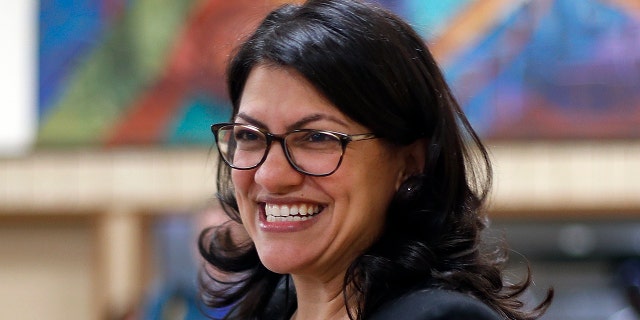
Rashida Tlaib, Democratic candidate for the Michigan's 13th
Congressional District, smiles during a rally in Dearborn, Mich.,
Friday, Oct. 26, 2018. (AP Photo/Paul Sancya)
Now, two more Democratic Socialists will join Sanders
in Congress on Thursday -- Reps. Alexandria Ocasio-Cortez, D-N.Y., and
Rashida Tlaib, D-Mich. Ocasio-Cortez has embraced the mantle, while
Tlaib is a member of the Democratic Socialists of America (DSA). And
while Ocasio-Cortez and Tlaib represent only a sliver of the Democratic
Party’s new majority in the House, they have attracted outsized media
attention and are pushing policies with dozens of supporters.
Medicare-for-all in particular is quickly picking up support. A New York Times analysis
found that one-third of Senate Democrats and more than half of House
Democrats have endorsed Medicare-for-all proposals -- including a number
of possible 2020 presidential hopefuls. Such proposals would lead to
more government involvement in health care, and bring the U.S. a step
closer to mostly socialized systems such as the British National Health
Service. Their popularity is driven by frustration with the current
private insurance system, which remains costly on the individual market
despite ObamaCare’s goals. And while Medicare-for-all is estimated to
cost tens of trillions of dollars over a decade, advocates argue some of
this would replace out-of-pocket expenses already being shouldered by
millions of Americans.
But even more ambitious than
Medicare-for-all is what’s known as the Green New Deal. While echoing
the language of President Franklin Delano Roosevelt’s New Deal, the
Green New Deal could be an even more sprawling government and economic
overhaul. Championed by groups such as the Sunrise Movement and Justice
Democrats, the plan would aim to combat both climate change and income
inequality – and has been picked up by lawmakers such as Sanders and
Ocasio-Cortez.
“We are calling for a wartime-level, just economic
mobilization plan to get to 100% renewable energy ASAP,” Ocasio-Cortez
tweeted.
A draft text
circulated around Congress calls for a select committee to be formed to
create a plan, and lays out a framework that includes eliminating
greenhouse gas emissions from manufacturing and agriculture
and “dramatically” expanding energy sources to meet 100 percent of power
demand through renewable sources.
If that wasn’t ambitious
enough, the proposal describes this as “a historic opportunity to
virtually eliminate poverty in the United States and to make prosperity,
wealth and economic security available to everyone participating in the
transformation.”
On the economic front, it also demands a job
guarantee program that offers “a living wage job to every person who
wants one,” a “just transition” for workers affected by climate change,
basic income programs, universal health care “and any others as the
select committee may deem appropriate to promote economic security,
labor market flexibility and entrepreneurism.”
In at least a
partial nod to the presumably mammoth cost that overhauling the nation’s
economy and energy sector would entail, it says that the financing
of “the Plan” would be accomplished by “the federal government, using a
combination of the Federal Reserve, a new public bank or system of
regional and specialized public banks, public venture funds and such
other vehicles or structures that the select committee deems
appropriate, in order to ensure that interest and other investment
returns generated from public investments made in connection with the
Plan will be returned to the treasury, reduce taxpayer burden and allow
for more investment.”
Indeed, the question that has long dogged
such proposals is how to pay for it all. But the answer has typically
avoided specifics, instead arguing that America has found ways to pay
for other gargantuan costs in the past. In a follow-up FAQ, one
explainer says the plan would be funded by “the same ways we paid for
World War II and many other wars.”
“The Federal Reserve can extend
credit to power these projects and investments, new public banks can be
created (as in WWII) to extend credit and a combination of various
taxation tools (including taxes on carbon and other emissions and
progressive wealth taxes) can be employed,” it says.
Conservatives warn these ambitious programs, though, would do generational damage to the U.S. economy.
“Together,
Ocasio-Cortez’s proposals would effectively eliminate fossil fuels from
most of society, destroy millions of jobs and trillions of dollars of
wealth, require 'upgrading' every home and business in America, create a
national federal jobs-guarantee program, impose single-payer health
care (costing trillions more), establish a new system of publicly owned
banks, run up the national debt by countless trillions of dollars, and
move the United States closer than ever to socialism,” Justin Haskins, a
research fellow at the Heartland Institute, wrote in an op-ed for Fox News. “If we don’t stop it, it will destroy our economy for a whole generation of Americans.”
Some liberal commentators have warmed to the proposals. The New York Times’ Paul Krugman said it wasn’t clear what the Green New Deal meant, “which is what makes it a good slogan.”
Such
a sweeping policy would almost certainly be dead on arrival as long as
Republicans control at least one chamber of Congress or the White House.
Krugman noted the political realities for the left, arguing that
Democrats can’t enact such a plan this year “but they should start
preparing now, and be ready to move in two years.”
But regardless
of how much progress these proposals might make on the House floor,
they’re already part of the 2020 conversation. Sen. Cory Booker, D-N.J.,
who has been tipped for a White House bid, said last month that he is
“excited” to support the Green New Deal.
The Chicago Tribune reported that Sen. Kamala Harris’, D-Calif., staff have been in touch with the organizers behind the Green New Deal. Axios
reported Wednesday that Sen. Elizabeth Warren, D-Mass., who just
launched an exploratory committee for a presidential run, supports a
Green New Deal.
"Senator Warren has been a longtime advocate of
aggressively addressing climate change and shifting toward renewables,
and supports the idea of a Green New Deal to ambitiously tackle our
climate crisis, economic inequality, and racial injustice," an aide told
the outlet.
Warren, Harris and Booker have also backed separate Medicare-for-all plans.
In the House, the Sunrise Movement
says that it has more than 40 House members who are backing the Green
New Deal, including Reps. Tulsi Gabbard, D-Hawaii, Joe Kennedy, D-Mass.,
Ted Lieu, D-Calif., and Veronica Escobar, D-Texas.
However, Democratic leadership has been cautious about adopting such proposals. Roll Call
reported that Rep. Frank Pallone, D-N.J., who is set to be the Energy
and Commerce Committee chairman, said he supports the idea of
Medicare-for-all but doesn’t think the votes are there.
Earlier this week, House Democrats formalized proposals
for a new committee on climate change, but without the features that
proponents of a Green New Deal have sought -- such as the power to
subpoena and the authority to vote on legislation and send it directly
to the House floor.
A sign of possible tensions within the party
was on display in November, when environmental activists took part in a
sit-in outside Speaker-designate Nancy Pelosi’s, D-Calif., office,
demanding leadership do more to promote the Green New Deal.
Joining
the protesters was Ocasio-Cortez, who said: “We need to tell her that
we’ve got her back in showing and pursuing the most progressive energy
agenda that this country has ever seen.”
The
calendar has flipped to 2019, and that means presidential politics are
kicking into high gear. Senator Elizabeth Warren, D-Mass., got the fun
started, triggering an avalanche of fellow White House wannabes in the
coming days.
Last week, an analysis from Bloomberg News likened
the forming field of contenders to the start of the March Madness
college basketball bracket. It’s an appropriate analogy, not only
because of the vast number of names, but also the unpredictability of
the outcome. The Democratic nominating process is quite literally a jump
ball.
Another worthwhile comparison to the Democrats in 2020 is
looking back at the Republican nominating process in 2016. Four years
ago, the 17-person GOP field boasted the brightest stars from Congress
and statehouses across the country. United in their opposition to
President Barack Obama, they all offered a change of direction. They all
struggled to understand the undercurrents in their party that, driven
by pitchfork populism, had shifted many of its bedrock principles on
trade and America’s role in the world. One candidate recognized the
changing political winds, and he now sits in the Oval Office.
It
is a similar story now on the other side. There could be as many as 40
household names vying for the Democratic prize. A recent CNN headline
stated “Democrats head into 2019 split on everything but Trump.”
Populism has hijacked the left-of-center policy debate, with polls
showing socialism more popular than capitalism. Ideological purity and
litmus tests on energy, health care and immigration are driving the
discussion. The center-left governing days of the Obama era championing
global trade deals are a distant memory.
Speaking of debates,
Democratic bigwigs tried to head off headaches by announcing they will
hold at least a dozen, beginning in June 2019. Last time, the debate
over debates consumed attention in both parties. Supporters of Bernie
Sanders accused the Democratic National Committee of rigging the process
for Hillary Clinton, while Republicans argued about the qualifying
threshold to make the primetime contests.
How
the party infrastructure accommodates the immense number of candidates
is an open question and promises to be messy process. In this age of
cable news sound bites and viral social media videos, one thing is
certain: being on the big debate stage matters. It made and broke
candidates in 2016 and will again in 2020.
Ultimately, the
successful Democratic nominee will be able to do two things: win over at
least two of the competing factions of the party – establishment,
liberal, diverse and outsider – and articulate an authentic economic
vision that goes beyond reflexive opposition to Trump. The actions of
the 44th and 45th occupants of the White House offer clues on how that
process will play out.
Trump is presiding over an
economy that remains healthy. The Democrats have yet to find a
compelling alternative economic message.
Not content
to fade into retirement, Barack Obama’s post-presidential life has
broken from tradition. A vocal critic of his successor, Obama actively
campaigned for Democrats in last year’s midterms, endorsing more than
300 candidates. His blessing remains highly coveted, and the public
comments from his former staff and advisers are parsed for clues about
his thinking.
While the party he once presided over is divided on
most everything, they are united in their reverence to Obama. Should he
throw his support behind a candidate down the road, he could be the only
prayer the party has of a semblance of unity.
That brings us to
President Trump. Despite the recent turmoil, the nomination is his for
the taking as long as he runs again. It’s difficult to unseat a sitting
president, and you can’t beat someone with no one – a lesson the
anti-Nancy Pelosi House Democrat insurgents just learned.
Beyond
incumbency, Trump is presiding over an economy that remains healthy. The
Democrats have yet to find a compelling alternative economic message.
Speaking
of breaking from tradition, Trump is not going to take the route of
focusing on being a president and ignoring the noise from his
competition. Hours after Warren made her news, Trump was questioning her
mental health in a media interview, reminding voters of her Native
American scandal and denying her valuable news oxygen.
Trump’s
megaphone and ability to disqualify his opponents are unmatched. Unlike
last year’s midterms, next year’s presidential race will be a choice
between two candidates and not a referendum on one. That’s a fight that
favors Trump, regardless of what Democrat ends up facing him.
DNA is irrelevant — Elizabeth Warren is simply not Cherokee
Elizabeth Warren has repeatedly identified herself as Cherokee.
From 1986 to 1995 she listed herself as Native American in
the Association of American Law Schools directory of law professors.
After gaining tenure, she insisted University of Pennsylvania categorize
her as Native American, too. She then identified herself as Native
American to Harvard — in her application and hiring materials and in
other forms beyond.
Harvard has
insisted that Warren’s Native American ancestry made no impact on their
hiring decisions. Yet, the university immediately held up the recruitment of Warren,
a “Native American woman,” to push back against claims that they were
insufficiently diverse and diffuse pressure to hire more people of
color. Warren was described as Harvard Law’s “first woman of color” in a
1997 Fordham Law Review article. She even published multiple recipes to a cookbook, Pow Wow Chow: A Collection of Recipes from Families of the Five Civilized Tribes — all signed, “Elizabeth Warren, Cherokee.”
Warren has consistently struggled to substantiate her claims to Native American ancestry (beyond her grandfather’s “high cheekbones”). Warren asserts her mother was “part Cherokee and part Delaware,” yet a prominent Cherokee genealogist who traced Warren’s maternal ancestry all the way back to the Revolutionary War era found no evidence of any Native American heritage. Some relatives have publicly disputed Warren’s narrative about their family. And, of course, Warren phenotypically presents as white.
For
these reasons, she has faced consistent accusations that her claims to
Native American ancestry were either mistaken or cynical. The president
of the United States mockingly refers to her as “Pocahontas” — and told
Warren he would pay $1 million dollars to
a charity of her choice “if you take the test and it shows you’re an
Indian.” He precited Warren would decline this challenge. It would have
been better for her if she had.
What the test shows (and doesn’t)
According
to the test, Warren’s DNA is between 1/64 and 1/1032 Columbian, Mexican
and/or Peruvian (used as proxies for measuring Cherokee heritage for
reasons described in the report);
between 0.1 percent and 1.5 percent of her DNA may be Native American
in origin; she may have had a Native American ancestor between six to 10
generations back.
Warren depicted this as “slam dunk” proof that she really is of Native American ancestry. This is a base-rate fallacy. In fact, the average white person in
America has 0.18 percent Native American DNA — meaning they could be
described as about 1/ 556 Native American or as having a Native American
ancestor nine to10 generations back. Warren does not seem to have a
unique claim to Native American heritage over and above the typical
white American.
For comparison: the
average U.S. white also has about 0.19 percent African DNA; they can be
said to be 1/ 526 black or to have a black ancestor nine to10
generations back. Rachel Dolezal might
have about the same genetic claim to being black as Elizabeth Warren
does to being Cherokee. Already, memes are circulating comparing the two.
Of course, Warren and supporters can make arguments explaining how the
two cases are not similar, but this is beside the point. If it has to be
explained why or how Warren is substantively different from Dolezal,
the war is already lost.
Non sequitur
Rather
than acknowledging she has no meaningful claim to Cherokee / Native
American heritage or identity, Warren has doubled down. She claims to
have “won” the bet, and has demanded Trump donate $1 million to the National Indigenous Women’s Resource Center.
The president has refused, insisting he won the wager. Unfortunately,
he is correct: although Warren did take the test it did not prove she is
“an Indian.”
Genes, race and ethnicity are non-identical and the relationship between them is complicated.
Warren is phenotypically white. She has no identifiable Native American
ancestor, no clan affiliation, and no meaningful connection to Cherokee
language, customs or culture. As a result, even if the DNA test had
suggested she could meet the 1/16 blood quantum required by Cherokee for
a federally recognized Certificate of Degree of Indian Blood(she was nowhere near this) — it would still not have established Warren is “an Indian.”
It
was actually impossible for Warren to actually win Trump’s bet:
Cherokee do not decide who is (or is not) one of them the basis of DNA;
what matters are clan ancestry, tracing one’s genealogy to an ancestor
on the “Dawes Rolls,”
or being adopted into a clan by a Clan Mother. Elizabeth Warren fails
to meet any of these criteria. As a result, she is simply not Cherokee
— not even a little. DNA is irrelevant.
This point was powerfully driven home by the Cherokee Nation’s Secretary of State,
who described Warren’s attempt as wrong-headed and insulting. He went
on to say that Warren is “undermining tribal interests with her
continued claims of tribal heritage” (neither Warren nor her team consulted with Cherokee leadership before conducting the test or releasing the results).
And so, rather than neutralizing Trump’s attacks, it is now has made it far easier to portray Warren as a phony: She appropriated Native American heritage for years in both private and professional settings.
Confronted
with evidence that her claims were illegitimate (her DNA is comparable
to the average white; she has no other empirical proof of heritage) —
Warren nonetheless claimed vindication, emulating Trump’s “post-truth politics.”
Throughout, she failed to challenge (and in fact, reinforced) Trump’s false narratives about race, Affirmative Action and the quality of the minority applicants who benefit from it.
Rather
than using her platforms and energies to discuss her own agenda, hold
Trump accountable for his record and proposals, or speak to
constituents’ priorities — we are instead discussing Warren’s (lack of)
Native American ancestry because she herself dragged the issue into the
spotlight.
The
Oscar for the biggest bluff of 2018 goes to Chuck Schumer and Nancy
Pelosi for almost having us convinced they’re opposed to immigration
reform from high atop the fabricated moral high ground they’ve staked
out.
In reality, they weren’t always opposed to illegal immigrants
being forced to follow the law and come here through legal channels.
How do we know this? They told us.
In
2009, while speaking at Georgetown University, Sen. Schumer, D-NY, said
“illegal immigration is wrong, plain and simple.” Indirectly
referencing over 600 miles of border fence that had already been built,
he literally claimed it was a “significant barrier to illegal
immigration.” This is exactly President Trump’s position about
completing the border wall, almost word for word.
Schumer is also
on record, and on video, as having said, "One of the most effective
things we do on the border is turn people back … they get up to the
border and we find them and say, 'go home!’" Again, this is President
Trump’s position, almost word for word.
House
Minority Leader and incoming Speaker of the House Nancy Pelosi,
D-Calif., also had a different position on borders. In 2008 she said,
“Because we do need to address the issue of immigration and the
challenge we have of undocumented people in our country. We certainly do
not want any more coming in.”
Even Hillary Clinton, the
Democratic frontrunner for president took a hard line on illegal
immigration as late as 2014 saying, “We have to send a clear message
that just because your child gets across the border, that doesn’t mean
your child gets to stay. We don’t want to send a message that is
contrary to our laws or encourage more children to make that dangerous
journey.”
Nancy and Hillary sound a lot like President Trump, again almost verbatim.
In
2013 every single Democrat in the Senate — all 54 of them — voted for
$46 billion in border security, which included 700 miles in border
fencing. Yet today, the Democrats are willing to shut down the
government over just $5 billion dollars.
To most people $5 billion is an inconceivable amount of money. To Congress it’s lunch money.
To
put it in perspective, in 2009 when Democrats controlled both Houses of
Congress and the White House, they passed a $787 billion stimulus bill,
a $410 billion Omnibus Appropriations bill. Then in 2015 they
overwhelmingly voted for President Obama’s Iran Nuclear Deal, which gave
that nation — the world’s most foremost sponsor of terrorism —$150
billion in the hope that would keep the Iranians from developing a
nuclear weapon.
President Trump rightly extracted the U.S. from
that deal, which Iran had no intention of honoring, but the money is
gone and we can’t get it back.
To show just how principled they
are in their spending, they’ve also thrown money at swine odor and
manure management research to the tune of $1.8 million.
When you
look at it in these terms, why would Democrats shut down the government
over a measly $5 billion, halt government employee paychecks and, in the
case of Pelosi, jet off to Hawaii to figure it all out later when
they’ve voted for almost 10 times that amount in border security?
Because
a border wall isn’t just a win for America, it’s a win for President
Trump. If America gets the wall, the president will have made good on
his biggest campaign promise, and it will likely mean he’s headed toward
a second term in 2020.
And Democrats can’t let President Trump win. This is what flexible morals look like.
They
are so consumed with contempt for the president they’re willing to
gamble on our country’s security — gangs, drug cartels and possibly even
terrorists crossing the border. In their mind, it’s better than the
likely alternative — another four years of Trump in the White House.
It’s Trump Derangement Syndrome at its worst.
While
Pelosi packed up and went on a Hawaiian vacation amidst the government
shutdown, President Trump canceled his Christmas plans at Mar-a-Lago.
Except for his trip to Iraq to visit U.S. troops he stayed at the White
House ready work with Democrats and reopen the government.
Of
course that wasn’t the headline the media reported. Many mainstream
outlets ignored Pelosi’s Christmas vacation at a Hawaiian resort, where
rooms go from $489 to $3,499 a night, ignored the fact that the
president was sticking around and willing to work, ignored that he went
to Iraq to support our soldiers, and ignored that for the first time in a
very long time a first lady went to a war zone with the president.
Instead,
they went full blown Scrooge on the military for daring to bring MAGA
hats for the president to sign during his visit to Iraq, accused the
president of turning the visit into a campaign rally, and made fun of
the first lady’s shoes.
Has anyone else noticed that the media has
a borderline creepy obsession with the first lady’s feet? The president
could broker a peace agreement in the Middle East and the headline
would mock what Melania wore on her feet.
The $5 billion President
Trump is asking for is less than one percent of the federal budget.
Considering the billions of dollars the Democrats have been more than
willing to spend, they look ridiculous digging their heels in over $5
billion — to secure our border nonetheless.
Walls work. Just ask
our ally Israel which has a wall along its border; a wall the Israelis
have found to be over 99 percent effective.
Democrats aren’t used
to Republicans not caving to them. For the first time in a long time we
have a president who’s working hard to deliver everything he promised.
For
the President Trump this is a national security fight, but for the
Democrats this is just another case of anti-Trump resistance. If he
didn’t want any funding for border security, Democrats would probably
insist on it. It’s all a game to them.
The president needs to stay the course. It’s the right thing for the country, and it’s why he was elected.
If
congressional Democrats won’t provide the $5 billion President Trump
has asked for to fund a wall or other physical barrier along the U.S.
border with Mexico and end the partial government shutdown, then
Republicans should offer an alternative proposal: $25 billion – five
times as much – for border security.
To properly protect the
integrity of our borders without a wall, the government will need at
least an additional $25 billion. That should be the message to the
Democrats.
Here’s how the $25 billion should be spent: CLICK
HERE TO READ MORE FROM JASON CHAFFETZ: TRUMP'S BORDER WALL MAY GET
FUNDING AFTER ALL (THANKS TO THIS DIRTY LITTLE WASHINGTON SECRET) Repairs to existing barriers
Congress
should agree with the Customs and Border Patrol that certain sections
of the nearly 2,000 miles of border with Mexico need a physical
impediment to curb the flow of human trafficking, drugs, weapons and
other illegal activity.
Use $5 billion to simply fix and improve
current border walls and fencing. Democrats should be able to live with
this because it would enables them to keep their commitment to oppose a
new wall. More officers at higher pay
Days
after he took office, President Trump signed an executive order to hire
5,000 additional Customs and Border Patrol officers, and 10,000
additional Immigration and Customs Enforcement (ICE) officers.
Two
years later there are fewer people at the Customs and Border Patrol and
only a negligible increase in ICE officers. There are currently roughly
4,800 ICE officers and 60,000 Transportation Security Administration
personnel.
Let’s give Customs and Border Patrol and ICE officers a
20 percent pay increase to attract the highest quality employees and to
diminish longstanding retention issues. Money will also be needed to
dramatically staff up as promised. Democrats should have no difficulty
justifying support for federal workers to their base.
Let’s
give Customs and Border Patrol and ICE officers a 20 percent pay
increase to attract the highest quality employees and to diminish
longstanding retention issues. Money will also be needed to dramatically
staff up as promised. Democrats should have no difficulty justifying
support for federal workers to their base.
Tracking entry and exit
For
decades, the law has required an entry and exit system to track
movement across the border. But that system is still not operational. It
remains in development.
President Trump has done more to move
this effort forward than any other president, but let’s take this
opportunity to get it across the finish line.
Properly funding the
entry and exit tracking system will provide the tools to address the
fundamental problem of visa overstays. If you don’t know who is coming
in and leaving the country, you can’t consistently enforce the law.
Further,
we should track the millions of people who use a border crossing card
to enter the U.S. The card is intended to be used for short trips – a
maximum of 72 hours.
We have no reliable method to track the abuse
of this system. Border crossing cards are valuable to criminals, drug
mules, or human traffickers who might use them to travel undetected to
our country’s interior. The cards are a convenience for those who live
near the border, but we must have the ability to track when those cards
are being abused. Holding illegal immigrants
With
large numbers of people crossing our border illegally, we must allocate
more money to detain, house, transport and deport illegal immigrants.
This is especially true with criminals and those who have previously
been deported but illegally returned to the United States.
The
Homeland Security Department needs to be able to increase the
contracting with county facilities and live with their standards of
incarceration. The county facilities should be compensated to hold
people while the feds process them for potential deportation. Cargo inspections
Current law requires 100 percent of all inbound cargo to the U.S. to be inspected. However, we inspect less than 2 percent.
Previously,
I worked with incoming House Judiciary Chairman Jerry Nadler, D-N.Y.,
on this topic. Improving inspections requires more funding. The Chinese
are the worst offenders.
Our customs officials have great working
relationships with South Korean and Pakistan, for instance, where we can
inspect cargo as it goes into the containers.
Not true with
China. The Chinese are the most secretive and difficult, from my
experience. Let’s do as the law requires and inspect 100 percent of the
cargo. Democrats such as Nadler have supported this previously and
should do so now. Sanctuary cities
In just
the last few weeks we have seen the devastation of the sanctuary
policies play out in the San Joaquin Valley of California as the
criminal element of the illegal immigrant population was able to evade
ICE officers.
It’s time to force the issue and allow local law
enforcement officers to appropriately cooperate with their federal law
enforcement partners. This may be a tough pill to swallow for Democrats,
but remember, in return there will be no new wall, which is just as
tough for Republicans.
In just the last few weeks we
have seen the devastation of the sanctuary policies play out in the San
Joaquin Valley of California as the criminal element of the illegal
immigrant population was able to evade ICE officers. It’s time to force
the issue and allow local law enforcement officers to appropriately
cooperate with their federal law enforcement partners.
DACA
DACA
stands for Deferred Action for Childhood Arrivals. Action should take
place now to help the illegal immigrants brought here by their parents
as children who are protected by this program.
Citizenship should
not be automatic, but this population should receive legal documentation
to be in the U.S. and an ability to get in line, like those who came
here legally, for citizenship if they choose.
Should a DACA
designee be convicted of a serious crime, then that person should be
subject to deportation just like any other non-citizen immigrant. Tunnel Task Force
When
many members of our military were being killed by Improvised Explosive
Devices in Iraq and Afghanistan, the Pentagon stood up the Joint
Improvised Explosive Device Defeat Organization (JIEDDO). We spent more
than $20 billion.
Let’s do the same to detect and destroy the
tunnels used by drug cartels and human traffickers to enter our country.
We can call it Tunnel Recognition Underground Military Program (TRUMP).
The
Democrats say they support “border security,” but they can’t back up
the claim. Many of them have advocated for abolishing ICE, supporting
sanctuary cities, and opposing an “immoral” wall on our southern border.
Perhaps
the steps outlined here strike the right balance for both parties to
solve the impasse and improve the integrity of our borders.
But then again, it is Washington, where delay, blame, and inaction usually prevail. #SAD.
A
former executive editor of the New York Times says the paper’s news
pages, the home of its straight-news coverage, have become “unmistakably
anti-Trump.”
Jill Abramson, the veteran journalist who led the
newspaper from 2011 to 2014, says the Times has a financial incentive to
bash the president and that the imbalance is helping to erode its
credibility.
In a soon-to-be published book, “Merchants of Truth,”
that casts a skeptical eye on the news business, Abramson defends the
Times in some ways but offers some harsh words for her successor, Dean
Baquet. And Abramson, who was the paper’s only female executive editor
until her firing, invoked Steve Bannon’s slam that in the Trump era the
mainstream media have become the “opposition party.”
“Though
Baquet said publicly he didn’t want the Times to be the opposition
party, his news pages were unmistakably anti-Trump,” Abramson writes,
adding that she believes the same is true of the Washington Post. “Some
headlines contained raw opinion, as did some of the stories that were
labeled as news analysis.”
What’s more, she says, citing legendary
20th century publisher Adolph Ochs, “the more anti-Trump the Times was
perceived to be, the more it was mistrusted for being biased. Ochs’s vow
to cover the news without fear or favor sounded like an impossible
promise in such a polarized environment.”
Abramson describes a
generational split at the Times, with younger staffers, many of them in
digital jobs, favoring an unrestrained assault on the presidency. “The
more ‘woke’ staff thought that urgent times called for urgent measures;
the dangers of Trump’s presidency obviated the old standards,” she
writes.
Trump claims he is keeping the “failing” Times in
business—an obvious exaggeration—but the former editor acknowledges a
“Trump bump” that saw digital subscriptions during his first six months
in office jump by 600,000, to more than 2 million.
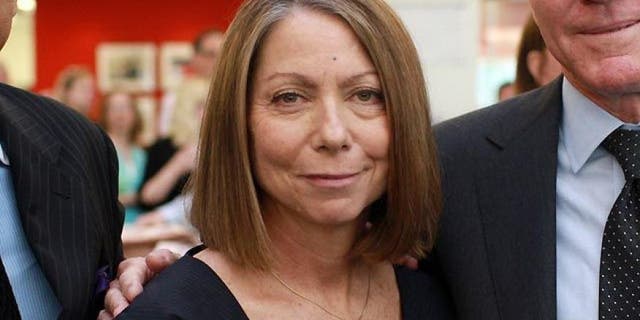
Former executive editor of the New York Times Jill Abramson.
Dean
Baquet 2019 New York Times Editor
“Given its mostly liberal audience, there was an
implicit financial reward for the Times in running lots of Trump
stories, almost all of them negative: they drove big traffic numbers
and, despite the blip of cancellations after the election, inflated
subscription orders to levels no one anticipated.”
The Times has
long faced accusations of liberal bias, even before Trump got into
politics and became its harshest critic. But Abramson’s words carry
special weight because she is also a former Times Washington bureau
chief and Wall Street Journal correspondent specializing in
investigative reporting.
Baquet has said that Trump’s attacks on
the press are “out of control” and that it is important to use the word
“lie” when the president tells a clear untruth.
In “Merchants of
Truth: The Business of News and the Fight for Facts,” Abramson praised
as “brave and right” Baquet’s decision to run this headline when Trump
abandoned his birtherism attacks on Barack Obama: “Trump Gives Up a Lie
But Refuses to Repent.”
Abramson, who had her share of clashes
with Baquet when he was her managing editor, sheds light on a 2016
episode when Baquet held off on publishing a story that would have
linked the Trump campaign with Russian attempts to influence the
election.
Liz Spayd, then the Times public editor, wrote that the
paper, which concluded that more evidence was needed, appeared “too
timid” in not running the piece, produced by a team that included
reporter Eric Lichtblau.
Baquet “seethed” at this scolding, Abramson says, and emailed Lichtblau: “I hope your colleagues rip you a new a*****e.”
Baquet
wrote that “the most disturbing thing” about Spayd’s column “was that
there was information in it that came from very confidential, really
difficult conversations we had about whether or not to publish the back
channel information. I guess I’m disappointed that this ended up in
print.
“It is hard for a journalist to complain when confidential
information goes public. That’s what we do for a living, after all. But
I’ll admit that you may find me less than open, less willing to invite
debate, the next time we have a hard decision to make.”
Lichtblau
soon left the Times for CNN, where he was one of three journalists fired
when the network retracted and apologized for a story making
uncorroborated accusations against Trump confidante Anthony Scaramucci.
And the Times soon abolished the public editor’s column.
Abramson
is critical of Trump as well. She calls his “fake news” attacks a “cheap
way of trying to undermine the credibility of the Times’s reporting as
something to be accepted as truth only by liberals in urban,
cosmopolitan areas.”
The Times, which broke the story of Hillary
Clinton’s private email server, also “made some bad judgment calls and
blew its Clinton coverage out of proportion,” Abramson writes. She says
Clinton “was wary of me,” mishandled the scandal and “was secretive to
the point of being paranoid.”
Abramson is candid in acknowledging
her faults. When then-publisher Arthur Sulzberger Jr. was considering
promoting her to the top job, he told her over lunch at Le Bernadin:
“Everyone knows there’s a good Jill and a bad Jill. The big question for
me is which one we’ll see if you become executive editor.”
She admitted to him that “I could be self-righteous when I felt unheard, I interrupted, I didn’t listen enough.”
It
was a heated battle with Baquet that led to her ouster in 2014. He was
furious upon learning that she was trying to trying to recruit another
top journalist—Abramson says an executive ordered her to keep it
secret—who would share the managing editor’s title.
Sulzberger called her in, fired her, and handed her a press release announcing her resignation.
Abramson
says she replied: “Arthur, I’ve devoted my entire career to telling the
truth, and I won’t agree to this press release. I’m going to say I’ve
been fired.”
Her final judgment: “I was a less than stellar
manager, but I also had been judged by an unfair double standard applied
to many women leaders.”