OAN Newsroom
UPDATED 10:14 AM PT — Friday, March 8, 2019
House Oversight Committee chairman Elijah Cummings appears to be
hesitant to follow through on referring Michael Cohen to the Department
of Justice for possible prosecution. While speaking to reporters Thursday, Cummings said he needs more
time to determine if there is any evidence Cohen may have committed
perjury during his testimony last week. Congressman Jim Jordan seized on the apparent lack of follow through
on Cummings part by asking the chairman what he plans to do to hold
Cohen accountable. According to Jordan, Cohen has lied to the Oversight
Committee at least seven times on a wide range of topics, including his
alleged request for a presidential pardon. “I have never asked for, nor would I accept, a pardon from Mr. Trump,” Cohen claimed. That statement later appeared to contradict remarks made by Cohen’s own personal attorney. “All I can say is Mr. Cohen’s got a story to tell, he was a leaky
ship to begin with,” said Senator Lindsey Graham. “There was discussions
about a pardon and he denied it, but that just furthers the narrative
that maybe he’s not the best conveyor of the truth.” This comes after Cummings warned Cohen about the consequences for lying to Congress. “I have made it abundantly clear to Mr. Cohen, that if he comes here
today and he does not tell the truth, tell us the truth, I will be the
first one to refer those untruthful statements to DOJ,”stated Cummings.
“So. when people say he doesn’t have anything to lose, he does have a
lot to lose if he lies”. Jordan was joined by Congressman Mark Meadows the day after Cohen’s
hearing in calling for the Justice Department to investigate the
inconsistencies.
The question of whether former Trump attorney Michael Cohen
ever sought a pardon from the president is difficult to answer due to a
lack of reliable sources, Washington Post opinion writer Charles Lane
argued Friday.
During his testimony to Congress, Cohen claimed he
never asked President Trump for a pardon, something the president
asserts was a lie. Trump even took to Twitter and insisted that Cohen
asked him directly about a pardon, and that Trump responded “no.”
On Friday's "Special Report"
All-Star panel, Lane -- along with Wall Street Journal columnist Jason
Riley and The Federalist co-founder Ben Domenech -- weighed in on the
pardon matter as it factors into the ongoing Russia probe. CLICK HERE TO VIEW THE FULL SHOW
Lane
began by suggesting that former Trump campaign chairman Paul Manafort
was still “holding out hope” that the president would pardon him after
he was sentenced this week to 47 months in prison on tax and bank fraud
charges. But regarding Cohen's pardon testimony, Lane said he could “see
it either way” on whether Trump or Cohen was being truthful, adding
that Cohen could have gone to “intermediaries” instead of the president.
“I
personally would like to know what the real story is about this pardon.
I want to know, was it dangled? I want to know, was it sought?” Lane
told the panel. “The problem is, of course, is that we have these two
guys who aren’t exactly on good terms with the truth who are our best
witnesses to it.”
“The problem is ... we have these two guys who aren’t exactly on good terms with the truth who are our best witnesses to it.” — Charles Lane, Washington Post opinion writer
Lane
added that Trump is taking a risk for depicting Cohen as a “liar,”
particularly because Cohen testified that he saw no proof of collusion
between Russia and the Trump campaign.
Domenech
said Trump “loves dunking” on his political enemies and that their
“attitude” toward the president “dictates his attitude” toward them. He
added that if House Republicans want to pursue a perjury charge against
Cohen, the White House may be forced to prove that Cohen lied about not
seeking a pardon.
Meanwhile, Riley noted that Manafort “isn’t out
of the woods” just yet as he faces another sentencing next week for
criminal behavior.
House Speaker Nancy Pelosi, D-Calif., and other House
Democrats rally ahead of the passage of H.R. 1, "The For the People
Act," at the Capitol in Washington, Friday, March 8, 2019. (Associated
Press)
U.S. House Democrats passed a sweeping
anti-corruption and voting rights bill Friday that they said was
intended to make voting easier, as well as strengthen ethics rules,
while also rejecting a motion to condemn voting by undocumented immigrants.
The legislation, dubbed the “For The People Act” or "H.R.1," passed 234-193 along party lines.
The
proposal -- nearly 700 pages -- calls for Election Day to be designated
a federal holiday, requires all states to offer automatic voter
registration, restores voting rights to convicted felons, institutes
independent redistricting commissions to weed out gerrymandering and
requires nonprofit organizations to disclose the names of donors who
contribute more than $10,000 in an effort to rein in dark-money groups. .
“It’s a power grab for the American people,” U.S. Rep. Zoe
Lofgren, D-Calif., who leads the House administration committee that
shepherded the legislation, according to the New York Times.
The
bill also requires the sitting president and vice president to release
10 years of federal tax returns, as well as presidential candidates.
“This
bill is a massive federal government takeover that would undermine the
integrity of our elections,” House Minority Leader Kevin McCarthy,
R-Calif., said Friday, the Times reported.
“This bill is a massive federal government takeover that would undermine the integrity of our elections.” — House Minority Leader Kevin McCarthy, R-Calif.
The
legislation has almost no chance of passing in the Senate. Senate
Majority Leader Mitch McConnell, R-Ky., has indicated he will not bring
the bill for a vote, effectively killing the bill.
"We know this
bill is not going to be signed into law," said Illinois Rep. Rodney
Davis, the ranking Republican on the House subcommittee on elections, on
the House floor before the vote. "This bill is nothing but a bill that
is for loading billions of billions of dollars into the coffers of
members of Congress."
In
the broader debate over voter accessibility, House Democrats also voted
Friday to defend localities that allow non-citizens to vote in their
elections, the Washington Times reported.
The 228-197 vote would have almost no effect as noncitizens are barred
from participating in federal elections. The GOP-backed measure would
have added language to "H.R.1 stating that “allowing illegal immigrants
the right to vote devalues the franchise and diminishes the voting
power of United States citizens.”
“We are prepared to open up the
political process and let all of the people come in,” Rep. John Lewis, a
Georgia Democrat and hero of the civil rights movement, told
colleagues. The measure referenced San Francisco's policy of allowing
noncitizens, including undocumented immigrants, to vote in school board
elections.
Just six Democrats voted against it and one Republican opposed it.
New York state goes to extraordinary lengths to catch wealthy residents who try to flee its burdensome taxes, leaving a gaping hole in the state’s treasury.
The aggressive approach by state tax
collectors comes as the Empire State faces a $2.3 billion budget
deficit that even Democratic Gov. Andrew Cuomo called “as serious as a
heart attack.”
Cuomo, a vocal critic of President Trump, blamed
congressional Republicans for passing tax reforms that reduced the state
and local tax deduction Americans can take on their annual income tax
forms -- meaning residents of high-tax blue states like New York have
been feeling the pinch, sparking their exodus.
“This is the flip
side. Tax the rich, tax the rich, tax the rich,” Cuomo said last month.
“We did. Now, God forbid, the rich leave.”
“Tax the rich, tax the rich, tax the rich. We did. Now, God forbid, the rich leave.” — Gov. Andrew Cuomo
But
New York state auditors are doing their best to ensure that those
fleeing the state’s high taxes will face difficulties, including being
subjected to an audit -- likely to be followed by a massive tax bill.
New York conducted 3,000 “nonresidency” audits between 2010 and 2017, recouping around $1 billion from the practice, CNBC reported.
Between
2015 and 2017, the auditors on average collected $144,270 per audit,
with more than half of those who were audited losing their cases.
New
York's success rate on audits can be attributed not only to the
traditional methods of investigation like going through an individual’s
credit card bills, but also to new high-tech tools that include tracking
phone records, social media, and even veterinary and dentist records,
according to the outlet.
Data show that between July 2017 and July
2018, the high-tax and Democrat-controlled states of New York and
Illinois lost the most residents, with New York losing more than 48,000
residents, while Illinois’ population declined by more than 45,000,
according to the U.S. Census Bureau.
It remains unclear how many
top-tax-paying residents were part of the people who fled the states,
but the data show that low-tax red states like Florida and Texas gained
new residents.
“If you’re a high earner in New York and you move
to Florida, your chances of a residency audit are 100 percent,” Barry
Horowitz, a partner at the WithumSmith+Brown accounting firm, told CNBC.
“New York has always been aggressive. But it’s getting worse.”
New
York is also working extensively to catch those high-worth individuals
who fake their move to Florida in a bid to avoid paying steep taxes in
New York.
Unlike in New York, where punitive tax rates apply to
fund its burgeoning public sector and welfare state, Florida’s residents
aren’t subjected to any income or estate tax.
Even Blanca Ocasio-Cortez, mother of pro-tax Rep. Alexandria Ocasio-Cortez, touted Florida’s low-tax system after fleeing the Big Apple.
“I was paying $10,000 a year in real estate taxes up north. I’m paying $600 a year in Florida. It’s stress-free down here.” — Blanca Ocasio-Cortez
“I
was paying $10,000 a year in real estate taxes up north. I’m paying
$600 a year in Florida. It’s stress-free down here,” she told the Daily Mail from her home in Eustis.
Yet
New York's get-tough approach toward its former residents may pose some
dangers in the long-term. While recouping unpaid money works for the
state’s treasury in the short-term, such practices create a hostile
environment for the wealthy that threatens to accelerate their exodus.
And with the top 1 percent paying nearly half of the income taxes in the state, New York can’t afford any more departures.
“Even if a small number of taxpayers leave, it has a dramatic effect on this tax space,” Cuomo said last month.
After several days of infighting and a near-rebellion
by rank-and-file Democrats, as well as a major last-minute
revision, the House on Thursday overwhelmingly passed a bipartisan
resolution that only indirectly condemned Minnesota Democratic Rep.
Ilhan Omar's repeated 'anti-Semitic' and 'pernicious' comments -- without mentioning her by name.
The
final vote was 407 to 23, with 23 Republicans voting no, and all
Democrats, including Omar, voting yes. Iowa GOP Rep. Steve King, who
faced his own bipartisan blowback for comments purportedly defending white nationalists, voted present.
The
final draft of the resolution was expanded Thursday afternoon to
condemn virtually all forms of bigotry, including white supremacy, in
what Republicans characterized as a cynical ploy to distract from Omar's
remarks. Texas Republican Rep. Louie Gohmert, speaking on the House
floor to announce that he would vote against the resolution, remarked,
"Now [the resolution] condemns just about everything. ... Hatred for
Israel is a special kind of hatred. It should never be watered down."
Gohmert
was joined in voting down the resolution by House Republican Conference
Chair Liz Cheney, as well as Reps. Lee Zeldin, Andy Biggs, Ken Buck,
Michael Conaway, Chris Collins, Mike Rogers, Paul Gosar, Pete King, Rick
Crawford, Ted Budd, Ted Yoho, Chip Roy, Dan Meuser, Jeff Duncan, Thomas
Massie, Doug LaMalfa, Tom Graves, Steve Palazzo, Greg Steube, Mo
Brooks, Mark Walker, and Michael Burgess.
“Today’s resolution vote
was a sham put forward by Democrats to avoid condemning one of their
own and denouncing vile anti-Semitism," Cheney said in a statement.
“While I stand whole heartedly against discrimination outlined in this
resolution, the language before the House today did not address the
issue that is front and center."
Cheney called Thursday "a sad
day for the House" and called for Omar's removal from the House Foreign
Affairs Committee, just as Republicans stripped King of his committee assignments in
January. (The House did not specifically name King in a bipartisan
disapproval measure that followed his comments on white nationalism.)
And Rep. Zeldin, who is Jewish, issued a fiery condemnation of the resolution on the House floor, calling it a "watered down" resolution that was both "spineless" and "disgusting."
The lead-up to the vote on the resolution to condemn all "forms of hatred" exposed a growing rift
between House Speaker Nancy Pelosi, D-Calif., and the far-left
progressive freshman contingent -- including not only Omar, but also
Alexandria Ocasio-Cortez, D-N.Y., Rashida Tlaib, D-Mich., and others --
that has emerged as a major challenge to her control over the House.
During
debate on the House floor over the resolution, Rep. Ted Deutch, a
Florida Democrat, slammed his party's leaders for hesitating to sharply
condemn Omar, and remarked that supporting language condemning
anti-Semitism "shouldn’t be this hard."
"Why
are we unable to singularly condemn anti-Semitism?" Deutch asked. "It
feels like we're only able to call out the use of anti-Semitic language
by a colleague of ours -- any colleague of ours -- if we're addressing
all forms of hatred. It feels like we can't say it's anti-Semitism
unless everyone agrees it's anti-Semitism."
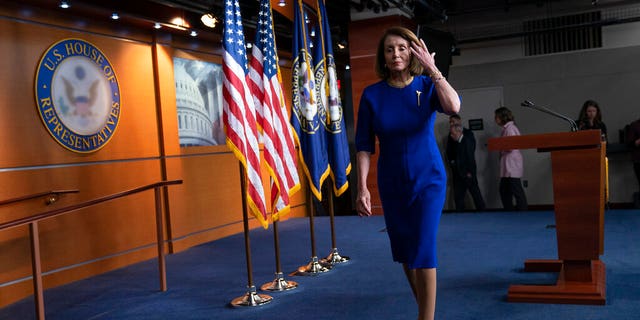
Speaker of the House Nancy Pelosi, D-Calif., after speaking with
reporters during her weekly news conference Thursday on Capitol Hill.
(AP Photo/J. Scott Applewhite)
Omar, peppered with reporters' questions as she left the House chamber following the vote, did not offer any comment.
Ocasio-Cortez, for her part, told Fox News that Democratic women of color "are being treated differently" and "targeted."
In a statement late Thursday, Omar, Tlaib, and Indiana Rep. Andre Carson called the vote "historic."
“Today
is historic on many fronts," the representatives said. "It’s the first
time we have voted on a resolution condemning Anti-Muslim bigotry in our
nation’s history. Anti-Muslim crimes have increased 99% from 2014-2016
and are still on the rise.
“We are tremendously proud to be part
of a body that has put forth a condemnation of all forms of bigotry
including anti-Semitism, racism, and white supremacy," the statement
continues. "At a time when extremism is on the rise, we must explicitly
denounce religious intolerance of all kinds and acknowledge the pain
felt by all communities. Our nation is having a difficult conversation
and we believe this is great progress.”
Tensions have run high
among Democrats in recent days. Apparently fed up with her party's
inability to come together to condemn anti-Semitism in the past week,
Pelosi reportedly even dropped her microphone and stormed out of a
meeting with junior Democrats on Wednesday, amid fierce disputes over
the planning and wording of the resolution.
And, on Thursday, Pelosi offered something of a strained excuse for the 37-year-old Omar, saying at a news conference, “I do not believe that she understood the full weight of the words.”
The
final text of the resolution reflected the Democrats' deep internal
divisions on the matter. It began by rejecting the "perpetuation of
anti-Semitic stereotypes in the United States and around the world,
including the pernicious myth of dual loyalty and foreign allegiance,
especially in the context of support for the United States-Israel
alliance."
Although the resolution stops short of using Omar's name, that provision was a transparent reference to her remarks
at a progressive Washington cafe last week, in which she suggested that
Israel supporters were pushing for U.S. politicians to declare
"allegiance" to Israel. 2020 DEMOCRATIC PRESIDENTIAL HOPEFULS CIRCLE THE WAGONS AROUND OMAR
The
accusation that Jewish politicians could be vulnerable to having "dual
loyalties" has been made for centuries in various contexts, and has been
seen widely as a religious-based attack intent on undermining their
leadership. Tlaib, who was seated next to Omar during her comments at
the cafe, made a similar comment in January, tweeting that Senate Republicans were more loyal to Israel than to their own country.
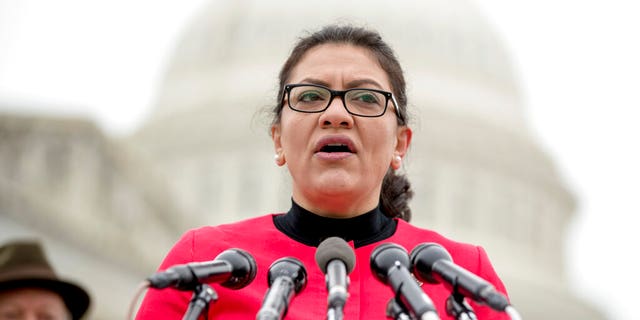
Rep. Rashida Tlaib, D-Mich., speaks at a news conference on
Capitol Hill in Washington, Thursday, Jan. 17, 2019, to unveil the
"Immediate Financial Relief for Federal Employees Act" bill which would
give zero interest loans for up to $6,000 to employees impacted by the
government shutdown and any future shutdowns. (AP Photo/Andrew Harnik)
The resolution also “condemns anti-Semitic acts and
statements as hateful expressions of intolerance that are contradictory
to the values that define the people of the United States.”
Last month, Omar ignited a bipartisan uproar across the country
when she suggested on Twitter that some members of Congress have been
paid by the American Israel Public Affairs Committee to support Israel.
AIPAC is a nonprofit organization that works to influence U.S. policy.
("Let me be really clear," New York City Mayor Bill de Blasio, a
Democrat, said. "Suggesting that support for Israel is beholden to a
foreign power is absolutely unacceptable and illogical too.")
Fox
News had been told the Democratic caucus was concerned about mentioning
Omar by name -- a non-starter for many members of the Congressional
Black Caucus. Two knowledgable sources said such a scenario could
increase security threats against Omar, who is Muslim.
But,
Democrats went to great lengths to broaden the resolution's focus far
beyond Omar's comments. A vote on the resolution was delayed briefly to
add a new clause condemning other forms of bigotry, reportedly in
response to concerns from members representing minority groups who felt
left out.
“I do not believe that she understood the full weight of the words.” — House Speaker Nancy Pelosi, on Ilhan Omar
Specifically,
the new clause stated: "Whereas white supremacists in the United States
have exploited and continue to exploit bigotry and weaponize hate for
political gain, targeting traditionally persecuted peoples, including
African Americans, Latinos, Native Americans, Asian Americans and
Pacific Islanders and other people of color, Jews, Muslims, Hindus,
Sikhs, the LGBTQ community, immigrants, and others with verbal attacks,
incitement, and violence."
Conservative commentators mocked the
dramatic, seemingly limitless expansion of the language, with Ben
Shapiro writing, "This resolution must not pass until it includes
condemnation of hatred against the disabled."
The resolution also "condemns anti-Muslim discrimination and 23 bigotry
against all minorities as contrary to the values of the United States."
It further "encourages all public officials to confront the reality of
anti-Semitism, Islamophobia, racism, and other forms of bigotry, as well
as historical struggles against them, to ensure that the United States
will live up to the transcendent principles of tolerance, religious
freedom, and equal protection as embodied in the Declaration of
Independence and the first and amendments to the Constitution."
Many 2020 Democratic hopefuls, meanwhile, lined up to support Omar -- including Bernie Sanders and Elizabeth Warren. Others have preferred to duck the issue.
Asked
about Omar at a news conference Thursday, Sen. Cory Booker, D-N.J.,
insisted he wanted to hear only "on-topic" questions about unrelated
legislation -- then, receiving none, stop taking questions entirely.
Top Republicans, however, have said the line between fair criticism of Israel and outright bigotry clearly had been crossed.
"Yeah,
I can understand the settlement policy is being criticized," South
Carolina Republican Sen. Lindsey Graham told Fox News on Thursday. "I
can understand sometimes the actions Israel takes are disproportionate.
But the point is, this wasn't about Israeli policy; it was about what
the Jews do -- that the Jews control the media, and the Jews used their
money to buy favors. That's the oldest anti-Semitic play in the book." Fox News' Chad Pergram and Alex Pappas contributed to this report.
Some of Fox News’ liberal rivals have been cheering the Democratic National Committee’s decision to exclude the network from the party’s primary debates.
In fact, Jane Mayer, author of the New Yorker article cited as the reason for the decision, posted a celebratory tweet:
“Boom! DNC Chair says Fox can't sponsor 2020 Dem Primary Debate.”
But a number of prominent journalists have sharply criticized the move by committee chairman Tom Perez.
NBC
reporter Jonathan Allen: “There are plenty of quality journalists at
Fox, some of whom have been excellent questioners at past presidential
debates.”
Politico’s Jack Shafer: “The idea that the New
Yorker story could have alerted Perez to some previously hidden
right-wing, anti-Democratic Party tendencies at Fox is hilarious…Any
politician who can’t hold his own against a journalist from the other
team should be disqualified from running.”
New York Times
correspondent Maggie Haberman: “Whether it’s the case or not, it sends a
message of being afraid of something. Which is what Trump feeds off in
opponents.”
While Perez said Fox “is not in a position to hold a
fair and neutral debate,” Fox Senior Vice President Bill Sammon said he
hoped the DNC would reconsider, since its moderators—Bret Baier, Chris Wallace and Martha MacCallum—“embody the ultimate journalistic integrity and professionalism.” DNC BARS FOX NEWS FROM HOSTING PRESIDENTIAL PRIMARY DEBATES
And
that points up what was missing from the more than 11,000-word New
Yorker story: an acknowledgement that Fox has a news division.
There
were a couple of mentions of Wallace asking tough questions or Shepard
Smith fact-checking the administration, but no exploration of the
separation between the news side—anchors, reporters and editors—and the
opinion side best known for prime-time hosts Sean Hannity, Laura
Ingraham and Tucker Carlson.
It’s hardly breaking news that they
and other commentators, such as the hosts of “Fox & Friends,”
generally support President Trump—although several harshly criticized
him for a temporary retreat on the border wall that preceded the 35-day
government shutdown. Hannity, in particular, speaks regularly to the
president, and drew criticism from me and many others for accepting
Trump’s invitation to come on stage, and praising him, at a November
rally.
Trump does watch an awful lot of Fox and is influenced by
what some hosts and guests say, as his Twitter feed makes clear. A
number of people who had roles at Fox, most notably former co-president
Bill Shine, have joined the administration. (By the way, two dozen
journalists, such as Time’s Jay Carney, went into the Obama
administration.)
I don’t want to cast any aspersions on Mayer, who
I’ve known for decades, but she is well known for taking on such
conservative targets as Trump, Mike Pence, Brett Kavanaugh, and the Koch
brothers (her latest book is about “the billionaires behind the rise of
the radical right”). The New Yorker has run a series of covers mocking
Trump, and its longtime editor, David Remnick, has called the president a
“master demagogue” and “unceasing generator of toxic gas.”
Fox
News has been controversial since Rupert Murdoch and Roger Ailes, a
former Republican operative, founded it in 1996. It is an even bigger
target now, as the nation’s dominant cable news network, in the Trump
era.
Let’s look at some of the article’s findings:
--While
the New Yorker largely ignored the news division, except for the quick
mentions of Chris Wallace and Shep Smith, Fox had provided the magazine
with far more material.
MacCallum, for instance, drew widespread
media praise for her grilling of Kavanaugh when she obtained the only
interview with him during his Supreme Court nomination fight.
Fox
news anchor Neil Cavuto has occasionally chastised Trump, saying last
year: “You are right to say that some are out to get you. But
oftentimes, Mr. President, the problem is you.”
Fox chief legal
analyst Andrew Napolitano said Trump faces “at least four potential
felonies” if Michael Cohen’s testimony is true.
The Mueller probe, the Cohen hearings and the hush-money investigation have all received ample coverage on Fox’s news shows.
What’s
more, Baier complained on the air about not being able to secure an
interview with Trump, and didn’t get one for nearly a year and a half
until he traveled to Singapore. Wallace didn’t land a Trump sitdown for
“Fox News Sunday” until last November.
--Baier and Megyn Kelly
opened the first GOP debate in 2015 with tough questions aimed at Trump.
The New Yorker says three unnamed sources “believe that Ailes informed
the Trump campaign about Kelly’s question” in advance. Kelly has said
she doesn’t believe that, and Ailes is deceased.
But a Fox
executive who was with Ailes the next day said he was furious that he
hadn’t been informed of the questions by the journalists doing the
debate prep in Cleveland. Also left unmentioned: Trump then went to war
with Fox and Kelly and boycotted the network’s next debate.
--The
website decided against running a story by Diana Falzone, then a
Foxnews.com entertainment reporter, about the alleged affair with Stormy
Daniels and a proposed cash settlement. Despite quotes from the
executive who then ran the website that the story wasn’t sufficiently
corroborated—other outlets in pursuit also declined to publish—the New
Yorker quotes an unnamed source as saying Falzone was told the reason
was that Murdoch wanted Trump to win.
But the Wall Street Journal—also owned by Murdoch—published a story on Stormy Daniels and Trump days before the election.
--The
New Yorker accurately recounts how Ailes was fired as chairman in 2016
after numerous allegations of sexual harassment, and that the ouster
came quickly following an outside investigation. That remains an
embarrassing episode in the network’s history. But there is only the
briefest mention of his successor, Suzanne Scott, the only woman running
a major network, and nothing on the workplace reforms she has
instituted.
--The magazine quotes Washington Post columnist
Jennifer Rubin, who despises Trump, as saying she would never appear on
Fox despite having done so in the past. There is no mention that she is
an MSNBC contributor.
--Two Media Matters executives are quoted in
the story. The liberal advocacy group has been openly crusading against
Fox for years.
--The piece concludes that “Fox has a financial
incentive to make Trump look good.” Even if that were true—the audience
is not a monolith--one could just as easily argue that CNN and MSNBC (as
well as the New York Times, as former executive editor Jill Abramson
has said) have a financial incentive to make Trump look bad.
But
there is no mention of the consistently anti-Trump tone on those two
networks, whose opinion hosts have repeatedly assailed the president as
unhinged, mentally deficient, racist, misogynist and dangerous; that is
deemed normal.
Shouldn’t the DNC, by its own standard, consider those voices as well in weighing the fairness of network debates?
The
president tweeted after the DNC excluded Fox that “I think I’ll do the
same thing with the Fake News Networks and the Radical Left Democrats in
the General Election debates!” That was not particularly helpful to Fox
News at a time the network is being criticized for excessive coziness
with Trump.
Perhaps this was inevitable, as Fox didn’t get a
Democratic debate in 2016 either. But the record of Fox’s debate
moderators, none of them in the opinion business, makes clear even to
critics that any such event would be handled fairly.
Conservative commentator Mark Steyn called freshman Rep. Alexandria Ocasio-Cortez, D-N.Y., "strangely unwoke" Thursday after she admitted in an interview that she threw away some of her plastic bags.
"Obviously
in a certain sense this is a boutique issue. We will be arguing about
plastic bags at the time Kim Jong Un decides to drop the big one on
Cleveland and we will look ridiculous," Steyn said on "Tucker Carlson Tonight." "What's oddly revealing about this is I think Alexandria Ocasio-Cortez comes across as strangely unwoke in this soundbite."
"I
can be upset that I get 10 plastic bags at the grocery store and then
have to toss out my plastic bags, because the recycling program in the
area is tough. And that's okay," Ocasio-Cortez told Spectrum News NY1. "All of these are not reasons to stop fighting, all of these are reasons to keep fighting."
Ocasio-Cortez's
push for the Green New Deal, a much-debated resolution that addresses
climate change and renewable energy among other issues, has opened up
the congresswoman to scrutiny from the media and critics.
The New York Post reported earlier this week
that Ocasio-Cortez elected to take a minivan back to her Queens office
Sunday instead of the subway, which was less than four blocks away. OCASIO-CORTEZ HIT WITH NEW ETHICS COMPLAINT OVER BOYFRIEND'S EMAIL ACCOUNT
"Living
in the world as it is isn’t an argument against working towards a
better future,” Ocasio-Cortez tweeted in response to the Post's story.
Steyn criticized the congresswoman for not using reusable bags instead of taking the plastic ones.
"I
can be upset that I get 10 plastic bags at the grocery store and then
have to toss out my plastic bags, because the recycling program in the
area is tough. And that's okay." — Rep. Alexandria Ocasio-Cortez, D-N.Y.
"They
take out the NPR tote bag and they have all the groceries in it and
they don't have to have the plastic bags," Steyn told Tucker Carlson.
"There's no reason for this problem."
"She sounds weirdly 'unwoke,'" Steyn reiterated. "Where is Alexandria's Charlie Rose tote bag? That's what we want to know."
U.S. Rep. Ilhan Omar, D-Minn., was apparently unmoved Thursday by Meghan McCain's tearful remarks about her on "The View."
McCain
had become emotional during the ABC talk show, discussing Omar's recent
criticisms of Israel and its supporters. She said Omar's remarks were
hurtful to many of her Jewish friends.
“It is very dangerous, very
dangerous," McCain added, "and I think we collectively as Americans on
both sides, what Ilhan Omar is saying is very scary to me. It’s very
scary to a lot of people and I don’t think you have to be Jewish to
recognize that.” OMAR, ANTI-SEMITISM DEBATE IN THE HOUSE ENDS WITH A LAUNDRY LIST RESOLUTION -- WHAT A SHAME
But
instead of responding directly to McCain, Omar retweeted a post that
criticized McCain for "faux outrage" and referred to past statements
attributed to McCain's late father, U.S. Sen. John McCain, R-Ariz., who
died last August at age 81.
“Meghan’s late father literally sang
‘bomb bomb bomb Iran’ and insisted on referring to his Vietnamese
captors as ‘g--ks'," read the post by Medhi Hasan, an "Intercept"
columnist and Al Jazeera host. "He also, lest we forget, gave the world
Sarah Palin. So a little less faux outrage over a
former-refugee-turned-freshman-representative pls.”
Omar's
retweet was praised by many of her followers as a sign that the
freshman congresswoman was "standing up to the establishment." But the
retweet also attracted more negative attention to the Somali-born
lawmaker, just hours after the U.S. House voted in favor of an anti-hate
resolution that was initially inspired by the Minnesota Democrat.
Omar
has resisted calls for her to apologize for blasting those who pledge
“allegiance to a foreign country,” referring to Israel, in what has been
decried as an anti-Semitic trope. The Associated Press contributed to this report