If you've watched cable news or read newspapers for the last two years, you know most of what's in the Mueller report.
That was perhaps the biggest surprise in poring over it. Even the president's lawyers were surprised by that.
On issue after issue, the special counsel's report describes what we already know — about President Trump and Michael Cohen,
Trump and Paul Manafort, Trump and Michael Flynn — and ultimately says
no collusion with Russia and only inconclusive evidence of possible
obstruction of justice.
To
be sure, there's a text message here or a voice mail there that paints a
fuller picture. But for the most part, the report consists of lengthy
legal arguments as to why the president could have obstructed justice,
might arguably have obstructed justice — only to say that Mueller's
office makes no recommendation.
That means, in my view, there's no
one anecdote or admission that political and media critics can seize
upon to change the overarching narrative, that Mueller is bringing no
further charges.
In fact, the best single scene
is when Jeff Sessions told Trump that a special counsel had been
appointed, the president replied: "Oh my God. This is terrible. This is
the end of my presidency. I’m f---ed." Then he demanded to know how
Sessions could let this happen.
But of course, he railed against
Sessions and his recusal so many times, until the AG was forced out,
that we sort of knew that (minus the F-bomb).
All
this is great fodder for the press, and for legal scholars, and for
historians. But there's very little that will change people's minds as
to whether Donald Trump engaged in misconduct.
Some examples:
—
When Trump called Paul Manafort, during jury deliberations, a "very
good person" and said "it's very sad what they've done to Paul
Manafort," the comments could "engender sympathy for Manafort among
jurors" if they learned of the remarks. But there are "alternative
explanations," such as that he "genuinely felt sorry for Manafort" or
was trying to influence public opinion, not the jury.
— "There is
evidence" that the president knew Michael Cohen had testified falsely
before Congress about continuing efforts during the campaign to win
approval for a Trump Tower in Moscow. But the available evidence "does
not establish that the president directed or aided Cohen's false
testimony."
It's like a legal seminar, as the report rehashes the
mostly known facts, floats the most damaging interpretations, offers the
counter-argument and concludes there is insufficient evidence.
Less flattering for Trump:
—
His firing of Jim Comey, request to his White House counsel to have Bob
Mueller fired, and direction to Corey Lewandowski to ask Sessions to
limit the scope of Mueller's probe all could be viewed as trying to
undercut the investigation. But these efforts were largely unsuccessful
because the people around Trump "declined to carry out orders or accede
to his requests."
— When a reporter said the vast majority of FBI
agents supported the just-fired Comey, Sarah Sanders said: "we've heard
from countless members of the FBI who say very different things." She
told Mueller's office this was a "slip of the tongue" that occurred "'in
the heat of the moment' that was not founded on anything."
—
Trump told Mueller in written answers that he had no advance knowledge
of the infamous Trump Tower meeting between Donald Trump Jr., Jared
Kushner, Paul Manafort and a Russian lawyer. In 2017, Hope Hicks and
another aide — after discussions with Jared Kushner and Ivanka Trump —
said the emails involved would inevitably leak and should be released.
Hicks was shocked by the emails and thought they looked "really
bad." Jared, Ivanka and Hope urged the president to release the emails —
Hicks said they could do it as part of an interview with "softball
questions" — but he disagreed that they would leak.
When
The New York Times got onto the story, the president dictated that they
should just say the meeting was about Russian adoptions. Don Jr.
objected, asking that the word "primarily" be added because there was
briefly a discussion about Hillary Clinton: "If I don't have it in there
it appears as though I'm lying later when they inevitably leak
something." The Times soon obtained the emails, leading to a wave of bad
press.
But all this is pretty down in the weeds. And that's in
part because so much of what the president said and did in battling
Mueller played out in public.
What is muting the report's impact,
in my view, is that expectations were so sky-high. The media, having
invested so much capital in this probe for two years, only to be let
down by the lack of criminal charges, were betting that the actual
report would be explosive. And yet it was more popgun than big-time
bomb.
George Conway, the husband of White House adviser Kellyanne Conway
and a fierce critic of President Trump, penned an op-ed in The
Washington Post that calls Trump a "cancer on the presidency" and urged
Congress to take action to remove him from office.
After 22 months, a redacted version of special counsel Robert Mueller’s Russia interference report was made available to the public.
The report showed no evidence that Trump’s team “coordinated or
conspired” with Russia, but many Democrats pointed out that Mueller
identified 10 times where there was potential obstruction, and
essentially left the next steps up to Congress.
Mueller wrote that
Trump’s efforts to obstruct “were often carried out through one-on-one
meetings in which the President sought to use his official power outside
of usual channels.”
He
continued, “The President's efforts to influence the investigation were
mostly unsuccessful, but that is largely because the persons who
surrounded the President declined to carry out orders or accede to his
requests."
Trump's team late Thursday appeared to take a
wait-and-see approach on how the public absorbed the findings. Rudy
Giuliani, Trump's lawyer, seemed to be in no particular hurry to release
a 45-page rebuttal when asked about it on CNN. The White House claimed
total victory and vindication for the president
Conway, who has
clashed publicly with the president before and questioned his mental
fitness, barely touches collusion in his piece but highlighted the
obstruction argument.
"Mueller couldn’t say, with any
“confidence,” that the president of the United States is not a criminal.
He said, stunningly, that “if we had confidence after a thorough
investigation of the facts that the President clearly did not commit
obstruction of justice, we would so state.” Mueller did not so state," Conway wrote.
He
pointed out that even if Trump did not reach the threshold of
criminality, he could still be impeached based on earlier precedent. He
called on Congress to act to “excise” the cancer in the White House
“without delay.”
There is no love lost between Trump and Conway. Trump has called Conway a “stone cold LOSER & husband from hell.”
“George
Conway, often referred to as Mr. Kellyanne Conway by those who know
him, is VERY jealous of his wife’s success & angry that I, with her
help, didn’t give him the job he so desperately wanted. I barely know
him but just take a look, a stone cold LOSER & husband from hell!” Trump tweeted in March.
Andrew McCarthy, a former federal prosecutor, wrote in
the New York Post that Trump could have simply shut down the
investigation and assert executive privilege to “deny the special
counsel access to key White House witnesses,” but he didn’t.
“Most
important, the special counsel found that there was no collusion
between the Trump campaign and Russia, and that the president’s
frustration wasn’t over fear of guilt — the typical motivation for
obstruction — but that the investigation was undermining his ability to
govern the country,” McCarthy wrote.
CNN political analyst April Ryan called for the firing of White House Press Secretary Sarah Sanders on Thursday, claiming Sanders “lied” to the media following the release of the Mueller report.
In
May 2017, following the turbulent firing of FBI Director James Comey,
Sanders told reporters that “countless” FBI agents had lost confidence
in Comey despite one reporter’s assertion that the “vast majority” of
them supported his leadership. According to Special Counsel Robert
Mueller’s office, Sanders told investigators her claim was a “slip of
the tongue” and was “in the heat of the moment,” admitting that it was
not founded on anything.
Ryan, who is also a White House reporter
for the American Urban Radio Networks, blasted the press secretary on
Thursday night for “lying” to the American people.
“Not only does
she not have any credibility left, she lied,” Ryan told CNN anchor Erin
Burnett. “She outright lied and the people, the American people can't
trust her. They can't trust what's said from the president's mouthpiece,
spokesperson, from the people's house. Therefore, she should be let go.
She should be fired. End of story. When there is a lack of credibility
there, you have to start and start lopping the heads off. It’s ‘Fire Me
Thursday’ or ‘Fire Me Good Friday,’ she needs to go."
The CNN pundit suggested that since President Trump “won’t take the fall” that Sanders might instead.
“Sarah
plays a dangerous game in that room… The game is dangerous because she
is lying to the American public,” Ryan continued. “Then, on top of all
that, she says the press is fake when she’s faking reports from the
people’s house. She’s calling us fake? We’ve had colleagues who’ve had
to move from their houses because of threats. I have to have security
because of being called ‘fake’ and a ‘loser’ and all sorts of things
from that White House. It’s time for her to go.”
Sanders appeared on “Hannity” on
Thursday night and reiterated that she shouldn't have used the word
“countless,” but insisted it was “not untrue” that “a number of current
and former FBI agents agreed with the president” about Comey, whom she
called a “disgraced leaker.”
Special Counsel Robert Mueller
and President Trump communicated directly at one point during the
long-running investigation into Russian election interference, when the
president's legal team submitted written testimony in response to
Mueller's questions on a variety of topics in November 2018.
And in some cases, Trump and his attorneys brought the sass.
One
of Mueller's questions referred to a July 2016 campaign rally, when
Trump said, "Russia, if you’re listening, I hope you’re able to find the
30,000 emails that are missing."
That was a reference to the slew
of documents deleted from Secretary of State Hillary Clinton's private
email server. Trump's comment prompted numerous frenzied accusations
that he was openly sending a signal to Russian hackers.
Mueller's
report noted that hours after Trump's remarks, a Russian-led attempt to
access some Clinton-linked email accounts was launched, although there
was no evidence Trump or his team directed or coordinated with that
effort.
"Why did you make that request of Russia, as opposed to any other country, entity or individual?" Mueller's prosecutors asked.
Mueller's report
noted that after Trump's statement, future National Security Adviser
Flynn contacted operatives in hopes of uncovering the documents, and
another GOP consultant started a company to look for the emails.
"I
made the statement quoted in Question II (d) in jest and sarcastically,
as was apparent to any objective observer," Trump, speaking through his
attorneys, shot back. "The context of the statement is evident in the
full reading or viewing of the July 27, 2016, press conference, and I
refer you to the publicly available transcript and video of that press
conference."
Separately, Mueller asked Trump why he previewed a
speech in June 2016 by promising to discuss "all of the things that have
taken place with the Clintons," and what specifically he'd planned to
talk about.
Trump didn't hold back.
"In general, l expected
to give a speech referencing the publicly available, negative
information about the Clintons, including, for example, Mrs. Clinton's
failed policies, the Clintons' use of the State Department to further
their interests and the interests of the Clinton Foundation, Mrs.
Clinton's improper use of a private server for State Department
business, the destruction of 33,000 emails on that server, and Mrs.
Clinton's temperamental unsuitability for the office of the president,"
Trump responded.
After
discussing other events, Trump concluded his reply: "I continued to
speak about Mrs. Clinton's failings throughout the campaign, using the
information prepared for inclusion in the speech to which I referred on
June 7, 2016."
In all, Mueller's 448-page report included 23
unredacted pages of Mueller's written questions and Trump's written
responses. The special counsel's team wrote that it tried to interview
the president for more than a year before relenting and permitting the
written responses alone.
An introductory note included in the
report said the special counsel's office found the responses indicative
of "the inadequacy of the written format," especially given the office's
inability to ask follow-up questions.
Citing
dozens of answers that Mueller's team considered incomplete, imprecise
or not provided because of the president's lack of recollection — for
instance, the president gave no response at all to the final set of
questions — the special counsel's office again sought an in-person
interview with Trump, and he once again declined.
Mueller's team
said it considered seeking a subpoena to compel Trump's in-person
testimony, but decided the legally aggressive move would only serve to
delay the investigation. Fox News' Brooke Singman and The Associated Press contributed to this report.
Republican strategist Karl Rove
doesn’t see Thursday’s Mueller report release as the end of a the
Trump-Russia collusion narrative, he sees it as “the beginning of the
next chapter”
“I wish I believed it was their last gasp. I think tomorrow is the beginning of the next chapter,” Rove said on “Hannity.”
Attorney General William Barr is set to hold a 9:30 a.m. news conference
Thursday accompanied by Deputy Attorney General Rod Rosenstein ahead of
the Justice Department's planned release of a redacted version
of Special Counsel Robert Mueller's report on Russian interference in
the 2016 presidential election
“I
think it is going to be first and foremost focusing on… they want the
entire document and that's going lead then to charges that he obstructed
justice and then it's going to be ‘Katie bar the door.’”
Rove added, “It's going to be months and months in my opinion of demanding a completely unredacted copy of it.”
President Trump has reportedly prepared a retort and Democrats including Rep. Jerry Nadler, D-N.Y., and House Speaker Nancy Pelosi are unhappy with roll out.
“AG
Barr has thrown out his credibility & the DOJ’s independence with
his single-minded effort to protect @realDonaldTrump above all else. The
American people deserve the truth, not a sanitized version of the
Mueller Report approved by the Trump Admin,” Nancy Pelosi tweeted
Wednesday.
Rove noted that Democrats will not be satisfied with tomorrow’s redacted report and will continue to promote their narrative.
“People
like Adam Schiff and Jerry Nadler are going to be calling for the
immediate and total release of everything. You see it in the language of
Nancy Pelosi who says that Barr is usurping the responsibility of
Congress. Congress is supposed to be the judge and jury, not our legal
system,” Rove told Sean Hannity.
Democrats in Congress attacked Attorney General William Barr Wednesday evening ahead of the Justice Department's planned release of a redacted version of Special Counsel Robert Mueller's report
on Russian interference in the 2016 presidential election and
allegations of collusion between the Trump campaign and Russian
officials.
Barr is set to hold a 9:30 a.m. news conference
Thursday accompanied by Deputy Attorney General Rod Rosenstein, who
oversaw the Mueller investigation after the special counsel's
appointment in May 2017. Neither Mueller nor other members of his team
will attend, according to special counsel spokesman Peter Carr.
Democrats have criticized the timing of the news conference, saying that
Barr would get to present his interpretation of the Mueller report
before Congress and the public see it.
At a news conference
Wednesday evening, House Judiciary Committee Chairman Jerrold Nadler,
D-N.Y., said the panel was expected to receive a copy of the report
between 11 a.m. and noon, "well after the attorney general's 9:30 a.m.
press conference. This is wrong."
"The attorney general appears to
be waging a media campaign on behalf of President Trump, the very
subject of the investigation at the heart of the Mueller report," Nadler
told reporters. "Rather than letting the facts of the report speak for
themselves, the attorney general has taken unprecedented steps to spin
Mueller’s nearly two-year investigation."
Hakeem Jeffries, another
member of the Judiciary Committee and the chairman of the House
Democratic Caucus, accused Barr -- whom Jeffries dubbed the "so-called
Attorney General" of "presiding over a dog and pony show.
"Here is
a thought," Jeffries added. "Release the Mueller report tomorrow
morning and keep your mouth shut. You have ZERO credibility."
House
Speaker Nancy Pelosi, D-Calif., tweeted that Barr "has thrown out his
credibility & the DOJ’s independence with his single-minded effort
to protect @realDonaldTrump above all else. The American people
deserve the truth, not a sanitized version of the Mueller Report
approved by the Trump Admin."
Senate Minority Leader Chuck Schumer, D-N.Y., said, "The process is poisoned before the report is even released."
"Barr
shouldn't be spinning the report at all, but it's doubly outrageous
he's doing it before America is given a chance to read it," Schumer
added.
Democrats were further angered Wednesday by a New York
Times report which said Justice Department officials have had "numerous
conversations with White House lawyers" about Mueller's conclusions,
which have aided the president's legal team as it prepares a rebuttal to
the special counsel's report. The Times report has not been
independently confirmed by Fox News.
Late Wednesday, Nadler and
four other Democratic committee chairs released a joint statement
calling on Barr to cancel the Thursday morning news conference, calling
it "unnecessary and inappropriate."
"He [Barr] should let the full
report speak for itself, read the statement from Nadler, Adam Schiff,
D-Calif., Elijah Cummings, D-Md., Maxine Waters, D-Calif., and Eliot
Engel, D-N.Y. "The Attorney General should cancel the press conference
and provide the full report to Congress, as we have requested. With the
Special Counsel’s fact-gathering work concluded, it is now Congress’
responsibility to assess the findings and evidence and proceed
accordingly."
In court filings in the case against Roger Stone on
Wednesday, the Justice Department also said it planned to provide a
"limited number" of members of Congress and their staff access to a copy
of the Mueller report with fewer redactions than the public version.
Nadler claimed Wednesday evening that the Judiciary Committee "has no
knowledge of this and this should not be read as any agreement or
knowledge or assent on our part."
Nadler added that he would
"probably find it useful" to call Mueller and members of his team to
testify after reading the version of the report Barr releases.
The
report is expected to reveal what Mueller uncovered about ties between
the Trump campaign and Russia that fell short of criminal conduct. And,
it likely will lay out the special counsel's conclusions about formative
episodes in Trump's presidency, including his firing of FBI Director
James Comey; his request of Comey to end an investigation into Trump's
first national security adviser, Michael Flynn; his relentless badgering
of former Attorney General Jeff Sessions over his recusal from the
Russia investigation; and his role in drafting an explanation about a
meeting his oldest son took at Trump Tower with a Kremlin-connected
lawyer.
The report is not expected to place the president in legal
jeopardy, as Barr made his own decision that Trump shouldn't be
prosecuted for obstruction. But it is likely to contain unflattering
details about the president's efforts to control the Russia
investigation
Overall,
Mueller brought charges against 34 people — including six Trump aides
and advisers — and revealed a sophisticated, wide-ranging Russian effort
to influence the 2016 presidential election. Twenty-five of those
charged were Russians accused either in the hacking of Democratic email
accounts or of a hidden but powerful social media effort to spread
disinformation online.
Five former Trump aides or advisers pleaded
guilty and agreed to cooperate in Mueller's investigation, including
former Trump campaign chairman Paul Manafort, former national security
adviser Michael Flynn and his former personal lawyer, Michael Cohen.
Stone is awaiting trial on charges including false statements and
obstruction. Fox News' Jake Gibson, Chad Pergram and The Associated Press contributed to this report.
Conservative commentator Ann Coulter
said she could support Sen. Bernie Sanders, I-VT, in 2020 and even
floated the idea of working in his administration if he returned to his
earlier stance on immigration.
In a preview clip of PBS’s “Firing
Line with Margaret Hoover” released Wednesday, host Margaret Hoover
asked Coulter how she viewed the progressive senator. She asked whether
she would support him if he campaign on “getting rid of low-skilled
workers” to ensure higher wages.
“If
he went back to his original position, which is the pro-blue-collar
position. I mean, it totally makes sense with him," she said. If he went
back to that position, I’d vote for him. I might work for him. I don’t
care about the rest of the socialist stuff. Just-- can we do something
for ordinary Americans?”
Coulter was apparently referencing Sanders’ policy position
from 2007 where he opposed an immigration reform bill that he feared
would drive down wages for lower-income workers. He co-authored a
restrictive immigration amendment with Sen. Chuck Grassley, R-IA. The
bill ultimately failed to pass the Senate.
Sanders rejected the idea of having open borders while speaking at a campaign event earlier this month.
“What
we need is comprehensive immigration reform. If you open the borders,
my God, there's a lot of poverty in this world, and you're going to have
people from all over the world. And I don't think that's something that
we can do at this point. Can't do it. So that is not my position,”
Sanders said.
Coulter, who authored the book “In Trump We Trust”
ahead of the 2016 election, was an early supporter of Donald Trump but
has since become a vocal critic of the president for not keeping his
campaign promise of building a wall at the southern border.
Nearly two years of fevered speculation surrounding Special Counsel Robert Mueller's
Russia probe will come to a head in a dramatic television finale-like
moment on Thursday morning at 9:30 a.m. ET, when Attorney General
William Barr and Deputy Attorney General Rod Rosenstein are set to hold a press conference to discuss the Mueller report's public release.
It
was not immediately clear exactly when on Thursday the DOJ
would release the redacted version of the nearly 400-page investigation
into Russian election meddling, but the document was expected to be
delivered to lawmakers and posted online by noon. With just hours to go
until that moment, hopes for finality amid a deep national divide -- and
persistent accusations of far-flung conspiracies -- are all but certain to remain unrealized.
Although Barr has already revealed that Mueller's report absolved the Trump team of illegally colluding with Russia, Democrats have signaled that
the release will be just the beginning of a no-holds-barred showdown
with the Trump administration over the extent of report redactions, as well as whether the president obstructed justice during the Russia investigation. FOX NEWS POLL: TRUMP POPULARITY HOLDING STEADY AFTER MUELLER SUMMARY RELEASE
Trump’s
legal team is preparing to issue a comprehensive rebuttal report on
Thursday, to challenge any allegations of obstruction against the
president, Fox News has learned.
The
lawyers originally laid out their rebuttal in response to written
questions asked by Mueller’s team of the president last year, according
to a source close to Trump's legal team.
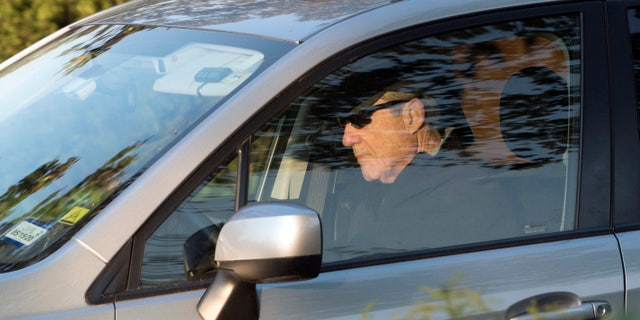
Special Counsel Robert Mueller drives away from his Washington
home on Wednesday. Outstanding questions about the special counsel's
Russia investigation have not stopped President Donald Trump and his
allies from declaring victory. (AP Photo/Kevin Wolf)
Barr has said redactions in the report's release are
legally mandated.to protect four broad areas of concern: sensitive grand
jury-related matters, classified information, ongoing
investigations and the privacy or reputation of uncharged "peripheral"
people.
Those individuals, Barr said, did not include Trump. "No,
I'm talking about people in private life, not public officeholders," the
attorney general said at a hearing last week.
In a filing in the ongoing Roger Stone prosecution
on Wednesday, the DOJ revealed that certain members of Congress will be
able to see the Mueller report "without certain redactions" in a secure
setting. Stone, a longtime confidant of the president, is awaiting
trial on charges including giving false statements and obstructing
justice.
Barr and Rosenstein are expected to take questions at the
Thursday press conference, which was first announced in a radio
interview by Trump and confirmed by the DOJ, and they'll likely be
pressed on the precise nature of the final redactions.
The
chairman of the House Judiciary Committee, Democrat New York Rep.
Jerrold Nadler, has said he is prepared to issue subpoenas "very
quickly" for the full report if it is released with blacked-out
sections, likely setting in motion a major legal battle.
Grand
jury information, including witness interviews, is normally off limits
but can be obtained in court. Some records were eventually released in
the Whitewater investigation into former President Bill Clinton and an
investigation into President Richard Nixon before he resigned.
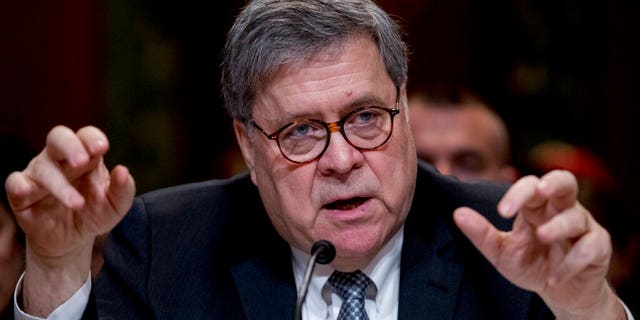
Attorney General William Barr reacts as he appears before a Senate
Appropriations subcommittee to make his Justice Department budget
request, Wednesday, April 10, 2019, in Washington. Barr said Wednesday
that he was reviewing the origins of the Trump-Russia investigation. He
said he believed the president's campaign had been spied on and he was
concerned about possible abuses of government power. (AP Photo/Andrew
Harnik)
Both of those cases were under somewhat different
circumstances, including that the House Judiciary Committee had
initiated impeachment proceedings. Federal court rules state that a
court may order disclosure "preliminary to or in connection with a
judicial proceeding," but prominent Democrats -- including House Speaker
Nancy Pelosi -- have dismissed suggestions that Trump should face impeachment.
Another
major area of scrutiny will be Barr's decision, along with Deputy
Attorney General Rod Rosenstein, that Mueller had not uncovered
sufficient evidence to prosecute Trump for obstruction of justice.
In his four-page summary of Mueller's findings released late last month,
Barr stated definitively that Mueller did not establish evidence that
Trump's team or any associates of the Trump campaign had conspired with
Russia to sway the 2016 election -- "despite multiple offers from
Russian-affiliated individuals to assist the Trump campaign."
But
on obstruction, Barr wrote that Mueller had laid out evidence on "both
sides" of the issue, even as he acknowledged that it would be more
difficult to prosecute an obstruction case without evidence of any
underlying crime. That evidence, on Thursday, will go under the
microscope.
The
report may also contain unflattering details about the president's
efforts to exert control over the Russia investigation. And it may paint
the Trump campaign as eager to exploit Russian aid and emails stolen
from Democrats and Hillary Clinton's campaign.
The report's
release will also be a test of Barr's credibility, as the public and
Congress judge the veracity of a letter he released relaying what were
purported to be Mueller's principal conclusions.
Barr, who was
unanimously confirmed by the Senate to the role of attorney general in
1991 before reclaiming the role in February, has endured withering criticism from Democrats who say he is covering for the president.
After
Barr announced plans for the Thursday press conference, Nadler quickly
charged that Barr "appears to be waging a media campaign" on behalf of
Trump.
In a statement joined by several other Democrat committee
chairs late Wednesday, Nadler called for Barr to cancel the press
conference.
"This press conference, which apparently will not
include Special Counsel Mueller, is unnecessary and inappropriate, and
appears designed to shape public perceptions of the report before anyone
can read it," the Democrats wrote. "[Barr] should let the full report
speak for itself. The Attorney General should cancel the press
conference and provide the full report to Congress, as we have
requested. With the Special Counsel’s fact-gathering work concluded, it
is now Congress’ responsibility to assess the findings and evidence and
proceed accordingly.”
Mueller is known to have investigated
multiple efforts by the president over the last two years to influence
the Russia probe or shape public perception of it.
In addition to
examining former FBI Director James Comey's firing, Mueller scrutinized
the president's reported request that Comey end an investigation into
Trump's first national security adviser; his relentless attacks on
former Attorney General Jeff Sessions over his recusal from the Russia
investigation; and his role in drafting an incomplete explanation about a
meeting his oldest son took at Trump Tower with a Kremlin-connected
lawyer.
But this week, Trump, who has long said that voicing his
opinions about the "witch hunt" against him wasn't a crime -- showed no
signs of backing down.
"Wow! FBI made 11 payments to Fake Dossier’s discredited author,
Trump hater Christopher Steele," Trump wrote on Wednesday. "The Witch
Hunt has been a total fraud on your President and the American people!
It was brought to you by Dirty Cops, Crooked Hillary and the DNC.
On
Monday, he wrote: "Mueller, and the A.G. based on Mueller findings (and
great intelligence), have already ruled No Collusion, No Obstruction.
These were crimes committed by Crooked Hillary, the DNC, Dirty Cops and
others! INVESTIGATE THE INVESTIGATORS!"
Republicans, including House Intelligence Committee ranking member Devin Nunes, have pushed aggressively for answers into the origins of the Mueller probe, which began shortly after Trump fired Comey in May 2017.
Trump
cited several justifications for terminating Comey, including what the
president called his mismanagement of the Hillary Clinton email probe,
and Comey's refusal to publicly announce that the president was not
under investigation.
The former FBI head acknowledged in testimony in December that
when the bureau initiated its counterintelligence probe into
possible collusion between Trump campaign officials and the Russian
government in July 2016, investigators "didn't know whether we had
anything."
An op-ed in The Washington Post earlier
in the week, entitled "Admit it: Fox News has been right all along,"
pointed to the role in the media in spreading the Russia collusion
narrative.
Justice Department legal opinions say that a sitting
president cannot be indicted, but Barr said he did not take that into
account when he decided the evidence was insufficient to establish
obstruction.
That conclusion was perhaps not surprising given
Barr's own unsolicited memo to the Justice Department from last June in
which he said a president could not obstruct justice by taking actions —
like the firing of an FBI director — that he is legally empowered to
take.
Overall, Mueller brought charges against 34 people —
including six Trump aides and advisers — and revealed a Russian effort
to influence the 2016 presidential election.
Twenty-five
of those charged were Russians accused either in the hacking of
Democratic email accounts or of a hidden but powerful social media
effort to spread disinformation online.
Five former Trump aides or
advisers pleaded guilty to charges unrelated to collusion and agreed to
cooperate in Mueller's investigation, including former Trump campaign
chairman Paul Manafort, former national security adviser Michael Flynn
and his former personal lawyer, Michael Cohen. Fox News' Brooke Singman, Jake Gibson and The Associated Press contributed to this report.