The economy is on fire right now, and that, more than anything, could be a major boost to President Trump's reelection chances. And
the Democrats are having a hard time figuring out how to run against
this steamroller at a time of 4 percent unemployment and soaring stocks. Of
course, things could cool off before the election, as many economists
predict a sharp slowdown in growth over the next two years. But
for now, the S&P and the Nasdaq just hit all-time highs, and the
newly announced rebound in first-quarter growth, to 3.2 percent,
trounced the market's all-important expectations. I've always felt
that a president presiding over strong growth is far more likely to win
a second term, even if other hot-button issues are dominating the news.
The flip side is that strong economic anxieties can derail a reelection
campaign, even if the economy is recovering from a recession, as
happened when George H.W. Bush lost to Bill Clinton in 1992. And the
Wall Street meltdown in the fall of 2008 helped put Barack Obama in the
White House. The nettlesome challenge for the Democratic
candidates is to avoid appearing that they're talking down a good
economy or getting traction when most people are satisfied with their
personal situation. During the 1982 midterms, Democrats privately hoped
the jobless rate under Ronald Reagan would top 10 percent, which it did,
but couldn't say so publicly on their way to picking up 27 House seats. Joe
Biden is touted for his ability to connect with white, working-class
voters in such industrial states as Michigan and Pennsylvania. But if
those workers, except in certain fields, are generally doing well, that
clearly undercuts the pitch. But don't take my word for it — ask Celinda Lake. She's a veteran Democratic pollster who told Politico
that "we really don't have a robust national message right now" on the
economy. "We will tend to talk about things like paid leave and equal
pay," which are popular but "don't add up to an economic message that is
robust enough to win the presidency." Lake also said that people
may not agree with Trump, but they know what his message is. "And
Democrats, you don't know what it is. And that's a recipe for disaster
in 2020." Look, many things will be at play in this election:
Immigration. Health care. The Mueller report. Terrorism. Race relations.
And Trump is underwater with key groups and has a 54 percent
disapproval rating in the latest ABC/Washington Post poll. And
even on the economic front, not everything is Rosy Scenario. By the
administration's own projections, we're looking at federal deficits over
$1 trillion for the next four years. That's what you get when you
combine only modest spending restraint with tax cuts, which many
Americans feel didn't help them. As the Politico piece notes, some
Democratic candidates are taking broad swipes at the Trump economy,
particularly on the subject of inequality. Kamala Harris: "We have an economy in this country that is not working for working people." Elizabeth Warren: "Let's make the zillionaires pay a fair share." Beto O'Rourke would undo the "worst excesses" of the GOP tax cuts. One
of the reasons that no economic message is breaking through is that
there are 20 Democratic candidates, each vying for a share of the
spotlight. That would matter less in hard times, but the Democrats don't
have that luxury. If "it's the economy, stupid" is as true today
as when James Carville coined it a quarter-century ago, beating Trump
will be harder than many Democrats think.
CNN anchor Don Lemon lashed out at former White House aide Cliff Sims over President Donald Trump’s
Charlottesville remarks and ended the segment early after he was
accused by his guest of "contributing" to the political divide in the
country. While covering the White House Correspondents’ Dinner and the rally
Trump held simultaneously in Green Bay, Wis. on Saturday night, CNN’s
Alisyn Camerota began the conversation by criticizing President Trump’s
pivot from his somber rally remarks about the deadly synagogue shooting
in Poway, Calif. to his fiery attacks against the Russia investigation. Sims
responded by saying all Americans are “watching the same movie” and how
they are “seeing dramatically different things” when it comes to the
Trump presidency. He used Lemon’s response to Charlottesville as an
example that his views of Trump’s remarks are “diametrically opposed” to
many others, including himself, adding that Trump “did condemn” white
supremacy. “Then you’re delusional. Then you’re delusional,
Cliff,” Lemon talked over Sims. “You’re saying because the president
says words that are hollow- because the president said ‘we should come
together.’” “I couldn’t hear anything you just said, Don, because
you insisted on talking over me,” Sims shot back. “So I really don’t
know what you’re saying right now.” “If you stop talking, then we won’t be talking over each other and I will let you respond,” Lemon said. “Well, you want to interview me!” Sims exclaimed. “You asked me to come on your program, so give me a chance to talk!”
CNN anchor Don Lemon (Photo by Evan Agostini/Invision/AP, File)
Lemon accused the “Team of Vipers” author of saying
that “the president’s words don’t matter,” which Sims denied. Sims then
challenged Lemon to give an example of Trump “being a white
supremacist.” “I never called the president a white supremacist,
so you’re watching the wrong program or you’re not hearing what I’m
saying. What I have called the president is a racist,” the CNN anchor
said. “When you call nations ‘s---hole countries,’ when you call
African-American players ‘sons of b--hes, when you say there are ‘fine
people on both sides,’ when you lie about it afterwards --“ Sims
attempted to explain that Trump was saying there were “fine people on
both sides” of the debate over Confederate statues, but Lemon insisted
that’s not what the president said. After another heated exchange,
the former Trump aide accused Lemon of “contributing” to stoking
division by re-litigating the Charlottesville remarks. “I’m not
the person who said that they were ‘fine people on both sides,’” Lemon
fired back. “I’m not the person who called countries ‘sh--hole
countries.’” “You actually don’t even know if he said that because
that’s another one of those based on anonymous and people in the room
say blah, blah, blah, you actually don’t know if he said that,” Sims
told Lemon. “Yes, I do know that he said that,” Lemon claimed. “And it’s not ‘blah, blah, blah.” The “CNN Tonight” host had enough of Sims and cut the segment short, shifting to someone he says “tried to bring this country together.” “And that’s you, Don. You do a great job at that,” Sims sarcastically added before his mic was cut. Lemon was actually referring to President Barack Obama. Joseph A. Wulfsohn is a media reporter for Fox News. Follow him on Twitter @JosephWulfsohn.
Counselor to the president Kellyanne Conway appeared on “Hannity” Monday where she explained why she attacked Rep. Alexandria Ocasio-Cortez, D-N.Y., for not tweeting about the Sri Lanka Easter massacre and referred to media who haven’t pressed the freshman congresswoman as “fangirls.” “I
usually leave Alexandria Ocasio-Cortez and some of these other freshmen
like Ilhan Omar, [Rashida] Tlaib alone because basically when they
speak, it's a gift to conservatives and to the Republican Party,” Conway
said. But she told Sean Hannity that while she is pressed consistently
on everything President Trump says, Ocasio-Cortez is treated like a
‘hero' and goes unchallenged in the media. “But
I really had to call her out here because I am on television shows, and
I'm asked constantly, ‘Why didn't Donald Trump say this, why did he use
that word? Where is the semi-colon in this tweet where I believe it
should be.’ And I said hey, does anybody ask Alexandria Ocasio-Cortez,
who you give a hero's welcome to? All you fangirls ever bother to ask
her why she’s been completely silent on the massacre against Sri Lanka
on Easter Sunday?” Conway said. Conway on Sunday criticized the freshman congresswoman for not tweeting about the bombings targeting Christians in Sri Lanka. "I
see officials who get a lot of airtime and ink like Alexandria
Ocasio-Cortez, congresswoman, who tweets many times about the mosque and
never once about the Christians being killed in Sri Lanka," Conway said
on CNN's "State of the Union." Ocasio-Cortez responded on Twitter
accusing Conway Sunday of attempting to "stoke suspicion" regarding the
freshman lawmaker's religion. The New York congresswoman also noted she
was visiting her grandmother in Puerto Rico for Easter and “away from
tech.” Conway criticized Ocasio-Cortez Monday while on
'Hannity" for not tweeting about Sri Lanka the next day, and instead
promoted a documentary about herself. “The
very next day, still picking through the rubble in Sri Lanka, looking
for survivors or of the deceased. She had time to tweet about a Netflix
documentary about her,” Conway said. The Daily Caller pointed
out that her tweets did end on April 18, and there were no tweets on
Easter Sunday, but "her account did include both a tweet and a retweet
about the upcoming movie “Knock Down The House.” Conway reiterated the issue was not about her faith. “It’s not about her faith, it’s about her selectivity,” Conway told Hannity.
President Trump called Monday night for a sweeping overhaul to an asylum system
he has long said is rife with fraud -- including a new fee to
process asylum applicants, and the capacity to rapidly adjudicate
applicants' claims while also barring them from working in the U.S. in
the meantime. In a presidential memorandum, Trump specifically
told Attorney General William Barr and acting Homeland Security
Secretary Kevin McAleenan that the move was necessary to address a
"crisis" at the border. In an article published earlier this month, The New York Times acknowledged that the humanitarian crisis of illegal immigration has hit a "breaking point." Arrests
along the southern border have skyrocketed in recent months, with
border agents making more than 100,000 arrests or denials of entry in
March, a 12-year high. Immigration courts that process asylum claims
currently have a backlog of more than 800,000 cases, and asylum
applicants are increasingly staying in the U.S. even after their claims
for asylum have been denied. “That
emergency continues to grow increasingly severe,” Trump's memo read.
“The extensive resources required to process and care for these
individuals pulls U.S. Customs and Border Protection personnel away from
securing our Nation’s borders.” According to a White House fact
sheet released Monday, on average, "out of every 100 aliens subject to
expedited removal who claim a fear of persecution, only about 12 will
ultimately be granted asylum." And "around half of all aliens who
make a credible fear claim and are subsequently placed in removal
proceedings do not actually apply for asylum."
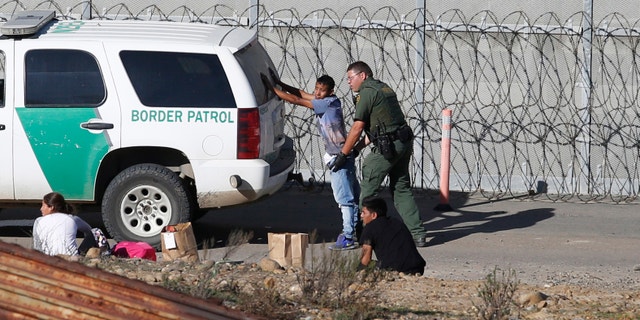
Honduran asylum seekers are taken into custody by U.S. Border
Patrol agents in San Diego this past Demceber. (AP Photo/Moises
Castillo, File)
Thought the vast majority of asylum applications are
ultimately unsuccessful, they still take months and even years to fully
process. Asylum law is intended to provide harbor only to refugees
fleeing personal persecution based on a limited number of factors --
such as political belief or religion -- and does not protect
individuals fleeing bad living conditions or poverty. The Trump administration last year rolled back an
Obama-era expansion of potential asylum justifications, which extended
protections to those alleging domestic abuse or gang-related attacks
back home. White House officials said at the time that those categories
were prone to abuse and expanded asylum law beyond its original intent. In
his memorandum, Trump gave his deputies 90 days to propose regulations
so that all asylum applications are adjudicated within 180 days, except
for those representing exceptional circumstances. The White House
and DHS officials did not immediately respond to questions about how
much applicants might be forced to pay in asylum fees, and it is unclear
how many families fleeing poverty would be able to afford such a
payment. The memo says the price would not exceed the cost of
processing applications, but officials did not immediately provide an
estimate for what that might be.
A Central American migrant takes a nap in the shade under a
freight train car, last week in Oaxaca State, Mexico. (AP Photo/Moises
Castillo)
Trump also wants to bar anyone who has entered or
tried to enter the country illegally from receiving a provisional work
permit and is calling on officials to immediately revoke work
authorizations when individuals are denied asylum and ordered removed
from the country. Immigration officials say one reason asylum
claims are booming is that migrants know they will be able to live and
work in the U.S. while their cases play out -- and, in many cases, even
after their claims have been rejected. According to the White
House, the number of "aliens who do not show up to court and are ordered
removed in absentia has soared, with 17,200 removal orders issued in
absentia in the first quarter of fiscal year (FY) 2019. ... If this pace
continues, in absentia removal orders would more than triple the 2013
total." For asylum cases originating in a credible fear claim, "in
absentia removal orders are on pace to increase to 17,636 in FY 2019,
around 20 times more than the total in FY 2010." And
since September 2018, "1 out of every 6 family unit cases filed on
special expedited dockets at 10 immigration courts has ended with an in
absentia removal order," the White House said. Trump is also
calling on DHS to reassign immigration officers and any other staff "to
improve the integrity of adjudications of credible and reasonable fear
claims, to strengthen the enforcement of the immigration laws, and to
ensure compliance with the law by those aliens who have final orders of
removal." Fox News' Shannon Bream and The Associated Press contributed to this report.
Brad Parscale, the campaign manager for President Trump’s 2020 campaign, said on Sunday that he believes states that normally vote Democrat could be flipped, according to recent data. Parscale told CBS’ “Face the Nation” that New Hampshire, New Mexico, Nevada and Colorado
could be up for grabs. He said the campaign also understands the
importance of maintaining support in Michigan, Pennsylvania, Wisconsin
and Florida. “In every single metric we’re looking at being
bigger, better and badder than we were in 2016. But this time we’re not
out there trying to prove we can do something. The president’s proved he
has done it, and now we just have to deliver what he’s done,” he said. CBS News pointed out that Hillary Clinton won New Mexico by over 8 points and Colorado by 5. The other states were closer. There
is no clear Democrat who will win the nomination, which could be a
drawn-out drubbing for the likes of Sen. Bernie Sanders, Joe Biden and
others. Larry
J. Sabato, the director of the University of Virginia Center for
Politics and Kyle Konik, who manages the center’s office in Washington
co-authored an op-ed in The Washington Post last week titled, “It’s Easy
to See How Trump Can Win Reelecton.” The piece points out that Trump is
not a shoo-in, but has a solid base and benefits from a strong economy. “Credit
the powers of incumbency and a strong economy, the state of which may
matter more to Trump’s odds than nearly anything else,” they wrote.
“Incumbency and the economy, among other matters, ended up being more
than enough for Nixon, Reagan and Bush. Despite Trump’s unprecedented
outlandishness, that same combination might work for him, too.”
Rep. Alexandria Ocasio-Cortez, D-N.Y. accused Kellyanne Conway Sunday of attempting to "stoke suspicion" regarding the freshman lawmaker's religion after the White House adviser questioned why she didn't comment on the Sri Lankan terrorist attacks on Easter Sunday. In a back-and-forth exchange on Twitter, Ocasio-Cortez asked why Conway would note that she didn't tweet about the bombings, which left more than 250 people dead. "Are
you trying to imply that I am less Christian? What was the point of you
bringing this up on national TV?" the lawmaker asked, alongside a jab
about how she was visiting her grandmother in Puerto Rico, "which
continues to suffer from the White House's incompetent disaster
response." Ocasio-Cortez called the Sri Lanka attack "horrifying,"
and called out Conway for "using this as an excuse to stoke suspicion
around my Christianity + faith life." "No one should be targeted
for their religion," she tweeted. "If you’re so moved, let’s do more to
welcome immigrants fleeing religious persecution." Conway
initially questioned the widespread use of the term "Easter Worshippers"
among politicians who expressed their condolences, including former
President Obama and Hillary Clinton. Ocasio-Cortez said, "Saying ‘Easter
worshippers’ matters bc Easter is the holiest day of the year for
Christians, & to be targeted on Easter highlights how heinous the
attack was - just as saying yesterday’s #SanDiego shooting was on
Passover. In
her response, Conway said it was "good" that Ocasio-Cortez condemned
the attacks, as she "found it odd a prolific tweeter was silent" on the
topic. The Trump confidante said that both women agree on the idea that
places of worship should remain unharmed. At least 253 people,
several of whom were American citizens, were killed and more than
500 others were injured after a series of explosions struck three
churches and three luxury hotels just outside of Sri Lanka's capital on
Easter. The attacks were among the worst since the South Asian country’s
26-year civil war ended in 2009, according to local officials.
Chicago’s top prosecutor, Kim Foxx, has been subpoenaed Friday over her handling of the Jussie Smollett case, according to The Chicago-Sun Times. Foxx,
Cook County’s state’s attorney, will have to appear in court after a
retired appellate judge, Sheila O’Brien, filed a petition last week for a
special prosecutor to probe the Smollett case, in which a 16-count
indictment against the “Empire” actor was dropped last month. Foxx’s top deputy, Joseph Magats, was also subpoenaed, and another document requested that Smollett appears at the hearing, the report said. O’Brien
requested Foxx, Magats, and Smollett produce original documents in the
criminal case to assure the public “that they have not been altered or
destroyed and will not be destroyed throughout this case,” the Sun-Times
reports. The petition for a special prosecutor claimed Foxx’s handling of the case was “plagued with irregularity.” O’Brien
argues that Foxx, who informally recused herself from the case due to
contact she had with a relative of Smollett’s during the investigation,
should have appointed a special prosecutor. “Foxx’s conflict in
this matter is beyond dispute,” O’Brien wrote, “instead, Foxx misled the
public into believing that Smollett’s case was handled like any other
prosecution and without influence.” Smollett
told police he was attacked on Jan. 29 around 2 a.m. as he was
returning home from a sandwich shop in Chicago. He said two masked men
shouted racial and anti-gay slurs, poured bleach on him, beat him and
tied a rope around his neck. He claimed they shouted, “This is MAGA
country” — a reference to President Trump’s “Make America Great Again”
campaign slogan. After an intense investigation, police said Smollett staged the entire incident to drum up publicity for his career. Barnini Chakraborty contributed to this report.
The New York Times Opinion section issued a second apology Sunday over a cartoon of President Trump and Israeli Prime Minister Benjamin Netanyahu which was called offensive because of "anti-Semitic tropes." "We
are deeply sorry for the publication of an anti-Semitic political
cartoon last Thursday in the print edition of The New York Times that
circulates outside of the United States, and we are committed to making
sure nothing like this happens again," the opinion section tweeted
Sunday. "Such imagery is always dangerous, and at a time when
anti-Semitism is on the rise worldwide, it's all the more unacceptable,"
continued the apology, which was widely shared on Twitter. The
new apology said that the decision to run the syndicated cartoon was
made by a single editor working without adequate oversight. The cartoon showed Trump wearing a pair of sunglasses and being led by a dog depicted as Netanyahu.
The dog had a Star of David collar. The cartoon appeared in the paper’s
opinion section next to a column penned by Thomas Friedman. The
political cartoon was criticized globally by numerous social media
users, who said the Times' first statement was inadequate. The
original apology read, “A political cartoon in the international print
edition of The New York Times on Thursday included anti-Semitic tropes,
depicting the prime minister of Israel as a guide dog with a Star of
David collar leading the president of the United States, shown wearing a
skullcap. The image was offensive, and it was an error of judgment to
publish it. It was provided by The New York Times News Service and
Syndicate, which has since deleted it.” In an op-ed published online Sunday evening, Times columnist Bret Stephens
took his employer to task, writing that the cartoon "in another age,
might have been published in the pages of Der Stürmer," a virulently
anti-Semitic tabloid published during Germany's Nazi regime. "The
problem with the cartoon isn’t that its publication was a willful act of
anti-Semitism. It wasn’t," Stephens wrote. "The problem is that its
publication was an astonishing act of ignorance of anti-Semitism .... at
a publication that is otherwise hyper-alert to nearly every conceivable
expression of prejudice, from mansplaining to racial microaggressions
to transphobia." Stephens added that the Times owed Netanyahu an
apology and should reflect on "how it came to publish that cartoon — and
how its publication came, to many longtime readers, as a shock but not a
surprise."