Fox News' host Sean Hannity
told his audience Monday that a barrage of news information will be
released in the coming days and weeks that will prove that "Trump-Russia collusion" was a "hoax from the get-go" and called for secret FBI transcripts to made public.
"At
this hour, your federal government is in possession of transcripts from
2016 featuring secretly recorded conversations between FBI informants
and one-time trump campaign aide George Papadopoulos," Hannity said in
his monologue.
"According
to those who have seen these transcripts, its contents are chock-full
of clear irrefutable, incontrovertible, exculpatory evidence proving
Trump-Russia collusion was always a hoax from the get-go. This includes
former congressman Trey Gowdy who is now calling these documents 'game
changing.'"
Gowdy, who appeared on "Sunday Morning Futures" told host Maria Bartiromo spoke about these potential transcripts.
“Some
of us have been fortunate enough to know whether or not those
transcripts exist. But they haven’t been made public, and I think one,
in particular ... has the potential to actually persuade people," Gowdy
said. “Very little in this Russia probe I’m afraid is going to persuade
people who hate Trump or love Trump. But there is some information in
these transcripts that has the potential to be a game-changer if it’s
ever made public.”
Hannity said "this material must be made available" explaining its importance.
Because
if Comey, Strzok, the highest level officials... the upper echelon, the
Intel community were withholding exculpatory evidence, let me tell you
this is bigger than we ever thought," Hannity said.
"It means the
of premeditated fraud, conspiracy against the FISA court, that means
there was a real attempt to steal a presidential election with Russian
lies paid for by Hillary and an effort when they lost, to unseat a duly
elected president of you, the people. Much worse than we ever knew."
President
Trump's former White House chief of staff Reince Priebus says the 2020
election will be the "biggest political battle in modern history."
"For
a Republican to win Wisconsin, Michigan, and Pennsylvania at any given
presidential election will be tough. It will be a fight. This will not
be easy. It doesn't matter... This is going to be a fight," Priebus said
Monday on "The Ingraham Angle."
"The
Democrats are energized, the Republicans will be energized and this
will be the biggest political battle in modern history."
Trump focused on the economy at a fiery rally Monday at the Energy Aviation Hangar in Montoursville, Pennsylvania, just two days after 2020 Democrat presidential frontrunner Joe Biden held his own campaign rally in nearby Philadelphia.
Priebus,
the former Republican National Committee chairman, criticized the
Democratic presidential candidates platform, in particular Joe Biden, saying it will be tough to run against Trump's economic numbers.
"You
cannot win Wisconsin, Michigan and Pennsylvania on a $93 trillion green
new deal, 600,000 per household, $32 trillion in a health care package.
It's not going to work. So the Trump campaign, I believe, is going to
jam down the throats of every person that is watching on television
these numbers," Priebus said.
In
a video posted on Saturday, Biden is seen fielding a question from a
member of the Youth Climate Strike, a group which organized over 100
marches worldwide by young people to protest climate change in March.
"You
know, I'm the guy that did all this stuff," Biden said. "Read
RealClearPolitics, it'll tell you how I started this whole thing back in
'87 on climate change." Fox News' Gregg Re and Anna Hopkins contributed to this report.
Attorney General William Barr said that his handling of the Mueller report and its aftermath is rooted in a desire to defend the power of the executive branch rather than personal support for President Trump.
"I
felt the rules were being changed to hurt Trump, and I thought it was
damaging for the presidency over the long haul," Barr told The Wall Street Journal
in El Salvador in an interview published Monday, where he traveled last
week to boost support for Trump's policies toward the violent street
gang MS-13.
"At every grave juncture the presidency has done what
it is supposed to do, which is to provide leadership and direction,"
Barr added. "If you destroy the presidency and make it an errand boy for
Congress, we’re going to be a much weaker and more divided nation."
Democrats
have accused Barr and Trump of trying to stonewall and obstruct
Congress' oversight duties a charge that was repeated Monday after Trump
directed former White House Counsel Don McGahn to defy a congressional
subpoena to testify before the House Judiciary Committee. That committee
voted earlier this month to hold Barr in contempt after he defied a
subpoena for an unredacted version of Special Counsel Robert Mueller's
report into Russian activities during the 2016 presidential campaign.
In
an interview with Fox News' Bill Hemmer last week, Barr described that
vote as "part of the usual ... political circus that's being played out.
It doesn't surprise me."
Barr has taken the opprobrium in stride,
going so far as to approach House Speaker Nancy Pelosi, D-Calif., at a
Capitol Hill event last week and ask her if she had brought her
handcuffs.
Barr told Fox News last week that he had ordered an
investigation into the origins of the Russia probe because many of the
answers he had gotten were "inadequate."
"People
have to find out what the government was doing during that period," he
told "America's Newsroom" host Bill Hemmer. "If we're worried about
foreign influence, for the very same reason we should be worried about
whether government officials abused their power and put their thumb on
the scale. I'm not saying that happened but its something we have to
look at."
Barr
specifically expressed a desire to focus on developments between
Election Day in 2016 and Trump's inauguration in 2017, saying “some very
strange developments” took place in that time.
"I think there's a
misconception out there that we know a lot about what happened,” he
said. “The fact of the matter is Bob Mueller did not look at the
government's activities. He was looking at whether or not the Trump
campaign had conspired with the Russians. But he was not going back and
looking at the counterintelligence program. And we have a number of
investigations underway that touch upon it." Fox News' Bill Hemmer and Liam Quinn contributed to this report.
Former Attorney General Loretta Lynch has flatly accused former FBI Director James Comey
of mischaracterizing her statements by repeatedly alleging, under oath,
that Lynch privately instructed him to call the Hillary Clinton email
probe a "matter" instead of an "investigation."
Lynch,
who testified that Comey's claim left her "quite surprised," made the
dramatic remarks at a joint closed-door session of the House Oversight
and Judiciary Committees last December. A transcript of her testimony was released on Monday by House Judiciary Committee ranking member Doug Collins, R-Ga.
The episode marked the latest public dispute
to break out among high-level ex-Obama administration officials, as
multiple government reviews of potential FBI and Justice Department
misconduct continue.
In a June 2017 interview under oath
with the House Intelligence Committee, Comey said Lynch had pressed him
to downplay the significance of the Clinton email review in September
2015, just before a congressional hearing in which Comey was expected to
be asked about the investigation. Comey said the moment led him to
question her independence and contributed to his decision to
unilaterally hold a press conference in July 2016 announcing the
conclusions of the probe.
“The attorney general had directed me
not to call it an investigation, but instead to call it a matter, which
confused me and concerned me," Comey testified. “That was one of the
bricks in the load that led me to conclude, ‘I have to step away from
the department if we’re to close this case credibly.’”
Comey
continued: “The Clinton campaign, at the time, was using all kind of
euphemisms — security review, matters, things like that, for what was
going on. We were getting to a place where the attorney general and I
were both going to have to testify and talk publicly about. And I wanted
to know, was she going to authorize us to confirm we had an
investigation? ... And she said, ‘Yes, but don’t call it that, call it a
matter.' And I said, ‘Why would I do that?’ And she said, ‘Just call it a matter.’”
Comey
said that Lynch's secret airport tarmac meeting with Bill Clinton in
the summer of 2016 later cemented his assessment that Lynch lacked
independence.
But in her testimony in December, Lynch said Comey had completely mischaracterized the situation.
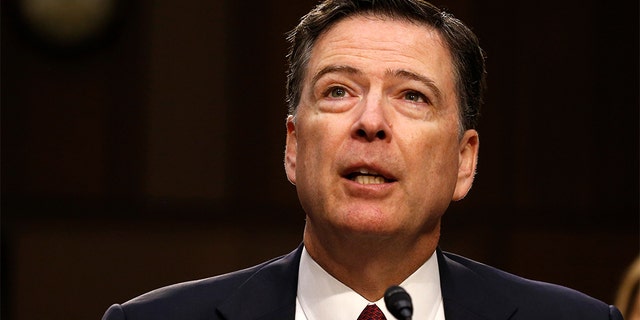
Former FBI Director James Comey testifies before a Senate
Intelligence Committee hearing on Russia's alleged interference in the
2016 U.S. presidential election on Capitol Hill in Washington, U.S.,
June 8, 2017. (Reuters)
"I did not," Lynch responded when asked if she had "ever" told Comey to call the investigation a "matter."
"I
have never instructed a witness as to what to say specifically. Never
have, never will," Lynch continued. "In the meeting that I had with the
Director, we were discussing how best to keep Congress informed of
progress and discuss requesting resources for the Department overall. We
were going to testify separately. And the concern that both of us had
in the meeting that I was having with him in September of 2015 was how
to have that discussion without stepping across the Department policy of
confirming or denying an investigation, separate policy from
testifying.
"Obviously, we wanted to testify fully, fulsomely, and
provide the information that was needed, but we were not at that point,
in September of 2015, ready to confirm that there was an investigation
into the email matter -- or deny it," Lynch added. "We were sticking
with policy, and that was my position on that. I didn't direct anyone to
use specific phraseology. When the Director asked me how to best to
handle that, I said: What I have been saying is we have received a
referral and we are working on the matter, working on the issue, or we
have all the resources we need to handle the matter, handle the issue.
So that was the suggestion that I made to him."
Pressed for her reaction to Comey's statements, Lynch said they had come as a shock.
"I
was quite surprised that he characterized it in that way," Lynch said.
"We did have a conversation about it, so I wasn't surprised that he
remembered that we met about it and talked about it. But I was quite
surprised that that was his characterization of it, because that was not
how it was conveyed to him, certainly not how it was intended."
House Oversight Commitee ranking member Jim Jordan, R-Ohio -- then the panel's chairman -- interjected.
"Excuse
me. Ms. Lynch, so in the meeting with the FBI Director you referred to
the Clinton investigation as a matter -- I just want to make sure I
understand -- but you did not instruct the Director when he testified in
front of Congress to call it a matter. Is that accurate?" Jordan asked.
"I
said that I had been referring to -- I had been using the phraseology,"
Lynch responded. "We've received a referral. Because we received a
public referral, which we were confirming. And that is Department
policy, that when we receive a public referral from any agency, that we
confirm the referral but we neither confirm nor deny the investigation.
That's actually a standard DOJ policy.
"So in the meeting with the
Director, which was, again, around September -- I don't recall the date
-- of 2015, it was very early in the investigation, I expressed the
view that it was, in my opinion, too early for us to confirm that we had
an investigation," Lynch said. " At some point in the course of
investigations, as you all know from your oversight, it becomes such
common knowledge that we talk about it using the language of
investigation and things, but at that point we had not done that and we
were not confirming or denying it. We weren't denying it at all. There
was, just essentially, in my view, we were following the policy. And
when the Director asked me about my thoughts, I said, yes, we had to be
-- we had to be completely cooperative and fulsome with Congress for
both of us, and that we needed to provide as much information as we
could on the issue of resources."
Last week, a high-level dispute over which senior government officials pushed the unverified Steele dossier amid efforts to surveil the Trump campaign broke out into the open, after it emerged that Attorney General William Barr appointed a U.S. attorney to examine the origins of the Russia investigation and determine if the FBI and DOJ's actions were "lawful and appropriate."
Sources
familiar with the records told Fox News that a late-2016 email chain
indicated Comey told bureau subordinates that then-CIA Director John Brennan insisted
the dossier be included in the intelligence community assessment on
Russian interference, known as the ICA. But in a statement to Fox News, a
former CIA official put the blame squarely on Comey.
A separate,
comprehensive report from the Justice Department Inspector General (IG)
into possible FBI and DOJ misconduct and surveillance abuse is expected
within a matter of weeks.
Secretary of State Mike Pompeo claims the U.S. is prepared to find a ‘common ground’ with Russia.
On Sunday, Pompeo held continued talks with his Russian counterparts
in the city of Sochi, to discuss issues affecting both nations.
During the meeting, Pompeo also urged Moscow to work with Ukraine in hopes of bringing peace to the country.
Officials hopes improving U.S.-Russian relations will set an example,
and help the Kremlin repair its relationship with its western neighbor.
“Our two nations share proud histories and respect to one another’s
cultures. We seek a better relationship with Russia and we urge that it
work alongside us to change the trajectory of the relationship which
will benefit each of our peoples,” Pompeo said.
He also reportedly discussed reports of Russian election
interference, saying similar acts would not be tolerated during the 2020
election cycle.
President Trump is firing back at GOP Representative Justin Amash after he accused the President of obstructing justice.
In a message to Twitter Sunday, President Trump called the lawmaker a
total ‘lightweight’ who only opposes Republican ideas to make his name
known.
Never a fan of @justinamash,
a total lightweight who opposes me and some of our great Republican
ideas and policies just for the sake of getting his name out there
through controversy. If he actually read the biased Mueller Report,
“composed” by 18 Angry Dems who hated Trump,….
This comes after Amash made headlines Saturday for becoming the first GOP Congressman to signal for impeachment.
He also accused the Attorney General of ‘deliberately misrepresent(ing) Mueller’s report.’
While the Special Counsel’s report conclusively found no collusion
between the 2016 Trump campaign and the Russians, House Democrats are
still largely divided on impeachment.
The lawmaker has been a vocal critic of the Administration, and voted
with a Democrat majority in February to overturn the President’s
Emergency Declaration at the U.S.-Mexico border, A move which was
unsuccessful.
Jimmy Carter is again a kingmaker in the next run for the White House.
It’s
quite a turnabout for a man who largely receded from party politics
after his presidency, often without being missed by his party’s leaders
in Washington, where he was an outsider even as a White House resident.
“Jimmy
Carter is a decent, well-meaning person, someone who people are talking
about again given the time that we are in,” Minnesota Sen. Amy
Klobuchar said in an interview. “He won because he worked so hard, and
he had a message of truth and honesty. I think about him all the time.”
Klobuchar
credited Carter with being “ahead of his time” on several issues,
including the environment and climate change (he put solar panels on the
White House), health care (a major step toward universal coverage
failed mostly because party liberals thought it didn’t go far enough)
and government streamlining (an effort that angered some Democrats at
the time).
But she also alluded to how his presidency ended: a
landslide loss after gas lines, inflation-then-unemployment, and a
14-month-long hostage crisis in Iran. “Their administration was not
perfect,” she said.
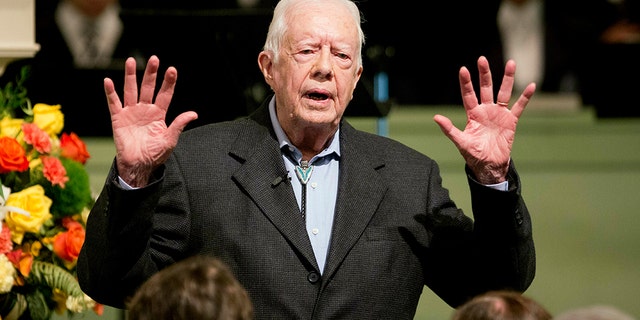
Now, six administrations later, former President Jimmy Carter, the
longest-living chief executive in American history, is re-emerging from
political obscurity at age 94 to win over his fellow Democrats once
again.
(AP)
Klobuchar
is one of at least three presidential hopefuls who has ventured to the
tiny town of Plains, Georgia, to meet with Carter and his wife,
Rosalynn, who is 91. New Jersey Sen. Cory Booker and Mayor Pete
Buttigieg of South Bend, Indiana, also have visited with the Carters and
attended the former president’s Sunday School lesson in Plains.
“An
extraordinary person,” Buttigieg told reporters after meeting Carter.
“A guiding light and inspiration,” Booker said in a statement. Klobuchar
has attended Carter’s church lesson, as well, and says she emails with
him occasionally. “He signs them ‘JC,’” she said with a laugh.
Carter
carved an unlikely path to the White House in 1976 and endured humbling
defeat after one term. Now, six administrations later, the
longest-living chief executive in American history is re-emerging from
political obscurity at age 94 to win over his fellow Democrats once
again.
A peanut farmer turned politician then worldwide
humanitarian, Carter is taking on a special role as Democratic
candidates look to his family-run campaign after the Watergate scandal
as the road map for toppling President Trump in 2020.
To be sure,
more 2020 candidates have quietly sought counsel from Trump’s
predecessor, Barack Obama. Several have talked with Bill Clinton, who
left office in 2001. But those huddles have been more hush-hush,
disclosed through aides dishing anonymously. Sessions with Carter are
trumpeted on social media and discussed freely, suggesting an appeal
that Obama and Clinton may not have.
Unlike Clinton, impeached
after an affair with a White House intern, Carter has no #MeToo
demerits; he and Rosalynn, married since the end of World War II, didn’t
even like to dance with other people at state dinners. And unlike
Obama, popular among Democrats but polarizing for conservatives and
GOP-leaning independents, Carter is difficult to define by current
political fault lines.
He’s an outspoken evangelical Christian who
criticizes Trump’s serial falsehoods, yet praises Trump for attempting a
relationship with North Korean leader Kim Jong Un. Carter touts his own
personal relationship with Russian President Vladimir Putin, another
Trump favorite. “I have his email address,” Carter said in September.
He
confirms that he voted for Vermont Sen. Bernie Sanders, a democratic
socialist, over Hillary Clinton in Georgia’s 2016 presidential primary.
In 2017, Carter welcomed Sanders, who’s running again this year, to the
Carter Center for a program in which the two men lambasted money in
politics. Carter called the United States “an oligarchy.”
Yet Carter has since warned Democrats against “too liberal a program,” lest they ensure Trump’s re-election.
Carter
is enough of an enigma that he is the only living president not to draw
Trump’s ire or mockery, even if Republicans have caricatured Carter for
decades as a failure. Trump and Carter chatted by phone this spring
after Carter sent Trump a letter on China and trade. Both men said they
had an amiable conversation.
Klobuchar recalled Carter telling her
that “family members would disperse to different states and then they
would all come back on Friday, go back through the questions they had
gotten.” Then “he would talk about how he would answer them” so they’d
all be prepared on their next trips, she said.
It was “a different
era,” Klobuchar added, recalling that Carter said he felt “high-tech
because they had a fax machine on his plane.” Indeed, Klobuchar, born in
1960, wasn’t old enough to vote for Carter until he sought a second
term. Booker, 50, recalls voting for Carter, but in a grade-school mock
election. Buttigieg, 37, wasn’t even born when Carter left office. The Associated Press contributed to this report.
Former congressman Trey Gowdy talked to Maria Bartiromo Sunday and discussed the infamous Christopher Steele Dossier, what it is and why it is important find the extent of its use.
"I
mean people use the word dossier and how such an official sound to it. I
mean let's just call it for what it is. It's a series of rank hearsay
compilations put together by an FBI source who was later defrocked. Paid
for by the Democrat National Committee then oh by the way Christopher
Steele hated Donald Trump too so that we can call it a dossier. It
sounds official," Gowdy said on "Sunday Morning Futures."
"It's
really something the National Enquirer would blush if they printed so
we know that it was used four times by the United States government."
Attorney General William Barr told Fox News’ Bill Hemmer
in the interview aired Friday that one portion of the investigation
into the Russia probe's orgins, which he has tapped U.S. Attorney John
Durham to lead, would cover the time period between Election Day and
Inauguration Day, saying “some very strange developments” took place
during that time.
Barr specifically was referring to the early
January 2017 briefing intelligence officials gave then-president-elect
Trump at Trump Tower, and “the leaking of information subsequent to that
meeting.” At that meeting, Trump was briefed by intelligence and law
enforcement officials on Russian election meddling -- and was also
informed by former FBI Director James Comey about the now-infamous
anti-Trump dossier which included salacious allegations against him.
Details which were later leaked to the press.
The former House
Oversight Committee chairman and House Judiciary Committee member
accused the Obama-era intelligence officials of not being upfront when
it comes to the dossier's use.
"What
we're trying to figure out is whether or not it was used a fifth time
and the intelligence assessment and you got Brennan, Clapper and Comey
all three who know full well whether or not it was used in the
intelligence assessment but... they're giving you different versions,
right," Gowdy said.
"So there is information that exist in
December of 2016 and I hope anyone who has access to it... Senator Burr,
Durbin, whoever is open minded. Go look at that. And I think it will
help you understand whether or not that dossier, that unverified
hearsay, was used... five times or just four times by the United States
government is pretty bad. If it was just four times it's really bad, if
it was five." Fox News' Brooke Singman and Liam Quinn contributed to this report.