Four voters in California, along with the conservative transparency group Judicial Watch, announced Monday they have filed a federal lawsuit against the left-wing state, alleging its new law aimed at strong-arming President Trump into releasing his income tax returns is patently unconstitutional. Democratic Gov. Gavin Newsom signed the law known as the "Presidential Tax Transparency and Accountability Act" last week. Its provisions would
require Trump and other presidential primary candidates to file their
tax returns for the most recent five years to the California secretary
of state by November 26 or be excluded from the March 3,
2020 presidential primary ballot. The law does not apply to the
general election, so Trump would still appear on the November 2020
California presidential ballot if he secured the national Republican
Party nomination. "Within five days of receipt of the candidate’s
tax returns, the Secretary of State shall make redacted versions of the
tax returns available to the public on the Secretary of State’s internet
website," the law states. The measure sailed through the state's Democratic-led
legislature. Former California Gov. Jerry Brown had vetoed a similar
version of the law last year, noting that it "may not be constitutional"
and sets a "slippery slope precedent" that could lead the state to
demand all kinds of documents from candidates. "Today we require
tax returns, but what would be next?" Brown asked. "Five years of health
records? A certified birth certificate? High school report cards? And
will these requirements vary depending on which political party is in
power." But Newsom, a frequent Trump critic who declared in June that the GOP is "finished" and will devolve into a third party, disregarded those concerns. The
Constitution requires only three things of presidents: They have to be a
natural-born U.S. citizen; must be at least 35 and must have lived in
the country for at least 14 years. (Although the precise legal meaning
of the term "natural-born U.S. citizen" is debated, it generally is
taken to apply when someone is either born in the U.S. or born abroad to
a U.S. citizen.)
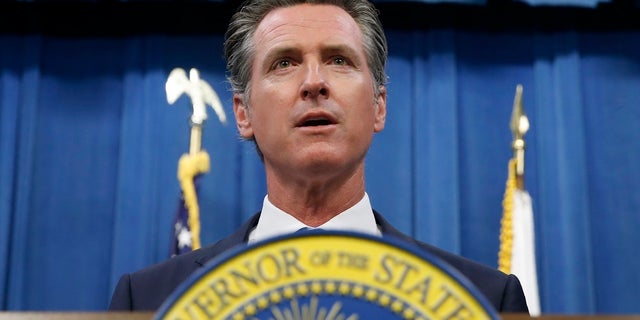
California Gov. Gavin Newsom during a news conference in
Sacramento, Calif. Newsom signed a law Tuesday, July 30, requiring
presidential candidates to release their tax returns to appear on the
state's primary ballot, a move aimed squarely at Republican President
Donald Trump. (AP Photo/Rich Pedroncelli)
The four plaintiffs are two Republicans, one Democrat and one independent. In their federal complaint, the plaintiffs call the law an unprecedented attempt by a state to add additional qualifications for the presidency. "No
state or federal law has ever mandated that presidential candidates
disclose their tax returns to qualify or appear on a ballot," the
complaint says. "The voluntary release of presidential candidates’ tax
returns is a recent, and partial, phenomenon, notwithstanding a current
media narrative suggesting otherwise." In a statement,
Judicial Watch President Tom Fitton said: "This is a nonpartisan
concern about the state running roughshod and attempting to amend the
Constitution on its own." “California politicians, in their zeal
to attack President Trump, passed a law that also unconstitutionally
victimizes California voters," Fitton added. "It is an obvious legal
issue that a state can’t amend the U.S. Constitution by adding
qualifications in order to run for president. The courts can’t stop this
abusive law fast enough.” Attorneys for Judicial Watch argue
California's law effectively alters the Constitution by adding a new
requirement for tax returns, something they say state governments don't
have the authority to do. California's
law says voters need to know details about presidential candidates'
finances to "better estimate the risks of any given Presidential
candidate engaging in corruption." But Judicial Watch argues that
rationale could lead states to demand things like medical and mental
health records and eventually things like Amazon purchases, Google
search histories and Facebook friends. Conservatives, who recognize that
Trump stands no chance of winning California's electoral votes
regardless of the outcome of this dispute, have similarly sounded the
alarm about where these restrictions might go in the future. Judicial
Watch also argues that by limiting the law to primary elections, it
does not apply to independent candidates. Judicial Watch also says the
law violates voters' constitutional rights to associate with
presidential candidates and the voters who support them, rights it says
are guaranteed under the First and 14th amendments. The lawsuit
names Secretary of State Alex Padilla as the defendant because his
office is in charge of enforcing the law. Representatives for Padilla
and Newsom declined to comment on Monday, saying they have not been
officially notified of the lawsuit. When he signed the law last week, Newsom released statements from three lawyers, including the dean of the University of California, Berkeley law school, saying the law is constitutional. "SB
27, which requires that presidential candidates disclose tax returns,
is constitutional. It does not keep any candidate from being on the
ballot so long as he or she complies with a simple requirement that is
meant to provide California voters crucial information," Berkeley
dean Erwin Chemerinsky said. "This
is the state acting to make sure that its voters have information that
might be very important to them when they cast their ballots as to who
they want to be President of the United States." Newsom contends
Congress has changed aspects of the presidency previously, including
limiting presidents to two terms after President Franklin Roosevelt was
elected to four terms, and passing anti-nepotism laws after President
John F. Kennedy appointed his brother, Robert, U.S. attorney general.
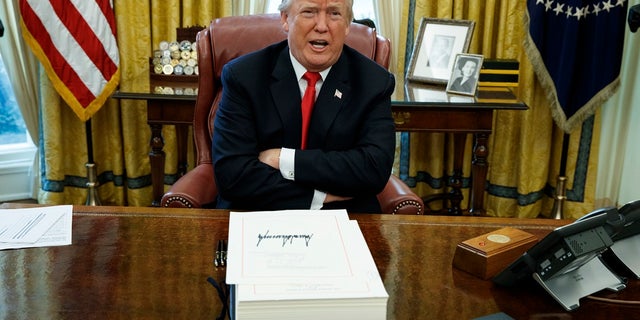
President Trump has said he will not release his tax returns as long as they are under audit. (AP Photo/Evan Vucci, File)
"If the federal government is not going to act, California needs to act. We've always done that," Newsom said in a video posted to his Twitter account. Citizens
have had to pay federal income taxes since 1913, but it wasn't until
1973 when a U.S. president made his personal tax returns public.
Republican Richard Nixon released his tax returns publicly while he was
being audited by the IRS, after an IRS employee leaked a portion of his
returns to the media. Ever
since, U.S. presidents have released at least a summary of their
personal income taxes. That includes most major candidates for
president, with some exceptions. Former California Democratic Gov. Jerry
Brown did not release his tax returns when he ran for president in
1992. In their lawsuit against California, the plaintiffs noted
that "one study found that 7 of 34 'major' candidates for president
since 1976, or about 20 percent, refused to produce their tax returns." The
complaint specifically alleges violations of the Qualifications Clause
of the Constitution, as well as the plaintiff's First Amendment rights
to express their political preferences. Additionally, because the law
only applies to party-affiliated candidates (non-party candidates do not
participate in primaries), the suit also alleges a violation of the
Constitution's Equal Protection Clause and a federal equal protection
statute. Trump has refused to release his tax returns, saying they are being audited by the IRS. Fox News' Louis Casiano and The Associated Press contributed to this report.
El
Paso, Texas, Mayor Dee Margo told reporters on Monday that President
Trump will visit the city on Wednesday, even as several prominent
Democrats indirectly blamed the president for Saturday's mass shooting there -- with some warning him, in frank terms, to stay away.
News
of Trump's planned appearance teed up a potentially bitter national
political moment just four days after suspected gunman Patrick Crusius,
21, allegedly opened fire at a Walmart and killed 22 people while
injuring more than two dozen others.
"He is president of the
United States," Margo, a Republican, told reporters. "So in that
capacity, I will fulfill my obligations as mayor of El Paso, and hope
that if we are expressing specifics that we can get him to come through
for us."
The
mayor said he anticipated "political spin" and was “already getting the
emails and the phone calls” from individuals "with lots of time on
their hands," but that his focus remains on his community, not politics.
He added that Trump had called and was "very gracious" and offered any
support necessary.
“We’re dealing with a tragedy of 22 people who
have perished by the hateful, evil act of a white supremacist,” Margo
said. “I don’t know how we deal with evil. I don’t have a textbook for
dealing with it other than the Bible.
"I’m sorry. We are going to
go through this," he continued. "The president is coming out. I will
meet with the president. I guess for people who have lots of time on
their hands, I will deal with the emails and phone calls.”
The White House has not confirmed Trump's schedule, or whether he will also visit Dayton, Ohio -- where a gunman who reportedly
supported the violent left-wing group Antifa, as well as Bernie Sanders
and Elizabeth Warren, killed nine people over the weekend. But the
Federal Aviation Administration has advised pilots of a presidential
visit Wednesday to both El Paso and Dayton.
Dayton Mayor Nan
Whaley, a Democrat, told reporters that she had "not gotten a call"
about a presidential visit as of late Monday, and didn't have more
details.
But
both before and after Margo's announcement, several
Democrats forcefully urged Trump not to visit El Paso. Rep. Veronica
Escobar, D-Texas, who represents the district that is home to the
Walmart where Saturday’s shooting took place, lashed out at the
president on Monday morning -- placing some of the blame for the
weekend’s tragedy at his feet.
“The president has made my community and my people the enemy,” she told MSNBC’s “Morning Joe.”
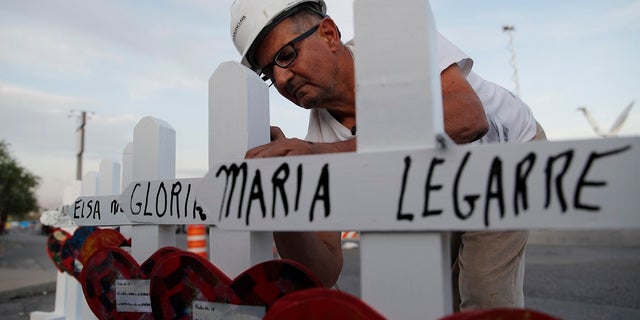
Greg Zanis prepares crosses to place at a makeshift memorial for
victims of a mass shooting at a shopping complex Monday in El Paso,
Texas. (AP Photo/John Locher)
“He has told the country that we are people to be
feared, people to be hated," Escobar continued. "From my perspective, he
is not welcome here. He should not come here while we are in mourning.”
And
Democratic presidential candidate Tim Ryan, D-Ohio, urged Margo in a
televised interview to "quietly" tell Trump that he is not "welcome" in
the city, because of his rhetoric on immigration.
Ryan has
escalated his language in the last 24 hours, as he struggles to raise
his political profile. He tweeted “Fck me” after Trump mistakenly, at
one point in his televised remarks earlier in the day, said the Ohio
shooting took place in Toledo and not Dayton.
For Ryan, the
language appeared to be part of a deliberate approach: Earlier Monday,
the longshot candidate went on CNN and tore into Senate Majority Leader
Mitch McConnell, saying, "Mitch McConnell needs to get off his a-- and
do something.” On Sunday, he tweeted: “Republicans need to get their s--- together and stop pandering to the NRA. Period.”
Sanders also
called out the president, saying "I say to President Trump, please stop
the racist anti-immigrant rhetoric. Stop the hatred in this country
which is creating the kind of violence that we see."
In 2017, a far-left Sanders supporter fired upon a Republican congressional baseball practice, critically
wounding House Majority Whip Steve Scalise, R-La., and injuring three
others before U.S. Capitol Police took him down. Kentucky Sen. Rand Paul
said the gunman was screaming, "This is for healthcare." Sanders did
not take responsibility for that episode.
Trump, for his part, on
Monday called for reforms at the intersection of mental health and gun
laws -- including so-called "red flag laws" to take guns from those
deemed a public risk -- in the wake of the back-to-back mass shootings
over the weekend, which left at least 31 people dead in total.
The Trump administration previously enacted an
unprecedented ban on firearm bump stocks that enable weapons to fire
with greater rapidity, like machine guns -- and the ban was recently upheld by the Supreme Court. The move came after a 2017 massacre in Las Vegas, Nevada killed 58 people.
In unequivocal terms, the president on Monday also condemned white supremacy,
responding to reports that the shooter in El Paso wrote a racist
manifesto ahead of the violence. The manifesto specifically said that
Trump's rhetoric was not to blame for the shooting, and said the
shooter's views "predate" Trump's presidential campaign.
However, some observers cautioned
that mass shooters are increasingly using disingenuous manifestos
primarily as a means to cause division and sow political discord, rather
than to advance a particular agenda. Crusius became the third mass shooter this
year believed to have posted to the website 8Chan, which is a haven for
both ironic trolls and racists, prior to going on a shooting rampage.
"The first mistake people are making is to assume the creep meant anything he said in his manifesto," wrote columnist Brian Cates.
"Something new has been added into the mix in the last year and we have
to recognize it: Mass shootings done for **fun** as the ultimate troll
where these [shooters] write confusing manifestos and then sit back
& watch the fun as both sides claim he belongs to the other."
Cates
pointed out that the Christchurch, New Zealand mass shooter's manifesto
contained a mixture of left-wing and right-wing rhetoric, and by its
own explicit terms, was intended to cause international political
division. The purported El Paso manifesto, like the New Zealand
shooter's manifesto, also espoused eco-fascist principles and lamented
the destruction of the environment.
Meanwhile, former Vice President Joe Biden falsely suggested after Trump's remarks that Monday was the first time the president had condemned white supremacy.
Later, McConnell – a Republican who has been lambasted by Democrats for
refusing to allow votes on gun control legislation – said Monday he is
willing to consider “bipartisan” solutions in the wake of the mass
shootings, though he emphasized that he opposes gun control policies
that infringe “on Americans’ constitutional rights.”
Democrats have been demanding McConnell recall Congress from its current recess, which is slated to run to the second week of September, to address the matter.
The
political fight over Trump's visit came amid a series of rapid-fire
developments in the investigations in both El Paso and Dayton. Crusius
was booked on capital murder charges, and authorities said Sunday that
he is under investigation for alleged domestic terrorism. Officials were also looking into whether hate crime charges are appropriate.
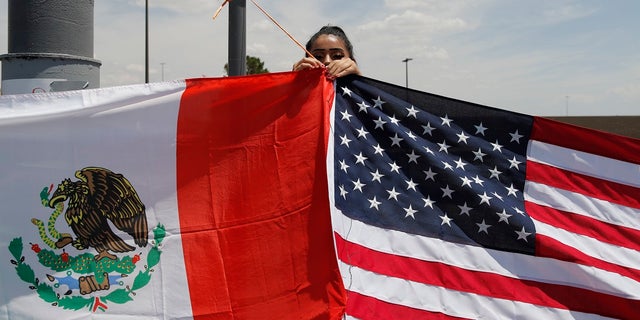
Maylin Reyes hangs a Mexican flag at a makeshift memorial near the
scene of a mass shooting at a shopping complex Monday, Aug. 5, 2019, in
El Paso, Texas. (AP Photo/John Locher)
El Paso District Attorney Jaime Esparza said his office will seek the death penalty against the suspect.
"The
loss of life is so great, we certainly have never seen this in our
community. We are a very safe community," he told reporters at a news
conference on Sunday. "We pride ourselves on the fact that we're so
safe, and certainly this community is rocked, shocked and saddened by
what has happened here yesterday."
El
Paso Police Chief Greg Allen said Monday that the gunman got lost in a
neighborhood before ending up at Walmart "because, we understand, he was
hungry." Allen didn't elaborate. Crusius' hometown is the affluent
Dallas suburb of Allen.
The police chief said the gun used in the shooting was legally purchased near the suspect's hometown.
In
his application for a public defender on Monday, Crusius said he has
been unemployed for five months, and has no income, assets or expenses.
He claimed he has been living with his grandparents.
In Ohio,
authorities revealed that the gunman in the Dayton rampage, 24-year-old
Connor Betts, opened fire outside a bar around 1 a.m. Sunday, killing
his adult sister and eight others. Police say he was fatally shot by
officers within 30 seconds, and was wearing a mask, bulletproof vest, earplugs and had at least 100 rounds.
Authorities
provided a dramatic video of officers rushing onto the scene and taking
Betts out before he could enter another packed bar.
Police had not determined a motive for the attack as of Monday evening. Reports linked him to Antifa, and showed that he supported Massachusetts Democratic Sen. Elizabeth Warren.
Betts
was armed with an AR-15-style rifle, police said. If all of the
magazines he had with him were full, which hasn't been confirmed, he
would have had a maximum of 250 rounds, said Police Chief Richard Biehl.
"It is fundamentally problematic. To have that level of weaponry in a civilian environment is problematic," Biehl added.
Of
the more than 30 people injured in Ohio, at least 14 had gunshot
wounds; others were hurt as people fled, city officials said. Eleven
remained hospitalized Monday, Fire Chief Jeffrey Payne said.
Still unknown is whether Betts targeted any of the victims, including his 22-year-old sister, Megan, the youngest of the dead.
"It
seems to just defy believability he would shoot his own sister, but
it's also hard to believe that he didn't recognize it was his sister, so
we just don't know," Biehl said.
While
the gunman was white and six of the nine killed were black, police said
the speed of the rampage made any discrimination in the shooting seem
unlikely. Fox News' Liam Quinn, Brooke Singman, and The Associated Press contributed to this report.
More than six months after the $15 minimum wage went into effect in New York City, business leaders and owners say the increased labor costs have forced them to cut staff, eliminate work shifts and raise prices. Many
business owners said these changes were unintended consequences of the
new minimum wage, which took effect at the beginning of the year. Susannah
Koteen, owner of Lido Restaurant in Harlem, said she worries about the
impact raising wages could have on her restaurant, where she employs
nearly 40 people. She hasn’t had to lay off anyone, but the increase has
forced her to cut back on shifts and be more stringent about overtime.
She said she changes her menu offerings seasonally and raises prices
more often since the wage boost. “What
it really forces you to do is make sure that nobody works more than 40
hours,” Ms. Koteen said. “You can only cut back so many people before
the service starts to suffer.” Ms. Koteen said she shelved plans
to move her restaurant to a larger location. That would require her to
hire more staff, and she isn’t willing to take the risk with the
unpredictability of her business. “You would just have no choice but to
cut people at the bottom,” she said. In June, the city’s
unemployment rate was 4.3%, compared with the state’s unemployment rate
of 4%, according to the New York State Department of Labor. Both numbers
have remained relatively steady during the past year. New York
City’s minimum wage has increased three times for employers with at
least 11 employees in the past three years. At the end of 2016, the
hourly rate rose to $11 from $9 an hour. In 2018, the minimum wage
jumped to $13 from $11 an hour. The rate will increase to $15 an hour
for employers with 10 or fewer workers at the end of 2019. The
current federally mandated minimum wage is $7.25 an hour. Other states
have passed $15-minimum-wage legislation, including Massachusetts,
California, Maryland, Illinois, New Jersey and Connecticut. Anthony
Advincula, spokesman for Restaurant Opportunities Centers United, which
advocated for the $15 minimum wage, said there are other factors beyond
higher wages that result in unsuccessful businesses, and owners
shouldn’t blame the boost for their struggles. “Increasing to $15
would reduce income inequality, and the number of individuals living in
poverty now is ridiculously high,” he said. “This is not just a business
issue, this is a race, gender, pay-equality issue.” Sarah
McNally, owner of McNally Jackson Books, employs 75 people at four shops
in Manhattan and Brooklyn. Ms. McNally said she hasn’t cut hours or
reduced the number of people she employs to mitigate the increase, but
she is working to open two more shops and scale her workload to stay
profitable. While
Ms. McNally said she always has paid her employees at least $5 above
minimum wage, January’s increase tightened that gap. “With raising
minimum wage to living wage, it feels now like we’re at the bottom of
the pay spectrum,” she said. “There’s absolutely no benefit to being a
retail business in New York.” Thomas Grech, president of the
Queens Chamber of Commerce, said he has seen an uptick in small-business
closures during the past six to nine months, and he attributed it to
the minimum-wage legislation. “They’re cutting their staff. They’re cutting their hours. They’re shutting down,” he said. “It’s not just the rent.” Lisa
Sorin, president of the Bronx Chamber of Commerce, said Manhattan
businesses and their customers can afford to pay more to compensate for
the wage increase, while those in the surrounding boroughs probably
couldn’t. “It’s almost like a whirlwind of keep up or get out,” Ms.
Sorin said. Restaurants and establishments with customer bases
with less disposable income are challenged, but all are experiencing
changes in customer habits regardless of borough, said Andrew Rigie,
executive director of the New York City Hospitality Alliance. To
mitigate the challenges restaurants face, Mr. Rigie said, local and
state government should consider providing tax incentives to owners and
preserve the tip credit, which allows restaurants to count some or all
of an employee’s tips toward its minimum-wage obligations. “Many
people working in the restaurant industry wanted to work overtime hours,
but due to the increase, many restaurants have cut back or totally
eliminated any overtime work,” he said. “There’s only so much consumers
are willing to pay for a burger or a bowl of pasta.”
The controversial chief of staff for Rep. Alexandria Ocasio-Cortez, D-N.Y., who resigned on Friday is currently being investigated by federal officials, a new report says. Saikat Chakrabarti
faced a complaint filed with the Federal Election Commission in March
for alleged violations having to do with illegal fundraising. An
investigation is currently underway, sources told the New York Post.
According to the FEC, complaints only lead to investigations if there
is enough evidence for them to believe there may have been a violation. “Upon
finding reason to believe that a violation has occurred or is about to
occur, the Commission may authorize an investigation,” an FEC
enforcement guidebook says. The investigation is reportedly
related to Brand New Congress and Justice Democrats, two PACs
Chakrabarti started to back progressive candidates. The March complaint
alleged that the groups funneled more than $885,000 to the similarly
named Brand New Campaign LLC and the Brand New Congress LLC -- companies
controlled by Chakrabarti that, unlike PACs, are exempt from reporting
all of their significant expenditures. The PACs claimed the payments
were for "strategic consulting." Chakrabarti and Ocasio-Cortez
were hit with another complaint in April over accusations that they used
Brand New Congress LLC to illegally provide in-kind political
contributions by offering consulting services for cheap rates, operating
at a loss by only charging candidates a portion of the costs. Ocasio-Cortez
has denied any wrongdoing, telling reporters in April: "It's
conservative interest groups just filing bogus proposals." Federal
officials are also looking into Chakrabarti’s salary from
Ocasio-Cortez, the Post reported. The independently wealthy aide earned
$80,000, as opposed to the average of $146,830. This not only allowed
junior staff members to get a pay bump, it let Chakrabarti avoid
requirements to reveal outside income, which only kick in for those
earning at least $126,000. The FEC did not immediately respond to
Fox News’ request for comment, and Chakrabarti could not be reached. A
statement from Ocasio-Cortez's office announcing Chakrabarti's departure
said he was leaving in order to take a new role at the non-profit
group New Consensus to help with work on a Green New Deal. Earlier
this summer, Chakrabarti put himself at the center of a rift in the
Democratic Party, with Ocasio-Cortez and Reps. Ilhan Omar, Ayanna
Pressley, and Rashida Tlaib on one side, and the party’s establishment
led by House Speaker Nancy Pelosi on the other. In June, he criticized Rep. Sharice Davids, D-Kansas, for her votes on issues to do with the migrant crisis at the border. “I
don't think people have to be personally racist to enable a racist
system. And the same could even be said of the Southern Democrats. I
don't believe Sharice is a racist person, but her votes are showing her
to enable a racist system,” he tweeted. The caucus Twitter account
reacted by saying, "Who is this guy and why is he explicitly singling
out a Native American woman of color?” an apparent reference to how
Ocasio-Cortez accused Pelosi of singling out women of color by making
comments about her and the other progressive freshman congresswomen. Fox News' Louis Casiano, Adam Shaw, Gregg Re and Andrew Keiper contributed to this report.
El Paso, Texas, and Dayton, Ohio, couldn’t be more different. But they’re the same, now. El
Paso and Dayton are identical with Newtown, San Bernardino, Aurora,
Orlando, Sutherland Springs, Blacksburg and a host of other places. This is why we fear August. Beware
of August. No month on the calendar warps the standard conventions for
news like August. It shreds the quotidian with some of the most
apocalyptic events imaginable … or unimaginable. August imposes its
will, vexing members of Congress, presidents, cabinet officials, mayors
and other leaders with the most catastrophic of circumstances. August
tears the norms asunder, often steering a new political course for the
nation – and sometimes the world. The
House and Senate usually abandon Washington for the fabled “August
recess.” When it comes to Congress and politics, that’s precisely why
people worry about August. Some of the weirdest, most-influential events in American and global politics unfold in August. Volatile
political town halls erupt into chaos. We’ve had occasional recalls of
Congress to Washington to wrestle with emerging issues or international
crises. There was even a major earthquake (an actual geological one, not
a political one) in Washington, D.C., during August a few years ago. Iraq
invaded Kuwait on Aug. 2, 1990, sparking the first Gulf War several
months later. The U.S. dropped nuclear bombs on Hiroshima and Nagasaki
in August 1945. That ended World War II weeks later. The East German government erected the Berlin Wall in August 1961. President Richard Nixon resigned in August 1974. The
U.S. lurched into the Vietnam War as Congress approved the Gulf of
Tonkin Resolution in August 1964. The measure’s stated goal was to
“promote the maintenance of international peace and security in
southeast Asia.” In reality, the resolution dragged the U.S. into a land
war in Asia. That congressional blessing did nothing but fuel years of
political dissent back home. Few in Washington will forget the lasting political impact of Hurricane Katrina lashing New Orleans in August 2005. “Beware
the Ides of March,” wrote Shakespeare in "Julius Caesar." The Bard
could have written about what President Trump said on Aug. 15, 2017 --
the “Ides” of August.” Mr. Trump uttered some of the most controversial
remarks of his presidency that day about the Charlottesville, Va., melee
a few days before. The president claimed “There is blame on both sides,” adding there “were very fine people on both sides.” Last
August featured the double political whammy of a guilty verdict in the
federal corruption trial of former Trump campaign chairman Paul Manafort
and a guilty plea by former Trump lawyer Michael Cohen – within minutes of each other. Sen. John McCain, R-Ariz., died in August of last year. In
early August 2011, Congress approved the Budget Control Act to impose
mandatory spending caps and hike the debt ceiling. Congress lived with
those spending caps until last week. That vote marked the end of a
tumultuous struggle over hiking the debt ceiling as the sides tried to
marshal a “grand bargain” to constrain federal spending. Those efforts
failed and lawmakers were stuck with the mandatory spending caps, known
as “sequestration.” It’s pretty simple. August is a defining month. It’s pretty early in this August. But we think we know what will define this August. Better yet, how August will define American politics. Of
course, just a day or two ago, we thought impeachment or a spate of
retirements by House Republicans could define August. Maybe another
tweetstorm about Baltimore. To be sure, there’s still lots of runway in
August. The impeachment front bears watching this month. More
than half of all congressional Democrats now support impeachment for
President Trump or commissioning an impeachment inquiry. And it’s not
just liberal Democrats anymore. Democrats who won battleground districts
last year are increasingly demanding an impeachment inquest. Take Rep.
Jennifer Wexton, D-Va., in the Washington, D.C., suburbs. Wexton just
flipped her district from red to blue. Republicans now are goading
moderate Democrats who seized other districts last fall to also endorse
impeachment. Here’s a mantra we often use in this space: It’s
about the math. It’s about the math. It’s about the math. With more than
half of all 235 House Democrats now backing impeachment, one wonders
how House Speaker Nancy Pelosi, D-Calif., will respond to the
impeachment push. But slightly more than half of the 235 House Democrats
pushing impeachment isn’t 190 or 200. While “it’s about the math” in
some respects,” it’s certainly “about the math” in other respects. The
House is a long way from having the votes to impeach President Trump on
the floor. Pelosi is keenly aware of both metrics. But Pelosi will
inevitably have to respond in some fashion. The House of
Representatives is scheduled to be in recess until Sept. 9. But August
could determine where the party goes with impeachment. Could there be a
groundswell for impeachment? Or does the conversation lose its zing,
struggling for relevance amid the fading vapor trail of the Robert
Mueller hearings? But El Paso and Dayton could well demarcate this August. House
Democrats have a pre-scheduled conference call at noon ET Monday. The
call was on the books before the shootings this weekend. One senior
congressional source tells Fox News the call could determine whether
Democratic leaders recall the House to work on gun-related legislation.
Dozens of Democratic lawmakers demand that Congress reconvene. In
particular, many Democrats are clamoring for Senate Majority Leader
Mitch McConnell, R-Ky., to summon the Senate back to town to address
some of the firearms legislation already approved by the House. But it’s
doubtful McConnell would do that. In addition, the Kentucky Republican
just fell at his home over the weekend and is nursing a fractured
shoulder. From the perspective of Democrats, there are several pieces of legislation the House could tackle. Multiple
sources tell Fox News the Disarm Hate Act is ready to go to the floor.
The bill bars people convicted of a hate crime from possessing firearms. Fox
is told there’s still work to do on "Extreme Risk Protection Orders"
and how to grapple “red flag” problems. In other words, how do
authorities balance constitutional rights and seize weapons from
mentally disturbed persons or those with other issues? Legislation
banning high-capacity magazines is ready but Democrats would still need
to massage that subject with rank-and-file members. Despite the
din, House Democrats are not yet ready to advance a bill to outlaw
“assault weapons.” Such arms were barred for a decade as a part of the
1994 Crime Bill – authored by former Vice President and Sen. Joe Biden,
D-Del. In fact, Congress had to return to Washington during the August
recess of 1994 to lug that measure across the finish line. But the
assault weapons ban expired in 2004. Congress did not renew the
prohibition. Some Democratic sources tell Fox pressure could
mount for Pelosi to recall the House this month, considering the
Democrats’ rhetoric on guns. Moreover, such a move could increase
pressure on Senate Republicans. This dynamic is amplified since House
Democrats repeatedly describe the Republican-controlled Senate as a
“legislative graveyard” and criticize McConnell’s stewardship. One
source told Fox it could be impossible for Democrats not to rally back
to Washington, to at least appear as though they are addressing the
issue and Senate Republicans are not. Pelosi and McConnell can
recall their respective bodies at their own discretion. That said,
Democrats aren’t prepared to return yet. We’re told Democrats would have
to develop a legislative strategy behind an August session and make
sure everyone in their caucus is in agreement. And, perhaps most
importantly, they’d have to make sure they have the votes on any
gun-related bills. In addition, Article II, Section 3 of the
Constitution says the President “may, on extraordinary Occasions,
convene both Houses, or either of Them.” No chief executive has deployed this gambit since President Harry Truman. And so here we are. August is proving to be more flammable this year than most. And we’ve got three-and-a-half weeks yet to go. The abnormal is just the norm in August.
President Trump on Sunday forcefully denounced two mass shootings in Ohio and Texas, saying "hate has no place in our country." As
the president spoke, top Democratic presidential candidates --
including Bernie Sanders, Elizabeth Warren, and Cory Booker -- demanded
Senate Majority Leader Mitch McConnell recall Congress from its recess,
currently slated to last until the second week of September, to vote on
initiatives to curb gun violence. Addressing reporters in
Morristown, New Jersey, Trump promised "we're going to take care" of the
problem. He said he's been speaking to the attorney general, FBI
director and members of Congress and will be making an additional
statement Monday morning. Trump pointed to a mental illness problem in the U.S., calling the shooters "really very seriously mentally ill."
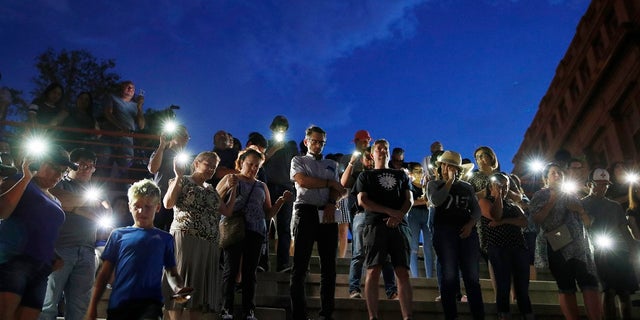
People attend a vigil for victims of the shooting Saturday, Aug.
3, 2019, in El Paso, Texas. A young gunman opened fire in an El Paso,
Texas, shopping area during the busy back-to-school season, leaving
multiple people dead and more than two dozen injured. (AP Photo/John
Locher)
He said the problem of shootings has been going on "for years and years" and "we have to get it stopped." The shootings in El Paso, Texas, and Dayton, Ohio, over the weekend left at least 29 people dead.
President Donald Trump, with first lady Melania Trump, walks back
to Airs Force One after speaking to the media before boarding Air Force
One in Morristown, N.J., Sunday, Aug. 4, 2019. (AP Photo/Jacquelyn
Martin)
The gunman in Ohio rampage, 24-year-old Connor Betts,
opened fire outside a bar around 1 a.m. Sunday, killing his adult
sister and eight others. Police say he was fatally shot by officers
within 30 seconds, and was wearing a mask, bulletproof vest, earplugs and had at least 100 rounds.
He injured more than two dozen people, with one in critical condition,
police said Sunday. Police had not determined a motive for the attack as
of Sunday evening. Meanwhile, authorities in Texas said the mass
shooting is being investigated as a domestic terrorism case. Officials
are also looking into whether hate crime charges against gunman Patrick
Crusius, who has also been charged with capital murder, are appropriate
after an alleged manifesto believed to be written by the 21-year-old
could indicate “a nexus to a hate crime.” The document posted
online expressed concern that an influx of Hispanics into the United
States will replace aging white voters, potentially turning Texas blue
in elections and swinging the White House to the Democrats. However, some observers cautioned
that mass shooters are increasingly using disingenuous manifestos
primarily as a means to cause division and sow political discord, rather
than to advance a particular agenda. Crusius became the third mass shooter this
year believed to have posted to the website 8Chan, which is a haven for
both ironic trolls and racists, prior to going on a shooting rampage. "The first mistake people are making is to assume the creep meant anything he said in his manifesto," wrote columnist Brian Cates.
"Something new has been added into the mix in the last year and we have
to recognize it: Mass shootings done for **fun** as the ultimate troll
where these [shooters] write confusing manifestos and then sit back
& watch the fun as both sides claim he belongs to the other." Cates
pointed out that the Christchurch, New Zealand mass shooter's manifesto
contained a mixture of left-wing and right-wing rhetoric, and by its
own explicit terms, was intended to cause international political
division. Politically, Democrats appeared split as to how much
blame to assign to Trump. Booker, D-N.J., declared that Trump is
"responsible" for the El Paso shooting, while another Democratic
presidential contender, Julian Castro said "there's one person that's
responsible directly" for the massacre -- "and that's the shooter." At the same time, Castro told ABC News' "This Week," Trump has embraced "division and bigotry and fanning the flames of hate" as a form of "political strategy." "It's
no accident that, just a few weeks after he announced his 2020
reelection bid, there he was indulging and entertaining this 'Send her back' chant,"
Castro said. "And he's spoken about immigrants as being invaders. "He's
given license for this toxic brew of white supremacy to fester more and
more in this country. And we're seeing the results of that."
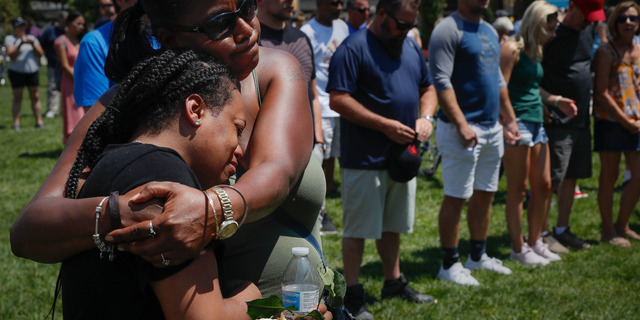
Mourners gather at a vigil following a nearby mass shooting,
Sunday, Aug. 4, 2019, in Dayton, Ohio. Multiple people in Ohio have been
killed in the second mass shooting in the U.S. in less than 24 hours,
and the suspected shooter is also deceased, police said. (AP Photo/John
Minchillo)
And Castro, who previously served as San Antonio
mayor and U.S. housing secretary, said Trump needs to do more to "unite
Americans instead of fanning the flames of bigotry." California Sen. Kamala Harris also found blame in Trump’s use of language, which she said has “incredible consequence.” “We
have a president of the United States who has chosen to use his words
in a way that have been about selling hate and division among us,” she
told reporters. Beto O'Rourke, a former congressman from Texas,
accused Trump of being a white nationalist and says he is encouraging
"open racism." But
Castro, speaking to anchor Jonathan Karl, reiterated that only the
shooter bears "direct" responsibility. In a statement released later
Sunday, Castro echoed that comment, saying, “These shooters are
ultimately to blame for their actions. They are attempting to terrorize
us but I believe that the vast majority of Americans reject this
hatred." In North Las Vegas, Bernie Sanders became one of several
prominent Democrats to demand Senate Majority Leader Mitch McConnell
call senators back to Washington from their summer recess. He said
the Senate should "have a special session to address gun violence in
America and let us finally have the courage to take on the NRA."
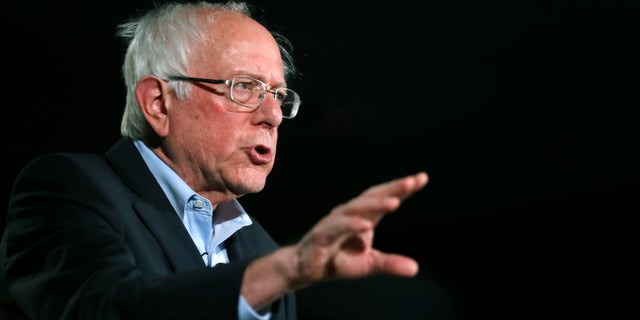
Democratic presidential candidate Sen. Bernie Sanders, I-Vt.,
speaks during an American Federation of State, County and Municipal
Employees Public Service Forum in Las Vegas Saturday, Aug. 3, 2019.
(Steve Marcus/Las Vegas Sun via AP)
He also called out the president, saying "I say to
President Trump, please stop the racist anti-immigrant rhetoric. Stop
the hatred in this country which is creating the kind of violence that
we see." Sanders then joined several of his fellow Democratic
presidential contenders in calling for universal background checks for
firearm purchases and more restrictions on assault weapons. "Assault
weapons are designed for one reason," Sanders claimed. "They are
military weapons. And I don't have to explain that to the people in Las
Vegas who experienced the worst gun tragedy in the history of this
country."
Eleven-year-old Leilani Hebben puts her head on her mother Anabel
Hebben's shoulder as they visit the scene of a mass shooting at a
shopping complex Sunday, Aug. 4, 2019, in El Paso, Texas. (AP Photo/John
Locher)
Booker backed up Sanders' call in a tweet: "This is a
national crisis. Mitch McConnell needs to bring the Senate back from
recess right now and hold votes on legislation to protect Americans from
gun violence. Enough. We need to end this carnage now." And Elizabeth Warren said the "public health crisis" of gun violence mandated a special session of Congress. “We
should vote within 48 hours on the two background check bills that have
already passed the House,” Warren said. “It’s not everything we need to
do on gun safety, but we could take important steps, and we could
demonstrate to the American people that the gun manufacturers are not
the ones who are calling the shots in Washington.” As the
political debate raged, FBI agents on Sunday executed search warrants at
three homes in the Dallas-Fort Worth area where Crusius had stayed. An agency spokeswoman, Melinda Urbina, declined to give more details on the locations. One of them was the home of his grandparents in Allen, Texas, where authorities shut down streets following the shooting. Also
on Sunday, U.S. Immigration and Customs Enforcement, responding to
online speculation, said the federal agency does not conduct immigration
enforcement operations "during tragedies." ICE spokeswoman Leticia Zamarripa said the statement was issued Sunday afternoon in an effort to dispel "false rumors." Zamarripa says ICE agents immediately responded to aid local and state law enforcement officers as the shooting unfolded. Fox News' Andrew O'Reilly, Travis Fedschun, and The Associated Press contributed to this report.
Defense Secretary Mark Esper says he is in favor of deploying
intermediate-range missiles in Asia, just a day after the U.S. pulled
out of the arms control treaty with Russia. During a visit to Australia Saturday, Esper said he would like to see
missiles in place within months, but noted such a process would take
more time.
U.S.
Secretary of Defense Mark Esper arrives in Sydney, Australia, Saturday,
Aug. 3, 2019, for annual bilateral talks. (AP Photo/Rick Rycroft)
He also assured that the recent withdrawal does not mean the beginning of a new arms race. “Right now, we don’t have plans to build nuclear-tipped INF range
weapons. It’s the Russians who have developed non-compliant likely,
possibly, nuclear tipped weapons, so I don’t see an arms race
happening.” On Friday the U.S. officially withdrew from the intermediate nuclear
forces treaty with Russia, claiming that the Kremlin failed to comply
with the agreement. Russia reportedly denied the accusations.
New reports claim President Trump is looking to remove all U.S.
troops from Afghanistan, by the 2020 election. Current and former
defense officials confirmed the report this week.
U.S.
soldiers attend a training session for the Afghan army in Herat,
Afghanistan, on Feb. 2. (Jalil Rezayee/EPA-EFE/Shutterstock)
Defense Hawks have pushed back against a full withdrawal in the next
15 months, saying they want some troops to remain to continue the fight
against ISIS and Al-Qaeda. Reports earlier this week said the Trump administration is planning
on reducing the number of troops in country by up to 9,000, down from
the 14,000 currently stationed there. The Pentagon said there has been no official withdraw order yet.


 California Gov. Gavin Newsom during a news conference in
Sacramento, Calif. Newsom signed a law Tuesday, July 30, requiring
presidential candidates to release their tax returns to appear on the
state's primary ballot, a move aimed squarely at Republican President
Donald Trump. (AP Photo/Rich Pedroncelli)
California Gov. Gavin Newsom during a news conference in
Sacramento, Calif. Newsom signed a law Tuesday, July 30, requiring
presidential candidates to release their tax returns to appear on the
state's primary ballot, a move aimed squarely at Republican President
Donald Trump. (AP Photo/Rich Pedroncelli)
 President Trump has said he will not release his tax returns as long as they are under audit. (AP Photo/Evan Vucci, File)