House Judiciary Committee Chairman Jerrold Nadler, D-N.Y., leads his
panel to approve guidelines for impeachment investigation hearings on
President Donald Trump, on Capitol Hill in Washington, Thursday, Sept.
12, 2019. (AP Photo/J. Scott Applewhite)
“Some call this process an
impeachment inquiry, some call it an impeachment investigation — there’s
no legal difference between these terms and I no longer care to argue
about their nomenclature.”
— Rep. Jerry Nadler, (D) Chairman – Judiciary Committee
The House Judiciary Committee has approved an apparent impeachment
inquiry into President Trump. On Thursday, the panel passed a resolution
in a 24-to-17 vote.
The resolution gave the committee power to deem meetings as
impeachment hearings,which provides them the ability to question
witnesses after members conclude hearings among other procedural
functions.
Committee Chairman Jerry Nadler tried to clarify the confusion
surrounding the intentions of the meeting and claimed terminology
regarding impeachment inquiry is insignificant. Ranking member Doug Collins blasted Nadler, saying he intended to use
the pointless meeting to appeal to Democrat colleagues and to fool the
general public into believing there is progress with an impeachment
inquiry.
Collins also had this to say:
“I’ve wanted for a long time to be
able to say this: welcome to fantasy island because we’re here…it may
all look good. The unfortunate part is when the screen goes down, you
just see a simple procedure issue…that doesn’t deal with impeachment,
that doesn’t do anything else. It just simply gives another press
release for whatever were doing now.”
The first committee hearing that will utilize the resolution is set
for September 17th. Former Trump campaign manager Corey Lewandowski has
been called to testify.
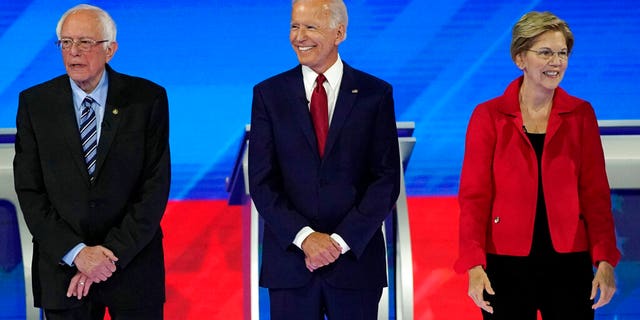
Long-simmering
policy disputes between Joe Biden, Bernie Sanders, Elizabeth Warren and
a slew of other candidates exploded into the open during Thursday
night's Democratic primary debate, as the candidates -- often with raised voices -- laid bare their fundamental disagreements on "Medicare-for-all," immigration and more.
Intermittent
efforts by some candidates to show unity and keep the heat on President
Trump repeatedly failed, with most striving instead to score an
aggressive debate "moment" onstage in Houston.
Amid the melee, Pete Buttigieg
offered an exit ramp from the feuding as he criticized the Democrats
for "scoring points against each other" -- prompting Julian Castro to
interject, "That's called an election!"
"Yeah, but a house divided cannot stand," Amy Klobuchar retorted, to no avail.
The economy,
which has performed well by virtually all major metrics in the past
year, went largely undiscussed during the raucous three-hour debate.
And, even as House Democrats made a push towards potentially impeaching the president this week, that topic conspicuously did not come up either.
Setting the tone
The brouhaha at the ABC News-hosted debate began from the outset, when Biden set the tone by going after Warren directly.
"I know the senator says she's for Bernie," Biden said. "Well, I'm for Barack."
"For a socialist, you've got a lot more confidence in corporate America than I do," Biden shot back at Sanders
shortly afterward, after the U.S. senator from Vermont suggested
corporations would return the money they currently make on high
insurance premiums if his sweeping plan were implemented.
Sanders
responded by referring to cancer treatment, leading Biden to sharply
reply, "I know a lot about cancer — it's personal to me." Brain cancer
killed Biden's son Beau four years ago.
The clashes settled any
questions about whether the top-tier candidates – meeting onstage for
the first time, with the addition of Warren – would hold back. To the
contrary, Biden was clearly mindful that Warren has been surging in
recent weeks and was ready to fight to hold his frontrunner status,
while several candidates continued to pile on Biden as they have at past
debates.
Heated clashes
But the most
heated clashes of the night came between Biden and fellow Obama
administration member Castro, who tangled at length in direct and
seemingly personal terms.
"I'm fulfilling the legacy of Barack
Obama, and you're not," Castro said, referring to the millions of
Americans who lack health coverage -- leading Biden to respond, "That'll
be a surprise to him."
Castro hammered Biden for claiming that
individuals would not be required to buy into his health care plan in
order to receive coverage.
"You just said two minutes ago they would have to buy in. Are you forgetting what you said two minutes ago?" Castro asked. Some commentators said Castro's jab was an improper, thinly veiled reference to Biden's age.
However,
Biden did not say during the debate that individuals would have to buy
in. Instead, Biden said that individuals would automatically be enrolled
if they lost their jobs.
"Anyone who can't afford it gets
automatically enrolled in the Medicare-type option we have," Biden had
said. "If you lose the job from your insurance company, from your
employer, you automatically can buy into this."
Biden responded
correctly, as the crowd roared in support of Castro, that he had said
that people would be "automatically enrolled" under his plan.
Later
on, during a discussion on immigration, Castro hit Biden for distancing
himself from Barack Obama's record when it suited him, only to
emphasize his tenure as vice president when it was beneficial.
"He wants to take credit for Obama's work, but not have to answer any questions!" Castro charged.
"I
stand with Barack Obama all eight years — good, bad and indifferent,"
Biden said. "I did not say, 'I did not stand with him.'"
Biden,
meanwhile, drilled Warren and Sanders for refusing to directly answer
whether taxes would go up under their preferred Medicare-for-all
proposal.
"The only question here in terms of difference is where to send the bill," Warren eventually offered.
She
added: "We all owe a huge debt to President Obama, who fundamentally
transformed health care in America, and committed this country to health
care for every human being. And now the question is, how best can we
improve on it?"
Warren
maintained that she had "never actually never met anybody who likes
their health insurance company ... what they want is access to health
care."
Sanders, his voice rising, repeated a familiar line in
defense of his "Medicare-for-all" plan against supposed distortions by
his opponents, saying, "I wrote the damn bill."
"Maybe you have run into people who love their premiums," Sanders barked. "I haven't."
Idiots
"While Bernie wrote the bill, I read the bill,"
Klobuchar snapped back later, to applause. Klobuchar, who does not
support Medicare-for-all, maintained that millions would lose their
private coverage.
Sen. Kamala Harris, meanwhile, insisted she had "always" supported Sanders' health care plan, even as she has publicly waffled as to what would happen to private insurance plans if
she were elected. She has said all private health care plans would be
eliminated, as Sanders prefers, only to quickly walk back that idea.
Protesters interrupt
Tensions
were evident both on and off the stage. Toward the end of the debate, a
group of protesters interrupted Biden for nearly a minute -- just
before he began speaking about personal tragedies in his life, including
the death of his first wife and daughter in 1972.
Biden also repeated the inaccurate claim that children were not kept in cages under the Obama administration. The most widely circulated photo of children in cages in immigration detention centers, though falsely attributed to the Trump era, was in fact taken during Obama's presidency.
"Nobody should be in jail for a non-violent crime." — Joe Biden, during the debate
The
former vice president also seemingly made a bungled and anachronistic
appeal to technology, urging attendees, "Play the radio. Make sure the
television, excuse me, make sure you have the record player on at night,
the phone..."
That response came after a question about what
Americans can do to help roll back the legacy of slavery. Biden was
suggesting that children need to "hear words" outside of the school
environment to improve their vocabulary. Then, when a moderator tried to
cut off his lengthy answer, Biden fired back, "No, I'm gonna go like
the rest of them do -- twice over."
In another
head-turning moment, during a discussion on criminal justice reform,
Biden suggested that nonviolent crimes should never result in prison
time.
"Nobody should be in jail for a non-violent crime," Biden
said. "When we were in the White House, we released 36,000 people from
the federal prison system."
Bizarre moment
But
before all the battles got underway, the debate immediately brought
about a bizarre moment early on, when longshot candidate Andrew Yang revealed he
would randomly give 10 families that registered on his website $1,000
per month -- what he called a "freedom dividend."
The plan
prompted a sustained moment of silence from Buttigieg, who took several
seconds to begin his own opening statement once Yang finished, and
eventually said, "That's original, I'll give it that."
Some suggested the plan might even violate campaign-finance laws.
Yang has advanced a plan to give every American at least $1,000 per month if elected -- via taxpayer funds.
For
the other candidates, the evening offered an opportunity for an
electric moment and a potential momentum boost. Harris' sustained attack
on Biden's decades-old opposition to federally required busing during
the June primary debate gained her the nation's attention, even as
critics said she had mischaracterized the former senator's position.
Harris' numbers have fallen since that moment, and big-money donors reportedly said this week they would abandon her candidacy if she didn't have a strong performance on Thursday.
"Kamala will take on Donald Trump directly," Harris press secretary Ian Sams promised.
In
her opening statement, Harris did just that. She dubiously claimed that
the only reason Trump has not been indicted is that Justice Department
guidelines prohibit the indictment of a sitting president -- a
proposition former Special Counsel Robert Mueller has explicitly denied.
For
his part, Trump's campaign was visible during the debate in Houston --
overhead. His campaign was using a plane to fly a banner that reads
“Socialism will kill Houston’s economy."
O'Rourke, meanwhile, continued to refocus his campaign on
pushing unprecedented gun-control measures -- including mandatory
buybacks of legal firearms. O'Rourke, when he was running for the Senate
in Texas just last year, explicitly said that he opposed confiscating legally purchased AR-15s.
In
his opening statement, O'Rourke urged Americans to be "bigger" than
petty politics -- just after he stated that the recent mass shooting in
El Paso, Texas, was inspired by the president. In his manifesto, the
shooter explicitly said Trump had not done so.
O'Rourke doubled
down on his mandatory gun-buyback program later on: "We have a white
supremacist in the White House, and he poses a mortal threat to people
of color all across this country." He said "hell yes" when asked if guns
needed to be confiscated.
O'Rourke added: "When we see that being
used against children. ... Hell yes, we're going to take your AR-15,
your AK-47. We're not going to allow it to be used against our fellow
Americans anymore."
His campaign, in a riff on Warren's virtual slogan, later tweeted, "Beto has a ban for that," next to a photo of a gun.
After the debate, a Texas state representative tweeted,
"My AR is ready for you Robert Francis," using O'Rourke's birth name.
Twitter quickly took down the post from Republican state Rep. Briscoe Cain.
O'Rourke responded
on Twitter: "This is a death threat, Representative. Clearly, you
shouldn't own an AR-15—and neither should anyone else."
Other candidates onstage largely agreed although they stopped short of endorsing O'Rourke's gun confiscation plan.
"A
few weeks ago, a shooter drove ten hours, inspired by this president,
to kill people who look like me," Castro said. "White supremacy is a
growing threat to this country, and we have to root it out."
For her part, Harris implicitly blamed Trump for the violence.
"Well, look," Harris said. "Obviously he didn't pull the trigger, but he's certainly been tweeting out the ammunition."
Harris
then took aim at Biden, and advanced her plan to unilaterally take
executive action on guns if necessary, bypassing Congress.
"Hey
Joe — instead of saying, 'No we can't,' let's say, 'Yes we can," Harris
said, referring mockingly to Obama's campaign slogan.
"Let's be constitutional," Biden responded.
Concerning
climate change, Warren sounded an apocalyptic note, saying flatly that
"every living thing" could die. She noted that experts have warned that
there is little time left to avert catastrophe. United Nations
scientists have claimed the world has 10 years to get global warming under control since at least 1989.
On
trade, the candidates largely agreed that China was acting improperly
-- "they steal our intellectual property," Harris said -- but all
asserted that Trump's approach of ever-increasing tariffs was reckless.
Democratic presidential candidate Beto O’Rourke responded late Thursday to what he claimed was a “death threat” from a Texas state lawmaker.
Briscoe Cain, a member of the Texas House of Representatives, had posted a Twitter message during Thursday’s Democratic debate in Houston, after O’Rourke said he planned to take away high-powered weapons from civilians if elected president.
“Hell yes, we’re gonna take your AR-15,” O’Rourke, a former congressman from El Paso, Texas, tweeted during the debate.
“My AR is ready for you Robert Francis,” Cain responded, using O’Rourke’s birth name.
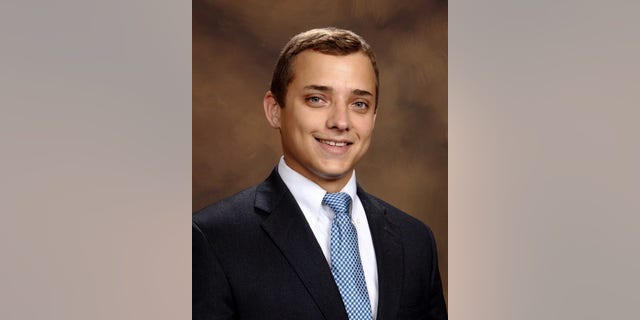
Texas state Rep. Briscoe Cain.
(Facebook/Briscoe Cain)
At that point, O’Rourke made it clear he didn’t interpret Cain’s tweet to be a joke.
“This is a death threat, Representative,” O’Rourke wrote. “Clearly, you shouldn’t own an AR-15—and neither should anyone else.”
Cain replied: “You’re a child Robert Francis.”
Such
weapons have become a topic of debate nationally after recent mass
shootings – but particularly in Texas, where 22 people were fatally shot
at a Walmart store in O’Rourke’s home city of El Paso on Aug. 3 and eight people were fatally shot in a suspect’s shooting spree in the Midland-Odessa area on Aug. 31.
O’Rourke,
46, served in Congress from January 2013 until earlier this year. He
launched his 2020 presidential bid after generating national name
recognition during a high-profile but failed U.S. Senate run against incumbent Ted Cruz, a Republican.
O’Rourke has argued for a mandatory buyback of assault weapons, among other gun control measures.
Cain, 34, is a Republican from Baytown who represents Texas’ 128th District, covering part of Harris County.
The website VoteSmart.org shows that Cain’s pro-Second Amendment
votes this year have included support for allowing handguns at places
of worship; allowing the storage and transportation of firearms in
school parking areas; and authorizing law enforcement officers to carry
weapons on school property.
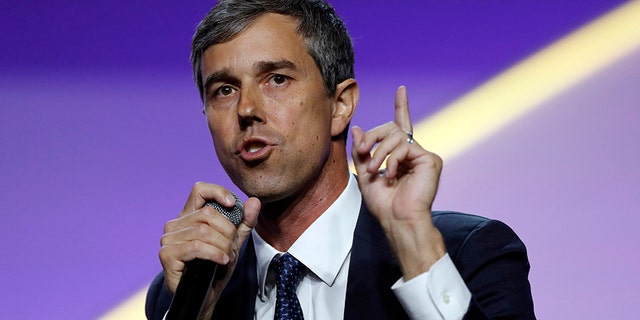
Democratic presidential candidate Beto O'Rourke speaks during a
candidates forum at the 110th NAACP National Convention in Detroit, July
24, 2019. (Associated Press)
In March, Cain drew attention to a class assignment at a Texas school that he argued was trying to promote a teacher’s anti-Trump agenda.
In February, Cain was among a group of state lawmakers who proposed using state money to help build a U.S.-Mexico border wall amid stalled federal efforts. Fox News’ Paul Steinhauser contributed to this story.
Change is coming to an influential group on Capitol Hill following a vote Tuesday.
U.S. Rep. Andy Biggs, R-Ariz., was elected the next chairman of the House Freedom Caucus, and will succeed U.S. Rep. Mark Meadows, R-N.C.
“I’m
grateful for the trust of my colleagues in selecting me to serve as the
next chairman of the House Freedom Caucus,” Biggs said in a statement
from the caucus. “The Freedom Caucus has revolutionized Capitol Hill
because our members have shown that they will stand for principle over
politics – every time.”
Meadows,
a key ally of President Trump, will step down as chairman Oct. 1 but
will remain a member of the group’s board, the statement said.
“I’ve
been honored and humbled to serve as chairman of the Freedom Caucus for
the last two and a half years, and I can’t think of a better person to
pass the torch to than Andy Biggs,” Meadows said, according to the
statement.
“Rep. Biggs is an outstanding public servant, a strong
conservative, and a steady voice with the right experience to build on
the tremendous strides our caucus has made since 2015 in fighting for
open, limited, and accountable government,” Meadows added. “He’ll be a
phenomenal leader for our group.”
Biggs, 60, a native of Tucson, represents Arizona’s 5th Congressional District, which mostly covers suburbs east of Phoenix.
A
member of Congress since 2017 after serving as a state lawmaker, Biggs
has been a staunch backer of President Trump’s plans to build a wall
along the U.S.-Mexico border.
Meadows, also 60, represents North
Carolina’s 11th Congressional District, in the western part of the
state, and has been serving in Congress since 2013.
Meadows
became chairman of the House Freedom Caucus in January 2017, succeeding
U.S. Rep. Jim Jordan, R-Ohio, who remains chairman emeritus of the
group.
The Freedom Caucus has struggled to advance its agenda since Democrats took control of the House following the 2018 midterms.
President Trump signed an executive order on Wednesday that forgives all student loan debt for any permanently disabled U.S. military veterans.
The
order, which Trump signed following a speech at the American Veterans
National Convention in Louisville, Ky., also clears those eligible
veterans from having to pay any federal income tax on the loans. Trump
added that he is pressuring individual states to follow suit.
“The
debt of these disabled veterans will be completely erased,” Trump said.
“That’s hundreds of millions of dollars of student loans debt for our
disabled veterans that will be completely erased.”
The
memo Trump signed directs the government to develop an "expedited"
process so veterans can have their federal student loan debt discharged
"with minimal burdens." Currently, just half of the roughly 50,000
disabled veterans who are qualified to have their federal student loan
debt forgiven have received the benefit because of a burdensome
application process.
Under the current process, disabled veterans
can have their debt forgiven under a loan forgiveness program, called
Total and Permanent Disability Discharge, or TPD, as long as they have a
VA service-connected disability rating of 100 percent. As of July,
however, only about 20 percent of the eligible pool of veterans
had taken advantage of the program due to the complicated nature of the
application and other factors.
Trump’s announcement comes days
after the administration hired a longtime student loan industry
executive to be the federal government's top watchdog for the student
loan market. Robert Cameron will serve as the Consumer Financial
Protection Bureau's new student loan ombudsman, the bureau said Friday.
It's
a job designed to protect student loan borrowers from poor practices in
the student loan industry and one of the few positions explicitly named
in the Dodd-Frank Act, the law passed after the 2008 financial crisis
that created the bureau. It's considered the go-to office for borrowers
who have complaints about their loans. Cameron most recently worked at
the Pennsylvania Higher Education Assistance Agency, better known as
FedLoan Servicing, as its head of compliance and risk mitigation.
PHEAA
has been cited for poor industry practices, most notably for how it has
handled the troubled Public Service Loan Forgiveness program, a program
designed to allow student loan borrowers who work in public service
jobs to get part of their loan balances forgiven.
The executive
order also comes as student loan forgiveness has become a major talking
point among the 2020 Democratic presidential primary candidates, with
contenders like Sens. Bernie Sanders of Vermont and Elizabeth Warren of
Massachusetts pushing plans to completely wipe out student loan debt
nationwide.
Currently, Americans hold around $1.6 trillion in student loan debt. The Associated Press contributed to this report.
The 9th Circuit Court of Appeals -- long a liberal bastion that has been aggressively reshaped into
a more moderate court by the Trump administration -- handed the
president a major win late Monday, lifting a nationwide injunction on
his asylum policy.
Obama-appointed U.S. District Judge Jon
Tigar in California on Monday had reinstated a nationwide halt on the
Trump administration's plan to prevent most migrants from seeking asylum
at the U.S.-Mexico border, if they first crossed through another
country on the way.
But in an administrative order first obtained by Politico, the
9th Circuit rolled Tigar's ruling right back, saying it should only
apply to the confines of the 9th Circuit for now -- which encompasses
California, Arizona, Alaska, Hawaii, Montana, Nevada, Idaho, Guam,
Oregon, and Washington.
The San Francisco-based 9th Circuit now
has seven Trump-appointed federal judges -- more than any other federal
appellate bench. The radical transformation of the court, which has 29
seats, is largely the result of Trump's push to nominate conservative
judges and bypass traditional consultations with Senate Democrats.
Thirteen of the 29 seats are now occupied by GOP-appointed judges. Last year, that number stood at six.
"Thanks to Trump, the liberal 9th Circuit is no longer liberal," The Washington Post noted earlier this year.
Tigar first blocked the asylum policy in July after a
lawsuit by groups that help asylum seekers. The 9th U.S. Circuit Court
of Appeals then partially limited the impact of Tigar's injunction.
That meant the policy was blocked in the border states of California and Arizona but not in New Mexico and Texas.
In
his ruling Monday, Tigar circled back, and stressed a "need to maintain
uniform immigration policy" and found that nonprofit organizations such
as Al Otro Lado don't know where asylum seekers who enter the U.S. will
end up living and making their case to remain in the country.
Tiger, citing new evidence, on Monday issued a second nationwide injunction.
"The
court recognized there is grave danger facing asylum-seekers along the
entire stretch of the southern border," Lee Gelernt, an attorney for the
American Civil Liberties Union, said in a statement.
Trump
said he disagreed with the judge's ruling, hours before the 9th Circuit
backed him up late Tuesday and again limited the injunction.
"I
think it's very unfair that he does that," Trump told reporters as he
departed the White House for a trip to North Carolina. "I don't think it
should be allowed."
White House Press Secretary Stephanie Grisham
said in a statement that a sole judge shouldn't have the ability to
exert such a broad impact on immigration policy, and noted the
administration's request to the Supreme Court to set aside the
injunction is still pending.
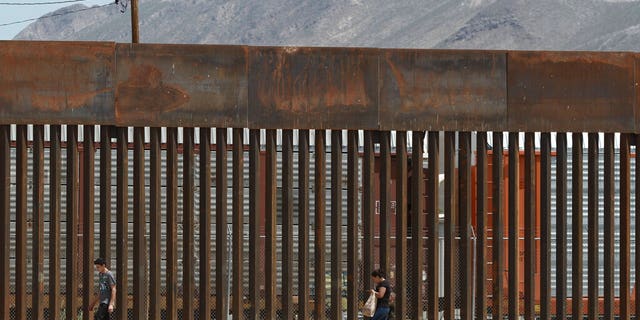
FILE - In this July 17, 2019, file photo, three migrants who had
managed to evade the Mexican National Guard and cross the Rio Grande
onto U.S. territory walk along a border wall set back from the
geographical border, in El Paso, Texas. (AP Photo/Christian Chavez,
File)
"This ruling is a gift to human smugglers and traffickers and undermines the rule of law," she said.
The
courts have halted some of Trump's key policy shifts on immigration,
including an earlier version of an asylum ban. The president has
prevailed on several fronts after initial legal setbacks, for example,
when the Supreme Court recently lifted a freeze on using Pentagon money
to build border walls.
The
rules issued by the Trump administration in July apply to most migrants
who pass through another country before reaching the United States.
They target tens of thousands of Central Americans fleeing violence and
poverty who cross Mexico each month to seek asylum and would affect
asylum seekers from Africa, Asia and South America who arrive regularly
at the southern border.
The shift reversed decades of U.S. policy
in what Trump administration officials said was an attempt to close the
gap between an initial asylum screening that most people pass and a
final decision on asylum that most people do not win.
U.S. law
allows refugees to request asylum when they get to the U.S. regardless
of how they arrive or cross. The crucial exception is for those who have
come through a country considered to be "safe," but the law is vague on
how a country is determined to be safe. It says pursuant to a bilateral
or multilateral agreement.
People are generally eligible for
asylum in the U.S. if they credibly fear return to their home country
because they would be persecuted based on race, religion, nationality or
membership in a particular social group.
The vast majority of
asylum claims are denied, however, and the administration has said the
system is being abused as a means of economic and humanitarian relief
when it was intended to be used for limited and extraordinary cases.
Asylum
claims have spiked since 2010, and there is currently a backlog of more
than 800,000 cases pending in immigration court. Most asylum claims
often fail to meet this high legal standard after they are reviewed by
asylum judges, and only about 20 percent of applicants are approved.
The Border Patrol apprehended about 50,000 people at the southern border in August, a 30 percent drop in arrests from July amid summer heat and an aggressive crackdown on both sides of the border to deter migrants.
The drop was more significant than it was during the same period last year, however, in what officials called a clear sign that its recent agreement with Mexico to curb illegal immigration was working.
The 64,006
migrants apprehended or deemed inadmissible represents a 22 percent
drop from July, when 82,055 were apprehended, and a 56 percent drop from
the peak of the crisis in May, when more than 144,000 migrants were
caught or deemed inadmissible. While the numbers typically drop in the
summer, the plummet is steeper than typical seasonal declines.
Meanwhile,
the number of caravans has also dropped. In May, 48 caravans of
migrants were recorded coming to the U.S. In August, the tally was six.
Border Patrol now has fewer than 5,000 migrants in custody, down from
19,000 at the peak in the spring.
“That international effort is
making an impact. Mexican operational interdiction is certainly [the]
highlight of that effort, but the shared responsibility we’re seeing in
the region, governments stepping up and saying we also own
this,” Homeland Security Secretary Kevin McAleenan told Fox News on
Monday.
A senior administration official also said, "the tariff threat with Mexico changed the dynamic significantly with our partners." Fox News' Adam Shaw and The Associated Press contributed to this report.
In a major victory for both President Trump and national Republicans, North Carolina GOP state Sen. Dan Bishop was projected to win a fiercely contested special U.S. House election for the 9th District that was widely seen as a bellwether for the president's chances in the 2020 election.
And
another Republican House candidate, Greg Murphy, decisively won a
separate special election in North Carolina's more solidly GOP-leaning
3rd District earlier Tuesday evening -- frustrating Democrats who spent
millions trying to make a splash in the state.
Even Democratic
Congressional Campaign Committee (DCCC) Chairwoman Cheri Bustos
acknowledged that the president contributed to Bishop's win, writing in a
statement that "we fell an inch short tonight, but it took more than $6
million in outside Republican spending and a last-minute Trump rally"
to seal Democratic candidate Dan McCready's fate in the 9th District.
McCready's
campaign spent approximately $4.7 million on the race, while Bishop's
spent only $1.9 million. Outside spending primarily from national party
committees helped Bishop to the tune of $5.8 million, though, compared
to McCready's roughly $1.4 million.
The clean sweep heartened the president, who has long emphasized the national implications at stake. Trump unloaded on McCready in the fiery rally on Monday night, telling attendees that "to stop the far-left, you must vote in tomorrow's special election."
That effort, Trump said late Tuesday, had clearly paid dividends.
"Dan
Bishop was down 17 points 3 weeks ago," Trump wrote on Twitter. "He
then asked me for help, we changed his strategy together, and he ran a
great race. Big Rally last night. Now it looks like he is going to win. @CNN &@MSNBC are moving their big studio equipment and talent out. Stay tuned!"
He added: "BIG NIGHT FOR THE REPUBLICAN PARTY. CONGRATULATIONS TO ALL!"
“The voters said no to radical, liberal polices pushed by today’s Democratic Party,” Bishop said in a victory speech.
GOP chairwoman Ronna McDaniel said the wins spelled trouble for Democrats in 2020,
and highlighted the importance of Republican National Committee (RNC)
efforts in North Carolina -- where the party will hold its national
nominating convention in 2020.
"Despite being massively outspent by Democrats, @realDonaldTrump
rallied voters and put Bishop over the top," McDaniel said. "A huge win
for the president and our grassroots field program that's working hard
to elect Republicans in 2020!"
The RNC had been active on the
ground in North Carolina working on the special elections since June.
The party has brought on nearly two-dozen full-time staffers and
invested more than $1.5 million in the state, while also making nearly a
half-million voter contacts through phone-bank work and door-to-door
canvassing.
With 100 percent of precincts reporting, Bishop led
McCready by 3,937 votes, 96,081 to 92,144, in the race to represent
the 9th District. Bishop ran up substantial numbers in outlying areas
and McCready eroded GOP advantages in suburban areas.
In 2018, the
Republican candidate, Mark Harris, defeated McCready by a much smaller
margin -- just 905 votes, 139,246 to 138,341. State officials ordered
the unusual special election earlier this year, invalidating Harris' win
after uncovering ballot fraud efforts.
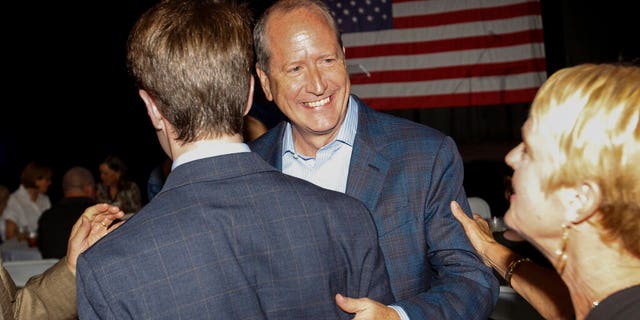
North Carolina 9th district Republican congressional candidate Dan
Bishop greets supporters in Monroe, N.C., Tuesday, Sept. 10, 2019. (AP
Photo/Nell Redmond)
Republicans cheered Bishop's even-higher margin of victory than Harris achieved, briefly, in 2018.
“Congratulations to
Dan Bishop on his definitive victory tonight in North Carolina’s 9th
Congressional District," National Republican Congressional Committee
Chairman Tom Emmer said in a statement.
"North Carolinians
rejected the Democrats’ socialist agenda and elected a representative
who will defend North Carolina values, and will always fight for freedom
and against socialism," he added. "I look forward to working with Dan
in Congress to hold the Democrats accountable for their extreme agenda.”
Analysts
had warned that the cloud from the fraud scandal could have harmed
Bishop's prospects. Additionally, polls apparently showing Trump's
declining national popularity -- which the president has dismissed as
inaccurate -- gave Democrats some cause for optimism. The president said
Monday he did not consider Bishop's race to be a bellwether for 2020.
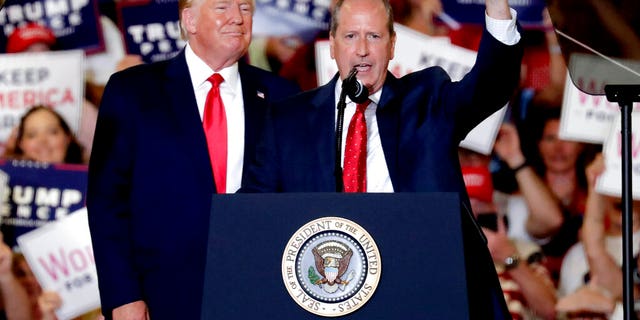
President Donald Trump, left, gives his support to Dan Bishop,
right, a Republican running for the special North Carolina 9th District
U.S. Congressional race as he speaks at a rally in Fayetteville, N.C.,
Monday, Sept. 9, 2019. (AP Photo/Chris Seward)
Nevertheless, Bishop and Murphy were evidently boosted by pair of visits to the district Monday by both Trump and Vice President Mike Pence.
At
the rally Monday, the president specifically called out McCready as a
dangerous proponent of "sanctuary cities" and rolling back gun rights.
"Just recently, Mecklenburg County set free an illegal alien charged with first-degree rape and crimes against a child,"
Trump said, his voice rising. "Support for sanctuary cities is
disloyalty to American cities -- and McCready wants sanctuary cities,
with all of their protections for people who are serious criminals.
Tomorrow is your chance to send a clear message to the America-hating
left."
Had McCready prevailed, it might have suggested GOP erosion
and raised questions about Trump's and his party's viability for 2020.
But
Trump projected confidence early Tuesday evening after Murphy was
projected to soundly defeat Democrat Allen Thomas in the separate
special election in the coastal 3rd District to succeed the late Rep.
Walter Jones Jr.
"One down, one to go," Trump wrote on Twitter.
Meanwhile,
McCready, a former Marine turned financier of solar energy projects,
had banked on the district's suburban moderates to carry him over the
top.
The 9th District, which stretches east from the prosperous
Charlotte suburbs into rural areas hugging the South Carolina
border, has been held by the GOP since 1963.
In 2016, Trump won the district by 11 percentage points.
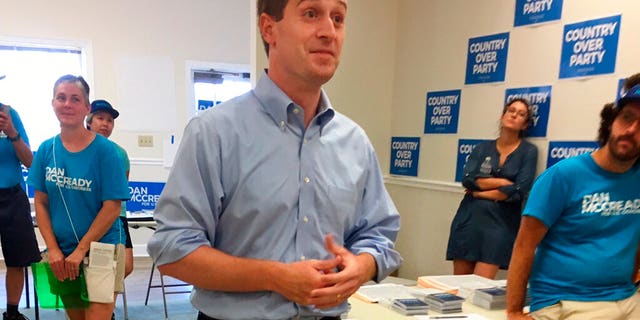
Democratic House candidate Dan McCready talks to volunteers at his
campaign office in Waxhaw, N.C., outside Charlotte, Saturday. (AP
Photo/Alan Fram)
As
voters headed to the polls Tuesday afternoon, a new balloting
controversy surfaced briefly when North Carolina election officials did
not act on a request by the state Republican Party to extend hours at a
single precinct.
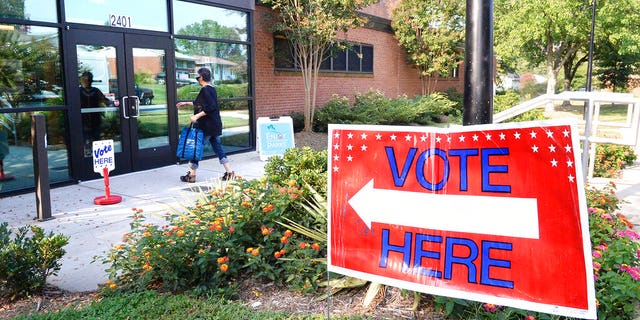
A voter enters a precinct at the West Charlotte Recreation Center Tuesday. (John D. Simmons/The Charlotte Observer via AP)
The state GOP asked that the voting site stay open an
extra hour and 45 minutes because they said some voters were showing up
at an old voting location in Union County, a Republican-heavy area east
of Charlotte.
The State Board of Elections met and discussed the GOP request, but took no action.
However,
by a 5-0 vote of the state board, one polling site in Mecklenberg
County was kept open 25 minutes past the 7:30 p.m. ET closing time due
to a reported gas leak.
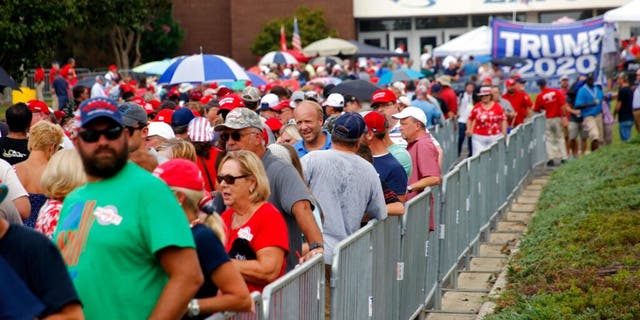
Attendees line up outside hours before President Donald Trump
speaks at a campaign rally in Fayetteville, N.C., Monday Sept. 9, 2019
(AP Photo/Chris Seward)
The 3rd District, where Murphy won easily early in
the night, was less closely watched because it was strongly expected to
stay Republican-controlled. Still, Republicans from the president on
down sounded the victory drums.
“Congratulations to Dr. Greg
Murphy on his decisive victory tonight in North Carolina’s 3rd
Congressional District," Emmer said in a statement.
"Dr. Murphy is
a selfless servant who is dedicated to conservative values," Emmer
continued. "Today, North Carolinians rejected the socialist agenda of
the Democrats and voted for freedom. I look forward to working with a
consistent conservative like Dr. Murphy in Congress.”
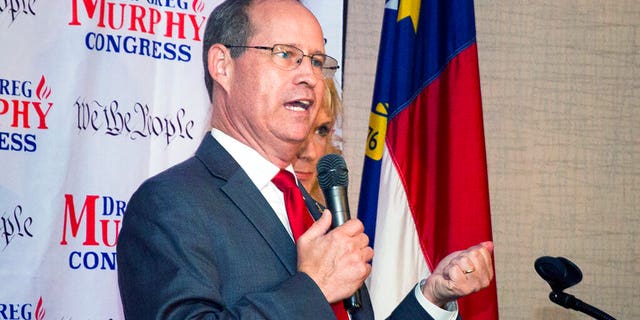
Greg Murphy was elected to Congress from North Carolina's 3rd
District Tuesday. (Molly Urbina/The Daily Reflector via AP, File)
The
3rd district extends from the Virginia border and Outer Banks to the
Marine Corps' Camp Lejeune, and inland to Greenville. Trump won the
district vote comfortably in 2016, and Murphy said at a Trump rally that
he would have the "president's back" if elected.
Thomas is a former Greenville mayor who questioned Murphy's "blind loyalty" to Trump. Fox News' David Lewkowictz and The Associated Press contributed to this report.