Rising Democratic co-frontrunner Sen. Elizabeth Warren came under attack from all sides during Tuesday night's presidential debate, as former Vice President Joe Biden defiantly defended his son's business practices overseas and vehemently denied any wrongdoing.
All of the 12 Democrats onstage in Westerville, Ohio,
meanwhile, backed the ongoing impeachment inquiry against President
Trump. In a sign of apparent disunity and hesitation among Democrats,
though, House Speaker Nancy Pelosi said only minutes before the debate began that there would be no vote on formally commencing the inquiry.
The
debate marked the first time the candidates met since Pelosi's news
conference last month at which she unilaterally declared the inquiry had
begun -- a move that the White House has said is legally insufficient.
The candidate lineup set a record for most politicians on a single
debate stage, topping the 11 Republican candidates who assembled in
2016. JOE BIDEN DEFENDS SON HUNTER'S UKRAINE WORK: 'MY SON DID NOTHING WRONG. I DID NOTHING WRONG'
"Sometimes
there are issues that are bigger than politics, and I think that's the
case with this impeachment inquiry," Warren, D-Mass., asserted at the
outset of the debate, when asked why Congress should bother with the
process given the impending election.
Biden has been at the top of
the crowded field for months, but has come under withering assault from
the White House concerning his son Hunter's lucrative overseas business
dealings.
The elder Biden faced something of a timid
confrontation over the issue during the debate, when CNN anchor and
debate moderator Anderson Cooper broached the topic by stating, without
evidence, that President Trump's accusations of misconduct by the Bidens
were "false."
But Cooper pressed Joe Biden on Hunter's admission in a televised interview earlier in the day that he made a mistake by obtaining a lucrative role on the board of a Ukraine
company, with no relevant expertise, while his father was vice
president and handled Ukraine policy. (“I know I did nothing wrong at
all. Was it poor judgment to be in the middle of something that is a
swamp in many ways? Yeah,” the younger Biden said Tuesday morning.)
Joe
Biden recently pledged that no members of his family would engage in
foreign deals if he were to be elected president -- a tacit admission,
Republicans said, of previous poor judgment or even wrongdoing.
"Look,
my son's statement speaks for itself," Biden said. “My son did nothing
wrong. I did nothing wrong. I carried out the policy of the United
States government which was to root out corruption in Ukraine, and
that’s what we should be focusing on.”
Biden insisted he never
discussed Ukraine matters with Hunter, although Hunter separately told
The New Yorker magazine that the dealings had come up in one instance.
He concluded: "The fact of the matter is, this is about Trump's corruption. That's what we should be focused on."
Devon Archer, far left, with former Vice President Joe Biden and
his son Hunter, far right, in 2014. Archer served on the board of the
Ukrainian company Burisma Holdings with Hunter, and began serving before
this picture was taken. Joe Biden has denied ever speaking to his son
about his overseas business dealings.
Later on, as the debate heated up, Biden remarked:
“These debates are kinda crazy." In a head-turning moment, he also
stumbled over his words, saying wealthy individuals might be found
"clipping coupons in the stock market."
Separately, asked about
Trump's policy in Syria, Biden appeared to give an extended answer in
which he meant to talk about Turkish President Recep Erdoğan -- but kept
referencing Syrian President Bashar al-Assad instead.
Asked
about his health toward the end of the debate, Biden vowed to release
his medical records before the Iowa caucuses are held, and said his age
(76) gives him "wisdom."
Hunter Biden obtained other
high-paying board positions domestically and internationally, with no
relevant expertise, while his father was a senator and vice president.
For example, Hunter became an executive at the financial services
company MBNA just two years after leaving law school. MBNA sources told Fox News
this week that the company was trying to curry favor with Joe Biden,
who was shepherding a bill favored by MBNA to passage in the Senate.
Meanwhile,
Warren has climbed to co-front runner status but faces new questions
about her dubious claims to Native American ancestry.
She was
under attack from all sides at the debate for refusing to answer whether
her "Medicare for All" plan would raise taxes for the middle
class. Warren once again dodged the issue, insisting only that "costs
will go down" for the middle class.
"I appreciate Elizabeth's
work, but again, the difference between a plan and a pipe dream is
something you can actually get done," Sen. Amy Klobuchar, D-Minn., said
to Warren. "At least Bernie’s being honest here. ... I’m sorry,
Elizabeth.”
“These debates are kinda crazy." — Joe Biden
South
Bend, Ind., Mayor Pete Buttigieg also lambasted Warren on health care:
“Your signature is to have a plan for everything, except this," he said.
Buttigieg
specifically knocked Warren for the nonanswer, saying her failure to
offer a direct answer is "why people are so frustrated with politicians"
and arguing that "Medicare-for-All" would "unnecessarily divide this
country."
"We heard it tonight," Buttigieg said. "A yes-or-no
question that didn't get a yes-or-no answer." He said he wanted a plan
that could be summed up as "Medicare-for-All" if you choose it, not
whether you want it or not.
Former U.S. Rep. Beto O'Rourke also
pressed Warren on the tax issue, to no avail. (Later on, O'Rourke had no
answer when Cooper asked how he could confiscate Americans'
firearms, given that the government has no way of knowing where the vast
majority of AR-15s are located. He said only that he believes Americans
"will do the right thing" voluntarily.)
Sen. Bernie Sanders, who
wrote the "Medicare-for-All" legislation that Warren has embraced, said
it was "appropriate to acknowledge taxes will go up."
Sanders, who Fox News has confirmed will soon be endorsed by New York Democratic Rep. Alexandria Ocasio-Cortez,
also spoke about his recent heart attack: “But let me take this moment,
if I might, to thank so many people from all over this country,
including many of my colleagues up here, for their love, for their
prayers, for their well wishes. ... And I just want to thank you from
the bottom of my heart, and I'm so happy to be back here with you this
evening.”
Also during the debate, Democrats also piled onto Warren
for her signature proposal, a 2 percent wealth tax to raise the
trillions needed for many of her ambitious proposals. Technology
entrepreneur Andrew Yang noted that such a measure has failed in almost
every European country where it's been tried.
The event, hosted by
CNN and The New York Times, was on the campus of Otterbein University,
just outside Columbus in Ohio, a state that has long helped decide
presidential elections but has drifted away from Democrats in recent
years.
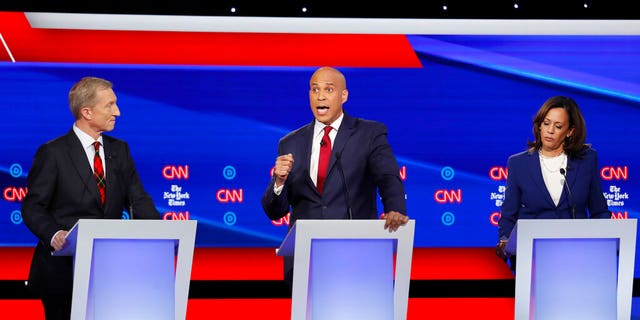
Democratic presidential candidate businessman Tom Steyer, left,
and Sen. Kamala Harris, D-Calif., right, listen as Sen. Cory Booker,
D-N.J., speaks during a Democratic presidential primary debate hosted by
CNN/New York Times at Otterbein University, Tuesday, Oct. 15, 2019, in
Westerville, Ohio. (AP Photo/John Minchillo)
Many of the candidates were struggling just to get
noticed — trying to make up ground in a race that kicks off officially
in just over three months with the Iowa caucuses on Feb. 3. Buttigieg
and Sen. Kamala Harris, D-Calif., are trying to crack the top tier.
In
one possible indicator the debate was a lengthy one, Harris briefly
mentioned her proposal to have Twitter take Trump's account down, and
demanded that Warren explain why she felt that approach was unwise.
Warren, who last week laughed openly when informed by a reporter of
Harris' idea, responded that she wants Trump out of the White House, not
just banned from Twitter.
Progressives and right-wing
commentators alike were aghast at Harris' decision to again bring up the
unrealistic and unpopular idea of somehow suspending Trump from
Twitter.
"I cannot believe @KamalaHarris
is pushing this suspend Donald Trump's twitter account bullshit at a
presidential debate," former Obama administration official and Pod Save
America cohost Tommy Vietor wrote on Twitter. "It's so small ball. She
is bigger and better than this."
Fellow Obama administration alumnus and podcast host Ben Rhodes added: "Seems like there are bigger issues in the world."
Also
debating were Sen. Cory Booker of New Jersey, former Obama housing
chief Julián Castro and Rep. Tulsi Gabbard of Hawaii. Making his debate
debut — and likely angling for a splash — was billionaire activist Tom
Steyer.
Gabbard hit The New York Times and CNN for waging what she
called a propaganda campaign against her, while also promoting endless
"regime-change wars."
"The New York Times and CNN have smeared
veterans like myself for calling for an end to this regime change war,"
Gabbard said. "Just two days ago, The New York Times put out an article saying I'm a Russian asset and an Assad apologist, and all these different smears. This morning, a CNN commentator said on national television that I'm an asset of Russia. Completely despicable."
Gabbard
has criticized Trump for how he's conducted the withdrawal in Syria,
but said Tuesday that while Trump has "the blood of the Kurds on his
hands. ... So do many of the politicians in both parties who supported
this regime change war."
Gabbard, who was one of the last
Democratic House members to back an impeachment inquiry, additionally
lamented that some Democrats had been calling for Trump's impeachment
since right after the 2016 election, undermining the party's case
against him.
The debate's foreign policy discussion concluded
without any mention by the moderators of the ongoing push by China to
censor American companies, including the NBA and Blizzard Entertainment,
from making or tolerating pro-Hong Kong statements. Buttigieg briefly
mentioned that the Hong Kong protests were not receiving support from
the White House.
Yang's plan for a universal basic income spurred a
discussion onstage concerning whether a federal jobs guarantee is a
better plan -- something of a remarkable achievement for Yang, who has
struggled in the polls while advancing his own unique agenda.
On
abortion, the Democrats agreed they would support a federal law
"codifying" the Supreme Court's holding in Roe v. Wade, which found a
constitutional right to abortion, as a kind of defense in case the
Supreme Court overturned Roe. At the same time, Biden emphasized he
would not support "court packing," or passing a federal law to expand
the size of the Supreme Court to load it with Democratic justices.
Buttigieg
then said he did not support court packing, but wanted "reforms" to
make the court less significant -- including possibly a "fifteen member
court, where five of the members can only be appointed by unanimous
agreement of the other ten." A similar idea was being debated in the
Yale Law Journal, Buttigieg said, in a shout-out to the left-wing
student publication.
Gabbard said that Democrats were right decades ago when they said abortion should be "safe, legal, and rare" -- highlighting a shift to the left among Democrats.
The
2020 field, which once had swelled to two dozen, has been shrinking as
the Democratic Party's rules have mandated that candidates meet higher
donor and fundraising thresholds to debate.
Just 10 White House contenders qualified for September's debate, but Gabbard and Steyer made Tuesday's lineup a record.
Earlier contests featuring 20 candidates were divided between two nights.
Author
Marianne Williamson, who was not physically present at the debate on
Tuesday because she failed to meet polling thresholds, remarked on
Twitter as it unfolded: "No, they're not the only Democratic candidates
for President of the United States." Fox News' Paul Steinhauser and The Associated Press contributed to this report.
At least three members of the “Squad” of far-left freshman members of Congress will reportedly endorse Sen. Bernie Sanders for president.
Fox News has learned that Rep. Alexandria Ocasio-Cortez,
D-N.Y., will appear with Sanders on Saturday in Queens, N.Y., at a
“Bernie’s Back” rally designed to generate excitement for the senator’s
campaign following his recent heart procedure. Rep. Ihan Omar, D-Minn.,
will also endorse the candidate, Fox News confirmed.
In addition, CNN reported that Rep. Rashida Tlaib, D-Mich., will endorse Sanders as well. It was not immediately clear if Omar and Tlaib will appear at the same Sanders event.
"Bernie
is leading a working class movement to defeat Donald Trump that
transcends generation, ethnicity and geography," Omar was quoted as
saying in a statement posted on Twitter by the Sanders campaign -- and
that Omar retweeted on her own Twitter page.
"I believe Bernie Sanders is the best candidate to take on Donald Trump in 2020," Omar added.
"I believe Bernie Sanders is the best candidate to take on Donald Trump in 2020."
— U.S. Rep. Ilhan Omar, D-Minn.
The endorsements would be a significant blow to the campaign of Sen. Elizabeth Warren, who like Sanders has been representing the party’s progressive wing.
Word of the endorsements also followed Tuesday night’s Democratic debate in Ohio, where Warren was under attack from multiple candidates after rising in the polls in recent weeks.
Winning
the OK of the “Squad” members was also viewed as crucial in attracting
young voters, as the top three Democrats in the polls are all senior
citizens – Sanders is 78, former Vice President Joe Biden is 76 and
Warren is 70.
There was no indication that the fourth member of
the Squad, Rep. Ayannna Pressley, D-Mass., was ready to make an
endorsement – either of Sanders or any other candidate. Fox News’ Paul Steinhauser and Andrew Craft contributed to this report.
Rep. Dan Crenshaw, the freshman Republican congressman from Texas, and a former Navy SEAL who was wounded in combat, defended himself Tuesday after a video showed an Illinois Democrat calling him “a racist.”
The
Democrat, Rep. Sean Casten, an Irish-born lawmaker whose district
covers suburbs west of Chicago, told an audience earlier this month that
Crenshaw was “a racist” because the Texan proposed an amendment in
Congress to prevent illegal immigrants from voting.
“The
last amendment on the floor that day … came from Dan Crenshaw, the new
Republican, the Navy SEAL with the eyepatch," Casten said, according to
the Washington Free Beacon. “He came up with an amendment to say, ‘We're
going to add a rider on this bill that says that illegals can't vote.'
And I sat there and I said, ‘You know what? You're not allowed to vote
if you're not a citizen.’ … Why are you doing that? The reason you're
doing that is because you are a racist. Because you are trying to appeal
to people who will vote for you if you stand up and oppose brown
people."
Crenshaw responded Tuesday on Twitter, after video from Casten’s Oct. 5 remarks surfaced.
“When
you can’t articulate a coherent argument, you resort to calling your
political opponents racist,” Crenshaw wrote. “Can’t say I’m surprised.
Just another day in Washington with the Democrat Party.”
Later, a Crenshaw spokeswoman added, in a statement to the Free Beacon:
“If Rep. Casten is so deeply offended that our laws prohibit
non-citizens from voting in federal elections, then he should be honest
with his constituents and let them know how little he values the power
of their vote.”
In a party-line vote, the Democrat-controlled House defeated Crenshaw’s proposal, the outlet reported.
Casten previously made headlines in June when he came out in support of the impeachment effort against President Trump.
The Democrat also drew criticism last year when he said Trump and 9/11 mastermind Usama bin Laden “have a tremendous amount in common.”
Crenshaw, during a September appearance on Fox & Friends, accused Democratic presidential candidate Sen. Bernie Sanders of deliberately tweeting about veterans issues in order to “make people angry.”
As investigators continue to investigate talks with foreign
governments, Senator Rand Paul says it’s crucial both sides of the aisle
are held accountable. While speaking on NBC’s “Meet the Press” Sunday,
Paul called for an investigation into the Democrat senators who
requested information into former Trump campaign manager Paul Manafort
back in 2018.
“If anything’s consistent here, both parties have tried to involve
themselves in Ukraine,” he stated. “So for example, four senators,
Democrats, wrote a letter to the Ukrainian government and said if you
don’t keep investigating Trump we may reconsider our bipartisan support
for your aid.”
This comes after the Kentucky lawmaker was asked if he’s bothered by
accusations President Trump’s personal attorney sought information on
former Vice President Joe Biden. Paul pointed out that it shouldn’t just
be one-sided, saying if you’re going to condemn the president then you
also need to condemn the Democrat senators.
“Everyone is going after President Trump,” he said. “Someone needs to
actually, in an objective way, evaluate a letter from four Democrats
that said to Ukraine ‘if you don’t keep investigating Trump we will
reconsider our bipartisan support for aid’ — that’s a threat and that’s
the same kind of stuff they’re accusing Trump of.”
Democrat Senators Robert Menendez, Dick Durbin, and Patrick Leahy
wrote a letter asking for Ukraine’s assistance into the Mueller
investigation back in 2018. According to Paul, if Ukraine refused the
Democrat leaders threatened to withhold aid from the country.
House Democrats have subpoenaed President Trump’s lawyer Rudy
Giuliani and are requesting he also turn over documents regarding
Ukraine. Giuliani said President Trump did not extort money or engage
with Ukraine, and claimed Biden did both to advance his corruption
scheme in the country.
The tables appear to be turning on CNN as a whistleblower launches
bombshell allegations of bias against the network. In its latest
investigative piece, Project Veritas claims to expose the anti-Trump
culture at the highest levels of the news outlet. The organization
worked with a CNN contractor who helped gather evidence, including
secret recordings at editorial meetings.
The first clip, released Monday, features a man who is allegedly CNN
President Jeff Zucker telling staffers he wants them to focus on the
president’s impeachment. The video also shows Nick Neville, a media
coordinator at CNN, acknowledging Zucker’s negative stance toward the
president is personal.
Project Veritas shared a clip of Zucker talking about the forthcoming
leaks on a morning call just before its release, confirming the source
was an insider. The whistleblower has now been identified as Cary
Poarch, who said he decided to secretly record meetings at the network
to expose the bias.
Conservative political activist and Project Veritas organizer James
O”Keefe took to Twitter to call for support for the insider, calling him
a “patriot. Poarch has set up a GoFundMe page in which he plans to use
for any legal challenges he may now face.
BEIJING (AP) — A truce in a U.S.-Chinese tariff
war and Beijing’s promises to open more of its state-dominated economy
are raising hopes among investors.
But Beijing has tempered expectations, while companies express frustration over the halting pace of market-opening moves.
The
China Daily, an English-language newspaper aimed at foreign readers,
warned the two sides have yet to put last week’s agreement on paper
after President Donald Trump suspended a planned tariff hike. In
exchange, Trump said Beijing would buy up to $50 billion of American
farm goods, a pledge China has yet to confirm.
“There is always the possibility that
Washington may decide to cancel the deal if it thinks that doing so will
better serve its interests,” said the newspaper. It called on the Trump
administration to “avoid backpedaling.”
Business
groups welcomed the truce as a possible step toward ending the costly,
15-month-old fight but said it was a small one. Talks broke down earlier
after Trump accused Beijing of backsliding on promises Washington
believed were locked in.
Friday’s agreement
coincided with China’s announcement of a timetable to carry out a 2017
promise to abolish limits on foreign ownership of some finance
businesses, starting with futures trading firms on Jan. 1. Securities
firms and mutual fund managers follow later in the year.
Investors
saw that as a commitment to freer trade. Chinese officials say it has
nothing to do with the trade talks and isn’t a concession to Washington.
Over
the past 18 months, President Xi Jinping’s government also has promised
to allow full foreign ownership in banking, insurance and auto
manufacturing in hopes of making its slowing, state-dominated economy
more competitive and productive.
Chinese
market-opening initiatives follow a standard script. Authorities
announce dramatic but vague promises that raise hopes abroad. Six months
to a year passes while companies wait to see regulations. Many are
dismayed when they impose costly licensing requirements or curbs on the
size of a business.
None addresses U.S.
complaints that plans for government-led creation of Chinese competitors
in robotics and other industries violate Beijing’s market-opening
commitments and are based on stealing or pressuring companies to hand
over technology.
Foreign companies are
frustrated that Beijing is moving so gradually 17 years after joining
the free-trading World Trade Organization. China, the biggest global
exporter, is widely seen as having benefited most from freer trade but
faces complaints it violates the rules and spirit of the WTO by blocking
access to its own markets and subsidizing Chinese competitors.
“China’s
opening-up process needs to move beyond piecemeal changes and instead
embrace an absolute approach in which China goes from ‘increasingly
open’ to ‘open’,” said Joerg Wuttke, the president of the European Union
Chamber of Commerce in China.
Chinese
leaders want foreign capital, skills and competition for an economy
where huge but inefficient state companies still control industries
including oil and gas, telecoms, banking, insurance and power
generation.
Beijing wants more foreign
involvement to help improve China’s finance industry but remains
skeptical about the maturity and capability of its own domestic players,
said Lester Ross, a lawyer in Beijing for the firm WilmerHale.
Still,
“There is a lot of attractiveness” for foreign banks, insurers and
other competitors in China’s fledgling market, he said.
Opening
its own markets also gives Beijing leverage to ask the United States
and other governments to let wholly Chinese-owned banks, insurance and
other companies into their markets, Ross said.
Beijing
allowed full foreign ownership of electric car producers starting last
year. Restrictions on commercial vehicle manufacturing end next year and
for passenger vehicles in 2022.
That
reflects confidence Chinese electric car brands including BYD Auto and
BAIC, which are among the global industry’s biggest producers by
vehicles sold, can compete with foreign rivals.
Global
automakers that until now were required to work through state-owned
partners are so deeply enmeshed in those ventures that most plan to
stick with them. Buying out partners could cost billions of dollars and
the foreigners would lose their political connections.
“China
is accelerating the pace of opening, but we still need to see those
implementing regulations in place and how fast those are carried out,”
said Ross.
Foreign banks are applying to set
up shop in China following an August 2018 pledge to allow full foreign
ownership. But they need an eye-wateringly high minimum capital of 40
billion yuan ($5.7 billion) to operate in China or 8 billion yuan ($1.1
billion) to conduct cross-border services.
That’s
beyond the reach of all but the richest foreign institutions but
affordable for state-owned Chinese banks, some the biggest global
competitors.
A handful of American, European
and Japanese banks have gotten approvals to set up Chinese ventures.
It’s unclear if they met the capital requirement or if regulators eased
that as a concession to Washington and other trading partners.
In
insurance, foreign investors face a time-consuming licensing process
requiring them to apply in each one of China’s 36 provinces and major
cities and wait up to a year for approvals. That could take up to a
decade.
“China’s efforts to boost investor
confidence face significant headwinds,” said Andrew Coflan and Allison
Sherlock of Eurasia Group in a report.
Another
hurdle: Government controls on the movement of money into and out of
China that add to the cost and difficulty of bringing in investment
capital and taking home profits.
Such obstacles “make entrance by foreign financial firms a challenge, even with no ownership caps,” said Coflan and Sherlock.
Also
Tuesday, the Chinese post office said fees it pays the United States
and other countries to deliver packages will nearly triple through 2025
under an agreement following complaints by Washington.
Payments
will rise 27% next year and by 164% in total through 2025 under the
Sept. 25 agreement by members of the Universal Postal Union, the State
Postal Bureau said in a statement.
The Trump
administration complained the U.S. Post Office was subsidizing Chinese
exporters, which it said pay too little to deliver the vast flow of
packages generated by online commerce.
WASHINGTON (AP) — Targeting Turkey’s economy,
President Donald Trump announced sanctions aimed at restraining the
Turks’ assault against Kurdish fighters and civilians in Syria — an
assault Turkey began after Trump announced he was moving U.S. troops out
of the way.
The United States on Monday
also called on Turkey to stop the invasion and declare a cease-fire, and
Trump is sending Vice President Mike Pence and national security
adviser Robert O’Brien to Ankara as soon as possible in an attempt to
begin negotiations. Pence said Trump spoke directly to Turkish leader
Recep Tayyip Erdogan, who promised not attack the border town of Kobani,
which in 2015 witnessed the Islamic State group’s first defeat in a
battle by U.S.-backed Kurdish fighters.
“President Trump communicated to him very
clearly that the United States of American wants Turkey to stop the
invasion, implement an immediate cease-fire and to begin to negotiate
with Kurdish forces in Syria to bring an end to the violence,” Pence
said.
The Americans were scrambling for
Syria’s exits, a move criticized at home and abroad as opening the door
to a resurgence of the Islamic State group, whose violent takeover of
Syrian and Iraqi lands five years ago was the reason American forces
came in the first place.
Trump said the approximately 1,000 U.S. troops
who had been partnering with local Kurdish fighters to battle IS in
northern Syria are leaving the country. They will remain in the Middle
East, he said, to “monitor the situation” and to prevent a revival of IS
— a goal that even Trump’s allies say has become much harder as a
result of the U.S. pullout.
The Turks began attacks in Syria last week against the Syrian Kurdish fighters, whom the Turks see as terrorists. On Monday, Syrian government troops moved north toward the border region, setting up a potential clash with Turkish-led forces.
Trump
said Turkey’s invasion is “precipitating a humanitarian crisis and
setting conditions for possible war crimes,” a reference to reports of
Turkish-backed fighters executing Kurdish fighters on the battlefield.
The
Kurdish forces previously allied with the U.S. said they had reached a
deal with President Bashar Assad’s government to help them fend off
Turkey’s invasion, a move that brings Russian forces deeper into the
conflict.
In his sanctions announcement,
Trump said he was halting negotiations on a $100 billion trade deal with
Turkey and raising steel tariffs back up to 50%. Trump also imposed
sanctions on three senior Turkish officials and Turkey’s defense and
energy ministries.
“I am fully prepared to swiftly destroy
Turkey’s economy if Turkish leaders continue down this dangerous and
destructive path,” Trump said.
Treasury
Secretary Steven Mnuchin said the sanctions will hurt an already weak
Turkish economy. Pence said the U.S. will continue to ramp up the
sanctions “unless Turkey is willing to embrace a cease-fire, come to the
negotiating table and end the violence.”
American troops consolidated their positions in northern Syria on Monday and prepared to evacuate equipment in advance of a full withdrawal, a U.S. defense official said.
The
official, who was not authorized to be quoted by name, said U.S.
officials were weighing options for a potential future counter-IS
campaign, including the possibility of waging it with a combination of
air power and special operations forces based outside Syria, perhaps in
Iraq.
The hurried preparations for a U.S.
exit were triggered by Trump’s decision Saturday to expand a limited
troop pullout into a complete withdrawal.
Defense
Secretary Mark Esper said Monday he would travel to NATO headquarters
in Brussels next week to urge European allies to impose “diplomatic and
economic measures” against Turkey — a fellow NATO ally — for what Esper
called Ankara’s “egregious” actions.
Esper
said Turkey’s incursion had created unacceptable risk to U.S. forces in
northern Syria and “we also are at risk of being engulfed in a broader
conflict.”
The only exception to the U.S.
withdrawal from Syria is a group of perhaps 200 troops who will remain
at a base called Tanf in southern Syria near the Jordanian border along
the strategically important Baghdad-to-Damascus highway. Those troops
work with Syrian opposition forces unrelated to the Kurdish-led fighters
in northern Syria.
Esper said the U.S.
withdrawal would be done carefully to protect the troops and to ensure
no U.S. equipment was left behind. He declined to say how long that
might take.
In a series of tweets Monday,
Trump defended his gamble that pulling U.S. forces out of Syria would
not weaken U.S. security and credibility. He took sarcastic swipes at
critics who say his Syria withdrawal amounts to a betrayal of the Kurds
and plays into the hands of Russia.
“Anyone
who wants to assist Syria in protecting the Kurds is good with me,
whether it is Russia, China, or Napoleon Bonaparte,” he wrote. “I hope
they all do great, we are 7,000 miles away!”
Trump
has dug in on his decision to pull out the troops, believing it
fulfills a key campaign promise and will be a winning issue in the 2020
election, according to White House officials.
This
has effectively ended a five-year effort to partner with Syrian Kurdish
and Arab fighters to ensure a lasting defeat of the Islamic State
group. Hundreds of IS supporters escaped a holding camp amid clashes
between invading Turkish-led forces and Kurdish fighters, and analysts
said an IS resurgence seemed more likely, just months after Trump
declared the extremists defeated.
Trump
spoke about the IS detainees in a phone call Monday with Kurdish General
Mazloum Kobani. Pence said Mazloum assured the president that Kurdish
forces would continue to support the prisons holding IS fighters.
Republican
Senate leader Mitch McConnell, normally a staunch Trump supporter, said
he was “gravely concerned” by events in Syria and Trump’s response so
far.
Withdrawing U.S. forces from Syria
“would re-create the very conditions that we have worked hard to destroy
and invite the resurgence of ISIS,” he said in a statement. “And such a
withdrawal would also create a broader power vacuum in Syria that will
be exploited by Iran and Russia, a catastrophic outcome for the United
States’ strategic interests.”
New Jersey
Sen. Bob Menendez, the top Democrat on the Senate Foreign Relations
Committee, said Trump is weakening America. “To be clear, this
administration’s chaotic and haphazard approach to policy by tweet is
endangering the lives of U.S. troops and civilians,” Menendez said in a
statement.
However, Trump got quick support
from Republican Sen. Lindsey Graham of South Carolina, who earlier had
lambasted his withdrawal decision as “shortsighted,” ″irresponsible” and
“unnerving to its core.” Graham said he was asked to join the president
and his team for phone calls with the key leaders in the conflict.
“President
Trump made it clear to President Erdogan this incursion is widely
unpopular in the United States, greatly destabilizing to the region, is
putting in jeopardy our successes against ISIS, and will eventually
benefit Iran,” Graham said.
The Kurds have turned to the Syrian government and Russia for military assistance, further complicating the battlefield.
The prospect of enhancing the Syrian government’s position on the battlefield and inviting Russia to get more directly involved is seen by Trump’s critics as a major mistake. But he tweeted that it shouldn’t matter.
“Others may want to come in and fight for one side or the other,” he wrote. “Let them!”
SAN
FRANCISCO (AP) — Millions of Californians spent part of the week in the
dark in an unprecedented effort by the state’s large electrical
utilities to prevent another devastating wildfire. It was the fifth time
Pacific Gas & Electric Co. has pre-emptively cut the power but
by far the largest to date in the utility’s effort to prevent a deadly
wildfire sparked by its power lines.
But do the power shut-offs actually prevent fires?
Experts
say it’s hard to know what might have happened had the power stayed on,
or if the utility’s proactive shutoffs are to thank for California’s
mild fire season this year.
“It’s
like trying to prove a negative,” said Alan Scheller-Wolf, professor of
operations management and an energy expert at Carnegie Mellon’s Tepper
School of Business. “They can’t prove they prevented a disaster because
there’s no alternative universe where they didn’t try this.”
The
winds that prompted the mass outage that affected nearly 2 million
people in northern and central parts of the state shifted southward by
Friday, where a wind-fueled wildfire prompted officials to order the
evacuation of 100,000 people from their homes in foothills of the San
Fernando Valley.
California is experiencing
the first major fire activity of the season after two years that brought
some of the most devastating fires on record, many of them caused by
utility equipment. Until Monday, fires had covered only about 5% of the
acreage burned by that date last year, and only about 13% of the average
for the last five years.
But it’s too early — and maybe impossible — to tell if that can be attributed to increased measures to cut power.
“We
have good reason to be skeptical, and the reason is that PG&E
bears the costs of starting a fire, but they don’t bear the costs of
shutting off power,” said Severin Borenstein, faculty director of the
Energy Institute at University of California, Berkeley’s Haas School of
Business.
He noted that weather forecasting
is notoriously difficult, “so even if PG&E were doing the best
possible job, it would not get it right sometimes.”
PG&E
said in a statement that employees located 23 spots where parts of its
systems were damaged during the strong winds, but officials have
declined to provide details, saying it will be included in a
state-mandated report.
Gov. Gavin Newsom
blasted PG&E for what he called decades of mismanagement,
underinvestment and lousy communication with the public. He pointed to
San Diego Gas & Electric, which pioneered proactive power
shutoffs following a devastating 2007 fire sparked by its equipment, as a
model for responsibly shutting off power in bad weather.
“Specifically
as it relates to their predictive analysis, their weather station, I
had a chance to visit it a few months ago,” Newsom said. “It’s
exceptional, it’s at another level.”
SDG&E,
which serves 3.6 million people, has spent about $1.5 billion to better
predict bad weather and update its equipment, said Chief Operating
Officer Caroline Winn. The company hired meteorologists, data scientists
and fire experts and deployed an extensive array of weather monitors,
she said. It replaced about 18,000 wooden poles with steel, installed
new conductors and increased the wind tolerance in remote areas, using
data from weather sensors to know which equipment was most at risk. The
company also sectionalized electrical circuits so power managers could
target outages more precisely to the lines facing danger.
“We didn’t have all the answers then, but what we did know as we had to change and we had to do things differently,” Winn said.
A
decade of data and the refined grid have helped SDG&E to
narrowly target outages when they’re necessary, she said. Of its 14
outages since 2013, only two affected more than 20,000 customers and
most have been significantly fewer.
Outside
California, other large western utilities in Nevada and Utah said they,
too, are considering proactively shutting off power to avoid sparking
fires.
“We want to make sure our system
isn’t the cause of one of these devastating fires,” said Tiffany
Erickson, a spokeswoman for Rocky Mountain Power in Utah, which has
notified 5,000 households and businesses that shutoffs are possible
during dangerous weather.
Last month,
Southern California Edison shut off electricity to 14,000 customers in
the remote Mammoth Lakes area along the eastern side of the Sierra
Nevada because of forecasts of extreme winds and extremely dry
vegetation.
Winds reached 88 mph (141 kph)
and the California Highway Patrol banned trucks and campers from
traveling along a highway after gusts blew over big-rig trucks, the
utility said. The winds knocked down power poles and damaged electric
circuits.
“It’s abundantly clear that the
conditions that were in place up there were so severe that they could
likely have caused a spark to occur,” said Don Daigler, a company
spokesman. “We’re not going to do this willy-nilly.”
Stephen
Pyne, a retired Arizona State University professor and fire historian,
likened the power line problem to challenges posed by railroads until
the early 1900s, when steam engines and train wheels regularly threw
sparks that ignited deadly fires.
“Think
about the railroads then,” Pyne said. “They were enormously powerful —
economically, politically, socially. And we took it on. Railroads ceased
to be a source of regular or lethal emissions (of sparks.)”
___
Cooper
reported from Phoenix. Associated Press writers Olga R. Rodriguez in
San Francisco; Keith Ridler in Boise, Idaho; Brady McCombs in Salt Lake
City and Brian Melley in Los Angeles contributed to this story.