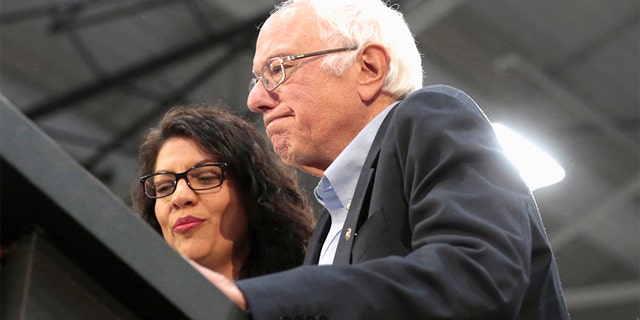
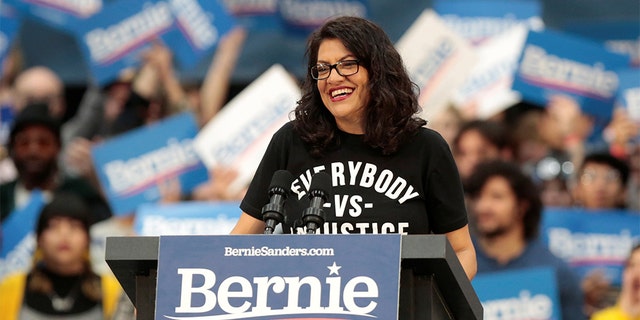
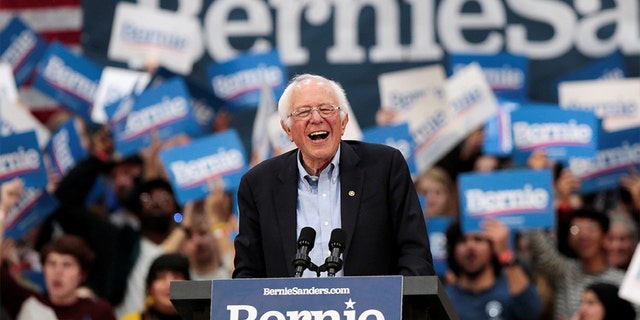
Rep. Rashida Tlaib, D-Mich., became the latest of her fellow “Squad” members to endorse Sen. Bernie Sanders, I-Vt., for president, joining him at a Detroit rally.
"We deserve someone who writes the damn bills," she said, noting Sanders is a man of the people, as Detroit Free Press reported. "We deserve Bernie Sanders."
Tlaib
noted that Sanders is a transformative leader who offers solutions not
beholden to corporations or the mediocre ideologies of the status quo.
"We need
a new vision for American and that's what our campaign is about,"
Sanders said. "The most important and significant opposition we face …
is the limitation to our imaginations.”
Democratic 2020 U.S. presidential candidate Senator Bernie Sanders
and Rep. Rashida Tlaib address the audience during a Sanders campaign
rally in Detroit, Michigan. (REUTERS/Rebecca Cook)
Sanders also took the time to praise Tlaib for her role in representing the party’s progressive wing.
"What
Rashida has been doing in less than one year is become a national
figure, not just in standing up against the vulgarity and ugliness of
Donald Trump, but she has taken on in a very forceful way, the greed and
corruption of the economic establishment and stood up to the political
establishment as well," he said.
Reps. Alexandria Ocasio-Cortez, D-N.Y., and Ilhan Omar., D-Minn., expressed their support for Sanders last week. Ocasio-Cortez
recently appeared alongside Sanders at a major rally in Queens, N.Y.,
that reportedly drew more than 20,000 people. Rep. Ayanna Pressley, D-Mass., is the only "Squad" member who has yet to make an endorsement.
US Representative Rashida Tlaib attends a campaign rally for
Democratic 2020 U.S. presidential candidate Senator Bernie Sanders in
Detroit, Michigan. (REUTERS/Rebecca Cook)
Winning
the OK of the “Squad” members has been viewed as crucial in attracting
young voters, as the top three Democrats in the polls are all senior
citizens — Sanders is 78, former Vice President Joe Biden is 76 and
Warren is 70 years old.
Democratic 2020 U.S. presidential candidate Senator Bernie Sanders
holds a campaign rally in Detroit, Michigan. (REUTERS/Rebecca Cook)
Rep. Katie Hill,
D-Calif., announced her resignation Sunday after a string of reports
shining a negative light on her personal life, including a reported
affair with her legislative director that sparked a House Ethics Committee investigation.
Hill tweeted
on Sunday evening, “It is with a broken heart that today I announce my
resignation from Congress. This is the hardest thing I have ever had to
do, but I believe it is the best thing for my constituents, my
community, and our country.” She is expected to step down by the end of
this week.
The congresswoman last week had fought back against
reports of an affair with the congressional staffer, as well as reports
she was in a so-called “throuple” relationship with husband Kenny
Heslep and a campaign staffer.
House Speaker Nancy Pelosi,
D-Calif., issued a statement saying, “Congresswoman Katie Hill came to
Congress with a powerful commitment to her community and a bright vision
for the future, and has made a great contribution as a leader of the
Freshman class.”
“She has acknowledged errors in judgment that
made her continued service as a member untenable,” Pelosi wrote. “We
must ensure a climate of integrity and dignity in Congress, and in all
workplaces.”
This past Thursday, the political fallout for Hill escalated as more compromising photos
of the freshman lawmaker surfaced. The Daily Mail published one photo
of what appeared to be Hill undressed and holding a bong, and another of
her kissing the campaign staffer.
The photos emerged shortly
after the conservative website RedState.org posted screenshots of
several text messages between Hill and the staffer detailing the
reported end of their three-person relationship earlier this year and reported on intimate pictures including a nude photo of Hill brushing the staffer’s hair.
According to the texts that were shown, Hill wanted to focus on her work and suggested that “political risk” was a factor.
Fox News has not verified the authenticity of the photos.
Hill,
in the letter announcing her resignation, wrote: “This is what needs to
happen so that the good people who supported me will no longer be
subjected to the pain inflicted by my abusive husband and the brutality
of hateful political operatives who seem to happily provide a platform
to a monster who is driving a smear campaign built around cyber
exploitation.”
She continued, “Having private photos of personal
moments weaponized against me has been an appalling invasion of my
privacy. It’s also illegal, and we are currently pursuing all of our
available legal options.”
Hill, an openly bisexual congresswoman
and the vice chairwoman of the powerful House Oversight Committee,
admitted Wednesday she had an “inappropriate” relationship with the
female campaign staffer.
In
a letter sent to constituents on Wednesday and obtained by Fox News,
Hill acknowledged that in the final years of what she called an “abusive
marriage,” she began a relationship with the unnamed campaign staffer.
Heslep filed for divorce from Hill earlier this year.
“I
am going through a divorce from an abusive husband who seems determined
to try to humiliate me,” Hill said in her statement last week. “I am
disgusted that my opponents would seek to exploit such a private matter
for political gain. This coordinated effort to try to destroy me and the
people close to me is despicable and will not succeed. I, like many
women who have faced attacks like this before, am stronger than those
who want me to be afraid.”
RedState also reported earlier this
month that Hill had an extramarital affair with Graham Kelly, her
legislative director and former campaign finance director, for at least a
year. Heslep was said to have shared his own screenshot of a text
exchange he had with a friend who had heard about the affair; it was
later deleted from his Facebook account.
The reported affair with a congressional staffer prompted the House Ethics Committee investigation.
According to RedState, the alleged affair was why Heslep filed for divorce. Hill has denied the affair with Kelly.
RedState
also published a series of purported late-night texts in which Heslep
called into question Hill’s drinking. Other texts showed the female
staffer involved in the “throuple” expressing concerns about Hill's
drinking.
“I know that as long as I am in Congress, we’ll live
fearful of what might come next and how much it might hurt,” Hill wrote
in Sunday’s statement. “That’s a feeling I know all too well. It’s the
feeling I decided to leave when I left my marriage, and one I will not
tolerate being forced upon others. I can no longer allow my community,
family, friends, staff, supporters, and especially the children who look
up to me as a role model, to suffer this unprecedented brand of
cruelty.”
She went on to apologize.
“For the mistakes made
along the way and the people who have been hurt, I am so sorry, and I am
learning – I am not a perfect person and never pretended to be. It’s
one of the things that made my race so special,” Hill wrote. “I hope it
showed others that they do belong, that their voice does matter, and
that they do have a place in this country.”
The Republican
challengers for Hill's congressional seat have pounced on the
controversy as they sought to win back one of the many districts the
Democrats took in the 2018 midterm elections.
“Katie Hill did the
right thing by resigning from Congress,” challenger Mike Garcia said in a
statement Sunday. “The past week has been a complete distraction from
the important work that needs to be done, and it’s time for our district
to move forward and unite around a leader.”
In a statement
reacting to Hill’s resignation, Angela Underwood-Jacobs, a Republican
council member in Lancaster, Calif., said Hill “blatantly violated the
trust of voters of the 25th District which is why I was the first of her
opponents to call on her to resign.”
Another GOP candidate, Mark
Cripe, said in a statement that the news of Hill’s resignation “affords
California’s 25th district an opportunity to move forward in a positive
direction, with new representation that better hears and supports all
the families of Antelope, Santa Clarita, and Simi valleys.”
George Papadopoulos,
the former foreign policy adviser for President Trump who served 12
days in federal prison for lying to federal investigators, also weighed
in on Hill's controversy. Papadopoulos, who recently moved to California
with his wife, has stirred speculation that he might challenge Hill for
her seat in 2020.
“I’m smelling blood in the water now that Katie Hill has resigned,” Papadopoulos tweeted
Sunday. “California’s 25th congressional district is wide open for the
taking. Someone has to step up. I love my state too much to see it run
down by candidates like Hill. All talk, no action, and a bunch of sell
outs.” Fox News’ Mike Arroyo, Ben Florance, Kevin Kirby, Chad Pergram and Andrew O’Reilly contributed to this report.
President Trump's successful operation
to take out Islamic State leader Abu Bakr al-Baghdadi sent Democrats
scrambling on Sunday, as several top party leaders had complained
publicly in recent days that the White House had no "real plan" to combat the terror group following the U.S. pullout in Syria.
In
a dramatic sign of how Democrats' messaging apparently backfired, NBC's
"Saturday Night Live" ran an ill-timed sketch suggesting that Trump had
created "jobs" for ISIS -- just hours before the president held a news
conference announcing al-Baghdadi's demise. The sketch aired around the
time the two-hour late-night raid in northwest Syria was underway.
"It's
genuinely fascinating watching Democrats in real-time struggle to
figure out what to say about this," journalist Glenn Greenwald wrote on
Sunday. "They want to be patriotic and anti-ISIS, but also need a way to
malign Trump without contradicting their gushing Obama praise over
[Usama bin Laden]: not an easy balancing act. Good luck!"
Through
the day, the Democrats -- including House Speaker Nancy Pelosi, Senate
Foreign Relations Committee ranking member Bob Menendez and former Vice
President Joe Biden -- seemingly settled on a new strategy. They praised
the troops who executed the historic raid, while pointedly avoiding
complimenting the president in any way.
Congressional Democrats
also lamented that they were not informed in advance of the operation,
while the Russian military was told so that their airspace could be
used. The president suggested Sunday that Democrats in Congress, who
have been conducting an impeachment inquiry against him that has been fraught with leaked information to the media, were not notified before the raid because of concerns they might compromise the operation with leaks.
"I
congratulate our special forces, our intelligence community, and all
our brave military professionals on delivering justice to the terrorist
Abu Bakr al-Baghdadi," Biden, one of the many Democrats seeking to
unseat Trump in 2020, said. He went on to call on Trump to "keep up the
pressure to prevent ISIS from ever regrouping or again threatening the
United States."
Pelosi, meanwhile, praised the "heroism,
dedication and skill of our military and our intelligence professionals
and acknowledge the work of our partners in the region," then condemned
Trump's "green-lighting of Turkish aggression into Syria against our
Kurdish partners."
However, in May 2011, when President Obama announced Usama bin Laden's death, Pelosi, D-Calif., was much less reluctant to praise the commander-in-chief.
"I
salute President Obama, his national security team, Director Panetta,
our men and women in the intelligence community and military, and other
nations who supported this effort for their leadership in achieving this
major accomplishment," Pelosi said at the time.
Some
commentators also noted that The Washington Post also had applied a
different standard on Sunday than it did when bin Laden was killed. "Abu
Bakr al-Baghdadi, austere religious scholar at helm of Islamic State,
dies at 48," read a head-turning, since-changed headline in the Post.
The
sympathetic obituary described the terror leader as “a shy, nearsighted
youth who liked soccer but preferred to spend his free time at the
local mosque” and noted that "despite the group’s extremist views and
vicious tactics, Mr. Baghdadi maintained a canny pragmatism as leader."
But in 2011, the Post's headline announcing bin Laden's death flatly called him the leader of a "terrorist group."
In
her statement Sunday, Pelosi further demanded that the "House must be
briefed on this raid, which the Russians but not top congressional
leadership were notified of in advance, and on the administration’s
overall strategy in the region."
That was a line of attack that
had already resonated among progressive commentators and journalists on
Twitter. CNBC reporter John Harwood remarked: "Trump didn’t give Pelosi
advance word, indicating he didn’t trust her to keep intel secrets
Pelosi was ranking Dem on Intel Committee. ... Trump gave top Russian
officials classified info in Oval Office."
For his part, Menendez,
D-N.J., on Sunday also steered clear of praising or saluting Trump, and
instead exalted "our men and women in uniform who successfully executed
the attack on a brutal murderer who mercilessly killed Americans,
terrorized populations across the Middle East, and threatened regional
peace and security."
The operation, Menendez said, "is a testament
to the courage of our military who put their lives at risk every day to
protect our nation, and a sobering reminder of the importance of
sustained American leadership with reliable and capable partners on the
ground, including the Syrian Democratic Forces and Iraqi military."
Republicans,
on the other hand, called the ISIS leader's death the culmination of
the Trump administration's campaign against the terror group. The
so-called ISIS caliphate that dominated Iraq has largely crumbled under a
withering barrage of airpower from U.S. and allied forces in the
region.
GOP Tennessee Rep. Mark Green, a member of the House
Homeland Security Committee, praised the soldiers who carried out the
raid, then added: "Of course, I commend the president. I mean, we got
one bada-- president to make this kind of decision, and his statement
this morning was awesome. It was awesome."
"We got one bada-- president to make this kind of decision, and his statement this morning was awesome. It was awesome." — GOP Tennessee Rep. Mark Green
Other Republicans echoed that sentiment, although with somewhat less colorful language.
"President
Trump and the Trump administration had already largely decimated and
destroyed ISIS -- the body of the snake," GOP Texas Rep. John Ratcliffe
told Fox News' "Sunday Morning Futures." "But, yesterday they cut off the head of the snake in killing Baghdadi. "
Georgia
GOP Rep. Doug Collins, the top Republican on the House Judiciary
Committee, suggested Trump's decision not to inform congressional
Democrats in advance of the raid was sound.
"Anybody who looks to
ISIS right now ought to look to their leader who went pretty, cowered in
a corner and blew himself up," Collins said. He added that the "bigger
story" was that Trump "can't get information from his own intel
committee about Syria. It goes to show you that this president who has
been attacked and who has been harassed by an impeachment probe for the
last 10 months, while all of this is going on in the House... this
president... kept his eye on the ball."
The spin commenced
immediately after Trump's speech to the nation Sunday morning, when he
announced that the ISIS leader -- a notorious murderer and rapist whom
Trump called a "gutless animal" -- had died "in a vicious and violent
way, as a coward, running and crying.”
al-Baghdadi detonated an
explosive vest as U.S. Special Operations Forces stormed his compound in
the Idlib Province, Trump said, killing him and three of his children.
"No
personnel were lost in the operation, while a large number of
Baghdadi’s fighters and companions were killed with him," Trump
announced, adding that the U.S. recovered "highly sensitive" materials
related to ISIS. "You are the very best anywhere in the world," Trump
later said of the U.S. forces.
Trump said al-Baghdadi died while
being chased down by U.S. forces in a tunnel, and that the ISIS leader
was "whimpering and crying and screaming all the way."
BEIRUT
(AP) — The Islamic State group erupted from the chaos of Syria and
Iraq’s conflicts and swiftly did what no Islamic militant group had done
before, conquering a giant stretch of territory and declaring itself a
“caliphate.”
Its territorial rule, which at
its height in 2014 stretched across nearly a third of both Syria and
Iraq, ended in March with a last stand by several hundred of its
militants at a tiny Syrian village on the banks of the Euphrates near
the border with Iraq.
But the militants have
maintained a presence in both countries, and their shadowy leader Abu
Bakr al-Baghdadi had continued releasing messages urging them to keep up
the fight. U.S. officials said late Saturday that he was the target of
an American raid in Syria and may have died in an explosion.
Here are the key moments in the rise and fall of the Islamic State group:
___
April
2013 — Abu Bakr al-Baghdadi, the leader of al-Qaida’s branch in Iraq,
announces the merger of his group with al-Qaida’s franchise in Syria,
forming the Islamic State in Iraq and the Levant.
___
2014
January
— Al-Baghdadi’s forces overrun the city of Fallujah in Iraq’s western
Anbar province and parts of the nearby provincial capital of Ramadi. In
Syria, they seize sole control of the city of Raqqa after driving out
rival Syrian rebel factions, and it becomes their de facto capital.
___
February
— Al-Qaida leader Ayman al-Zawahri disavows al-Baghdadi after the Iraqi
militant ignores his demands that IS leave Syria.
___
June
— IS captures Mosul, Iraqi’s second-largest city, and pushes south as
Iraqi forces crumble, eventually capturing Saddam Hussein’s hometown of
Tikrit and reaching the outskirts of Baghdad. When they threaten Shiite
holy sites, Iraq’s top Shiite cleric issues a call to arms, and masses
of volunteers, largely backed and armed by Iran, join militias.
___
June
29 — The group renames itself the Islamic State and declares the
establishment of a self-styled “caliphate,” a traditional model of
Islamic rule, in its territories in Iraq and Syria. Al-Baghdadi is
declared the caliph.
___
July
4 — Al-Baghdadi makes his first public appearance, delivering a Friday
sermon in Mosul’s historic al-Nuri Mosque. He urges Muslims around the
world to swear allegiance to the caliphate and obey him as its leader.
___
August
— IS captures the town of Sinjar west of Mosul and begins a systematic
slaughter of the tiny Yazidi religious community. Women and girls are
kidnapped as sex slaves; hundreds remain missing to this day.
___
Aug. 8 — The U.S. launches its campaign of airstrikes against IS in Iraq.
___
Sept. 22 — The U.S.-led coalition begins an aerial campaign against IS in Syria.
___
2015
January
— Iraqi Kurdish fighters, backed by U.S.-led airstrikes, drive IS out
of several towns north of Mosul. In Syria, Kurdish fighters backed by
U.S. airstrikes repel an IS onslaught on the town of Kobani on the
border with Turkey, the first significant defeat for IS.
___
April 1 — U.S.-backed Iraqi forces retake Tikrit, their first major victory against IS.
___
May 20 — IS captures the ancient Syrian town of Palmyra, where the extremists later destroy archaeological treasures.
___
2016
Feb.
9 — Iraqi forces recapture Ramadi after months of fighting and at
enormous cost, with thousands of buildings destroyed. Almost the entire
population fled the city.
___
June 26 — Fallujah is declared liberated by Iraqi forces after a five-week battle.
___
July
3 — IS sets off a gigantic suicide truck bomb outside a Baghdad
shopping mall, killing almost 300 people, the deadliest attack in Iraq
since the 2003 U.S.-led invasion.
___
Oct. 17 — Iraqi Prime Minister Haider al-Abadi announces the start of the operation to liberate Mosul.
___
Nov.
5 — The U.S.-backed, Kurdish-led Syrian Democratic Forces launch
Operation Euphrates Wrath, the first of five operations aiming to retake
Raqqa, starting with an encircling of the city.
___
2017
Jan. 24 — Al-Abadi announces eastern Mosul has been “fully liberated.”
___
May
10 — SDF captures the strategic Tabqa dam after weeks of battles and a
major airlift operation that brought SDF fighters and their U.S.
advisers to the area. The fall of the dam facilitated the push on Raqqa,
about 40 kilometers (25 miles) away.
___
June 6 — SDF fighters begin an attack on Raqqa from three sides, backed by U.S.-led coalition airstrikes.
___
June 18 — Iraqi forces launch battle for Mosul’s Old City, the last IS stronghold there.
___
June
21 — IS destroys Mosul’s iconic al-Nuri Mosque and its 12th century
leaning minaret as Iraqi forces close in, according to Iraqi and
coalition officials.
__
July 10 — Iraqi prime minister declares victory over IS in Mosul and end of the extremists’ caliphate in Iraq.
___
Oct. 17 — SDF takes full control of Raqqa after months of heavy bombardment that devastates the city.
___
September-December
—Syrian government forces, backed by Russian air power and Iranian
forces, recapture IS territory on the western bank of the Euphrates
River, seizing the cities of Deir el-Zour, Mayadin and Boukamal on the
border with Iraq.
___
2018
Aug.
23 — IS leader al-Baghdadi resurfaces in his first purported audio
recording in almost a year; he urges followers to “persevere” and
continue fighting.
___
Sept.
10 — SDF launches a ground offensive, backed by U.S.-led coalition
airstrikes, to take the last territory held by IS in Syria’s eastern
province of Deir el-Zour.
___
2019
March 23 — SDF declares the complete capture of Baghouz and the end of the Islamic State group’s territorial “caliphate.”
Oct.
27 — The White House says President Donald Trump plans to make a “major
announcement” after U.S. officials say al-Baghdadi was the target of an
American raid in Syria’s northwestern Idlib province. The officials say
confirmation of his death in an explosion is pending.
WASHINGTON (AP) — An ex-White House adviser
scheduled to testify before House impeachment investigators on Monday
has asked a federal court whether he should comply with a subpoena or
follow President Donald Trump’s directive against cooperating in what
the president dubs a “scam.”
Full Coverage: Trump impeachment inquiry
After getting a subpoena Friday, former deputy national security adviser Charles Kupperman quickly filed a lawsuit
in U.S. district court in Washington. He asked a judge to decide
whether he should accede to House demands for his testimony or to assert
“immunity from congressional process” as directed by Trump.
The
lawsuit came as Democrats’ impeachment inquiry continued at full speed
with a rare Saturday session. Philip Reeker, the acting assistant
secretary of state for Europe, took questions behind closed doors for
more than eight hours about Trump’s ouster of the ambassador of Ukraine
in May and whether he had knowledge about efforts to persuade Ukraine to
pursue politically motivated investigations. Reeker told the lawmakers
that he was disturbed by a campaign — led by Trump — to oust ambassador
Marie Yovanovitch in May and had supported efforts to publicly back her,
even though those statements were ultimately never issued by the
department.
Kupperman, who provided foreign policy advice
to the president, was scheduled to testify in a similar session on
Monday. In the lawsuit, Kupperman said he “cannot satisfy the competing
demands of both the legislative and executive branches.” Without the
court’s help, he said, he would have to make the decision himself — one
that could “inflict grave constitutional injury” on either Congress or
the presidency.
The impeachment inquiry
is rooted in a July 25 phone call Trump made to Ukrainian President
Volodymyr Zelenskiy. During the call, Trump asked the Ukrainian leader
to pursue investigations of Democratic political rival Joe Biden’s
family and Ukraine’s role in the 2016 election that propelled Trump into
the White House.
At the time of the call,
Trump was withholding congressionally approved military aid for Ukraine.
He has repeatedly said there was no quid pro quo for the Ukraine
investigations he was seeking, though witness testimony has contradicted
that claim.
Kupperman’s filing says “an
erroneous judgment to abide by the President’s assertion of testimonial
immunity would unlawfully impede the House from carrying out one of its
most important core Constitutional responsibilities” — the power of
impeachment — and subject Kupperman to “potential criminal liability for
contempt of Congress.”
On the other hand,
“an erroneous judgment to appear and testify in obedience to the House
Defendants’ subpoena would unlawfully impair the President in the
exercise of his core national security responsibilities ... by revealing
confidential communications” from advisers, according to the filing.
He
has asked the court to expedite a decision, but unless the judge issues
an opinion by Monday, Kupperman’s testimony might not occur as
scheduled.
Rejecting his arguments, the
three chairmen of the House committees overseeing the inquiry told
Kupperman’s lawyers in a letter that the suit was without merit and
appeared to be coordinated with the White House. They called the suit
“an obvious and desperate tactic by the President to delay and obstruct
the lawful constitutional functions of Congress and conceal evidence
about his conduct from the impeachment inquiry.”
The
chairmen also said Kupperman’s defiance of the subpoena would
constitute evidence in a contempt proceeding as well as additional
evidence of Trump’s obstruction of the inquiry. They said they planned
to proceed with the Monday session as scheduled.
The
lawsuit came as Democrats investigating the president won a victory in a
separate case. A federal judge ordered the Justice Department on Friday
to give the House secret grand jury testimony from special counsel
Robert Mueller’s Russia investigation and affirmed the legality of the
Democrats impeachment inquiry. That decision could inform Kupperman’s
suit.
On Saturday, Trump tweeted that he’s “not concerned with the impeachment scam. I am not because I did nothing wrong.”
In
the House deposition, according to a person familiar with the
testimony, Reeker told the lawmakers he was disturbed by the effort to
oust Yovanovitch, and had supported efforts by some officials in the
department to put out statements of support for her in both March, right
before she was ousted, and in September, after the effort became
public. The person, like others, requested anonymity to discuss the
confidential testimony.
In both cases,
Reeker testified that the officials were told by Undersecretary for
Political Affairs David Hale that there would not be a statement,
according to the person.
Reeker also told
the lawmakers that he knew the military aid for Ukraine was being
delayed and that a White House meeting between Trump and Zelinskiy was
being delayed, but in both cases, didn’t know why, according to two
people familiar with the testimony.
While Reeker had some visibility into the matter, Ukraine is only one country in his portfolio of 50, he told investigators.
Lawmakers
leaving the meeting with Reeker said he was backing up testimony from
previous witnesses, most all of whom have detailed concerns with Trump’s
efforts to oust Yovanovitch and said they were wary of Rudy Giuliani,
Trump’s personal lawyer who was driving the push for the Ukrainian
probes.
Washington Rep. Denny Heck, a member
of the House intelligence panel, would not give details about the
closed-door interview but said, “It’s almost startling how much in
alignment all of the witnesses to date have been, in terms of their
affirmation of the fact pattern. I’m almost taken aback by it.”
As
was the case with other witnesses, the Trump administration directed
Reeker not to testify, according to two people familiar with the
situation who spoke on condition of anonymity because they were not
authorized to publicly discuss the interaction. But Reeker appeared
anyway after receiving his subpoena from the House, the people said.
Although
he is currently the top U.S. diplomat for Europe and has been since
Yovanovich was recalled earlier this year, Reeker was not directly
involved in debate over aid to Ukraine, which other current and former
officials have said was delegated to Ambassador to the European Union
Gordon Sondland and special envoy Kurt Volker.
Volker
testified and released text messages that detailed conversations
between him, Sondland and William Taylor, the top U.S. diplomat in
Ukraine. In the messages, Taylor wrote that he thought it was “crazy” to
withhold aid from Ukraine for help with a political campaign. Sondland
and Taylor, who still work for the government, have already testified
and detailed their concerns about the influence of Trump’s personal
lawyer, Rudy Giuliani, on Ukraine. Giuliani was leading the push for the
investigations.
Taylor testified that he was told the aid would be withheld until Ukraine conducted the investigations that Trump had requested.
___
Associated Press writers Alan Fram and Eric Tucker contributed to this report.
2020 Democratic presidential hopeful Pete Buttigieg
called for eliminating incarceration for drug possession offenses as
part of his criminal justice reform plan released Saturday.
The
South Bend, Indiana mayor rolled out his plan, titled “Securing
Justice,” and is focused on “rebalancing” and “refocusing” the criminal
system in the U.S., and reducing mass incarceration, as well as racial
disparities.
“It
is past time to transform the criminal legal system to one that truly
promotes justice, and benefits all of us,” Buttigieg said.
Buttigieg
plans to reduce the number of people incarcerated in the U.S. at both
the federal and state level by 50 percent. As part of that effort,
Buttigieg said he would prioritize funding for programs aimed at
pretrial reforms, decarceration, and expansion of alternative to
incarceration programs.
As part of the incarceration reduction
plan, Buttigieg said on the federal level, he would eliminate
incarceration for drug possession, reduce sentences for other drug
offenses, and apply the reductions “retroactively.” Buttigieg said he
also would legalize marijuana and “expunge past convictions.”
Buttigieg’s
plan also would eliminate mandatory minimums and would establish an
“independent clemency commission” outside of the Justice Department.
In
addition, Buttigieg said he would “abolish private federal prisons and
reduce the use of private contractors,” as well as work with states to
“cap the amount of revenue cities and counties receive from fines and
fees.”
The plan would also aim to promote justice for youth, with
federal support to state efforts to abolish youth prisons and replace
them with community-based programs. Buttigieg said he would invest in a
new $100 million federal competitive grant program for states and
localities to close those prisons, and “repurpose them to serve the
needs of children.”
Buttigieg
also said he would support a constitutional amendment to abolish the
death penalty; while also ensuring that detention facilities have
medical treatment and appropriate conditions for trans and gender
non-conforming inmates.
Buttigieg is one of nine Democrats slated
to speak at the Second Step Forum in Columbia, South Carolina on
Saturday—a criminal justice reform forum.
2020 presidential
hopeful Sen. Kamala Harris, D-Calif., is boycotting that event, after
the organization gave President Trump an award for his successful
passage of the “First Step Act,” which grants earlier release to
thousands of nonviolent offenders who are currently serving time in
federal prisons.
The Trump criminal justice reform legislation received bipartisan support before Trump signed it into law. Fox News' Kelly Phares contributed to this report.
ISIS leader Abu Bakr al-Baghdadi is dead, sources have confirmed to Fox News.
Al-Baghdadi,
who took over ISIS after his predecessor Abu Omar al-Baghdadi was
killed in 2010, detonated a suicide vest, killing himself when U.S.
Special Operations forces entered a compound in northern Syria where he
was located, according to a U.S. defense official. No U.S. Special
Operations forces were hurt or killed in the raid.
“U.S. forces
did a terrific job,” a U.S. military source told Fox News.“This just
shows it may take time but terrorists will not find a sanctuary.” The
same source told Fox News that biometric tests confirmed that it was
indeed Baghdadi.
The compound was located near the Turkish border
in northwest Syria’s Idlib Province, a known terrorist stronghold that
has served as a home to groups linked to al-Qaeda. Al-Baghdadi had long
been suspected to be hiding in the Idlib Province.
Mazloum Adbi,
General Commander of the Kurdish-led Syrian Democratic Forces, touted a
“historical operation” in a tweet Sunday morning, crediting “joint
intelligence work with the United States of America.”
Regarding
Mazloum’s claim of Kurdish assistance in the operation, a U.S. military
source simply told Fox News, “the Kurds have always been good partners.”
SAN FRANCISCO (AP) — A wildfire in California
wine country that may have been caused by a high-voltage transmission
line called into question Pacific Gas & Electric’s strategy of
selectively cutting off power in windy weather to prevent blazes and
could force it to resort to even bigger blackouts affecting millions as
early as this weekend.
The repeated
shut-offs and the prospect of longer and more widespread ones brought
anger down on the utility from the governor and ordinary customers.
“We
will hold them to account,” warned Gov. Gavin Newsom, who has
repeatedly blasted PG&E — the nation’s largest utility — for what he
calls years of mismanagement and underinvestment that have left its
grid less resilient.
Twice
over the past two weeks, PG&E has cut power to large areas of
northern and central California to reduce the risk of its equipment
sparking fires. Nearly 2 million people lost electricity earlier this
month, and then as many as a half-million this week.
But
PG&E’s decision to shut down distribution lines but not
long-distance transmission lines may have backfired this time when a blaze erupted near the Sonoma County wine country town of Geyserville.
The
fire burned at least 49 buildings and 34 square miles (65 square
kilometers) and prompted evacuation orders for some 2,000 people. No
serious injuries were reported.
PG&E said a live, 230,000-volt transmission
line near Geyserville had malfunctioned minutes before the fire erupted
Wednesday night, and a broken “jumper” wire was found on a transmission
tower.
PG&E Corp. CEO Bill Johnson said
it was too soon to say whether the faulty equipment sparked the fire.
He said the tower had been inspected four times in the past two years
and appeared to have been in excellent condition.
But PG&E stock plummeted 31 percent on the news. And the blaze could mean wider blackouts ahead.
“It’s
kind of a logical next step to say, ‘Well, if our high-voltage
transmission lines are at risk, we’ve got to shut those down too,’” said
Alan Scheller-Wolf, professor of operations management and an energy
expert at Carnegie Mellon University.
PG&E, he said, “can’t win.”
The utility acknowledged that the discovery of the tower malfunction already had prompted a change in its strategy.
“We
have revisited and adjusted some of our standards and protocols in
determining when we will de-energize high-voltage transmission lines,”
Andrew Vesey, CEO of Pacific Gas & Electric Co., said at a briefing
Friday night.
With dangerously high winds in
the forecast this weekend, the utility said it is planning another
major shutdown that could hit more than 2 million people throughout the
region starting Saturday afternoon and last up to two days.
The
preparations came as firefighters simultaneously battled flames in both
Northern and Southern California: the fire amid Sonoma County’s
vineyards, and a wind-whipped blaze that destroyed at least six homes in
the Santa Clarita area near Los Angeles and led to evacuation orders
covering an estimated 50,000 people.
The
possible link between the wine country fire and a PG&E transmission
line contained grim parallels to the catastrophic fire last year that
tore through the town of Paradise, killing 85 people and destroying
thousands of homes in the deadliest U.S. fire in a century. State
officials concluded that fire was sparked by a PG&E transmission
line.
The line that failed this week is
newer and should have been more robust, said Michael Wara, director of
the climate and energy program at Stanford University. Its failure will
probably make PG&E more cautious, which means more widespread
blackouts, he said.
“There’s going to be more collateral damage,” Wara said.
Turning
off big transmission lines reduces the stability of the electrical
grid, leading to bigger outages, Wara said. Transmissions lines also
take longer to re-energize because everything connected to them must be
inspected, he said.
PG&E’s CEO has said it will take about a decade before widespread outages aren’t necessary.
Minimizing
blackouts will require PG&E to harden its grid with stronger poles
and newer equipment less likely to fall or spark. Cameras, weather
sensors and a more segmented grid would allow the company to target
blackouts to areas in the most danger.
PG&E
began resorting to large-scale shut-offs after its equipment was blamed
for several blazes in recent years that killed scores of people, burned
thousands of homes and ran up billions of dollars in claims that drove
the utility into bankruptcy, where it is still trying to put its
finances in order.
The repeated and
sometimes lengthy blackouts have frustrated Californians contending with
uncertainty, spoiled food and disrupted plans. Many have complained
about poor communication from the power company.
“I feel like we’re being held hostage for their failings and their incompetence,” said Logan Martin, 55, of Santa Rosa.
This
year’s fire season in California has so far been mild, with fewer
deaths and fewer acres burned following two years of deadly
conflagrations.
Experts say it is impossible
to know how much the blackouts contributed to that, but PG&E has
cited numerous instances of wind damage to its equipment that it said
could have caused fires if the lines had been electrified.
Losing
power doesn’t put a huge burden on firefighters, but they need to know
outages are coming so they can install generators where needed, such as
pumps for retardant, said Thom Porter, chief of the California
Department of Forestry and Fire Protection.
Firefighters
sometimes draw water from rural water systems that use electrical
pumps, but there have been no reports of problems getting water to fight
either of the major blazes burning in California now.
___
This story has been corrected to show that nearly 2 million people lost electricity earlier this month, not 2.5 million.
___
Cooper
reported from Phoenix. Associated Press writers Jocelyn Gecker and
Juliet Williams in San Francisco and Stefanie Dazio in Los Angeles
contributed.


 Democratic 2020 U.S. presidential candidate Senator Bernie Sanders
and Rep. Rashida Tlaib address the audience during a Sanders campaign
rally in Detroit, Michigan. (REUTERS/Rebecca Cook)
Democratic 2020 U.S. presidential candidate Senator Bernie Sanders
and Rep. Rashida Tlaib address the audience during a Sanders campaign
rally in Detroit, Michigan. (REUTERS/Rebecca Cook)
 US Representative Rashida Tlaib attends a campaign rally for
Democratic 2020 U.S. presidential candidate Senator Bernie Sanders in
Detroit, Michigan. (REUTERS/Rebecca Cook)
US Representative Rashida Tlaib attends a campaign rally for
Democratic 2020 U.S. presidential candidate Senator Bernie Sanders in
Detroit, Michigan. (REUTERS/Rebecca Cook)
 Democratic 2020 U.S. presidential candidate Senator Bernie Sanders
holds a campaign rally in Detroit, Michigan. (REUTERS/Rebecca Cook)
Democratic 2020 U.S. presidential candidate Senator Bernie Sanders
holds a campaign rally in Detroit, Michigan. (REUTERS/Rebecca Cook)


