OAN Newsroom
UPDATED 1:50 PM PT — Tuesday, November 5, 2019
New documents have revealed a massive lobbying effort at the
Obama-era State Department by Ukrainian energy company Burisma. The
newly released State Department documents show Joe Biden pressured the
Ukrainian government to fire its top prosecutor back in 2016, which is
about a month after Burisma reached out to the agency.
The company employed Biden’s son Hunter and was under an
investigation by prosecutor Viktor Shokin at the time. Ukraine suspected
Burisma executives of money laundering and corruption.
Awkward
Emails show Burisma lobbyists requesting meeting in early 2016 with
Obama administration to discuss corruption investigation involving
Hunter Biden pic.twitter.com/jl7ogTBxOk
— Jack Posobiec (@JackPosobiec) November 5, 2019
Republican lawmakers have said the so-called whistleblower may have ties to Biden’s alleged corruption schemes.
“The whistleblower, actually, is a
material witness completely separate from being the whistleblower
because he worked for Joe Biden. He worked for Joe Biden at the same
time Hunter Biden was receiving $50,000 a month. So, the investigation
into the corruption of Hunter Biden involves this whistleblower because
he was there at the time. Did he bring up the conflict of interest? Was
there discussion of this? What was his involvement with the relationship
between Joe Biden and the prosecutors?” — Sen. Rand Paul (R-Ky.)
Meanwhile, Ukrainian officials have said the only reason Biden sat on
Burisma’s board was to “protect” the company from scrutiny.
It’s time for:
*Joe Biden and John Kerry to come clean about the full nature of the access Hunter was able to secure for Burisma
AND
*House Democrats must release all of the transcripts from their closed-door depositions immediatelyhttps://t.co/rEtwSAYEmc
— GOP (@GOP) November 5, 2019
President Trump said it’s time for Mexico to wage war on the
country’s drug cartels with the help of the U.S. In a series of tweets
Tuesday, the president weighed in on the recent killing of an American
family in Northern Mexico. It happened Monday about 70 miles from the
U.S. border.
The suspected cartel attack left at least six children and three
women dead as well as several others injured. Five of the victims were
discovered in a charred SUV and four others were found in a separate
unidentified location. President Trump has called the killings “vicious”
and assured the U.S. stands ready to get involved in efforts to battle
the dangerous cartels.
….monsters, the United States stands ready,
willing & able to get involved and do the job quickly and
effectively. The great new President of Mexico has made this a big
issue, but the cartels have become so large and powerful that you
sometimes need an army to defeat an army!
President
Donald Trump speaks to members of the media on the South Lawn of the
White House in Washington, Monday, Nov. 4, 2019, before boarding Marine
One for a short trip to Andrews Air Force Base, Md., and then on to
Lexington, Ky., for a campaign rally. (AP Photo/Patrick Semansky)
Family members of the victims say they are in complete shock.
“We just can’t believe that this has
actually happened to our family, this seems like a bad dream. We just
knew their vehicle was on fire and there was bullet holes all around it,
and that they were all dead. My sister was in one with nine of her
children, and then my sister was in one with her baby.” — Leah Staddon,
family member to victims
Surviving family members say they are in touch with the American
consulate in Mexico as local authorities continue to investigate the
attack.
LOUISVILLE, Ky.
(AP) — Kentucky’s bitter race for governor went into overtime as
Democrat Andy Beshear declared victory while Republican Gov. Matt Bevin,
a close ally of President Donald Trump, refused to concede with results
showing he trailed by a few thousand votes.
Kentucky has some sorting out to do before inaugurating its next governor.
With
100% of precincts reporting, Beshear — the state’s attorney general and
the son of Kentucky’s last Democratic governor, Steve Beshear — had a
lead of 5,333 votes out of more than 1.4 million counted, or a margin of
nearly 0.4 percentage points. The Associated Press has not declared a
winner.
In competing speeches late Tuesday, Beshear claimed victory while Bevin refused to concede.
“My
expectation is that he (Bevin) will honor the election that was held
tonight,” Beshear said. “That he will help us make this transition. And
I’ll tell you what, we will be ready for that first day in office, and I
look forward to it.”
That first day isn’t far off. Kentucky inaugurates its governors in the December following an election.
Bevin, meanwhile, called the contest a “close, close race” and said he wasn’t conceding “by any stretch.”
“We want the process to be followed, and there is a process,” he said.
Bevin
hinted there might be “irregularities” to look into but didn’t offer
specifics. His campaign didn’t immediately respond to an email seeking
an explanation.
There
is no mandatory recount law in Kentucky. Bevin may request counties
recanvass their results, which is not a recount, but rather a check of
the vote count to ensure the results were added correctly. Bevin would
need to seek and win a court’s approval for a recount.
The
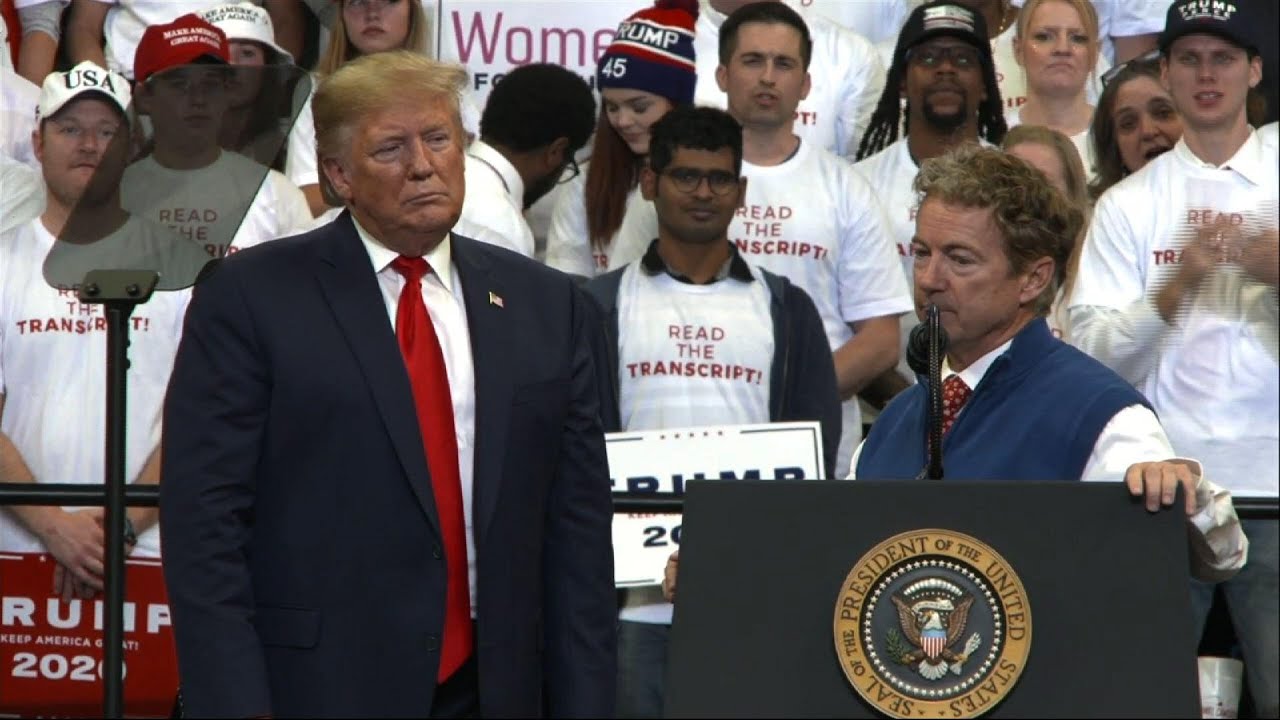
final hours of campaigning were dominated by the endorsement Bevin
received from Trump at a boisterous rally Monday night in Lexington,
Kentucky. Through a spokesman, the president boasted Tuesday night about
the boost he had given the incumbent governor despite Bevin finishing
with fewer votes to his name.
“The
president just about dragged Gov. Matt Bevin across the finish line,
helping him run stronger than expected in what turned into a very close
race at the end,” Trump campaign manager Brad Parscale said in a
statement. “A final outcome remains to be seen.”
Trump
had loomed large in the race as Bevin stressed his alliance with the
Republican president in TV ads, tweets and speeches. Trump carried
Kentucky by a landslide in winning the presidency in 2016 and remains
popular in the state. The president took center stage in the campaign
with his election eve rally to energize his supporters to head to the
polls for his fellow Republican.
But
the combative Bevin had been struggling to overcome a series of
self-inflicted wounds, highlighted by a running feud with teachers who
opposed his efforts to revamp the state’s woefully underfunded public
pension systems.
Bevin
lagged well behind the vote totals for the rest of the GOP slate for
statewide offices. Republican candidates swept Kentucky’s races for
attorney general, secretary of state, auditor, treasurer and agriculture
commissioner.
Meanwhile, the Libertarian candidate for governor, John Hicks, got 2% of the vote.
Beshear
dominated in the state’s urban areas in Louisville and Lexington and
won some traditionally Republican suburban counties in the state’s
northernmost tip, just south of Cincinnati, to offset Bevin’s strength
in rural areas. Beshear also made inroads in eastern Kentucky, winning
several counties in a region where Trump is highly popular.
While
Beshear looks to quickly pivot to governing, he’ll be confronted by a
dominant GOP. Republicans hold overwhelming majorities in the state
legislature.
Beshear
maintained his focus throughout the race on “kitchen table” issues like
health care and education to blunt Bevin’s efforts to hitch himself to
Trump and nationalize the race.
On
health care, Beshear could have an immediate impact by backing away
from a Bevin proposal to attach work requirements to Medicaid benefits
received under the Affordable Care Act. Bevin’s plan for some
“able-bodied” recipients has been challenged in court and is yet to be
enacted, and Beshear has vowed to rescind it.
On
the campaign trail, Beshear also said he wants to legalize casino
gambling, proposing to use that revenue to support public pensions. Some
Republican lawmakers campaigning for Bevin vowed to reject that idea if
it came before them.
Beshear also exploited Bevin’s feud with teachers over pensions and education issues, repeatedly referring to Bevin as a bully.
Beshear said Tuesday night that teachers shared in his victory.
“To
our educators, your courage to stand up and fight against all the
bullying and name calling helped galvanize our entire state,” Beshear
said.
Beshear
proposed a $2,000 across-the-board pay raise for public school teachers
and vowed to submit “an education-first budget” to lawmakers.
School
bus driver Conley McCracken said earlier Tuesday in Bowling Green that
he voted for Bevin the first time. He said school issues turned him away
from the Republican.
“He’s
trying to keep retirement away from a lot of the teachers and school
employees and things of that nature,” the 68-year-old McCracken said.
Trump’s support of Bevin wasn’t enough to get McCracken’s vote a second time around.
“I don’t like the way he’s doing (things), so I changed my mind,” McCracken said.
___
Jonathan Mattise contributed to this article from Bowling Green, Kentucky.
TUCSON, Ariz. (AP)
— After Arizona passed a law that required local police to check the
immigration status of people suspected to be in the country illegally,
the state’s second-largest city wanted to send a message.
The
Democrats who control Tucson designated their town an “immigrant
welcoming city” in 2012, and the police department adopted rules
limiting when officers can ask about the immigration status of people
they encounter.
But
on Tuesday, given the chance to push the envelope further, the heavily
Democratic city voted overwhelmingly not to become an official
“sanctuary city” with more restrictions on how and when police officers
can enforce immigration laws.
The
incongruous result followed a contentious disagreement that divided
progressives between those eager to stand up for immigrants and against
President Donald Trump, and those who said the initiative would bring
nothing more than unintended consequences.
“The
city of Tucson, in all respects except being labeled as such, operates
as a sanctuary city,” Mayor Jonathan Rothschild said in an interview
before the vote.
The
sanctuary initiative, he argued, would have tied the hands of police
even on matters unrelated to immigration while inviting expensive
retaliation from the Trump administration and Republicans in the state
Legislature.
The
Trump administration has fought sanctuary cities and tried to restrict
their access to federal grants. The 9th U.S. Circuit Court of Appeals
ruled in June that the Trump administration could consider cities’
willingness to cooperate in immigration enforcement when doling out law
enforcement money.
Tucson
has a deep history welcoming immigrants. It’s widely credited as the
birthplace of the Sanctuary Movement in the 1980s, an effort by churches
to help refugees from Central America and shield them form deportation.
The
ballot measure was pushed by activists who wanted to give a voice to
Tucson’s Latino community. They said it would have sent the message that
immigrants are safe and protected in Tucson at a time when many are
fearful of Trump’s immigration policies.
“We
have been failed by the city government here,” Zaira Livier, executive
director of the People’s Defense Initiative, which organized the
initiative, told supporters following the vote, according to KOLD-TV.
Tucson politicians say they stand with immigrants, but when the going gets tough, they back down, she said.
“We are here to test you and to tell you that the bare minimum is no longer good enough and we expect better,” Livier said.
The
initiative explicitly aimed to neuter a 2010 Arizona immigration law
known as SB1070, which drew mass protests and a boycott of the state.
Courts threw out much of the law but upheld the requirement for officers
to check immigration papers when they suspect someone is in the country
illegally.
A
handful of Republican state lawmakers have said they would pursue
legislation to punish Tucson. Prior legislation approved by the GOP
Legislature to tie the hands of liberal cities, including Tucson, allows
the state to cut off funding for cities that pass laws conflicting with
Arizona laws.
Meanwhile,
Tucson voters elected their first Latina mayor. Regina Romero will be
the first woman to lead Arizona’s second-largest city after Phoenix,
with a population of about 546,000 people.
Tucson’s
last Hispanic mayor was Estevan Ochoa, who was elected in 1875 — nearly
four decades before Arizona became a state and just 21 years after the
United States bought Southern Arizona, including Tucson, from Mexico in
the Gadsden Purchase.
Romero,
who is on the city council, opposed the sanctuary city initiative,
saying it’s unnecessary given Tucson’s welcoming attitude and policies
toward immigrants.
“I am so proud and so humbled for tonight,” she said in a victory speech.
Thanking her family, she added, “No single person can make history on their own.”
World Series MVP pitcher Stephen Strasburg is not going to put up with the Internet’s “fake news.”
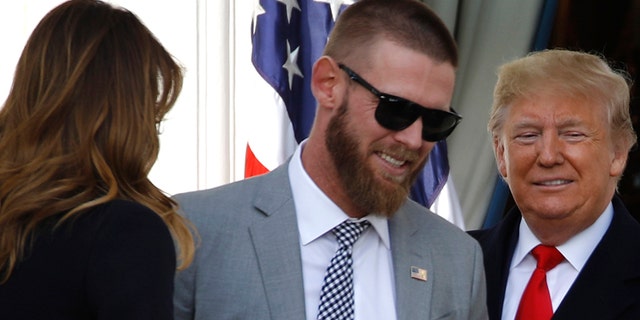
That was the hashtag he used showing a video of him and the Washington Nationals celebrating their victory at the White House with President Trump.
Strasburg had been accused of snubbing Trump in a deceptively trimmed viral video, as USA TODAY reported, so the 31-year-old right-hander tweeted the full video showing him shaking hands with the president.
Strasburg went 5-0 in the MLB postseason as the Nationals won their first world championship in franchise history.
President Trump with Washington Nationals starting pitcher Stephen
Strasburg at Monday's ceremony, with first lady Melania Trump nearby.
(AP Photo/Patrick Semansky)
Strasburg has opted out
of the final four years of his contract, making him a free agent. The
decision meant he was leaving $100 million on the table – with the
prospect of earning more, either from the Nationals or another team.
The Nationals defeated the Houston Astros in seven games to win the World Series this past Wednesday, coming back from a 3-2 series deficit.
They were the first World Series winner with all four victories coming on the road.
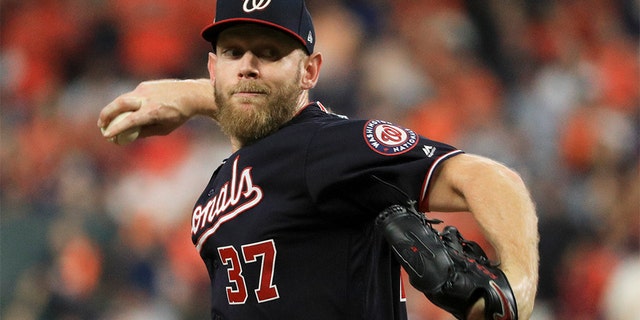
Washington Nationals starting pitcher Stephen Strasburg throwing
against the Houston Astros during the first inning of Game 6 on Oct. 29
in Houston. (AP Photo/Mike Ehrmann, Pool)
The Nationals have been celebrating across D.C. on their whirlwind victory tour.
The team paraded down Constitution Avenue on Saturday and celebrated at the Washington Capitals hockey game Sunday night.
TEHRAN, Iran (AP) —
Iran’s president announced on Tuesday that Tehran will begin injecting
uranium gas into 1,044 centrifuges, the latest step away from its
nuclear deal with world powers since President Donald Trump withdrew
from the accord over a year ago.
The
development is significant as the centrifuges previously spun empty,
without gas injection, under the landmark 2015 nuclear accord. It also
increases pressure on European nations that remain in the accord, which
at this point has all but collapsed.
In
his announcement, President Hassan Rouhani did not say whether the
centrifuges, which are at its nuclear facility in Fordo, would be used
to produce enriched uranium. The centrifuges would be injected with the
uranium gas as of Wednesday, Rouhani said.
His
remarks, carried live on Iranian state television, came a day after
Tehran’s nuclear program chief said the country had doubled the number
of advanced IR-6 centrifuges in operation.
There
was no immediate reaction from the International Atomic Energy Agency,
the United Nations’ nuclear watchdog now monitoring Iran’s compliance
with the deal. The European Union on Monday called on Iran to return to
the deal, while the White House sanctioned members of Supreme Leader
Ayatollah Ali Khamenei’s inner circle as part of its maximalist campaign
against Tehran.
Rouhani
stressed the steps taken so far, including going beyond the deal’s
enrichment and stockpile limitations, could be reversed if Europe offers
a way for it to avoid U.S. sanctions choking off its crude oil sales
abroad.
“We should be able to sell our oil,” Rouhani said. “We should be able to bring our money” into the country.
The
centrifuges at Fordo are IR-1s, Iran’s first-generation centrifuge. The
nuclear deal allowed those at Fordo to spin without uranium gas, while
allowing up to 5,060 at its Natanz facility to enrich uranium.
A
centrifuge enriches uranium by rapidly spinning uranium hexafluoride
gas. An IR-6 centrifuge can produce enriched uranium 10 times faster
than an IR-1, Iranian officials say.
Iranian
scientists also are working on a prototype called the IR-9, which works
50-times faster than the IR-1, Iran’s nuclear chief Ali Akhbar Salehi
said Monday.
As
of now, Iran is enriching uranium up to 4.5%, in violation of the
accord’s limit of 3.67%. Enriched uranium at the 3.67% level is enough
for peaceful pursuits but is far below weapons-grade levels of 90%. At
the 4.5% level, it is enough to help power Iran’s Bushehr reactor, the
country’s only nuclear power plant. Prior to the atomic deal, Iran only
reached up to 20%.
Tehran
has gone from producing some 450 grams (1 pound) of low-enriched
uranium a day to 5 kilograms (11 pounds), Salehi said. Iran now holds
over 500 kilograms (1,102 pounds) of low-enriched uranium, Salehi said.
The deal had limited Iran to 300 kilograms (661 pounds).
The
collapse of the nuclear deal coincided with a tense summer of
mysterious attacks on oil tankers and Saudi oil facilities that the U.S.
blamed on Iran. Tehran denied the allegation, though it did seize oil
tankers and shoot down a U.S. military surveillance drone.
JACKSON, Miss.
(AP) — Mississippi Attorney General Jim Hood is trying to become the
second Democratic governor in the Deep South as he faces Republican Lt.
Gov. Tate Reeves in the state’s most competitive governor’s race in
years.
President Donald Trump and Vice President Mike Pence both traveled to Mississippi to campaign for Reeves in the closing days before Tuesday’s election.
Hood,
Reeves and two lesser-known candidates are on the ballot. The winner
will succeed Republican Gov. Phil Bryant, who is limited by law to two
terms.
Democrats
see Hood as their strongest nominee in nearly a generation in a
conservative state where Republicans have been governor for 24 of the
past 28 years.
The
lone Democratic governor in the Deep South, Louisiana’s John Bel
Edwards, is in a Nov. 16 runoff as he seeks a second term. Kentucky is
the only other state choosing a governor this year, and its election is
also Tuesday.
Hood,
57, is finishing his fourth term as attorney general and for more than a
decade has been the only Democrat holding statewide office in
Mississippi.
Hood, who eschews connections to national Democratic figures , has campaigned for governor on improving schools and highways and on expanding Medicaid to the working poor.
Expansion
is an option under the federal health overhaul signed into law in 2010
by then-President Barack Obama. Mississippi is among the 14 states that
have not expanded Medicaid, a decision that Hood said has cost the state
$1 billion a year in federal money.
“I
grew up in a small Baptist church in northeast Mississippi, and I
believe in fighting for the least among us,” Hood said Saturday after
speaking to potential voters at a barbershop near Jackson State
University.
“I’ve
fought for working people in Mississippi, particularly for children —
to protect our children, widows, orphans and elderly. I mean, that’s
what Jesus talked more about than anything else, and that’s my core
beliefs,” Hood said. “And that’s what I’m going to do as governor.”
Reeves,
45, is finishing his second term as lieutenant governor and previously
served two terms as the elected state treasurer. He frequently says that
voting for Hood is akin to voting for “liberal” national Democrats,
including U.S. House Speaker Nancy Pelosi. Reeves has campaigned on
limiting government regulation of businesses, and he has said a large
tax-cut package Republicans pushed into law in the past four years is
boosting the state economy.
“If
Mississippi chooses to go in a different direction ... and elect a
liberal Democrat to lead our state, they’ve already promised they’re
going to repeal those tax cuts,” Reeves told hundreds of business people
at a state chamber of commerce event last week. “Everyone in here that
pays income taxes — your taxes are going to go up.”
Hood
is the best-funded Democrat to run for Mississippi governor since 2003.
Four years ago, the party’s nominee was Robert Gray, a long-haul truck
driver who didn’t vote for himself in the primary, raised little money
and lost the general election by a wide margin.
In
addition to Reeves and Hood, the candidates on Tuesday’s ballot for
governor are independent David Singletary and the Constitution Party’s
Bob Hickingbottom, who have both run low-budget campaigns.
Mississippi
has a Jim Crow-era election process that could make a tight election
difficult to decide on Election Day. The state’s 1890 constitution
requires a statewide candidate to win a majority of the popular vote and
the electoral vote. If nobody wins both, the election is decided by the
state House, now controlled by Republicans.
One
electoral vote is awarded to the top vote-getter in each of the 122
state House districts. But, if representatives decide the race in
January, they are not obligated to vote as their districts did.
Mississippi’s
election process was written when white politicians across the South
were enacting laws to erase black political power gained during
Reconstruction, and the separate House vote was promoted as a way for
the white ruling class to have the final say in who holds office.
Some African American residents sued the state this year , arguing that the system unconstitutionally diminishes the value of some votes. U.S. District Judge Daniel P. Jordan III ruled Friday
that he would not immediately block the system days before the
election, but he wrote that he has “grave concern” that the electoral
vote could violate the one person, one vote principle.
Gubernatorial and
legislative elections in four states Tuesday will test voter enthusiasm
and party organization amid impeachment proceedings against President
Donald Trump and a fevered Democratic presidential primary scramble.
Results
in Kentucky, Mississippi, New Jersey and Virginia won’t necessarily
predict whether Trump will be reelected or which party will control
Congress after the general election next fall. But partisans of all
stripes invariably will use these odd-year elections for clues about how
voters are reacting to the impeachment saga and whether the president
is losing ground among suburban voters who rewarded Democrats in the
2018 midterms and will prove critical again next November.
Trump
is eager to nationalize whatever happens, campaigning Monday evening in
Kentucky for embattled Republican Gov. Matt Bevin, a first-term Trump
ally, as he tries to withstand Democrat Andy Beshear, the attorney
general whose father was the state’s last Democratic governor. The
president campaigned in Mississippi on Friday, trying to boost
Republican Tate Reeves in a tight governor’s race against Democrat Jim
Hood. Reeves is lieutenant governor; Hood is attorney general.
Legislative
seats are on the ballots in New Jersey and Virginia, with the latter
presidential battleground state offering perhaps the best 2020
bellwether. Democrats had a big 2017 in the state, sweeping statewide
offices by wide margins and gaining seats in the legislature largely on
the strength of a strong suburban vote that previewed how Democrats
would go on to flip the U.S. House a year later. This time, Virginia
Democrats are looking to add to their momentum by flipping enough
Republican seats to gain trifecta control of the statehouse: meaning the
governor’s office and both legislative chambers.
In
New Jersey, Democrats are looking to maintain their legislative
supermajorities and ward off any concerns that Trump and Republicans
could widen their reach into Democratic-controlled areas.
Both parties see reasons for confidence.
“With
a Democratic Party engaged in a race to the left and promoting an
increasingly radical impeachment agenda, the choice for voters is
extremely clear,” said Amelia Chase of the Republican Governors
Association, predicting victories for Kentucky’s Bevin and Mississippi’s
Reeves.
Yet
Democrats point to their expanded party infrastructure in states like
Virginia and believe it positions them to capitalize on the GOP’s
embrace of a president with job approval ratings below 40%.
“Republicans
are sweating elections in traditionally conservative areas,” said
Democratic National Committee Chairman Tom Perez. “Democrats are making
historic, early investments to lay the groundwork for our eventual
nominee to win the White House in 2020 and for Democrats to win at every
level.”
Indeed,
Kentucky and Mississippi are expected to be closer than the states’
usual partisan leanings would suggest, though that has as much to do
with local dynamics as with any national trends.
Bevin’s
first term as Kentucky governor has been marked by pitched battles
against state lawmakers — including Republicans — and teachers. Beshear,
meanwhile, is well known as state attorney general and the son of Steve
Beshear, who won two terms as governor even as the state trended more
solidly Republican in federal elections.
Given
Bevin’s weakness, Trump would claim a big victory if the governor
manages a second term. Senate Majority Leader Mitch McConnell, who
easily defeated Bevin in a 2014 Senate primary, also has a vested
interest in the outcome. McConnell is favored to win reelection next
year in Kentucky, even as national Democrats harbor hopes of defeating
him. And the powerful senator would quell some of those hopes with a
Bevin victory.
As
with the 2018 midterms nationally, Beshear is looking for wide margins
in cities and an improved Democratic performance in the suburbs,
particularly in formerly GOP territory south of Cincinnati.
In
Mississippi, Republicans have controlled the governor’s office for two
decades. But Phil Bryant is term-limited, leaving two other statewide
officials to battle for a promotion. Reeves and Republicans have sought
to capitalize on the state’s GOP leanings with the Democrat Hood
acknowledging that he voted for Hillary Clinton over Trump in 2016. Hood
would need a high turnout of the state’s African American voters and a
better-than-usual share of the white vote to pull off the upset.
Virginia is where national Democrats are putting much of their attention.
For
this cycle, the DNC has steered $200,000 to the state party for its
statewide coordinated campaign effort that now has 108 field organizers
and 16 other field staffers in what the party describes as its
largest-ever legislative campaign effort. At the DNC, Perez and his
aides bill it as a preview of what they’re trying to build to combat the
fundraising and organizing juggernaut that the Republican National
Committee and Trump’s reelection campaign are building in battleground
states.
___
AP National Political Writer Steve Peoples in New York contributed to this report.