Democratic 2020 presidential hopeful Elizabeth Warren is expected to be joined at a town hall event in North Carolina on Thursday by Ayanna Pressley, the Massachusetts congresswoman who on Wednesday broke away from her Democratic “Squad” pack to support her home-state senator.
The boost for Warren's candidacy comes as she has spent the week fending off attacks from former Vice President Joe Biden and other Democratic rivals -- and even from billionaires Bill Gates and Jamie Dimon.
It also comes as Warren has seen a surge in the polls. The newest numbers show her surpassing Sen. Bernie Sanders -- the choice of Squad members Alexandria Ocasio-Cortez, Ilhan Omar and Rashida Tlaib -- as she now jockeys with Biden for the Democratic Party’s first-place slot.
“This
election is a fight for the very soul of our nation. Elizabeth knows
how to fight and knows how to win,” Pressley said in a video statement
on Twitter. “I’m proud to call her my senator. I can’t wait to call her
our president.”
The
endorsement from Pressley, who like the other Squad members attracts
media attention, can help as Warren battles those both inside and
outside her party who oppose her estimated $52 trillion "Medicare-for-all" plan -- and her proposed wealth tax to pay for it.
As Warren's poll numbers have climbed, Biden and other 2020 Democrats have responded with ramped-up attacks against her.
In
an op-ed published Tuesday on Medium, Biden slammed Warren as an
elitist and representative of “an angry unyielding viewpoint that has
crept into our politics.” The former vice president said Warren’s “my
way or the highway” approach to politics is “condescending to the
millions of Democrats who have a different view” regarding what’s best
for the nation’s health care system, as well as other issues.
"[Warren's] my way or the highway [approach is] condescending to the millions of Democrats who have a different view." — Joe Biden
Last
week, Warren unveiled a proposal detailing how she would pay for her
health care proposal, including a 6 percent levy on fortunes worth more
than $1 billion. Warren frequently rails against the ultra-wealthy and
has proposed a wealth tax to fund a number of sweeping plans, including
Medicare-for-all, canceling student loan debt for the majority of
Americans and providing universal child care, which she’s introduced.
Also targeting Warren this week was Sen. Amy Klobuchar, D-Minn., who continued her vocal opposition to her 2020 rival's Medicare-for-all plan.
“'Medicare-for-all'
is a worthy idea and my issue is with how that bill works and the fact
that you would kick 149 million people off their insurance in just four
years -- and I don’t agree with it. And her name is on that bill,”
Klobuchar said.
"You would kick 149 million people off their insurance in just four years ... I don’t agree with it." — Sen. Amy Klobucher, commenting on Warren's Medicare-for-All plan
Klobuchar,
who’s seen a boost in energy and fundraising in recent weeks following a
well-received performance in October’s Democratic presidential
nomination debate, added she disagreed with Biden’s term – “elitist” —
to describe Warren’s approach to Medicare-for-all.
Warren has also received pushback from the wealthy.
Jamie Dimon -- the JPMorgan Chase chairman and chief executive who’s worth $1.6 billion – became the latest Wall Street executive to criticize Warren, saying the senator “uses some pretty harsh words" that "some would say vilifies successful people.”
In
an interview on CNBC this week, Dimon also said Warren’s proposed
Accountable Capitalism Act would change the “complete nature of how you
run a corporation.” Warren introduced the measure in April as a way to
make it easier to criminally charge and jail corporate executives for
alleged abuses by their companies, pointing out that no CEOs were
prosecuted after the financial crisis.
“I think we have to look
at [how] America was founded on free enterprise; freedom and free
enterprise are interchangeable,” Dimon told CNBC. “If people have very
specific things that we should do different, then we should think about
doing them different.”
Warren fired back in a tweet, saying that
“Dimon and his buddies” were successful because of “opportunities,
workforce and public services that we all paid for,” and therefore
should pay more in taxes.
“The fact that they've reacted so
strongly—so angrily!—to being asked to chip in more tells you all you
need to know,” Warren said. “The system is working great for the wealthy
and well-connected, and Jamie Dimon doesn't want that to change. I'm
going to fight to make sure it works for everyone.”
Then on Wednesday, Microsoft founder Bill Gates, during the New York Times/DealBook conference, took issue with Warren’s proposed wealth tax
and questioned how willing she would be to “sit down with somebody you
know who has large amounts of money” to hear their point of view.
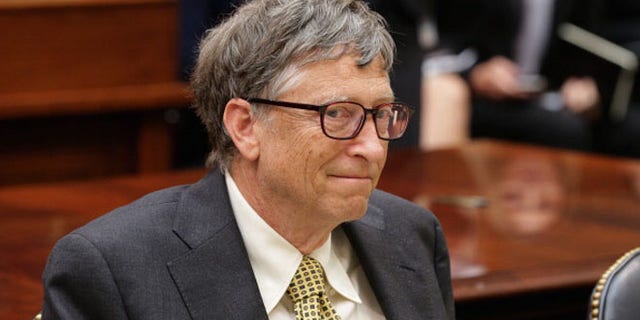
Microsoft co-founder Bill Gates meets with the House Foreign Affairs Committee in Washington, Dec. 3, 2013. (Getty Images)
Gates said he does not agree with Warren’s stance that billionaires should not exist at all in the U.S.
“Maybe
I’m just too biased to think that if you create a company that’s
super-valuable, that at least some part of that, you should be able to
have – a little bit for consumption, and hopefully the balance to do
philanthropic things,” Gates said.
“I’ve
paid over $10 billion in taxes, I’ve paid more than anyone in taxes,”
he continued. “If I’d had to have paid $20 billion in taxes – fine. But,
when you say I should pay $100 billion, OK, I’m starting to do a little
math about what I have left over.”
Warren said on Twitter she was
always happy to sit down with people who don't share her opinions,
adding that Gates would not have to pay as much as $100 billion under
her plan. Fox News’ Paul Steinhauser and Adam Shaw, as well as Fox Business’ Megan Henney and Brittany De Lea contributed to this report.
Mark Zaid,
one of the attorneys representing the intelligence community
whistleblower at the center of the Democrats' ongoing impeachment
inquiry, tweeted conspicuously in January 2017 that a "coup has started"
and that "impeachment will follow ultimately."
Then, in July 2017, Zaid remarked, "I predict @CNN will play a key role in @realDonaldTrump
not finishing out his full term as president." Also that month, Zaid
tweeted, "We will get rid of him, and this country is strong enough to
survive even him and his supporters."
Amid a slew of
impeachment-related posts, Zaid assured his Twitter followers that
"as one falls, two more will take their place," apparently referring to
Trump administration employees who defy the White House. Zaid promised
that the "coup" would occur in "many steps."
The tweets, which
came shortly after President Trump fired then-acting Attorney General
Sally Yates for failing to defend federal laws in court, are likely to
fuel Republican concerns that the anonymous whistleblower's complaint is
tainted with partisanship. Trump's call with Ukraine's leader, which
is the subject of the complaint, occurred in July 2019.
“The
whistleblower’s lawyer gave away the game," the Trump campaign's
communications director, Tim Murtaugh, told Fox News. "It was always the
Democrats’ plan to stage a coup and impeach President Trump and all
they ever needed was the right scheme. They whiffed on Mueller so now
they’ve settled on the perfectly fine Ukraine phone call. This proves
this was orchestrated from the beginning.”
Added House GOP leader Kevin McCarthy: "We should take [Zaid] at his word that this is a coordinated, premeditated plot to overturn the election."
Trump
has repeatedly accused Democrats and partisans in the intelligence
community of effectively plotting a coup against him, through selective
leaks and lengthy investigations.
"45 years from now we might be recalling stories regarding the impeachment of @realDonaldTrump. I'll be old, but will be worth the wait," Zaid wrote in June 2017.
He emphasized his interest in impeachment in a variety of other posts.
"Johnson (1868), Nixon (1973), Clinton (1998) impeachment hearings. Next up @realDonaldTrump (2017)," he said in May.
Fox
News has previously reported on social media posts by Zaid that
highlighted what appeared to be open animus toward the president.
Although Zaid described Democratic House Intelligence Committee Chairman Adam Schiff, D-Calif., as a "mature professional," and circulated articles that touted the reliability of the largely discredited Steele dossier used
by the FBI to surveil a former member of Trump's campaign, Zaid
has repeatedly unloaded on the president in no uncertain terms.
"I'm not a Trump fan," Zaid said on a podcast last year. "I
go out of my way on Twitter to say '#Resistance.' It's not a resistance
against the GOP or a Republican -- I don't think [Trump] is a
Republican, quite frankly." (Zaid also boasted that he has sued "every"
president since 1993, and pursues "them all," regardless of party
affiliation.)
Also
in the podcast, Zaid acknowledged that he had been fishing for
plaintiffs to launch a lawsuit concerning the Trump hotel in Washington,
D.C., alleging unfair competition by the president and his associates.
"The
unfair competition becomes, when Donald Trump became president, he has
exploited his use of the presidency, of the Oval Office. ... to send
business to the hotel. ... We identified this as a cause of action, and
we were looking for a plaintiff, and we finally found this one
restaurant that was willing," Zaid admitted. A federal judge dismissed
the lawsuit last year.
Zaid also had something of an open casting
call for whistleblowers on Twitter as Trump took office, writing that
CIA employees should "come to" his law firm "to lawfully challenge" the
new president.
Zaid publicly requested that celebrities Debra
Messing, Nancy Sinatra, Cher and Rob Reiner help promote his
whistleblower law firm.
"@cher please check out our new whistleblower page," Zaid wrote in one tweet, which garnered no response from the famed singer.
In
February, Zaid escalated his pitch to Reiner, asserting that "we have a
chance to depose" Trump in court. At one point last year, Zaid even
pitched his services to Michael Avenatti, after the now-embattled
attorney mentioned that he was "now representing whistleblowers within
ICE."
Another of the whistleblower's attorneys, Andrew Bakaj,
tweeted in August 2017 that Trump should be removed under the 25th
Amendment, which applies to incapacitated presidents.
The posts
have surfaced as Republicans demand that the anonymous whistleblower
come forward and testify. On Sunday, House Oversight Committee Ranking
Member Jim Jordan, R-Ohio, rejected an offer from Zaid for the
whistleblower to anonymously provide written answers to GOP questions.
"Written
answers will not provide a sufficient opportunity to probe all the
relevant facts and cross-examine the so-called whistleblower," Jordan
said. "You don't get to ignite an impeachment effort and never account
for your actions and role in orchestrating it."
Zaid acknowledged in a statement in
October that his client "has come into contact with presidential
candidates from both parties" -- but insisted that the contact involved
the politicians' roles as "elected officials – not as candidates."
His abrupt disclosure came shortly after The Washington Examiner reported
that Intelligence Community Inspector General Michael Atkinson told
lawmakers the whistleblower worked “or had some type of professional
relationship” with one of the Democratic presidential candidates, citing
three sources familiar with Atkinson’s interview with lawmakers last
month.
Zaid and the other whistleblower attorneys did assert that
the whistleblower "has never worked for or advised a political
candidate, campaign or party" -- leaving open the possibility that the
whistleblower did advise a current 2020 Democratic presidential
candidate prior to his or her run for office.
"The whistleblower
is not the story," the attorneys said. "To date, virtually every
substantive allegation has been confirmed by other sources. For that
reason, the identity of the whistleblower is irrelevant."
But Republicans have challenged that claim, noting that various statements in the whistleblower claim have seemingly proved inaccurate.
For example, the whistleblower complaint stated that Trump made a
“specific request that the Ukrainian leader locate and turn over servers
used by the Democratic National Committee (DNC) and examined by the
U.S. cybersecurity firm CrowdStrike" -- a request that does not appear
in the declassified transcript of the call released by the Trump administration. Trump mentioned CrowdStrike, but did not demand the server.
Meanwhile, Democrats on Wednesday released a transcript of
testimony from U.S. diplomat Bill Taylor in which he claimed to have a
“clear understanding” that Trump wanted to leverage military aid to
Ukraine in return for investigations that could benefit him politically
-- while acknowledging he didn't have firsthand knowledge of "what was
in the president's mind."
“That was my clear understanding,
security assistance money would not come until the President [of
Ukraine] committed to pursue the investigation,” Taylor said. READ THE TRANSCRIPT
Taylor
is a top U.S. diplomat in Ukraine who has emerged as a key figure of
interest in the Trump impeachment inquiry, having alleged a quid pro quo
was at play despite White House denials.
The transcript shows
that Taylor testified he had been told by other officials that the White
House was willing to hold up both military aid and a prospective White
House meeting with Ukraine's president to extract a public announcement
from Kiev that probes related to election interference and a company
linked to former Vice President Joe Biden's son were underway.
"Coup has started. ... We will get rid of him." — Whistleblower attorney Mark Zaid, in 2017
"That's
what Ambassador Sondland said," Taylor said, referring to E.U.
ambassador Gordon Sondland. "He said that they were linked. They were
linked."
But Republicans have countered that Taylor did not have
primary knowledge regarding the key events in question, but rather based
his testimony off conversations with others.
In
one exchange between GOP Rep. Lee Zeldin and Taylor during his
deposition, Taylor was asked whether he had any firsthand knowledge of
Trump conditioning an investigation into the 2016 election and the
Bidens on military aid.
Taylor said he did not speak to the
president, or have any direct communication with the president regarding
the requests for investigations. Instead, he said he was basing much of
his testimony on what former United States Special Representative for
Ukraine Negotiations Kurt Volker and Sondland told him. Fox News' Alex Pappas contributed to this report.
OAN Newsroom
UPDATED 1:50 PM PT — Tuesday, November 5, 2019
New documents have revealed a massive lobbying effort at the
Obama-era State Department by Ukrainian energy company Burisma. The
newly released State Department documents show Joe Biden pressured the
Ukrainian government to fire its top prosecutor back in 2016, which is
about a month after Burisma reached out to the agency.
The company employed Biden’s son Hunter and was under an
investigation by prosecutor Viktor Shokin at the time. Ukraine suspected
Burisma executives of money laundering and corruption.
Awkward
Emails show Burisma lobbyists requesting meeting in early 2016 with
Obama administration to discuss corruption investigation involving
Hunter Biden pic.twitter.com/jl7ogTBxOk
— Jack Posobiec (@JackPosobiec) November 5, 2019
Republican lawmakers have said the so-called whistleblower may have ties to Biden’s alleged corruption schemes.
“The whistleblower, actually, is a
material witness completely separate from being the whistleblower
because he worked for Joe Biden. He worked for Joe Biden at the same
time Hunter Biden was receiving $50,000 a month. So, the investigation
into the corruption of Hunter Biden involves this whistleblower because
he was there at the time. Did he bring up the conflict of interest? Was
there discussion of this? What was his involvement with the relationship
between Joe Biden and the prosecutors?” — Sen. Rand Paul (R-Ky.)
Meanwhile, Ukrainian officials have said the only reason Biden sat on
Burisma’s board was to “protect” the company from scrutiny.
It’s time for:
*Joe Biden and John Kerry to come clean about the full nature of the access Hunter was able to secure for Burisma
AND
*House Democrats must release all of the transcripts from their closed-door depositions immediatelyhttps://t.co/rEtwSAYEmc
— GOP (@GOP) November 5, 2019
President Trump said it’s time for Mexico to wage war on the
country’s drug cartels with the help of the U.S. In a series of tweets
Tuesday, the president weighed in on the recent killing of an American
family in Northern Mexico. It happened Monday about 70 miles from the
U.S. border.
The suspected cartel attack left at least six children and three
women dead as well as several others injured. Five of the victims were
discovered in a charred SUV and four others were found in a separate
unidentified location. President Trump has called the killings “vicious”
and assured the U.S. stands ready to get involved in efforts to battle
the dangerous cartels.
….monsters, the United States stands ready,
willing & able to get involved and do the job quickly and
effectively. The great new President of Mexico has made this a big
issue, but the cartels have become so large and powerful that you
sometimes need an army to defeat an army!
President
Donald Trump speaks to members of the media on the South Lawn of the
White House in Washington, Monday, Nov. 4, 2019, before boarding Marine
One for a short trip to Andrews Air Force Base, Md., and then on to
Lexington, Ky., for a campaign rally. (AP Photo/Patrick Semansky)
Family members of the victims say they are in complete shock.
“We just can’t believe that this has
actually happened to our family, this seems like a bad dream. We just
knew their vehicle was on fire and there was bullet holes all around it,
and that they were all dead. My sister was in one with nine of her
children, and then my sister was in one with her baby.” — Leah Staddon,
family member to victims
Surviving family members say they are in touch with the American
consulate in Mexico as local authorities continue to investigate the
attack.
LOUISVILLE, Ky.
(AP) — Kentucky’s bitter race for governor went into overtime as
Democrat Andy Beshear declared victory while Republican Gov. Matt Bevin,
a close ally of President Donald Trump, refused to concede with results
showing he trailed by a few thousand votes.
Kentucky has some sorting out to do before inaugurating its next governor.
With
100% of precincts reporting, Beshear — the state’s attorney general and
the son of Kentucky’s last Democratic governor, Steve Beshear — had a
lead of 5,333 votes out of more than 1.4 million counted, or a margin of
nearly 0.4 percentage points. The Associated Press has not declared a
winner.
In competing speeches late Tuesday, Beshear claimed victory while Bevin refused to concede.
“My
expectation is that he (Bevin) will honor the election that was held
tonight,” Beshear said. “That he will help us make this transition. And
I’ll tell you what, we will be ready for that first day in office, and I
look forward to it.”
That first day isn’t far off. Kentucky inaugurates its governors in the December following an election.
Bevin, meanwhile, called the contest a “close, close race” and said he wasn’t conceding “by any stretch.”
“We want the process to be followed, and there is a process,” he said.
Bevin
hinted there might be “irregularities” to look into but didn’t offer
specifics. His campaign didn’t immediately respond to an email seeking
an explanation.
There
is no mandatory recount law in Kentucky. Bevin may request counties
recanvass their results, which is not a recount, but rather a check of
the vote count to ensure the results were added correctly. Bevin would
need to seek and win a court’s approval for a recount.
The
final hours of campaigning were dominated by the endorsement Bevin
received from Trump at a boisterous rally Monday night in Lexington,
Kentucky. Through a spokesman, the president boasted Tuesday night about
the boost he had given the incumbent governor despite Bevin finishing
with fewer votes to his name.
“The
president just about dragged Gov. Matt Bevin across the finish line,
helping him run stronger than expected in what turned into a very close
race at the end,” Trump campaign manager Brad Parscale said in a
statement. “A final outcome remains to be seen.”
Trump
had loomed large in the race as Bevin stressed his alliance with the
Republican president in TV ads, tweets and speeches. Trump carried
Kentucky by a landslide in winning the presidency in 2016 and remains
popular in the state. The president took center stage in the campaign
with his election eve rally to energize his supporters to head to the
polls for his fellow Republican.
But
the combative Bevin had been struggling to overcome a series of
self-inflicted wounds, highlighted by a running feud with teachers who
opposed his efforts to revamp the state’s woefully underfunded public
pension systems.
Bevin
lagged well behind the vote totals for the rest of the GOP slate for
statewide offices. Republican candidates swept Kentucky’s races for
attorney general, secretary of state, auditor, treasurer and agriculture
commissioner.
Meanwhile, the Libertarian candidate for governor, John Hicks, got 2% of the vote.
Beshear
dominated in the state’s urban areas in Louisville and Lexington and
won some traditionally Republican suburban counties in the state’s
northernmost tip, just south of Cincinnati, to offset Bevin’s strength
in rural areas. Beshear also made inroads in eastern Kentucky, winning
several counties in a region where Trump is highly popular.
While
Beshear looks to quickly pivot to governing, he’ll be confronted by a
dominant GOP. Republicans hold overwhelming majorities in the state
legislature.
Beshear
maintained his focus throughout the race on “kitchen table” issues like
health care and education to blunt Bevin’s efforts to hitch himself to
Trump and nationalize the race.
On
health care, Beshear could have an immediate impact by backing away
from a Bevin proposal to attach work requirements to Medicaid benefits
received under the Affordable Care Act. Bevin’s plan for some
“able-bodied” recipients has been challenged in court and is yet to be
enacted, and Beshear has vowed to rescind it.
On
the campaign trail, Beshear also said he wants to legalize casino
gambling, proposing to use that revenue to support public pensions. Some
Republican lawmakers campaigning for Bevin vowed to reject that idea if
it came before them.
Beshear also exploited Bevin’s feud with teachers over pensions and education issues, repeatedly referring to Bevin as a bully.
Beshear said Tuesday night that teachers shared in his victory.
“To
our educators, your courage to stand up and fight against all the
bullying and name calling helped galvanize our entire state,” Beshear
said.
Beshear
proposed a $2,000 across-the-board pay raise for public school teachers
and vowed to submit “an education-first budget” to lawmakers.
School
bus driver Conley McCracken said earlier Tuesday in Bowling Green that
he voted for Bevin the first time. He said school issues turned him away
from the Republican.
“He’s
trying to keep retirement away from a lot of the teachers and school
employees and things of that nature,” the 68-year-old McCracken said.
Trump’s support of Bevin wasn’t enough to get McCracken’s vote a second time around.
“I don’t like the way he’s doing (things), so I changed my mind,” McCracken said.
___
Jonathan Mattise contributed to this article from Bowling Green, Kentucky.
TUCSON, Ariz. (AP)
— After Arizona passed a law that required local police to check the
immigration status of people suspected to be in the country illegally,
the state’s second-largest city wanted to send a message.
The
Democrats who control Tucson designated their town an “immigrant
welcoming city” in 2012, and the police department adopted rules
limiting when officers can ask about the immigration status of people
they encounter.
But
on Tuesday, given the chance to push the envelope further, the heavily
Democratic city voted overwhelmingly not to become an official
“sanctuary city” with more restrictions on how and when police officers
can enforce immigration laws.
The
incongruous result followed a contentious disagreement that divided
progressives between those eager to stand up for immigrants and against
President Donald Trump, and those who said the initiative would bring
nothing more than unintended consequences.
“The
city of Tucson, in all respects except being labeled as such, operates
as a sanctuary city,” Mayor Jonathan Rothschild said in an interview
before the vote.
The
sanctuary initiative, he argued, would have tied the hands of police
even on matters unrelated to immigration while inviting expensive
retaliation from the Trump administration and Republicans in the state
Legislature.
The
Trump administration has fought sanctuary cities and tried to restrict
their access to federal grants. The 9th U.S. Circuit Court of Appeals
ruled in June that the Trump administration could consider cities’
willingness to cooperate in immigration enforcement when doling out law
enforcement money.
Tucson
has a deep history welcoming immigrants. It’s widely credited as the
birthplace of the Sanctuary Movement in the 1980s, an effort by churches
to help refugees from Central America and shield them form deportation.
The
ballot measure was pushed by activists who wanted to give a voice to
Tucson’s Latino community. They said it would have sent the message that
immigrants are safe and protected in Tucson at a time when many are
fearful of Trump’s immigration policies.
“We
have been failed by the city government here,” Zaira Livier, executive
director of the People’s Defense Initiative, which organized the
initiative, told supporters following the vote, according to KOLD-TV.
Tucson politicians say they stand with immigrants, but when the going gets tough, they back down, she said.
“We are here to test you and to tell you that the bare minimum is no longer good enough and we expect better,” Livier said.
The
initiative explicitly aimed to neuter a 2010 Arizona immigration law
known as SB1070, which drew mass protests and a boycott of the state.
Courts threw out much of the law but upheld the requirement for officers
to check immigration papers when they suspect someone is in the country
illegally.
A
handful of Republican state lawmakers have said they would pursue
legislation to punish Tucson. Prior legislation approved by the GOP
Legislature to tie the hands of liberal cities, including Tucson, allows
the state to cut off funding for cities that pass laws conflicting with
Arizona laws.
Meanwhile,
Tucson voters elected their first Latina mayor. Regina Romero will be
the first woman to lead Arizona’s second-largest city after Phoenix,
with a population of about 546,000 people.
Tucson’s
last Hispanic mayor was Estevan Ochoa, who was elected in 1875 — nearly
four decades before Arizona became a state and just 21 years after the
United States bought Southern Arizona, including Tucson, from Mexico in
the Gadsden Purchase.
Romero,
who is on the city council, opposed the sanctuary city initiative,
saying it’s unnecessary given Tucson’s welcoming attitude and policies
toward immigrants.
“I am so proud and so humbled for tonight,” she said in a victory speech.
Thanking her family, she added, “No single person can make history on their own.”
World Series MVP pitcher Stephen Strasburg is not going to put up with the Internet’s “fake news.”
That was the hashtag he used showing a video of him and the Washington Nationals celebrating their victory at the White House with President Trump.
Strasburg had been accused of snubbing Trump in a deceptively trimmed viral video, as USA TODAY reported, so the 31-year-old right-hander tweeted the full video showing him shaking hands with the president.
Strasburg went 5-0 in the MLB postseason as the Nationals won their first world championship in franchise history.
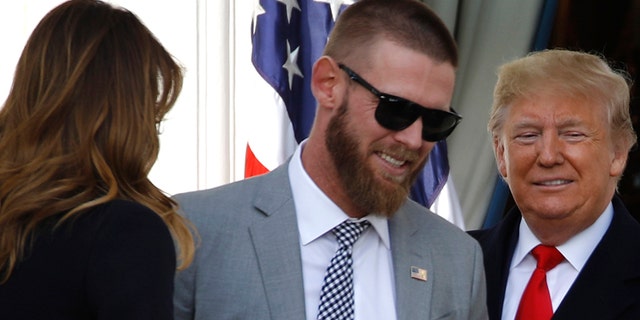
President Trump with Washington Nationals starting pitcher Stephen
Strasburg at Monday's ceremony, with first lady Melania Trump nearby.
(AP Photo/Patrick Semansky)
Strasburg has opted out
of the final four years of his contract, making him a free agent. The
decision meant he was leaving $100 million on the table – with the
prospect of earning more, either from the Nationals or another team.
The Nationals defeated the Houston Astros in seven games to win the World Series this past Wednesday, coming back from a 3-2 series deficit.
They were the first World Series winner with all four victories coming on the road.
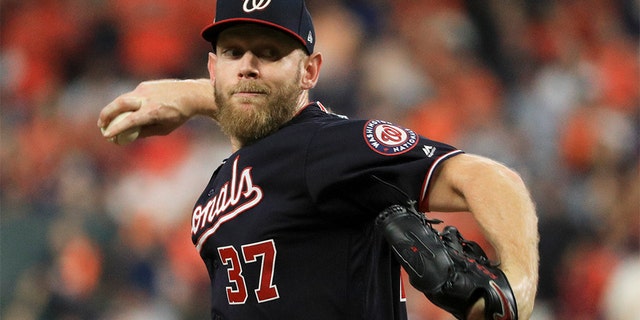
Washington Nationals starting pitcher Stephen Strasburg throwing
against the Houston Astros during the first inning of Game 6 on Oct. 29
in Houston. (AP Photo/Mike Ehrmann, Pool)
The Nationals have been celebrating across D.C. on their whirlwind victory tour.
The team paraded down Constitution Avenue on Saturday and celebrated at the Washington Capitals hockey game Sunday night.
TEHRAN, Iran (AP) —
Iran’s president announced on Tuesday that Tehran will begin injecting
uranium gas into 1,044 centrifuges, the latest step away from its
nuclear deal with world powers since President Donald Trump withdrew
from the accord over a year ago.
The
development is significant as the centrifuges previously spun empty,
without gas injection, under the landmark 2015 nuclear accord. It also
increases pressure on European nations that remain in the accord, which
at this point has all but collapsed.
In
his announcement, President Hassan Rouhani did not say whether the
centrifuges, which are at its nuclear facility in Fordo, would be used
to produce enriched uranium. The centrifuges would be injected with the
uranium gas as of Wednesday, Rouhani said.
His
remarks, carried live on Iranian state television, came a day after
Tehran’s nuclear program chief said the country had doubled the number
of advanced IR-6 centrifuges in operation.
There
was no immediate reaction from the International Atomic Energy Agency,
the United Nations’ nuclear watchdog now monitoring Iran’s compliance
with the deal. The European Union on Monday called on Iran to return to
the deal, while the White House sanctioned members of Supreme Leader
Ayatollah Ali Khamenei’s inner circle as part of its maximalist campaign
against Tehran.
Rouhani
stressed the steps taken so far, including going beyond the deal’s
enrichment and stockpile limitations, could be reversed if Europe offers
a way for it to avoid U.S. sanctions choking off its crude oil sales
abroad.
“We should be able to sell our oil,” Rouhani said. “We should be able to bring our money” into the country.
The
centrifuges at Fordo are IR-1s, Iran’s first-generation centrifuge. The
nuclear deal allowed those at Fordo to spin without uranium gas, while
allowing up to 5,060 at its Natanz facility to enrich uranium.
A
centrifuge enriches uranium by rapidly spinning uranium hexafluoride
gas. An IR-6 centrifuge can produce enriched uranium 10 times faster
than an IR-1, Iranian officials say.
Iranian
scientists also are working on a prototype called the IR-9, which works
50-times faster than the IR-1, Iran’s nuclear chief Ali Akhbar Salehi
said Monday.
As
of now, Iran is enriching uranium up to 4.5%, in violation of the
accord’s limit of 3.67%. Enriched uranium at the 3.67% level is enough
for peaceful pursuits but is far below weapons-grade levels of 90%. At
the 4.5% level, it is enough to help power Iran’s Bushehr reactor, the
country’s only nuclear power plant. Prior to the atomic deal, Iran only
reached up to 20%.
Tehran
has gone from producing some 450 grams (1 pound) of low-enriched
uranium a day to 5 kilograms (11 pounds), Salehi said. Iran now holds
over 500 kilograms (1,102 pounds) of low-enriched uranium, Salehi said.
The deal had limited Iran to 300 kilograms (661 pounds).
The
collapse of the nuclear deal coincided with a tense summer of
mysterious attacks on oil tankers and Saudi oil facilities that the U.S.
blamed on Iran. Tehran denied the allegation, though it did seize oil
tankers and shoot down a U.S. military surveillance drone.


 Microsoft co-founder Bill Gates meets with the House Foreign Affairs Committee in Washington, Dec. 3, 2013. (Getty Images)