LONDON (AP) —
Former U.S. Secretary of State Hillary Clinton says she’s “dumbfounded”
the U.K. government has failed to release a report on Russian influence
in British politics as the country prepares for national elections.
Clinton
told the BBC in an interview broadcast Monday that the public needs to
know what is in the report by Parliament’s Intelligence and Security
Committee. The government said it needs more time to consider the report
before releasing it to the public, but critics claim the report has
been withheld until the next Parliament because it is embarrassing to
Prime Minister Boris Johnson’s Conservative Party.
“I’m
dumbfounded that this government won’t release the report ... because
every person who votes in this country deserves to see that report
before your election happens,” Clinton said.
An American investigation into the 2016 U.S. presidential election found “sweeping and systemic” interference.
Bill
Browder, a former investment manager in Russia, told the BBC he gave
the committee evidence on wealthy Russians working to influence British
politics.
The
Intelligence and Security Committee report was sent to the prime
minister on Oct. 17, and it needs government approval before it is made
public. Johnson’s Downing Street office says the report has not yet gone
through the clearance process necessary for publication.
Lawmakers
from a range of parties, including Johnson’s Conservatives, urged the
government to publish the report during a debate in the House of
Commons. But Foreign Office minister Christopher Pincher argued it was
“not unusual” for the review of such reports to “take some time.”
Clinton also spoke with the Guardian newspaper at the event promoting “The Book of Gutsy Women,” co-authored with her daughter.
“I
am, as a great admirer of Britain, concerned, because I can’t make
sense of what is happening,” Clinton told the Guardian. “We have a
president who admires dictators and takes their help and does all kinds
of crazy stuff. So we need you to be the sane member of this partnership
going forward.”
Nikki Haley knows how to thread the needle.
And she understands a thing or two about selling books.
The
former U.N. ambassador, who obviously wants a political future, is
depicting herself as a Trump loyalist—with a few exceptions. Haley knows
that if she distances herself too much from the president, she’s toast
with today’s Republican Party.
At the same time, she wants to maintain her viability with those who have grown skeptical of the president.
In
granting exclusives to the Washington Post and CBS “Sunday Morning,”
she put out the clickiest of the clickbait: how in her view John Kelly
and Rex Tillerson tried to recruit her into a cabal to undermine Trump.
Yes, it’s palace intrigue, but it’s pretty intriguing.
In “With
All Due Respect,” Haley writes: “Kelly and Tillerson confided in me that
when they resisted the president, they weren’t being insubordinate,
they were trying to save the country. It was their decisions, not the
president’s, that were in the best interests of America, they said. The
president didn’t know what he was doing,” Haley wrote of the views the
two men held. What’s more, she writes, Tillerson said people would die
unless Trump was reined in.
Kelly, the former White House chief of
staff, said in a statement that if providing the president “with the
best and most open, legal and ethical staffing advice from across the
[government] so he could make an informed decision is ‘working against
Trump,’ then guilty as charged.”
There have been other books (by
Bob Woodward, for instance) and other ex-officials who say they tried to
steer the president away from unrealistic or outlandish ideas. If you
oppose Trump, you view them as patriots doing the best they can to work
within the system. If you support Trump, you view them as rogue
operators trying to usurp his authority.
Haley puts herself in the latter camp.
This
obviously fuels Trump’s frequent claim that people in his own
administration are trying to undermine him. In this case, though,
they’re two of his own top appointees rather than members of some
nefarious Deep State.
But in the end, they were staff. He’s the guy who got elected. And so they became ex-staff.
According to the Post,
Haley “backed most of the foreign policy decisions by Trump that others
tried to block or slow down, including withdrawal from the Iran nuclear
deal and the Paris climate accord and the relocation of the U.S.
Embassy in Israel to Jerusalem.”
What about impeachment? Here,
too, Haley backs Trump but not 100 percent, telling the Post’s Anne
Gearan: “So, do I think it’s not good practice to talk to foreign
governments about investigating Americans? Yes. Do I think the president
did something that warrants impeachment? No, because the aid flowed.”
That, of course, is a reference to the $391 million in military aid to
Ukraine that Trump held up—and the argument that it doesn’t matter
because it was eventually released.
But in a clear bow to the
president’s critics, Haley writes that she objected to Trump’s handling
of the Helsinki summit with Vladimir Putin, as well as his response to
the violence in Charlottesville. Reflecting on Trump’s “both sides”
comments, Haley writes:
“A leader’s words matter in these
situations. And the president’s words had been hurtful and dangerous. I
picked up the phone and called the president.”
The most
interesting excerpt involves the murder of nine black churchgoers in
Charleston, when Haley was South Carolina’s governor. She says she was
treated for post-traumatic stress syndrome, including episodes of
sobbing, loss of appetite and feelings of guilt.
Joe Scarborough
says Haley is auditioning for Mike Pence’s spot on the 2020 ticket. I
don’t think there’s an opening there, but as a former governor,
ex-diplomat and daughter of Indian immigrants, Haley obviously has
potential as a presidential contender down the road.
Perhaps
that’s why she wrote a memoir that keeps her in Trump’s camp, criticizes
him in selected spots and throws a couple of her former White House
colleagues under the bus.
The Supreme Court on Tuesday is set to take up the Trump administration’s
plan to end protections that shield about 660,000 immigrants from
deportation, and legal experts say all eyes will be on the likely
tie-breaker Chief Justice John Roberts.
Created under an Obama-era executive order, DACA
gives some undocumented immigrants brought to the U.S. as children the
chance to receive a renewable two-year period of deferred action from
deportation and become eligible for a work permit.
Legal experts have looked back on Roberts’ June vote that blocked a citizenship question from
appearing on the 2020 census. The Trump administration claimed that
Americans have the right to know who’s in the country illegally.
"So
important for our Country that the very simple and basic "Are you a
Citizen of the United States?" Question be allowed to be asked in the
2020 Census," Trump tweeted at the time.
Critics said the question
would discourage illegal immigrants from participating. Census totals
determine congressional seats and political boundaries.
Linda Greenhouse, a New York Times columnist who focuses on the Supreme Court, wrote last week that the parallels between the census case and DACA is not exact, "but they are striking."
She wrote that Roberts called the Commerce Department's claim in the case "contrived."
The
department claimed that the question needed to be included so the
Justice Department could better job enforcing the Voting Rights Act.
Greenhouse said Roberts' opinion "made it clear that the court was
addressing process, not substance."
Agencies are required to
offer "genuine justifications for important decisions, reasons that can
be scrutinized by courts and the interested public," he wrote, according
to the Times. "Accepting contrived reasons would defeat the purpose of
the enterprise."
The Los Angeles Times reported Monday that Dreamers' "best hope for victory almost surely depends on" Roberts. CNN reported that lawyers were crafting their argument to appeal to one justice: Roberts.
But
the L.A. Times pointed out that Roberts wrote in the travel ban ruling
that the country's chief executive oversees immigration enforcement.
Roberts also handed two other immigration wins to the administration.
The
court sided with President Trump in allowing him to enforce the travel
ban on visitors from some majority Muslim countries and Roberts voted in
favor of Trump shifting military dollars to fund the wall.
Janet
Napolitano, the University of California president who served as Obama's
homeland security secretary when DACA was created, said the
administration seems to recognize that ending DACA protections would be
unpopular.
"And so perhaps they think it better that they be
ordered by the court to do it as opposed to doing it correctly on their
own," Napolitano said in an interview with The Associated Press. She is a
named plaintiff in the litigation.
Trump
has said a ruling in his favor would force Democrats back to the table
and a "bipartisan deal will be made to the benefit of all." The Associated Press contributed to this report
Deputy Assistant Secretary of Defense Laura Cooper testified last month that Pentagon officials began receiving "phone calls from industry"
-- apparently referring to private companies that supply weapons and
military hardware to the government -- after President Trump initiated a
hold on military aid to Ukraine earlier this year.
The revelation, which came in a transcript of Cooper's closed-door Oct. 23 deposition released Monday by House Democrats as part of their impeachment inquiry, prompted concerns from commentators that the most self-destructive elements of the Russia probe were resurfacing.
"Like Russiagate,
Ukrainegate enrolls liberals in the Cold War designs of dangerous hawks
and neocons," tweeted journalist Aaron Mate.
Additionally, Cooper
testified that the Trump administration had pushed Ukraine to issue a
public statement disavowing any efforts to influence U.S. elections --
but Cooper stopped short of saying that officials wanted to include a
reference to Joe and Hunter Biden's business dealings in the country.
Previous testimony
in the inquiry has suggested that the White House improperly pressured
Ukraine to implicate the Bidens publicly. Former U.S. envoy to Ukraine
Kurt Volker, for example, had remarked that European Union envoy Gordon
Sondland and Trump attorney Rudy Giuliani worked with a top Ukrainian aide to include a reference to the Biden-linked Ukrainian natural gas company Burisma Holdings.
But, Cooper said that on Aug. 20, Volker met with her -- and the idea of mentioning the Bidens apparently didn't come up.
"In
that meeting, he did mention something to me that, you know, was the
first about, somehow, an effort that he was engaged in to see if there
was a statement that the government of Ukraine would make that would
somehow disavow any interference in U.S. elections and would commit to
the prosecution of any individuals involved in election interference,"
Cooper said. "And, that was about as specific as it got."
Cooper's testimony was made public as House Democrats on Monday also released transcripts from their interviews with Christopher Anderson, a career foreign service officer at the State Department, and Catherine Croft,
a Ukraine expert at the State Department. Croft testified that she
speculated Trump would be willing to shift Ukraine policy to hurt a
Biden candidacy, and that news of a holdup of Ukraine aid "blew up" a
State Department meeting.
Croft,
in her remarks, said that the Office of Management and Budget
had "reported that the White House chief of staff, Mick Mulvaney, had
placed an informal hold on security assistance to Ukraine. The only
reason given was that it came at the direction of the president."
Separately,
Cooper testified about Defense Department concerns that Trump's
temporary withholding of military aid to Ukraine may have been illegal.
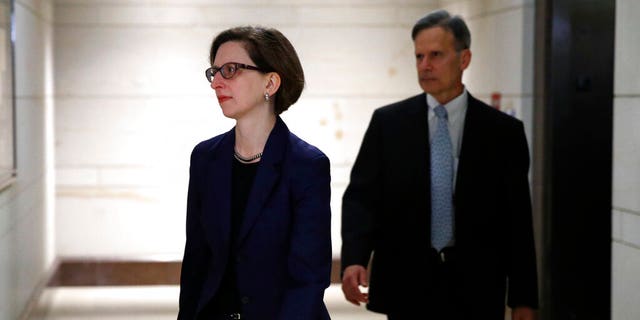
Deputy Assistant Secretary of Defense Laura Cooper, left, on Capitol Hill on Oct. 30. (AP Photo/Patrick Semansky, File)
"I'm not an expert on the law, but in that meeting
immediately deputies began to raise concerns about how this could be
done in a legal fashion because there was broad understanding in the
meeting that the funding -- the State Department funding related to an
earmark for Ukraine and that the DOD funding was specific to Ukraine
security assistance," Cooper testified, concerning a July 23 meeting of
national security officials. "The comments in the room at the deputies'
level reflected a sense that there was not an understanding of how this
could legally play out, and at that meeting, the deputies agreed to look
into the legalities and to look at what was possible."
The
legalities likely regarded the issue of "impoundment" – the requirement
that the president either had to spend the money or "impound" it. The
White House was coming up against an impoundment deadline when it
released the funds for Ukraine.
Moreover, Cooper said, Defense Department officials were concerned that Trump's decision would weaken a "strategic partner."
"I
mean, so DOD was concerned about the obligation of funds," she
said. "Policy, my team, we were also concerned about any signal that we
would send to Ukraine about a wavering in our commitment. ... They are
trying to negotiate a peace with Russia, and if they are seen as weak,
and if they are seen to lack the backing of the United States for their
Armed Forces, it makes it much more difficult for them to negotiate a
peace on terms that are good for Ukraine."
She added: "My sense is
that all of the senior leaders of the U.S. national security
departments and agencies were all unified in their — in their view that
this assistance was essential, and they were trying to find ways to
engage the president on this."
Croft, meanwhile, told House
investigators, "If this were public in Ukraine it would be seen as a
reversal of our policy and would, just to say sort of candidly and
colloquially, this would be a really big deal, it would be a really big
deal in Ukraine, and an expression of declining U.S. support for
Ukraine."
Ukraine
had satisfied all necessary benchmarks to obtain Ukraine Security
Assistance Initiative funding, Cooper told lawmakers. This past May,
Cooper said, Under Secretary of Defense for Policy John Rood "provided
the certification to Congress, but that was after coordination with the
State Department."
Cooper also told investigators she could make a
"very strong inference" that Ukraine was aware in August that the Trump
administration was holding up the financial assistance, shortly before
the aid was released in September. The Ukraine aid was
suspended temporarily in August -- two weeks before the White
House released it, Politico reported.
"It could have been my
inference, yes, a very strong inference that there was some knowledge on
the part of the Ukrainians," Cooper testified. She called the aid
suspension, which came without an explanation to her knowledge,
"unusual."
Military aid to Ukraine, Cooper further testified, was relevant to U.S. national-security interests.
"Ukraine,
and also Georgia, are the two front-line states facing Russian
aggression," Cooper said. "In order to deter further Russian aggression,
we need to be able to shore up these countries' abilities to defend
themselves. That's, I think, pure and simple, the rationale behind our
strategy of supporting these countries. It's in our interest to deter
Russian aggression elsewhere around the world."
Trump's suggested
in his July call with Ukrainian President Volodymyr Zelensky that the
country investigate Joe and Hunter Biden's business dealings there,
after it emerged that Joe Biden, the former vice president and current
2020 presidential candidate, had pressured Ukraine to fire its top
prosecutor while Hunter Biden held a lucrative role on the board of a
Ukrainian natural gas company. Zelensky has said he felt no improper
pressure during the call.
In a statement, top House Democrats
leading the impeachment inquiry noted that Cooper's testimony indicated
that Trump's Ukraine policy angered some officials in the
administration.
The two-term Republican who was ousted in 2018 by Katie Hill announced on his website Sunday that he will attempt to win back his old seat.
“I
am proud to return to public service and deliver the type of
representation our district deserves,” Steve Knight posted on his
website.
Hill defeated Knight by 9 points in California’s 25th
District in November. Hill-- a centrist-- was seen as a rising
Democratic star because the district is seen as one of a few in the
state that could be carried by a Republican.
Henry Olsen, a columnist in the Washington Post, wrote a piece last
month that questioned whether or not the state was “reopening” the
doors to Republicans. He pointed out that the district was a Republican
stronghold before President Trump. He also called the election—which
will likely occur on March 3, a possible bellwether for Republicans.
"Republicans have no chance of retaking the House if they cannot retake seats like the one Hill is vacating," Olsen wrote.
Hill
resigned from her seat last month after she said explicit private
photos of her with a campaign staffer had been “weaponized” by her
husband and political operatives.
House
Speaker Nancy Pelosi said Hill had acknowledged “errors in judgment”
that Pelosi said made her continued service in Congress “untenable.” The Associated Press contributed to this report
Donald Trump Jr., who is on a nationwide book tour that included a tense stop at “The View,” was in Southern California on Sunday where he was greeted by protesters and some supporters at the University of California, Los Angeles.
Trump
Jr.'s appearance, once inside, was marked by an argument between him
and the audience over why he would not take questions, the Guardian
newspaper reported. Trump was initially being greeted with shouts of
shouts of "USA! USA!" when he first appeared on the stage of a lecture
hall, members of the audience eventually turned to louder, openly
hostile chants of "Q and A! Q and A!" after they were told he would not
take questions, the newspaper reported.
The Guardian said that
Trump Jr. told the audience that taking questions from the floor risked
creating soundbites that leftwing social media posters would abuse and
distort.
Kimberly Guilfoyle, his girlfriend, told audience members that they were being rude, according to the Guardian.
After
the stop at the university, Trump Jr. posted on Twitter that he
appeared at the Reagan Library in Simi Valley where he said he stayed
for over four hours and had about 1,400 in attendance. He said the
audience had high energy.
Former U.S. Ambassador to the United Nations Nikki Haley is claiming
two former cabinet members tried to recruit her to help undermine the
president. In a recent interview, Haley said former Secretary of State
Rex Tillerson and former White House Chief of Staff John Kelly
confronted her in a closed-door meeting to enlist her in opposing
President Trump.
Haley will detail the alleged meeting in her soon to be released
memoir, “With All Due Respect.” She said Kelly and Tillerson “confided
in me that when they resisted the president, they weren’t being
insubordinate — they were trying to save the country.”
Former Secretary of State Rex Tillerson leaves a courthouse in New York, Wednesday, Oct. 30, 2019. (AP Photo/Seth Wenig)
According to the memoir, Tillerson told Haley lives were at stake if
the president were to go unchecked. The former South Carolina governor
said she declined their offers, calling them offensive.
“Go tell the president what your differences are and quit if you
don’t like what he’s doing,” said Haley. “To undermine a president is
really a very dangerous thing — it goes against the Constitution and
what the American people want.”
Although Haley has not always seen eye to eye with the president, she
said she will stand by him as he continues to seek another term in
office in 2020.
“What I’ll be doing is campaigning for this one,” she said. “I look forward to supporting the president in the next election.”
FILE
– In this Nov. 16, 2018, file photo, now former White House Chief of
Staff John Kelly watches as President Donald Trump speaks in the Oval
Office of the White House in Washington. (AP Photo/Evan Vucci, File)
The former UN ambassador has also spoken out against House Democrats’
efforts to impeach President Trump. She said his alleged attempts to
seek assistance from foreign nations for political investigations is not
impeachable.
“The Ukrainians never did the investigation and the president
released the funds,” stated Haley. “There’s just nothing impeachable
there.”
Haley stepped down from her position in the UN back in 2018 and
received a warm sendoff from President Trump. “With All Due Respect”
will showcase Haley’s perspectives on major national and international
matters, along with other insights into her time in the Trump
administration.
The book is set to be released on Tuesday.
South Korean officials are saying the U.S. is working ‘very actively’
in an effort to restart denuclearization talks with the Korean
peninsula.
South Korea’s National Security Advisor Chung Eui-yong said Sunday
that North Korea is reportedly taking the one-year negotiating deadline
with the Trump administration very seriously.
The adviser went on to say that a third summit will only be possible
if substantial progress is made during talks with high-ranking
officials.
“Only if talks between high-rank officials happen and lead to
substantial progress, will the third North Korea-United States summit be
possible,” stated Chung Eui-yong. “As you know, the North side has
shown the year-end deadline — considering that position of the North
Korean side, we are closely coordinating with the U.S. side.”
This comes after North Korean leader Kim Jong Un imposed a year-end
deadline back in April for the U.S. to demonstrate flexibility on
negotiations. North Korean officials said the deadline would be a
mistake to ignore.
President
Donald Trump meets with North Korean leader Kim Jong Un on Sentosa
Island, Tuesday, June 12, 2018, in Singapore. (AP Photo/Evan Vucci)
Just last week, North Korea fired two projectiles into its eastern
sea. This was their 13th weapons test this year and the first since the
Trump administration’s latest attempts to restart negotiations stalled.
Secretary of State Mike Pompeo has downplayed the launches, saying
they were consistent with Pyongyang’s previous moves. He said progress
has been “far too slow” and added he hopes to reach a good outcome in
the months ahead.
“It has, for an awfully long time, told its people that those nuclear
weapons were the thing that kept them secure,” stated Pompeo. “They now
need to shift to the narrative, which is: those are the things that put
them at risk.”
President Trump has met three times with Kim Jong Un in hopes of
sealing a potentially historic denuclearization deal. He continues to
express optimism about brokering an agreement.
“Kim Jong Un has been pretty straight with me, I think,” stated the
president. “He likes testing missiles, but we never restricted short
range missiles.”