These days it seems everyone’s a fashion critic – especially on social media. The latest target: Mick Mulvaney.
The acting White House chief of staff drew numerous critical comments Friday after being photographed at a Florida airport while wearing an American-flag-themed shirt and U.S. Space Force cap.
Mulvaney had just returned to the U.S. after accompanying President Trump on a top-secret visit to Afghanistan to spend Thanksgiving Day with American troops.
The
Twitterati didn’t seem to care whether Mulvaney was inspired by the
trip to express some patriotic spirit. They just let him have it.
“This
is what disrespectful white trash Americans look like,” one Twitter
critic wrote. “He thinks that this offensive shirt ‘owns the Libs’. It
doesn’t.”
“This is what disrespectful white trash Americans look like. He thinks that this offensive shirt ‘owns the Libs’. It doesn’t.” — Twitter commenter
“Mulvaney’s shirt direct from the Walmart clearance rack,” another wrote.
“Trump made Mulvaney wear that sniper-target shirt the whole time they were in Afghanistan,” a third critic wrote.
Other Republicans recently targeted over their attire include former White House press secretary Sean Spicer and U.S. Rep. Jim Jordan of Ohio.
The Spicer comments were triggered by his recent stint as a contestant on TV’s “Dancing with the Stars,” which involved wearing various costumes for different dance routines.
Perhaps drawing the most scorn was a bright neon rumba shirt.
“Sean Spicer is basically wearing the Puffy Shirt from Seinfeld,” one Twitter user wrote.
“Anytime that image of Spicer in a lime green rumba shirt pops up I question if this isn’t purgatory,” another wrote.
“Anytime that image of Spicer in a lime green rumba shirt pops up I question if this isn’t purgatory.” — Twitter commenter
After wearing it, Spicer placed the shirt up for auction to raise money for the “Yellow Ribbon” fund, which assists the caregivers of wounded service members.
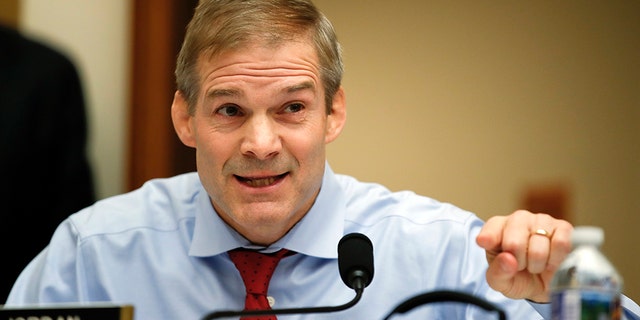
Jordan,
a member of the House Intelligence Committee, which recently conducted
impeachment hearings, is known for opting against wearing a jacket while
performing his congressional duties. Earlier this month, The Washington
Post let Jordan know it disapproved.
U.S. Rep. Jim Jordan, R-Ohio, has often faced criticism for opting
against wearing a jacket during committee hearings on Capitol Hill.
(Associated Press)
(AP Photo/Carolyn Kaster)
“For dignity’s sake, Jim Jordan, put on a jacket,” the Nov. 13 piece was titled. It later described Jordan’s fashion choice as “his power move” and his “sartorial chest thump.”
For his part, Jordan claims that shedding his jacket simply helps him do his job better.
“I can’t really get fired up and get into it if you’ve got some jacket slowing you down,” he told the Post.
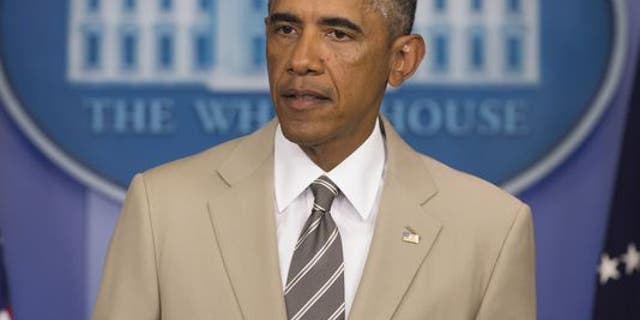
Former President Barack Obama's choice of a tan suit did not go over well in Washington in 2014.
Fashion comments have also run in the opposite political direction: For example, former President Barack Obama was once taken to task over a tan-colored suit, and former Secretary of State Hillary Clinton has been the butt of many jokes about her pantsuits.
A Republican challenging U.S. Rep. Ilhan Omar, D-Minn., in 2020 blasted Twitter
on Friday after having her accounts permanently suspended this week
following a tweet suggesting that the incumbent congresswoman should be
hanged if found guilty of treason.
Danielle Stella wrote on her
campaign Twitter account Tuesday, “If it is proven @IlhanMN passed
sensitive info to Iran, she should be tried for #treason and hanged,"
The Washington Examiner reported.
She later added a link to a blog post that included a drawing of a stick figure being hanged.
Stella's tweet followed media reports that Omar's name came up in a Canadian businessman's deposition in a Florida court case.
The
businessman, Alan Bender, claimed that Qatari officials told him Omar
was the "jewel in the crown" of U.S. politicians who allegedly were
Qatari assets and shared information with Iran, the Washington Examiner reported.
But
several journalists have tweeted that they have found no evidence to
support any of Bender's claims about Omar, the Examiner added.
Meanwhile,
a Twitter spokesperson said Stella's accounts were closed for “repeated
violations of the Twitter rules," The Examiner reported.
“To clarify, I said, "If it is proven ____ passed sensitive info to Iran, she should be tried for #treason and
hanged". Treason is the only thing mentioned in the constitution for
the death penalty, punishable by hanging or firing squad," Stella wrote
in a statement posted on Facebook on Friday. "I believe all involved
should be thoroughly investigated. I did not threaten anyone.”
Stella
said people were “making this into something it's not. You are making
it about race, about religion, about anything but the truth.”
“My
suspension for advocating for the enforcement of federal code
proves Twitter will always side with and fight to protect terrorists,
traitors, pedophiles and rapists,” she told The Examiner.
She added that she’s received death threats over her comments.
Omar
tweeted in response, “This is the natural result of a political
environment where anti-Muslim dogwhistles and dehumanization are
normalized by an entire political party and its media outlets. Violent
rhetoric inevitably leads to violent threats, and ultimately, violent
acts.”
Stella’s website describes her as a special-education-needs
professional who has dedicated her life to “teaching, supporting, and
caring for children with Autism.”
Stella also claism she is a strong supporter of President Trump and free speech.
A couple takes in the view of the San Francisco, California skyline. (Reuters Photo/Robert Galbraith)
Tamara Mitchell, a volunteer for the Coalition on Homelessness, said
it’s becoming impossible to live in San Francisco as the country’s
housing crisis is only getting worse. Major cities in the Bay Area,
including San Francisco, have the third largest population of people
experiencing homelessness.
“We’ve been homeless, we’ve been staying in hotels, we’ve been staying with family members – it’s been a lot,” she explained.
However, help may soon be on the way. That’s because companies such
as Apple, Facebook, Google and Microsoft have promised to pay more than
$3 billion to help solve the problem. This comes as many blame the
housing crisis, in part, on Big Tech for building companies like the
ones in Silicon Valley without considering where their employees would
live with factors like strict house zoning laws and the possibility of
prices skyrocketing.
This comes at the heels of a bipartisan initiative in Congress called
the Affordable Housing Credit Improvement Act, which would give
incentives to purchase homes by setting a locked-in tax credit rate. The
bill would also create more housing units, which would hopefully drive
down prices.
So far, a large number of house legislators and U.S. senators from
both parties have backed the bill. Lawmakers say the legislation would
also make the country’s housing credit more effective for veterans,
rural residents and Native American communities.
FILE – A man stands outside his tent on Division Street in San Francisco. (AP Photo/Eric Risberg, File)
Business leaders say it’s about time Big Tech owns up to its role in
causing the housing crisis and that Congress also finally takes action
to remedy the issue.
“As long as I’ve lived here, and that’s 30 years, people have said,
‘oh the housing is just out of control, it’s no longer connected to
reality, this can’t continue’ and yet here we are,” said Russell
Hancock, president and CEO Joint Ventures. “What’s happening most
recently though is now we’re referring to it as a crisis.”
Hancock suggested that the most marginalized communities will
continue to be hit the hardest by the housing crisis if action isn’t
taken soon by Congress, Big Tech or both.
BAGRAM AIR FIELD, Afghanistan (AP) — The Latest on President Donald Trump’s first visit to Afghanistan (all times local):
12:20 a.m.
President
Donald Trump is returning to the U.S. after an unannounced trip to
Afghanistan, his first visit to the site of America’s longest war.
Trump
took off after midnight from Bagram Air Field after several hours with
the troops and a brief meeting with Afghan President Ashraf Ghani.
Trump says the U.S. and Taliban have been engaged in ongoing peace talks and he thinks the Taliban want to make a deal.
Trump
abruptly broke off peace talks with the Taliban in September, canceling
a secret meeting with at Camp David after a bombing in Kabul that
killed 12 people, including an American soldier. It was not immediately
clear how long or substantive the U.S. reengagement with the Taliban has
been.
White
House spokesman Judd Deere said Ghani was notified of the president’s
visit a few hours before Trump’s arrival and accepted an invitation to
meet at the base.
___
11:50 p.m.
President
Donald Trump is thanking U.S. troops in Afghanistan during a surprise
visit to Bagram Air Field in his first trip to the site of America’s
longest war.
He
says he flew 8,331 miles to be there to tell them the U.S. has never
been stronger. He says, “There is nowhere I’d rather celebrate
Thanksgiving.”
Trump
spoke to a crowd of about 1,500 troops gathered in a hangar on the
base. He stood behind a podium surrounded by army green sandbags and
flanked by military equipment.
Trump
at one point invited Afghan President Ashraf Ghani to join him onstage.
Ghani wished the troops a “Happy Thanksgiving” and commended Trump for
his leadership.
Tens
of thousands of Afghan civilians and more than 2,400 American service
members have been killed since America’s longest war began 18 years ago.
___
11:40 p.m.
President
Donald Trump had a Thanksgiving meal with U.S. troops at Bagram Air
Field in Afghanistan, where he traveled secretly Thursday.
Trump’s
first stop was a dining hall decked out in paper Thanksgiving
decorations where he plated turkey for the troops at the largest U.S.
base in the country.
He
was then greeted by a round of loud cheers as he headed into a main
dining area and sat down for a meal, chatted and posed for photos.
He also thanked the troops and joked that, “It’s a long flight, but we love it.”
The
meal included turkey, ham, macaroni and cheese, mashed potatoes and
candied yams. The Macy’s Thanksgiving Day parade, Entertainment Tonight
and a Harry Potter movie played on dining hall TVs.
___
11:30 p.m.
President Donald Trump is making a surprise visit to Afghanistan to spend time with U.S. troops on Thanksgiving.
Trump
arrived at Bagram Air Field shortly after 8:30 p.m. local time and
spent more than two-and-a-half hours on the ground. Reporters were under
strict instructions to keep the trip a secret to ensure his safety.
The
visit comes more than two months after Trump abruptly broke off peace
talks with the Taliban after a bombing in Kabul killed 12 people,
including an American soldier.
And it comes at a pivotal moment in Trump’s presidency, with the impeachment inquiry moving quickly.
The president and first lady made a similar trip last year to Iraq on Christmas night — their first to an active conflict zone.
Vice President Mike Pence also visited troops in Iraq this week.
___
11 p.m.
The
White House went to great lengths to keep the president’s surprise
Thanksgiving trip to Afghanistan secret after his cover was blown last
year.
Cell
phones were confiscated from everyone traveling aboard Air Force One to
Bagram Air Field. And Thanksgiving-themed tweets were teed up to publish
ahead of time from the president’s account to prevent suspicions
arising about his silence.
The
president first flew back to the Washington area secretly from Florida,
where reporters had been told he’d be spending Thanksgiving.
Meanwhile,
the plane he’d flown to Florida remained parked on the tarmac at West
Palm Beach Airport to avoid revealing the president’s movement.
Last year, Air Force One was spotted en route to Iraq by an amateur British flight watcher.
MADISON,
Wis. (AP) — A divisive leader drove the opposition to extreme measures.
The political climate was toxic — with little civil debate or middle
ground. The clash ended in a high-risk political showdown that captured
the nation’s attention and shaped the next election.
This
was the 2012 battle to recall Republican Gov. Scott Walker, not the
2019 fight to impeach President Donald Trump. But for some who lived
through the former, the episodes have clear similarities and a warning
for Democrats about overreach and distraction.
“In
both cases, they thought just as they were upset about something,
everyone was,” Walker said, describing one of his takeaways from the
campaign that failed to remove him from office. “Just because your base
feels strongly about something doesn’t mean that the majority of other
voters do.”
Although
moderates declined to join liberals back then in voting to eject
Walker, Democrats warn against presuming they’ll break the same way for
Trump next year in Wisconsin, a state seen as pivotal in 2020.
Voters who were likely wary of undoing Walker’s election via a rare
recall face a simpler choice in whether to hand Trump a second term,
they say.
“People
may not like impeachment, simply because it adds to the drama of his
presidency, but that doesn’t mean they are on the fence or sympathetic
to Trump,” said Jon Erpenbach, a Democratic Wisconsin state senator.
The
Walker recall sprang from a law he signed just months into his first
term that effectively ended collective bargaining for most public
employees. Walker didn’t reveal his plan until after he was elected in
2010, and the move sparked massive protests that made Wisconsin the
center of a growing national fight over union rights.
Angry
activists gathered nearly a million signatures to force the recall.
Although Democrats had fought hard against the bill, with some state
senators even fleeing the state at one point to avoid a vote, they were
initially reluctant to embrace the recall for fear it would hurt
then-President Barack Obama’s reelection hopes in 2012.
The
recall became a proxy battle ahead of the presidential election, with
Democrats arguing that Walker unfairly targeted teachers, nurses and
other public employees to weaken the unions that traditionally supported
Democratic candidates. Walker argued that his proposal shouldn’t have
been a surprise since he campaigned on forcing public employees to pay
more for their benefits while capping how much they could bargain for in
raises. He also argued that it wasn’t proper to use the extraordinary
option of recall over a policy dispute.
Walker
ultimately won the recall election in June 2012, becoming a
conservative hero on his way to a short-lived run for president in 2015.
In a testament to Wisconsin’s political division, just five months
after Walker won the recall vote, Obama cruised to victory in Wisconsin
on his way to reelection.
Trump is accused
of improperly withholding U.S. military aid that Ukraine needed to
resist Russian aggression in exchange for Ukraine’s new president
investigating Trump political rival Joe Biden and his son. Trump has
argued that he was within his rights to ask Ukraine to look into
corruption and that impeachment is just an attempt by Democrats to
remove him from office.
Both
impeachment and attempting to recall governors from office are
exceedingly rare. Impeachment has only been leveled by the House against
two presidents, Andrew Johnson in 1868 and Bill Clinton 130 years
later. Richard Nixon was on the brink of it in 1974 before he resigned.
Walker was only the third governor in U.S. history to face a recall
election and the first to survive it.
The
rarity of the remedy may help explain why voters are reluctant to do
either one, said Charles Franklin, who has regularly surveyed voter
attitudes in Wisconsin for Marquette University.
A Marquette University Law School
poll conducted just as public impeachment hearings were beginning
earlier this month showed 53% of voters in Wisconsin were against
removing Trump for office, with just 40% in support. National polls have
shown a more even divide.
Even
more troubling for Wisconsin Democrats was that while 78% of Democrats
supported removing Trump through impeachment, 93% of Republicans were
against it. That stronger rallying behind the incumbent, with the other
side not as unified, parallels what was seen during the Walker recall,
Franklin said.
Walker
saw his support among independent voters go from about even six months
before the recall election to positive 16 points just before the
election. The latest Marquette poll also shows independents currently
breaking against impeachment, with 47% against and 36% in favor.
Mike
Tate, who was chairman of the state Democratic Party during the recall
and continues to work in the state as a consultant, cautioned against
making too much of where independents are on impeachment — and where
they may be next November. After the impeachment process runs its
course, Democrats will move on to talk about many other issues
throughout the presidential campaign, Tate said.
“Impeachment will be in the rearview mirror,” he said.
But
Stephan Thompson, who led the state GOP during the recalls and went on
to manage Walker’s successful 2014 reelection campaign, said impeachment
is “such a monumental event in history and politics” that it will hang
over Democrats the rest of the cycle and make it difficult for them to
bring moderate voters back to their side.
“When
the left pushes this hard and overreaches, it helps you band together
with people because you’re all in the foxhole together,” Thompson said.
“I think that’s something they don’t realize.”
Erpenbach,
the state senator, was among those who fled to Illinois for two weeks
to try to kill the anti-union bill. He argues that unlike the recall,
which was motivated by a policy disagreement, Congress was forced to
hold impeachment hearings because Trump is alleged to have violated the
Constitution.
Democrats
are taking a political chance, Erpenbach said, but they’re doing what
the Constitution requires, a key distinction from the recall.
“It worries me that it could backfire,” Erpenbach said, “but that’s not the point.”
And you thought there was tension at your Thanksgiving table.
Once a year, Maureen Dowd, the Pulitzer Prize-winning columnist at the New York Times,
allows her Republican brother Kevin Dowd to take over her column and
opine about anything that he sees as a matter of importance. This
year, he laid out his argument for President Trump's second term and
what he sees as a flawed Democratic field.
To say his sister is no fan of Trump could be an understatement. Some of her most recent columns were titled, “Impeaching the Peach One,” “Blowhard on the Brink” and “A Down and Dirty White House."
But her brother seems to see things differently. He began his column by pointing out that readers have asked his sister how it is possible that he can still support the president. He responded, "Have you looked at the alternative?"
Kevin
Dowd praised Trump over his handling of Iran and North Korea and
pointed to economic gains seen during his presidency. He praised Trump
for supporting law enforcement and criticized 2020 candidates – Michael
Bloomberg in particular—for “apologizing” for reducing crimes in big
cities. Bloomberg has apologized for employing stop-and-frisk during his
tenure as the mayor of New York City and then defended the practice
after he left office.
He said Trump may be a bully at times, but
overall he’s been "pleasantly surprised that he has done exactly what he
promised despite a hostile press." He went on to criticize the media
over its attempt to "valorize" bureaucrats taking part in
the impeachment inquiry armed with second and third-hand information.
He said, “if these people were that conflicted, they should have quit.”
He
called the inquiry into the allegation that Trump withheld military
funding from Ukraine in an attempted quid pro quo a “farce,” and said he
thinks all "aid is a quid pro quo."
"The Democrats have never recovered from the 2016 election when they nominated the worst candidate in political history and lost to a political novice," he wrote.
Maureen
Dowd wrote something of a disclaimer at the beginning of the column and
it appears her brother is not the only GOP supporter in the family. She
wrote that her sister admires Rep. Jim Jordan.
"My
sister thinks Jim Jordan is hot," she wrote. "Well, she didn't say
"hot" exactly, but the words "admire," “forceful,” and fighter have been
thrown around.”
Gordon Chang, the author of "The Coming Collapse of China," said Thursday that Beijing’s threats of taking "countermeasures" over the U.S. law backing the protests in Hong Kong are “laughable” and is in no position to "anger its best customer" as its economy slumps.
Beijing
was quick to admonish President Trump and Congress for passing two
bills aimed at supporting human rights in Hong Kong. The Chinese
foreign ministry said in a statement that the bills will only
"strengthen the resolve of the Chinese people, including the Hong Kong
people, and raise the sinister intentions and hegemonic nature of the
U.S," and promised vague "countermeasures."
Chang said in an
email that anything Beijing can do "will hurt itself more than us, and
given how close its economy is to the edge of the cliff the regime could
end up doing itself in by retaliating."
He continued, "For four
decades, we were told by elites and policymakers that we could not
afford to upset China. Wednesday, President Trump did what his
predecessors would not do—defend America from a China that is going
after us. The same power that is encroaching on Hong Kong’s autonomy is
attacking our society across the board."
Hong Kong, a former
British colony that was granted semi-autonomy when China took control in
1997, has been rocked by six months of sometimes violent pro-democracy
demonstrations after an extradition bill surfaced last summer that-- if
passed-- would have sent alleged criminals in Hong Kong to China for
trial.
The Hong Kong Human Rights and Democracy Act, which was
sponsored by Sen. Marco Rubio, R-Fla., requires that the U.S. conducts
yearly reviews into Hong Kong’s autonomy from Beijing. If ever found
unsatisfactory, the city's special status for U.S. trading could be
tossed.
Up until Wednesday's announcement, Trump did not indicate
whether or not he would sign the bill. Secretary of State Mike Pompeo
refused to answer a reporter's question about the president's leanings
as recent as Tuesday.
"I signed these bills out of respect for
President Xi, China, and the people of Hong Kong," Trump said in a
statement. "They are being enacted in the hope that Leaders and
Representatives of China and Hong Kong will be able to amicably settle
their differences leading to long term peace and prosperity for all."
The
Hong Kong Human Rights and Democracy Act, which was sponsored by Sen.
Marco Rubio, R-Fla., requires that the U.S. conducts yearly reviews into
Hong Kong’s autonomy from Beijing. If ever found unsatisfactory, the
city's special status for U.S. trading could be tossed.
The bills were applauded by protesters who see them as a warning to Beijing and Hong Kong.
"In
any event, let the Chinese huff and puff over the bills President Trump
signed," Chang wrote. "Wednesday was a great day for America, and a
great day for free societies across the world."


 U.S. Rep. Jim Jordan, R-Ohio, has often faced criticism for opting
against wearing a jacket during committee hearings on Capitol Hill.
(Associated Press)
(AP Photo/Carolyn Kaster)
U.S. Rep. Jim Jordan, R-Ohio, has often faced criticism for opting
against wearing a jacket during committee hearings on Capitol Hill.
(Associated Press)
(AP Photo/Carolyn Kaster)
 Former President Barack Obama's choice of a tan suit did not go over well in Washington in 2014.


