President Trump
on Wednesday will be far away from Capitol Hill -- and the Washington
establishment he has long criticized as an irredeemable "swamp" -- as
the Democrat-controlled House of Representatives prepares to impeach him in a likely party-line vote on charges of obstruction of Congress and abuse of power.
Instead, the president will be on friendly turf in downtown Battle Creek, Mich.,
hosting a rally that may rank among his most defiant -- a marked
contrast from the approach of former President Bill Clinton, who mostly
stayed under the radar during his own impeachment proceedings in 1998.
There
will be unusually tight security near the Capitol building in
Washington on Wednesday, Fox News was told, and some of those measures
were visible Tuesday night. House Democrats will convene to adopt the
rules for the impeachment debate shortly after 9 a.m. ET, followed by
six hours of debate evenly divided between Republicans and Democrats.
Some members will be afforded only one minute to speak, and no
amendments to the impeachment resolutions will be permitted.
The
final vote sequence will likely begin well into the evening hours, with
one vote held on each article of impeachment, Fox News was told.
The stage
was set late Tuesday night by the House Rules Committee, which approved
the procedures for Wednesday's impeachment proceedings in a 9-4
party-line vote after a marathon day of contentious hearings.
Wednesday "promises to be a long day," Rules Committee Chairman Jim McGovern, D-Mass., told reporters.
It
will likely end with Trump becoming just the third U.S. president ever
to be impeached -- a history-making development that Trump has said
reflects far worse on congressional Democrats than it does on him.
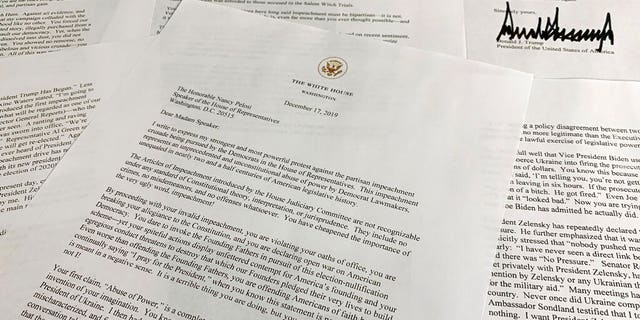
In a blistering, no-holds-barred six-page letter Tuesday to House Speaker Nancy Pelosi, D-Calif.,
Trump lambasted the Democrats' impeachment inquiry as an "open war on
American Democracy," writing that Pelosi has violated her oath of office
and "cheapened the importance of the very ugly word, impeachment!"
"Everyone,
you included, knows what is really happening," Trump said. "Your chosen
candidate lost the election in 2016, in an Electoral College landslide
(306-227), and you and your party have never recovered from this
defeat. So you have spent three straight years attempting to overturn
the will of the American people and nullify their votes. You view
democracy as your enemy!"
Conceding the House vote, Trump said he wanted to set his words down “for the purpose of history.”
"You
are the ones interfering in America's elections," Trump wrote. "You are
the ones subverting America's Democracy. You are the ones Obstructing
Justice. You are the ones bringing pain and suffering to our Republic
for your own selfish personal, political, and partisan gain." READ IT: TRUMP LETTER SAYS DEMOCRATS WANTED IMPEACHMENT FOR YEARS, CAN'T HANDLE 2016 ELECTION LOSS
A letter from President Trump to House Speaker Nancy Pelosi is
seen Tuesday, Dec. 17, 2019, in Washington. (Associated Press)
Trump specifically hammered Pelosi for daring "to
invoke the Founding Fathers in pursuit of this election-nullification
scheme," and "even worse," for "offending Americans of faith by
continually saying 'I pray for the President,' when you know this
statement is not true, unless it is meant in a negative sense."
"It is a terrible thing you are doing," Trump added, "but you will have to live with it, not I!"
Concerning
the obstruction-of-Congress impeachment count, Trump attacked Democrats
for "trying to impeach the duly elected President of the United States
for asserting Constitutionally based privileges that have been asserted
on a bipartisan basis by administrations of both political parties
throughout our nation's history."
And, regarding the abuse-of-power charge, Trump noted that it was former Vice President Joe Biden who had "bragged" on video about having Ukraine's
allegedly corrupt prosecutor fired by threatening to withhold $1
billion in critical U.S. aid. But, House Republicans have been barred by
Democrats from calling witnesses that would help them make the case
that Trump's concerns about Ukraine corruption were legitimate.
"More
due process was afforded to those accused in the Salem Witch trials,"
Trump wrote, observing that even Ukrainian President Volodymyr Zelensky
has repeatedly said at the United Nations that he felt no pressure from the White House to conduct political investigations in exchange for military aid.
"More due process was afforded to those accused in the Salem Witch trials." — President Trump, to House Speaker Nancy Pelosi
The
president argued that Democrats were trying to distract Americans from
the strong economy and historically low unemployment numbers, and
pointed out that Democrats have openly called for impeachment since the day he took office.
Michigan
Democratic Rep. Rashida Tlaib, Trump noted, announced that "We're going
to impeach the motherf---er" all the way back in January -- long before
Trump's mentioned Biden's possible corruption in a phone call with
Zelensky.
Democrats' persistent but unsubstantiated allegations
that the Trump campaign had conspired with Russians to influence the
2016 election, the president observed, ultimately "dissolved into dust,"
but not before the nation had to endure years of "turmoil and torment."
(Also on Tuesday, in a highly unusual public statement, the secretive
Foreign Intelligence Surveillance Court slammed the FBI for
its misleading warrant applications to surveil a former Trump aide
during the Russia probe, and demanded immediate corrective action.)
But
Pelosi, who warned earlier this year that impeachment would need to be
bipartisan, called Trump's letter "ridiculous." She reaffirmed that
Democrats would go ahead with impeachment, even though they lack any
Republican support in the House.
“Very sadly, the facts have made
clear that the President abused his power for his own personal,
political benefit and that he obstructed Congress,” Pelosi wrote to
colleagues. “In America, no one is above the law.”
One by one this
week, centrist Democratic lawmakers, including many first-term freshmen
who built the House majority and could risk their reelection in
districts where the president is popular, announced they would follow
Pelosi's lead and vote to impeach.
Polls have shown that Trump is now leading his top Democratic rivals, and that impeachment is actually helping Trump in key battleground states that might decide the 2020 election.
Nationally, a Fox News poll this week found that 50 percent of respondents want Trump impeached and removed from office, even as Trump's job approval ticked up.
Voters in swing districts have increasingly voiced their frustrations at heated town halls as their representatives have said they will support impeachment. Rep. Elissa Slotkin, D-Mich., who represents a district Trump won in 2016, pointedly ignored protesters as she backed impeachment at an event this week.
For
her part, Rep. Abby Finkenauer, D-Iowa, referred to the oath she took
in January as she was sworn into office as guiding her decision. She
announced support for both articles of impeachment to “honor my duty to
defend our Constitution and democracy from abuse of power at the highest
levels.”
One new Democratic congressman, Jared Golden of Maine,
said he would vote to impeach on abuse of power but not obstruction, in
an apparent effort to appease both sides on the issue.
And a
freshman Democrat, Jeff Van Drew of New Jersey, is indicating he will
switch parties to become a Republican after opposing impeachment.
Earlier this year, Michigan conservative Rep. Justin Amash left the GOP
when he favored impeachment. Amash is now an independent.
A crowd gathers on Federal Plaza for a protest against President
Trump on the eve of a scheduled vote by the U.S. House of
Representatives on the two articles of impeachment against the
president, Tuesday, Dec. 17, 2019, in Chicago. (Associated Press)
After Trump's likely impeachment by a majority vote in the House, attention will soon shift to the Senate, which,
under the Constitution, is required to hold a trial on the charges.
That trial is expected to begin in January, and a two-thirds vote would
be needed to convict Trump and remove him from office.
Senate
Majority Leader Mitch McConnell, R-Ky., has embraced the partisan nature
of impeachment, dropping pretenses of fairness -- such as those adopted
by Democrats, which he has characterized as superficial and
transparently phony, even as they refused GOP witness requests, called
numerous hearsay witnesses, and introduced articles of impeachment that
do not track any criminal statute.
“I'm not an impartial juror,”
McConnell declared, saying that Democrats' procedures in the House were
exclusively one-sided. The Republican-majority chamber is all but sure
to acquit the president; McConnell has announced
that he intends to spend Wednesday confirming new federal judges to
lifetime appointments every two hours while Democrats are debating and
voting on impeachment.
“Impeachment
is a political decision,” McConnell said. "The House made a partisan
political decision to impeach. I would anticipate we will have a largely
partisan outcome in the Senate. I’m not impartial about this at all.''
McConnell struck back Tuesday at his Democratic counterpart's calls for an in-depth impeachment trial featuring multiple new witnesses, dismissing the push as a "fishing expedition" that would set a "nightmarish precedent."
"The Senate is meant to act as judge and jury, to hear a trial,
not to re-run the entire fact-finding investigation because angry
partisans rushed sloppily through it,” he said on the Senate floor.
"The
Senate is meant to act as judge and jury, to hear a trial, not to
re-run the entire fact-finding investigation because angry partisans
rushed sloppily through it.” — Senate Majority Leader Mitch McConnell
Senate Majority Leader Mitch McConnell, R-Ky., joined by Sen. Roy
Blunt, R-Mo., left, and Sen. Joni Ernst, R-Iowa, dismisses the
impeachment process against President Trump, saying, "I'm not an
impartial juror. This is a political process," as he meets with
reporters at the Capitol in Washington, Tuesday, Dec. 17, 2019.
(Associated Press)
In a Sunday letter, Senate Democratic Leader Chuck Schumer
had called for the chamber to subpoena new documents and call witnesses
who had been blocked by the White House during the impeachment inquiry
on the House side.
McConnell claimed that such investigative
steps, though, were part of the House role -- not a mission for the
Senate. He warned that entertaining Schumer’s proposal to do House
lawmakers’ “homework” could invite a string of future “dubious” and
“frivolous” impeachment inquiries.
He stressed the fact-finding
mission should have been completed during the impeachment inquiry led by
House Intelligence Committee Chairman Rep. Adam Schiff,
D-Calif. McConnell accused the House of doing a rush job, and said
Schumer is now looking "to make Chairman Schiff's sloppy work more
persuasive."
Even after voting to impeach Trump, the House still
would need to vote formally to send the impeachment articles to the
Senate. In 1998, the House approved the resolution to send the articles
to the Senate about 10 minutes after the House voted to impeach
then-President Bill Clinton. But, Democrats might delay sending the
articles to the GOP-held Senate this time around, in a bid to influence
the proceedings there.
Such
an unprecedented move, however, would likely only further inflame
Republicans and moderates who have already looked with skepticism on the
impeachment proceedings.
"The allegations against the President
are incredibly, incredibly serious," Virginia Democratic Rep. Abigail
Spanberger, who flipped a GOP seat in 2018, told constituents this week.
A constituent quickly retorted: "They're incredible bulls--t." Fox News' Chad Pergram, Adam Shaw, and The Associated Press contributed to this report.
WASHINGTON (AP) —
House leaders unveiled a $1.4 trillion government-wide spending package
with an unusually large load of unrelated provisions catching a ride on
the last train out of Congress this year.
A
House vote was slated for Tuesday on the sprawling package, some 2,313
pages long, as lawmakers wrap up reams of unfinished work — and vote on
impeaching President Donald Trump.
The
legislation would forestall a government shutdown this weekend and give
Trump steady funding for his U.S.-Mexico border fence. The year-end
package is anchored by a $1.4 trillion spending measure that caps a
difficult, months-long battle over spending priorities.
The
mammoth measure made public Monday takes a split-the-differences
approach that’s a product of divided power in Washington, offering
lawmakers of all stripes plenty to vote for — and against. House Speaker
Nancy Pelosi, D-Calif., was a driving force, along with administration
pragmatists such as Treasury Secretary Steven Mnuchin, who negotiated
the summertime budget deal that it implements.
Trump
hasn’t said for sure that he’ll sign the measure. He invariably has
second thoughts, but he’s not interested in another government shutdown
and has always bowed to Pelosi and Senate Majority Leader Mitch
McConnell, R-Ky., when they’ve teamed up on compromise spending
packages.
Retired
coal miners and labor union opponents of Obama-era taxes on high-cost
health plans came away with big wins in weekend negotiations by top
congressional leaders and the Trump White House. The bill would also
increase the age nationwide for purchasing tobacco products from 18 to
21, and offers business-friendly provisions on export financing, flood
insurance and immigrant workers.
The
roster of add-ons grew over the weekend to include permanent repeal of a
tax on high-cost “Cadillac” health insurance benefits and finance
health care and pension benefits for about 100,000 retired union coal
miners threatened by the insolvency of their pension fund. A tax on
medical devices and health insurance plans would also be repealed
permanently.
The
deficit tab for the package grew as well — almost $400 billion over 10
years to repeal the three so-called “Obamacare” taxes alone — with a
companion package to extend several business-friendly tax breaks still
under negotiation. The Obama-era taxes have previously been suspended on
a piecemeal basis.
The
legislation is laced with provisions reflecting divided power in
Washington. Republicans maintained the status quo on several
abortion-related battles and on funding for Trump’s border wall.
Democrats controlling the House succeeded in winning a 3.1 percent raise
for federal civilian employees and the first installment of funding on
gun violence research after more than two decades of gun lobby
opposition.
The
sweeping legislation, introduced as two packages for political and
tactical purposes, is part of a major final burst of legislation that’s
passing Congress this week despite bitter partisan divisions and
Wednesday’s likely impeachment of Trump. Thursday promises a vote on a
major rewrite of the North American Free Trade Agreement, while the
Senate is about to send Trump the annual defense policy bill for the
59th year in a row.
The
core of the spending bill is formed by the 12 annual agency
appropriations bills passed by Congress each year. It fills in the
details of a bipartisan framework from July that delivered about $100
billion in agency spending increases over the coming two years instead
of automatic spending cuts that would have sharply slashed the Pentagon
and domestic agencies.
The
increase in the tobacco purchasing age to 21 also applies to
e-cigarettes and vaping devices and gained momentum after McConnell
signed on.
Other add-ons include a variety of provisions sought by business and labor interests and their lobbyists in Washington.
For
business, there’s a seven-year extension of the charter of the
Export-Import Bank, which helps finance transactions benefiting U.S.
exporters, as well as a renewal of the government’s terrorism risk
insurance program. The financially troubled government flood insurance
program would be extended through September, as would several visa
programs for both skilled and seasonal workers.
Labor
won repeal of the so-called Cadillac tax, a 40% tax on high-cost
employer health plans, which was originally intended to curb rapidly
growing health care spending. But it disproportionately affected
high-end plans won under union contracts, and Democratic labor allies
had previously succeeded in temporary repeals.
Democrats
controlling the House won increased funding for early childhood
education and a variety of other domestic programs. They also won higher
Medicaid funding for the cash-poor government of Puerto Rico, which is
struggling to recover from hurricane devastation and a resulting
economic downturn.
While
Republicans touted defense hikes and Democrats reeled off numerous
increases for domestic programs, most of the provisions of the spending
bill enjoy bipartisan support, including increases for medical research,
combating the opioid epidemic, and Head Start and childcare grants to
states.
Democrats
also secured $425 million for states to upgrade their election systems,
and they boosted the U.S. Census budget $1.4 billion above Trump’s
request. They won smaller increases for the Environmental Protection
Agency, renewable energy programs and affordable housing.
“We
are scaling up funding for priorities that will make our country safer
and stronger and help hardworking families get ahead,” said House
Appropriations Committee Chairwoman Nita Lowey, D-N.Y.
The
outcome in the latest chapter in the longstanding battle over Trump’s
border wall awards Trump with $1.4 billion for new barriers — equal to
last year’s appropriation — while preserving Trump’s ability to use his
budget powers to tap other accounts for several times that amount.
That’s a blow for liberal opponents of the wall but an acceptable
trade-off for pragmatic-minded Democrats who wanted to gain $27 billion
in increases for domestic programs and avert the threat of simply
funding the government on autopilot.
Because
dozens of Democrats might vote against the border wall, Pelosi is
pairing money for the Department of Homeland Security with the almost
$700 billion Pentagon budget, which is guaranteed to win GOP votes to
offset Democratic defections.
The
coal miners’ pension provision, opposed by House GOP conservatives like
Minority Leader Kevin McCarthy, R-Calif., had the backing of Trump and
powerful Senate GOP Leader McConnell and Trump. Sen. Joe Manchin,
D-W.Va., was a dogged force behind the scenes and said the other leaders
rolled the House GOP leader, who also lost a behind-the-scenes battle
with Pelosi on parochial California issues.
“Something
had to be done and we finally got Mitch McConnell to sign onto the
bill,” Manchin said. “But we could not move McCarthy. Then finally we
just had to move forward and they did it.”
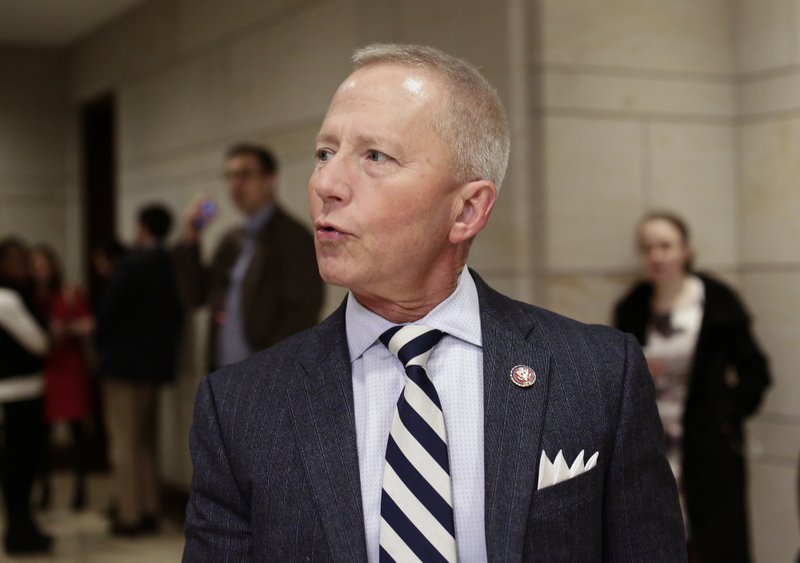
In
this file photo from Jan. 3, 2019, Rep. Jeff Van Drew, D-N.J., arrives
for a classified briefing on Capitol Hill in Washington. Van Drew, a
Democrat who plans to switch and become a Republican, has said he plans
to vote this week against impeaching President Donald Trump.The freshman
represents a southern New Jersey district that Trump carried in 2016
and was expected to face a difficult reelection next year. (AP Photo/J.
Scott Applewhite, file)
WASHINGTON
(AP) — The political fate of party-switching Rep. Jeff Van Drew may
well hinge on how forcefully he is backed by President Donald Trump,
whose impeachment the New Jersey lawmaker is refusing to support.
With the House set for a near party-line vote impeaching Trump this week,
the longtime Democrat told his staff two days ago that he will become a
Republican, a former aide said Monday. Underscoring the partisan
animosity that the impeachment fight has spawned, at least six of Van Drew’s top aides promptly quit.
Now,
the 66-year-old former state legislator, who’s been a political
powerhouse in his southern New Jersey district, must figure out how to
survive a race in which local Democrats now despise him and Republicans
don’t want him elbowing them aside.
His
race will also test the electoral impact of his party switch on the
face of the impeachment showdown, which has sharply divided the two
parties. In recent years, congressional party switchers have had mixed
records extending their careers.
Trump
met with Van Drew last week and has complimented him on Twitter for his
“honesty.” With impeachment on the horizon, Trump praised the
congressman again early Tuesday. “Congressman Jeff Van Drew is very
popular in our great and very united Republican Party,” the president
wrote. “It was a tribute to him that he was able to win his heavily
Republican district as a Democrat. People like that are not easily
replaceable!
One
rival for the GOP nomination for the seat says he’s been told Trump
will endorse Van Drew. While there’s been no word on whether Trump will
help Van Drew win the GOP nod in next June’s primary or aid him during
next November’s general election, analysts say Trump’s backing will be
crucial.
“Whatever
trouble in the Republican primary Jeff Van Drew might have goes away
when Donald Trump throws his arm around the guy,” said Ben Dworkin,
director of the nonpartisan Rowan Institute for Public Policy &
Citizenship in Glassboro, New Jersey.
Van
Drew’s general election prospects will depend on factors including how
liberal the Democratic presidential nominee and the Democrat seeking the
House seat are. His district has become increasingly conservative, with
Trump carrying it narrowly in 2016 after Barack Obama won it in 2008
and 2012.
“I
think Van Drew would be the early favorite, assuming Trump helps him get
the nomination,” said Patrick Murray, director of the nonpartisan
Monmouth University Polling Institute.
Van Drew did not return phone calls and text messages seeking comment.
Van
Drew’s defection to the GOP got a thumbs-up Monday from Cheryl McCleary
as she waited tables at a luncheonette in Surf City, on New Jersey’s
Long Beach Island.
“I
appreciate the fact that he’s staying true to his conscience,” said
McCleary, an independent voter. “If you feel like you’re not in touch
with your party on key issues, it’s a good thing to switch.”
Van
Drew’s decision came after a poll by his campaign showed that by 2-1
margins, voters in his district preferred alternatives to him in the
primary and general election. The poll was provided by a senior
Democratic aide.
“This
is a guy who cut and ran away from the Democratic Party to protect his
own skin,” said David Richter, former CEO of a global construction firm
who’s seeking the GOP nomination.
Richter said local GOP officials have told him Trump will back Van Drew, but says he thinks he can still defeat him.
“Anybody
who runs on the Republican side is against the impeachment. I’m against
the impeachment,” Richter said. “That’s not enough. You also have to be
someone who has integrity. You also have to be someone who stood up for
Republican principles their whole lives.”
Van Drew, a former dentist, was a conservative state senator before he
joined Congress, bucking Democrats on issues including gun control and
gay marriage.
In
his first year in Congress, Van Drew was among a handful of Democrats
who voted against Nancy Pelosi, D-Calif., becoming speaker. He and
Minnesota Rep. Collin Peterson were the only two Democrats who voted in
October against starting the impeachment inquiry, and both were expected
to oppose impeachment this week, with perhaps a handful of others.
Overall,
Van Drew has voted with Trump 7 percent of the time, according the data
tracking website fivethirtyeight.com. That’s one of the higher scores
among House Democrats, and far beneath the lowest loyalty score for any
Republican, which was 35 percent.
New Jersey Democrats were already bidding him good riddance.
“It’s
certainly not a profiles in courage award that he gets,” Sen. Bob
Menendez, D-N.J., said in an interview. He said he believed Van Drew was
switching because his anti-impeachment vote would have cost him the
Democratic Party’s endorsement next year.
“Congressman
Van Drew has long voted against core Democratic values,” Democratic
Gov. Phil Murphy said in a tweet. “Betraying our party by siding with
Donald Trump is the final straw.”
Montclair
State University political science Professor Brigid Harrison, who
declared Monday that she would seek the Democratic nomination for Van
Drew’s seat, called Van Drew “a blind pawn for Donald Trump.”
After
Republicans captured the House majority in 1994, five Democrats
switched to the GOP, including two who lost their next elections. But
Rep. Billy Tauzin of Louisiana joined the GOP leadership and became a
committee chairman while Georgia Rep. Nathan Deal was elected governor.
“They
were more than happy for us to leave,” former Rep. Mike Parker of
Mississippi said of his former Democratic colleagues in an interview.
In 1999, five House Democrats backed impeaching President Bill Clinton. Three of them eventually switched to the GOP.
Among
the most recent party switchers was Rep. Parker Griffith, D-Ala., who
joined the GOP in 2009. He lost the Republican nomination for his seat
the following year.
Conservative
Rep. Justin Amash of Michigan left the GOP and became an independent
this year after saying he was open to impeaching Trump. His prospects
for reelection next year are unclear.
___
Associated Press writers Michael Catalini in Trenton and Wayne Parry in Surf City, New Jersey, contributed to this report.
With
just hours to go until the House Rules Committee meets at 11 a.m. ET
Tuesday for a marathon session to set the ground rules on this week's
final impeachment vote, many of the moderate Democrats in districts President Trump won in 2016 have started to fall in line in favor of impeachment.
Other than New Jersey Rep. Jeff Van Drew, who has mulled switching to the Republican Party, and Minnesota Rep. Collin Peterson,
no other Democrat occupying one of the 31 House districts that Trump
won in 2016 has announced opposition to impeachment. All Republicans in
Congress and the Senate have opposed impeachment.
At the same
time, New York Rep. Max Rose, whose district backed Trump by 10 points
in 2016 and who has long campaigned on bipartisanship, announced Friday he would support impeaching the president.
“A
president coercing a foreign government into targeting American
citizens is not just another example of scorched earth politics, it
serves as an invitation to the enemies of the United States to come
after any citizen, so long as they disagree with the President,” Rose
said in a statement.
Pennsylvania Rep. Conor Lamb, Arizona
Rep. Tom O’Halleran and Nevada Rep. Susie Lee, all Democrats
representing Trump-won districts, have also said they will back
impeachment.
And, Texas Rep. Colin Allred, a Democrat who flipped a
GOP seat in 2018, called Trump's actions an “unacceptable violation of
his oath of office and constitute an impeachable abuse of power.”
Allred's district went to Hillary Clinton by just 1.9 points.
Not
all moderate Democrats have weighed in, with several saying the vote
will be a challenging decision. The House is comprised of 431 members,
meaning Democrats would need 217 yeas to impeach Trump. There currently
have been 233 Democrats, so they could lose only 16 of their own and
still impeach the president.
The indications from moderates
strongly suggested, though, that the president will be impeached by a
floor vote of the full House this week, either on Wednesday or Thursday
-- setting up an all-but-certain acquittal by the GOP-controlled Senate.
Meanwhile, support for impeachment has flatlined in several battleground-state polls. However, a Fox News poll this week
showed that nationally, 50 percent wanted Trump impeached and removed
from office. Only 4 percent wanted Trump impeached but not removed by
the Senate, and 41 percent opposed impeaching him altogether.
On Monday, House Democrats laid out their impeachment case against Trump in a sweeping report accusing him of betraying the nation and deserving to be ousted.
What
Democrats once likely hoped would be a bipartisan act, only the third
time in U.S. history the House will be voting to impeach a president, is
now on track to be a starkly partisan roll call Wednesday.
Before
that can happen, the Rules Committee will weigh in, in a break from
recent history. During the 1998 impeachment of Bill Clinton, the House
did not look to the Rules Committee to set up debate. Instead, the
articles of impeachment came up on the House floor through a
parliamentary phenomenon known as “privilege.” The House then secured a
unanimous consent agreement, meaning all 435 members agreed to continue
to consider the articles of impeachment over a two-day period. Such
unanimous agreement was not considered feasible in this hyper-partisan
environment. (An eye-popping 283 members of the House participated in
the impeachment debate on the floor in 1998.)
After the Rules
Committee concludes testimony Tuesday, the panel will present a “rule”
for the actual floor debate on Wednesday. After a committee debate, the
panel votes on the rule and sends it to the floor. House Rules Committee
Chairman Jim McGovern, D-Mass., told Fox News he wasn’t sure how long
the debate would be on Wednesday or if they would tie together debate on
both articles of impeachment or set up separate debate on each article.
McGovern doubted the debate, and thus vote on the articles of
impeachment, would drift into Thursday.
The Rules Committee
usually has to produce a rule for debate one day in advance. That’s why
the Rules Committee is meeting Tuesday, so the actual impeachment debate
will unfold on the floor Wednesday.
Tension has remained high
outside Washington. A raucous town hall Monday in the Detroit suburbs,
for example, put on display the nation's wrenching debate over the
unconventional president and the prospect of removing him from office.
Freshman Rep. Elissa Slotkin was both heckled and celebrated as the
Democrat announced her support for impeachment.
“There’s certainly
a lot of controversy about this,” Slotkin told the crowd of 400. “But,
there just has to be a moment where you use the letter of the law for
what they were intended.”
And, a California town hall meeting featuring House Intelligence Committee Chairman Adam Schiff, D-Calif., descended into chaos after jeers led to clashes among attendees. Schiff was discussing how recognition of the Armenian genocide was
a significant bipartisan issue at the event hosted by the Armenian
National Committee of America on Saturday when members of the crowd
began shouting at him.
"You will be going to jail for treason!" one man could be heard shouting in videos from the event
that were posted online. The man acknowledged the outburst was
unrelated to the purpose of the event, stating, "No disrespect to you
all, I'm glad you guys are getting recognized for your genocide, but
this man is a f-----g liar!"
"Liar!" at least one attendee at the Glendale event yelled.
The
commotion escalated from there, with a number of people present bearing
signs or shirts supporting President Trump and opposing the impeachment
process. Schiff is one of the leaders of the impeachment inquiry, which
is expected to lead to a vote by the full House later this week.
Democrats
have introduced two articles of impeachment against Trump. They said he
abused the power of his office by pressuring Ukraine to investigate
2020 election rival Joe Biden and obstructed Congress by trying to block
the House investigation and its oversight duties as part of the
nation's system of checks and balances.
Republicans
have countered that Hunter Biden was engaged in corrupt business
dealings in Ukraine while his father oversaw Ukraine policy as vice
president, and argued that separation-of-powers principles counseled
against impeaching the president for failing to comply with
congressional demands.
Under former Attorney General Eric Holder,
Republicans noted, the Obama administration steadfastly refused to
cooperate on various probes, including Congress' review of the "Fast and
Furious" gunrunning scandal. Republicans eventually held Holder in
contempt of Congress. Fox News' Chad Pergram and The Associated Press contributed to this report.
Rudy
Giuliani, a personal attorney for President Trump, said Monday that he
played a key role in forcing ex-U.S. Ambassador to Ukraine Marie Yovanovitch
from her post earlier this year, and claimed that he has evidence the
Trump impeachment inquiry is a "cover-up" of Democratic malfeasance.
Giuliani, one of Trump's most loyal defenders, told Laura Ingraham on "The Ingraham Angle" that he helped forced out Yovanovitch because she was corrupt and obstructing the investigation into Ukraine and the Bidens.
Giuliani
raised eyebrows recently after an interview was published in the New
Yorker where he was quoted saying that he needed her "out of the way"
because she would make the investigation into the Bidens "difficult for
everybody."
He told Ingraham that he needed her out of the way
because she was corrupt. Giuliani said he was not the first person to go
to the president with concerns about the diplomat.
Yovanovitch,
60, a career diplomat and daughter of immigrants who fled the former
Soviet Union and Nazi Germany, claimed that she was ousted from her role
due to a smear campaign by Trump allies. Trump's tweets about her were
shown during her testimony in front of Congress and she called them
"very intimidating."
Yovanovitch “clearly is somebody who’s been a
public servant to the United States for decades and I don’t think the
president should have done that,” said Rep. Liz Cheney, R-Wyo., at the
time.
Giuliani
said others voiced their concerns about the diplomat, including [former
Texas Republican U.S. Congressman] Pete Sessions, and a number of
congressmen.
He added that he interviewed several individuals who
claimed Yovanovitch was "holding up" their U.S. visas "in order to
obstruct the investigation of collusion in the Ukraine and specifically
to obstruct the Biden investigation."
"It is a cover-up, a cover-up," Giuliani claimed.
The
law firm representing Yovanovitch did not immediately respond to an
after-hours email from Fox News for comment. Yovanovitch and others have
described Giuliani as leading what one called an "irregular
channel" outside the diplomatic mainstream of U.S.-Ukraine relations.
Ingraham asked the former mayor why Trump didn't go to Secretary of
State Mike Pompeo about concerns with Yovanovitch.
"I have that
testimony under oath. I gave it to the State Department. They never
investigated a single witness. When they say that she is innocent, it is
innocent-without-investigation," he added.
Regarding the Bidens, Giuliani has claimed that former Vice President Joe Biden and his son Hunter should be investigated --
relating to the younger Biden's position on the board of a Ukrainian
energy firm while his father was serving in the Obama administration.
Giuliani
further told Ingraham that Trump was simply asking new Ukrainian
President Volodymyr Zelensky -- in a July phone call -- to investigate
crimes at the "highest levels" of both Kiev and Washington.
"So, he is being impeached for doing the right thing as president of the United States," he said. The Associated Press contributed to this report
CLINTON,
Iowa (AP) — Seven Democratic presidential candidates will stand on
stage this week in Los Angeles, a pool of survivors who have withstood
almost a year on the campaign trail, sustained attacks from rivals in
both parties, and five rounds of high-pressure debates.
And
while the field has been effectively cut down from more than 20 in the
span of six months, a deepening sense of volatility is settling over the
Democratic primary on the eve of the sixth and final debate of 2019.
The remaining candidates, those in the debate and some trying to compete
from outside, are grappling with unprecedented distraction from
Washington, questions about their core principles and new signs that the
party’s energized factions are turning against each other.
Lest
there be any doubt about the level of turbulence in the race, it’s
unclear whether Thursday’s debate will happen at all given an unsettled
labor union dispute that might require participants to cross a picket
line. All seven candidates have said they would not do so.
The
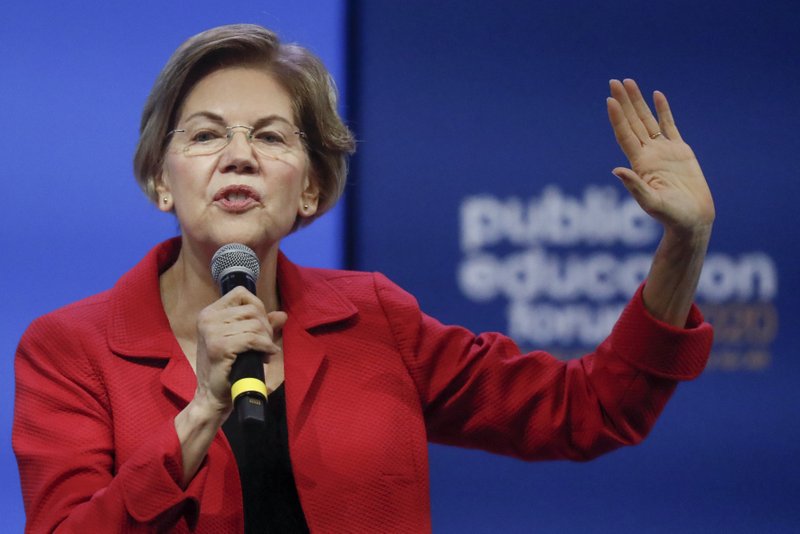
Democratic dilemma is perhaps best personified by Elizabeth Warren,
whose progressive campaign surged through the late summer and fall but
is suddenly struggling under the weight of nagging questions about her
health care plan, her ability to compete against President Donald Trump
and her very authenticity as a candidate.
Boyd
Brown, a South Carolina-based Democratic strategist who recently
decided to back Joe Biden only after his preferred candidate, Beto
O’Rourke, was forced from the race, likened Warren’s position to that of
someone falling down a mountain grasping for anything to slow her
descent.
“She’s got real problems,” Brown said.
Warren
has avoided conflict with her Democratic rivals for much of the year,
but she has emerged as the chief antagonist of the leading candidates in
the so-called moderate lane, former Vice President Joe Biden and Mayor
Pete Buttigieg of South Bend, Indiana. Seven weeks before Iowa’s Feb. 3
caucus, the Massachusetts senator is attacking both men with increasing
frequency for being too willing to embrace Republican ideas and too cozy
with wealthy donors.
Those
close to Warren hope the strategy will allow her to shift the
conversation away from her own health care struggles back to her
signature wealth tax and focus on corruption. Yet she could not escape
questions about her evolving position on Medicare for All as she
campaigned in Iowa over the weekend.
When
asked about health care, Warren told a crowd of roughly 180 people in
the Mississippi River town of Clinton, Iowa, about a plan to expand
insurance coverage without immediately moving to a universal,
government-run system. She promised that those who wanted government
health insurance could buy it before finally concluding, “At the end of
my first term, we’ll vote on Medicare for All.”
The next question came from a man who said he was on Medicare and mostly happy about it, but had lingering issues.
“You call it Medicare for All and it’s better. Can’t you change the name?” he asked of her proposal.
“I
like your suggestion,” Warren responded, in a tone suggesting she
wasn’t entirely joking. “Let’s call it health care for everybody.” She
later added, “Let’s call it better than Medicare for All. I’m in.”
Even
entertaining a name change seemed to mark yet another shift for Warren,
who first co-sponsored Medicare for All in 2017, but began pivoting
away from the proposal after experts questioned the plan she released in
October to pay for it without raising middle-class taxes. She
subsequently released a “transition plan” promising to get Medicare for
All approved by Congress by the end of her third year as president while
relying on existing insurance plans, including those established by
Obamacare, to expand health coverage in the interim.
Warren’s
Democratic critics suggest her evolution on the issue has stalled her
momentum because it goes beyond a policy dispute and raises broader
questions about what may be the most important personal quality in
politics: authenticity.
Indeed,
Buttigieg, Biden and other rivals have seized on her shifts. Even
Bernie Sanders, Warren’s progressive ally and Medicare for All’s author,
seemed to pile on by promising to send a full bill to Congress
implementing the measure during the first week of his administration.
Without
naming any of his rivals, Biden adviser Symone Sanders said candidates
would not succeed in shifting the conversation away from health care
this week even if they wanted to. She said to expect another “robust
exchange” on the issue, which “is not going away and for good reason,
because it is an issue that in 2018 Democrats ran on and won.”
Tough questions for Warren haven’t just come from her rivals.
Since
Thanksgiving, she’s shortened her typically 30-minute and more stump
speech to around 10 minutes and used the extra time to take more
audience questions — only to be forced further on the defensive about
health care.
Barton
Wright, a 69-year-old technical writer, pressed Warren on Medicare for
All at a recent event in Rochester, New Hampshire, noting after the
event that he wants a deeper explanation.
“It
just sounds awful,” Wright said. “It sounds ‘like Hemlock for All’ for
people who don’t like Medicare. And that’s a lot of people.”
Even after questioning Warren, however, Wright said he was helping her campaign and still plans to vote for her.
Meanwhile,
Buttigieg, the surprise member of the top-tier, is grappling with
issues of his own that expose another fissure between the moderate and
progressive wings of the party.
Protesters
aligned with Warren and Sanders tracked him across New York City last
week banging pots and pans and calling him “Wall Street Pete” as he
continued his aggressive courtship of wealthy donors. The 37-year-old
seemed genuinely confused by the protests, which he was forced to
acknowledge during at least one Manhattan fundraiser because the noise
outside was so loud.
As
he faced supporters in Seattle over the weekend, Buttigieg acknowledged
that the intra-party attacks will almost certainly continue, although
he tried to downplay the intensity of the infighting.
“There’s
gonna have to be some fighting,” Buttigieg said, “but I’m never gonna
let us get to where it feels like the fight is the point.”
The
fighting is almost certain to be on display at Thursday night’s debate,
especially among the four candidates in the top-tier: Biden, Buttigieg,
Sanders and Warren. The three others on stage — Minnesota Sen. Amy
Klobuchar, billionaire activist Tom Steyer and entrepreneur Andrew Yang —
only narrowly hit the polling threshold needed to qualify and have an
obvious incentive to make waves of their own as well.
Voters don’t want a public fight, even if they sense one is coming.
Steve
Wehling, a 43-year-old University of Iowa employee, said he doesn’t
like Democrats feuding with each other, but he won’t hold it against
Warren or anyone else. He said he understands that, with the caucuses
looming, “all of the campaigns are really starting to put the squeeze
on.”
“Voters
turn on the debates and still see 10 people on stage and I think a lot
would of them would like to see the field narrowed down,” said Wehling,
who plans to vote for Sanders and says Warren is his second choice. “The
pressure is really on.”
___
Peoples reported in New York. Associated Press writer Hunter Woodall in Rochester, New Hampshire, contributed to this report.
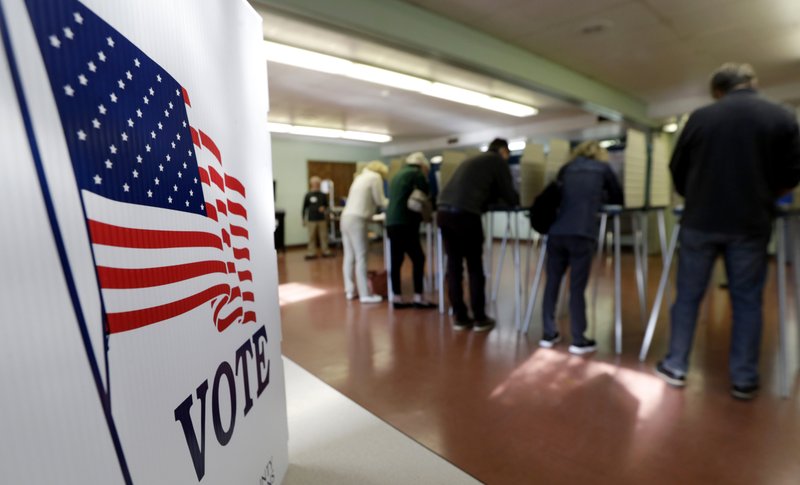
FILE
- In this Nov. 6, 2018, file photo, voters cast their ballots, in Gates
Mills, Ohio. An Associated Press review has found that thousands of
Ohio voters were held up or stymied in their efforts to get absentee
ballots by mail in 2018's general election because of a missing or
mismatched signature on their ballot application. (AP Photo/Tony Dejak,
File)
COLUMBUS,
Ohio (AP) — Thousands of Ohio voters were held up or stymied in their
efforts to get absentee ballots for last year’s general election because
of missing or mismatched signatures on their ballot applications, an
Associated Press review has found.
The
signature requirement on such applications is a largely overlooked and
spottily tracked step in Ohio’s voting process, which has shifted
increasingly to mail-in ballots since early, no-fault absentee voting
was instituted in 2005.
To
supporters, the requirement is a useful form of protection against
voter fraud and provides an extra layer of security necessary for
absentee balloting.
To
detractors, it’s a recipe for disenfranchisement — a cumbersome
addition to an already stringent voter identification system.
Susan
Barnard, of Dayton in Montgomery County, said her 78-year-old husband,
Leslie, who has cancer, missed a chance to vote last year because of a
delay related to the signature requirement.
“We
had planned a cruise last fall to give him something to look forward
to,” said Barnard, 73. “It fell at the time of the election, and we were
going to vote the absentee ballot. We got right down to the wire and we
didn’t have one for him, and so he did not vote because of that.”
She
said he had hoped to vote in the election, which included races for
governor, state Supreme Court and Congress. Barnard suspects her husband
simply forgot to sign his ballot application.
Figures
provided to the AP through public information requests to Ohio’s 88
county boards of elections show 21 counties rejected more than 6,500
absentee ballot applications because a signature was either missing or
didn’t match what was on file. That requirement is not for the ballot
itself, which faces a different battery of requirements, but merely for
an application requesting one. Another five counties reported rejecting
about 850 applications combined, for various reasons that the boards
didn’t specify.
The
few counties that tracked what happened to applications after they were
rejected said issues were largely addressed before or on Election
Day.
Twelve
responding counties recorded encountering no signature issues with the
absentee applications. The remaining responding counties said they
didn’t track how many applications they rejected.
It’s
a statistic conspicuously absent from all the official data collected
by the state, making it all but impossible to compare the issue across
years or multiple states.
Signatures
and other verification requirements are there to safeguard Ohio’s
elections, said state Rep. John Becker, a southwestern Ohio Republican.
He said if a voter fails to sign the application form, “that’s on them.”
Ï’m
a big believer in personal responsibility,” Becker said. “You’ve got
the form in front of you. If you forget to sign it, there are
consequences.”
But
Jen Miller, executive director of the League of Women Voters of Ohio,
said the AP analysis highlights a largely unexamined step in a process
her organization already views as inefficient and subject to uneven
enforcement.
“So
a person can register to vote online, but if you go online to request
an absentee ballot, a form is mailed to you that you have to mail back,”
Miller said. Her organization supports allowing people to request
absentee ballots online.
About 1.4 million of Ohio’s roughly 8 million registered voters cast absentee ballots last year.
Republican
Secretary of State Frank LaRose advocated as a state lawmaker for Ohio
to allow voters to apply for absentee ballots online. A version of
legislation he first proposed in 2013 is now before Ohio’s Legislature.
“While
Ohio has long been a national leader in early voting, there is
certainly more that can be done to prevent issues like these from
occurring,” LaRose said. “Election integrity and voter access can
certainly coexist, so let’s work together to modernize the process so we
can improve the antiquated system currently in place.”
LaRose’s predecessor mailed absentee ballot applications to 6.6 million of Ohio’s 8 million registered voters in 2018. And state law
actually says a request for an absentee ballot “need not be in any
particular form” — meaning it could conceivably arrive on a cocktail
napkin or the back of an envelope.
Still,
the signature requirement is one of eight or nine pieces of
information, depending on the type of election, that a successful
request must contain.
According
to the National Conference of State Legislatures, three states —
Oregon, Washington and Colorado — conduct all-mail elections,
eliminating the ballot application process by automatically mailing a
ballot to every registered voter before Election Day.
Miller
said Ohio has not shown the political will to move in this direction,
but her organization is pushing establishment of a permanent absentee
list for those voters who meet certain criteria that require help, such
as illness, permanent disability or illiteracy. Seven states and the
District of Columbia have just such a system.
The
House Judiciary Committee's minority blasted the committee's rush to
impeach President Trump and wrote that history will not look kindly on
how exculpatory evidence was ignored to meet a "self-imposed December
deadline," according to the full articles of impeachment report released early Monday.
The
minority, which is comprised of Republicans, blasted the Democrat-led
majority for not making the case for impeachment and simply employing
"holdover" arguments from other investigations to make their case.
Despite the divide, Rep. Jerrold Nadler, D-N.Y., the chairman of the
committee, wrote for the majority that Trump is a threat to the
Constitution and should be removed from office.
The
committee released a 658-page report on the impeachment resolution that
lays out the case against Trump. Democrats have raised two articles of
impeachable offenses, including abuse of power by soliciting Ukraine to
interfere in the 2020 election and then obstructing Congress during its
investigation.
The
minority wrote that both articles are supported by assumptions and
hearsay. The minority, headed by Rep. Doug Collins, R-Ga., the ranking
member of the committee, wrote that the majority decided to “pursue
impeachment first and build a case second.”
The majority ignored exculpatory evidence but proclaimed the "facts are uncontested,” the minority wrote.
"The
facts are contested, and, in many areas, the majority's claims are
directly contradicted by the evidence," the minority wrote.
They continued that "not one of the criminal accusations leveled at the
president over the past year—including bribery, extortion,
collusion/conspiracy with foreign enemies, or obstruction of justice—has
found a place in the articles. Some of these arguments are just
holdovers from an earlier disingenuous attempt by the majority to
weaponized the Russia collusion investigation for political gain."
The
majority's actions were "unprecedented, unjustifiable, and will only
dilute the significance of the dire recourse that is
impeachment," they wrote.
The minority also claimed procedural
missteps by the majority by not allowing a "minority day of hearings,"
despite several requests to Nadler. They called the denial “blatant” and
“intentional.” They claim Nadler also refused a request to subpoena
witnesses. They wrote that there was a complete absence of “fact
witnesses” and the case rested with the testimony from four academics
and another with a panel of Congressional staffers.
The majority
claimed that they were transparent. The majority wrote that the minority
wanted to hear testimony from the whistleblower, but the
majority stressed the importance of protecting the person’s identity.
The minority's request to hear from Hunter Biden—the son of Joe
Biden—was "well outside the scope of the inquiry," the majority wrote.
At
the heart of the first charge, is Trump’s July 25 phone call with
Ukrainian President Volodymyr Zelensky. Democrats have relied on a
whistleblower’s complaint that claimed that there was at least an
implied quid pro quo during the phone conversation. Trump was also
accused of using agents "within and outside" the U.S. government to
compel Kiev to investigate the Bidens and their business dealings in the
country. The claim is that Trump withheld $391 million in essential
military funds to pressure Kiev on the investigations.
Both Trump and Zelensky deny there was ever any implied or explicit quid pro quo.
The newly released report also claims that Trump directed key players in the inquiry from participating.
Trump
"interposed the powers of the Presidency against the lawful subpoenas
of the House of Representatives, and assumed to himself functions and
judgments necessary to the exercise of the ‘‘sole Power of Impeachment’’
vested by the Constitution in the House of Representatives,” the report
said.
The report listed John “Mick” Mulvaney, Trump’s acting
chief of staff, and Robert B. Blair, a senior adviser to Mulvaney, as
officials who have denied subpoenas.
Sen. Chuck Schumer, D-N.Y., on Sunday proposed in a letter
to Senate Majority Leader Mitch McConnell, R-Ky., that Mulvaney be
subpoenaed to testify in an impeachment trial. McConnell told Fox News
last week that the chances of Trump being removed from office are zero.
Republicans
say Democrats are impeaching the president because they can’t beat him
in 2020. Democrats warn Americans can’t wait for the next election
because they worry what Trump will try next.
The House is expected
to vote on the articles next week, in the days before Christmas. That
would send the impeachment effort to the Senate for a 2020 trial.
The
majority claimed that the impeachment inquiry was performed in a fair
manner and pointed out that the purpose of the inquiry was to determine
if Trump “may have committed an impeachable offense.” Trump was offered
the opportunity to participate, but he declined, the majority wrote. The
president has refused to participate in the proceedings.
At about
the time the impeachment report was being released, Trump was on
Twitter touting his record and slamming the allegations. He wrote that
despite the impeachment and "obstruction," he had one of the most
successful presidencies in history. The Associated Press and Bradford Betz contributed to this report


 A letter from President Trump to House Speaker Nancy Pelosi is
seen Tuesday, Dec. 17, 2019, in Washington. (Associated Press)
A letter from President Trump to House Speaker Nancy Pelosi is
seen Tuesday, Dec. 17, 2019, in Washington. (Associated Press)
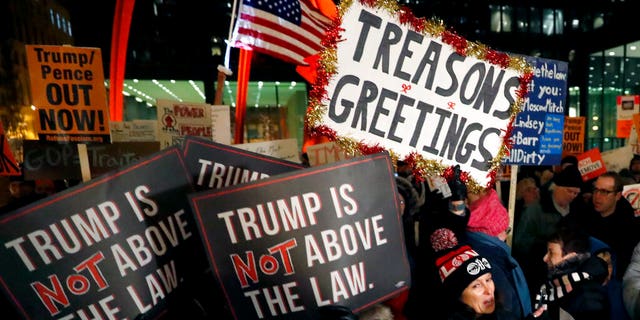 A crowd gathers on Federal Plaza for a protest against President
Trump on the eve of a scheduled vote by the U.S. House of
Representatives on the two articles of impeachment against the
president, Tuesday, Dec. 17, 2019, in Chicago. (Associated Press)
A crowd gathers on Federal Plaza for a protest against President
Trump on the eve of a scheduled vote by the U.S. House of
Representatives on the two articles of impeachment against the
president, Tuesday, Dec. 17, 2019, in Chicago. (Associated Press)
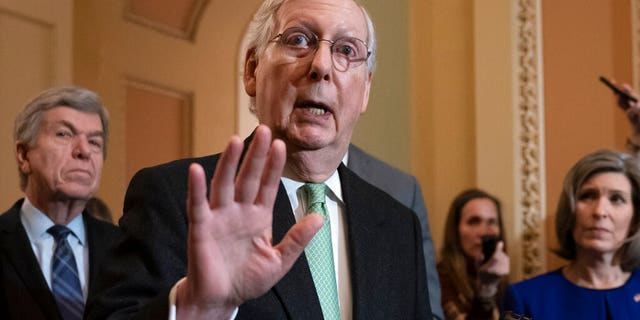 Senate Majority Leader Mitch McConnell, R-Ky., joined by Sen. Roy
Blunt, R-Mo., left, and Sen. Joni Ernst, R-Iowa, dismisses the
impeachment process against President Trump, saying, "I'm not an
impartial juror. This is a political process," as he meets with
reporters at the Capitol in Washington, Tuesday, Dec. 17, 2019.
(Associated Press)
Senate Majority Leader Mitch McConnell, R-Ky., joined by Sen. Roy
Blunt, R-Mo., left, and Sen. Joni Ernst, R-Iowa, dismisses the
impeachment process against President Trump, saying, "I'm not an
impartial juror. This is a political process," as he meets with
reporters at the Capitol in Washington, Tuesday, Dec. 17, 2019.
(Associated Press)