NEW
YORK (AP) — Four years after President Donald Trump drove the rules of
politics over a cliff to win the Republican presidential nomination and
ultimately the White House, Democrats will go through their own version
of the same test.
In
less than a month, Democratic voters will begin the formal process of
sifting through a historically large field of candidates. The options
include progressives who have inspired energy — and strong opposition —
by rejecting traditional party politics and pushing for fundamental
changes to America’s political, social and economic systems. Voters
could pick the oldest nominee in the party’s history — or the youngest.
Ironies abound at the outset of the Democratic primary.
The
oldest candidate at 78, Vermont Sen. Bernie Sanders, has a loyal
following among young voters but has yet to prove he can build a broader
coalition. Older voters, meanwhile, have shown interest in Pete
Buttigieg, the 37-year-old former mayor of South Bend, Indiana, whose
moderate vision has been greeted with skepticism by many fellow
millennials.
And a party that prides itself on valuing diversity is contending with a top tier that is all white and mostly male.
The
battle for the White House will unfold amid a great political
realignment that is disrupting decades-long political alliances and
further dividing America by education, gender and race. That means the
election will likely serve as a referendum not only on the candidates,
but also the country and its definition of the American presidency.
Some
of Trump’s most influential allies say he is ready and willing to make
2020 the nastiest presidential contest in living memory.
Steve
Bannon, a former White House adviser who has long fanned the flames of
Trump’s scorched-earth politics, indicated that Trump would lean more
aggressively into populism and nationalism over the coming year. And he
offered a warning to Democrats who have engaged in a largely polite
nomination fight so far: The “pillow fight” is almost over.
“This will be one for the ages. You’re going to get full Trump at max speed,” Bannon told The Associated Press.
Trump
and his massive political machine are an ever-present force in the
Democratic contest. The most important question each candidate must
answer is why they are best positioned to defeat a president many in the
party consider an existential threat to democracy.
Trump
has already hurled personal and policy attacks at his Democratic
opponents, even inviting assistance from foreign governments to defeat
them. And with his surprise move last week to strike Gen. Qassem
Soleimani, Trump showed how he can use the powers of the presidency to
scramble American politics in an instant.
In
a race that was already certain to be brutish, Trump’s decision to
order the attack prompted some Democratic candidates to suggest he may
have done so to divert attention from his impeachment trial.
The
urgent question of which Democrat will ultimately challenge Trump will
take months to resolve. The winnowing process formally begins with
Iowa’s Feb. 3 caucus and ends at the party’s mid-July national
convention after every state and U.S. territory holds its own primary
contest.
The
candidates represent the ideological diversity of an evolving Democratic
Party that is teetering on the edge of its own civil war, united if
only by overwhelming disdain for Trump.
Former
Vice President Joe Biden and Buttigieg represent the party’s moderate
wing, favoring a more cautious shift leftward on core issues like health
care, education and immigration. On the other side, Elizabeth Warren, a
70-year-old progressive Massachusetts senator, and Sanders, a
self-described democratic socialist, are fighting for transformational
changes including a shift to a single-payer health care system.
At
the same time, one of the richest men in the world, former New York
Mayor Michael Bloomberg, is trying to use his fortune to rewrite the
rules of primary politics. The $50 billion man, who registered as a
Democrat little more than a year ago, will ignore the first four states
on the primary calendar and focus instead on more than a dozen Super
Tuesday states in early March.
Political
operatives are skeptical, and many progressives are disgusted, yet the
strategy promises to complicate and prolong the bitter primary season.
Each Democratic faction is convinced that the other will trigger the very thing they fear most: Trump’s reelection.
“If
we nominate a candidate that I would describe as far left, extreme
left, I think that unfortunately, a lot of union members will just not
get there,” said Biden supporter Harold Schaitberger, the general
president of the International Association of Firefighters, who
specifically warned Democrats against nominating Sanders or Warren.
The
case for a moderate Democrat lies with the belief that white,
working-class men in a handful of states will largely decide Trump’s
fate in November.
Non-college-educated
white men shifted sharply away from the Democratic Party in 2016,
fueling razor-thin victories for Trump in three states that previously
made up the Democrats’ “blue wall”: Michigan, Pennsylvania and
Wisconsin. If Trump can hold same states again in 2020, he will return
to the White House for another four years.
Schaitberger
fears that some Democrats don’t appreciate the dire nature of the
situation that continues in the Midwest, where many of his union members
remain concerned by the leftward shift of the Democratic Party.
“It
doesn’t matter if we get 10 million more votes in California or 4
million more votes in New York or Massachusetts, you gotta be able to
come up in the battlegrounds with an electoral victory,” Schaitberger
said, pointing to Michigan, Pennsylvania, Wisconsin and Florida as the
states that matter most.
Alexandra
Rojas, executive director of the liberal group Justice Democrats, feels
just as strongly that her party must nominate a “bold progressive” like
Sanders or Warren to take back the presidency. She and thousands of
like-minded activists are fighting Biden and Buttigieg’s candidacies,
outraged by their reliance on wealthy donors and their refusal to
embrace transformative domestic policies like Medicare for All, which
would replace the U.S. private insurance system with free
government-backed health coverage for all Americans.
“We’re fighting like we have nothing to lose,” Rojas declared.
She
predicted that Democrats would ultimately come together after an
explosive primary fight. Given several factors working in the Republican
president’s favor, the Democrats’ feuding factions have no choice but
to unite if they hope to take back the White House.
Rarely
in modern political history has an incumbent president failed to win
reelection in the midst of economic growth. And while there is debate
about the strength of the U.S. economy, there is no debating the
numbers: unemployment rates and the stock market are better today than
when Trump took office.
Meanwhile,
Trump amassed the largest political fortune in U.S. history heading
into an election year, which he’s already using to construct a massive
political machine. Backed by more than $100 million in his campaign
account to begin the year, his team insists it can expand the
traditional political battleground this fall to compete in
Democratic-leaning states like Minnesota, New Mexico and even Oregon.
While
he is optimistic, evangelical leader and Trump confidant Jerry Falwell
Jr., the president of Liberty University, said it’s too early to predict
a Trump electoral landslide. But he’s calling on all Republicans to
embrace the Trump playbook.
“He’s
teaching Republicans a lesson that I hope they learn — that nobody’s
going to support them if they continue to be so diplomatic and so,
what’s the word I’m looking for? I mean they act like royalty, like it’s
beneath them to get down in the mud and fight,” Falwell said in an
interview. “The people have been looking for somebody who will get down
in the mud and fight, and wade in up to their waste. Trump’s the first
one who’s the done that.”
Indeed,
Trump has eagerly attacked anyone and everyone who has criticized his
personal style or governing decisions, even members of his own
administration at times. He has already used ethnic slurs to go after
Warren, raised questions about Sanders’ age, falsely called his rivals
socialists, and openly encouraged foreign governments — namely Ukraine
and China — to dig up dirt on Biden.
As
his political base cheers, such tactics threaten to inflict lasting
damage on Trump’s standing with some voters — especially women.
Democrats
scored sweeping victories in the 2018 and 2019 as college-educated
women, particularly in America’s suburbs, turned their backs on Trump’s
GOP. At the same time, there is evidence that younger voters and
minorities are both energized and repelled by Trump entering the new
year.
Bannon
insisted the GOP has become the “working-class party” under Trump,
although he has some concern about Trump’s standing with working-class
women. His more serious concern, however, lies with the narrow, but
vocal slice of establishment-minded Republicans who are fighting his
reelection.
He
referenced the recent birth of an anti-Trump group dubbed the Lincoln
Project, led by veteran Republican strategists who are planning a
nationwide campaign to convince disaffected Republicans and independent
voters to vote Democrat. The group’s leadership features conservative
attorney George Conway, who is the husband of Trump’s chief White House
counselor Kellyanne Conway.
“We
need the Republican establishment on board,” Bannon said, noting that
Trump essentially won the presidency because of less than 80,000
combined votes across Michigan, Pennsylvania and Wisconsin — “an inside
straight,” he called it.
“If these guys can peel off 3% or 4%, that’s going to be serious,” he said of Trump’s Republican rivals.
Yet
for all the talk of shifting voting blocs, intra-party fights and what
will almost certainly be the most expensive campaign in the history of
the world, Bannon believes that Trump’s fate will ultimately be decided
by one man.
TEHRAN,
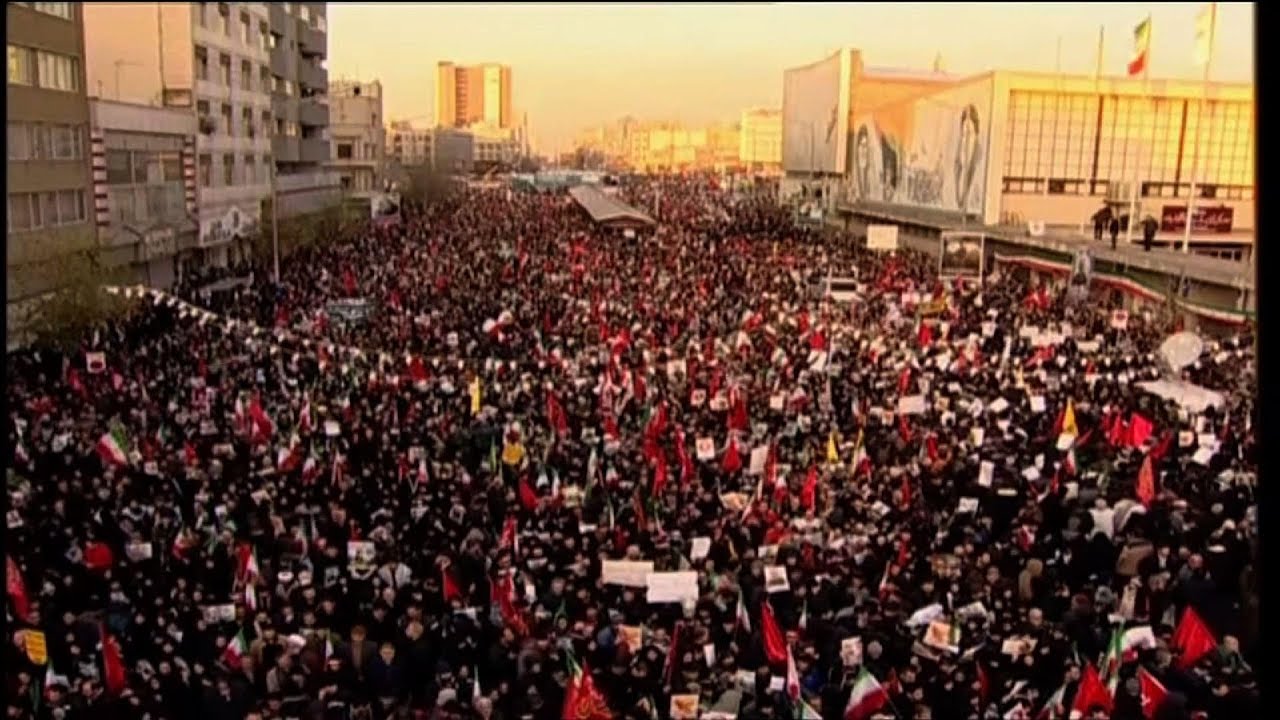
Iran (AP) — Weeping amid wails from a crowd of hundreds of thousands of
mourners, Iran’s supreme leader on Monday prayed over the remains of a
top Iranian general killed in a U.S. airstrike in Baghdad, an attack
that’s drastically raised tensions between Tehran and Washington.
The
targeted killing of Iranian Revolutionary Guard Gen. Qassem Soleimani
already has seen his replacement vow to take revenge. Additionally,
Tehran has abandoned the remaining limits of its 2015 nuclear deal with
world powers in response to the slaying while in Iraq, the parliament
has called for the expulsion of all American troops from Iraqi soil.
The
developments could bring Iran closer to building an atomic bomb, set
off a proxy or military attack launched by Tehran against America and
enable the Islamic State group to stage a comeback in Iraq, making the
Middle East a far more dangerous and unstable place.
Adding
to the tensions, President Donald Trump threatened to demand billions
of dollars in compensation from Iraq or impose “sanctions like they’ve
never seen before” if it goes through with expelling U.S. troops.
Soleimani’s
daughter, Zeinab, directly threatened an attack on the U.S. military in
the Mideast while speaking to a crowd of hundreds of thousands in
Tehran that stretched as far as the eye could see. Iranian state TV put
the crowd size at “millions,” though that number could not be verified.
“The
families of the American soldiers in western Asia ... will spend their
days waiting for the death of their children,” she said to cheers.
Iranian state television and others online shared a video
that showed Trump’s American flag tweet following Soleimani’s killing
turn into a coffin, the “likes” of the tweet replaced by over 143,000
“killed” with the hashtag #severerevenge.
Iran’s
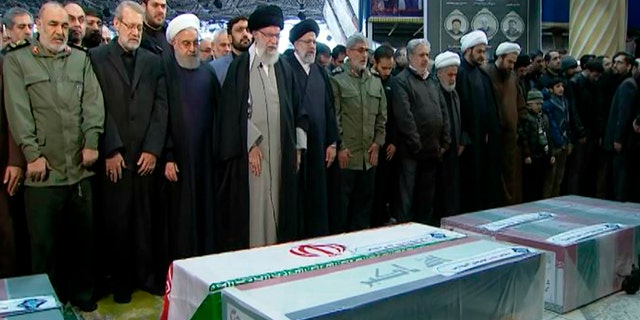
Supreme Leader Ayatollah Ali Khamenei himself prayed over the caskets
of Soleimani and others slain in the attack. Khamenei, who had a close
relationship with Soleimani, wept at one point during the traditional
Muslim prayers for the dead. The crowd wailed.
Soleimani’s
successor, Esmail Ghaani stood near Khamenei’s side, as did Iranian
President Hassan Rouhani and other top leaders in the Islamic Republic.
While Iran recently faced nationwide protests over government-set
gasoline prices that reportedly killed over 300 people, Soleimani’s mass
processionals has seen politicians and leaders across the Islamic
Republic’s political spectrum take part, temporarily silencing that
anger.
Demonstrators
burned Israeli and U.S. flags, carried a flag-draped U.S. coffin or
effigies of Trump. Some described Trump himself as a legitimate target
for Iran’s revenge.
Mohammad Milad Rashidi, a 26-year-old university graduate, predicted more tension ahead.
“Trump
demolished the chance for any sort of possible agreement between Tehran
and Washington,” Rashidi said. “There will be more conflict in the
future for sure.”
Ghaani
made his own threat in an interview with Iranian state television aired
Monday. “God the Almighty has promised to get his revenge, and God is
the main avenger. Certainly actions will be taken,” he said.
Markets
reacted Monday to the tensions, sending international benchmark Brent
crude above $70 a barrel. The Middle East remains a crucial source of
oil and Iran in the past has threatened the Strait of Hormuz, the narrow
mouth of the Persian Gulf through which 20% of all the world’s oil
traded passes.
Ghaani,
a longtime Soleimani deputy, has now taken over as the head of the
Revolutionary Guard’s Quds Force, an expeditionary arm of the
paramilitary organization answerable only to Khamenei. Ghaani has been
sanctioned by the U.S. since 2012 for his work funding its operations
around the world, including its work with proxies in Iraq, Lebanon and
Yemen.
Those proxies likely will be involved in any operation targeting U.S. interests in the Mideast or elsewhere in the world.
Already, the U.S. Embassy in Saudi Arabia warned Americans “of the heightened risk of missile and drone attacks.” In Lebanon, the
leader of the Iranian-backed militant group Hezbollah said Soleimani’s
killing made U.S. military bases, warships and service members across
the region fair game for attacks. A former Iranian Revolutionary
Guard leader suggested the Israeli city of Haifa and others could be
targeted should the U.S. attack Iran.
“We
promise to continue down martyr Soleimani’s path as firmly as before
with help of God, and in return for his martyrdom we aim to get rid of
America from the region,” Ghaani said.
The
head of the Guard’s aerospace program, Gen. Amir Ali Hajizadeh,
suggested Iran’s response wouldn’t stop with a single attack.
“Firing
a couple of missiles, hitting a base or even killing Trump is not
valuable enough to compensate for martyr Soleimani’s blood,” Hajizadeh
said on state TV. “The only thing that can compensate for his blood is
the complete removal of America from the region and taking away their
evil from the oppressed people of the region.”
On
the nuclear deal, Iranian state television cited Sunday a statement by
Rouhani’s administration saying the country would not observe the
nuclear deal’s restrictions on fuel enrichment, on the size of its
enriched uranium stockpile and on its research and development
activities.
German
Chancellor Angela Merkel, French President Emmanuel Macron and British
Prime Minister Boris Johnson specifically urged Iran to “withdraw all
measures” not in line with the 2015 agreement that was intended to stop
Tehran from pursuing its atomic weapons program.
Iran
insisted that it remains open to negotiations with European partners
over its nuclear program. And it did not back off from earlier promises
that it wouldn’t seek a nuclear weapon.
However,
the announcement represents the clearest nuclear proliferation threat
yet made by Iran since Trump unilaterally withdrew from the accord in
2018 and reimposed sanctions last year. It further raises regional
tensions, as Iran’s longtime foe Israel has promised never to allow Iran
to produce an atomic bomb.
Iran
did not elaborate on what levels it would immediately reach in its
program. Tehran has already broken some of the deal’s limits as part of a
step-by-step pressure campaign to get sanctions relief. It already has increased its production, begun enriching uranium to 5% and restarted enrichment at an underground facility.
While
it does not possess uranium enriched to weapons-grade levels of 90%,
any push forward narrows the estimated one-year “breakout time” needed
for it to have enough material to build a nuclear weapon if it chose to
do so.
The
International Atomic Energy Agency, the United Nations watchdog
observing Iran’s program, did not respond to a request for comment.
However, Iran said that its cooperation with the IAEA “will continue as
before.”
Soleimani’s
killing has escalated the crisis between Tehran and Washington after
months of back-and-forth attacks and threats that have put the wider
Middle East on edge. Iran has promised “harsh revenge” while Trump has vowed on Twitter that the U.S. will strike back at 52 targets “VERY FAST AND VERY HARD. ”
He
doubled down on that threat Sunday, dismissing warnings that targeting
cultural sites could be a war crime under international law.
“They’re
allowed to kill our people. They’re allowed to torture and maim our
people. They’re allowed to use roadside bombs and blow up our people.
And we’re not allowed to touch their cultural sites? It doesn’t work
that way,” Trump told reporters.
The
processions for Soleimani mark the first time Iran honored a single man
with a multi-city ceremony. Not even Ayatollah Ruhollah Khomeini, who
founded the Islamic Republic, received such a processional with his
death in 1989.
Soleimani will be buried in his hometown of Kerman.
___
Gambrell reported from Dubai, United Arab Emirates.
President
Trump warned Sunday that Iran could suffer a "major retaliation" if the
rogue nation targets the U.S., as tensions continue to escalate in the
Middle East after the U.S.-led airstrike killed Iranian Gen. Qassem Soleimani.
Iran
has vowed to retaliate and avenge the death of the head of the Islamic
Revolutionary Guard Corps' elite Quds Force. However, Trump said Sunday
of a potential attack: "If it happens, it happens. If they do anything,
there will be major retaliation."
Iranian officials also announced
they would be abandoning the 2015 nuclear deal, signaling threats of
further nuclear proliferation.
Trump
had tweeted Saturday that the Iran’s cultural sites were potential
targets for U.S. military action. "They're allowed to kill our people.
They're allowed to torture and maim our people. They're allowed to use
roadside bombs and blow up our people, and we’re not allowed to touch
their cultural sites? It doesn't work that way," Trump told reporters
aboard Air Force One on Sunday.
Earlier that day, Iraqi lawmakers approved a resolution calling to expel U.S. troops from the country, who were sent there more than four years ago to aid in the fight against the Islamic State terror group.
Trump
said American troops would refuse to leave unless the Iraqi government
paid back the U.S. for "a very extraordinarily expensive air base that’s
there."
He continued, "It cost billions of dollars to build, long before my time. We're not leaving unless they pay us back for it."
The
president also threatened to charge Iraq "sanctions like they’ve never
seen before ever," if they ousted U.S. troops prematurely.
"It’ll
make Iranian sanctions look somewhat tame. If there’s any hostility,
that they do anything we think is inappropriate, we are going to put
sanctions on Iraq, very big sanctions on Iraq," Trump said.
The daughter of slain Iranian Gen. Qassem Soleimani warned the families of U.S. soldiers deployed in the Middle East that they "will spend their days waiting for the death of their children" during the funeral Monday in Tehran.
While
speaking to a vast crowd at Enqelab-e-Eslami (Islamic Revolution)
square, Soleimani's daughter, Zeinab, directly threatened an attack on
the U.S. military in the region, following an increase in tensions
between Tehran and Washington.
"Families of the American soldiers
in western Asia have witnessed America's humiliation in Syria, Iraq,
Lebanon, Afghanistan, Yemen and Palestine wars, and will spend their
days waiting for the death of their children," she said in Farsi, which
was translated by the Associated Press.
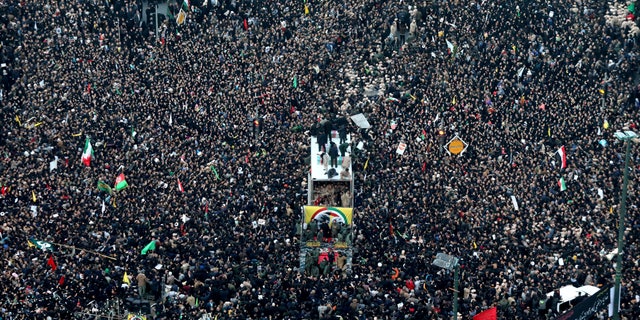
Coffins of Gen. Qassem Soleimani and others who were killed in
Iraq by a U.S. drone strike, are carried on a truck surrounded by
mourners during a funeral procession, in the city of Mashhad, Iran,
Sunday, Jan. 5, 2020. (Mohammad Hossein Thaghi/Tasnim News Agency via
AP)
During the funeral, Iran's Supreme Leader Ayatollah
Ali Khamenei -- who had a close relationship with Soleimani -- wept and
prayed over his casket and the caskets of others killed during
traditional Muslim prayers for the dead.
Esmail Ghaani, the
general replacing Soleimani reportedly stood near Khamenei during the
funeral. Iranian President Hassan Rouhbaani and other top leaders within
the Islamic Republic were also in attendance.
Ayatollah Ali Khamenei, fourth from left, leads a prayer over the
coffins of Gen. Qassem Soleimani and others who were killed in Iraq in a
U.S. drone strike on Friday. (Office of the Iranian Supreme Leader via
AP)
Demonstrators
unfurled red Shiite flags, which traditionally symbolize both the
spilled blood of someone unjustly killed and a call for vengeance.
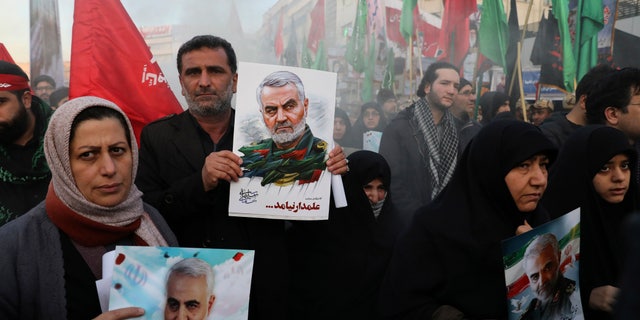
Mourners holding posters of Iranian Gen. Qassem Soleimani attend a
funeral ceremony for him and his comrades, who were killed in Iraq in a
U.S. drone strike on Friday, at the Enqelab-e-Eslami (Islamic
Revolution) Square in Tehran, Iran, Monday, Jan. 6, 2020. (AP
Photo/Ebrahim Noroozi)
The processions mark the first time Iran honored a
single man with a multi-city ceremony. Not even Ayatollah Ruhollah
Khomeini, who founded the Islamic Republic, received such a processional
with his death in 1989. Soleimani on Monday will lie in state at
Tehran’s famed Musalla mosque as the revolutionary leader did before
him.
Soleimani will be buried in his hometown of Kerman. The Associated Press contributed to the report
FORT
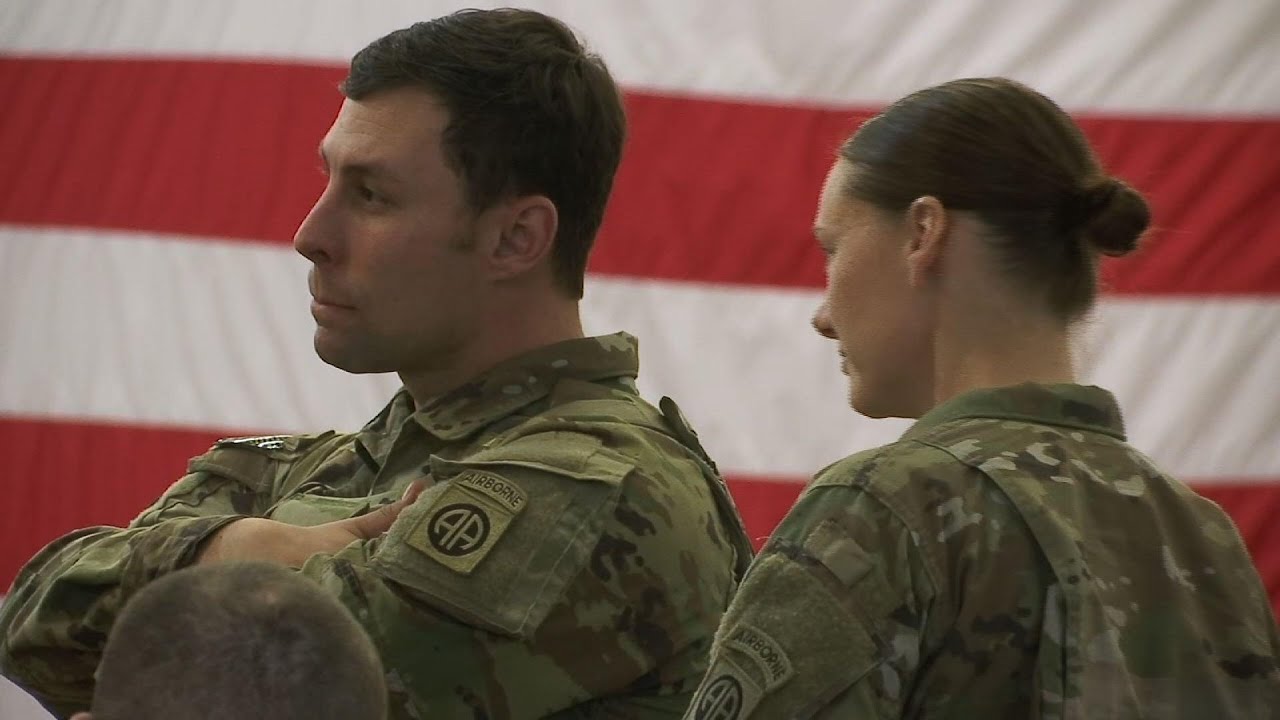
BRAGG, N.C. (AP) — Hundreds of U.S. soldiers deployed Saturday from
Fort Bragg, North Carolina, to Kuwait to serve as reinforcements in the
Middle East amid rising tensions following the U.S. killing of a top
Iranian general.
Lt.
Col. Mike Burns, a spokesman for the 82nd Airborne Division, told The
Associated Press 3,500 members of the division’s quick-deployment
brigade, known officially as its Immediate Response Force, will have
deployed within a few days. The most recent group of service members to
deploy will join about 700 who left earlier in the week, Burns said.
A
loading ramp at Fort Bragg was filled Saturday morning with combat gear
and restless soldiers. Some tried to grab a last-minute nap on wooden
benches. Reporters saw others filing onto buses.
The
additional troop deployments reflect concerns about potential Iranian
retaliatory action in the volatile aftermath of Friday’s drone strike
that killed Gen. Qassem Soleimani, the head of Iran’s elite Quds Force who has been blamed for attacks on U.S. troops and American allies going back decades.
President
Donald Trump ordered the airstrike near Baghdad’s international
airport. Iran has vowed retribution, raising fears of an all-out war,
but it’s unclear how or when a response might come.
Reporters
weren’t able to interview the soldiers leaving Fort Bragg on Saturday,
but an airman loading one of the cargo planes told an Army cameraman he
was making New Year’s plans when he got a call to help load up the
soldiers, according to video footage released by the military.
“We’re
responsible for loading the cargo. Almost our whole squadron got
alerted. Like a bunch of planes are coming over here,” the unnamed
airman said. “I was getting ready to go out for New Year’s when they
called me.”
In
the gray early morning light Saturday, Army video showed soldiers
dressed in camouflage fatigues filing into planes, carrying rucksacks
and rifles. Humvees were rolled onto another cargo plane and chained in
place for the flight to the Middle East.
Burns
said the soldiers within the Immediate Response Force train constantly
to be ready to respond quickly to crises abroad. When called by their
superiors, they have two hours to get to base with their gear and must
maintain a state of readiness so that they can be in the air headed to
their next location within 18 hours.
“So
whether they were on leave, whether they were home drinking a beer,
whether they were, you know, hanging out, throwing the kids up in the
yard, you get the call and it’s time to go,” he said.
He said that soldiers typically keep individual “go-bags” of their personal gear with them at their living quarters.
The
wife of a member of the 82nd Airborne who deployed earlier this week
said his departure was so abrupt she didn’t have the chance to say
goodbye in person or by phone.
April
Shumard said she was at work on New Year’s Eve and he was watching
their five children when he texted her that he had to rush to base. He
wasn’t sure if it was a drill or a deployment. She said her husband has
been in the military since 2010 and has already deployed twice to
Afghanistan. But with those prior deployments, the family had much more
time to prepare and say goodbye. This time, she got a second message
confirming he was leaving, and he departed in a plane on the afternoon
of New Year’s Day.
“The
kids kept going, ‘When’s Dad going to be home?’” said Shumard, 42.
“It’s literally thrown me for a loop. And him as well. He’s still in
disbelief of where he’s gone. Our heads are spun.”
She
said that Fayetteville is a tight-knit community, and she expects
people to work together to support families who are suddenly missing a
parent.
“This
was so last-minute,” she said, urging people to reach out to 82nd
Airborne families. “Just try to help out whoever you know who might need
some babysitting or help or just get some groceries and bring it to
their house.”
Similarly,
Bri’anna Ferry’s husband got the call on New Year’s Eve, and she said
he was on a plane to the Middle East within hours. She fears he could
miss milestones with their young daughter but also wants him to focus on
his mission.
“I told him, don’t worry about us. We’ll be fine,” she said. “Focus on your mission.”
This
undated photo released by the official website of the office of the
Iranian supreme leader, shows Maj. Gen. Esmail Ghaani. Supreme Leader
Ayatollah Ali Khamenei later on Friday appointed Qassem Soleimani's
deputy, Maj. Gen. Esmail Ghaani as the new commander of the
Revolutionary Guard's Quds Force. Soleimani was killed in the U.S.
airstrike in Iraq. (Office of the Iranian Supreme Leader via AP)
TEHRAN,
Iran (AP) — A new Iranian general has stepped out of the shadows to
lead the country’s expeditionary Quds Force, becoming responsible for
Tehran’s proxies across the Mideast as the Islamic Republic threatens
the U.S. with “harsh revenge” for killing its previous head, Qassem
Soleimani.
The
Quds Force is part of the 125,000-strong Revolutionary Guard, a
paramilitary organization that answers only to Iran’s Supreme Leader
Ayatollah Ali Khamenei. The Guard oversees Iran’s ballistic missile
program, has its naval forces shadow the U.S. Navy in the Persian Gulf
and includes an all-volunteer Basij force.
Like
his predecessor, a young Esmail Ghaani faced the carnage of Iran’s
eight-year war with Iraq in the 1980s and later joined the newly founded
Quds, or Jerusalem, Force.
While
much still remains unknown about Ghaani, 62, Western sanctions suggest
he’s long been in a position of power in the organization. And likely
one of his first duties will be to oversee whatever revenge Iran intends
to seek for the U.S. airstrike early Friday that killed his longtime
friend Soleimani.
“We
are children of war,” Ghaani once said of his relationship with
Soleimani, according to Iran’s state-run IRNA news agency. “We are
comrades on the battlefield and we have become friends in battle.”
The
Guard has seen its influence grow ever-stronger both militarily and
politically in recent decades. Iran’s conventional military was
decimated by the execution of its old officer class during the 1979
Islamic Revolution and later by sanctions.
A
key driver of that influence comes from the elite Quds Force, which
works across the region with allied groups to offer an asymmetrical
threat to counter the advanced weaponry wielded by the U.S. and its
regional allies. Those partners include Iraqi militiamen, Lebanon’s
Hezbollah and Yemen’s Houthi rebels.
In
announcing Ghaani as Soleimani’s replacement, Ayatollah Ali Khamenei
called the new leader “one of the most prominent commanders” in service
to Iran.
The Quds Force “will be unchanged from the time of his predecessor,” Khamenei said, according to IRNA.
Soleimani
long has been the face of the Quds Force. His fame surged after
American officials began blaming him for deadly roadside bombs targeting
U.S. troops in Iraq. Images of him, long a feature of hard-line
Instagram accounts and mobile phone lockscreens, now plaster billboards
calling for Iran to avenge his death.
But
while Soleimani’s exploits in Iraq and Syria launched a thousand
analyses, Ghaani has remained much more in the shadows of the
organization. He has only occasionally come up in the Western or even
Iranian media. But his personal story broadly mirrors that of Soleimani.
Born
on Aug. 8, 1957 in the northeastern Iranian city of Mashhad, Ghaani
grew up during the last decade of monarchy. He joined the Guard a year
after the 1979 revolution. Like Soleimani, he first deployed to put down
the Kurdish uprising in Iran that followed the shah’s downfall.
Iraq
then invaded Iran, launching an eight-year war that would see 1 million
people killed. Many of the dead were lightly armed members of the
Guard, some of whom were young boys killed in human-wave assaults on
Iraqi positions.
Volunteers
“were seeing that all of them are being killed, but when we ordered
them to go, would not hesitate,” Ghaani later recounted. “The commander
is looking to his soldiers as his children, and in the soldier’s point
of view, it seems that he received an order from God and he must to do
that.”
He
survived the war to join the Quds Force shortly after its creation. He
worked with Soleimani, as well as led counterintelligence efforts at the
Guard. Western analysts believe while Soleimani focused on nations to
Iran’s west, Ghaani’s remit was those to the east like Afghanistan and
Pakistan. However, Iranian state media has not elaborated on his time in
the Guard.
In
2012, the U.S. Treasury sanctioned Ghaani, describing him as having
authority over “financial disbursements” to proxies affiliated with the
Quds Force. The sanctions particularly tied Ghaani to an intercepted
shipment of weapons seized at a port in 2010 in Nigeria’s most-populous
city, Lagos.
Authorities
broke into 13 shipping containers labeled as carrying “packages of
glass wool and pallets of stone.” They instead found 107 mm Katyusha
rockets, rifle rounds and other weapons. The Katyusha remains a favored
weapon of Iranian proxy forces, including Iraqi militias and the
Lebanese militant group Hezbollah.
An Iranian and his Nigerian partner later received five-year prison sentences over the shipment,
which appeared bound for Gambia, then under the rule of dictator Yahya
Jammeh. Israeli officials had claimed the rockets would be shipped to
militants in the Gaza Strip, while Nigerian authorities alleged that
local politicians could use the arms in upcoming elections.
Also
in 2012, Ghaani drew criticism from the U.S. State Department after
reportedly saying that “if the Islamic Republic was not present in
Syria, the massacre of people would have happened on a much larger
scale.” That comment came just after gunmen backing Syrian President
Bashar Assad killed over 100 people in Houla in the country’s Homs
province.
“Over
the weekend we had the deputy head of the Quds Force saying publicly
that they were proud of the role that they had played in training and
assisting the Syrian forces — and look what this has wrought,”
then-State Department spokeswoman Victoria Nuland said at the time.
In January 2015, Ghaani indirectly said that Iran sends missiles and weapons to Palestinians to fight Israel.
“The
U.S. and Israel are too small to consider themselves in line with
Iran’s military power,” Ghaani said at the time. “This power has now
appeared alongside the oppressed people of Palestine and Gaza in the
form of missiles and weapons.”
Now,
Ghaani is firmly in control of the Quds Force. While Iran’s leaders say
they have a plan to avenge Soleimani’s death, no plan has been
announced as the country prepares for funerals for the general starting
Sunday.
Whatever that plan for revenge is, Ghaani likely will be involved.
“That
Qaani survived at such high ranks in the (Guard), and remained
Soleimani’s deputy for so long, says a lot about the trust both Khamenei
and Soleimani had in him,” said Afshon Ostovar, the author of a book on
the Guard. “I suspect he’ll have little difficulty filling Soleimani’s
shoes when it comes to operations and strategy.”
___
Gambrell reported from Dubai, United Arab Emirates.
TEHRAN,
Iran (AP) — Thousands of mourners accompanied a casket carrying the
remains of the slain Gen. Qassem Soleimani through two major Iranian
cities Sunday as part of a grand funeral procession across the Islamic
Republic amid soaring tensions between Iran and the U.S.
President
Donald Trump has threatened to bomb 52 sites in Iran if it retaliates
by attacking Americans. The U.S. Embassy in Saudi Arabia separately
warned Americans “of the heightened risk of missile and drone attacks.”
Meanwhile, Iran vowed to take an even-greater step away from its
unraveling nuclear deal with world powers as a response to Soleimani’s
slaying.
The U.S. drone strike killing Soleimani in Iraq Friday
escalated the crisis between Tehran and Washington after months of
trading attacks and threats that put the wider Middle East on edge. The
conflict is rooted in Trump pulling out of Iran’s atomic accord.
Iran
has promised “harsh revenge” for the U.S. attack, which shocked
Iranians across all political lines. Many saw Soleimani as a pillar of
the Islamic Republic at a moment when it is beset by U.S. sanctions and
recent anti-government protests.
Retaliation
for Soleimani could potentially come through the proxy forces which he
oversaw as the head of an elite unit within the paramilitary
Revolutionary Guard. Soleimani’s longtime deputy Esmail Ghaani already has taken over as the Quds Force’s commander.
Late
Saturday, a series of rockets launched in Baghdad fell inside or near
the Green Zone, which houses government offices and foreign embassies,
including the U.S. Embassy.
Trump
wrote on Twitter afterward that the U.S. had already “targeted 52
Iranian sites (representing the 52 American hostages taken by Iran many
years ago), some at a very high level & important to Iran & the
Iranian culture.”
Trump did not identify the targets but added that they would be “HIT VERY FAST AND VERY HARD.”
The
1954 Hague Convention, of which the U.S. is a party, bars any military
from “direct hostilities against cultural property.” However, such sites
can be targeted if they have been re-purposed and turned into a
legitimate “military objective,” according to the International Committee of the Red Cross.
Iran,
home to 24 UNESCO World Heritage sites, has in the past reportedly
guarded the sprawling tomb complex of the Islamic Republic’s founder,
Ayatollah Ruhollah Khomeini, with surface-to-air missiles.
After
thousands in Baghdad on Saturday mourned Soleimani and others killed in
the strike, authorities flew the general’s body to the southwestern
Iranian city of Ahvaz. An honor guard stood by early Sunday as mourners
carried the flag-draped coffins of Soleimani and other Guard members off
the tarmac.
The
caskets then moved slowly through streets choked with mourners wearing
black, beating their chests and carrying posters with Soleimani’s
portrait. Demonstrators also carried red Shiite flags, which
traditionally both symbolize the spilled blood of someone unjustly
killed and call for their deaths to avenged.
Officials
brought Soleimani’s body to Ahvaz, a city that was a focus of fighting
during the bloody, 1980-88 war between Iraq and Iran in which the
general slowly grew to prominence. After that war, Soleimani joined the
Guard’s newly formed Quds, or Jersualem, Force, an expeditionary force
that works with Iranian proxy forces in countries like Iraq, Lebanon and
Yemen.
Authorities
then took Soleimani’s body to Mashhad later Sunday. His remains will go
to Tehran and Qom on Monday for public mourning processions, followed
by his hometown of Kerman for burial Tuesday.
This
marks the first time Iran honored a single man with a multi-city
ceremony. Not even Khomeini received such a processional with his death
in 1989. Soleimani on Monday will lie in state at Tehran’s famed Musalla
mosque as the revolutionary leader did before him.
Soleimani was the architect of Iran’s regional policy of mobilizing militias
across Iraq, Syria and Lebanon, including in the war against the
Islamic State group. He was also blamed for attacks on U.S. troops and
American allies going back decades.
Though
it’s unclear how or when Iran may respond, any retaliation was likely
to come after three days of mourning declared in both Iran and Iraq.
Iranian
officials planned to meet Sunday night to discuss taking a fifth step
away from its 2015 nuclear deal with world powers, one that could be
even greater than planned, Foreign Ministry spokesman Abbas Mousavi told
journalists.
“In the world of politics, all developments are interconnected,” Mousavi said.
Iran
previously has broken limits of its enrichment, its stockpiles and its
centrifuges, as well as restarted enrichment at an underground facility.
After
the airstrike early Friday, the U.S.-led coalition has scaled back
operations and boosted “security and defensive measures” at bases
hosting coalition forces in Iraq, a coalition official said on condition
of anonymity according to regulations.
Meanwhile,
the U.S. has dispatched another 3,000 troops to neighboring Kuwait, the
latest in a series of deployments in recent months as the standoff with
Iran has worsened. Protesters held demonstrations in dozens of U.S.
cities Saturday over Trump’s decisions to kill Soleimani and deploy more
troops to the Mideast.
In
a thinly veiled threat, one of the Iran-backed militias, Asaib Ahl
al-Haq, or League of the Righteous, called on Iraqi security forces to
stay at least a kilometer (0.6 miles) away from U.S. bases starting
Sunday night. However, U.S. troops are invariably based in Iraqi
military posts alongside local forces.
The
Iranian parliament on Sunday opened with lawmakers in unison chanting:
“Death to America!” Parliament speaker Ali Larijani compared Soleimani’s
killing to the 1953 CIA-backed coup that cemented the shah’s power and
to the U.S. Navy’s shootdown of an Iranian passenger plane in 1988 that
killed 290 people. He also described American officials as following
“the law of the jungle.”
“Mr. Trump! This is the voice of Iranian nation. Listen!” Larijani said as lawmakers chanted.
A
spokesman for Iran’s armed forces, Gen. Abolfazl Shekarchi, likewise
threatened the U.S. by saying Iran and the “resistance front will decide
the time, place and way” revenge will be carried out.
Iraq’s
parliament is meeting for an emergency session Sunday. Its government
has come under mounting pressure to expel the 5,200 American troops who
are based in the country to help prevent a resurgence of the Islamic
State group.
The
U.S. has ordered all citizens to leave Iraq and temporarily closed its
embassy in Baghdad, where Iran-backed militiamen and their supporters
staged two days of violent protests
in which they breached the compound. Britain and France have warned
their citizens to avoid or strictly limit travel in Iraq, as London said
it would begin escorting ships through the Strait of Hormuz. Oman, long
an interlocutor between Iran and the West, urged Tehran and Washington
on Sunday to pursue dialogue.
No
one was hurt in the embassy protests, which came in response to U.S.
airstrikes that killed 25 Iran-backed militiamen in Iraq and Syria. The
U.S. blamed the militia for a rocket attack that killed a U.S.
contractor in northern Iraq.
___
Gambrell
reported from Dubai, United Arab Emirates. Associated Press writers Aya
Batrawy in Dubai, Qassim Abdul-Zahra in Baghdad, Zeina Karam and Sarah
El Deeb in Beirut and Kelvin Chan in London contributed to this report.
President Trump issued a stern warning to Iran on
Saturday through a series of Twitter messages intended to deter the
country from retaliating after the U.S.-ordered airstrike that killed Iran's Gen. Qassem Soleimani last week.
"Iran
is talking very boldly about targeting certain USA assets as revenge
for our ridding the world of their terrorist leader who had just killed
an American, & badly wounded many others, not to mention all of the
people he had killed over his lifetime, including recently hundreds of
Iranian protesters," Trump tweeted.
The president continued: "He
was already attacking our Embassy, and preparing for additional hits in
other locations. Iran has been nothing but problems for many years."
Soleimani,
head of the Islamic Revolutionary Guard Corps' elite Quds Force, was
killed in an airstrike Friday in Baghdad that was ordered by President
Trump.
"Let this serve as a WARNING that if Iran strikes any
Americans, or American assets, we have targeted 52 Iranian sites
(representing the 52 American hostages taken by Iran many years ago),
some at a very high level & important to Iran & the Iranian
culture, and those targets, and Iran itself, WILL BE HIT VERY FAST AND
VERY HARD," Trump wrote Saturday, explicitly laying out that the U.S.
will act if Iran retaliates.
Following Soleimani's death, Iranian
Supreme Leader Ayatollah Ali Khamenei said "harsh retaliation is waiting
for the criminals whose filthy hands spilled his blood."
Iranian President Hassan Rouhani promised to "take revenge for this heinous crime."
The Iran-backed militias
that spawned in Iraq, known as the Popular Mobilization Forces (PMF),
have been quick to threaten revenge on U.S. personnel and interests.
Killed alongside Soleimani at the airport in Baghdad was his close
confidante Abu Mahdi al-Mohandas, the deputy head of the PMF.
Trump has made it clear that he expects the Iranians to stop threatening the United States.
"The USA wants no more threats!" Trump had tweeted. Fox News' Danielle Wallace and Hollie McKay contributed to this report.