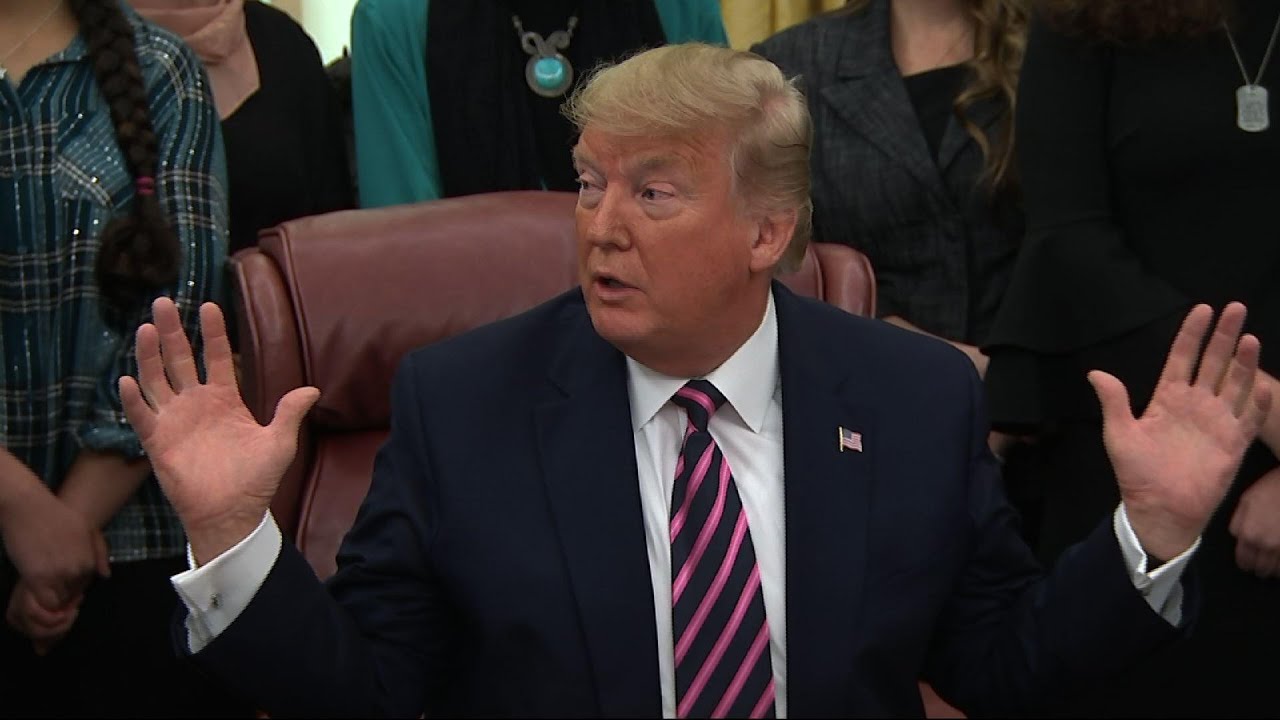
After an opening salvo of back-and-forth arguments from President Trump's attorneys and Democrats' impeachment managers on Monday, Senate impeachment trial proceedings
are set to begin at 1 p.m. ET on Tuesday with the expectation they will
stretch well into a wild night on Capitol Hill -- even as key
procedural questions, including the timeline for debate and whether
additional witnesses will testify, remain undecided and hotly
contentious. In a surprise move Monday night, a detachment of
high-profile House Republicans announced that they would formally join
the president's legal team, including Reps. Doug Collins, Mike Johnson,
Jim Jordan, Debbie Lesko, Mark Meadows, John Ratcliffe, Elise
Stefanik and Lee Zeldin. The last-minute show of force underscored the
fluid nature of the Senate trial, which is also set to feature
full-throated arguments against impeachment from constitutional scholar
Alan Dershowitz and Bill Clinton independent counsel Ken Starr. “We
are not planning for them to present statements on the Senate floor," a
senior administration official told Fox News, referring to the latest
additions to Trump's defense team, headed up by White House Counsel Pat
Cipollone and Trump's personal attorney Jay Sekulow. "The group will
continue to give critical guidance on the case because of their strong
familiarity with the facts and evidence." Jordan Sekulow told Fox
News' "Hannity" on Monday night that his father and the rest of
Trump's legal team were "champing at the bit and ready to go." He
maintained that executive privilege, a longstanding constitutional
principle protecting executive branch deliberations from disclosure, by
itself defeated the "obstruction of Congress" article of impeachment,
while Democrats had only hearsay evidence and speculation to support
their "abuse of power" charge. Neither "obstruction of Congress" nor
"abuse of power" are federal crimes, and they have no established
definition. Democrats have seethed openly ever since House Speaker Nancy Pelosi, D-Calif., failed in her gambit
to force Senate Majority Leader Mitch McConnell's hand before the House
would turn over the articles of impeachment to the Senate. Pelosi had
sought a commitment allowing Democrats to call witnesses prior to
arguments in the trial -- but, with just hours to go until the
proceedings commenced, McConnell, R-Ky., dashed those hopes. McConnell
specifically revealed Monday that he wanted a condensed, two-day
calendar for each side to give opening statements, at 12 hours per day.
After the four days of opening arguments, senators would be allowed up
to 16 hours for written questions to the prosecution and defense,
followed by four hours of debate. Only then would there be votes on
calling other witnesses, likely next week. At the end of deliberations,
the Senate would then vote on each impeachment article. Utah Republican Sen. Mitt Romney said in a statement
Monday night that McConnell's resolution, overall, "aligns closely with
the rules package approved 100-0 during the Clinton trial. If attempts
are made to vote on witnesses prior to opening arguments, I would oppose
those efforts." Romney was among a small number of Republican senators
who said they wanted to consider witness testimony and documents that
weren't part of the House impeachment investigation. Democrats, however, were incensed by the speedy timeline. Some took to calling McConnell "Midnight Mitch," the latest in a string
of unintentionally flattering nicknames. Senate Minority Leader Chuck
Schumer, D-N.Y., called McConnell's rules package a "national disgrace,"
adding, "it’s clear Sen. McConnell is hell-bent on making it much more
difficult to get witnesses and documents and intent on rushing the trial
through." Even before McConnell's announcement, congressional
Democrats apparently were off-balance: "The House managers have
absolutely no idea what the structure of the trial two days before the
trial begins,” one source with House Democrats working on the
impeachment trial complained to Fox News late Sunday. “It is
completely unfathomable,” fumed another source with the Democrats. “Is
Sen. McConnell going to have 12-hour trial days which run until 2 or 3
in the morning?” McConnell is expected to kick off the afternoon's
proceedings by introducing his proposed resolution for the parameters
for the trial, which he has said will pass with at least 53 votes.
Senators will not be directly speaking out in the debate over
McConnell's resolution, which is slated to last for approximately two
hours -- only members of Trump's defense team, and the seven Democrats
serving as House impeachment managers, are expected to participate. Schumer
likely will then present his counter-proposals to McConnell's motion,
followed by another two hours of debate among the managers and Trump's
counsel. Potential proposals include requests to subpoena specific
witnesses -- including, perhaps, Rudy Giuliani associate Lev Parnas or former National Security Adviser John Bolton -- or to adjust debate time. Then,
at approximately 6 p.m. ET or even later, Fox News is told to expect a
closed Senate session of indeterminate length after the debates. When
the Senate returns to open session, lawmakers -- including two leading
Democratic presidential contenders, Sens. Elizabeth Warren and Bernie
Sanders -- likely will vote in turn on any amendments to McConnell's
proposal, then McConnell's proposal itself. McConnell's proposal also was said to include a so-called "kill switch," allowing Trump's team to move to dismiss the articles of impeachment in the Senate quickly. In
a sign of the prevailing give-no-ground mentality ahead of the trial,
Trump's legal team traded blows with House prosecutors on Monday,
asserting that the president did "absolutely nothing wrong" and
urging the Senate to reject an impeachment case it called “flimsy" and a
"dangerous perversion of the Constitution." House Democrats
impeached the president for "abuse of power" related to his
administration's withholding of U.S. military aid to Ukraine while
he suggested the country investigate rival Joe Biden's dealings in Ukraine. The aid was eventually released, and Ukrainian officials have denied feeling any undue pressure.
The administration's refusal to comply with Democrats' probe, citing
executive privilege, led to the "obstruction of Congress" count.
"It is a constitutional travesty." — President Trump's legal team, on the impeachment proceedings
The 110-page filing from the White House condemned
the "rigged" House impeachment process, calling the majority vote to
impeach there a "brazenly political act ... that must be rejected." The
White House's legal argument hinged in part on Trump’s assertion he did
nothing wrong and did not commit any recognized crime, as well as on
poking holes in the hearsay witness testimony offered by Democrats. For
example, the White House pointed out that EU ambassador Gordon Sondland
had said he "had come to believe" that aid to Ukraine was linked to an
investigation of Biden, "before talking to the president." Additionally,
Trump's lawyers pointed out that Sondland admitted having "no evidence"
other than his "own presumption," and that he was "speculating" based
on hearsay that the Trump administration ever linked a White House
meeting with Ukraine's leaders to the beginning of an investigation. "After focus-group testing
various charges for weeks, House Democrats settled on two flimsy
Articles of Impeachment that allege no crime or violation of law
whatsoever—much less 'high Crimes and Misdemeanors,' as required by the
Constitution," the lawyers wrote. “It is a constitutional travesty." Additionally,
the White House released Justice Department legal opinions meant to
bolster its case that defying subpoenas from Congress did not amount to
"obstruction of Congress." One opinion, dated Sunday, said Trump
administration officials were free to disregard subpoenas sent last fall
before the House of Representatives had formally authorized an
impeachment inquiry. That approval, the memo said, was necessary before
congressional committees could begin their own investigations and issue
subpoenas for documents and testimony.
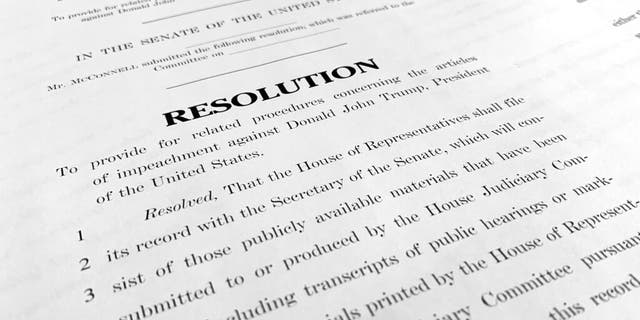
A copy of a Senate draft resolution to be offered by Senate
Majority Leader Mitch McConnell, R-Ky., regarding the procedures during
the impeachment trial of President Trump. (AP Photo/Jon Elswick)
Meanwhile, the prosecution team of House managers was
spending another day on Capitol Hill preparing for the trial, which
will take place under heavy security. The Democrats made their way
through crowds of tourists in the Rotunda to tour the Senate chamber. In
their own filing Monday, House prosecutors replied to Trump's "not
guilty" plea by making fresh demands for a fair trial in the Senate.
"President Trump asserts that his impeachment is a partisan ‘hoax.' He
is wrong," the prosecutors wrote in their reply. They wrote that
the president can't have it both ways -- rejecting the facts of the
House case but also stonewalling congressional subpoenas for witnesses
and testimony. "Senators must honor their own oaths by holding a fair
trial with all relevant evidence," they wrote. No president has
ever been removed by the Senate. The current Senate, with a 53-47
Republican majority, is not expected to mount the two-thirds voted
needed for conviction. Even if it did, the White House team has
argued it would be an "unconstitutional conviction'' because the
articles of impeachment were too broad. Administration officials have argued that similar imprecision applied to the perjury case in Clinton's impeachment trial. The
White House has also suggested the House inquiry was lacking because it
failed to investigate Biden or his son Hunter, who served on the board
of a gas company in Ukraine in a lucrative role while his father was
overseeing Ukraine policy as vice president. Should Democrats insist on
calling witnesses like Parnas and Bolton, Republicans have openly
suggested that they might then push for a subpoena the Bidens. In a
show of confidence, Trump tweeted a video late Monday touting his
achievements in office, including the nation's historically low
unemployment rate, booming stock market and rising wages, with the note:
"THE BEST IS YET TO COME!" Fox News' Caroline McKee, Chad Pergram, John Roberts and The Associated Press contributed to this report.
Sen. Tim Scott, R-S.C., said Sunday that Democrats have been focused on impeachment because “they’re pretty concerned” due to the fact that “they believe the American people are now solidly behind President Donald Trump.” Scott appeared on “Fox & Friends Weekend”
one day after House impeachment managers filed their brief to the
Senate, claiming the evidence against Trump “overwhelmingly” established
abuse of power and obstruction of Congress. Scott added that “the most important statement made about this entire impeachment process was made by [Texas] Congressman Al Green when he said if we don’t impeach him, he might win.” The South Carolina senator also pointed out, “[House Speaker] Nancy Pelosi held the impeachment documents for nearly a month, which means there is no existential threat. There is no national-security threat.” Scott
explained, “I believe the Democrat strategy is not to bring more
illumination to the case, but to put a bull’s eye on the back of
[Colorado Republican Sen.] Cory Gardner, [Iowa Republican Sen.] Joni Ernst, [Arizona Republican Sen.] Martha McSally, [North Carolina Republican Sen.] Thom Tillis. That
is the strategy they’re using to try to win back the Senate,” Scott
said, referring to Republican senators facing tough reelection
campaigns. “This is actually not about removing the president,
this is about removing enough senators in the Republican Party in order
to take control of the Senate and to rebuke the president for the next
four years because they’re pretty concerned.” In Saturday’s 111-page brief, the impeachment managers wrote, “President Trump’s conduct is the Framers’ worst nightmare.” The
brief was the Democrats’ opening salvo in the historic impeachment
trial, with House managers arguing Trump used his official powers to
pressure Ukraine to
interfere in the 2020 U.S. presidential election for personal political
gain, then tried to cover it up by obstructing Congress’s investigation
into his alleged misconduct. “The evidence
overwhelmingly establishes that he is guilty. ... The Senate must use
that [impeachment] remedy now to safeguard the 2020 U.S. election, …
protect our constitutional form of government and eliminate the threat
that the President poses to America's national security,” the brief
stated. Scott said Sunday that Democrats were reacting in such a
way because their “greatest fears are coming true” due to Trump’s
success. “The
fact is that this president has focused on bringing opportunities to
the poorest communities in the nation,” Scott said. “This president has
helped bring the minority unemployment rate to record lows for Asians, for African-Americans, for Hispanics.” Scott
noted the country’s 3.5-percent unemployment rate. “Our stock market is
going through the ceiling. They are trembling in their boots, so the
only thing they have focused on their minds today is not President
Trump, it is removing senators from office so that they can have control
of the United States Senate.” He went on to say, “There’s no question that President Trump’s economic agenda has brought more prosperity into the African-American community than we’ve seen in my lifetime.” “This
president is producing the type of results that only say one thing to
the African-American community,” Scott continued. “We believe that there
is high-potential, incredible people who only needed opportunity
and access to those opportunities. President Trump has brought so many
of those to the community that I believe that we’re going to have a
record turnout on behalf of the president [in November].” Fox News’ Marisa Schultz contributed to this report.
Steve Hilton weighed in Sunday on the drama involving the Duke and Duchess of Sussex's decision to "step back" as members of the royal family, reacting to Prince Harry on Sunday publicly addressing the situation. "To
be completely honest, I'm sick of Harry. I'm sick of Meghan. I'm sick
of this story. I'm sick of the royals," Hilton said on his show "The Next Revolution."
"As far as I'm concerned, when the Queen, who we all love very much, is
finished with her reign then Britain should go and stop being a banana
republic as it is when we have the royal family and become a real
republic." "Abolish the monarchy," Hilton added. "That is my populist take." In
a speech given at a dinner for supporters of the Sentebale charity in
London Sunday, the Prince addressed why he and his wife, Meghan Markle, choose to relinquish their "royal highness" titles and move part-time to Canada. "The
decision that I have made for my wife and I to step back is not one I
made lightly," the Prince said. "It was so many months of talks after so
many years of challenges. And I know I haven't always gotten it right,
but as far as this goes, there really was no other option. What I want
to make clear is, we're not walking away, and we certainly aren't
walking away from you." Former deputy National Security Adviser
K.T. McFarland, a guest on the program, said that Prince Harry may
regret his decision to "break with his family" when he is older. "I
think Prince Harry as a young man and his may end up regretting and
have a number of years to regret, regret breaking with his family,
particularly with his grandmother, and that sometimes things done in
haste and youth are not the things that keep you happy in old age,"
McFarland said. Jenna Ellis, a Trump 2020 senior legal advisor, praised the Prince for his decision. "He
may have been born into this, but he's making, now as a husband and a
father, the best decisions for his family," Ellis said. Hilton said Prince Harry should step out of the limelight. "Please just sort of go away and figure it out and just stop with this endless obsession with the royals," Hilton said. Fox News' Nate Day contributed to this report
The
New York Times announced late Sunday that its editorial board was
breaking "from convention" and will endorse two candidates for president in 2020: Minnesota Sen. Amy Klobuchar and Massachusetts Sen. Elizabeth Warren. The paper’s endorsement has traditionally been one of the most coveted for a Democratic politician. The editorial board wrote that in choosing these two candidates, it recognizes that both "radical" and "realist" models should be considered. The paper said it spent more than 12 hours with the candidates before coming to its conclusion. "The
history of the editorial board would suggest that we would side
squarely with the candidate with a more traditional approach to pushing
the nation forward, within the realities of a constitutional framework
and a multiparty country," the editorial read. "But the events of the
past few years have shaken the confidence of even the most committed
institutionalists. We are not veering away from the values we espouse,
but we are rattled by the weakness of the institutions that we trusted
to undergird those values." The paper called Warren a "gifted
storyteller" who has "emerged as a standard-bearer for the Democratic
left." The editorial board called her path to the White House
"challenging, but not hard to envision." Warren reposted the
article on Twitter, joking, "So I guess @AmyKlobuchar and I are now both
undefeated in New York Times endorsements!" Klobuchar was
described as the "standard-bearer," but for the party’s center. The
paper gushed that she is the very definition of "Midwestern charisma,
grit and sticktoitiveness." The paper pointed to her goals of
slashing childhood poverty, achieve 100 percent net-zero emissions by
2050 and her push for a more robust public option in healthcare. He
moderate approach to governing would make for a formidable deal maker in
Washington, the editorial wrote. Reports on how she treats her staff “gave us pause,” but she pledged to do better in the future, the paper wrote. Perhaps as important as who the paper endorsed is who it did not. Joe Biden, the former vice president
who continues to lead in polls, but his agenda does not go far enough
on issues like climate and health care, the board wrote. The editorial
board also wrote that Sen. Bernie Sanders, I-Vt., appeared to have
missed his moment. The paper pointed out that he would be 79 when he's
sworn in and has recently suffered a heart attack. "His health is a
serious concern," it wrote. The paper said it is looking forward
to watching South Bend, Ind., Mayor Pete Buttigieg develop as a
politician and said it was impressed with his resume, but it also
pointed out that he never won more than 11,000 votes. The paper said it
hopes Andrew Yang, the entrepreneur, also continues to work in politics
and recommended looking to New York to get started. Michael
Bloomberg, the billionaire former mayor who the editorial board
endorsed twice, falls short of the editorial board’s aspirations for
2020. The editorial pointed to issues like barring his own media company
from investigating him and his refusal to let women who signed
nondisclosure settlements speak to the media. The paper said his
campaign approach “reveals more about America’s broken system than his
likelihood of fixing it.”
Senate Majority Leader Mitch McConnell reportedly
is close to finalizing a rule that would allow President Trump's team
to move to dismiss the articles of impeachment in the Senate quickly
after some evidence has been presented, as a sort of safety valve in
case Democrats try to drag out the trial for weeks. The discussions came as Texas GOP Sen. Ted Cruz told Fox News' "Sunday Morning Futures"
that the trial could extend "to six to eight weeks or even longer" if
the Senate decided to hear from additional witnesses -- a prospect that
could interfere with the imminent presidential primary contests, as
Sens. Bernie Sanders, I-Vt., and Elizabeth Warren, D-Mass., likely would
get pulled off the campaign trail. McConnell, R-Ky., wouldn't be
obligated to publicize the final version of his resolution setting the
parameters of the impeachment trial until Tuesday, but top Republicans
have said they supported affording Trump the opportunity to cut the
trial short. Republican
Missouri Sen. Josh Hawley, for example, said he would be "very, very
surprised" if McConnell's resolution didn't include that kind of kill
switch. "I am familiar with the resolution as it stood a day or two ago," Hawley told Axios.
"My understanding is that the resolution will give the president's team
the option to either move to judgment or to move to dismiss at a
meaningful time." Trump, Hawley wrote on Twitter after
Axios' article was published, "deserves the right during Senate trial
to ask for a verdict or move to dismiss - otherwise trial will become
endless circus run by Adam Schiff." Democrats, meanwhile, have
voiced frustration privately that McConnell was holding the final rules
for the trail close to the vest. “The House managers have
absolutely no idea what the structure of the trial two days before the
trial begins,” one source with House Democrats working on the
impeachment trial told Fox News. The discussion may end up being
moot: Law professor Alan Dershowitz, who is set to present an argument
against impeachment during the Senate trial, said Sunday it
will be clear there will be "no need" for witnesses if his presentation
were to succeed. "Criminal-like conduct," Dershowtiz said, was required
for impeachment. For his part, Trump suggested earlier this month
that an "outright dismissal" might be appropriate. But, Republicans
almost certainly wouldn't be able to muster the votes necessary to end
the trial prematurely. The issue of witnesses may remain in limbo
for a few more days. Alaska GOP Sen. Lisa Murkowski said she's
comfortable waiting to decide if more information would be needed as
part of the Senate's impeachment trial until after hearing arguments
from House managers and attorneys for the president. Murkowski
said Saturday she wanted to make sure there was a process that would
allow senators to "really hear the case" and ask questions "before we
make that determination as to, what more do we need. I don't know what
more we need until I've been given the base case." If
Democrats were to try adding certain witnesses to an organizing
resolution, Murkowski said she expected McConnell would move to table
such a request and she would support a tabling motion. "What I've
worked hard to do is make sure that we have a process that will allow
for that determination" — whether witnesses or documents would be
needed, she said. "But, I want to have that at a point where I know
whether or not I'm going to need it." She said all senators faced
political pressures but her responsibility was "not to focus on the
politics of where we are but a recognition that we are in the midst of
an infrequent and in many ways extraordinary process that the
Constitution allows for, and I'm going to take my constitutional
obligations very, very seriously." Regardless of how one viewed
the House's handling of the impeachment process, the matter has moved to
the Senate, she said, adding later she did not want the proceedings to
become a "circus." No senators were more eager to avoid a circus,
and get going with the proceedings, than the presidential candidates
facing the prospect of being marooned in the Senate ahead of kickoff
nominating votes in Iowa and New Hampshire. “I'd rather be here,” Sanders said on New Hampshire Public Radio while campaigning Sunday in Concord. During
the trial, Sanders and other senators are required to sit mutely for
perhaps six grueling hours of proceedings daily — except Sundays, per
Senate rules — in pursuit of the "impartial justice" they pledged to
pursue. Fox News' Chad Pergram and The Associated Press contributed to this report.
JUNEAU,
Alaska (AP) — Alaska U.S. Sen. Lisa Murkowski said she’s comfortable
waiting to decide if more information is needed as part of the Senate’s
impeachment trial until after hearing arguments from House managers and
attorneys for President Donald Trump and questions from members.
The
Republican said Saturday she wants to make sure there’s a process that
allows senators to “really hear the case” and ask questions “before we
make that determination as to, what more do we need. I don’t know what
more we need until I’ve been given the base case.”
Murkowski spoke to reporters from Anchorage ahead of Senate impeachment trial proceedings expected to begin Tuesday.
If
Democrats try to add certain witnesses to an organizing resolution,
Murkowski said she expects Senate Majority Leader Mitch McConnell would
move to table such a request and that she would support a tabling
motion.
“Because
what I’ve worked hard to do is make sure that we have a process that
will allow for that determination” — whether witnesses or documents are
needed, she said. “But I want to have that at a point where I know
whether or not I’m going to need it.”
She
said there are political pressures “on all of us” but said her
responsibility is “not to focus on the politics of where we are but a
recognition that we are in the midst of an infrequent and in many ways
extraordinary process that the Constitution allows for, and I’m going to
take my constitutional obligations very, very seriously.”
Regardless
of how one views the House’s handling of the impeachment process, the
matter is now before the Senate, she said, adding later she does not
want the proceedings to become a “circus.”
Trump
was impeached by the House on charges he abused his power by pushing
Ukraine to investigate his Democratic political rival Joe Biden and that
he obstructed Congress by blocking witnesses and testimony in the House
investigation. Trump has said he did nothing wrong.
Murkowski
said a recent Government Accountability Office report that concluded
the White House violated federal law by withholding congressionally
approved security aid to Ukraine reminded her of last year’s debate over
Trump’s declaration of a border emergency that he invoked to spend more
for border barriers than Congress had approved.
During
that debate, she said she maintained the president could not take funds
congressionally directed to one area and use them to advance his own
policies. “Whether it was for the wall or for any other thing, I have
been one that has said, ‘Congress has a very specific role when it comes
to appropriation of funding and that needs to be respected,’” she said.
She said she
viewed the GAO report with a “little bit of concern,” in part because of
the need to respect Congress’ appropriation powers.
In
a telephone interview Friday with the Anchorage Daily News, Alaska’s
other Republican U.S. senator, Dan Sullivan, said he supports using the
same rules as the impeachment of President Bill Clinton in the 1990s,
which Sullivan said would give Trump a “fair and balanced” process.
Under those rules, he said, the determination of whether or not to bring
witnesses would happen in the second phase.
“I
think this is going to be a stark contrast to what happened over in the
House where you literally witnessed the most rushed most partisan and
unprepared impeachment proceedings in the House in U.S. history,”
Sullivan said.
President
Donald Trump escorted by Col. Brian Daniels walks to board Air Force
One at Andrews Air Force Base, Md., Friday, Jan. 17, 2020, en route to
his Mar-a-Lago estate, in Palm Beach, Fla. ( AP Photo/Jose Luis Magana)
WEST PALM BEACH, Fla. (AP) — The National Archives said Saturday it made a mistake when it blurred images of anti-Trump signs used in an exhibit on women’s suffrage.
The
independent agency is charged with preserving government and historical
records and said it has always been committed to preserving its
holdings “without alteration.”
But the archives said in a statement Saturday “we made a mistake.” The archives’ statement came one day after The Washington Post published an online report about the altered images.
The
archives said the photo in question is not one of its archival records,
but rather was licensed for use as a promotional graphic in the
exhibit.
“Nonetheless, we were wrong to alter the image,” the agency said.
The
current display has been removed and will be replaced as soon as
possible with one that uses the original, unaltered image, the archives
said.
The
exhibit about the 19th Amendment, which gave women the right to vote,
blurred some anti-Trump messages on protest signs in a photo of the 2017
Women’s March in Washington.
Signs
that referred to women’s private parts, which also were widespread
during the march, which was held shortly after Trump took office, also
were altered.
The
archives said it will immediately begin a “thorough review” of its
policies and procedures for exhibits “so that this does not happen
again.”
T he American Civil Liberties Union called on the archives to issue a more detailed, explanation.
“Apologizing
is not enough,” Louise Melling, the organization’s deputy legal
director, said in a statement. “The National Archives must explain to
the public why it took the Orwellian step of trying to rewrite history
and erasing women’s bodies from it, as well as who ordered it.”
Archives
spokeswoman Miriam Kleiman told the Post for its report that the
nonpartisan, nonpolitical federal agency blurred the anti-Trump
references “so as not to engage in current political controversy.”
References
to female anatomy in the signs were obscured in deference to student
groups and young people who visit the archives, Kleiman told the
newspaper.
Kleiman
did not respond to an emailed request for comment Saturday from The
Associated Press. The public affairs office at the archives emailed the
statement.
The
archives issued the apology as thousands again gathered in Washington
and in cities across the country Saturday for Women’s March rallies
focused on issues such as climate change, pay equity and reproductive
rights.
WASHINGTON (AP) — President Donald Trump’s legal team issued a fiery response Saturday ahead of opening arguments in his impeachment trial,
while House Democrats laid out their case in forceful fashion, saying
the president betrayed public trust with behavior that was the “worst
nightmare” of the founding fathers.
The
dueling filings previewed arguments both sides intend to make once
Trump’s impeachment trial begins in earnest Tuesday in the Senate. Their
challenge will be to make a case that appeals to the 100 senators who
will render the verdict and for an American public bracing for a
presidential election in 10 months.
“President
Donald J. Trump used his official powers to pressure a foreign
government to interfere in a United States election for his personal
political gain,” the House prosecutors wrote, “and then attempted to
cover up his scheme by obstructing Congress’s investigation into his
misconduct.”
Trump’s
legal team, responding to the Senate’s official summons for the trial,
said the president “categorically and unequivocally” denies the charges
of abuse and obstruction against him.
“This
is a brazen and unlawful attempt to overturn the results of the 2016
election and interfere with the 2020 election, now just months away,”
the president’s filing states.
Stripped
of legalese and structured in plain English, the documents underscored
the extent to which the impeachment proceedings are a political rather
than conventional legal process.
They
are the first of several filings expected in coming days as senators
prepare to take their seats for the rare impeachment court.
Senators
swore an oath to do “impartial justice”′ as the chamber convenes to
consider the two articles of impeachment approved by the House last
month as Trump’s presidency and legacy hangs in balance.
One
Republican whose votes are closely watched, Sen. Lisa Murkowski of
Alaska, acknowledged Saturday the political pressure bearing on them.
“I’m going to take my constitutional obligations very, very seriously,” she told reporters from Anchorage on a call.
The
House’s 111-page brief outlined the prosecutors’ narrative, starting
from Trump’s phone call with Ukraine and relying on the private and
public testimony of a dozen witnesses -- ambassadors and national
security officials at high levels of government -- who raised concerns
about the president’s actions.
The
House managers wrote: “The only remaining question is whether the
members of the Senate will accept and carry out the responsibility
placed on them by the Framers of our Constitution and their
constitutional Oaths.”
The
Trump team called the two articles of impeachment “a dangerous attack
on the right of the American people to freely choose their president.”
Trump’s
team encouraged lawmakers to reject “poisonous partisanship” and
“vindicate the will of the American people” by rejecting both articles
of impeachment approved by the House.
The
Senate is still debating the ground rules of the trial, particularly
the question of whether there will be new witnesses as fresh evidence
emerges over Trump’s Ukraine actions that led to impeachment.
New
information from Lev Parnas, an indicted associate of Trump lawyer Rudy
Giuliani, is being incorporated in the House case. At the same time,
Senate Democrats want to call John Bolton, the former national security
adviser, among other potential eyewitnesses, after the White House
blocked officials from appearing in the House.
With
Republicans controlling the Senate 53-47, they can set the trial rules —
or any four Republicans could join with Democrats to change course.
Murkowski
told reporters she wants to hear both sides of the case before deciding
whether to call for new witnesses and testimony.
“I don’t know what more we need until I’ve been given the base case,” Murkowski said.
The House’s impeachment managers are working through the weekend and will be at the Capitol midday Sunday to prep the case.
Trump’s
answer to the summons was the first salvo in what will be several
rounds of opening arguments. Trump will file a more detailed legal brief
on Monday, and the House will be able to respond to the Trump filing on
Tuesday.
Trump’s
team led by White House counsel Pat Cipollone and Trump personal lawyer
Jay Sekulow, is challenging the impeachment on both procedural and
constitutional grounds, claiming Trump has been mistreated by House
Democrats and that he did nothing wrong.
The
filings came a day after Trump finalized his legal team, adding Ken
Starr, the former independent counsel whose investigation into President
Bill Clinton led to his impeachment, and Alan Dershowitz, a Harvard law
professor emeritus who intends to make constitutional arguments.
White
House attorneys and Trump’s outside legal team have been debating just
how political Monday’s legal brief laying out the contours of Trump’s
defense should be.
Some
in the administration have echoed warnings from Senate Majority Leader
Mitch McConnell, R-Ky., that the pleadings must be sensitive to the
Senate’s more staid traditions and leave some of the sharper rhetoric
exhibited during the House proceedings to Twitter and cable news.
One
Democratic aide said Saturday that Trump’s initial filing read more
like a Trump campaign fundraising email than a legal document.
People
close to the Trump legal team said Cipollone would deliver the
president’s opening argument before the Senate and that Sekulow would
follow. Starr and Dershowitz would have “discrete functions” on the
legal team, according to those close to the legal team, who were not
authorized to discuss the strategy by name and spoke on condition of
anonymity.
At
issue in the impeachment case are allegations that Trump asked Ukraine
to announce an investigation of Democratic political rival Joe Biden at
the same time the White House withheld hundreds of nearly $400 million
in aid from the former Soviet republic as it faces a hostile Russia at
its border.
The Government Accountability Office said last week the administration violated federal law by withholding the funds to Ukraine. The money was later released after Congress complained.
The
House brief said, “President Trump’s misconduct presents a danger to
our democratic processes, our national security, and our commitment to
the rule of law. He must be removed from office.
Trump’s
attorneys argue that the articles of impeachment are unconstitutional
in and of themselves and invalid because they don’t allege a crime.
Under
the Constitution impeachment is a political, not a criminal process,
and the president can be removed from office if found guilty of whatever
lawmakers consider “high crimes and misdemeanors.”
_____
Associated Press writers Mary Clare Jalonick in Washington and Becky Bohrer in Anchorage, Alaska, contributed to this report.


 A copy of a Senate draft resolution to be offered by Senate
Majority Leader Mitch McConnell, R-Ky., regarding the procedures during
the impeachment trial of President Trump. (AP Photo/Jon Elswick)
A copy of a Senate draft resolution to be offered by Senate
Majority Leader Mitch McConnell, R-Ky., regarding the procedures during
the impeachment trial of President Trump. (AP Photo/Jon Elswick)