President Trump voiced optimism regarding the Senate impeachment trial as he arrived for a breakfast meeting with American CEOs and business leaders at the World Economic Forum in Davos, Switzerland, on Wednesday morning. “We
have a great case,” the president said to reporters gathered at the
Davos Congress Center after his motorcade arrived from the
Intercontinental Hotel. He added that he thought his legal team was
doing “a very good job,” according to the Associated Press. The
brief comment from Trump came just hours after a marathon first day of
the impeachment trial concluded across the Atlantic in Washington,
capped off just after midnight by a shouting match between Republicans
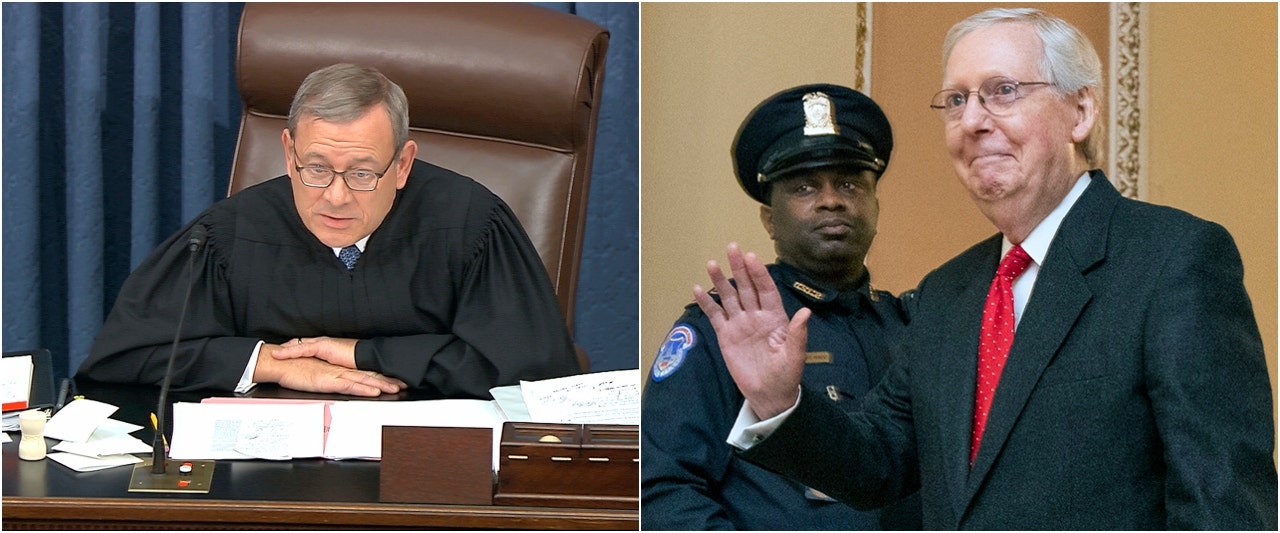
and Democrats that prompted Chief Justice John Roberts to admonish both sides.
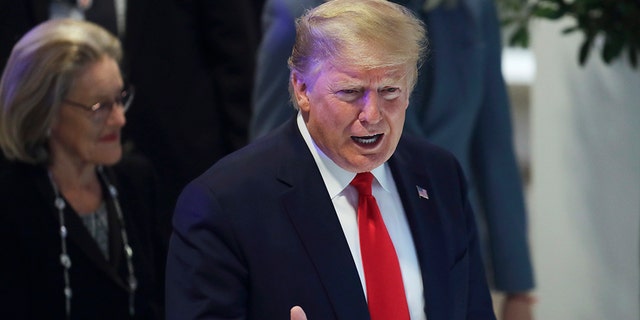
President Trump flashes a thumbs-up as he arrives at the World
Economic Forum in Davos, Switzerland, Wednesday, Jan. 22, 2020.
(Associated Press)
The confrontation was sparked when Rep. Jerry Nadler,
D-N.Y., accused Senate Republicans of “voting for a cover-up” after a
series of trial-rules amendments proposed by Senate Democrats went down
in defeat in party-line votes. The amendments had called for
permitting testimony from new witnesses and the release of documents,
but were rejected 53-47 each time. While most of the Senate spent
Tuesday sitting in silence at the impeachment trial, Trump spent part of
the day boasting of a robust U.S. economy in a speech to the global business community at the Switzerland gathering. “Today
I'm proud to declare the United States is in the midst of an economic
boom, the likes of which the world has never seen before,” he said,
vowing to never to let “radical socialists destroy our economy.” Trump
was expected to participate in a pair of bilateral press conferences
with leaders from Kurdistan and Iraq before returning to Washington
later Wednesday. Fox News' Rachel O'Neill and Edmund DeMarche and the Associated Press contributed to this story.
A marathon, 12-hour first day in the Senate impeachment trial against
President Trump erupted into a shouting match well after midnight
Wednesday morning, as Trump's legal team unloaded on Democratic
impeachment manager Rep. Jerry Nadler, D-N.Y. -- in an exchange that
prompted a bleary-eyed Chief Justice John Roberts to sternly admonish
both sides for misconduct in the chamber. Nadler began the historic spat by speaking in support of the eighth amendment of
the day, which was proposed by Senate Minority Leader Chuck Schumer,
D-N.Y., just as the clock struck midnight. The proposal would have
amended the trial rules offered by Senate Majority Leader Mitch
McConnell, R-Ky., to immediately subpoena former National Security
Advisor John Bolton. McConnell's rules, which were eventually
adopted in a 53-47 party-line vote at 1:40 a.m. ET Wednesday and largely
mirror those from the Bill Clinton impeachment trial in 1999, permit
new witnesses and documents to be considered only later on in the
proceedings, after opening arguments are made. But Nadler, who was overheard apparently
planning to impeach Trump back in 2018, said it would be a "treacherous
vote" and a "cover-up" for Republicans to reject the Bolton subpoena
amendment, claiming that "only guilty people try to hide evidence."
Bolton has reportedly described Trump's conduct as akin to a "drug
deal," and he has indicated he would be willing to testify and provide
relevant information. “It’s embarrassing,” Nadler began. “The
president is on trial in the Senate, but the Senate is on trial in the
eyes of the American people. Will you vote to allow all the relevant
evidence to be presented here? Or will you betray your pledge to be an
impartial juror? ... Will you bring Ambassador Bolton here? Will you
permit us to present you with the entire record of the president's
misconduct? Or will you instead choose to be complicit in the
president's coverup? So far I'm sad to say I see a lot of senators
voting for a coverup, voting to deny witnesses, an absolutely
indefensible vote, obviously a treacherous vote.” Trump's legal team, which has argued that Democrats' impeachment case couldn't be as "open-and-shut"
as advertised given the apparently urgent need for new evidence even
after the House impeachment inquiry, immediately rose in response. "We've
been respectful of the Senate," an animated White House counsel Pat
Cipollone fired back. "We've made our arguments to you. And you don't
deserve, and we don't deserve, what just happened. Mr. Nadler came up
here and made false allegations against our team. He made false
allegations against all of you; he accused you of a cover-up. He's been
making false allegations against the president. The only one who should
be embarrassed, Mr. Nadler is you, for the way you've addressed the
United States Senate. This is the United States Senate. You're not in
charge here. ... It’s about time we bring this power trip in for a
landing." Then, Trump attorney Jay Sekulow hammed Nadler for
suggesting that executive privilege, a longstanding constitutional
principle protecting executive branch deliberations from disclosure,
wasn't legitimate. The White House has said the privilege prevents
Democrats from forcing administration officials to provide testimony
before Congress. "At about 12:10 a.m., January 22, the chairman of
the [House] Judiciary Committee, in this body, on the floor of this
Senate, said 'executive privilege and other nonsense,'" Sekulow said.
"Now think about that for a moment. 'Executive privilege and other
nonsense.' Mr. Nadler, it is not 'nonsense.' These are privileges
recognized by the Supreme Court of the United States. And to shred the
Constitution, on the floor of the Senate. To serve what purpose? The
Senate is not on trial. The Constitution doesn't allow what just took
place. Look what we've dealt with for the last, now 13 hours. And we
hopefully are closing the proceedings, but not on a very high note." Sekulow
accused Democrats of hypocrisy given that Attorney General Eric
Holder had similarly cited executive privilege to avoid providing
documents as part of House Republicans' "Fast and Furious" gunrunning
probe. Holder was later held in contempt of Congress. "'Only
guilty people try to hide evidence?'" Sekulow asked, quoting Nadler
incredulously. "So, I guess when President Obama instructed his attorney
general to not give information, he was guilty of a crime? That's the
way it works, Mr. Nadler? Is that the way you view the United States
Constitution? Because that's not the way it was written, that is not the
way it's interpreted, and that's not the way the American people should
have to live." The outbursts prompted Roberts, who as Chief
Justice of the United States is constitutionally required to serve
as the presiding judge in the impeachment trial, to issue a highly
unusual rebuke to both sides of the debate. "It is appropriate at
this point for me to admonish both the House managers and the
president's counsel in equal terms to remember that they are addressing
the world's greatest deliberative body," Roberts said. "One reason it
has earned that title is because its members avoid speaking in a manner,
and using language, that is not conducive to civil discourse. " Roberts
continued: "In the 1905 [Judge Charles] Swayne trial, a senator
objected when one of the managers used the word 'pettifogging' -- and
the presiding officer said the word ought not to have been used. I don't
think we need to aspire to that high a standard, but I do think those
addressing the Senate should remember where they are." The vote on
the Bolton amendment, like the roll call on Schumer's previous failed
quixotic proposals on the day, was not a final determination on any
witness or document request, because McConnell's proposal would allow
new evidence to be considered later on in the process. At 1:30
a.m. ET, Schumer introduced his last amendment to McConnell's rules--
and he unexpectedly put Roberts back in the spotlight. The proposal
would have allowed Roberts to decide the appropriateness of witnesses,
which Republicans nixed because the Constitution affords the Senate the
"sole" power over impeachment trials. That last amendment was tabled by a 53-47 party-line vote, just like ten of Schumer's other proposals. When
McConnell thanked Roberts for his "patience" as the proceedings wrapped
up at 1:40 a.m. ET following that vote, Roberts remarked to applause,
"It comes with the job." The trial adjourned until 1 p.m. ET on
Wednesday. As some Democratic impeachment managers told Fox News
that they were exhausted from the "long day" while staffers streamed out
of the Capitol complex at 2 a.m. ET, McConnell smirked and simply told Fox News that it had been a "good day."
McConnell's rules package
Under
McConnell's final, adopted rules resolution, both the Democrats'
impeachment managers and Trump's lawyers will now have three session
days, totaling 24 hours, allocated to present their case. McConnell's
original resolution had allowed 24 hours of arguments over only two
days. Democrats complained that that would push the trial into “the dead
of night,” and McConnell expanded the timeline with a handwritten note
on the resolution on Tuesday after the GOP moderates voiced similar
concerns.
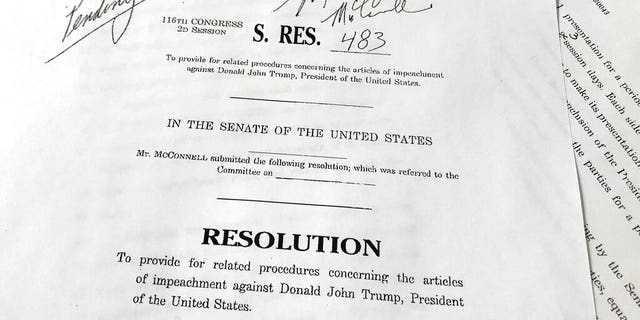
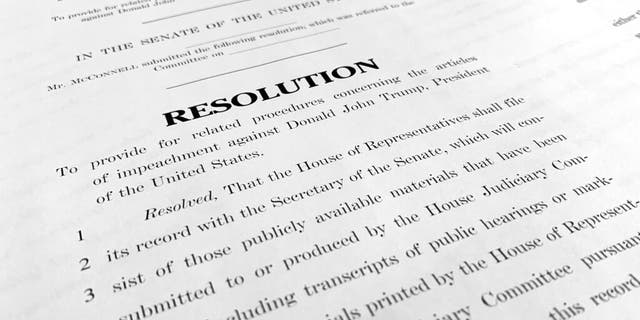
A copy of revised U.S. Senate Resolution 483, which provides
procedures concerning the articles of impeachment against President
Donald Trump, released Tuesday, Jan. 21, 2020 on Capitol Hill in
Washington. Senate Majority Leader Mitch McConnell has abruptly changed
his proposed rules for President Donald Trump’s impeachment trial after
some of his fellow Republican senators objected. (AP Photo/Wayne
Partlow)
A spokeswoman for Maine Republican Sen. Susan
Collins said that she and others had raised concerns. Collins saw the
changes as significant improvements, the spokeswoman said. Additionally,
Ohio GOP Sen. Rob Portman and a substantial number of other Republicans
from across the party's ideological spectrum reportedly wanted to make
the changes. The rules for Clinton’s trial give the two sides 24
hours each for arguments but didn't specify how many days. They each
took three. The rules for senators’ questions are identical as
compared with the Clinton trial: “Upon the conclusion of the president’s
presentation, senators may question the parties for a period of time
not to exceed 16 hours." Per underlying Senate rules, upon which both
resolutions were based, the senators have to submit those questions in
writing. After the senators' question period, Trump’s trial will
follow Clinton’s format with debate over witnesses. In the Trump trial,
the House prosecutors and White House defense will have four hours of
debate over the question of whether to subpoena witnesses or documents. The
Clinton resolution was similar, but it gave the two sides six hours of
debate. Both sets of rules also require witnesses to be deposed before
they testify publicly. In Clinton’s trial, the Senate eventually
decided to depose three witnesses and allow video excerpts to be played
on the Senate floor. But the public had already heard from all three of
those witnesses, as they had been interviewed by Starr’s team. It’s still unclear what will happen with witnesses in Trump’s trial. The
Clinton rules resolution provided that there would be a vote on a
motion to dismiss the charges. McConnell’s resolution does not mention a
motion to dismiss, known as a "kill switch" in GOP circles, but does
not rule it out. Trump has tweeted that he would like such a
motion, but Senate Republicans have indicated that they don’t have the
votes to pass it and that they would prefer for the president to be
acquitted, as he is expected to be. Still, any senator could offer a
motion to dismiss the two articles. With the rules debate resolved, all indications are that the days ahead are likely to be acrimonious. Shortly before the trial
dragged on overnight into the wee hours Wednesday with a series of
Democrat-proposed subpoena requests that Republicans methodically shot
down one-by-one, McConnell had offered Democrats an option: bundle all
of their document requests into a "stack" for a single vote, so that the
process could move along. But, Schumer was having none of it --
and made clear that he wanted individual votes on each of Democrats'
proposed amendments to McConnell's trial rules, no matter how long it
took. McConnell's rules passed 53-47 followed immediately by adjournment
until 1 p.m. Wednesday. "A number" of additional amendments were
going to be offered, Schumer promised. Indeed, at 10:30 p.m. ET, Schumer
rose to present his sixth proposal of the day: a subpoena for the testimony
of White House budget aides Robert Blair and Michael Duffey. Debate on
that proposal wrapped up in a little over an hour before the Senate
voted to table it.
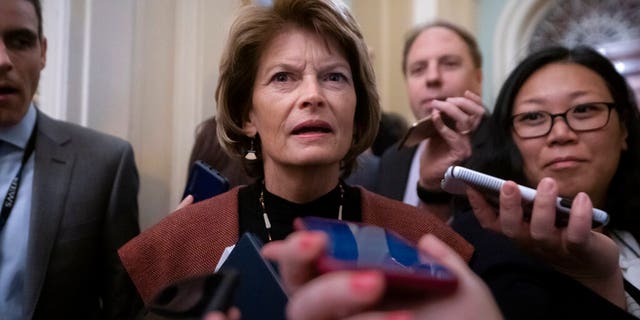
Sen. Lisa Murkowski, R-Alaska, arrives at the Senate for the start
of the impeachment trial of President Donald Trump on charges of abuse
of power and obstruction of Congress, at the Capitol in Washington,
Tuesday, Jan. 21, 2020. (AP Photo/J. Scott Applewhite)
Then, at 11:19 p.m. ET, Schumer introduced yet another amendment,
in the form of a procedural modification requiring that if any party
"seeks to admit evidence that has not been submitted as part of the
record of the House of Representatives and that was subject to a duly
authorized subpoena," then that party "shall also provide the opposing
party all other documents responsive to that subpoena." However,
Trump's lawyers objected to the premise that the House's subpoenas were
"duly authorized," given that the subpoenas were not issued pursuant to
an impeachment inquiry authorized by a vote of the full House. The Bolton amendment came next, followed by another procedural amendment on subpoenas. In
all, the Senate handed President Trump a series of wins throughout the
day Tuesday by voting 53-47 ten separate times to effectively kill a
series of previous proposals from Schumer to subpoena White House, State
Department, Defense Department,
and Office of Management and Budget documents, as well as testimony
from acting White House Chief of Staff Mike Mulvaney, Blair and Duffey,
respectively. The party-line votes demonstrated GOP unity at the
start of the trial, which is all but certain to result in the
president's acquittal.
"I do think those addressing the Senate should remember where they are." — Chief Justice John Roberts, after midnight
An
additional, less consequential amendment on written responses was
tabled by a 52-vote majority. Collins joined with Democrats on that
vote, marking the first time a Republican did so all day. There
were signs that attention was flagging in the chamber with the night
winding on. As of 10 p.m. ET, the galleries to watch the proceedings
contained only 29 members of the public. "It’s getting
late," White House counsel Pat Cipollone said late Tuesday night. "I
would ask you, respectfully, if we could simply start, maybe tomorrow we
can start -- and they can make their argument, and they can, I guess,
make a case that they once called 'overwhelming.' We'll
see... Seriously, can we please start?” Meanwhile,
a report emerged in Politico that Democrats' lead impeachment manager,
California Rep. Adam Schiff, may have publicly mischaracterized evidence in the case. Schiff had asserted that Rudy Giuliani associate Lev Parnas “continued
to try to arrange a meeting with President [Volodymyr] Zelensky" -- but
the "mr Z" that Parnas was referring to in his text message was
apparently not Ukraine's president, but Ukrainian businessman Mykola
Zlochevsky. Separately, as Democrats' amendments were being summarily shot down, reports emerged that some Democrats were privately considering something of a compromise: calling for the testimony of Hunter Biden
in exchange for the appearance of some key administration officials.
Biden obtained a lucrative board role with a Ukrainian company while his
father, Joe Biden, was overseeing Ukrainian policy as vice president. Trump had asked in his now-infamous July 25 call with Ukraine's president for a look into Joe Biden's admitted pressure campaign to have Ukraine's top prosecutor fired. Republicans
have sought to portray Trump's push for a probe as a legitimate request
given the Bidens' dealings in Ukraine, while Democrats have alleged
that senior administration officials would testify that the
administration withheld military aid to Ukraine in order to secure a
politically motivated probe. Mulvaney, for example, has publicly argued
that there is nothing wrong with tying financial assistance to
anti-corruption efforts and other U.S. objectives, even as the
administration has denied specifically targeting the Bidens for
political purposes. The
barrage of amendments Tuesday night killed early hopes that the
senators would have time to meet in a closed session to converse --
which would be a valuable opportunity, given that the senators were
legally barred from having any sustenance other than water or milk at
their desk all day, and could not communicate verbally with one another
during the proceedings. The restriction on cellphone possession
and oral interaction led some members to pass and flash written notes to
each other like students in a classroom, as Democratic House
impeachment managers and the president's legal team traded lengthy
legalistic arguments. At one point during the proceedings, former
Bill Clinton press secretary and CNN political analyst Joe Lockhart
wrote on Twitter that Texas GOP Sen. Ted Cruz could go to "prison,"
noting that Cruz's Twitter account was posting tweets during the trial.
Lockhart was quickly mocked by social media users pointing out that it's
common for senators' Twitter accounts to be run by staff, and Cruz's
representatives confirmed to Fox News that Cruz had not sneaked his
phone into the chamber. Even Cruz's staff couldn't resist poking some fun at Lockhart, writing "COME AND TAKE IT," with an image of a cellphone. It
was a moment of levity in an otherwise emotionally charged day, with
Democrats accusing the president of "high crimes and misdemeanors" and
Republicans calling out what they see as a transparent partisan stunt. "It's
a partisan impeachment they've delivered to your doorstep in an
election year," Cipollone thundered early in the day, pointing out that
Sens. Elizabeth Warren and Bernie Sanders, and others, were being pulled
off the campaign trail. "Some of you should be in Iowa." "They're not here to steal one election, they're here to steal two elections," Cipollone added. Trump
attorney Patrick Philbin said Democrats' document requests were a
"stunning admission" that House prosecutors, who had full rein to
conduct their own impeachment inquiry, were now essentially asking the
Senate "to do their job for them."
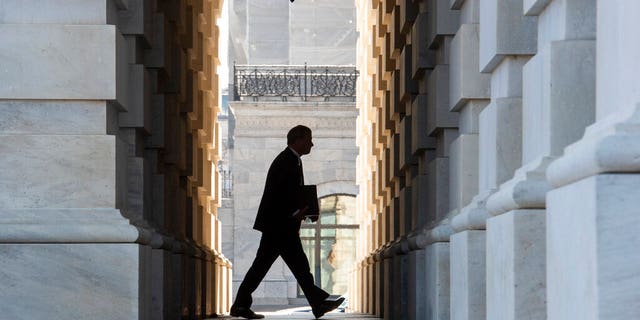
Supreme Court Chief Justice John Roberts arrives at the Capitol in
Washington, Tuesday, Jan. 21, 2020. President Donald
Trump’s impeachment trial quickly burst into a partisan fight Tuesday as
proceedings began unfolding at the Capitol. Democrats objected strongly
to rules proposed by the Republican leader for compressed arguments and
a speedy trial. (AP Photo/Cliff Owen)
California Democratic Rep. Zoe Lofgren, one of the
House Democrats' impeachment managers, countered in her remarks on the
Senate floor that additional documents were needed to provide "clarity." “As
powerful as our evidence is," Lofgren said, "we did not receive a
single document from an executive branch agency including the White
House itself."
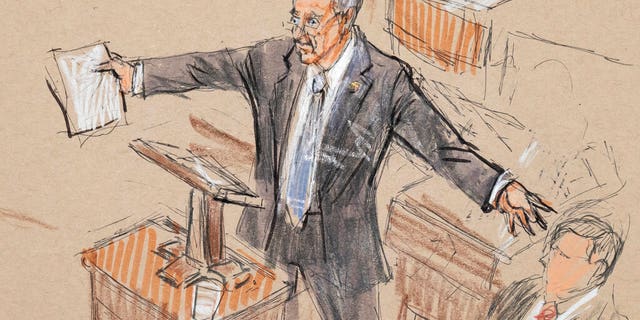
This artist sketch depicts Senate Minority Leader Chuck Schumer,
D-N.Y., speaking in the Senate chamber during the impeachment trial
against President Donald Trump on charges of abuse of power and
obstruction of Congress, at the Capitol in Washington, Tuesday, Jan. 21,
2020. (Dana Verkouteren via AP)
Lofgren specifically sought, among other
materials, summary notes from an Aug. 30, 2019 meeting between Trump,
Defense Secretary Mark Esper and Secretary of State Mike Pompeo in which
they apparently tried to convince the president that freeing up aid
money for Ukraine would be "the right thing to do." “It would be wrong for you senators ... to be deprived of the relevant evidence,” Lofgren said. For his part, Trump appeared undeterred by the proceedings, and committed to conducting business as usual.
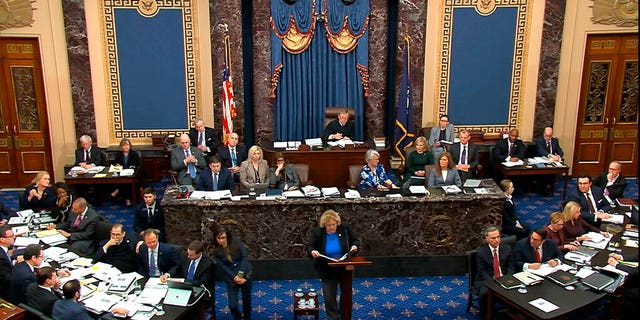
In this image from video, impeachment manager Rep. Zoe Lofgren,
D-Calif., speaks in support of an amendment offered by Sen. Chuck
Schumer, D-N.Y., during the impeachment trial against President Donald
Trump in the Senate at the U.S. Capitol in Washington, Tuesday, Jan. 21,
2020. (Senate Television via AP)
“READ THE TRANSCRIPTS!” the president tweeted from
overseas, as he returned to his hotel far away from Washington's
impeachment drama, at a global leaders economic conference in Davos,
Switzerland. As the contentious day wrapped up in Washington well
after midnight, Trump posted another high-spirited tweet from Davos that
again pointedly avoided commenting on the trial. "Making great progress in @Davos," Trump wrote. "Tremendous numbers of companies will be coming, or returning, to the USA. Hottest Economy! JOBS, JOBS, JOBS!" Fox
News' Chad Pergram, Mike Emanuel, Caroline McKee, Jason Donner, and
Adam Shaw contributed to this report, as well as The Associated Press.
Fox News contributor Karl Rove explained Monday why he believes some Democratic senators could break ranks with their colleagues and vote to acquit President Trump following the upcoming Senate impeachment trial. "Looking at it, you've had a number of Democrats, [Sen. Joe] Manchin of West Virginia, [Sen. Doug] Jones of Alabama...all have sort of [made] temperate comments about this," Rove said on "America's Newsroom." "Sure,
most Democrats are gonna be like Kamala Harris and these others who
have made it clear they're voting to convict no matter what," Rove
continued, emphasizing that some Democratic senators are questioning
whether Trump's removal is "what we ought to be doing as a country" and
whether they should "just be going along with the herd." Over the
weekend, Rove told "Fox News Sunday" that he believed "it is much more
likely we'll have more Democrats voting to retain the president in
office than Republicans [voting to convict]." In December, Senate Majority Leader Mitch McConnell, R-Ky., shared similar sentiments on
"Hannity," saying he believed that one or two Democratic senators who
hail from states won by Trump in 2016 could vote to acquit-- singling
out Jones and Manchin. "I'm very much torn on it," Manchin told CNN recently. "I think it weighs on everybody." Jones,
considered by many analysts to be the most vulnerable incumbent up for
reelection this year, said last month that he was "concerned" of the
ramifications that an impeachment inquiry would have on the country. Rove
predicted that while all senators will vote with their respective party
on procedural matters, their ultimate vote may prove to be in Trump's
favor. "I
think they'll go with the rest of the Democrats on procedural questions
like...witnesses...," Rove said, "but I think that's going to be a
different question than the ultimate one of should we remove the
president from office." After formally opening Thursday, the Senate's impeachment trial will begin in earnest Tuesday afternoon. Fox News' Brooke Singman contributed to this report.
It’s
perfectly obvious that the New York Times copped out when it comes to
backing a Democratic candidate. The more interesting question is why. The editorial board, seemingly unable to settle on one contender, endorsed two instead, picking Elizabeth Warren and Amy Klobuchar. Voters,
of course, only get one pick (or risk jail as a result). The central
conceit of newspaper endorsements is that editors study the candidates
and their records—and, in the case of the Times, interview them—to make a
recommendation for busy people who don’t have time to conduct that kind
of examination. Instead, they punted. But a careful reading
suggests the Times is really endorsing Amy Klobuchar, and not just
because her name was first. Given its determination to defeat President
Trump, the paper is hedging its bets, with the Minnesota senator still
mired in single digits and betting most of her chips on Iowa. If she
gets knocked out, the Times is still backing Warren. The
editorial begins by praising Warren as a great storyteller with “the
passion of a convert,” a former Republican from Oklahoma. And it hailed
many of her liberal proposals. But then come the cavernous caveats. Warren’s wealth tax is “constitutionally suspect” and would be tied up in the courts for years. She’s
displayed “some questionable political instincts.” She can sound like
she sees “a universe of us-versus thems.” She’s backed away from
Medicare for All. She goes too far in “placing the blame for a host of
maladies from climate change to gun violence at the feet of the business
community when the onus is on society as a whole. The country needs a
more unifying path.” That sounds like a rationale for not supporting the Massachusetts senator, and that’s the point where the piece pivots. Amy
Klobuchar is “the very definition of Midwestern charisma, grit and
sticktoitiveness.” Her “bipartisan credentials” would make her “a deal
maker…and uniter for the wings of the party — and perhaps the nation.” Sounds like a closing argument. While
there’s a mild swipe about Klobuchar treating her staff poorly and
having “struggled” to gain traction on the trail, the Times says she’s
“enormously popular” in Minnesota. It’s pretty clear the editors would
like her to be president. But
here’s the thing: Warren is a full-throated progressive who’s embraced
some of Sanders’ proposals. Klobuchar is a moderate liberal who’s
running against their big-government plans. It’s inconsistent for the
Times to embrace both, except to have a horse in each lane. Newspaper
endorsements don’t have nearly the clout they once did, except perhaps
locally. The Washington Post helped elect a couple of D.C. mayors, and
the Union-Leader’s nod in New Hampshire is a boost to GOP candidates. For
Klobuchar, the support of the Des Moines Register would be worth its
weight in gold. In fact, she joked that the backing of the Quad-City
Times was more important because it covers four cities and the Times
serves only one. The Times endorsement is like chicken soup and
certainly doesn’t hurt a Democratic candidate. But a co-endorsement is
like a weak handshake instead of a big kiss.
It’s good for Rep. Adam Schiff,
D-Calif., that his prosecutor days are behind him, and that he’s now
only playing one on TV as House manager for the impeachment. He’s
enjoyed putting on a show for the cameras, pretending to be a brave
civil servant prosecuting President Trump for “high crimes and
misdemeanors.” But if he behaved in a real courtroom the way he has
since Democrats’ crusade against the president began, a court
would sanction him and throw him off the case, and his law license could
be taken away. From the very beginning of the impeachment
charade, Schiff has injected himself and his own personal hatred into
what is meant to be a rare, solemn, and bipartisan process, all while
pantomiming the restrained, professional behavior of an officer of the
court. He’s blatantly lied, in the committee room and in public, about
the evidence
we've seen, ranging from a series of breathtaking whoppers regarding
now-discredited surveillance warrants to fictionalizing the content of
the president’s call with Ukrainian president Volodymyr Zelensky. Schiff
repeatedly refused to allow cross-examination of his supposed witnesses
— including the “whistleblower” who, by his own admission, holds no
first-hand knowledge of the facts in question.
(Where are those whistleblower transcripts, by the way? Suppressed by
Schiff.) Worst of all, he’s had access to evidence and knowledge that
casts doubt on his entire contrived corruption narrative, and he’s
prevented the president and Republicans from using it in their defense. If
the U.S. attorney or district attorney in charge of Schiff’s office
didn’t have the good sense to remove such a prosecutor from trying a
case, a judge would do it for them. Even if he were the head prosecutor,
he might well be referred to the state bar for disciplinary charges. Making
things up, trying to railroad the defendant, manipulate the jury, bias
the outcome, suppressing evidence, procuring false evidence, tampering
with evidence – any one of these things can and do get prosecutors
disbarred. Just ask Mike Nifong, the North Carolina district attorney
overseeing the now-infamous 2006 Duke lacrosse rape case. Like
Schiff, Nifong took a thin and implausible case, based on the
accusation of a troubled young woman, and twisted it to nearly destroy
the lives of three innocent Duke lacrosse players. He tried parading
them in front of the country as brutal, privileged rapists, while
presenting himself as the champion of the voiceless, a lone defender of
justice. Like
Schiff, Nifong viewed the defendants in his case as merely a means to
further his own fame and political career, going on a
TV-talking-head-spree like an early precursor to Schiff. He exploited a
tense political situation around racial division and campus sexual
assault the same way Schiff is exploiting political polarization in
America today. And like Schiff, Nifong messed up. He got
caught. Remember when Schiff had to ridiculously claim he didn’t know
the identity of the whistleblower, despite his office advising him on
how to come forward with his conspiracy theory about the president’s
phone call with Zelensky? Nifong had to claim he didn’t have the DNA
evidence to show the Duke kids were innocent, despite the fact that he
had worked with the crime lab director to withhold it. The
difference is that, because he was a real prosecutor, Nifong paid for
his actions when he was caught. Evidence that can exonerate defendants
in a criminal case is called “Brady material.” Withholding it is a
classic example of prosecutorial misconduct. Nifong was brought up on
ethics charges, resigned from his office, and was forced to surrender
his law license. For good measure, he then spent a day in jail for
contempt of court. Schiff’s sentence for his Pinocchio behavior? More
time on cable news.
From the start, this entire
impeachment process has been political and illegitimate. Impeachment is
always inherently political, but the denial of due process to the
president is historic.
Schiff is not a prosecutor.
He’s a politician, and ultimately the only price he’ll pay for his utter
contempt of the Constitution and the public trust is the political hit
that he will take when the president is speedily acquitted in the
Senate. From the start, this entire impeachment process has been
political and illegitimate. Impeachment is always inherently political,
but the denial of due process to the president is historic. House
Speaker Nancy Pelosi, D-Calif., miffed by Democratic New York Rep. Jerry
Nadler’s lackluster showmanship in the House Russiagate hearings,
delegated the hastily conjured impeachment process to Schiff, who has
made a mockery of the role of a prosecutor. Schiff is the one who
solicited evidence, colluded with “witnesses” who were anything but,
suppressed evidence that would be Brady material in a court of law, lied
to his own “grand jury” by falsely mimicking the president, and went on
television to poison the “jury pool” of senators with his running
commentary, lies and pressure tactics. He’s never been held accountable
for his daily shredding of the Constitution he swore to uphold, and he
probably never will be, given the far-left district he represents in Los
Angeles County. Courts
and bar associations come down hard on lying, cheating, feckless
prosecutors not only because they fail to uphold their duties to the
defendant and to the courts, but also because they undermine public
confidence in the system of justice itself. What Schiff is doing is a
million times worse, because every American is watching this charade and
seeing a lawyer with power misbehave and make a mockery of our ultimate
law, the Constitution. His disgraceful performance will permanently mar
our civic fabric and people’s confidence in fair trials, due process,
equal protection of the laws. Only the voters in Schiff’s district
can hold him accountable – but his misconduct leaves a stain on Nancy
Pelosi’s legacy as speaker of the house, and on the Democratic Party,
whose leaders’ zeal to overturn the results of the 2020 election have
blinded them to the maxim that a prosecutor’s first job is to do
justice, not rack up indictments regardless of merit.
After an opening salvo of back-and-forth arguments from President Trump's attorneys and Democrats' impeachment managers on Monday, Senate impeachment trial proceedings
are set to begin at 1 p.m. ET on Tuesday with the expectation they will
stretch well into a wild night on Capitol Hill -- even as key
procedural questions, including the timeline for debate and whether
additional witnesses will testify, remain undecided and hotly
contentious. In a surprise move Monday night, a detachment of
high-profile House Republicans announced that they would formally join
the president's legal team, including Reps. Doug Collins, Mike Johnson,
Jim Jordan, Debbie Lesko, Mark Meadows, John Ratcliffe, Elise
Stefanik and Lee Zeldin. The last-minute show of force underscored the
fluid nature of the Senate trial, which is also set to feature
full-throated arguments against impeachment from constitutional scholar
Alan Dershowitz and Bill Clinton independent counsel Ken Starr. “We
are not planning for them to present statements on the Senate floor," a
senior administration official told Fox News, referring to the latest
additions to Trump's defense team, headed up by White House Counsel Pat
Cipollone and Trump's personal attorney Jay Sekulow. "The group will
continue to give critical guidance on the case because of their strong
familiarity with the facts and evidence." Jordan Sekulow told Fox
News' "Hannity" on Monday night that his father and the rest of
Trump's legal team were "champing at the bit and ready to go." He
maintained that executive privilege, a longstanding constitutional
principle protecting executive branch deliberations from disclosure, by
itself defeated the "obstruction of Congress" article of impeachment,
while Democrats had only hearsay evidence and speculation to support
their "abuse of power" charge. Neither "obstruction of Congress" nor
"abuse of power" are federal crimes, and they have no established
definition. Democrats have seethed openly ever since House Speaker Nancy Pelosi, D-Calif., failed in her gambit
to force Senate Majority Leader Mitch McConnell's hand before the House
would turn over the articles of impeachment to the Senate. Pelosi had
sought a commitment allowing Democrats to call witnesses prior to
arguments in the trial -- but, with just hours to go until the
proceedings commenced, McConnell, R-Ky., dashed those hopes. McConnell
specifically revealed Monday that he wanted a condensed, two-day
calendar for each side to give opening statements, at 12 hours per day.
After the four days of opening arguments, senators would be allowed up
to 16 hours for written questions to the prosecution and defense,
followed by four hours of debate. Only then would there be votes on
calling other witnesses, likely next week. At the end of deliberations,
the Senate would then vote on each impeachment article. Utah Republican Sen. Mitt Romney said in a statement
Monday night that McConnell's resolution, overall, "aligns closely with
the rules package approved 100-0 during the Clinton trial. If attempts
are made to vote on witnesses prior to opening arguments, I would oppose
those efforts." Romney was among a small number of Republican senators
who said they wanted to consider witness testimony and documents that
weren't part of the House impeachment investigation. Democrats, however, were incensed by the speedy timeline. Some took to calling McConnell "Midnight Mitch," the latest in a string
of unintentionally flattering nicknames. Senate Minority Leader Chuck
Schumer, D-N.Y., called McConnell's rules package a "national disgrace,"
adding, "it’s clear Sen. McConnell is hell-bent on making it much more
difficult to get witnesses and documents and intent on rushing the trial
through." Even before McConnell's announcement, congressional
Democrats apparently were off-balance: "The House managers have
absolutely no idea what the structure of the trial two days before the
trial begins,” one source with House Democrats working on the
impeachment trial complained to Fox News late Sunday. “It is
completely unfathomable,” fumed another source with the Democrats. “Is
Sen. McConnell going to have 12-hour trial days which run until 2 or 3
in the morning?” McConnell is expected to kick off the afternoon's
proceedings by introducing his proposed resolution for the parameters
for the trial, which he has said will pass with at least 53 votes.
Senators will not be directly speaking out in the debate over
McConnell's resolution, which is slated to last for approximately two
hours -- only members of Trump's defense team, and the seven Democrats
serving as House impeachment managers, are expected to participate. Schumer
likely will then present his counter-proposals to McConnell's motion,
followed by another two hours of debate among the managers and Trump's
counsel. Potential proposals include requests to subpoena specific
witnesses -- including, perhaps, Rudy Giuliani associate Lev Parnas or former National Security Adviser John Bolton -- or to adjust debate time. Then,
at approximately 6 p.m. ET or even later, Fox News is told to expect a
closed Senate session of indeterminate length after the debates. When
the Senate returns to open session, lawmakers -- including two leading
Democratic presidential contenders, Sens. Elizabeth Warren and Bernie
Sanders -- likely will vote in turn on any amendments to McConnell's
proposal, then McConnell's proposal itself. McConnell's proposal also was said to include a so-called "kill switch," allowing Trump's team to move to dismiss the articles of impeachment in the Senate quickly. In
a sign of the prevailing give-no-ground mentality ahead of the trial,
Trump's legal team traded blows with House prosecutors on Monday,
asserting that the president did "absolutely nothing wrong" and
urging the Senate to reject an impeachment case it called “flimsy" and a
"dangerous perversion of the Constitution." House Democrats
impeached the president for "abuse of power" related to his
administration's withholding of U.S. military aid to Ukraine while
he suggested the country investigate rival Joe Biden's dealings in Ukraine. The aid was eventually released, and Ukrainian officials have denied feeling any undue pressure.
The administration's refusal to comply with Democrats' probe, citing
executive privilege, led to the "obstruction of Congress" count.
"It is a constitutional travesty." — President Trump's legal team, on the impeachment proceedings
The 110-page filing from the White House condemned
the "rigged" House impeachment process, calling the majority vote to
impeach there a "brazenly political act ... that must be rejected." The
White House's legal argument hinged in part on Trump’s assertion he did
nothing wrong and did not commit any recognized crime, as well as on
poking holes in the hearsay witness testimony offered by Democrats. For
example, the White House pointed out that EU ambassador Gordon Sondland
had said he "had come to believe" that aid to Ukraine was linked to an
investigation of Biden, "before talking to the president." Additionally,
Trump's lawyers pointed out that Sondland admitted having "no evidence"
other than his "own presumption," and that he was "speculating" based
on hearsay that the Trump administration ever linked a White House
meeting with Ukraine's leaders to the beginning of an investigation. "After focus-group testing
various charges for weeks, House Democrats settled on two flimsy
Articles of Impeachment that allege no crime or violation of law
whatsoever—much less 'high Crimes and Misdemeanors,' as required by the
Constitution," the lawyers wrote. “It is a constitutional travesty." Additionally,
the White House released Justice Department legal opinions meant to
bolster its case that defying subpoenas from Congress did not amount to
"obstruction of Congress." One opinion, dated Sunday, said Trump
administration officials were free to disregard subpoenas sent last fall
before the House of Representatives had formally authorized an
impeachment inquiry. That approval, the memo said, was necessary before
congressional committees could begin their own investigations and issue
subpoenas for documents and testimony.
A copy of a Senate draft resolution to be offered by Senate
Majority Leader Mitch McConnell, R-Ky., regarding the procedures during
the impeachment trial of President Trump. (AP Photo/Jon Elswick)
Meanwhile, the prosecution team of House managers was
spending another day on Capitol Hill preparing for the trial, which
will take place under heavy security. The Democrats made their way
through crowds of tourists in the Rotunda to tour the Senate chamber. In
their own filing Monday, House prosecutors replied to Trump's "not
guilty" plea by making fresh demands for a fair trial in the Senate.
"President Trump asserts that his impeachment is a partisan ‘hoax.' He
is wrong," the prosecutors wrote in their reply. They wrote that
the president can't have it both ways -- rejecting the facts of the
House case but also stonewalling congressional subpoenas for witnesses
and testimony. "Senators must honor their own oaths by holding a fair
trial with all relevant evidence," they wrote. No president has
ever been removed by the Senate. The current Senate, with a 53-47
Republican majority, is not expected to mount the two-thirds voted
needed for conviction. Even if it did, the White House team has
argued it would be an "unconstitutional conviction'' because the
articles of impeachment were too broad. Administration officials have argued that similar imprecision applied to the perjury case in Clinton's impeachment trial. The
White House has also suggested the House inquiry was lacking because it
failed to investigate Biden or his son Hunter, who served on the board
of a gas company in Ukraine in a lucrative role while his father was
overseeing Ukraine policy as vice president. Should Democrats insist on
calling witnesses like Parnas and Bolton, Republicans have openly
suggested that they might then push for a subpoena the Bidens. In a
show of confidence, Trump tweeted a video late Monday touting his
achievements in office, including the nation's historically low
unemployment rate, booming stock market and rising wages, with the note:
"THE BEST IS YET TO COME!" Fox News' Caroline McKee, Chad Pergram, John Roberts and The Associated Press contributed to this report.
Sen. Tim Scott, R-S.C., said Sunday that Democrats have been focused on impeachment because “they’re pretty concerned” due to the fact that “they believe the American people are now solidly behind President Donald Trump.” Scott appeared on “Fox & Friends Weekend”
one day after House impeachment managers filed their brief to the
Senate, claiming the evidence against Trump “overwhelmingly” established
abuse of power and obstruction of Congress. Scott added that “the most important statement made about this entire impeachment process was made by [Texas] Congressman Al Green when he said if we don’t impeach him, he might win.” The South Carolina senator also pointed out, “[House Speaker] Nancy Pelosi held the impeachment documents for nearly a month, which means there is no existential threat. There is no national-security threat.” Scott
explained, “I believe the Democrat strategy is not to bring more
illumination to the case, but to put a bull’s eye on the back of
[Colorado Republican Sen.] Cory Gardner, [Iowa Republican Sen.] Joni Ernst, [Arizona Republican Sen.] Martha McSally, [North Carolina Republican Sen.] Thom Tillis. That
is the strategy they’re using to try to win back the Senate,” Scott
said, referring to Republican senators facing tough reelection
campaigns. “This is actually not about removing the president,
this is about removing enough senators in the Republican Party in order
to take control of the Senate and to rebuke the president for the next
four years because they’re pretty concerned.” In Saturday’s 111-page brief, the impeachment managers wrote, “President Trump’s conduct is the Framers’ worst nightmare.” The
brief was the Democrats’ opening salvo in the historic impeachment
trial, with House managers arguing Trump used his official powers to
pressure Ukraine to
interfere in the 2020 U.S. presidential election for personal political
gain, then tried to cover it up by obstructing Congress’s investigation
into his alleged misconduct. “The evidence
overwhelmingly establishes that he is guilty. ... The Senate must use
that [impeachment] remedy now to safeguard the 2020 U.S. election, …
protect our constitutional form of government and eliminate the threat
that the President poses to America's national security,” the brief
stated. Scott said Sunday that Democrats were reacting in such a
way because their “greatest fears are coming true” due to Trump’s
success. “The
fact is that this president has focused on bringing opportunities to
the poorest communities in the nation,” Scott said. “This president has
helped bring the minority unemployment rate to record lows for Asians, for African-Americans, for Hispanics.” Scott
noted the country’s 3.5-percent unemployment rate. “Our stock market is
going through the ceiling. They are trembling in their boots, so the
only thing they have focused on their minds today is not President
Trump, it is removing senators from office so that they can have control
of the United States Senate.” He went on to say, “There’s no question that President Trump’s economic agenda has brought more prosperity into the African-American community than we’ve seen in my lifetime.” “This
president is producing the type of results that only say one thing to
the African-American community,” Scott continued. “We believe that there
is high-potential, incredible people who only needed opportunity
and access to those opportunities. President Trump has brought so many
of those to the community that I believe that we’re going to have a
record turnout on behalf of the president [in November].” Fox News’ Marisa Schultz contributed to this report.
Steve Hilton weighed in Sunday on the drama involving the Duke and Duchess of Sussex's decision to "step back" as members of the royal family, reacting to Prince Harry on Sunday publicly addressing the situation. "To
be completely honest, I'm sick of Harry. I'm sick of Meghan. I'm sick
of this story. I'm sick of the royals," Hilton said on his show "The Next Revolution."
"As far as I'm concerned, when the Queen, who we all love very much, is
finished with her reign then Britain should go and stop being a banana
republic as it is when we have the royal family and become a real
republic." "Abolish the monarchy," Hilton added. "That is my populist take." In
a speech given at a dinner for supporters of the Sentebale charity in
London Sunday, the Prince addressed why he and his wife, Meghan Markle, choose to relinquish their "royal highness" titles and move part-time to Canada. "The
decision that I have made for my wife and I to step back is not one I
made lightly," the Prince said. "It was so many months of talks after so
many years of challenges. And I know I haven't always gotten it right,
but as far as this goes, there really was no other option. What I want
to make clear is, we're not walking away, and we certainly aren't
walking away from you." Former deputy National Security Adviser
K.T. McFarland, a guest on the program, said that Prince Harry may
regret his decision to "break with his family" when he is older. "I
think Prince Harry as a young man and his may end up regretting and
have a number of years to regret, regret breaking with his family,
particularly with his grandmother, and that sometimes things done in
haste and youth are not the things that keep you happy in old age,"
McFarland said. Jenna Ellis, a Trump 2020 senior legal advisor, praised the Prince for his decision. "He
may have been born into this, but he's making, now as a husband and a
father, the best decisions for his family," Ellis said. Hilton said Prince Harry should step out of the limelight. "Please just sort of go away and figure it out and just stop with this endless obsession with the royals," Hilton said. Fox News' Nate Day contributed to this report


 President Trump flashes a thumbs-up as he arrives at the World
Economic Forum in Davos, Switzerland, Wednesday, Jan. 22, 2020.
(Associated Press)
President Trump flashes a thumbs-up as he arrives at the World
Economic Forum in Davos, Switzerland, Wednesday, Jan. 22, 2020.
(Associated Press)