Presumptuous Politics

Tuesday, February 4, 2020

Hong Kong reports virus death as workers strike at hospitals


BEIJING (AP) — Hong Kong hospitals cut services as medical workers were striking for a second day Tuesday to demand the border with mainland China be shut completely to ward off a virus that caused its first death in the semi-autonomous territory.
All but two of Hong Kong’s land and sea crossings with the mainland were closed at midnight after more than 2,000 hospital workers went on strike Monday. As many as 9,000 medical workers could join the bigger walkout Tuesday to demand closure of the border across which tens of thousands of people continue to travel daily.
Hong Kong’s Hospital Authority said it was cutting back services because “a large number of staff members are absent from duty” and “emergency services in public hospitals have been affected.”
Hong Kong was hit hard by SARS, or severe acute respiratory syndrome, in 2002-03, an illness from the same virus family as the current outbreak. Trust in Chinese authorities has plummeted following months of anti-government protests in the Asian financial hub.
Also Tuesday, the leader of the nearby gambling enclave of Macao asked the city’s casino bosses to suspend operations to prevent further infections after a worker at one of resorts tested positive for the virus. Macao has recorded 10 cases in all.
The mainland’s latest figures of 425 deaths and 20,438 confirmed infections of the new coronavirus were up from 361 deaths and 17,205 cases the previous day. Outside mainland China, at least 180 cases have been confirmed, including two fatalities, in Hong Kong and the Philippines.
The patient who died in Hong Kong was a 39-year-old man who had traveled to Wuhan, the mainland city that has been the epicenter of the outbreak, before being hospitalized. The Hospital Authority said Tuesday he had existing health conditions but did not give details.
Most cases of the illness have been mild, but most who died have been older people with other ailments such as diabetes or heart disease.
China has struggled to maintain supplies of masks to filter out the virus, along with protective suits and other key articles, as it seeks to enforce temperature checks at homes, offices, shops and restaurants, require masks be worn in public and keep more than 50 million people from leaving home in Wuhan and neighboring cities.
To help meet demand, the European Union office in Beijing said member states have shipped 12 tons of protective equipment to China, with more on the way.
Late Monday, China’s President Xi Jinping presided over a special meeting of the top Communist Party body for the second time since the crisis started, saying “we have launched a people’s war of prevention of the epidemic.” Xi threatened punishments for those who neglect their duties will be punished, state broadcaster CCTV reported.
Other countries are continuing evacuations and restricting the entry of Chinese or people who have recently traveled in the country. A plane carrying Malaysians from Wuhan arrived in Kuala Lumpur and the 133 people on board were to be screened and quarantined for 14 days, the maximum incubation period for the virus.
Taiwan on Monday flew home 247 of its citizens from Wuhan and had sent three passengers for treatment after they were found to have fever or sore throats. The other passengers are being quarantined at medical facilities for the next two weeks.
Germany’s Lufthansa became the latest international airline to suspend flights to China, and several countries are barring Chinese travelers or people who passed through China recently.
In Wuhan, patients were being transferred to a new 1,000-bed hospital that officials hope will improve isolation to stem the virus’s spread. It was built in just 10 days, its prefabricated wards equipped with state-of-the-art medical equipment and ventilation systems. A 1,500-bed hospital also specially built for patients infected with the new virus is due to open within days.
Elsewhere in Wuhan, authorities are converting a gymnasium, exhibition hall and cultural center into hospitals with a total of 3,400 beds to treat patients with mild symptoms of the virus. Television footage of those facilities showed beds placed in tight rows in large rooms without dividers or any barriers to keep patients isolated.
With no end to the outbreak in sight, authorities in Hubei and elsewhere extended the Lunar New Year holiday break, due to end this week, well into February to try to keep people at home and reduce the spread of the virus. All Hubei schools are postponing the start of the new semester until further notice, as a many in Beijing, Shanghai and elsewhere.
Chinese scientists said they have more evidence the virus originated in bats. In a study published in the journal Nature, Shi Zhen-Li and colleagues at the Wuhan Institute of Virology reported that genome sequences from seven patients were 96% identical to a bat coronavirus.
On Tuesday, the Korea Centers for Disease Control and Prevention said a 42-year-old South Korean woman tested positive for the virus, days after she returned from a trip to Thailand with chills and other symptoms.
It is South Korea’s 16th case. Thailand has confirmed 19 cases, mostly Chinese tourists but also in a Thai taxi driver.
A passenger on a Japanese-operated cruise ship tested positive after leaving the vessel while it was in Hong Kong, and Japanese officials were conducting medical checks on the more than 3,000 people on board Tuesday.
___
Associated Press writers Maria Cheng in London and Mari Yamaguchi in Tokyo contributed to this report.

Dems lay a big caucus egg: No results from Iowa election


DES MOINES, Iowa (AP) — Democratic party officials in Iowa worked furiously Tuesday to deliver the delayed results of their first-in-the-nation caucus, as frustrated presidential candidates claimed momentum and plowed ahead in their quest for the White House.
Technology problems and reporting “inconsistencies” kept Iowa Democratic Party officials from releasing results from Monday’s caucus, the much-hyped kickoff to the 2020 primary. It was an embarrassing twist after months of promoting the contest as a chance for Democrats to find some clarity in a jumbled field with no clear front-runner.
Instead, caucus day ended with no winner, no official results and many fresh questions about whether Iowa can retain its coveted “first” status.
State party officials said final results would be released later Tuesday and offered assurances that the problem was not a result of a “hack or an intrusion.” Officials were conducting quality checks and verifying results, prioritizing the integrity of the results, the party said in a statement.
The statement came after tens of thousands of voters spent hours Monday night sorting through a field of nearly a dozen candidates who had spent much of the previous year fighting to win the opening contest of the 2020 campaign and, ultimately, the opportunity to take on President Donald Trump this fall.
Youtube video thumbnail

The candidates didn’t wait for the party to resolve its issues before claiming, if not victory, progress and moving on to next-up New Hampshire.
“It looks like it’s going to be a long night, but we’re feeling good,” former Vice President Joe Biden said, suggesting the final results would “be close.”
Vermont Sen. Bernie Sanders said he had “a good feeling we’re going to be doing very, very well here in Iowa” once results were posted. “Today marks the beginning of the end for Donald Trump,” he predicted.
“Listen, it’s too close to call,” Massachusetts Sen. Elizabeth Warren said. “The road won’t be easy. But we are built for the long haul.”
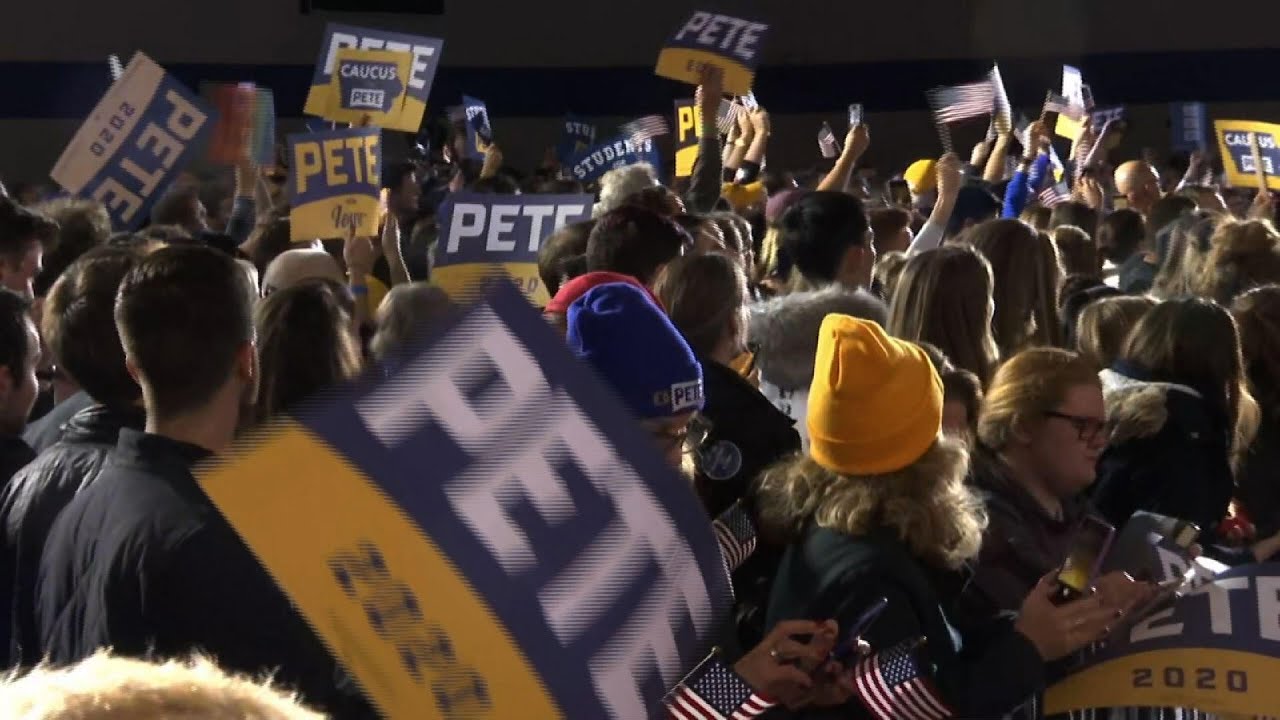
And Pete Buttigieg, the former mayor of South Bend, Indiana, was most certain.
“So we don’t know all the results, but we know by the time it’s all said and done, Iowa, you have shocked the nation,” he said. “By all indications, we are going on to New Hampshire victorious.”
Democrats faced the possibility that whatever numbers they ultimately released would be questioned. And beyond 2020, critics began wondering aloud whether the Iowa caucuses, a complicated set of political meetings staged in a state that is whiter and older than the Democratic Party, are a tradition whose time had past.
The party has tried to accommodate critics, this year by promising to report three different data points about voters’ preferences, presumably improving transparency. But the new system created new headaches.
State party spokeswoman Mandy McClure said it had “found inconsistencies in the reporting of three sets of results,” forcing officials to try to verify results with “underlying data” and the paper trail.
Some of the trouble stemmed from issues with a new mobile app developed to report results to the party. Caucus organizers reported problems downloading the app and other glitches.
Des Moines County Democratic Chair Tom Courtney said the new app created “a mess.” As a result, Courtney said precinct leaders were phoning in results to the state party headquarters, which was too busy to answer their calls in some cases.
Organizers were still looking for missing results several hours after voting concluded.
Shortly before 2 a.m., the state party was making plans to dispatch people to the homes of precinct captains who hadn’t reported their numbers. That’s according to a state party official in the room who was not authorized to share internal discussions publicly.
Earlier in the night, Iowa Democrats across the state cast their votes, balancing a strong preference for fundamental change with an overwhelming desire to defeat Trump. At least four high-profile candidates vied for the lead in a contest that offered the opening test of who and what the party stands for in the turbulent age of Trump.
It’s just the first in a primary season that will span all 50 states and several U.S. territories, ending at the party’s national convention in mid-July.
For Democrats, the moment was thick with promise for a party that has seized major gains in states since Trump won the White House in 2016. But instead of clear optimism, a growing cloud of uncertainty and intraparty resentment hung over the election as the prospect of an unclear result raised fears of a long and divisive primary fight in the months ahead.
One unsurprising development: Trump won the Republican caucus, a largely symbolic victory given that he faced no significant opposition.
The president’s campaign eagerly seized on the Democrats’ problems.
“Democrats are stewing in a caucus mess of their own creation with the sloppiest train wreck in history,” Trump campaign manager Brad Parscale said. “It would be natural for people to doubt the fairness of the process. And these are the people who want to run our entire health care system?”
Pre-caucus polls suggested Sanders entered the night with a narrow lead, but any of the top four candidates — Sanders, Biden, Warren and Buttigieg — was positioned to score a victory. Sen. Amy Klobuchar, who represents neighboring Minnesota, was also claiming momentum, while outsider candidates including entrepreneur Andrew Yang, billionaire activist Tom Steyer and Hawaii Rep. Tulsi Gabbard could be factors.
“We know one thing: We are punching above our weight,” Klobuchar said late Monday, promising to keep fighting in New Hampshire.
New voters played a significant role in shaping Iowa’s election.
About one-quarter of all voters reported that they were caucusing for the first time, according to AP VoteCast, a survey of voters who said they planned to take part in Monday’s Democratic caucuses. The first-timers were slightly more likely to support Sanders, Warren or Buttigieg, compared with other candidates.
At the same time, VoteCast found that roughly two-thirds of caucusgoers said supporting a candidate who would fundamentally change how the system in Washington works was important to their vote. That compared to about a third of caucusgoers who said it was more important to support a candidate who would restore the political system to how it was before Trump’s election in 2016.
Not surprisingly, nearly every Iowa Democrat said the ability to beat Trump was an important quality for a presidential nominee. VoteCast found that measure outranked others as the most important quality for a nominee.
The 2020 fight has already played out over myriad distractions, particularly congressional Democrats’ push to impeach Trump, which has often overshadowed the primary and effectively pinned several leading candidates to Washington at the pinnacle of the early campaign season.
Meanwhile, ultrabillionaire Mike Bloomberg, the former mayor of New York City, is running a parallel campaign that ignored Iowa as he prepares to pounce on any perceived weaknesses in the field come March.
The amalgam of oddities was building toward what could be a murky Iowa finale before the race pivoted quickly to New Hampshire, which votes next Tuesday.
For the first time, the Iowa Democratic Party planned to report three sets of results: a tally of caucus-goers’ initial candidate preference; vote totals from the “final alignment” after supporters of lower-ranking candidates were able to make a second choice; and the total number of State Delegate Equivalents each candidate receives.
There is no guarantee that all three will show the same winner when they’re ultimately released.
The Associated Press will declare a winner based on the number of state delegates each candidate wins, which has been the traditional standard.

Trump campaign manager blasts Democrats, calls Iowa caucuses a 'train wreck'


Brad Parscale, Donald Trump's campaign manager, issued a statement Monday on the Iowa caucuses that have suffered a series of largely unexplained delays and raised questions about the legitimacy of the contest.
"Democrats are stewing in a caucus mess of their own creation with the sloppiest train wreck in history. It would be natural for people to doubt the fairness of the process. And these are the people who want to run our entire health care system?" Parscale said.
In the statement, he also said the Republican caucuses had a "record turnout" for Trump.

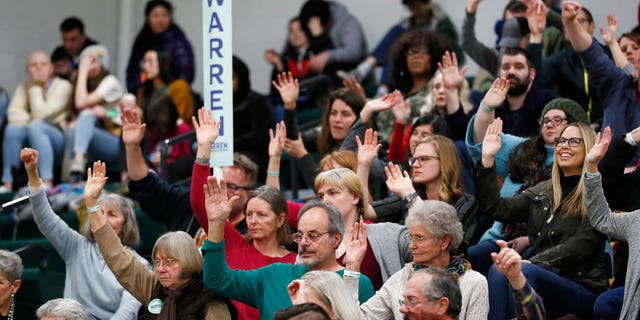
Supporters for Democratic presidential candidate Sen. Elizabeth Warren, D-Mass., raise their hands to be counted during a Democratic party caucus at Hoover High School, Monday, Feb. 3, 2020, in Des Moines, Iowa. (AP Photo/Charlie Neibergall)

"Tonight President Trump posted a record performance in the well-run GOP Iowa caucuses with [a] record turnout for an incumbent,” he added.
His statement comes as people been reportedly waiting hours for the Iowa Democratic Party to share their results. Inconsistencies in reporting are allegedly causing the delay.
The Iowa Democratic Party said Monday night that results from the state’s first-in-the-nation caucus were indefinitely delayed due to “quality checks” and “inconsistencies” in some reporting, an embarrassing complication that added a new layer of doubt to an already uncertain presidential primary season.
The party said the problem was not a result of a “hack or an intrusion.”
Monday’s confusion allowed every candidate to claim momentum, though no results were announced by the state party as Monday night was about to turn to Tuesday.
“It looks like it’s going to be a long night, but we’re feeling good,” former Vice President Joe Biden said, suggesting the final results would “be close.” “We’re in this for the long haul.”
Fox News' Gregg Re and the Associated Press contributed to this report

Iowa caucus vote totals delayed amid 'inconsistencies'; campaigns lash out at 'crazy' state party


The Iowa Democratic Party (IDP) still has not reported official vote totals in the critical Iowa caucuses as of early Tuesday morning, in a largely unexplained and unprecedented delay that has raised questions about the legitimacy of the contest -- and Democratic campaign officials are livid, Fox News has learned.
The Trump campaign, meanwhile, openly suggested that the delay meant that the caucuses were being "rigged," and that the embarrassing night proved that the Democratic Party can't be trusted to run Americans' health care and implement sweeping new government programs. Even if a winner were ultimately announced, the chaos and confusion has seemingly erased any hope for the major momentum boost that would normally result.
"We found inconsistencies in the reporting of three sets of results," the IDP said in a statement at 11:30 p.m. ET. "In addition to the tech systems being used to tabulate results, we are also using photos of results and a paper trail to validate that all results match and ensure that we have confidence and accuracy in the numbers we report. This is simply a reporting issue. The app did not go down and this is not a hack or an intrusion. The underlying data and paper trail is sound and will simply take time to further report the results."
Fox News is told that during an initial conference call with the campaigns, an IDP representative said the party would be "getting photos of the paper results sent over," but didn't answer any questions and then hung up on all the campaigns, even as frustrated staffers pushed for answers. A campaign staffer told Fox News the IDP's brief call was "crazy."
Jeff Lopez holds his son, Tristan, 4, as they and Jeff's wife, Jessika, sit in an area for Bernie Sanders supporters during the Woodbury County Third Precinct Democratic caucus, Monday, Feb. 3, 2020, at West High School in Sioux City, Iowa. Iowans across the state attended Democratic and Republican caucuses Monday. (Tim Hynds/Sioux City Journal via AP)
Another campaign official told Fox News, “Yes, they did hang up.”
During a second, equally contentious conference call early Tuesday morning, the IDP reportedly informed campaigns they could expect results sometime later on Tuesday, but gave no information about how the results would be verified or when precisely they would be published. (The 2016 Iowa caucus tallies were provided on the same day of voting, with more than 90 percent of precincts reporting by 11:00 p.m. ET that year.)
Speaking on a brief call with reporters at approximately 1:10 a.m. ET on Tuesday that lasted a little over a minute, the IDP said the system to validate electoral results was taking longer than expected, but that there had been no hack or intrusion. The IDP did not specify a precise time for results to post on Tuesday.
Former Vice President Joe Biden's campaign wrote to the IDP late Tuesday, complaining about the "considerable flaws" in the caucus reporting process. Biden, who arrived in New Hampshire early Tuesday, appeared to be dramatically underperforming at several precincts in Iowa throughout the night.
"The app that was intended to relay Caucus results to the Party failed; the Party’s back-up telephonic reporting system likewise has failed," the campaign wrote in a letter. "Now, we understand that Caucus Chairs are attempting to — and, in many cases, failing to — report results telephonically to the Party. These acute failures are occurring statewide. We appreciate that you plan to brief the campaigns momentarily on these issues, and we plan to participate. However, we believe that the campaigns deserve full explanations and relevant information regarding the methods of quality control you are employing, and an opportunity to respond, before any official results are released."
Screenshots posted to social media seemingly showed crash screens from the caucus app that indicated poor programming.
"With every passing minute that there is a delay, we worry that the process will lose credibility."
— Elizabeth Warren aide
About an hour earlier, IDP spokesperson Mandy McClure said in a statement, "The integrity of the results is paramount. We have experienced a delay in the results due to quality checks and the fact that the IDP is reporting out three data sets for the first time. What we know right now is that around 25% of precincts have reported, and early data indicates turnout is on pace for 2016."
However, the turnout in the 2016 Democratic caucuses in Iowa was only 171,109. That was far below the nearly 240,000 that took part in the 2008 Democratic caucuses, when then-Sen. Barack Obama won the contest -- indicating that Democrats' high hopes for enthusiasm have not panned out.

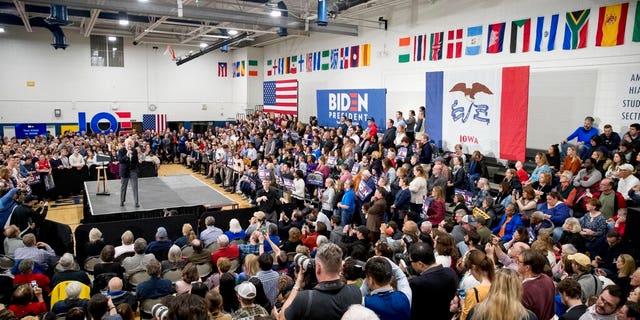
People wait for results at a caucus night campaign rally for democratic presidential candidate former Vice President Joe Biden on Monday, Feb. 3, 2020, in Des Moines, Iowa. (AP Photo/John Locher)

"With every passing minute that there is a delay, we worry that the process will lose credibility," a top Elizabeth Warren aide told CNN.
Former 2020 presidential contender Julian Castro tweeted: "This is a total mess. I respect the people of Iowa, they’ve been great—but it’s become very clear that our democracy has been misserved by a broken system."

Buttigieg declares victory -- without votes 

The void of information allowed campaigns to spin the results in their favor. Former South Bend, Ind., Mayor Pete Buttigieg even said he was "victorious" early Tuesday and that Iowa had "shocked the nation," claiming the campaign's internal numbers showed he had pulled ahead.
"77 percent of our precinct captains have reported results from their caucuses," a Buttigieg aide told Fox News, noting that previous projections "had the race at a virtual tie on state delegate equivalents, but from the 77 percent of reported precincts, we’re performing 8 points better than our projections."
The aide added: "We believe we’re on our way to winning the SDE [State Delegate Equivalent] count. In the 1,301 precincts our precinct captains have reported, Pete reached viability in 1,064 (83%). For additional context, turnout returned to historical norms and we expect participation rates to wind up near 2016 levels. We found that our support in rural parts of the state was ~5% better than we expected (coming in at 28% so far.)"
Former presidiential candidate Marianne Williamson remarked incredulously from the sidelines, "Did Pete Buttigieg just claim victory in Iowa when the results haven’t been announced yet?"
Vermont Sen. Bernie Sanders went rogue, and released internal data that his campaign said represented vote totals 40 percent of precincts. The figures, which indicated Sanders was winning with a narrow lead over Buttigieg, were also unverified.
In a surreal moment shortly before Minnesota Sen. Amy Klobuchar took the stage at her Iowa headquarters to thank her supporters -- even as no voting results were available -- a precinct chief was being interviewed on CNN while he was on hold for more than an hour with the IDP to report results.
The IDP then hung up on the precinct chief live on-air after he was too slow to respond once they took him off hold.
At least four precincts had to resolve ties in their vote results by flipping a coin during the evening, Fox News has learned.
Speaking at 11:30 p.m. ET, Biden said he felt good about the caucus, then remarked, "So it's on to New Hampshire, Nevada, South Carolina, and well beyond. We're in this for the long haul."
"I want to thank the Iowans that are here," Biden said. "Well, the Democratic Party is working to get this result to get it straight. And I want to make sure they're very careful in their deliberations. ... We're gonna walk out of here with our share of delegates. We don't know exactly what it is yet, but we feel good about where we are."
Taking the microphone ten minutes later, Sanders said that when the results were in, he had a "good feeling we're going to be doing very very well here in Iowa."
Nearing midnight local time, the bar at Sanders headquarters was packed, and the crowd had not thinned at all.
Klobuchar's team, for their part, sounded its own note of optimism.
"Big night in Iowa," Klobuchar campaign chairman Justin Buoen wrote on Twitter. "With the numbers we’ve seen internally and publicly, we’re running even or ahead of Vice President Biden. Wheels up to New Hampshire!”

Trump team mocks 'rigged' vote

Before voting began, the IDP had announced that for the first time ever, it would report three sets of results at the end of the state’s first-in-the-nation caucuses: a tally of caucus-goers’ initial candidate preference; vote totals from the “final alignment” after supporters of lower-ranking candidates were able to make a second choice, and the total number of State Delegate Equivalents each candidate receives. There was no guarantee that all three will show the same winner.
By the end of the night, it became clear that there was no guarantee there would be any winner at all.
In social media posts, the Democratic National Committee (DNC) had boasted that it had been "preparing" for the Iowa process "for three years" to make the primary process "the most transparent" ever.
As the situation broke down minute by minute, the Trump campaign mocked the delay on Twitter, even as it celebrated the huge crowds at GOP caucuses in the state that showed up to vote for the president.
"Quality control = rigged?" asked Trump campaign manager Brad Parscale.
“Democrats are stewing in a caucus mess of their own creation with the sloppiest train wreck in history," Parscale said in a statement just after midnight. "It would be natural for people to doubt the fairness of the process. And these are the people who want to run our entire health care system?"
Parscale added: "Tonight President Trump posted a record performance in the well-run GOP Iowa caucuses with record turnout for an incumbent.”
For his part, with just hours to go until his State of the Union address Tuesday night, Trump tweeted only, "Big WIN for us in Iowa tonight. Thank you!"
"If the Democrats can’t run a #caucus that they had four years to prepare for, how the hell can anyone think they could actually run the country?" Donald Trump, Jr., tweeted.

Sanders supporters storm out

The drama began unfolding late Monday, as the night wound on without any official vote figures released. In one precinct, Sanders reportedly won by 20 points, but received only one delegate -- along with four other candidates.
Sanders supporters called the situation a "joke" and stormed out, according to The Washington Examiner's Philip Klein.
Each candidate has to meet a threshold of 15 percent to be considered viable in each precinct. That means the number of people backing a candidate has to be at least 15 percent of the total number of people in the room at the local caucus.
For example, if there are 100 people in the room and 14 are backing a particular candidate, that candidate is not considered viable. If a candidate is determined to be not viable, that contender’s supporters would be given the opportunity to support another candidate in the next round.

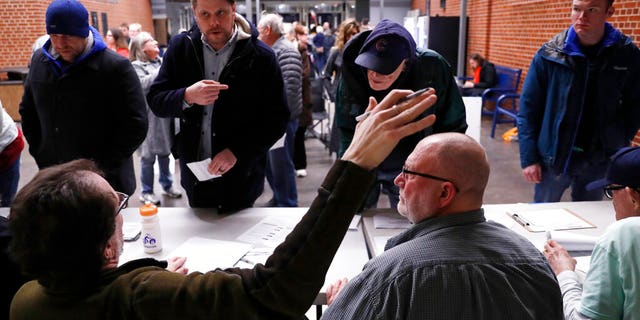
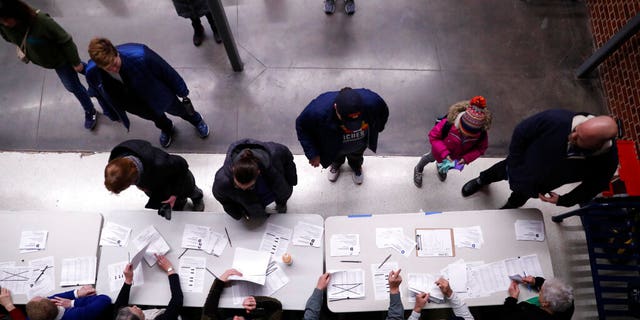
Caucus goers check in at a caucus at Roosevelt High School, Monday, Feb. 3, 2020, in Des Moines, Iowa. (AP Photo/Andrew Harnik)

An adviser to Biden told Fox News he was watching the caucus coverage with his family in Des Moines, and that the entry polls they’ve seen lined up with what the campaign was expecting -- although it wasn't clear what polls the adviser was referring to.
"Joe's had Iowa to himself," Donald Trump, Jr., told Bloomberg News Monday night, alluding to Biden's ability to campaign in the state while Warren and Klobuchar stayed in Washington, D.C. for Senate impeachment proceedings. "If he doesn't win big tonight, I think that's very indicative of his campaign."
In an unexpected move, almost all of the caucus-goers for the nonviable candidates at the Drake University precinct in Des Moines teamed up for Cory Booker, who has already dropped out of the presidential race. The caucus-goers told Fox News tactic was designed to keep delegates always from the viable candidates.
There were 402 caucus-goers after the first alignment, and three reached viability: Warren with 120, Buttigieg with 101, and Sanders with 100. The nonviable were Andrew Yang with 33, Biden with 17, Klobuchar with 24, and Tom Steyer with 1.
The precinct leaders for the nonviable candidates told Fox News the strategy was purely decided among the caucus-goers at the Drake University precinct and did not represent a statewide strategy dictated by the campaigns.

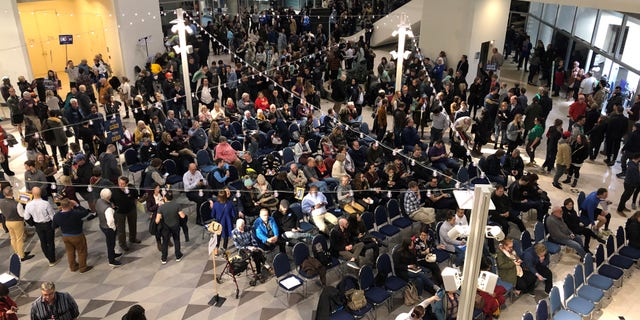
Precinct 55 in downtown Des Moines. 1,080 people showed up -- far more than expected. (Paul Steinhauser, Fox News)

Ultimately, ‪Warren and Buttigieg each received 2 delegates from the Drake precinct, and Sanders and Booker each received 1.
A member of the Buttigieg campaign, meanwhile, told Fox News, "We’re reaching into every demographic and across cities, suburbs, and rural areas, and communities, including [Barack] Obama counties that flipped to [Donald] Trump in 2016. That’s a good sign for accumulating delegates, but also makes the case that Pete’s uniquely positioned to take on Donald Trump."
The Buttigieg advisor added: "The best data point [in the entry polls] is that Pete’s leading with new caucus-goers."
Late in the evening, at 10:45 p.m. ET, the Buttigieg team told Fox News the IDP wasn't in touch concerning the delay in posting the results.

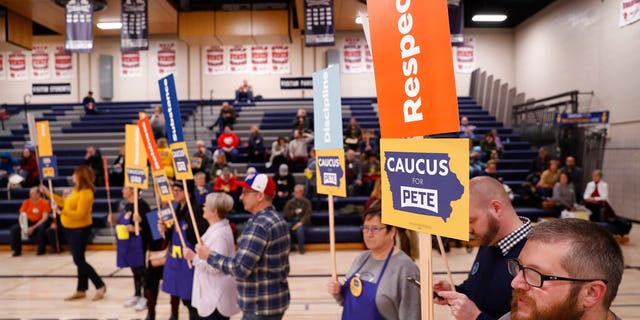
Supporters of Democratic presidential candidate former South Bend, Ind., Mayor Pete Buttigieg stand at a caucus site at Roosevelt Hight School, Monday, Feb. 3, 2020, in Des Moines, Iowa. (AP Photo/Andrew Harnik)

A senior Klobuchar official separately told Fox News the campaign was very happy with early indicators, and that she was showing “more strength than we were expecting in some areas."
The Klobuchar team also said the IDP hasn't kept them in the loop concerning the delayed vote results.

Votes from Scotland

The action was taking place at 1,679 precincts across the state – held in school gymnasiums, church basements, union halls, community centers, libraries and other locations.
This year, there was another new twist: Iowa Democrats who couldn't make it to their local caucus site were able to take part at one of the additional 987 additional satellite caucuses across the state, the country and the globe.
These new satellite caucuses took place at factories, firehouses, group homes or community gathering places. The new option should help shift workers, Iowans with disabilities and those serving overseas take part.

Caucus goers check in at a caucus at Roosevelt High School, Monday, Feb. 3, 2020, in Des Moines, Iowa. (AP Photo/Andrew Harnik)

Only registered Democrats were allowed to take part in the Democratic caucuses.
Dr. Jane Sanders, the wife of Bernie Sanders, told Fox News Monday evening that although Hillary Clinton narrowly bested her husband in the 2016 Iowa caucuses, this year would be different.
"In 2016, he was just getting to be known by the people of Iowa," she said. "They didn't know him. Now they've watched him over the last four years, never back down on the issues that he talked about, that he continued to work on. And I think they know that he is there for the right reasons to improve their quality of life, to have more fairness and equity and justice in our country, both racial, social, economic, environmental justice."
Some of the earliest results of the Iowa caucuses trickled in from thousands of miles away earlier in the day.
In Glasgow, Scotland, Sanders won the most support in a small, satellite caucus for Iowans living abroad.
Sanders received support from nine of the 19 caucus-goers who attended. Warren ended up with six supporters, and Buttigieg had three. (The last attendee didn't support a candidate.)
The other candidates were not viable. Biden received no votes. The results can hardly be considered meaningful -- some 200,000 people are expected to caucus Monday night.

Democratic presidential candidate former Vice President Joe Biden speaks at a campaign stop at Hiatt Middle School, Sunday, Feb. 2, 2020, in Des Moines, Iowa. (AP Photo/Andrew Harnik)

This is the first time Iowa Democrats have held caucuses outside Iowa. The remote sites are intended to make the caucuses more inclusive to Iowans living out of state or abroad.
Meanwhile, Democratic presidential candidate Michael Bloomberg said Monday he has no regrets on skipping the Iowa caucuses.
The billionaire former New York City mayor was campaigning in California as his rivals for the Democratic nomination prepared for the first-in-the-nation Iowa caucuses.

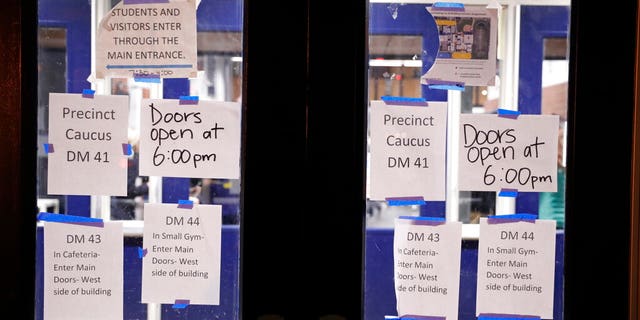
Directional signs are posted on doors at a caucus at Roosevelt Hight School, Monday, Feb. 3, 2020, in Des Moines, Iowa. (AP Photo/Andrew Harnik)

Bloomberg suggested that his rivals were falling behind in the race. He noted in Compton that he has made stops in 24 states and 60 cities while the other candidates have been hunkered down in Iowa.
He'd like to think he's a few steps ahead. “I hope so,” Bloomberg said.
Fox News' Paul Steinhauser, Ellison Barber, Nicholas Kalman, Andres del Aguila, Bill Hemmer, Jacqui Heinrich and Peter Doocy in Des Moines, Iowa, contributed to this report, as well as The Associated Press.

CartoonDems