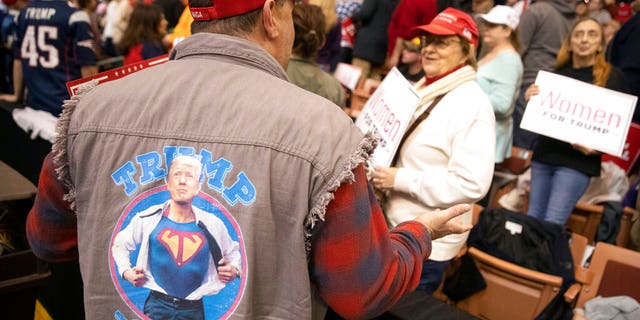
President Donald Trump speaks during a campaign rally Monday, Feb. 10, 2020, in Manchester, N.H. (AP Photo/Evan Vucci)
WASHINGTON
(AP) — After the Parkland school shooting in Florida two years ago,
President Donald Trump chided Republican lawmakers for being too
“scared” of the National Rifle Association to tighten gun laws — then
backed away from the idea.
After
back-to-back mass shootings in Ohio and Texas in 2019, Trump embraced
calls for “strong background checks” — only to backpedal once again.
Now,
as he primes the pump on his 2020 reelection effort, Trump is going
all-in on embracing the mantle of gun rights champion, a stark turn from
earlier moments in his presidency when he toyed with the idea of
pushing Congress to enact stricter gun laws.
There
was no public discussion of tighter gun laws when Trump welcomed
Parkland families to the White House for a private meeting on Monday,
four days before the two-year anniversary of the rampage that left 17
dead. Instead, administration officials unveiled a website intended to
help educators, parents and law enforcement address threats to school
safety.
In
recent weeks, Trump has repeatedly warned supporters at his rallies that
Democrats “will take your guns away.” Last month, he labeled Virginia
Gov. Ralph Northam a “whack job” as gun rights advocates protested the
Democratic governor’s moves to tighten gun laws in the aftermath of a
mass shooting in Virginia Beach.
Drawing
a straight line from gun rights to presidential politics, Trump tweeted
that Democrats in the state “will take your guns away. Republicans will
win Virginia in 2020. Thank you Dems!”
And
on Monday night, as he came to the apex of an hourlong campaign speech
in New Hampshire, Trump framed his supporters’ Second Amendment right to
bear arms as being as precious as the rights to privacy, free speech
and religious freedom.
Campaign
officials believe the effort could help put states like Minnesota, New
Mexico and New Hampshire in play. For that to happen, Trump will need to
draw even more rural and white men to the polls -- key groups that
helped drive the president’s 2016 surprise victory.
Trump’s
advisers believe his consistent efforts to spotlight his credentials as
a Second Amendment warrior can help him draw a contrast with the
eventual Democratic presidential nominee. The top tier of Democratic
candidates have made bolstering gun restrictions a key part of their
platforms.
Mike
Bloomberg, the former New York City mayor, has poured millions from his
own fortune into supporting a series of gun control advocacy groups.
Former Vice President Joe Biden served as the Obama administration’s
point man on the president’s failed push for sweeping gun reform laws
following the Sandy Hook school shooting in Connecticut. Vermont Sen.
Bernie Sanders, who got a D- grade from the NRA, has been knocked by
fellow Democrats for not being tough enough on gun restrictions.
“Democrats
have shown they don’t respect the Second Amendment, which will be one
of many contrasts drawn during the campaign,” Trump campaign spokesman
Tim Murtaugh said.
After
spending more than $50 million in support of Trump’s 2016 election
victory, the NRA is likely to have less impact on this election cycle,
said Robert Spitzer, a professor of political science at the State
University of New York-Cortland whose research focuses on American gun
laws.
The
powerful gun rights group has been mired in financial difficulties,
internal strife within the organization’s leadership, and probes by the
New York attorney general’s office that threaten the group’s tax-exempt
status.
Trump’s
joint campaign committees and the Republican national party committee
had $195 million in cash on hand at the close of 2019, making the NRA’s
money less significant this election cycle.
But
with a hard gun-rights pitch, Trump appears to be strategizing that he
could persuade some voters who have become disenchanted with politics to
come back to the ballot box to vote for him.
“He
really is doubling down not on the broadening of his base but for
pushing for higher turnout among his people,” Spitzer said. “One of the
keys in 2016, but not the only one, was that turnout among rural white
voters was a little higher than predicted. This pitch, he figures, will
help him get there.”
Trump
and fellow Republicans are likely to face a deluge of spending from gun
control advocates, who think their message will resonate with
on-the-fence suburban voters.
Everytown
for Gun Safety, an umbrella group of gun control advocacy organizations
funded by Bloomberg, recently announced that it would spend $60 million
to beat gun rights proponents on the state and federal level in 2020.
The
group has not said how much it much it would spend on the presidential
race, but thus far has budgeted $1.25 million to help reelect North
Carolina Gov. Roy Cooper and Pennsylvania Attorney General Josh Shapiro,
both Democrats. It also plans to spend some of that first tranche of
money toward beating two Republican senators, Cory Gardner of Colorado
and Martha McSally of Arizona.
Gun
control advocates feel emboldened after the 2018 midterm elections in
which more than 30 NRA-backed Republican candidates lost their races.
“His
tactic has been to say incendiary things about guns to whip up the
base, but he and the NRA haven’t been able to pass any of the gun
lobby’s priority legislation — even with a Republican Congress for two
years,” said Shannon Watts, founder of Mom’s Demand Action, part of the
Everytown for Gun Safety coalition.
When
Trump met with members of the group Stand with Parkland on Monday,
administration officials highlighted the school safety website. Stand
with Parkland backed the creation of the website — but it also has urged
Congress to require universal background checks on gun purchases.
Asked
if there was disappointment in the president backing away from taking
on background checks, one Parkland parent who met with Trump, Max
Schachter, said the president’s efforts should not be minimized.
“Of
course there is always more that can be done,” said Schachter, whose
14-year-old son, Alex, was among the victims at Parkland. “But let’s not
let perfection be the enemy of good.”
On
the campaign trail, Trump’s dire warnings about what might happen to
American gun owners if a Democrat wins the White House have become a
regular line in his speeches, reliably drawing boos and hisses for his
to-be-determined opponent.
At
a recent campaign rally in Iowa, Trump again turned his attention back
to Virginia, where Democrats in November claimed majorities in both
houses of the legislature and secured the first unified Democratic
government in the commonwealth in 26 years.
“In
the state of Virginia they want to take your guns away, can you believe
it?” Trump said. “I love Virginia. Of all states, they want to take
your guns away. The Democrats. Not going to happen.”
He
offered similar dark predictions to a friendly crowd last month in New
Jersey, saying the gun control effort in Virginia was “just the
beginning.”
And
on Monday night, he reassured New Hampshire supporters that his
administration is “going to protect your Second Amendment, by the way.”
DOVER AIR FORCE BASE, Del. — President Donald Trump traveled
Monday to Dover Air Force Base in Delaware to pay respects to two U.S.
soldiers killed Saturday in Afghanistan when a soldier dressed in an
Afghan army uniform opened fire with a machine gun. National security adviser Robert O’Brien told reporters traveling with Trump on Air Force One that the president wrapped up a reelection campaign
rally in New Hampshire a bit early so he could visit with the families
of the soldiers. He described such moments as “probably the toughest
thing he does as president,” along with visiting wounded soldiers at
Walter Reed National Military Medical Center.
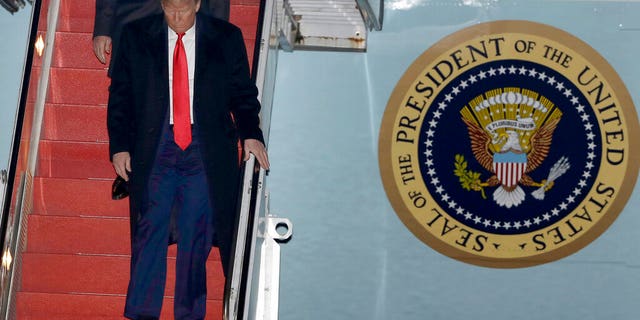
President Donald Trump walks down the stairs of Air Force One upon
his arrival at Manchester-Boston Regional Airport, Monday, Feb. 10,
2020, in Manchester, N.H., for a campaign rally. (AP Photo/Steven Senne)
“These are terrible sacrifices for the families. And
these guys are heroes, they’re real warriors and did a great job for the
American people,” O’Brien said. “These are tough times. It’s tough for
the president but he thinks it’s important to be there for the families
and recognize them.” The Defense Department has identified the dead American soldiers
as Sgt. Javier Jaguar Gutierrez, 28; and Sgt. Antonio Rey Rodriguez,
28. Six other American soldiers were wounded in the attack. Gutierrez
was born in Jacksonville, N.C. He had also served in Iraq. Rodriguez
was born in Las Cruces, New Mexico. He deployed eight times in support
of Operation Freedom’s Sentinel, which began in 2015. Both men were
posthumously promoted to Sgt. 1st Class and awarded the Bronze Star
Medal and Purple Heart. Six U.S. service members have been killed
in Afghanistan since the start of 2020, including Saturday’s casualties.
Last year, 20 U.S. service personnel died in combat there and there
were two non-combat deaths. The incident came as Washington has sought to find an end to the war in Afghanistan.
President Trump said he was looking to get under Democrats' skin Monday with a rally in New Hampshire on the eve of the state's first-in-the-nation primaries, and he wasted little time -- quickly reliving his dramatic State of the Union speech with a thinly veiled shot at House Speaker Nancy Pelosi, D-Calif. "I had somebody behind me who was mumbling terribly," Trump mused, as chants of "Lock her up!" broke out. "Very
distracting. Very distracting," Trump continued. "I'm speaking, and a
woman is mumbling terribly behind me. There was a little anger back
there. We're the ones who should be angry, not them." Trump sped through his remarks to attendees unusually quickly, so that he could head to Dover Air Force base in Delaware late Monday night to participate in the dignified transfer of the remains of two soldiers killed recently in Afghanistan. Before
he departed the rally, the president made sure to thank Pelosi for
giving Republicans the highest poll numbers they've "ever" had -- or at
least since 2005, according to a recent Gallup survey. Pelosi, who ripped up
Trump's State of the Union address as soon as it concluded, was widely
criticized especially after videos emerged showing she had visibly torn some of the pages in advance. "Nine
months from now, we are going to retake the House of Representatives,
we are going to hold the Senate, and we are going to keep the White
House," Trump said to thunderous applause. "We have so much more
enthusiasm, it's not even close. They're all fighting each other. ...
They don't know what they're doing; they can't even count their votes." Perhaps worst of all, Trump said, liberals and the "fake news" media simply "can't take a joke." Later,
he again jabbed the Democrats over the Iowa caucus debacle and the
party's treatment of Sen. Bernie Sanders, I-Vt.: "The Democratic Party
wants to run your health care, but they can't even run a caucus in Iowa.
... Actually, I think they're trying to take it away from Bernie again.
They're doing it to you again, Bernie! They're doing it to you again."
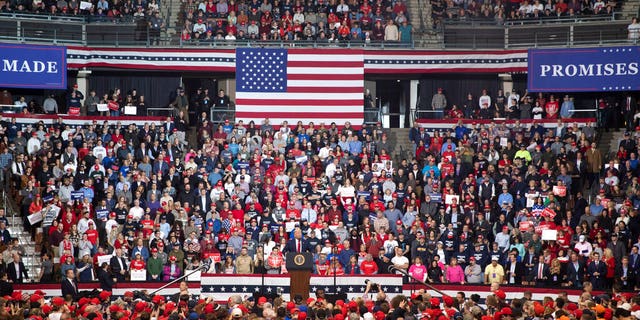
President Trump speaking at his campaign rally Monday in Manchester, N.H. (AP Photo/Mary Altaffer)
Huge crowds gathered in the overflow viewing area
outside the packed Southern New Hampshire University (SNHU) arena in
Manchester, which can hold approximately 11,000. Earlier in the
day, Trump retweeted a post from ABC News Chief White House
Correspondent Jonathan Karl: "Cold rain, snow and lots of Trump
supporters. Despite the miserable weather, there are already more people
lining up outside the venue of @realDonaldTrump‘s rally tonight than you see at most of the events for the Democratic candidates. Some have been out here all night." At
the rally, Trump remarked to applause, "We have more in this arena and
outside this arena than all of the other candidates, meaning
the Democrats, put together and multiplied by five. ... We have never
had an empty seat from the day your future First Lady and I came down
the escalator." Turning to illegal immigration and "insane" sanctuary cities -- just minutes after Attorney General Bill Barr announced sweeping new sanctions against sanctuary cities -- the president boasted that his administration had built over 100 miles of wall on the southern border. "You
have to see -- you wouldn't believe it, when that wall goes up, the
numbers change like magic," Trump said. "Two things never change: a
wheel and a wall." The president then delivered a dramatic reading
of a 1968 Al Wilson song that he used as an allegory to illegal
immigration, in which a "tender woman" let a snake inside her home, only
to suffer a "vicious bite." "'Now I'm going to die,'" the woman
complained. "'Shut up, silly woman,' said the reptile with a grin; 'You
knew damn well I was a snake before you took me in.'" Attendees both
inside and outside the SNHU arena erupted in cheers.
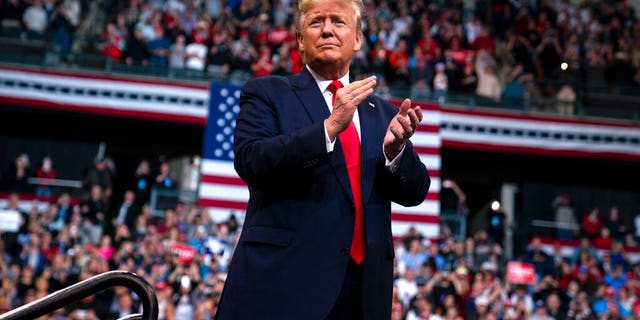
President Donald Trump arrives at SNHU Arena to speak at a
campaign rally, Monday, Feb. 10, 2020, in Manchester, N.H. (AP
Photo/Evan Vucci)
The Mexican government has played a key role in keeping illegal border crossings down, the president added, noting that he had pressured the country to
do so under the threat of tariffs last year. Washington Democrats, by
contrast, "want to let anyone into our country" and "give them free health care" and "free education," Trump said. That was a reference to a recent presidential debate, when all candidates on stage seemingly endorsed the idea of paying for illegal immigrants' health expenses. Additionally, Trump again honored House Republican Whip Steve Scalise, R-La., saying he looked "better now than when he got shot" in
2017 by a radical Sanders supporter while playing softball. Capitol
Police officers took down the attacker as Scalise tried to crawl away,
in a dramatic moment that Trump recounted last week at the White House.
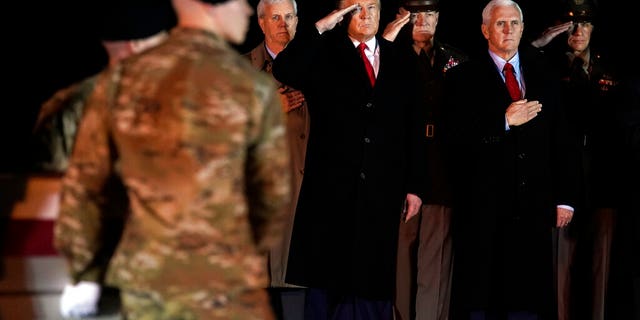
President Donald Trump and Vice President Mike Pence watch as a
U.S. Army carry team moves a transfer case containing the remains of
Sgt. 1st Class Javier Gutierrez, of San Antonio, Texas, Monday, Feb. 10,
2020, at Dover Air Force Base, Del. According to the Department of
Defense both Gutierrez and Sgt. 1st Class Antonio Rodriguez, of Las
Cruces, N.M., died Saturday, Feb. 8, during combat operations in
Afghanistan. (AP Photo/Evan Vucci)
The president, as he did during the State of the
Union, further touted the historically low unemployment numbers for the
country and minority groups specifically, as the crowd screamed, "USA!"
Democrats' sweeping and expensive policies and regulations, Trump
argued, would crush the stock market and reverse the ongoing economic
boom.
"The Democratic Party wants to run your health care, but they can't even run a caucus in Iowa." — President Trump
"To
support working families, we have reduced the cost of child care,
expanded paid leave, and given 40 million American families an average
of $2,200 more in their pockets thanks to the Republican child tax
credit," Trump asserted. "We are the party of equal opportunity for all
Americans." He added, "While the extreme left has been wasting
America's time with this vile hoax, we've been killing terrorists,
creating jobs, raising wages, enacting fair trade deals, securing our
borders, and lifting up citizens of every race, color, religion, and
creed!"
Supporters waiting for the start of President Trump's rally Monday in Manchester, N.H. (AP Photo/Mary Altaffer)
In an apparent flub as he attempted to appeal to the
hometown crowd, Trump then seemingly confused the pivotal Revoluntary
War site of Concord, Mass., with the less notable Concord, N.H. "I
love Concord. ... That's the same Concord we read about all the time,
right?" Trump asked. In fact, the Battles of Lexington and Concord
occurred in Massachusetts. The rally was part of a
tried-and-tested tactic for Trump: scheduling counter-programming to
divert attention from the Democrats' debates and other major moments,
keeping him in the spotlight and building supporters' enthusiasm in the
months before Election Day. Though it may not be the same show of
force as last week, when dozens of Trump's surrogates, including
officials from across all levels of government, flooded the state of
Iowa, the Trump campaign made its presence known in New Hampshire before
the state's primaries. Vice
President Mike Pence and Ivanka Trump, the president's daughter and
senior adviser, got to the state ahead of the president to do some
campaigning. Also being deployed by the president's re-election
campaign: Scalise, Republican Sens. Lindsey Graham and Rand Paul, New
Hampshire Gov. Chris Sununu and Trump's former campaign manager, New
Hampshire resident Corey Lewandowski. Still, the marquee event has
been Trump's rally, and supporters started lining up for it Sunday.
Images of bundled-up supporters camped outside the SNHU Arena in
Manchester broke through the news coverage of the Democrats' primary.
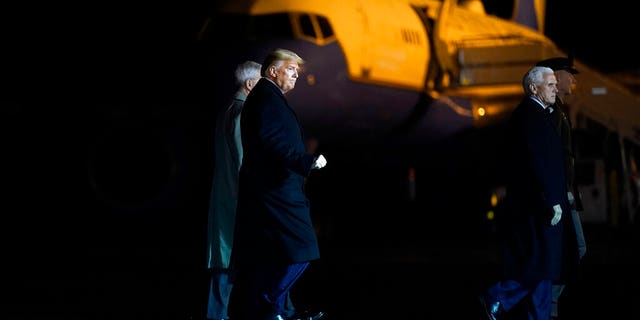
President Donald Trump and Vice President Mike Pence depart after
watching a casualty return for Sgt. 1st Class Javier Gutierrez, of San
Antonio, Texas and Sgt. 1st Class Antonio Rodriguez, of Las Cruces,
N.M., Monday, Feb. 10, 2020, at Dover Air Force Base, Del. According to
the Department of Defense both died Saturday, Feb. 8, during combat
operations in Afghanistan. (AP Photo/Evan Vucci)
New Hampshire has always loomed large in Trump's
political lore as the first nominating contest he won during 2016's
heated Republican primaries. He was about to take the stage at a
rally in Manchester that October when news broke that the FBI was
re-opening its investigation into Hillary Clinton's emails, breathing
new life into his then-struggling campaign. And, it was the site
of the penultimate rally of the 2016 contest — an extravagant send-off
just hours before a post-midnight rally in Michigan. Though Trump
narrowly lost New Hampshire in the general election four years ago, his
team has said it's one of the few states that could flip to red in
November. Democrats in the state had a different view. "It's
obvious that Trump and the RNC are desperate to put New Hampshire in
play after losing the state by 3,000 votes in 2016. But, we'll make sure
that Granite Staters know that he has broken his promises to his state
and he will lose here again in November," New Hampshire Democratic Party
Chairman Ray Buckley told reporters. The
president relished the idea of dominating the stage in New Hampshire
and stealing some of the media oxygen from the Democrats. Advisers
reportedly hoped that Secret Service moves in downtown Manchester to
secure the area for the president's arrival would make it harder for
Democrats and their supporters to transverse the state’s largest city in
the hours before the primary's first votes are cast. Fox News' Andrew O'Reilly and The Associated Press contributed to this report
MANCHESTER, NH – New Hampshire’s
presidential primary kicked off at midnight – as voters in three tiny
townships in the state’s North Country and White Mountains cast the
first ballots in the first primary in the White House race. Dixville
Notch – which has held the midnight voting tradition for 60 years – as
well as nearby Millsfield and Hart’s Location – grab the national
spotlight every four years as they report the first results in New
Hampshire. On the final day before the before primary, Sen. Bernie Sanders
emphasized to supporters that “what happens here in New Hampshire is
enormously important...the whole country is not only looking at New
Hampshire - in fact the whole world is looking at New Hampshire.” The populist senator from Vermont who’s
making his second straight White House run is in the driver’s seat – is
sitting atop the final public opinion polls, drawing large and
energetic crowds in the closing days, and sporting arguably the largest
grassroots get-out-the-vote operation in the Granite State. After getting out of Iowa’s caucuses with essentially a tie with 2020 nomination rival Pete Buttigieg, expectations are high for Sanders in a state where he shares home-field advantage with fellow progressive standard-bearer Sen. Elizabeth Warren of Massachusetts. As
he did in Iowa, Sanders is stressing to his supporters that “if we have
the highest voter turnout in New Hampshire primary history, I am
confident that we are going to win here in New Hampshire and if we win
here in New Hampshire, we're going to set the pace to win Nevada and
South Carolina and California.” But meeting expectations in a state where he crushed eventual nominee Hillary Clinton four years ago is crucial for Sanders. Sanders
closed out his bid in the first primary state with a massive rally and
concert that drew over 7,500 to the University of New Hampshire at
Durham - which was by far the largest crowd for any Democratic
presidential candidate in New Hampshire this cycle. He was joined by Rep. Alexandria Ocasio-Cortez and a bunch of other high profile surrogates. “New
Hampshire remains Bernie’s to lose. He dominated in 2016 and his
coalition seems confident again. That said, if he doesn’t win, it’s a
huge hit to the Sanders path,” emphasized longtime Democratic strategist
Sean Downey, a national adviser on Sen. Cory Booker of New Jersey’s now
defunct 2020 presidential bid and a veteran of numerous political
campaigns in New Hampshire.’ Sanders
declared victory in Iowa – where the results dribbled in for days after
a reporting debacle on caucus night – by pointing to his lead in the
raw vote totals coming out of the caucus precinct sites. Buttigieg -the former South Bend, Indiana mayor
- also claimed victory, spotlighting his narrow edge in the percentage
of state delegates won. And for Buttigieg – like Sanders – a strong
finish in New Hampshire is vital for his hopes of capturing the
nomination. Buttigieg was also stressing the importance of the
primary, telling supporters the eve of the primary that Tuesday will be a
“historic night that will set the course for the party and the rest of
the world. We are lucky and unlucky enough to be in a point of history
where it will be recorded what we did.” The 38-year old candidate –
the youngest in the field – told supporters on the primary eve that
Tuesday will be a "historic night that will set the course for the party
and the rest of the world." Buttigieg closed in on Sanders in the
polls in the days after the Iowa caucuses. But one of the two tracking
polls suggested that the candidate saw his numbers drop over the
weekend. That wasn’t reflected on the campaign trail, as Buttigieg drew
more than 5,000 people to his events on Sunday. Buttigieg has
struggled to resonate with African American and Latino voters. And with
the White House race moving next to Nevada and South Carolina – which
have much more diverse electorates – a strong finish in New Hampshire is
paramount for Buttigieg. Pointing to the calendar ahead, Downey
emphasized that “Mayor Pete’s situation here is urgent given his real
lack of traction in the south and out west.” Illustrating
the tension between the top two contenders, Buttigieg once again took
aim at Sanders on Monday, saying that “at a moment when our country is
so divided we can't risk further polarizing the American people. That's
why I'm very concerned about the suggestion that either you got to be
for revolution, or you must be for the status quo, because that vision
of politics as all or nothing is a vision that most of us can't see
where we fit in.” Sanders – who’s funding his massive campaign war chest through small dollar grassroots donation – took jabs at Buttigieg and former Vice President Joe Biden – saying they “have dozens and dozens of billionaires contributing to their campaigns.” The
former vice president’s message on Monday night to his supporters:
“stick with me 24 hours and we’re going to be just fine. We’re going to
win this nomination.” Biden’s said he’s not “writing off” New Hampshire– but it sure looks like he’s lowering expectations. “I
took a hit in Iowa and I’m probably going to take a hit here,” Biden
said in a striking moment at the top of Friday night’s prime-time
Democratic presidential nomination debate. Asked the next day by
Fox News if he was writing off the Granite State, the former vice
president fired back, saying, “I’m not writing off New Hampshire. I’m
going to campaign like hell here in New Hampshire, as I’m going to do in
Nevada, in South Carolina and beyond. Look, this is just getting going
here. This is a marathon.” For Biden, however, at least a
third-place finish here could be critical, if only to prevent an exodus
of donors and the possible erosion of his so-called "firewall" of
support in the looming South Carolina contest. With the race for first
increasingly looking to be between Sanders and Buttigieg, Biden’s
essentially battling with Warren and Sen. Amy Klobuchar of Minnesota for
a top-three ticket out of the Granite State. It's a stunning
predicament for the candidate who was once the unrivaled front-runner
for the nomination. He's long made electability central to his campaign
pitch. But University of New Hampshire pollster Andrew Smith highlighted
that the final UNH tracking poll for CNN – conducted after Biden’s
lackluster fourth-place finish in the Iowa caucuses, indicate that
“Bernie Sanders is seen as the most electable candidate” to take on
Republican President Donald Trump in November’s general election. “If
your candidacy is based on electability, once you don’t win elections,
that electability argument dissipates very rapidly,” Smith explained,
“If Biden does very poorly in New Hampshire, going forward those voters
in Nevada and South Carolina are going to look at that electability
argument in a very different light because to be electable, you need to
win elections.” Warren – once a co-frontrunner in the nomination
race - is also under the spotlight. She faced a deluge of questions the
past couple of days from reporters asking how crucial a strong finish in
New Hampshire is to her White House bid “I didn't start by doing
polls a year ago, and I still don't do polls,” responded the
senator, who famously avoids all talk of her position in the polls. Warren
– who’s repeatedly avoided saying New Hampshire’s a “must-win” state,
has emphasized that “the way I see this is it’s going to be a long
campaign…we’ve built a campaign to go the distance.” Talking to
reporters on her campaign’s press bus on Monday, the candidate told
reporters “I've been counted down and out for much of my life.” But
she emphasized that “you get knocked down, you get back up. And you
keep fighting because it's not about me, it's about the people who are
counting on me.” Downey noted that “with a full field, the
difference between third and fourth could be a few points and I’d look
to strong organizing game and surrogate operations from Warren and Biden
to make things interesting.” But thanks to a last-minute surge, add Klobuchar to the mix in the fight for third place. Klobuchar
touted on Monday that “as you probably heard we’re on a bit of a surge.
I woke up this morning to find out that we are third in two polls.” One
of the two final surveys – a Suffolk University tracking poll for the
Boston Globe and WBZ – suggested that Klobuchar soared nine percentage
points over the past two days. But the big question is whether Klobuchar can capitalize on her late tide of momentum. Smith
cautioned that “I don’t think though that Klobuchar’s going to have the
organization necessary to take advantage of her debate performance and
her performance in Iowa and get those people out to vote. She doesn’t
have anywhere near the on-the-ground organization as the other top
candidates.” Adding to the uncertainty ahead of the primary
results – the fact that Granite Staters are traditionally late deciders.
The final polls illustrate the point – showing that nearly half of
those who are currently backing a candidate suggested that they could
change their minds before they vote. Smith gauged that “I would see, easily 15-20% of New Hampshire Democrats making up their mind on primary day.” And Downey said “I can’t stress this enough. New Hampshire likes underdogs and will decide late. This race isn’t over.” Fox News' Kelly Phares, Tara Prindiville, Andrew Craft, Andres del Aguilla, and Madeleine Rivera contributed to this report
BEIJING
(AP) — China reported a rise in new virus cases Monday, possibly
denting optimism that disease control measures including isolating major
cities might be working, while Japan reported dozens of new cases
aboard a quarantined cruise ship.
The
mainland death toll rose by 97 to 908 in the 24 hours through midnight
Sunday and 3,062 new cases were reported. That was up 15% from Saturday
and broke a string of daily declines. A government spokesman had said
Sunday those declines showed containment measures were successful.
The
operator of a cruise ship quarantined in Yokohama, near Tokyo, said an
additional 66 cases were found aboard. That is in addition to 70
reported earlier.
Health
Minister Katsunobu Kato said the Japanese government was considering
testing all 3,711 passengers and crew on the Diamond Princess, which
would require them to remain aboard until results are available. Health
authorities are scrambling to deliver medicine requested by more than
600 passengers.
“We are doing the utmost to keep everyone in good health,” Kato said.
The
fatality toll from the new virus has passed the 774 people believed to
have died in the 2002-03 epidemic of severe acute respiratory syndrome,
another viral outbreak that originated in China. The total of 40,171
cases on the mainland of the new virus vastly exceeds the 8,098 sickened
by SARS.
More than 360 cases have been confirmed outside mainland China, including two deaths in Hong Kong and the Philippines.
China
has built two hospitals and sent thousands of extra doctors, nurses and
other health care workers to Wuhan, the city of 11 million people in
central China that is the epicenter of the outbreak. Most access to
Wuhan was suspended Jan. 23. Restrictions have spread to cities with a
total of 60 million people.
Businesses
are gradually reopening following the Lunar New Year holiday, which was
extended to discourage travel in an attempt to contain the virus, but
they face heavy losses.
At
the Sanyuanli market in Beijing, the Chinese capital, shoppers in face
masks mixed with delivery drivers who were collecting orders of meat,
fruit and vegetables. Stalls were stocked with pork, mutton, seafood and
vegetables.
“The
number of customers here is down a lot, maybe by more than half,” said
Liu Ying, who sells walnuts, cashews and other specialties. “But you can
see a lot of people calling in orders, so we’re slowly getting busy
again.”
Asian
stock markets slid Monday following warnings that investor optimism the
disease and its economic impact were being brought under control might
be premature.
China’s
central bank announced a 300 billion yuan ($43 billion) fund to make
low-interest loans to producers of medicine and medical supplies or
other companies involved in fighting the virus.
Over
the weekend, the government promised tax cuts and subsidies to farmers,
supermarkets, producers of medical supplies and companies that
contribute to anti-disease work.
China’s
leaders are trying to keep food flowing to crowded cities despite the
anti-disease controls and to quell fears of possible shortages and price
spikes following panic buying after most access to Wuhan and nearby
cities was cut off.
Consumer
inflation spiked to an eight-year high of 5.4% over a year earlier in
January, driven by a 4.4% rise in food costs, the government reported
Monday. Food prices rose 1.4% from the previous month.
“It
appears that supply disruptions and hoarding due to the coronavirus
outbreak helped to keep food prices elevated during the week after
Chinese New Year, when they would normally drop back,” Julian
Evans-Pritchard of Capital Economics said in a report.
Organizers
of the Hong Kong Arts Festival on Monday canceled all of its more than
120 planned music, dance and drama performances, including two concerts
by the Boston Symphony Orchestra. The festival was due to start this
week and run through mid-March.
Meanwhile,
the mother of a physician who died last week in Wuhan said in a video
released Sunday she wants an explanation from authorities who
reprimanded him for warning about the virus in December.
The
death of Li Wenliang, 34, prompted an outpouring of public anger. Some
postings left on his microblog account said officials should face
consequences for mistreating Li.
“We
won’t give up if they don’t give us an explanation,” Lu Shuyun said in
the video distributed by Pear Video, an online broadcast platform.
The video shows flowers in her home with a note that says, “Hero is immortal. Thank you.”
___
Associated Press Writers Mari Yamaguchi in Tokyo and Eileen Ng in Kuala Lumpur, Malaysia, contributed.
The White House on
Sunday unveiled a $4.8 trillion budget proposal that would slash
spending dramatically on foreign aid and social safety nets, while
including $2 billion for a southern border wall and substantially
boosting funding to NASA, the Department of Veterans Affairs and the Department of Homeland Security. Fox News has confirmed the details of the budget, which The Wall Street Journal first reported.
The package, set to be formally announced on Monday, as-is stood little
chance of passage in the House of Representatives, which the Democrats
have controlled. Still, it served as a signal of the president's
priorities as Republicans have aimed to retake the chamber in the 2020
elections. The plan aims to eliminate the federal deficit -- or the difference between spending and revenue that is slated to exceed $1 trillion
this year -- by 2035. In all, the White House is seeking to cut $4.4
trillion in federal spending over the next 10 years, including
reductions in spending on food stamps and federal disability benefits
through more stringent work and eligibility requirements. Total
cuts to "non-defense discretionary programs,” which do not include
Medicare or Social Security, amount to $2 trillion in savings under the
plan. The budget additionally calls for renewing the Trump
administration's tax cuts for individuals and families that would
otherwise expire in 2025. Modifications in Medicare prescription-drug
pricing would account for $130 billion in savings. "Working together, the Congress can reduce drug prices substantially from current levels," Trump said during last week's State of the Union address. "I
have been speaking to Senator Chuck Grassley of Iowa and others in the
Congress in order to get something on drug pricing done, and done
properly. I am calling for bipartisan legislation that achieves the goal
of dramatically lowering prescription drug prices. Get a bill to my
desk, and I will sign it into law without delay." House Speaker
Nancy Pelosi, D-Calif., bashed the plan Sunday night. "The budget is a
statement of values and once again the president is showing just how
little he values the good health, financial security and well-being of
hard-working American families." Foreign aid would be reduced by
21 percent, in keeping with the president's push to have other countries
pay what he calls their "fair share" for their own defense.
Trump's temporary suspension of aid to Ukraine helped trigger
impeachment proceedings; one of Republicans' defenses was that the
president has long sought to suspend or reduce U.S. financial commitments overseas -- especially to notoriously corrupt countries. The Environmental Protection Agency (EPA) would face a massive 26-percent reduction in funding. The Trump administration has rolled back Obama-era EPA regulations and oversight, saying they have hurt the economy for little benefit. The
proposal also would cut the Department of Housing and Urban
Development's budget by 15 percent, while incorporating $2.8 billion for
grants to help combat homelessness. And, The Centers for Disease
Control and Prevention would see a 9 percent cut, although its $4.3
billion allocation for fighting infectious disease would remain amid
the coronavirus spread. Homeland Security's budget would grow by 3
percent; the National Nuclear Security Administration's by 19 percent;
and the Department of Veterans Affairs' by 13 percent. The
Fiscal Year 2021 budget further aims to increase military spending 0.3
percent to $740.5 billion. It doubles spending on
artificial intelligence from $973 million to nearly $2 billion by 2020,
including a focus on quantum computing. Fox News reported this
weekend on the budget's 12-percent hike in NASA funding, with the goal
of returning astronauts to the moon. No one has been to the moon since
1972 under NASA's now-shuttered Apollo program. Since taking
office, Trump has made space exploration one of its top priorities, and
his administration has set a target of 2024 for the next lunar landing. NASA's new space program named Artemis,
for the Greek goddess of the moon and sister to Apollo, has aimed to
put the first woman on the moon. Long-term, NASA has wanted to establish
a sustainable human presence on the moon with the goal of sending
humans to Mars in the 2030s. Trump’s budget specifically would
increase NASA spending from about $22.6 billion to $25.2 billion
in fiscal 2021, one of the biggest spending increases requested since
the 1990s. $3 billion will go toward new funding to develop human
landers. The big
lunar budget request was in addition to Trump's other astronomical
project: the Space Force. Trump signed an Oval Office directive last
February to make the Space Force the sixth branch of the military, with a
mission to patrol the orbit and protect the U.S. from attacks. "Just
weeks ago, for the first time since President Truman established the
Air Force more than 70 years earlier, we created a brand-new branch of
the U.S. armed forces," Trump said at the State of the Union. "It is
called the Space Force. Very important." Fox News' Chad Pergram, John Roberts and Marisa Schultz contributed to this report.
Sen. Joe Manchin, D-W.Va., on Saturday defended his vote to convict President Trump on two charges of impeachment, even as Trump mocked him on Twitter, dubbing him "Joe Munchkin." Manchin,
who has represented a state Trump carried by 40 percentage points in
2016, previously voted against his own party on some issues; among them,
he was the only Democrat who voted to confirm Supreme Court Justice
Brett Kavanaugh in 2018. Manchin seemed on the fence about whether to
acquit Trump in the days leading up to last Wednesday's vote but said he
ultimately voted with his party because
Trump's defense team refused to introduce key witnesses and produce
relevant documents necessary to prove the president's innocence. MANCHIN DEFENDS IMPEACHMENT TRIAL VOTE TO OUST TRUMP, SAYS HE WANTED MORE EVIDENCE TO ACQUIT Trump goaded Manchin, telling him to "read the transcript" of the July 25, 2019 phone call. Democrats had alleged Trump attempted to strongarm the president of Ukraine into opening an investigation
into 2020 presidential candidate Joe Biden in exchange for military
aid; Trump and the White House have denied he did anything wrong. "I’ve
read the transcripts thoroughly & listened to the witnesses under
oath. Where I come from a person accused defends themselves with
witnesses and evidence," Manchin responded on Twitter. In
the days since his acquittal, Trump has attacked the probe, calling it a
"hoax" and lambasting the Democrats and lone GOP senator, Mitt
Romney of Utah, who voted to convict him. Trump called Manchin a "puppet Democrat Senator" and claimed his constituents were "furious" with Manchin's vote. "The
people of West Virginia will no longer look at weak & pathetic Joe
Manchin the same (I got the Pension Bill approved, Manchin couldn't do
it)," Trump tweeted. "The wonderful people of Utah will never look at
"grandstander" Mitt Romney with anything but contempt & disgust!" Manchin
fired back, accusing Trump of taking credit for key legislation that
raised the minimum pension for state employees, including teachers. "Pres.
Trump - no Democrat has worked harder in a bipartisan way in the hopes
that you would succeed. The people of WV know exactly who has worked day
& night for the last 5 years to secure their healthcare &
pensions & it wasn’t you," Manchin tweeted.
Humorist Will Rogers may have summed it up best. “All I can say for the United States Senate is that it opens with a prayer and closes with an investigation,” he said. Support it or not, the Senate just completed a rancorous impeachment trial. Now, President Trump has been contesting whether House Speaker Nancy Pelosi, D-Calif., truly prayed for him, as she often has intimated at her weekly news conferences. Harvard professor Arthur Brooks delivered the keynote speech at the National Prayer Breakfast
in Washington the day after the trial concluded. Brooks asserted
Washington was gripped by a “crisis of contempt and polarization.” He
urged those in attendance to “love your enemies.” But, speaking at the same breakfast, Trump was having none of it. “I don’t know if I agree with you,” the president told Brooks and those assembled at the prayer breakfast. First, Trump couldn’t contain his enmity for Sen. Mitt Romney, R-Utah, the sole Republican senator who voted to convict him on one article of impeachment. In
his floor speech announcing he’d vote to convict the president, Romney
observed that at the outset of the trial, senators “swore an oath before
God to exercise impartial justice. I am profoundly religious. My faith
is at the heart of who I am. I take an oath before God as enormously
consequential.” Romney added that his “promise was before God.” He
wasn’t beholden to Trump or the rest of the Senate Republican
Conference – despite efforts by colleagues to persuade the Utah Republican to acquit Trump. Yet, there at the National Prayer Breakfast, the president hectored Romney for speaking about his faith when deciding how to cast his votes in the trial. “I don’t like people who use their faith as justification for doing what they know is wrong,” Trump said. Pelosi was seated a few spots away from the president. “Nor
do I like people who say ‘I pray for you’ when you know that is not
so,’” Trump added, referring to the speaker’s intercessions on his
behalf. Back at the Capitol that same morning, Pelosi railed
against Trump for contesting how Romney and the speaker both said they
turned to faith. “Whatever he said, it was just so completely inappropriate,” Pelosi said of Trump, “especially at a prayer breakfast.” But then, it was Pelosi who called into question whether “the president understands prayer or people who do pray.” She reiterated that she prayed “hard for him, because he is so off the track of our Constitution, our values, our country.” The California Democrat noted she would continue to “pray for him, and I do so sincerely and without anguish.” And, just as Trump challenged the sincerity of the speaker, Pelosi wondered about the president, too. “He’s talking about things he knows little about: faith and prayer,” Pelosi said. Someone who has known something about faith and prayer: Senate Chaplain Barry Black.
Prayer permeated Trump’s impeachment trial on a daily basis. Many TV
networks took in the daily invocations delivered by Black, live on the
air. In his nearly two decades as Senate Chaplain, Black has been known
for infusing daily prayers, which have opened Senate sessions, with
devotionals related to the business at hand on the floor. On the
day the Senate received the articles of impeachment from the House,
Black prayed that the Lord would “strengthen our lawmakers for their
journey. Prepare them for the ravages of the valley and the chill of the
mountain summits.” The next day, Black prayed that God would guide “our
lawmakers to make right choices in challenging times.” On the first
formal day of arguments at the trial, Black prayed that God would grant
“wisdom to the distinguished Chief Justice John Roberts
as he presides.” He noted that since senators had “become jurors,
remind them of Your admonition in 1 Corinthians 10:31, that whatever
they do should be done for Your Glory. Help them remember that patriots
reside on both sides, of the aisle. That words have consequences.” Black also prayed for “civility” during the trial. On
January 24, Black prayed that senators would “respect the right of the
opposing side to differ regarding convictions and conclusions. Give them
the wisdom to distinguish between facts and opinions without lambasting
the messengers.” In the lone Saturday session of the Senate trial,
Black prayed that “we trust the power of Your prevailing providence to
bring this impeachment trial to the conclusion You desire.” On the following Monday, Black had two nuggets for senators. He observed the death of Kobe Bryant and his daughter Gianna, and, later, noted that it was the birthday of Roberts. “As this impeachment process unfolds, give our senators the desire to make the most of their time on Earth,” Black said. Black also prayed for God to “guard us from those who smile but plan evil in their hearts.” As
the trial moved tilted toward its final stages, Black reminded senators
that “they alone are accountable to You for their conduct,” adding “we
always reap what we sow.” Black also prayed that God would “guide our
lawmakers. May they strive to permit justice to roll down like waters
and righteousness like a mighty stream.” There’s always been a
fine line for House and Senate chaplains to walk when tangling with
political business in their prayers – yet refraining from delivering a
vanilla, indistinctive message which doesn’t resonate. The late Senate Chaplain Richard Halverson raised eyebrows in 1994, when he prayed for O.J. Simpson on the Senate floor following the arrest of the football star after the nationally televised car chase. “Our
nation has been traumatized by the fall of a great hero,” prayed
Halverson. “May he be comforted by the sense of the presence of the God
who loves him.” The Senate wrestled with a sweeping
telecommunications policy bill in 1995. One question in the legislation
was how to deal with obscene material -- which Senate Chaplain Lloyd
Ogilvie noted was “littering this information superhighway.” Opening the
Senate one morning in the middle of the telecommunications debate,
Ogilvie prayed that God would “guide the senators as they consider how
to control computer pollution.” Sen. Patrick Leahy,
D-Vt., took issue with Ogilvie’s prayer. Leahy argued that Ogilvie went
too far and “it seemed he was part of the debate.” Leahy suggested that
Ogilvie should leave the legislating to the senators. “Perhaps he should allow us to debate these issues,” said Leahy of Ogilvie. Such is the power of prayer now in the nation’s capital. Perhaps Washington doesn’t have a prayer now... at least one to which everyone can agree.