Presumptuous Politics

Wednesday, February 26, 2020

Mary Anne Marsh: In Democratic debate, 3 winners and 4 losers in a two-hour street fight


There was a two-hour street fight in South Carolina Tuesday night that turned into something that resembled a debate between the seven leading Democratic presidential candidates.
The only way to view this final debate before the South Carolina primary Saturday and Super Tuesday March 3 is whether it changed the race for the Democratic presidential nomination. The answer that it did not.
That means that Sen. Bernie Sanders, I-Vt. is still the front-runner. Some other candidates had good performances, especially Sen. Elizabeth Warren of Massachusetts and former Vice President Joe Biden. Other candidates had a bad night, especially former New York City Mayor Mike Bloomberg.
But the only measure that matters is how the debate affects the race – especially when it could be over on Super Tuesday. The debate didn’t change anything for Sanders. And that made it a very good night for him.
It is remarkable that Sanders, on his second run for president, has hardly been vetted to this day. A series of interviews and articles leading up to the debate served to underscore that fact, as did his performance Tuesday night.
Sanders had trouble answering a number of questions about socialism, authoritarianism, guns, and how to pay for his costly health care and education plans. At one point he was booed and that rattled him more than any question.

More from Opinion

But to stop Sanders from securing an insurmountable delegate lead on Super Tuesday, the competing candidate needed to derail or disqualify him in the debate. That didn’t happen. And that means it’s more likely than not that Sanders could wrap up the race for the Democratic presidential nomination next week when California – the most delegate-rich of the 14 Super Tuesday states – finishes counting its ballots.
Warren had another strong performance in the debate, making her case against Sanders and Bloomberg as well as for herself. While her attacks didn’t spark the fireworks of the debate last week, Tuesday marked the first time she drew strong contrasts between herself and Sanders.
Warren was very effective and very deft, but it is late in the primary campaign. Better late than never. But Warren will wish she had taken this approach a month ago. It would have served her well.
There’s no one better prepared with better plans and clearer ideas to do a good job as president than Warren. Unfortunately for her, that won’t get her enough delegates in the upcoming contests.
Biden had his best performance of late. He showed a lot of fight and that’s what his supporters needed to see – especially in South Carolina. No doubt Biden shored up his support going into the primary Saturday when he needs it most, leaning on his relationship with former President Barack Obama and his own record to make the case.
The fact is that the biggest threat to Joe Biden throughout this race has been Joe Biden. He didn’t sabotage himself Tuesday night and did what he needed to do. But that’s not likely to get him enough delegates to catch Sanders, even with a win Saturday.
Finally, it was another bad night for Bloomberg. It’s clear he went to debate camp to prepare for this one – but it didn’t work.
Yes, a few of Bloomberg’s lines were better than when he debated for the first time last week. But his canned jokes failed and his lack of awareness about his treatment of women was fatal.
Warren’s continued attacks on Bloomberg – specifically about his treatment of women – were met with more dismissive responses that were not only tone deaf but also wrong. In addition, the Bloomberg campaign ran ads during the debate that served to remind voters that the guy on the stage isn’t the guy in the ads.
Bloomberg is 0-2 in the debates and all the money in the world can’t fix it.
Here are the night’s biggest winners and losers:
WINNERS
BIGGEST WINNER: Bernie Sanders
Sanders walked into the debate as the front-runner and walked out as the front-runner. And that makes him the likely nominee if he does well, as expected, on Super Tuesday.                                                             
What should trouble many Democrats about Sanders is his continued inability or unwillingness to address how he’s going to pay the $60 trillion for his promises and programs, including “Medicare-for-all.” Sanders is using the same answer he’s been using for weeks – ducking the details, joking about how much time it would take, referring to nickels and dimes in a condescending manner.
The lack of response to that question raises questions about Sanders’ unwillingness to release his medical records. In many way he’s much like Trump with a lack of transparency about matters that matter. Yet Sanders is on his way to the nomination to face Trump.
WINNER: Elizabeth Warren
The strategy Warren employed Tuesday night is the one she should have been using for the past month: saying that while she holds similar positions to Sanders, she can turn those ideas into reality and get the job done.
With more time that approach could take a good number of votes from Sanders. And that could put Warren in the hunt for the nomination again.
There was no better debater on the stage than Warren as she made her case with substance and style that she employed once again in devastating fashion with Bloomberg.
In addition to raising more questions about Bloomberg’s treatment of women, Warren pointed out all the Republicans whose campaigns he contributed to, including Sens. Lindsey Graham of South Carolina and Pat Toomey of Pennsylvania. She noted that Bloomberg also made campaign contributions to former Sen. Scott Brown of Massachusetts, who was defeated by Warren.
No one has hurt Bloomberg more than Warren in the two debates he participated in and in the nomination race.
But it all may be too little too late for Warren. Barring a cataclysmic event in the next week or on route to the convention, Warren is unlikely to catch Sanders.
WINNER: Joe Biden
Biden had his best debate performance when he needed it the most. His performance should reassure South Carolina voters and that will help Biden in the primary Saturday.
South Carolina is considered a must-win state for Biden and he has said he will win. But even a big win in South Carolina isn’t likely to enable Biden to gain ground on Sanders, and that’s the name of the game.
LOSERS
BIGGEST LOSER: Mike Bloomberg
At one point during the debate as it went to the first commercial break, Bloomberg checked his watch. This was reminiscent of President George H.W. Bush during a debate that marked the end of his chances to defeat challenger Bill Clinton.
The same could be true of Bloomberg. All the money in the world isn’t going to help Bloomberg win this race because in the end, you can’t hide the real Bloomberg.
The ads are a great substitute for Bloomberg. But the real Bloomberg has been revealed in these debates. Warren has shown him to be the antithesis of how he is portrayed in his nearly half-billion dollars of advertising.
It is the real-life person voters are casting their ballots for – not the one portrayed in ads. That’s the real problem for Bloomberg and it was on full display again Tuesday night.
LOSER: Pete Buttigieg
Once again, Buttigieg -- the former mayor of South Bend., Ind.,-- delivered a serviceable debate performance with his well-packaged talking points and lines. But it didn’t change the challenges he faces in the upcoming contests with voters of color.
Instead, Buttigieg rang the alarm throughout the debate about the risks that face the country and the Democratic Party if Sanders is nominated. However, raising these concerns fell woefully short of what was necessary for him to be successful.
This adds to Buttigieg’s woes in the remainder of this campaign and keeps him in the cycle of moderate voter cannibalism that could deny all of the moderates the nomination.
LOSER: Amy Klobuchar
The New Hampshire debate is now officially a one-hit-wonder for Sen. Klobuchar of Minnesota. Her performance in the two debates since that night fell short of that one, and so too will her prospects in the remaining contests as a result.
 LOSER: Tom Steyer
Like his fellow billionaire Mike Bloomberg, Tom Steyer has an endless reservoir of money to stay in the race. It has done little to improve his debate performance but it has put him in contention for third place in the South Carolina primary. That hurts Biden, Buttigieg and Klobuchar and it doesn’t help Steyer – but it does help Sanders.

Tuesday, February 25, 2020

Sotomayor Cartoons


Trump says Sotomayor, Ginsburg should recuse themselves from cases dealing with his administration


In a remarkable public rebuke, President Trump late Monday called on Supreme Court justices Sonia Sotomayor and Ruth Bader Ginsburg to recuse themselves from any cases involving his administration over their past comments.
Trump has proven in the past that he is not bashful about criticizing justices, but he seemed to be particularly bothered by a recent dissent by Sotomayor hinting that conservative-leaning justices have a bias towards Trump.
The president's tweet cited Laura Ingraham's Fox News show, "The Ingraham Angle," and he accused Sotomayor of attempting to shame other justices to vote with her.
Sotomayor, who was nominated by President Obama in 2009, issued the blistering dissent Friday after a ruling in the case of Wolf v. Cook County.
The case dealt with the Trump administration's expansion of situations where the government can deny visas to non-citizens looking to enter the U.S.
Federal law already says that officials can take into account whether an applicant is likely to become a "public charge," which government guidance has said refers to someone "primarily dependent on the government for subsistence.
Sotomayor wrote in her dissent, "It is hard to say what is more troubling: that the Government would seek this extraordinary relief seemingly as a matter of course, or that the Court would grant it."
Vox pointed out what appeared to be the crux of Sotomayor's argument: the Trump administration has a practice of using a favorable Supreme Court to bypass lower courts still considering cases. The report pointed to a paper written by Stephen Vladeck, a University of Texas law professor. Vladeck wrote that Trump's solicitor general has filed at least 21 stay applications in the Supreme Court and compared that number to the combined eight times the applications were used during the George W. Bush and Obama administrations.
"Claiming one emergency after another, the Government has recently sought stays in an unprecedented number of cases, demanding immediate attention and consuming limited Court resources in each," Sotomayor wrote in the dissent. "And with each successive application, of course, its cries of urgency ring increasingly hollow. Indeed, its behavior relating to the public-charge rule in particular shows how much its own definition of irreparable harm has shifted.”
Trump supporters say the administration has good reason to take its cases to the Supreme Court.
Carrie Severino, the president of the Judicial Crisis Network, told Ingraham that Sotomayor's concern is misplaced. She said lower-court judges are repeatedly issuing nationwide injunctions at a quantity never before seen -- that is, ruling that their decision affects the entire country rather than the jurisdiction wherein it was brought.
Trump, once again, brought up the time Ginsburg called him a "faker" during the 2016 presidential campaign. She told CNN at the time that Trump has "no consistency about him. He says whatever comes to his head at the moment."
She apologized shortly thereafter, but Trump brought the slight up during a later interview, while Ginsburg was recovering from a health issue two years later.
"I wish her well. She said something very inappropriate during the campaign, but she apologized for it," he said.
Fox News' Ronn Blitzer and Charles Creitz contributed to this report

Sanders doubles down on his Fidel Castro praise amid criticism: 'Teaching people to read and write is a good thing'


Sen. Bernie Sanders, I-Vt., doubled down on his remarks praising former Cuban dictator Fidel Castro during a televised town hall on Monday night after he raised eyebrows for complimenting the brutal leader's education reforms.
"When Fidel Castro first came into power ... you know what he did? He initiated a major literacy program. It was a lot of folks in Cuba at that point who were illiterate and he formed the Literacy Brigade ... and they went out and they helped people learn to read and write  You know what? I think teaching people to read and write is a good thing," Sanders said in response to criticism.
He continued, "I have been extremely consistent and critical of all authoritarian regimes all over the world including Cuba, including Nicaragua, including Saudi Arabia, including China, including Russia. I happen to believe in democracy, not authoritarianism. ... China is an authoritarian country ... but can anyone deny, I mean the facts are clear, that they have taken more people out of extreme poverty than any country in history. Why you criticize when I say that -- that's the truth. So that is the fact. End of discussion."
When CNN anchor Chris Cuomo echoed critics who said you don't give Castro a "pat on the back for anything," Sanders pushed back, saying "truth is truth," which was welcomed by applause from the South Carolina audience.
Sanders, a self-described Democratic socialist, was criticized for remarks he said during a "60 Minutes" interview over the weekend.
"We're very opposed to the authoritarian nature of Cuba," Sanders said, "but you know, it's unfair to simply say everything is bad. When Fidel Castro came into office, you know what he did? He had a massive literacy program. Is that a bad thing? Even though Fidel Castro did it?"
Several Democratic lawmakers, many of them who represent Cuban-Americans in Florida, blasted Sanders for his remarks.

Bernie Sanders reveals 'major plans' to be funded by new taxes, massive lawsuits, military cuts

Idiot
Bernie Sanders unexpectedly released a fact-sheet Monday night explaining that he'd pay for his sweeping new government programs through new taxes and massive lawsuits against the fossil fuel industry, as well as by slashing spending on the military, among other methods.
The move sought to head off complaints from Republicans and some rival Democrats that his plans were economically unrealistic, especially after a head-turning CBS News interview in which the frustrated Vermont senator said he couldn't "rattle off to you every nickle and every dime" about his proposed expenditures.
He released his plan on his website just minutes after promising to do so during a CNN town hall.
However, the fact-sheet highlighted for the first time that many of Sanders' expected cost-saving measures relied on conjecture and best-case scenarios. For example, Sanders' document asserts that a "modest tax on Wall Street speculation ... will raise an estimated $2.4 trillion over ten years" and, in one fell swoop, make all "public colleges, universities and trade schools tuition-free ... and cancel all student debt over the next decade."
The proposal specifically would place a "0.5 percent tax on stock trades – 50 cents on every $100 of stock – a 0.1 percent fee on bond trades, and a 0.005 percent fee on derivative trades."
The National Review has likened a tax on so-called "Wall Street speculation" to a de facto tax on savings, saying the Sanders plan "would mean paying $25 to the federal government every time you traded $5,000 worth of stock — or five times what you’d pay the typical online brokerage in fees. ... Over the long term, that imposes serious costs on actively traded funds such as the ones containing many Americans’ retirement funds."
Meanwhile, housing for everyone would cost $2.5 trillion over ten years, and would be paid entirely by a "wealth tax on the top one-tenth of one percent," raising a total of $4.35 trillion, according to Sanders' fact-sheet. Similarly, "universal childcare and pre-school to every family in America" would be provided with a wealth tax on the "top 0.1 percent," again raising more than $4 trillion.
Sanders' plan did not discuss the possible stock market ramificiations of a major seizure of some of this wealth, much of which is held in markets and other investments. The plan also did not discuss how the government would be able to reliably obtain the money, given that many investments could simply be liquidated or transferred elsewhere before his administration took office.
BLOOMBERG STAGING MASSIVE AD, SURROGATE BLITZ AGAINST SANDERS 
Instead, Sanders' proposal said only that it would eventually establish a "national wealth registry and significant additional third party reporting requirements," buff up IRS funding and, and "include enhancements to the international tax enforcement." The plan would require the IRS "to perform an audit of 30 percent of wealth tax returns for those in the 1 percent bracket and a 100 percent audit rate for all billionaires," and would include a "40 percent exit tax on the net value of all assets under $1 billion and 60 percent over $1 billion for all wealthy individual seeking to expatriate to avoid the tax."
A new "income inequality tax on large corporations that pay CEOs at least 50 times more than average workers" would take care of $81 billion in past-due medical debt, Sanders further claimed.
Sanders' projections also stated without providing details that his Green New Deal plan would create "20 million new jobs," thus ensuring $2.3 trillion in "new income tax revenue."
Additionally, Sanders cited "economists" as he promised that by "averting climate catastrophe we will save: $2.9 trillion over 10 years, $21 trillion over 30 years and $70.4 trillion over 80 years."
FACT CHECK: WERE SANDERS' REMARKS ON CUBAN LITERACY PROGRAMS OFF-BASE?
No information was provided to validate that assertion, although the Trump administration's National Climate Assessment found that it was possible climate change could reduce the size of the U.S. economy by 10 percent by the end of the century, assuming no substantial changes in technology (including carbon-reducing innovations) or policy occur in the meantime.
Sanders claimed to be able to raise "$3.085 trillion by making the fossil fuel industry pay for their pollution, through litigation, fees, and taxes, and eliminating federal fossil fuel subsidies." He has repeatedly suggested on the campaign trail that he would direct the Justice Department to pursue the fossil fuel industry, although it was unclear how successful that legal strategy would be.
"If we do not act, the U.S. will lose $34.5 trillion by the end of the century in economic productivity," Sanders alleged -- putting the consequences of climate change in stark economic terms.
On health care, Sanders has previously vowed to provide benefits, including health care, even to illegal immigrants. It's unclear how many people that unprecedented proposal would cover, especially given that such a plan would likely lead to a rise in immigration to the United States and that the number of illegal immigrants presently in the country is unknown. The issue is not mentioned at all in Sanders' fact-sheet.
BLOOMBERG OFFICES ALLEGEDLY VANDALIZED WITH ANTI-RICH GRAFFITI; ARE WE SURE WHO IS RESPONSIBLE?
Instead, although some nonpartisan estimates have put the cost of Sanders' "Medicare-for-all" proposal at over $32 trillion, Sanders' fact-sheet simply doubled down on a "proposed a menu of financing options that would more than pay" for the program.
Among the available options: "creating a 4 percent income-based premium paid by employees, exempting the first $29,000 in income for a family of four," as well as imposing a 7.5 percent "income-based premium paid by employers, exempting the first $1 million in payroll to protect small businesses."

Democratic presidential candidate Sen. Bernie Sanders I-Vt. speaks at a campaign event in El Paso, Texas, Saturday, Feb. 22, 2020. Sanders urged his supporters to vote in the primary, which is already underway. Democratic primary voting in Texas ends March 3, along with other states who, all together, will decide one third of the delegates in the contest. (AP Photo/Cedar Attanasio)

Other savings would come from eliminating "health tax expenditures, which would no longer be needed under Medicare for All," and "raising the top marginal income tax rate to 52% on income over $10 million."
Reducing defense spending by "$1.215 trillion" would be achievable by "scaling back military operations on protecting the global oil supply," Sanders' fact-sheet continued. Defense spending is slated to total $934 billion from Oct. 1, 2020 to Sept. 30, 2021.
As the numbers were released, Sanders doubled down on his comments praising Cuban dictator Fidel Castro's "literacy program," saying it was a positive outcome from the violent Cuban Revolution that literacy rates quickly rose.
The pro-Castro remarks had drawn scrutiny even from Democratic lawmakers, especially in Florida, which has a large Cuban-American population.
"As the first South American immigrant member of Congress who proudly represents thousands of Cuban Americans, I find Senator Bernie Sanders’ comments on Castro’s Cuba absolutely unacceptable," wrote Florida Democratic Rep. Debbie Mucarsel-Powell. "The Castro regime murdered and jailed dissidents, and caused unspeakable harm to too many South Florida families. To this day, it remains an authoritarian regime that oppresses its people, subverts the free press, and stifles a free society."
Other Democrats pointed out that Cuba's literacy was on the rise pre-Castro, and asserted that the literacy program amounted to an indoctrination effort. Even so, on Monday, Sanders refused to apologize for his remarks at the CNN town hall, when pressed by moderator Chris Cuomo.
"Truth is truth," Sanders said to applause. "If you want to disagree with me, if somebody wants to say -- and by the way, all of those congresspeople that you mention, just so happen to be supporting other candidates -- accidentally no doubt, coincidentally. But, you know, the truth is the truth. And that's what happened in the first years of the Castro regime."
Also at the town hall, after arguing that people should not be judged solely by their skin color, Sanders promised that his vice president "definitively" would not be an "old white guy."

Monday, February 24, 2020

2020 Cartoons


Iran news agency: Death toll from new virus in Qom is at 50


DUBAI, United Arab Emirates (AP) — A staggering 50 people have died in the Iranian city of Qom from the new coronavirus this month, Iran’s semiofficial ILNA news agency reported on Monday.
The new death toll is significantly higher than the latest number of confirmed cases of infections that Iranian officials had reported just a few hours earlier by and which stood at just 12 deaths out of 47 cases, according to state TV.
An official from Qom, Ahmad Amiriabadi Farahani, was quoted in ILNA saying that more than 250 people are in quarantined in the city, which is a popular place of religious study for Shiites from across Iran and other countries.
He said the 50 deaths date as far back as Feb. 13. Iran, however, first officially reported cases of the virus and its first deaths on Feb. 19.
The new coronavirus originated in China sometime around December. There are concerns that clusters in Iran, as well as in Italy and South Korea, could signal a serious new stage in its global spread.
A top World Health Official expressed concerns Monday over the virus’ spread. “We are worried about the situation in the Islamic Republic of Iran and in Italy,” WHO chied Tedros Adhanom Ghebreyesus told a news conference in Stockholm via a video link.
Authorities in Iran have closed schools across much of the country for a second day and as neighboring countries reported infections from travelers from Iran, prompting several to shut their borders to Iranian citizens.
The number of deaths compared to the number of confirmed infections from the virus is higher in Iran than in any other country, including China and South Korea, where the outbreak is far more widespread.
Iranian health officials have not said whether health workers in Qom who first came in contact with infected people had taken precautionary measures in treating those who died of the virus. Iran also has not said how many people are in quarantine across the country overall.
Kuwait announced on Monday its first cases of the virus, saying that three travellers returning from the northeastern city of Mashhad, Iran were confirmed infected with the coronavirus.
Iran, however, has not yet reported any confirmed cases of the virus in Mashhad, raising questions about how the government is carrying out tests and quarantines.
Iran has confirmed cases so far in five cities, including the capital, Tehran. A local mayor in Tehran is among those infected and in quarantine.
Kuwait has been evacuating some 750 citizens from Iran and testing them as they enter the country after saying that Iran had barred its medical workers from testing travelers at an exit terminal in Iran, despite an agreement to do so.
The three returning from Iran to Kuwait who were infected with the virus are being treated in Kuwait and were identified as a Kuwaiti male, 53, a Saudi male, 61, and the third was not identified except as a 21-year-old. The news was reported by the Kuwait News Agency quoting the Kuwait Health Ministry.
Iranian travelers with the virus have also been confirmed in Canada, Lebanon, the United Arab Emirates and Bahrain.
The outbreak in Iran has centered mostly on the city of Qom, but spread rapidly over the past few days as Iranians went to the polls on Friday for nationwide parliamentary elections, with many voters wearing masks and stocking up on hand sanitizer.
Iran is already facing diplomatic and economic isolation under U.S. pressure. The virus threatens to isolate Iran even further as countries shut their borders to Iranians.
Soccer fans across the country will not be allowed to attend matches, and shows in movie theaters and other venues were suspended until Friday. Authorities have begun daily sanitization of Tehran’s metro, which is used by some 3 million people, and public transportation cars in the city.
___
Associated Press writers Nasser Karimi in Tehran, Iran, and Jan M. Olsen in Copenhagen, Denmark, contributed to this report.

Sara Carter: Dems acting as Russian 'tools' in attempts to further Putin agenda, delegitimize Trump


Investigative reporter Sara Carter said Sunday that the Democrats' response to reports that Russia allegedly tried to interfere in the 2020 election proves they are mere "tools" helping to further the narrative created by Russian President Vladimir Putin.
"Democrats and 'Never Trumpers'... they keep bringing up that Vladimir Putin has this grand scheme and people placed inside the Republican and Democratic Party," Carter said on "The Next Revolution."
"Listen", she continued, saying that Russian intelligence offers didn't "need to look far for Russian agents because [Democrats] are doing all the work for Russia. It must be a celebration. All they have to do is say something and plant a little seed out there that 'Putin wants Bernie [Sanders]... Putin wants Trump... Putin wants Joe Biden,' and America is tearing itself apart."
The Washington Post reported last week that U.S. intelligence officials determined Moscow was attempting to interfere in the race on behalf of both the president and Vermont Sen. Bernie Sanders, the frontrunner among Democrats seeking the White House.
On Friday night, President Trump took to Twitter and slammed the media, singling out MSNBC -- which he called "MSDNC" -- and CNN, claiming they grouped Sanders and others as "Russian Sympathizers."
"MSDNC (Comcast Slime), @CNN and others of the Fake Media, have now added Crazy Bernie to the list of Russian Sympathizers, along with @TulsiGabbard & Jill Stein (of the Green Party), both agents of Russia, they say," Trump wrote. "But now they report President Putin wants Bernie (or me) to win."
On Saturday morning, he warned Democrats in the "Great State of Nevada" -- which he predicted he would win come November -- to be "careful of Russia, Russia, Russia."
"According to Corrupt politician Adam 'Shifty' Schiff, they are pushing for Crazy Bernie Sanders to win. Vote!" Trump tweeted, a reference to the House Intelligence Committee chairman.
“I don't care, frankly, who [Russian President Vladimir] Putin wants to be president,” Sanders said in a statement following the article's release Friday. “My message to Putin is clear: stay out of American elections, and as president I will make sure that you do.”
Carter said she was "frightened" by the efforts from Democrats and the media who ran with the unverified reports.
"This is frightening because in a way, what they don’t see is that they are the tools of Russia. Not the Republicans, but the Democrats... the 'Never Trumpers' are the tools of Russia," Carter said.
"And," she continued, "that's why President Trump is doing the right thing by blowing it off, ignoring them and not even paying attention to anything that could be coming out of Putin's mouth or out of Russia... he just lets it go."
Carter concluded, "the American people are going to vote."
Fox News' Julia Musto contributed to this report.

Bernie Sanders defends Fidel Castro's socialist Cuba: 'Unfair to simply say everything is bad'


Sen. Bernie Sanders, the frontrunner for the Democrats' presidential nomination, doubled down on his support for some of Cuban dictator Fidel Castro's policies, saying in an interview that aired Sunday, "it's unfair to simply say everything is bad."
Speaking to CBS News' "60 Minutes," Sanders, a self-proclaimed democratic socialist, pointed to social welfare programs introduced under Castro's regime that he described as redeeming, despite the communist dictator's often repressive human-rights violations against Cubans.
"We're very opposed to the authoritarian nature of Cuba but you know, it's unfair to simply say everything is bad. You know? When Fidel Castro came into office, you know what he did? He had a massive literacy program. Is that a bad thing? Even though Fidel Castro did it?" Sanders told Anderson Cooper.
Fidel Castro relinquished power to his brother, Raúl, in 2011 after nearly half a century in charge of the island nation; Fidel died in 2016.
Some Republicans jumped on Sanders' comments. "It really makes a difference when those you murder at the firing squad can read & write," Sen. Ted Cruz,
In a resurfaced speech given at the University of Vermont in 1986, Sanders praised the socialist policies implemented in Cuba by the Castro regime and criticized bipartisan efforts in the U.S. to tamp down on Castro's spread of communism.
While Sanders said in the new interview he "condemns" any human rights violations Castro committed, he also took aim at President Trump for his unlikely friendships with some dictators or strongman leaders, including North Korea's Kim Jong Un and Russia's Vladimir Putin.
"I do not think that Kim Jong Un is a good friend," Sanders said. "I don't trade love letters with a murdering dictator. Vladimir Putin, not a great friend of mine."
Despite victories in all three of the earliest state contests, the Vermont senator has faced criticism from other party contenders, including billionaire Michael Bloomberg, who lambasted his socialist policies declaring they would never fare in a November matchup with Trump.
Sanders went on to define his brand of democratic socialism, which has tapped into a more progressive ideology that has been gaining traction with young voters across the country.
"When Donald Trump was a private businessman in New York, he got $800 million in tax breaks and subsidies to build luxury housing. That's called corporate socialism. What democratic socialism is about is saying, 'Let's use the federal government to protect the interests of working families,'" he explained.
CLICK HERE TO GET THE FOX NEWS APP
Trump has used Sanders' policy initiatives, including "Medicare-for-all" and free college tuition and elimination of student loan debt, to take aim at the senator, even going so far as to label him a communist.
"You know what? We will fight back," Sanders said of these attacks. "This is what we will bring up... that the president of the United States is a pathological liar, and it is increasingly clear that many people just don't believe anything that he says. He is a fraud. I look forward to taking him on."
Fox News' Gregg Re contributed to this report.

Trump arrives in India to speak at large rally, first visit as president


President Trump departed the White House for Ahmedabad, India, where he said he'll be ‘talking trade’ with Indian Prime Minister Narendra Modi; The Center for Strategic and International Studies senior adviser Richard Rossow weighs in.
President Trump, in his first official visit to India on Monday, was greeted by overflowing crowds and a massive stadium rally where he announced a $3 billion deal that will send state-of-the-art military helicopters to the country.
The "Namaste Trump" rally was a sequel to the "Howdy, Modi" event Trump held with prime minister Narendra Modi in Houston last September.
Trump's motorcade passed along seemingly endless crowds in Ahmedabad with many cheering and waving American flags on the way to the 110,000 capacity Sardar Patel Stadium where the rally was conducted.
Large billboards were spread throughout the route showing Trump alongside Modi and his wife Melania.

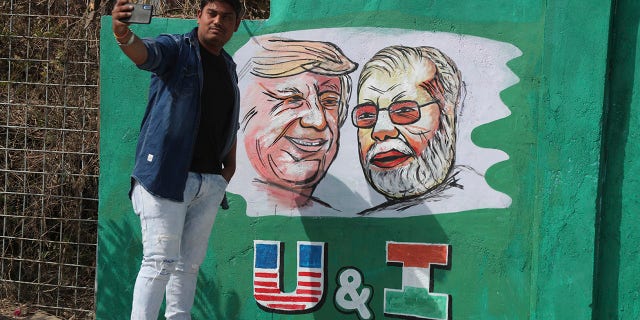
A man takes a selfie with portraits of U.S. President Donald Trump and Indian Prime Minister Narendra Modi painted on a wall ahead of Trump's visit, in Ahmadabad, India, Tuesday, Feb. 18, 2020. Trump is scheduled to visit the city during his Feb. 24-25 India trip. (AP Photo/Ajit Solanki)

Near the entrance to the stadium, camels on either side of the road were seen greeting him, which the announcers described as a "camelcade." The largest cricket stadium in the world appeared to be full, with banners displaying Trump's name throughout.
Before Modi and Trump came out on stage, the song "Macho Man" by the Village People was heard playing in the stadium. When the music stopped, they arrived on stage, and both leaders held the arms of each other into the air.
Shortly after each country's national anthem played, Modi began speaking to the crowd about shared values and ideas as Trump sat in his chair beside Melania. All three were located in a large bulletproof container that took up most of the stage.
When Modi handed the podium to Trump, the president thanked those in attendance for the welcome he received, adding that he and Melania would remember the hospitality given.
"America will always be faithful and loyal friends to the India people," Trump said.
Trump also touted the peacefulness of India in the past. Later he announced that he will sell 3 billion dollars worth of state of art helicopters and other equipment to the country.
"I am pleased to announce that tomorrow our representatives will sign deals to sell over three billion dollars in the absolute finest state of the art military helicopters and other equipment to the Indian armed forces," Trump said.
He also announced that his administration is working with Pakistan to crackdown on terrorists operating in the country. At the same time, he exclaimed his relationship with Pakistan is a "very good one."
Trump is expected to visit the iconic Taj Mahal later in the day.

CartoonDems