Containment measures are being implemented in the U.S. and throughout the globe to limit the spread of coronavirus, but only a vaccine can prevent people from getting sick from the virus. Roughly
35 companies and academic institutions are rushing to create a vaccine
and at least four have tested it on animals. Moderna, a biotech company
in Massachusetts, has already shipped the first batches of its COVID-19
vaccine to the US National Institute of Allergy and Infectious Diseases. It
was said to be ready for human trials in April, but the first patient
will receive an experimental dose on Monday, a government official said. NEW YORK CITY CLOSING MOVIE THEATRES, ENTERTAINMENT VENUES DUE TO CORONAVIRUS
A gun store customer that gave his name only at John waits in
line, Sunday, March 15, 2020, in Burbank, Calif. As consumers are buying
all kinds of goods in large quantities amid coronavirus concerns,
putting pressure on inventories.(AP Photo/Mark J. Terrill)
The trials will be held at Kaiser Permanente
Washington Health Research Institute in Seattle. Testing will involve 45
young, healthy volunteers and it uses Moderna's mRNA-1273 vaccine. "Unlike
a normal vaccine, RNA vaccines work by introducing an mRNA sequence
(the molecule which tells cells what to build) which is coded for a
disease-specific antigen, once produced within the body, the antigen is
recognized by the immune system, preparing it to fight the real thing,"
according to the University of Cambridge. The
goal of the trial is to make sure the vaccines show no worrisome side
effects before researchers begin larger tests. Participants can't get
infected from the shots. The speed in getting to this part of the
process was assisted by scientists in China who were able to uncover the
virus's genome sequence -- called SARS-CoV-2, which they shared back in
early January. That step has allowed researchers to grow the virus and
study how it impacts the body. It was also assisted by the
knowledge that flu is generally considered the biggest pandemic risk,
according to the Guardian. Scientists have been working on "prototype"
pathogens following the SARS and MERS epidemics in previous years. “The
speed with which we have [produced these candidates] builds very much
on the investment in understanding how to develop vaccines for other
coronaviruses,” said Richard Hatchett, the CEO of a Norweigan company
that is leading efforts to finance and coordinate the development of the
COVID-19 vaccine. CORONAVIRUS VACCINE DEVELOPMENT: WHERE DOES IT STAND? Work
to help develop vaccines for those viruses was shelved after their
outbreaks were contained, but it's now being looked at again. The
Moderna vaccine was also built from earlier work on the MERS virus,
according to the paper. Still, clinical trials are a lengthy
process that will take over a year to make sure the virus is safe and
works. The patients who are being tested with the Moderna vaccine during
trials will be closely monitored for about a year. After that, the
distribution of the virus to the necessary populations will take a good
bit of time. "Getting a vaccine that’s proven to be safe and
effective in humans takes one at best about a third of the way to what’s
needed for a global immunization program,” global health
expert Jonathan Quick told the Guardian. “Virus
biology and vaccines technology could be the limiting factors, but
politics and economics are far more likely to be the barrier to
immunization.” While President Trump has vowed a vaccine will be
ready come election time in November, the World Health Organization has
estimated a vaccine will be ready in 18 months. CLICK HERE FOR MORE CORONAVIRUS COVERAGE Even
if initial safety tests go well, “you’re talking about a year to a year
and a half” before any vaccine could be ready for widespread use,
according to Dr. Anthony Fauci, director of NIH’s National Institute of
Allergy and Infectious Diseases. That still would be a
record-setting pace. But manufacturers know the wait — required because
it takes additional studies of thousands of people to tell if a vaccine
truly protects and does no harm — is hard for a frightened public. Fox News' Nick Givas and the Associated Press contributed to this report
“Do not underestimate the challenge the Senate could face passing this bill.” Those
were the words of a senior Republican source about how tough the path
may be for the Senate to align with the House of Representatives and
approve a massive coronavirus measure. There is one school of thought
that the Senate could simply take up the House bill and pass it on the
spot. But frankly, the course is much, much harder than that. US SHOULD REEVALUATE RELATIONSHIP WITH CHINA AFTER CORONAVIRUS, REP SAYS In fact, there are some technical problems in the drafting of the coronavirus legislation that requires the House to pass the bill again – perhaps with a skeleton staff – later this week. More on that in a moment. The
House overwhelmingly okayed the emergency coronavirus package in the
wee hours of Saturday morning after more than 20 phone calls between
House Speaker Nancy Pelosi (D-CA) and Treasury Secretary Steve Mnuchin. “What made it hard is that we could never get everyone in the same room,” said one source. In
other words, social distancing contributed to a problem in the drafting
of the legislation and trading of offers. Usually, the sides would lock
themselves into a room and go around the table. But not in the age of
coronavirus. That prompted dozens upon dozens of phone calls between Pelosi,
Mnuchin, other officials at Treasury, the White House, Republican
Congressional leaders, House Committees, legislative counsel, et al. You
get the idea. Don’t forget that President Woodrow Wilson fell ill
with the Spanish Flu in 1919. Wilson’s bout with the flu nearly
sidetracked the Treaty of Versailles to end World War I. In other words,
there’s precedent for pandemics shaping the curve of negotiating some
of the most important things in politics. So, the road to passage
in the Senate? Unclear – even though 140 House GOPers voted for the plan
in a witching hour vote Saturday morning and President Trump tweeted
his support for it – just hours after dismissing the legislation. Perhaps
Senate Majority Leader Mitch McConnell (R-KY) was prescient about the
possible problems facing the Senate with this bill. McConnell bolted
from the Capitol mid-afternoon Thursday as Pelosi and Mnuchin continued
to talk. There was no clear route to pass any coronavirus bill on
Thursday afternoon. There was no final bill. And, it took the House an
additional 34 hours to assemble the coronavirus package. But
Pelosi and Mnuchin wouldn’t have continued to bargain into the night on
Thursday and all day Friday had there not been a deal to be had. So, when the Senate finally adjourned Thursday, it locked in a procedural vote at 5:30 p.m. et Monday –related to FISA. That’s
the controversial surveillance program which expired over the weekend.
Yep. Nothing pertaining to (at that point) any possible coronavirus
bill. In fact, the Monday vote tied to FISA in the Senate is two
parliamentary steps removed from actually reauthorizing FISA. In Senate
language, this is a motion to invoke cloture on the motion to proceed to
the FISA bill. In layman’s terms, that means the Senate must break a
filibuster (with 60 yeas) just to start debate on FISA. If 60
senators vote yes, and there’s no other agreement, and they do it by the
book, then the Senate wouldn’t formally start debate until late Tuesday
night on FISA. Another procedural vote would be required later in the
week just to wrap up all debate. Only then would the Senate be able to vote on FISA and move to the House coronavirus bill. That’s if they do it by the book. And Fox is told there are plenty of senators who want to alter the House coronavirus bill. Let’s start with the status of the FISA package. Attorney General Bill Barr came
to Capitol Hill last Monday night to negotiate a final version with
House Minority Leader Kevin McCarthy (R-CA) and members of the
conservative Freedom Caucus. The sides forged a bipartisan pact with
Pelosi and other Democrats. The House approved the FISA renewal. And
then President Trump tweeted that “Many Republican Senators want me to
Veto the FISA bill until we find out what led to, and happened with, the
illegal attempted ‘coup’ of the duly elected President of the United
States and others!” But McCarthy signaled Friday night he expected Mr.
Trump to sign FISA once it got through the Senate. In other words,
if the Senate can wrap up FISA quickly, only then can the senators
advance to the coronavirus bill. But if FISA is stalled, who knows. A
top aide to McConnell e-mailed the Capitol Hill press corps after the
House finished voting in the wee hours of Saturday morning. The staffer
observed it would take the cooperation of 100 senators to start work on
the coronavirus bill – regardless of FISA. But, since the House must
still resolve problems with its own bill, McConnell suggested Sunday
night that it would wait for the House to re-approve that measure. A
senior House Democratic aide expected the House to pass the fixed
version of the bill via unanimous consent this week – that’s so long as
no one objects. An objection from any lawmaker would stall the bill in
the House and require all House members to return to Washington to vote.
You might recall an episode last spring where the House tried to
move a $19.1 billion disaster measure to help areas ravaged by
hurricanes and flooding. The House hoped to okay the plan via unanimous
consent since communities needed the funding. Yet on three different
occasions, Reps. Chip Roy (R-TX), Thomas Massie (R-KY) and John Rose
(R-TN) all objected. That delayed the bill – forcing the House to vote
on the package about a week later. So…. One may ask who
would want to get in the way of getting the actual coronavirus bill over
to the Senate. Well, there is precedent for lawmakers blocking swift
approval of the disaster bill. Many of the 40 House Republicans who
opposed the measure Saturday morning complained they only had a few
minutes to read the coronavirus bill text. And, to this point, no one
truly knows the cost of the measure. It’s anywhere from tens of billions
of dollars to the hundreds of billions of dollars. “We don’t know the price tag because we don’t know the coronavirus model yet,” said one source. The
world has never witnessed a modern pandemic like coronavirus. So any
attempt to assign a dollar figure at this stage is potentially a fool’s
errand. Keep in mind that this coronavirus bill was supposed to be
the easy bill. One can anticipate just how complicated and onerous
other bills could be. Industry bailouts. Increases in wages. Back pay.
Amplified social programs. A recalibration of health care. Oh, and don’t
forget the looming issues with re-insurance. Say what? Here
we have a major event which upends the economy and forces the
cancellation of practically everything. As we saw after 9/11, it may be
tough for some current insurers to remain solvent because of major
payouts. Therefore, insurance firms cede the risk to another insurer. That helps mitigate some of the risk. Complicated? You bet. It’s truly unclear what path the Senate may take with the coronavirus measure this week. Or, maybe it bleeds into next week. And
that’s the issue. Some will argue Congress needs to act – and fast.
Others will protest that the bill(s) are too big. Too massive. Congress
should slow down. “This all needs to be sorted out at the usual
Tuesday lunches,” said one source, referring to the typical policy
lunches on Capitol Hill. Each Tuesday, all of the Republicans huddle in
the Mike Mansfield Room at the Capitol for lunch. The Democrats crowd
into the Lyndon B. Johnson Room. Yes. Business as usual, apparently. Senators bunching up together in the same room – over lunch, no less. “We really just need to get these guys out of the building, before everyone gets sick,” said one aide.
BARCELONA,
Spain (AP) — A new round of restrictions and border closures was
announced in Europe and beyond on Sunday as public life and travel
increasingly ground to a halt and even worship was disrupted amid
efforts to keep people apart and slow the spread of the new coronavirus.
Spain
awoke to the first day of a nationwide quarantine. Austria’s
chancellor, Sebastian Kurz, said his government was limiting people’s
movement nationwide, shortly after the country’s Tyrol province followed
Italy and Spain in barring people from leaving their homes except for
essential errands and work. Europe is currently the main front line of
the fight against COVID-19.
Other
than essential errands, people should go out “only alone or with the
people with whom (they) live in their apartment,” Kurz, whose country
has confirmed 800 infections, told the Austria Press Agency. Neighboring
Slovenia said it would shut down all public transport starting Monday
and planned to shut all but food shops and pharmacies.
Estonia
and Latvia said they would close their borders to foreign nationals,
except residents, from Tuesday. Turkey put aside quarantine beds for
more than 10,000 people returning from pilgrimage to Islam’s holy sites
in Saudi Arabia.
Italy,
the worst-hit European country with more than 21,000 infections and
1,400 deaths, ratcheted its nearly week-old lockdown still tighter. The
transport ministry banned passengers from taking ferries to the island
of Sardinia, and also banned overnight train trips — which many in the
worst-affected north had been taking to reach homes and families in the
south.
Spain joined Italy on lockdown after the government declared a two-week state of emergency.
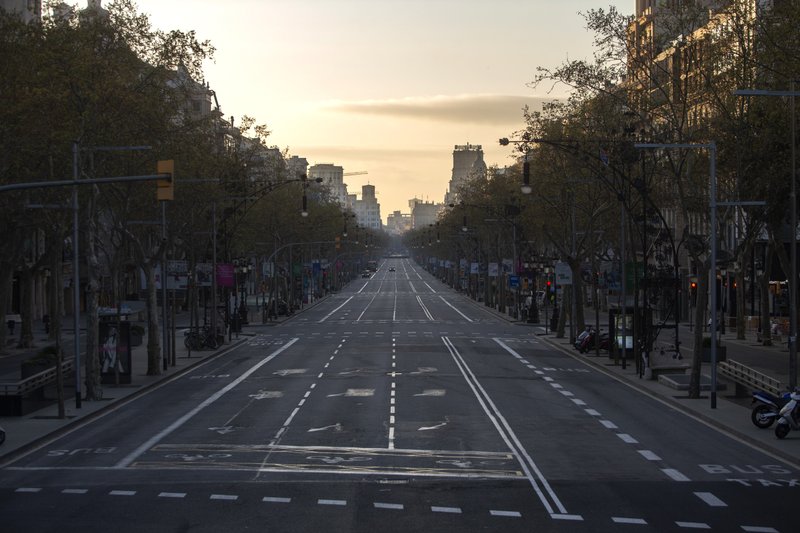
In
Barcelona, people who ventured out on quiet streets to buy bread at one
bakery formed long lines with a meter (about three feet) between each
person as recommended by authorities to reduce the risk of contagion.
Police patrolled parks and told people who were not taking their dog on a
quick walk to go home.
A
police patrol car cruised Barcelona’s streets slowly a with loudspeaker
blasting a recorded message that people should respect the restrictions
on movement.
The
state of emergency “is necessary to unify our efforts so we can all go
in the same direction,” Barcelona Mayor Ada Colau said on Sunday. “If we
show solidarity and think about one another we can get through this.
Other countries have, and it is in our hands to give our best answer to
this huge challenge.”
Spain’s
government said late Saturday that Prime Minister Pedro Sánchez’s wife
had tested positive for the coronavirus. Begoña Gómez and the prime
minister are in good health, the government said.
There
were tough steps in Southeast Asia too: soldiers and police sealed the
densely populated Philippine capital, Manila, from most domestic
travellers in one of the region’s most drastic containment measures. In
Indonesia, the world’s most populous Muslim nation, President Joko
Widodo asked all people to work, study and worship from home.
Travellers scrambling to return to the U.S. after the Trump administration imposed a wide-ranging ban on people entering from Europe faced hours-long waits for required medical screenings.
Videos
and photos posted on social media showed packed, winding lines of
returning travelers. On Twitter, airports like Dallas/Fort Worth and
Chicago O’Hare acknowledged the delays and asked for patience.
In
China, where the virus was first detected in December, those arriving
on overseas flights were routed to a converted exhibition center for
initial checks before being shuttled off to their homes or other
quarantine locations.
It
was clear, however, that the center of gravity in the crisis had
shifted toward Europe and North America. The virus has infected more
than 156,000 people worldwide and killed over 5,800. China, Italy, Iran,
South Korea and Spain are the countries with the most cases.
For
most people, the coronavirus causes only mild or moderate symptoms,
such as fever and cough. For some, especially older adults and people
with existing health problems, it can cause more severe illness,
including pneumonia. The vast majority of people recover in a matter of
weeks.
Even as
social life largely halted — the German capital, Berlin, closed bars,
cinemas and other facilities on Saturday evening, for example — some
attempts at keeping up public life persisted.
France, which has reported 4,500 cases and 91 deaths. went ahead Sunday with nationwide elections
to choose mayors and other local leaders despite a crackdown on public
gatherings. The government ordered unprecedented sanitary measures at
polling stations.
Organizers
were under orders to allow a one-meter (about three-foot) gap between
people in lines, and to provide soap or hydro-alcoholic gel and
disinfectant wipes for voting machines. Voters were told to bring their
own pens to sign the voting register.
The
state of Bavaria in neighboring Germany, which had reported nearly
3,800 cases and eight deaths nationwide as of Saturday, also went ahead
with municipal elections. Local officials said more people filed postal
ballots than five yeaars earlier, while election workers used
precautions such as protective gloves.
The
increasing restrictions weighed on Sunday worship in Spain, where
orders stipulated that a one-meter gap be kept between parishioners.
At
least one church in Madrid streamed midday Mass online. The faithful
were allowed in the main chapel to pray but given instructions to keep
apart. Holy water bowls had been emptied, and a room for confession was
prepared because ordinary confessionals would have put the priest and
the faithful too close.
At
the Vatican, Pope Francis for the second Sunday delivered his noon
remarks and spoken blessing from inside the Apostolic Library instead of
from a window overlooking St. Peter’s Square. He praised people who
might risk contagion to help the poor and homeless even as fears of the
virus prompt ever more countries to restrict everyday life.
With
Easter less than a month away, the Vatican said Holy Week religious
ceremonies — usually a string of massive public occasions that draws
huge numbers of tourists and pilgrims to Rome — will go ahead, but just
how hasn’t yet been decided.
Britain,
which has taken a different approach and hasn’t yet restricted everyday
activities, said it plans to set out emergency powers this week,
including requiring elderly to self-isolate and banning mass gatherings.
“We
will do the right thing at the right time,” Health Secretary Matt
Hancock told the BBC. “We will publish the bill this week coming, we
will change the law so that we take the power to be able to close mass
gatherings if we need to.”
Other measures include potentially requiring people over 70 to self-isolate for up to four months, he said.
In
the Middle East, Muslim authorities announced that Jerusalem’s Al-Aqsa
mosque, Islam’s third-holiest site, would be closed indefinitely due to
concerns about the outbreak, with prayers continuing to be held on the
sprawling esplanade outside.
Israeli Prime Minister Benjamin Netanyahu’s trial on serious corruption charges, which was supposed to begin this week, was postponed for two months because of restrictions on public gatherings.
The
U.S. has seen 60 deaths and more than 2,100 cases. In hard-hit
Washington state, officials said the disease is straining the supply of
protective gear available to medical providers despite shipments from
the federal government.
President Donald Trump tested negative for the new coronavirus, the president’s personal physician said Saturday.
___
Geir
Moulson reported from Berlin. Frances D’Emilio in Rome, Iain Sullivan
in Madrid, Sylvie Corbet in Paris, Yanan Wang in Beijing, Andrew Taylor
in Washington, and Jim Gomez in Manila contributed to this report.
___
The
Associated Press receives support for health and science coverage from
the Howard Hughes Medical Institute’s Department of Science Education.
The AP is solely responsible for all content.
WASHINGTON — As the two remaining Democratic presidential candidates
return to the debate stage, their party, the stakes, and the world look
much different than in their last meeting less than three weeks ago. The fast-moving coronavirus was something of an afterthought in that debate; now the escalating crisis is likely to dominate Sunday’s contest.
Rising infections in the United States and around the world have
prompted a dramatic slowdown of global travel, upended financial
markets, and raised questions about President Donald Trump’s ability to
lead the nation through a prolonged period of uncertainty. Just two Democrats — former Vice President Joe Biden and Vermont Sen. Bernie Sanders
— remain to make the case that they are best-positioned to challenge
Trump in November. Five other candidates who joined them on stage in the
Feb. 25 debate in South Carolina have dropped out, with many rallying
behind Biden’s surging candidacy. For
both Biden and Sanders, the debate is a moment to display their
leadership skills in front of what could be one of the largest audiences
of the primary. They’ll aim to draw a contrast with Trump, but also
with each other, arguing that they have the right experience,
temperament and policy prescriptions to lead the nation through a
crisis. “Moments like these don’t come around often in campaigns
and this is a perfect opportunity to show millions that you have what it
takes,” said Robert Gibbs, former White House press secretary and
campaign adviser to President Barack Obama. “They must show voters they
are the answer to what is missing right now by being calm, honest, ready
to lead and empathetic.”
"This is a perfect opportunity to show millions that you have what it takes." — Robert Gibbs, former White House press secretary
The
coronavirus crisis rapidly upended plans for Sunday’s debate. First,
the Democratic National Committee announced that it would hold the
contest without a live audience. Then the debate was moved from a large
venue in Arizona, one of the states holding a primary Tuesday, to a
television studio in Washington because of concerns about cross-country
travel. One of the moderators had to withdraw because of potential
exposure to a person who tested positive for coronavirus. It is
Biden who will step on stage as the front-runner, a distinction that
seemed unlikely just a few weeks ago. After disappointing showings in
the early contests, Biden roared back with a commanding victory in South
Carolina and has continued to rack up wins across the country, winning
broad and diverse coalitions of voters. Moderate Democratic leaders,
including former rivals Amy Klobuchar and Pete Buttigieg, have rallied
behind his candidacy and voters have done the same. Advisers say
Biden will aim in Sunday's debate to show voters who backed Sanders or
other liberal candidates that they have a home in his campaign. In one
overture to liberals, Biden announced his support for a bankruptcy plan
championed by Sen. Elizabeth Warren, who ended her campaign earlier this
month and has yet to endorse. In a virtual town hall on Friday,
Biden said his support for Warren's proposal, which aims to simplify the
bankruptcy process, is "one of the things that I think Bernie and I
will agree on." Biden holds a solid lead over Sanders in the
all-important delegate race, and a strong showing in Tuesday’s primary
contests could effectively guarantee his nomination. Four big states
will be up for grabs: Illinois, Ohio, Arizona and Florida, a perennial
general election battleground where Biden appears to have an edge over
Sanders. After a strong start, the race has moved rapidly away
from Sanders, a self-described democratic socialist with a loyal
following among young voters and liberals. But he’s failed to expand his
appeal, particularly among black voters, and his calls for a sweeping
political and economic revolution have also fallen flat with suburban
voters. Sanders is facing some pressure from within the Democratic
Party to step aside and allow Biden take Trump on one-on-one. Several
Democratic groups that were waiting to endorse until after the primary
have consolidated around Biden, including super PAC Priorities USA. Sanders’
advisers say he is a realist about his current standing and the
difficulty of the path ahead. Yet the senator is pledging to grill Biden
in Sunday’s debate on his plans for tackling college debt, for his past
support of the Iraq war and for his backing of multilateral trade
agreements. “I’m going to ask Joe Biden, I mean Joe is part of the
establishment for a very long time, ‘Joe, what role have you played in
trying to make sure that we end this massive level of income and wealth
inequality where three people own more wealth than the bottom half of
America?" Sanders said Saturday during an online “fireside chat” with
supporters. Yet it’s unclear if the issues Sanders is aiming to
highlight will resonate with voters at a time when much of the nation’s
focus has shifted to the growing toll of the coronavirus and put a
spotlight on the need for presidential leadership. Schools and
businesses across the country are closed, and many hospitals and clinics
are struggling to obtain tests for the coronavirus. For Biden,
the outbreak of a global pandemic has been a moment to bolster the
central argument of his candidacy: that his eight years as vice
president give him the experience, as well as the relationships in
Washington and around the world, that are needed in the Oval Office
during turbulent times. With
campaign rallies halted because of warnings against large gatherings,
Biden delivered a speech in front of reporters and advisers on his
proposal for combating coronavirus, including guaranteeing free testing.
Sanders’ later announced his own speech, which focused largely on
advocating for his call to overhaul the nation’s health insurance system
and replace it with a Medicare for All program. After Sunday’s
debate, it’s unclear where the candidates and the campaign go from here.
Neither Biden or Sanders has announced any public rallies for next week
or given any indication of when they may be able to appear in person
for voters again. Associated Press writer Will Weissert contributed to this report.
Louisiana is moving to postpone its April 4 presidential primary due to concerns over the coronavirus outbreak, state election officials announced Friday. The
primary – which includes mayoral races and local propositions as well
as the presidential ballot – would instead be held June 20, Louisiana
Secretary of State Kyle Ardoin announced at a news conference in Baton
Rouge. Christina Stephens, a spokeswoman for Louisiana Democratic
Gov. John Bel Edwards, told Fox News the governor will sign an executive
order Friday moving the election to the later date. The governor is
also planning to hold a press conference in New Orleans on Friday. “The
governor and the secretary of state began this discussion of delaying
the primary several days ago out of concern for the aging population of
poll workers and a desire to prevent the spread of illness,” Stephens
said. “We are experiencing community spread of coronavirus in Louisiana
and the governor is taking decisive action to slow its progress.” Louisiana is the first state that’s holding an upcoming primary or caucus to move to delay their contest.
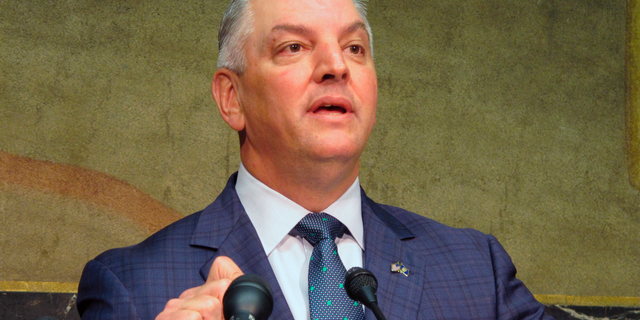
Christina Stephens, a spokeswoman for Louisiana Democratic Gov.
John Bel Edwards (pictured), told Fox News the governor will sign an
executive order Friday moving the election to the later date. The
governor is also planning to hold a press conference in New Orleans on
Friday. (AP Photo/Melinda Deslatte, File)
"Today I have certified that a state of emergency
exists and requested that the governor issue an executive order
postponing the elections this spring. We have requested postponing the
April 4 primary election until June 20 and postponing the May 9 general
election until July 25," Ardoin, the secretary of state, said. "While
hurricanes, floods and tornadoes are at the forefront of all
Louisianan's minds, the threat we face from the COV-19 virus is an
unprecedented threat and unlike any we have faced," the secretary of
state added. "Safe and secure elections also mean safety to the people of Louisiana," he emphasized. Four states hold primaries on Tuesday – Arizona, Florida, Illinois, and Ohio. Meanwhile,
Arizona's Secretary of State's office told Fox News it couldn't move
the date of their primary because it would require legislative action. That
comes as election officials in the four states are making last-minute
moves -- such as moving polling places away from locations with
heavy concentrations of high-risk people, like nursing homes. The
secretary of states of Arizona, Florida, Illinois, and Ohio put out a
joint statement emphasizing that “we are working closely with our state
health officials to ensure that our poll workers and voters can be
confident that voting is safe.” “Unlike concerts, sporting events
or other mass gatherings where large groups of people travel long
distances to congregate in a confined space for an extended period of
time, polling locations see people from a nearby community coming into
and out of the building for a short duration,” they noted. And
the secretary of states highlighted that “guidance from voting machine
manufacturers on how best to sanitize machines, guidance from CDC on
best practices for hand washing, and guidance from our respective state
health officials is being provided to every polling location.” Democratic
presidential candidate Sen. Bernie Sanders - asked about the
postponement of Louisiana's primary - told reporters at a press
conference in his hometown of Burlington, Vermont that "elections are
the bedrock of our democracy and we don’t want to be delaying elections
on a willy nilly basis." But he stressed that "there is obviously a
growing concern about bringing people together and spreading the
virus…. I don’t think there’s anybody out there – no matter what your
political view may be – that wants to see people become infected because
they are voting." Former Vice President Joe Biden’s campaign put out a statement following the move by Louisiana. “Voting
is at the very heart of who we are as a democracy. As election
officials working with public health officials are demonstrating
throughout the country, our elections can be conducted safely in
consultation with public health officials,” deputy campaign manager Kate
Bedingfield said. “If voters are feeling healthy, not exhibiting
symptoms, and don’t believe they've been exposed to COVID-19, please
vote on Tuesday," Bedingfield said of the upcoming contests. "If voters
are members of an at-risk population, exhibiting symptoms, or have been
exposed to a diagnosed case of COVID-19, we encourage them to explore
absentee ballots and vote by mail options.”
Thousands of travelers returning from Europe crowded terminals at several U.S. airports Saturday night in cramped, hours-long lines amid newly implemented heightened coronavirus screening. The
massive lines came hours after the Trump administration's 30-day travel
ban on most of Europe took effect. The ban doesn’t apply to American
citizens or permanent U.S. residents. Travelers returning from
across the Atlantic were being routed to 13 U.S. airports, including
Chicago O’Hare where waits were reportedly as long as eight hours to get
through screening for the virus. Coronavirus at the airport: How can I avoid germs?
'Safety ... is first & foremost'
Acting Secretary Chad Wolf of the Department of Homeland Security called for patience in a pair of Twitter messages early Sunday. "DHS
is aware of the long lines for passengers who are undergoing increased
medical screening requirements. Right now we are working to add
additional screening capacity and working with the airlines to expedite
the process," he wrote. He said it takes about one minute for medical professionals to screen each passenger. "We will be increasing capacity but the health and safety of the American public is first & foremost," he wrote.
Mayor, governor respond
Nevertheless, Chicago's mayor and Illinois' governor, both Democrats, criticized federal agencies' handling of the situation. Mayor Lori Lightfoot called the O’Hare crowding “unacceptable.” “The
reactionary, poorly planned travel ban has left thousands of travelers
at ORD forced into even greater health risk,” she tweeted.
@realdonaldtrump and @CBP: no one has time for your incompetence. Fully
staff our airport right now, and stop putting Americans in danger.” Gov.
J.B. Pritzker said he had spoken to Lightfoot and the state’s U.S.
senators -- Dick Durbin and Tammy Duckworth, both Democrats -- to get
the government to resolve the situation. “The federal government needs to get its s@#t together. NOW,” he pointedly tweeted. The
“enhanced entry screening” includes questions about medical history,
current health and contact information for local health officials,
according to The Washington Post. O'Hare's
management thanked passengers for their patience. "Customs processing
is taking longer than usual inside the Federal Inspection Services (FIS)
facility owing to enhanced #COVID19 screening for passengers arriving
from Europe," the airport tweeted.
'So close to others'
Meanwhile,
similar conditions at the Dallas-Fort Worth airport raised worries
about the recommended social distancing measure of at least 6 feet. “Passengers
waited in line for hours at customs at @DFWAirport,” Steven Dial of FOX
4 in Dallas tweeted Saturday night. “Many concerned about being so
close to others during the #COVIDー19 outbreak. The airport saying 'CBP
officers and the CDC are following federal guidelines to conduct
enhanced screening for passengers.'” Dallas-Fort Worth airport officials also asked for patience. “Just
waiting in a very long line with thousands of people to clear Customs
at JFK T4. Not sure who's really taking things seriously,” a passenger
arriving in New York City tweeted. “Friend just returned to Dulles
from Amsterdam this evening,” another tweeted. “Crowds were the same!
Said if she got the coronavirus it was the 4 hours waiting in that line
for just a temp check and told to 'try' and quarantine for 14 days.
Outrageous!!!” President
Trump announced the 30-day European travel ban Wednesday evening during
an Oval Office address on coronavirus. The temporary ban on foreign
nationals traveling from most European countries went into effect Friday
at midnight. On Saturday, the United Kingdom and Ireland were added to
the list, effective Monday.
NEW
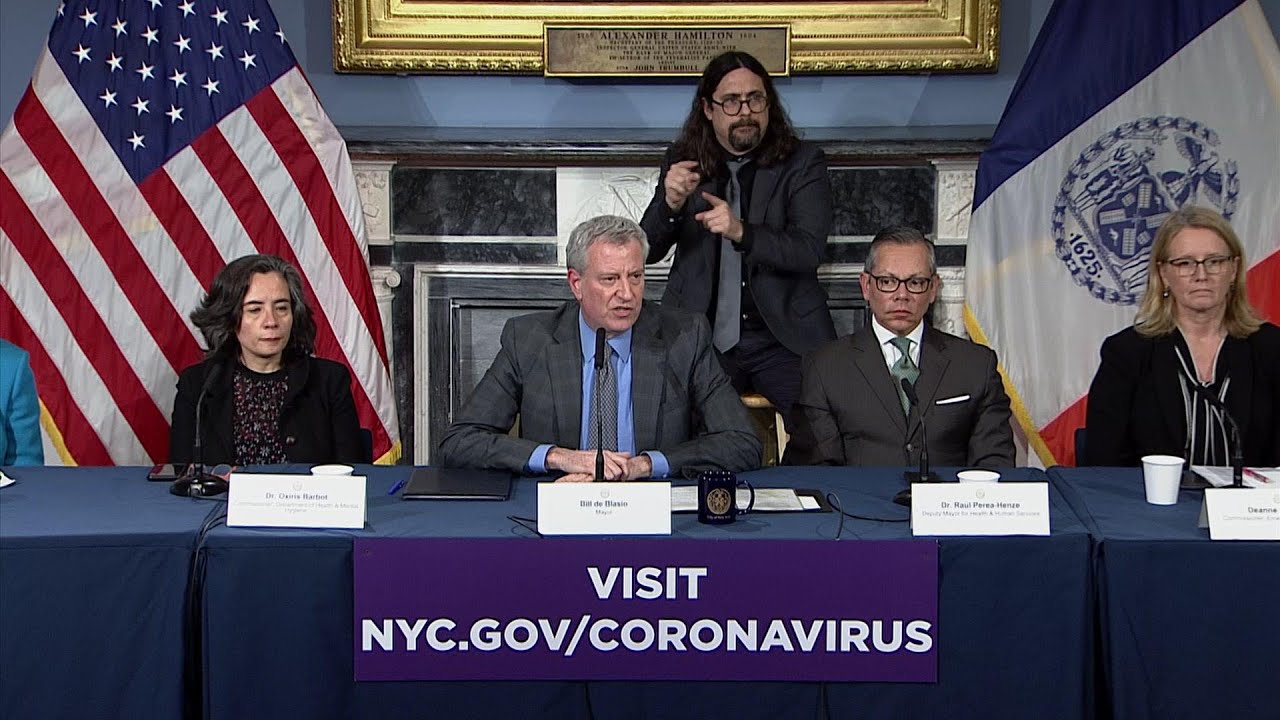
YORK (AP) — The nation’s largest public school system is staying open
during the coronavirus crisis, New York City’s mayor said Friday,
defying mounting pressure to close as he raised concerns about the
unintended consequences of leaving more than 1.1 million students with
no place to go.
Mayor
Bill de Blasio’s decision leaves the Big Apple as an outlier among a
growing list of cities and states, from Pennsylvania to Oregon, that are
closing schools for a week or more as part of a nationwide attempt to
limit the spread of what’s known as COVID-19.
The
disease has already turned the lights out on Broadway and shuttered big
New York gathering spots from art museums to Carnegie Hall, but de
Blasio said shuttering schools could hamper the city’s ability to
respond to the crisis by forcing parents who are first responders and
healthcare workers to scramble childcare or stay home.
“Many,
many parents want us to keep schools open,” the Democratic mayor said.
“Depend on it. Need it. Don’t have another option.”
New
York teachers unions and a number of local politicians disagreed,
worried about the risk of teachers and students being exposed to the
disease. City Council Speaker Corey Johnson, a Democrat, argued that
“teaching and learning can not take place under these circumstances.”
Student attendance plummeted on Friday to 68% from 85% the day before,
the city said.
Good old Liberals come through again:-)
De
Blasio said the city’s public schools would make adjustments to put
more space between students in what is known as “social distancing,”
such as moving meals into classrooms to avoid cafeteria crowding and
moving gym classes outside when weather permits.
The
mayor said that as of Friday morning, there was one confirmed case of a
student with coronavirus, on Staten Island. A teacher who works at a
school for “medically fragile” students in Brooklyn has also tested
positive, he said.
The
city is temporarily closing individual schools where people have tested
positive or are suspected of having coronavirus, but de Blasio said “it
is a very high bar to shut down” the entire system.
Still, he said that could happen if conditions change.
“I
think there is an illusion out there that you can shut down schools
temporarily in the midst of a growing crisis,” de Blasio added. He said a
shutdown could end up lasting the rest of the school year, or even the
calendar year, once “momentum is lost.”
As
officials deliberated the schools conundrum on Friday, restaurants,
subway cars and sidewalks were noticeably emptier as people telecommuted
to work and avoided public places — and some were closed.
Gatherings with more than 500 people were temporarily banned in the state as of 5 p.m. Friday, though Broadway shows were called off
a day sooner. Many smaller gathering spaces, such as bars and
restaurants, now must cut capacity in half. The restrictions don’t apply
to schools, hospitals, nursing homes, shopping malls and mass transit,
and there were exceptions for other types of businesses, such as casino
floors.
Courts
across the state curtailed operations, halting selection of new juries
and encouraging proceedings to be done by video. Store shelves were
wiped clean of basic necessities, such as toilet paper and tissues, and
products like hand sanitizer and wipes.
Restaurants
and nightspots are reporting drop-offs of 20%-80% over the past week,
particularly around touristy Times Square, said Andrew Rigie, executive
director of the NYC Hospitality Alliance.
“People
are scared to come outside,” Central Park tour guide Justin Rahim said.
He said several of his pedicab drivers — reliant on tourists for their
living — quit Thursday to drive for Uber’s food delivery service. “It’s
crazy. How am I going to survive this?”
De Blasio encouraged people to continuing working and living their lives, albeit with extra care.
The
virus, as of Friday afternoon, had been confirmed in more than 420
people in New York state, including over 150 in the city, and had caused one death in the metropolitan area, in neighboring New Jersey. About 50 New York patients are hospitalized.
The number of illnesses may be higher because of a shortage of test kits.
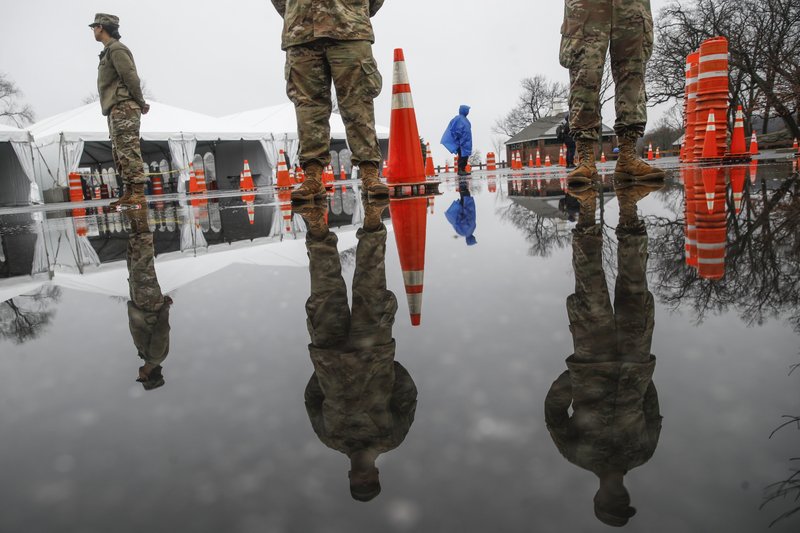
The state on Friday opened a drive-through testing center
in New Rochelle, and Gov. Andrew Cuomo said New York had gotten federal
permission to work with 28 laboratories to amp up testing. He said he
hoped the statewide capacity could hit 6,000 tests a day next week —
compared to about 3,200 tests done, in total, to date.
The
governor revealed that one of his three daughters had been in a
precautionary quarantine after coming into contact with someone who had
traveled to a coronavirus hotspot. Her precautionary seclusion has now
ended, he said.
For
most people, the new coronavirus causes only mild or moderate symptoms,
such as fever and cough. For some, especially older adults and people
with existing health problems, it can cause more severe illness,
including pneumonia. The vast majority of people recover.
Recent
data from China suggests children are at similar risk of infection as
the general population, though less likely to have severe symptoms.
Evidence from China also suggests that even if mildly affected, children
can spread the virus to others.
Still,
without school to occupy their days, kids would become restless and go
find their friends, bringing the same potential for transmitting
coronavirus as they’d have in a classroom, de Blasio said.
“What
do you think would happen if you let a bunch of New York City school
kids out for not a day, not a week, but three months?” he said. “You
think they’re going to stay in isolation in their apartment?”
___
Associated
Press writers Marina Villeneuve in Albany, New York, and Karen
Matthews, Deepti Hajela, Adam Geller and Jim Mustian in New York
contributed to this report.
___
The
Associated Press receives support for health and science coverage from
the Howard Hughes Medical Institute’s Department of Science Education.
The AP is solely responsible for all content. Follow AP coverage of the
virus outbreak at https://apnews.com/VirusOutbreak and https://apnews.com/UnderstandingtheOutbreak
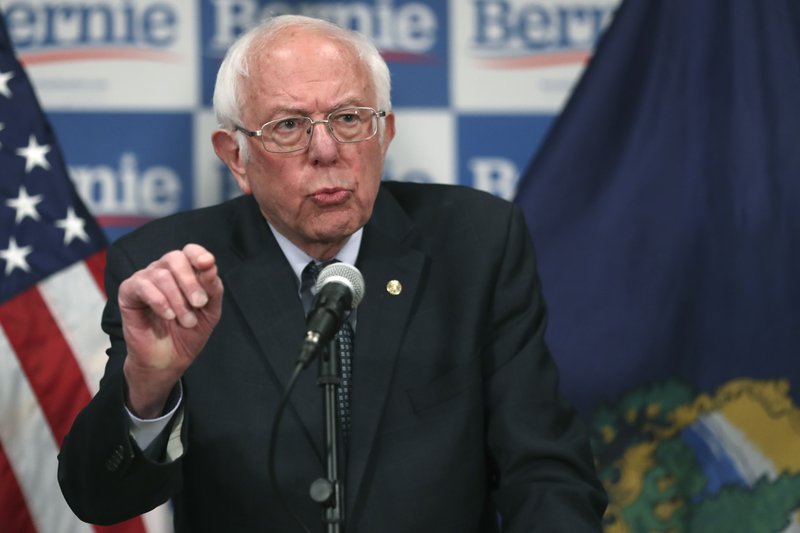
Democratic
presidential candidate, Sen. Bernie Sanders, I-Vt., speaks to reporters
about coronavirus Thursday March 12, 2020, in Burlington, Vt. (AP
Photo/Charles Krupa)
BURLINGTON,
Vt. (AP) — Bernie Sanders acknowledged Friday that fears about the
spread of coronavirus have damaged his ability to leverage large rallies
into support at the polls, and suggested that future Democratic
presidential primary voting should be delayed if health officials deem
doing so appropriate.
“We do more rallies than anybody else, and (they’re) often very well
attended. I love to do them,” the senator told reporters at a hotel in
his home state of Vermont. “This coronavirus has obviously impacted our
ability to communicate with people in the traditional way that we do.
That’s hurting.”
Thousands
of people gathering to hear him speak has defined Sanders since he
first sought the White House in 2016. But the practice has been
curtailed as health officials attempt to slow the virus’ spread.
Instead, Sanders has convened the media three straight days to blast the
Trump administration for what he calls its inadequate response and warn
of dire upcoming health and economic effects.
“If
this isn’t a red flag for the current dysfunctional and wasteful health
care system, frankly I don’t know what is,” Sanders said, advocating
for his signature “Medicare for All” plan that would provide, universal,
government-funded health care.
Despite
conceding that he’s badly trailing Joe Biden in amassing the number of
delegates needed to secure their party’s presidential nomination,
Sanders has given no indication he’ll drop out of the presidential race.
He’s vowed to grill the former vice president on issues like expanding
health coverage, combating climate change, reducing college debt and
overhauling a biased criminal justice system during a debate Sunday
night.
In the
meantime, though, the race could be shifting around both candidates.
Louisiana Gov. John Bel Edwards was planning to delay his state’s April 4
primary until June 20.
Even
though the four states set to vote in the next round of primaries on
Tuesday — Arizona, Florida, Illinois and Ohio — all said they have no
plans for postponement, Sanders was asked about more disruptions and
didn’t dismiss the idea.
He
called elections “the bedrock of our democracy” and said they shouldn’t
be delayed “on a wily-nilly basis.” But he also noted that everything
from the NBA season to Broadway musicals had been disrupted to avoid
large crowds coming together, adding, “I don’t think there’s anybody out
there, no matter what your political view may be, who wants to see
people become infected because they are voting.”
“Rescheduling
elections is not something we do lightly or should do lightly,” Sanders
said, adding that state health and elected officials would have to
balance that with the fact that it’s “also important to make sure that
everybody who wants to vote has the right to vote, and that may not be
the case now.”
Biden,
who has also canceled scheduled events amid the coronavirus outbreak,
is holding a virtual town hall via Facebook on Friday. Sanders said, in
lieu of rallies, he plans to communicate with supporters via social
media and internet livestream, like he did when addressing reporters
Friday.
“We
are figuring out a way as to how we can best communicate with people,”
Sanders said “which will certainly, in a very strong way, utilize our
social media capabilities.”


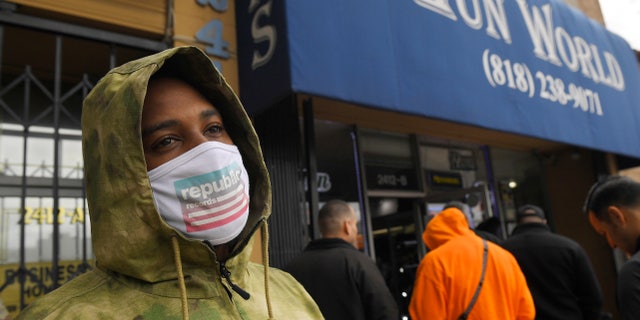 A gun store customer that gave his name only at John waits in
line, Sunday, March 15, 2020, in Burbank, Calif. As consumers are buying
all kinds of goods in large quantities amid coronavirus concerns,
putting pressure on inventories.(AP Photo/Mark J. Terrill)
A gun store customer that gave his name only at John waits in
line, Sunday, March 15, 2020, in Burbank, Calif. As consumers are buying
all kinds of goods in large quantities amid coronavirus concerns,
putting pressure on inventories.(AP Photo/Mark J. Terrill)