Presumptuous Politics

Monday, March 23, 2020

Trump hints possibility of less-restrictive approach in coronavirus fight


President Trump tweeted Sunday that his administration will reassess its response to the coronavirus outbreak at the end of the 15-day period that calls on Americans to limit their normal behaviors in an effort to slow the spread of the virus.
Businesses across the U.S. have been turned on their heads as federal, state and local governments called for drastic measures to block more infections. Stocks on Wall Street plunged to their worst losses in more than three decades.
"We cannot let the cure be worse than the problem itself," the president tweeted in caps lock, before announcing the reassessment.
Trump last week moved to blunt the impact of the pandemic on a U.S. economy fundamentally altered by a push for the nation to stay home. Hotels, restaurants, airlines, and retailers have suffered major losses. The emergency stimulus bill also hit a snag in the Senate hours before Trump's tweet.
The GOP-controlled Senate failed to move forward with the $1.4 trillion "Phase Three" stimulus package intended to help businesses and families devastated by the downturn over the coronavirus outbreak.
Many Democrats had complained that the draft aid package did not go far enough to provide health care and unemployment aid for Americans, and failed to put restraints on a proposed $500 billion "slush fund" for corporations, saying the ban on corporate stock buy-backs are weak and the limits on executive pay would last only two years.
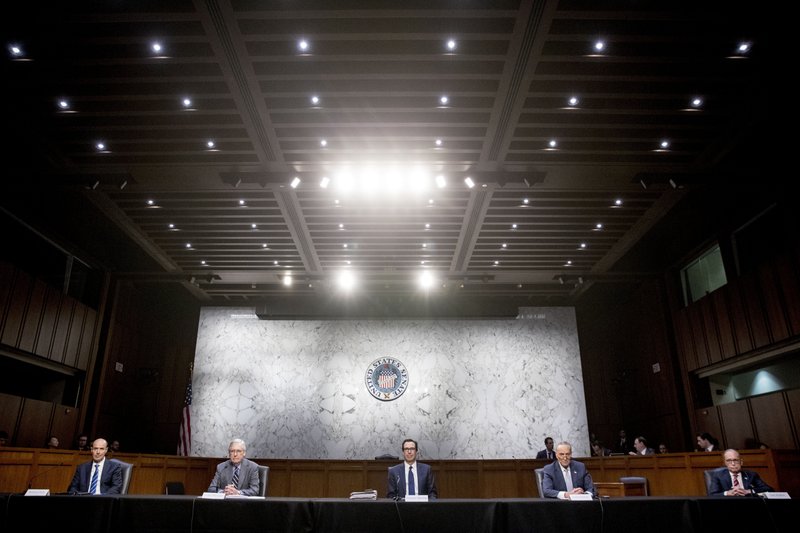
Treasury Secretary Steven Mnuchin, exiting the Capitol just before midnight, struck an optimistic note: "We're very close," he said, adding negotiators would work through the night.
Senate Democratic leader Chuck Schumer, D-N.Y., after meeting multiple times with Mnuchin, said progress was being made.
"There's a good chance we'll have an agreement," Schumer said as the Senate gaveled close, shortly before midnight. "We are fighting for a better bill."
Ray Dalio, the billionaire founder of hedge fund behemoth Bridgewater Associates, sounded the alarm Thursday over the coronavirus crisis and said U.S. corporations will lose up to $4 trillion and Trump needs to dramatically increase his stimulus plan.
Dalio’s comments come a day after Bill Ackman, another billionaire investor, called on the president to shut down the country for 30 days or “America will end as we know it.”
Fox News' Bradford Betz and the Associated Press contributed to this report

‘By Monday’ never seemed so far away after Senate fails to advance coronavirus stimulus package


“We need Congressional action by Monday,” warned one Republican administration source late last week to Fox.
“Monday” was supposed to be the deadline for the Senate to act on the third legislative phase of the coronavirus response. Senate Majority Leader Mitch McConnell (R-KY) set up a process late last week where the Senate would take a procedural vote Sunday to begin debate on a “shell” of a bill. Once there was a deal, McConnell would insert the coronavirus package into the parliamentary empty box. The hope was that the Senate could get 60 yeas to open debate on the coronavirus measure Sunday – then speed up the process and pass the bill Monday. Then the House would have to move to align with the Senate sometime in the near future.
That all melted down Sunday night.
Republicans were always going to need buy-in by Senate Democrats to start debate on the legislation. As we always say on Capitol Hill, it’s about the math, it’s about the math, it’s about the math.
The current Senate breakdown is 53 Republicans and 47 senators who caucus with the Democrats. The procedural vote required 60 yeas to overcome a filibuster.
But lacking sign-off by Senate Democrats - to say nothing of House Speaker Nancy Pelosi (D-CA) - the procedural vote garnered only 47 yeas. McConnell was for advancing the plan. But the Kentucky Republican changed his vote at the end. Senate rules allow a senator to call for a re-vote if they cast their ballot on the prevailing side of the issue – in this instance, the nays. So even though McConnell was for it, he strategically switched his vote so he could ask for another vote. Late Sunday night, there was no vote scheduled.
It’s unclear how fast the sides can forge an agreement – if at all. But it didn’t take an exercise in Euclidian Geometry to see that the procedural vote was going to fail on Sunday afternoon. Sen. Rand Paul (R-KY) announced he tested positive for coronavirus before the vote. Two other GOPers were already self-quarantining. Sens. Mike Lee (R-UT) and Mitt Romney (R-UT) announced they would quarantine since they had exposure to Paul.
That means Senate Republicans barely have a majority right now: 48-47. McConnell excoriated Senate Democrats and Pelosi for blocking the shell bill Sunday.
“We’re fiddling here. Fiddling with the emotions of the American people. Fiddling with the markets. Fiddling with our health care,” thundered a visibly angry McConnell.
The Majority Leader then publicly lambasted Pelosi.
“She’s the Speaker of the House. Not the Speaker of the Senate. We don’t have one. We were doing just fine until that intervention,” bellowed McConnell.
But Senate Democrats weren’t going to budge unless there was sign-off from Pelosi. After all, Pelosi must figure out a way to shepherd a Senate-GOP produced product through her body. And, if time is of the essence, there are questions as to why McConnell forged ahead without the votes lined up.
And so, we’ll see if things move on Monday.
As the Senate voted, the Dow futures plummeted five percent within minutes of opening Sunday night. That’s the maximum decline allowed before circuit breakers kick in, suspending trading. That’s an ominous warning, portending a rocky trading session on Monday.
So what about all of that talk about Congress moving “by Monday?”
Fox was told last week that “by Monday” was a dire warning to lawmakers to wrap this up. It was reminiscent of the nighttime meeting on September 18, 2008 in the Speaker’s Office amid the financial crisis. Pelosi phoned then Treasury Secretary Hank Paulson for a status report. Paulson told Pelosi that they urgently needed to talk in person at the Capitol that night as the country teetered on the edge of an economic collapse.
Pelosi later said that Paulson told her if they didn’t negotiate later that evening “we wouldn’t have an economy by Monday.”
Now, back to 2020.
“The markets are not going to tolerate inaction,” said one Republican source. “They need to move by Monday.”
So, we’ll see what they can resolve to avoid a bloodbath on Wall Street Monday morning.
And then there is the war of attrition: actual concern about the health of senators.
As I reported on the air last Wednesday night, Fox was told then that finishing the coronavirus bill was a race against time. Lawmakers needed to wrap this up before everyone on Capitol Hill got sick. Now “coronavirus is in the Senate,” as McConnell declared Sunday night. Some senators from both parties are livid at Paul, an ophthalmologist by training, for showing up on Capitol Hill as he awaited results of a coronavirus test. Paul’s positive test sent shockwaves through the Senate.
Some questioned the wisdom of why, day after day after day, GOP senators have repeatedly huddled for lunch meetings on Capitol Hill. At first, it was the standard location, the Mike Mansfield Room near the Senate chamber. Then, the Kennedy Caucus Room in the Russell Senate Office Building. There were also conclaves in the Central Hearing Facility in the Hart Senate Office Building. Notably, no Democratic senator has yet tested positive. Democrats have held all of their meetings via conference call.
“Personally, I would just stay a lot further away if I had a test pending,” said Sen. Kevin Cramer (R-ND) of Paul. “Might not have gone to the gym. Might not have sat at a meal. Maybe I would make arrangements to vote all by myself without somebody else in the chamber. There’s lots of room here. He is a physician himself. So one would think his ability to assess the risk is pretty good. And maybe in that education and ability, he calculated wrong.”
Sen. Kyrsten Sinema (D-AZ) scorched Paul on Twitter, though she didn’t mention her colleague by name.
“I’ve never commented about a fellow Senator’s choices/actions. Never once,” tweeted Sinema. “This, America, is absolutely irresponsible. You cannot be near other people while waiting for coronavirus test results.”
Most lawmakers think they are ten feet tall and bulletproof anyway. Lawmakers keep saying they are doing everything in compliance with CDC guidelines and in consultation with U.S. Capitol Attending Physician Dr. Brian Monahan.
But patience is running thin.
“We need to walk with the Attending Physician,” said one senior GOP source, referring to Monahan. “And Paul.”
This is why no one is quite sure how they bring the House back to vote on the phase three coronavirus bill. They’ve floated everything from approving the package via unanimous consent – where no one in the chamber objects – to stretching out the vote over a day or two. To be frank, House members are completely flipped out about having to come back to align with the Senate.
But that presumes the Senate can get an agreement and send it to the House.
Let alone, “by Monday.”

Sunday, March 22, 2020

March 2020 Cartoons


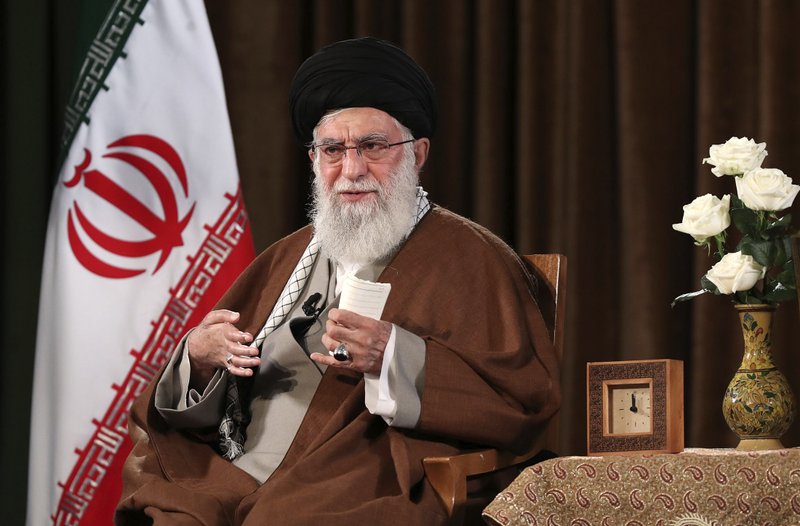
Iran leader refuses US help, citing virus conspiracy theory


DUBAI, United Arab Emirates (AP) — Iran’s supreme leader refused U.S. assistance Sunday to fight the new coronavirus, citing an unfounded conspiracy theory that the virus could be man-made by America.
Ayatollah Ali Khamenei’s comments come as Iran faces crushing U.S. sanctions blocking the country from selling its crude oil and accessing international financial markets.
But while Iranian civilian officials in recent days have increasingly criticized those sanctions, 80-year-old Khamenei instead chose to traffic in the same conspiracy theory increasingly used by Chinese officials about the new virus to deflect blame for the pandemic.
“I do not know how real this accusation is but when it exists, who in their right mind would trust you to bring them medication?” Khamenei said. “Possibly your medicine is a way to spread the virus more.”
He also alleged without offering any evidence that the virus “is specifically built for Iran using the genetic data of Iranians which they have obtained through different means.”
“You might send people as doctors and therapists, maybe they would want to come here and see the effect of the poison they have produced in person,” he said.
There is no scientific proof offered anywhere in the world to support Khamenei’s comments.
However, his comments come after Chinese government spokesman Lijian Zhao tweeted earlier this month that it “might be US army who brought the epidemic to Wuhan. Be transparent! Make public your data! US owe(s) us an explanation!”
Lijian likewise offered no evidence to support his claim, which saw the U.S. State Department summon China’s ambassador to complain.
Wuhan is the Chinese city where the first cases of the disease were detected in December. In recent days, the Trump administration has increasingly referred to the virus as the “Chinese” or “Wuhan” virus, while the World Health Organization used the term COVID-19 to describe the illness the virus causes. Even a U.S. senator from Arkansas has trafficked in the unfounded conspiracy theory it was a man-made Chinese bioweapon.
For most people, the new coronavirus causes only mild or moderate symptoms, such as fever and cough. For some, especially older adults and people with existing health problems, it can cause more severe illness, including pneumonia. The vast majority of people recover from the new virus.
Scientists have not yet determined exactly how the new coronavirus first infected people. Evidence suggests it originated in bats, which infected another animal that spread it to people at a market in Wuhan. The now-shuttered Huanan Seafood Wholesale Market advertised dozens of species such as giant salamanders, baby crocodiles and raccoon dogs that were often referred to as wildlife, even when they were farmed.
An article published last week in the peer-reviewed scientific journal Nature Medicine similarly said it was “improbable” that the virus “emerged through laboratory manipulation of a related SARS-CoV-like coronavirus.”
Khamenei made the comments in a speech in Tehran broadcast live Sunday across Iran marking Nowruz, the Persian New Year. He had called off his usual speech at Imam Reza shrine in Mashhad over the virus outbreak.
His comments come as Iran has over 21,600 confirmed cases of the new coronavirus amid 1,685 reported deaths, according to government figures released Sunday.
Iran is one of the hardest-hit countries in the world by the new virus. Across the Mideast, Iran represents eight of 10 cases of the virus and those leaving the Islamic Republic have carried the virus to other countries.
Iranian officials have criticized U.S. offers of aid during the virus crisis as being disingenuous. They have accused the Trump administration of wanting to capitalize on its “maximum pressure” campaign against Tehran since withdrawing from the nuclear deal in May 2018. However, the U.S. has directly offered the Islamic Republic aid in the past despite decades of enmity, like during the devastating Bam earthquake of 2003.
Reassigning blame could be helpful to Iran’s government, which faced widespread public anger after denying for days it shot down a Ukrainian jetliner, killing 176 people. Widespread economic problems as well has seen mass demonstrations in recent years that saw hundreds reportedly killed.
Iranian hard-liners have supported conspiracy theories in the past when it suited their interests. Following the Sept. 11 attacks, some publicly doubted al-Qaida’s role and state TV promoting the unfounded conspiracy theory that the Americans blew up the building themselves.
Former hard-line President Mahmoud Ahmadinejad similarly raised doubt about the Sept. 11 attack, calling it a “big lie,” while also describing the Holocaust as a “myth.”
Meanwhile on Sunday, Iran imposed a two-week closure on major shopping malls and centers across the country to prevent spreading the virus. Pharmacies, supermarkets, groceries and bakeries will remain open.
In Saudi Arabia, the kingdom said its armed forces are now taking part in combating the virus, setting up mobile hospitals in various cities.
And in Kuwait, authorities have instituted a nightly curfew from 5 p.m. to 4 a.m., warning violators face up to three years in prison and fines of $32,000 if arrested and convicted.
___
Associated Press writer Aya Batrawy in Dubai, United Arab Emirates, contributed to this report.
___
The Associated Press Health and Science Department receives support from the Howard Hughes Medical Institute’s Department of Science Education. The AP is solely responsible for all content.

McDonald's, Boeing heed Trump's warning against buybacks


Corporate America is following the White House's lead in combatting economic fallout from the coronavirus pandemic by standing down on stock repurchases even before potential government bailouts -- and despite the temptation of a more than 28 percent drop on the S&P 500 this year.
On Friday, McDonald's, AT&T and Boeing separately announced that share repurchases would be paused or suspended until further notice.
 
TickerSecurityLastChangeChange %
MCDMCDONALD'S CORP.148.49-1.01-0.68%
TAT&T INC.28.45-2.70-8.67%
BABOEING COMPANY95.01-2.70-2.76%

It was a move President Trump and other lawmakers had advised earlier this week for companies hit hard by the virus that might receive federal assistance, one that reflected widespread dissatisfaction with how cash from government bailouts was invested during the 2008 financial crisis.
"I don't want to have stock buybacks," said Trump. "I don't want some executives saying we're gonna buyback 200,000 shares of stock. I want that money to be used by the workers and the company to keep the company going," he added during a coronavirus task force briefing.
Aerospace giant Boeing took an additional step and suspended its 8.6 percent-yielding dividend indefinitely to conserve cash already depleted by the yearlong grounding of its best-selling 737 Max. CEO David Calhoun and Board Chairman Larry Kellner will not take a paycheck for the rest of the year.
BOEING SUSPENDS DIVIDEND, CEO CALHOUN TO FORGO PAY
The company is now "drawing on all of its resources to sustain operations, support its workforce and customers, and maintain supply chain continuity through the COVID-19 crisis and for the long term," according to a statement on Friday. Shares have lost over 70 percent this year.
As for telecom giant AT&T, the company tabled a planned, accelerated repurchase of $4 billion shares through an agreement with Morgan Stanley in the second quarter.
Scrapping the plan and any other repurchases will "maintain flexibility and focus on continued investment in serving our customers, taking care of our employees and enhancing our network, including nationwide 5G," AT&T said in an SEC filing described as an update regarding the COVID-19 pandemic. "Continued investments will help ensure the company is well-positioned when the pandemic passes and economies begin to recover."
AT&T stock has fallen 27 percent this year.
At McDonald's, CEO Chris Kempczinski, who took over in November, told CNBC that the company's buybacks are suspended but its dividend policy remains unchanged. The payout yields more than 3 percent.
The fast-food operator employs 2.2 million people globally and has seen its stock fall 25 percent this year.
TickerSecurityLastChangeChange %
MMACY'S INC.6.02-0.67-10.01%
In separate news, retailer Macy's, which joined scores of rivals in closing stores amid the outbreak, suspended "its regular quarterly cash dividend payout beginning in the second quarter of fiscal 2020. The company’s previously announced dividend payment occurring on April 1, 2020, is not affected by the suspension," the retailer said.

Election limbo as coronavirus outbreak delays voting in at least 13 states


ATLANTA  — U.S. elections have been upended by the coronavirus pandemic. At least 13 states have postponed voting and more delays are possible as health officials warn that social distancing and other measures to contain the virus might be in place for weeks, if not months.
The states that have yet to hold their primaries find themselves in a seemingly impossible situation as they look to balance public health concerns with the need to hold elections. While election officials routinely prepare for natural disasters such as hurricanes and wildfires, the virus outbreak poses a unique challenge.
“Usually when we are dealing with a crisis in elections, it’s something that happens and then it’s done,” said Chris Harvey, Georgia's director of elections. “The difference now is that it’s a spreading threat, a fast-growing threat. We don’t know where, when or how it is going to end.”
"It’s a spreading threat, a fast-growing threat. We don’t know where, when or how it is going to end."
— Chris Harvey, Georgia's director of elections
Primaries scheduled for Georgia, Ohio, Maryland, Indiana, Louisiana, Connecticut and Kentucky have all been postponed to May or June. The Rhode Island Board of Elections has recommended the primary be delayed to June, while officials in Wisconsin are debating what to do.
Wisconsin Gov. Tony Evers has insisted the April 7 primary be held as scheduled, but a state elections commissioner said this past week that doing so would put people at risk. The state's chief elections official cited a host of problems Wisconsin could face if it moved forward with the election: a poll worker shortage, lack of polling places and potential disruption of absentee voting if mail service in the U.S. were to shut down.
All this comes at the worst possible time for election officials, in the middle of a major election year. The virus outbreak erupted halfway through the presidential primary season. Voters in 23 states have yet to cast their ballots.
While Arizona, Florida and Illinois held their elections as scheduled last Tuesday, Ohio halted voting over public health concerns after federal officials encouraged people over age 65 to stay home.
“We cannot tell people to stay inside, but also tell them to go out and vote,” Gov. Mike DeWine, R-Ohio, said on Twitter, in announcing plans to delay.
The states that have opted to press ahead have found themselves dealing with what one Chicago elections official called a “tsunami” of cancellations by poll workers, who tend to be older, and a last-minute scramble to relocate polling places away from nursing homes and senior living communities. Severe illness and death associated with coronavirus has been most common in people 65 and older, especially those who have heart disease or other chronic conditions.
In addition to the presidential race, dozens of congressional and local primaries are in limbo. Primaries play an important role in deciding which party candidates will appear on the ballot for the November general election.
Runoff elections in Alabama, Texas and Mississippi were also delayed, as were local elections in Oklahoma, Missouri and New Jersey.
There's no indication May or June will be any better to hold elections, but officials say postponing voting even for a few weeks gives them an opportunity to put in place plans to keep the public safe while voting. This includes moving polling places, recruiting backup poll workers and acquiring enough cleaning supplies for voting sites.
“At some point, we have to execute an election,” Harvey said, adding Georgia planned a major push to expand absentee voting for the May primary.
There have been calls, including from Democratic National Committee Chairman Tom Perez, for elections to be held mostly by mail. But making this switch will be difficult for some and impossible for others.
In several states, it would take legislation or even a constitutional amendment to allow. Even then, election experts say there would be costs and logistical hurdles.
For instance, states would have to decide whether taxpayers or individual voters would be responsible for return postage. It would require new machines and software in many places to track ballots in the mail and process and count them when they’re returned. All of that could cost billions of dollars, at a time when state revenues are likely to drop amid increased unemployment and decreased tax collections.

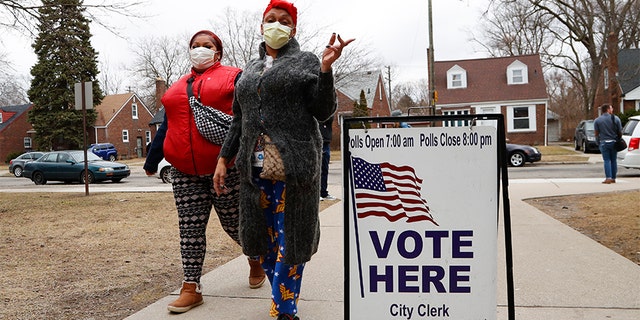
Voters arrive with masks in light of the coronavirus COVID-19 health concern at Warren E. Bow Elementary School in Detroit, Tuesday, March 10, 2020. (Associated Press)

Further, advocates say not all voters can fill out ballots by hand and that sending ballots could miss some voters, such as Native Americans who live on reservations where mail isn’t delivered to every home.
Meanwhile, steps taken — or not taken — to change aspects of the voting process are being met with lawsuits from political parties and voting rights advocates.
In Ohio, voting rights groups are suing the state for refusing to reopen the voter registration window for the state primary, now scheduled for June 2. Under Ohio law, voters can register up to 30 days before an election. Advocates say the other states with postponed primaries are allowing voter registration ahead of rescheduled elections.
In Wisconsin, the Democratic Party has sued to force the state to make it easier to register to vote and request an absentee ballot. They also have asked for mailed ballots to count if they are postmarked by Election Day and received within 10 days after voting.
Any increase in absentee voting will surely add to the workload for election offices already stretched thin and navigating recommendations that people work from home.
The elections office in Cobb County, Georgia, has sent home most of its temporary and seasonal employees brought on to help prep for elections. That means more work for the full-time employees who remain, as they are already seeing an increase in applications for absentee ballots.
“As we prepare for May, there is still so much to do,” said Janine Eveler, elections director for the metro Atlanta county. “Many of us are here when we would like to be home with our families because it’s scary right now.”
Looming over the scramble over the primaries are worries about the general election in November, a date that is set by federal law. Federal legislation has been proposed that would have all voters receive a mail-in ballot for the November election and provide federal funds to help states cover the costs.
The Brennan Center for Justice at NYU's School of Law is calling for task forces in every state to implement plans for executing an election amid a pandemic and urging Congress to provide money to help states. They estimate their proposals, including universal mail-in voting, could cost up to $2 billion.
“Things will need to change,” said Wendy Weiser, head of the center's democracy program.
For most people, the new coronavirus causes only mild or moderate symptoms, such as fever and cough. For some, especially older adults and people with existing health problems, it can cause more severe illness, including pneumonia. The vast majority of people recover from the new virus. According to the World Health Organization, people with mild illness recover in about two weeks, while those with more severe illness may take three weeks to six weeks to recover.
Associated Press writer Geoff Mulvihill in Cherry Hill, New Jersey, contributed to this report.

Coronavirus rescue deal topping $1T 'very close,' McConnell says


WASHINGTON — Top-level negotiations between Congress and the White House are pushing toward resolution on a ballooning $1 trillion-plus economic rescue package, as President Donald Trump urged a deal to steady a nation shuttered by the coronavirus pandemic.
With a population on edge and financial markets teetering, all sides indicated late Saturday that a deal is within reach. At issue is how best to keep paychecks flowing for millions of workers abruptly sidelined by the crisis.
Talks also narrowed on a so-called Marshall Plan for hospitals as well as industry loans to airlines and others all but grounded by the virus outbreak and national shutdown. The post-World War II Marshall Plan helped to rebuild Western Europe.
Senate Majority Leader Mitch McConnell announced late Saturday all sides were “very close” to a bipartisan resolution.
McConnell instructed committee chairmen to assemble draft legislation. Officials put the price tag at nearly $1.4 trillion and said that with other measures from the Federal Reserve it could pump $2 trillion into the U.S. economy.
“We are poised to deliver the significant relief that Americans need with the speed that this crisis demands,” McConnell said.
“We are poised to deliver the significant relief that Americans need with the speed that this crisis demands.”
— Senate Majority Leader Mitch McConnell, R-Ky.
Talks will resume Sunday morning when the top four congressional leaders of both parties are set to confer privately at the Capitol with Treasury Secretary Steven Mnuchin in hopes of striking a final accord.
A spokesman for Senate Democratic leader Chuck Schumer said there is “not yet an agreement.” Spokesman Justin Goodman said Democrats look forward to reading the draft and further negotiations.
“Everybody's working hard and they want to get to a solution that's the right solution, I think we're very close," Trump said at Saturday's briefing, striking a confident tone about the nation's ability to defeat the pandemic soon.
“Everybody's working hard and they want to get to a solution that's the right solution, I think we're very close."
— President Trump
On Capitol Hill, the Senate convened the rare weekend session as negotiators raced to complete the package. The Senate's goal is to hold an initial vote Sunday and win Senate passage on Monday.
The urgency to act is mounting, as jobless claims skyrocket, businesses shutter and the financial markets are set to re-open Monday eager for signs that Washington can soften the blow of the healthcare crisis and what experts say is a looming recession.
Trump has largely stayed out of the details, but said Saturday that he would be lobbying the lead negotiators.
On one topic, Trump appears to be agreeing with Democrats as Washington tries to steer clear of the politically toxic bailouts from the last economic crises.
Trump expressed a clear distaste for any industry, including the airlines, that would use federal assistance to buy back its own stock in an effort to increase profits. Banning stock buy-backs is one of Democrats’ top business priorities in the emerging package.
Treasury Secretary Steven Mnuchin and other top White House officials were on Capitol Hill for a second day of nonstop negotiations. But no announcement was expected.
House Speaker Nancy Pelosi, who has been in talks with Mnuchin, returned to Washington on Saturday and was scheduled to join Sunday's meeting.
Negotiations are focused on providing direct relief to Americans, with one-time checks of $1,200, as well as ongoing payroll support and enhanced unemployment benefits for the newly out of work.
Talks are also focused on loans to airlines and other industries blindsided by the crisis, as well as possible aid to the states and billions for hospitals and healthcare providers on the front lines of the outbreak.
The emerging package builds on a GOP proposal but Democrats push for add-ons, including food security aid, small business loans and other measures for workers.
“We're making very good progress,” Schumer said late Saturday. “We're going to continue working though the night.”
On Saturday, Trump opened the daily virus briefing with a roll call of his administration's accomplishments, a week-in-review meant to rebut criticism that the White House was moving too slowly to combat the crisis.
The president pushed back against accusations that he was sluggish to act for fear of upsetting China, though he told aides last month that he had not wanted to alienate Beijing by criticizing its secretive handling of the initial outbreak.
Trump did not lose his temper, as he did the day before. But mixed, vague messaging still ruled the briefing.
For example, as hospitals across the nation report a dire shortage of supplies to care for an expected surge of patients, Vice President Mike Pence said the government was completing a half-billion-dollar order for masks. But none of the government officials at the briefing could suggest when the masks would reach medical facilities, a moment of confusion that caused Trump to grow visibly frustrated.
Dr. Anthony Fauci, the government's top infectious disease expert, tried not to over-promise the effectiveness or speed of medication that could possibly be used to treat the virus. After Trump had exited the briefing room, Fauci answered a question about a Trump tweet about the drugs by saying, “I'm not totally sure what the president was referring to."
Trump also sowed confusion about his use of the Defense Production Act to force American businesses to manufacture needed medical supplies, saying that while he invoked the act this week, he has not yet needed to utilize it to compel businesses to mobilize, despite the pronounced supply shortage.
Pence announced that, out of an abundance of caution, he and his wife, Karen, would be tested for the virus after a member of the vice president's staff had tested positive. The result for both was negative, Pence press secretary Katie Miller tweeted Saturday night.
Pence had said the staffer, who did not have close contact with either the president or vice president, was doing well.
The emerging rescue plan from Congress would be a striking intervention at enormous cost being crafted with a speed unseen since the 2008-09 financial crisis and recession.
It builds on Trump's request for Congress to “go big.”
A central element is now $350 billion for small businesses to keep making payroll. Companies with 500 or fewer employees could tap up to $10 million in forgivable small business loans to keep paychecks flowing.
That's on top of a proposal for one-time checks to all Americans, $1,200 per individual, $2,400 for couples, cut off at higher incomes.
Democrats are pushing for increased eligibility for unemployment insurance for those who jobs are simply disappearing.
For industry, the initial GOP plan called for $208 billion in loans to airlines and other industries, which would have to be repaid.
Negotiators are still hammering out whether there will be money to the states, whose governors have requested billions, as well as how much will be going to hospitals and healthcare providers.
Trump acknowledged the outbreak was hurting his family's business of hotels and country clubs but said he did not know whether his business would be one of the many to seek government assistance.
For most people, the new coronavirus causes only mild or moderate symptoms, such as fever and cough. For some, especially older adults and people with existing health problems, it can cause more severe illness, including pneumonia.
The vast majority of people recover from the new virus. According to the World Health Organization, people with mild illness recover in about two weeks, while those with more severe illness may take three to six weeks to recover.
___ Bev Banks contributed. Associated Press writers Mary Clare Jalonick, Ricardo Alonso-Zaldivar, Alan Fram and Padmananda Rama contributed to this report. The Associated Press receives support for health and science coverage from the Howard Hughes Medical Institute’s Department of Science Education. The AP is solely responsible for all content.

Saturday, March 21, 2020

Medicine Made in China Cartoons


Imports of medical supplies plummet as demand in US soars


The critical shortage of medical supplies across the U.S., including testing swabs, protective masks, surgical gowns and hand sanitizer, can be tied to a sudden drop in imports, mostly from China, The Associated Press has found.
Trade data shows the decline in shipments started in mid-February after the spiraling coronavirus outbreak in China led the country to shutter factories and disrupted ports. Some emergency rooms, hospitals and clinics in the U.S. have now run out of key medical supplies, while others are rationing personal protective equipment like gloves and masks.
The United States counts on receiving the vast majority of its medical supplies from China, where the coronavirus has infected more than 80,000 people and killed more than 3,200. When Chinese medical supply factories began coming back on line last month, their first priority was their own hospitals.
The government required makers of N95 masks to sell all or part of their production internally instead of shipping masks to the U.S.
The most recent delivery of medical-grade N95 masks arrived from China about a month ago, on Feb. 19. And as few as 13 shipments of non-medical N95 masks have arrived in the past month — half as many as arrived the same month last year. N95 masks are used in industrial settings, as well as hospitals, and filter out 95% of all airborne particles, including ones too tiny to be blocked by regular masks.
Governors across the country are becoming panicked as states run out of equipment. President Donald Trump has urged them to buy masks on the open market, but few if any are available.
“Without adequate protection, more of our hospital staff could become ill, which would mean there wouldn’t be people to care for patients,” said Nancy Foster, the American Hospital Association’s vice president of quality and patient safety policy.
Some hospitals are down to just a day or two of personal protective equipment, she said.
The AP found that in the past month, hand sanitizer and swab imports both dropped by 40%, N95 mask imports were down 55%, and surgical gowns, typically sourced from China, were at near normal levels because the sourcing was shifted to Honduras.
Typically, medical supplies are delivered along both coasts. But almost all the supplies that did arrive in the past month came into Newark, New Jersey, across the country from the earliest and most severe coronavirus outbreaks.
The AP identified the falling imports by looking at shipment data maintained by ImportGenius and Panjiva Inc., services that independently track global trade.
In mid-February, the World Health Organization warned that global demand for safety gear for medical providers was 100 times higher than normal. Prices were 20 times higher, stockpiles were depleted and there was a four- to six-month backlog. Despite this, federal contracting data shows there was no big effort at that point to submit orders.
Trade policies haven’t helped. Tariffs on medical supplies made them more expensive, and they were only lifted March 5, even though health care associations asked the administration last year to exempt items like masks, gloves and gowns. And now countries including South Korea, India and Taiwan are blocking exports of medical supplies to save them for their own citizens, leaving the U.S. with fewer options.
“The lag time could be weeks. It could be upward of months,” said Khatereh Calleja, CEO of the Healthcare Supply Chain Association.
Doctors, nurses and first responders in the U.S. are resorting to spraying their masks with bleach at the end of each day and hanging them up at home to dry to use for another day, according to the American College of Emergency Physicians.
“There is a little bit of anxiety, as you can imagine, going to work and not knowing if you will have enough personal protective equipment,” said Dr. David Tan, president of the National Association of EMS Physicians.
The decline in swabs included multiple varieties, not just ones needed to test for COVID-19. The Centers for Disease Control and Prevention has for weeks warned state and local health departments about shortages of swabs, which are needed for the testing that is critical to containing the pandemic.
Even over-the-counter medical shipments are decreasing. Ten shipping containers filled with medical thermometers arrived at U.S. ports a year ago this month. But in the last 30 days, there were just five.
Hand sanitizer, also commonly sourced from China, has disappeared from U.S. stores, and it may stay scarce. Last year by this time, 223 shipments had arrived. This year, since January, just 157 shipments have come.
The shortages affect patients because they can’t get tested and their providers may be carrying the virus from one person to the next. But the far greater risk is to medical personnel: Already, there are reports of dozens of doctors, nurses and medical staff who have contracted the virus.
Nurses across the country report that they are not receiving the proper personal protective equipment and their hospitals don’t have the isolation rooms they need to safely care for COVID-19 patients, according to National Nurses United, the largest union of registered nurses in the U.S.
“It’s not safe at all. Nobody is safe,” said Consuelo Vargas, an emergency room nurse at Cook County Hospital in Chicago. On Friday morning, after a possible exposure at work, she went to a local hardware store and bought all the painter booties and jumpsuits they had to wear while caring for people.
“It’s so frustrating because we feel like health care workers are being asked for a lot — and that’s fine, we can do our job. We’re just asking for the equipment we need,” she said.
The shortage doesn’t affect only health care. The humanitarian medical firm Direct Relief thought it was heading into 2020 well-stocked, with several million N95 masks. The organization had increased its orders in 2019 after massive wildfires in the West filled cities with smoke, squeezing its supplies in recent years.
But then bushfires overwhelmed Australia with smoky skies and so Direct Relief began sending the masks there, vice president Tony Morain said.
When the coronavirus hit China, the organization began shipping the masks to Wuhan — the outbreak’s epicenter — in an effort to contain the disease.
Morain said they’ve ordered 2 million more masks and are awaiting the shipments. Those typically take at least five weeks to arrive: two weeks to make the masks, two weeks of shipping and a week to get through the port. Meanwhile, he said, Direct Relief has received well over 100 requests from hospitals and health centers down to their last boxes.
In an effort to fill the gap, Minnesota-based 3M is running its Aberdeen, South Dakota, plant around the clock, producing millions of N95 masks per month. The company is also ramping up production of surgical masks and commercial cleaning solutions, CEO Mike Roman said.
Nonetheless, one federal contract with 3M for $4.8 million of N95 masks dated March 12 says the masks will be delivered April 30 — seven weeks later, according to public contract data.
A number of Chinese companies told the AP this week that they will be resuming exports — which bring higher prices — but that they are overwhelmed and can’t meet demand.
“Chinese mask manufacturers have received too many orders from abroad, but have no time to produce all of them and make a delivery,” said David Peng, manager of Ningbo Buy Best International Trading Co. Ltd.
Coping With the Outbreak:
Trade data shows importers have managed to maintain some supplies by shifting to factories outside China. Shipments of surgical gowns, for example, have dropped less than 5% since December, since they are now coming from Honduras. The same is true for medical gloves, which are now primarily coming from South Korea.
The federal government said a national stockpile was being made available at the state level, but governors said they weren’t getting what they need.
“I think every governor in the United States has been banging on the door of the federal government with respect to the stockpile. We certainly have, and we’re going to continue to,” Massachusetts Gov. Charlie Baker said at a news conference this week.
Dr. Peter Chin-Hong, an infectious-disease specialist at the University of California-San Francisco, said he was alarmed by new CDC advice for hospitals that run out of masks.
“For the CDC to say people can wear bandanas is actually quite frightening,” he said. “I never thought the CDC would say something like that. We’re in the United States of America in 2020, and we have a recommendation to use bandanas?”
___
AP researcher Yu Bing in Beijing, reporter Steve LeBlanc in Boston, reporter Michael Biesecker in Washington and data editor Meghan Hoyer contributed to this story.
___

Congress toils on $1 trillion rescue


WASHINGTON (AP) —
Negotiators from Congress and the White House, narrowing differences on a sweeping $1 trillion-plus economic rescue package, were set to resume top-level talks Saturday after President Donald Trump unleashed fury on those questioning his handling of the coronavirus outbreak.
It was an extraordinary moment in Washington: Congress undertaking the most ambitious federal effort yet to shore up households and the U.S. economy and an angry president lashing out at all comers. All while the global pandemic and its nationwide shutdown grip an anxious, isolated population bracing for a healthcare crisis and looming recession.
When one reporter asked Trump what he would tell a worried nation, the president snapped, “I say that you’re a terrible reporter.”
Despite the enormous pressure on Washington to swiftly act, the challenges are apparent. On Capitol Hill, lawmakers and administration officials labored late into the evening over eye-popping sums and striking federal interventions, surpassing even the 2008-09 bank bailout and stimulus.
“Everybody is working very hard,” Treasury Secretary Steven Mnuchin said, exiting one closed-door session and heading into another.
While key negotiators said they made progress during the daylong talks, they failed to hit an end-of-day deadline to strike a deal. Talks broke around 10:30 p.m.

Youtube video thumbnail

Mnuchin launched negotiations with Senate Majority Leader Mitch McConnell, Senate Democratic Leader Chuck Schumer and senators from both parties using McConnell’s GOP offer as a starting point.
“Our nation needs a major next step, and we need it fast,” McConnell said earlier in the day to an empty chamber, the iconic U.S. Capitol closed to visitors.
Preliminary Senate votes are set for Sunday. McConnell said the goal is passage by Monday.
But Mnuchin also conferred privately Friday with Schumer and House Speaker Nancy Pelosi as the two leaders pressed for Democratic priorities. Pelosi late Friday called the GOP plan a “non-starter.”
At one point, Schumer told reporters, “We’re making good progress.” But Schumer acknowledged trying to wrap up “tonight is hard.”
The GOP plan aims to pump billions into $1,200 direct checks to Americans and billions to small businesses to pay idled workers during the global pandemic.
But Democrats say McConnell’s plan is insufficient, arguing for greater income support for workers and a “Marshall Plan” for the U.S. healthcare industry, which is preparing for an onslaught of newly sick patients.
At the White House, Trump welcomed the stimulus plan, believing it is needed to stabilize the economy.
The administration also announced a further closing of the nation’s border, as the U.S. and Mexico agreed to limit crossings to all but essential travel and trade, while the U.S. moved to restrict entry to anyone without documentation.
Later Friday, the White House said a member of Vice President Mike Pence’s staff had tested positive for the new coronavirus. Pence spokeswoman Katie Miller said the staff member, who is not being identified, did not have “close contact” either the vice president or Trump.
Unveiled Thursday, McConnell’s rescue proposal from Republicans builds on Trump’s request for Congress to “go big.”
The GOP plan proposes $300 billion for small businesses to keep idled workers on payroll and $208 billion in loans to airlines and other industries. It also seeks to relax a just-enacted family and medical leave mandate on small to medium-sized businesses from an earlier rescue package.
It puts McConnell’s imprint on the GOP approach after the Senate leader left earlier negotiations to Pelosi and Mnuchin, which angered some of his GOP senators feeling cut out of the final product.
Keeping paychecks flowing for workers not at work is a top priority for both Democrats and Republicans as jobless claims skyrocket.
But how best to send direct payments to Americans — as one-time stipends, ongoing payroll support or unemployment checks — is a crucial debate.
Under McConnell’s approach, small businesses with 500 or fewer employees would be able to tap up to $10 million in forgivable loans from the federal government to continue cutting paychecks.
Democrats prefer sending the money to workers via the existing unemployment insurance system. Schumer called it “unemployment insurance on steroids.”
Both income support approaches have benefits and drawbacks, lawmakers said. Republicans say their plan would keep workers linked to employers, for easy recall once the crisis abates. Democrats argue the unemployment system provides a ready-made distribution channel, though states could also become overwhelmed by the surge of jobless claims.
Meanwhile, industries of all kinds are lining up for help.
As the Senate chairmen hammered out the details — and House chairmen funneled their input — the total price tag is sure to grow beyond $1 trillion, lawmakers said.
The House, which adjourned last weekend, is not expected to resume until the new package is ready.
Lawmakers on conference calls with leaders this week said they preferred not to board airplanes amid the virus outbreak. Despite calls to change the rules, Congress does not have a mechanism in place for remote voting.
Trump has already signed into law a $100 billion-plus bill to boost testing for the coronavirus and guarantee paid sick leave for millions of workers hit by it. Earlier, Trump signed an initial $8.3 billion package from Congress.
For most people, the new coronavirus causes only mild or moderate symptoms, such as fever and cough. For some, especially older adults and people with existing health problems, it can cause more severe illness, including pneumonia.
The vast majority of people recover from the new virus. According to the World Health Organization, people with mild illness recover in about two weeks, while those with more severe illness may take three to six weeks to recover.

CartoonDems