Fox News Channel is hosting a two-hour virtual town hall with President Trump and members of the White House coronavirus task force on Tuesday, March 24, at 12 p.m. ET. The president and his team will be answering text and video questions you submit to Fox News' Twitter, Facebook and Instagram accounts, as well as email submissions for the special live event at live-blog@foxnews.com. Anchors Harris Faulkner and Bill Hemmer
will co-moderate the event, and will be joined by Dr. Mehmet Oz and Fox
News contributors Dr. Nicole Saphier and Dr. Marc Siegel. Part
One of the town hall will feature Faulkner and Hemmer interviewing
members of the coronavirus task force about the latest developments from
the pandemic. They will explain how the White House is handling
the growing crisis before President Trump joins the forum at roughly
12:30 p.m. ET to answer questions from Fox News viewers across the
country. Fox
Corporation announced last week that unlimited free access to Fox News
Channel and FOX Television Stations is available during the pandemic so
all Americans can access the latest news and information. Fox News
is available for free on FoxNews.com, the Fox News app, FOX.com and the
FOX NOW app. FOX’s 29 owned-and-operated television stations will be
available for free on FOX.com and the FOX NOW app. Faulkner has
been holding special Q&A segments related to the coronavirus on a
regular basis during “Outnumbered Overtime,” often speaking with the
nation’s top medical experts. Hemmer
has also been a leading journalist during the coronavirus crisis,
explaining the impact of the pandemic with easily digestible facts.
Hemmer also anchors a nightly three-minute live coronavirus report
weekdays at 6 p.m. ET on local FOX affiliates. Fox News recently celebrated its 18th consecutive year as the most-watched cable news network,
dating back to January 2002. FNC’s 18-year streak is for both primetime
and total-day viewers, including the key demographic of adults age
25-54.
U.S. equity futures are pointing to a higher open when Wall Street begins trading on Tuesday as congressional and White House officials emerged from grueling negotiations at the Capitol over the $2 trillion coronavirus rescue package saying they expected to reach a deal Tuesday. This comes after the Federal Reserve promised support to the struggling economy. The major futures indexes are indicating a gain of more than 4 percent or around 700 Dow points. The Fed promised to buy as many Treasurys and other assets as needed to keep financial markets functioning. That
came as Wall Street fell 3 percent after Congress failed to approve an
economic support package. It would send checks to U.S. households and
offer support for small businesses and the hard-hit travel industry, but
Democrats say it favors companies too heavily at the expense of workers
and public health. In Asia, Japan's Nikkei rose 7 percent, the
Hang Seng in Hong Kong was 4.4 percent higher and China's Shanghai
Composite rose 2.3 percent. In Europe, London's FTSE added 2.9 percent, Germany's DAX rose 4.4 percent and France's CAC was 3.3 percent higher. The Fed's promise goes beyond the $700 billion in purchases announced last week. The
central bank said it will buy a wide range of investments, including
corporate bonds for the first time, to improve trading in markets that
help home buyers purchase houses, state and local governments borrow and
businesses to get enough short-term cash to make payroll.
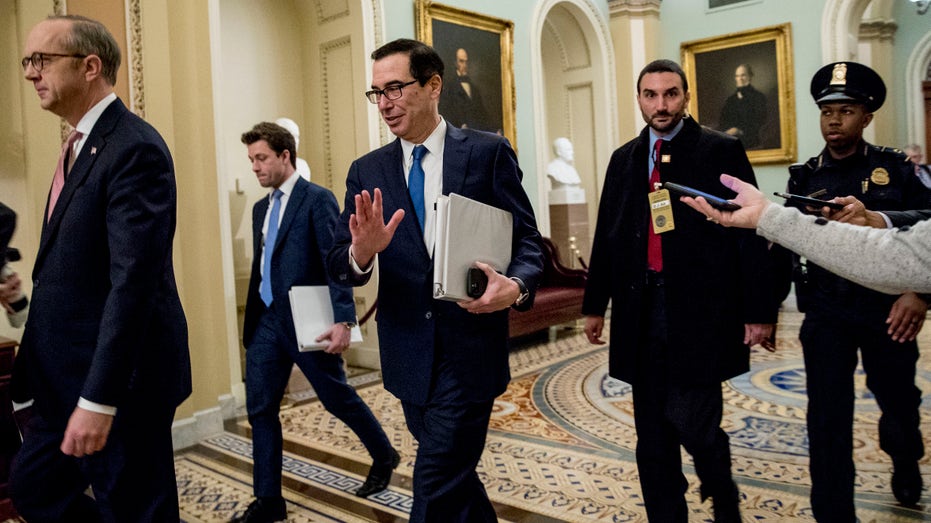
Treasury
Secretary Steven Mnuchin, third from left, and White House Legislative
Affairs Director Eric Ueland, left, walk to a meeting with Senate
Minority Leader Sen. Chuck Schumer of N.Y. in his office on Capitol
Hill, Monday, March 23, 2020, in Was
As Congress was
locked in stalemate, the number of known infections worldwide jumped
past 380,000. After just a few weeks, the United States has more than
46,000 cases and more than 600 deaths. Also Monday, trading on the
New York Stock Exchange went all-electronic for the first time after
the trading floor was temporarily closed as a precaution. The exchange
announced the move last week after two employees tested positive for the
virus. The number of floor traders had dwindled sharply in recent years
as more trading become electronic. Wall Street and some other
stock markets have lost nearly one-third of their value over the past
month as business shutdowns spread and airlines, retailers and other
industries suffer rising losses. Economists increasingly say a
recession seems inevitable. Analysts are slashing their forecasts for
upcoming corporate profits. Forecasters say they cannot project how deep
the downturn might be or how long it will last. Professional traders say investors need to see a decline in numbers of new infections before markets can find a bottom. Congress
debated through the weekend on the rescue plan, but White House
officials and congressional leaders are struggling to finalize it.
Democrats blocked a vote to advance the package Monday. They want to
steer more of the assistance to public health and workers. Even if
the two sides find a compromise, Congress may need to go through more
rounds of similar negotiations if the outbreak isn't brought under
control.
On
Wall Street, the benchmark S&P 500 fell 2.9 percent in another day
of sudden swings. It was down as much as 4.9 percent and as little as
0.2 percent earlier in the day. The Dow Jones Industrial Average
fell 3 percent. The Nasdaq, which is dominated by technology companies,
lost only 0.3 percent as tech shares held up better than the rest of the
market. In
energy markets, benchmark U.S. crude gained $1.06 to $24.43 per barrel
in electronic trading on the New York Mercantile Exchange. The contract
lost $2.59 the previous session to close at $22.63. Brent crude, used to
price international oils, added 84 cents to $27.91 per barrel in
London. It lost $1.49 the previous session to $26.98. The Associated Press contributed to this article.
Tucker Carlson called
on Democrats in Congress Monday to put aside their "stupid partisan
points" and stop "indulging their creepy ideological obsessions" to
focus on getting a coronavirus relief bill passed. "Americans
worry they can die of this disease and someone they love could die
if they lose their jobs and could be crippled permanently in the wake of
this disaster. It's a terrifying moment," Carlson said. "In that
moment, we need wisdom and steady guidance from our leaders. We need
altruism, [they] need to care more about you than they care about
themselves ... but in Congress, they don't." "The
foremost concern of some members is saving their own investment
portfolios or making stupid partisan points or indulging their
creepy ideological obsessions," Carlson went on. "Wonder why Congress
hasn't yet passed a bill to help the country survive this? That's why." Lawmakers clashed on
the Senate floor Monday over phase three of a coronavirus response
package, with Democrats blocking Republican efforts to advance the
massive stimulus bill for the second day in a row.
"At a
time when America so desperately needs to come together, Democrats
remain intent on splitting this country into warring tribes." — Tucker Carlson
House Speaker Nancy Pelosi,
D-Calif., introduced her own emergency coronavirus stimulus bill on
Monday, leading furious Republicans to argue that much of the proposal
contained a progressive wishlist seemingly unrelated to the crisis. "Read
it and you will find disgusting little handouts added by lobbyists,"
Carlson said. "Worse, it is suffused with the cruel bigotry of identity
politics. At a time when America so desperately needs to come together,
Democrats remain intent on splitting this country into warring
tribes. It’s shocking." The bill proposed by Pelosi includes
provisions to eliminate debt held by the U.S. Postal Service, require
same-day voter registration, pay off $10,000 in student debt per person,
mandate that airlines reduce their overall carbon emissions by 50
percent by 2050, and force federal agencies to explain to Congress how
they are increasing their usage of "minority banks." And, Carlson noted, the legislation is filled with "totally unrelated political priorities" would provide for the automatic extension of nonimmigrant visas and restrict colleges from providing authorities information about citizenship status. "So
we are staring down the barrel of the most profound employment crisis
of our lifetime -- that’s not an exaggeration -- and what are Democrats
doing?" asked Carlson. "Trying to automatically renew visas and work
permits for all immigrants because their jobs are very important, way
more important than yours. Democrats want to make certain that people
who are replacing you are secure and happy, PELOSI STIMULUS BILL INCLUDES RETURN OF 'OBAMAPHONES' "The whole thing defies belief and that's not a partisan observation." Carlson
further criticized a provision in Pelosi's bill that would require
every corporation that received coronavirus aid to have officers and a
budget dedicated to diversity and inclusion initiatives for a minimum
of five years. "Because that's going to keep America healthy and prosperous," he mocked. "In
all, this [House] bill uses the word 'diverse' or 'diversity' more
than 60 times," Carlson went on. "What does that have to do with the
pandemic that might kill you? Not one thing. Just more ugly race
politics, the kind they specialize in. Democrats think that's much
more important right now." Pelosi's bill
also allocates $300 million for the hiring of experts to
manage coronavirus preparation and response, but "instead of looking for
the most qualified people at a time of national emergency, the
only criteria right now orders employees be chosen on the basis of their
race and disability status," Carlson explained. "Who cares what color your scientists are?" Carlson concluded. "This is dangerous insanity." Fox News' Gregg Re contributed to this report.
Sen. Chuck Schumer, D-N.Y., told reporters early Tuesday that he expects Republicans and Democrats
in the Senate to come together and reach an agreement on the $2
trillion coronavirus stimulus package that set off a fierce debate on
the Senate floor and allegations from both sides that the other was
politicizing the emergency. Despite the logjam,
Schumer, the Senate minority leader, and Treasury Secretary Steven
Mnuchin told reporters that there was progress made in late-night
negotiations. Schumer said he expects a vote sometime on Tuesday. PENCE URGES DEMS TO ACT ON BILL One
of the key issues in the package is the $500 billion "Exchange
Stabilization Fund." Democrats call it a "slush fund," and claim
Mnuchin would have far too much influence over which industries would
have access to the fund. Mnuchin denied the claim on Fox Business,
saying, "It's not a slush fund; it's a mechanism that we can use
working with the Federal Reserve that will provide another $4 trillion
of potential liquidity into the market. That’s on top of the Fed’s
balance sheet." A Politico reporter, citing three sources, tweeted that Mnuchin agreed to "significant oversight" for the fund in part of the negotiations. President Trump claimed Monday that the Senate Democrats were “playing partisan politics” and should make the deal. “I think we've made a lot of progress, Mnuchin told reporters. "Both sides have been working around the clock." He said there are a few documents that need to be reviewed and turned around but he is hopeful they will be resolved Tuesday. Schumer also s struck an optimistic tone. “We
expect to have an agreement tomorrow morning. There’s still a few
little differences. Neither of us think they’re in any way going to get
in the way of a final agreement,” he said. At
around the time Schumer and Mnuchin were leaving the Capitol, Trump
re-tweeted a National Review article about last-minute "ideological
demands" from Democrats that were added to the relief package. The
report said these demands included the expansion of wind and solar tax
credits and increased fuel emissions standards for airlines. Trump tweeted, “This will never be approved by me or any other Republican!”
Senate Democrats late Sunday blocked the $1.3 trillion economic rescue package Republicans say would help businesses and families hurt financially by the coronavirus outbreak, prompting U.S. stock futures to fall 5 percent and sparking a new wave of uncertainty that the two sides can get together and forge an agreement. Democrats
insist that President Trump and Sen. Mitch McConnell, R-Ky., are using
the funds to put corporations ahead of families. The attempt to advance
the legislation stalled in a 47-47 vote. Sixty votes were needed to
pass. Many Americans are facing unforeseen hardships after the
coronavirus outbreak hit the country and temporarily closed businesses.
The stimulus was championed by Trump, who said Saturday that the package
was very close to being a done deal. McConnell blasted his
Democrat colleagues and accused them of being influenced by Sen. Chuck
Schumer and House Speaker Nancy Pelosi. "I want everybody to fully
understand if we aren't able to act tomorrow, it will be because of our
colleagues on the other side continuing to dicker when the country
expects us to come together and address the problem," McConnell said on
the floor. Democrats risk being portrayed by Trump as politically
bent on stopping him at any cost. Sen. Susan Collins, R-Maine, said the
move by Democrats is "irresponsible and unwise." "They are playing with fire," she said, according to the New York Times. McConnell’s office said early Monday that three votes are expected later Monday after his remarks at around noon. The Sunday vote came while at least five GOP senators were in self-quarantine, including Sen. Rand Paul, R-Ky., who became the first U.S. senator to announce he tested positive for the virus. Many
Democrats complained that the draft aid package did not go far enough
to provide health care and unemployment aid for Americans, and failed to
put restraints on a proposed $500 billion "slush fund" for
corporations. They said the ban on corporate stock buy-backs are weak
and the limits on executive pay would last only two years. "They’re
trying to advance a proposal that would be great for giant corporations
and leave everyone else behind," said Sen. Elizabeth Warren, according to the Wall Street Journal. Democrats
also pushed for add-ons including food security aid, small business
loans and other measures for workers — saying the three months of
unemployment insurance offered under the draft plan was insufficient. Schumer,
the Senate minority leader, said the draft package "significantly cut
back our hospitals, our cities, our states, our medical workers and so
many others needed in this crisis." MARK LEVIN: PEOPLE ARE SICK AND DYING AND PELOSI IS PLAYING GAMES Pelosi, D-Calif., urged colleagues to "take responsibility" as Democrats prepared their own draft. The House had just returned from a weeklong recess. After the
bill failed to move forward, McConnell tore into Democrats, accusing
them of backing out of a bipartisan agreement once Pelosi and Schumer
intervened. He claimed Pelosi took "a week off" and "poured cold water
on the whole process." "She's the Speaker of the House, not the Speaker of the Senate," McConnell said, according to Politico. "We were doing just fine until that intervention." Schumer
was in touch with Treasury Secretary Steven Mnuchin late into the night
Sunday to negotiate the plans. Their last meeting was at 11: 45 p.m.
inside Schumer’s officer in the Capitol. We’re closer now than we
were in the past 48 hours to an agreement, Schumer said. “Can we
overcome the remaining disagreements in the next 24 hours? Yes. We can
and should.” Earlier, Mnuchin told “Fox News Sunday” that he was looking forward to wrapping up the package on Sunday. He
said that the government will provide direct deposits, with an average
family of four receiving approximately $3,000, as well as “enhanced
unemployment insurance” for those laid off due to the outbreak. The
fourth part, Mnuchin said, is “a significant package working with the
federal reserve, which will provide “up to $4 trillion of liquidity that
we can use to support the economy.” “The
U.S. economy is strong. We’ve stopped major parts of it, but when we
get through this virus, as I’ve said, I think you’re gonna see the U.S.
economy come back to the strength, we have great companies, we have
great workers," he said. "What we need to do is have a bridge to get
through this. And this isn’t the financial crisis that’s gonna go on for
years.” Fox News' Ronn Blitzer and the Associated Press contributed to this report
U.S. equity futures climbed off limit down Sunday evening as Congress continues to grapple over the details of a third COVID-19 stimulus package and as millions of Americans remain isolated at home in an attempt to combat the disease. Top-level
negotiations between U.S. Congress and the White House continued after
the Senate voted against advancing the $2 trillion economic rescue
package. The Democrats said the bill was tilted too much toward
aiding corporations and would not do enough to help individuals and
healthcare providers. At 4:30 a.m. ET Dow futures were trading
down 735 points, or 3.8 percent, after having fallen by as many as 954
points. S&P 500 futures, which fell by the limit 5 percent, were off
3.6 percent. The losses come after the major averages last week
suffered through their sharpest weekly drop since the 2008 financial
crisis as more industries instituted massive layoffs and business slowed
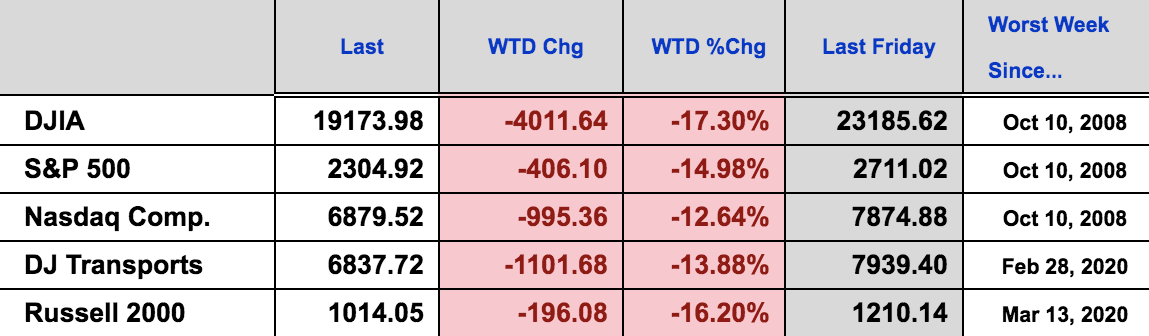
to a near standstill. The Dow Jones Industrial Average last week
tumbled 4,011 points, or 17.3 percent, while the S&P 500 and Nasdaq
Composite lost 14.98 percent and 12.64 percent, respectively. Treasury
Secretary Steven Mnuchin told Fox News' John Roberts on Sunday morning
the third stimulus package will have four components, consisting of
small business retention loans that will provide two weeks of cash flow
to pay workers and some overhead, direct deposits amounting to
approximately $3,000 for a family of four, enhanced employment insurance
for those who are laid off and up to $4 trillion to support the
economy. He added there is a "significant amount of money" for hospitals and medical professionals. COVID-19,
which has caused eight states to issue "stay-at-home" orders, has
infected more than 32,700 people in the U.S. and killed 409, according
to the latest figures provided by Johns Hopkins University &
Medicine. One hundred seventy-people have recovered. West Texas
Intermediate crude oil futures for May delivery plunged before paring
that loss to 0.5 percent at around $22.48 per barrel while gold futures
for June delivery traded up by nearly the same amount at $1,498 an
ounce. In Europe, London's FTSE fell 4.8 percent, Germany's DAX declined 4.6 percent and France's CAC dropped 4.1 percent. In
Asian markets, Japan's Nikkei added 2 percent, Hong Kong's Hang Seng
fell 4.9 percent and China's Shanghai Composite declined 3 percent.
President Trump tweeted
Sunday that his administration will reassess its response to the
coronavirus outbreak at the end of the 15-day period that calls on
Americans to limit their normal behaviors in an effort to slow the spread of the virus. Businesses
across the U.S. have been turned on their heads as federal, state and
local governments called for drastic measures to block more infections.
Stocks on Wall Street plunged to their worst losses in more than three
decades. "We cannot let the cure be worse than the problem
itself," the president tweeted in caps lock, before announcing the
reassessment. Trump last week moved to blunt the impact of the
pandemic on a U.S. economy fundamentally altered by a push for the
nation to stay home. Hotels, restaurants, airlines, and retailers have
suffered major losses. The emergency stimulus bill also hit a snag in
the Senate hours before Trump's tweet. The GOP-controlled Senatefailed
to move forward with the $1.4 trillion "Phase Three" stimulus package
intended to help businesses and families devastated by the downturn over
the coronavirus outbreak. Many
Democrats had complained that the draft aid package did not go far
enough to provide health care and unemployment aid for Americans, and
failed to put restraints on a proposed $500 billion "slush fund" for
corporations, saying the ban on corporate stock buy-backs are weak and
the limits on executive pay would last only two years. Treasury
Secretary Steven Mnuchin, exiting the Capitol just before midnight,
struck an optimistic note: "We're very close," he said, adding
negotiators would work through the night. Senate Democratic leader Chuck Schumer, D-N.Y., after meeting multiple times with Mnuchin, said progress was being made. "There's
a good chance we'll have an agreement," Schumer said as the Senate
gaveled close, shortly before midnight. "We are fighting for a better
bill." Ray Dalio, the billionaire founder of hedge fund behemoth Bridgewater Associates, sounded the alarm Thursday over the coronavirus crisis and said U.S. corporations will lose up to $4 trillion and Trump needs to dramatically increase his stimulus plan. Dalio’s
comments come a day after Bill Ackman, another billionaire investor,
called on the president to shut down the country for 30 days or “America
will end as we know it.” Fox News' Bradford Betz and the Associated Press contributed to this report
“We need Congressional action by Monday,” warned one Republican administration source late last week to Fox. “Monday” was supposed to be the deadline for the Senate to act on the third legislative phase of the coronavirus response. Senate Majority Leader Mitch McConnell (R-KY)
set up a process late last week where the Senate would take a
procedural vote Sunday to begin debate on a “shell” of a bill. Once
there was a deal, McConnell would insert the coronavirus package into
the parliamentary empty box. The hope was that the Senate could get 60
yeas to open debate on the coronavirus measure Sunday – then speed up
the process and pass the bill Monday. Then the House would have to move
to align with the Senate sometime in the near future. That all melted down Sunday night. Republicans
were always going to need buy-in by Senate Democrats to start debate on
the legislation. As we always say on Capitol Hill, it’s about the math,
it’s about the math, it’s about the math. The current Senate
breakdown is 53 Republicans and 47 senators who caucus with the
Democrats. The procedural vote required 60 yeas to overcome a
filibuster. But lacking sign-off by Senate Democrats - to say
nothing of House Speaker Nancy Pelosi (D-CA) - the procedural vote
garnered only 47 yeas. McConnell was for advancing the plan. But the
Kentucky Republican changed his vote at the end. Senate rules allow a
senator to call for a re-vote if they cast their ballot on the
prevailing side of the issue – in this instance, the nays. So even
though McConnell was for it, he strategically switched his vote so he
could ask for another vote. Late Sunday night, there was no vote
scheduled. It’s unclear how fast the sides can forge an agreement –
if at all. But it didn’t take an exercise in Euclidian Geometry to see
that the procedural vote was going to fail on Sunday afternoon. Sen.
Rand Paul (R-KY) announced he tested positive for coronavirus
before the vote. Two other GOPers were already self-quarantining. Sens.
Mike Lee (R-UT) and Mitt Romney (R-UT) announced they would quarantine
since they had exposure to Paul. That means Senate Republicans
barely have a majority right now: 48-47. McConnell excoriated Senate
Democrats and Pelosi for blocking the shell bill Sunday. “We’re
fiddling here. Fiddling with the emotions of the American people.
Fiddling with the markets. Fiddling with our health care,” thundered a
visibly angry McConnell. The Majority Leader then publicly lambasted Pelosi. “She’s
the Speaker of the House. Not the Speaker of the Senate. We don’t have
one. We were doing just fine until that intervention,” bellowed
McConnell. But Senate Democrats weren’t going to budge unless
there was sign-off from Pelosi. After all, Pelosi must figure out a way
to shepherd a Senate-GOP produced product through her body. And, if time
is of the essence, there are questions as to why McConnell forged ahead
without the votes lined up. And so, we’ll see if things move on Monday. As
the Senate voted, the Dow futures plummeted five percent within minutes
of opening Sunday night. That’s the maximum decline allowed before
circuit breakers kick in, suspending trading. That’s an ominous warning,
portending a rocky trading session on Monday. So what about all of that talk about Congress moving “by Monday?” Fox
was told last week that “by Monday” was a dire warning to lawmakers to
wrap this up. It was reminiscent of the nighttime meeting on September
18, 2008 in the Speaker’s Office amid the financial crisis. Pelosi
phoned then Treasury Secretary Hank Paulson for a status report. Paulson
told Pelosi that they urgently needed to talk in person at the Capitol
that night as the country teetered on the edge of an economic collapse. Pelosi later said that Paulson told her if they didn’t negotiate later that evening “we wouldn’t have an economy by Monday.” Now, back to 2020. “The markets are not going to tolerate inaction,” said one Republican source. “They need to move by Monday.” So, we’ll see what they can resolve to avoid a bloodbath on Wall Street Monday morning. And then there is the war of attrition: actual concern about the health of senators. As
I reported on the air last Wednesday night, Fox was told then that
finishing the coronavirus bill was a race against time. Lawmakers needed
to wrap this up before everyone on Capitol Hill got sick. Now
“coronavirus is in the Senate,” as McConnell declared Sunday night. Some
senators from both parties are livid at Paul, an ophthalmologist by
training, for showing up on Capitol Hill as he awaited results of a
coronavirus test. Paul’s positive test sent shockwaves through the
Senate. Some questioned the wisdom of why, day after day after day, GOP senators have repeatedly huddled for lunch meetings
on Capitol Hill. At first, it was the standard location, the Mike
Mansfield Room near the Senate chamber. Then, the Kennedy Caucus Room in
the Russell Senate Office Building. There were also conclaves in the
Central Hearing Facility in the Hart Senate Office Building. Notably, no
Democratic senator has yet tested positive. Democrats have held all of
their meetings via conference call. “Personally, I would just
stay a lot further away if I had a test pending,” said Sen. Kevin Cramer
(R-ND) of Paul. “Might not have gone to the gym. Might not have sat at a
meal. Maybe I would make arrangements to vote all by myself without
somebody else in the chamber. There’s lots of room here. He is a
physician himself. So one would think his ability to assess the risk is
pretty good. And maybe in that education and ability, he calculated
wrong.” Sen. Kyrsten Sinema (D-AZ) scorched Paul on Twitter, though she didn’t mention her colleague by name. “I’ve
never commented about a fellow Senator’s choices/actions. Never once,”
tweeted Sinema. “This, America, is absolutely irresponsible. You cannot
be near other people while waiting for coronavirus test results.” Most
lawmakers think they are ten feet tall and bulletproof anyway.
Lawmakers keep saying they are doing everything in compliance with CDC
guidelines and in consultation with U.S. Capitol Attending Physician Dr.
Brian Monahan. But patience is running thin. “We need to walk with the Attending Physician,” said one senior GOP source, referring to Monahan. “And Paul.” This
is why no one is quite sure how they bring the House back to vote on
the phase three coronavirus bill. They’ve floated everything from
approving the package via unanimous consent – where no one in the
chamber objects – to stretching out the vote over a day or two. To be
frank, House members are completely flipped out about having to come
back to align with the Senate. But that presumes the Senate can get an agreement and send it to the House. Let alone, “by Monday.”