The U.S. Foreign Intelligence Surveillance Court on Wednesday granted
the Justice Department a one-week extension to give details about
court-ordered reforms to the Foreign Intelligence Surveillance Act
(FISA) amid the coronavirus outbreak. “The
government, through counsel, orally requested a one-week extension of
the time to provide such information, in view of modified staffing and
telework practices occasioned by the COVID-19 outbreak,” Judge James
Boasberg, chief judge of the FISA court, wrote, The Washington Examiner reported. “Accordingly, the government’s time to provide such information is hereby extended.” FISA court blocks FBI agents linked to Carter Page probe from seeking wiretaps, other surveillance Late
last year, the inspector general found at least 17 "significant
inaccuracies and omissions" in the application to get a warrant to
monitor former Trump campaign adviser Carter Page. Inspector
General Michael Horowitz’s nearly 500-page report was also sharply
critical at times of the FBI’s handling of the case, including failing
to share information. Earlier this month, Boasberg also largely
approved revisions that the FBI said it would make to its process for
seeking wiretaps – in reaction to Horowitz's report. Among the
problems, Boasberg noted, were that the FBI had "omitted or
mischaracterized" various "information bearing on [former British spy
Christopher] Steele's personal credibility and professional judgment." Boasberg
told the Justice Department to provide details about proposed FISA
reforms in March and asked for a report on “improving DOJ proactiveness
in ensuring the completeness of FISA applications,” according to the
Examiner. The deadline was pushed from March 27 to April 3, the Examiner reported. Fox News' Dom Calicchio, Ronn Blitzer and Brooke Singman contributed to this report.
By a vote of 96-0, the Senate passed a massive $2 trillion coronavirus stimulus compromise package just before midnight Wednesday, ending days of deadlock and sending the bill to the House of Representatives
-- which House Speaker Nancy Pelosi said will soon take up the historic
measure to bring relief to individuals, small businesses, and larger
corporations "with strong bipartisan support." The 880-page legislation is the largest economic relief bill in U.S. history. Senate Majority Leader Mitch McConnell,
R-Ky., appeared somber and exhausted as he announced the vote. He
released senators from Washington until April 20, though he promised to
recall them if needed. "96-0 in the United States Senate," President Trump wrote on Twitter. "Congratulations AMERICA!" The
unanimous vote came despite misgivings on both sides about whether it
goes too far or not far enough. The vote capped days of difficult
negotiations as Washington confronted a national challenge unlike any it
has ever faced. Unemployment numbers were set to be revealed Thursday
morning, and experts warned they could reach alarming new highs. The package would
provide one-time direct payments to Americans of $1,200 per adult
making up to $75,000 a year, and $2,400 to married couples making up to
$150,000, with $500 payments per child. After a $75,000 threshold for
individuals, the benefit would be reduced by $5 for each $100 the
taxpayer makes. A similar $150,000 threshold applies to couples, and a
$112,500 threshold for heads of households. READ THE FINAL BILL; READ A SUMMARY OF THE BILL ; READ THE SASSE AMENDMENT The
legislation passed by the Senate will use 2019 tax returns, if
available, or 2018 tax returns to assess income for determining how much
direct financial aid individuals receive. Those who did not file tax
returns can use a Form SSA-1099, Social Security Benefit Statement or
Form RRB-1099, a Social Security Equivalent Benefit Statement, per Page
149 of the bill.
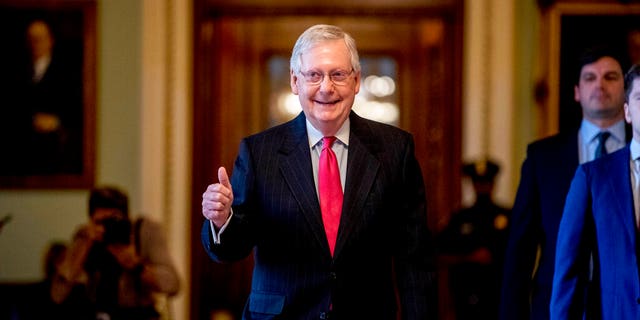
Senate Majority Leader Mitch McConnell of Ky. gives a thumbs up as
he leaves the Senate chamber on Capitol Hill in Washington, Wednesday,
March 25, 2020, where a deal has been reached on a coronavirus bill. The
2 trillion dollar stimulus bill is expected to be voted on in the
Senate Wednesday. (AP Photo/Andrew Harnik)
Further, the bill allocates $250 billion to extend
unemployment insurance to more workers, and lengthen the duration to 39
weeks, up from the normal 26 weeks. $600 extra a week would be provided
for four months. (Just before voting on the final package began late
Wednesday, the Senate was debating an amendment from Sen. Ben Sasse,
R-Neb., to bar people from getting more from new unemployment benefits
than they would have received on the job; the amendment needed 60 votes
and failed 48-48.) The final package would additionally provide
$349 billion in loans to small businesses -- and money spent on rent,
payroll and utilities becomes grants that don't need to be paid back.
Many hotels would qualify as small businesses under the plan. Passenger
airlines would receive $25 billion for workers' "salaries and
benefits," plus up to $25 billion more in loan guarantees and loans.
Contract workers would also receive $3 billion in assistance. Airlines
would have to agree not to furlough workers until at least the end of
September in return. WHO QUALIFIES FOR A CHECK? About
$17 billion will go to other distressed companies like Boeing, which is
seen as essential to national security. And, approximately $200 billion
would be provided in tax assistance to small businesses, including
through payroll tax deferrals. At the same time, the bill omits many -- though not all -- items from Pelosi's version
of the legislation that Republicans had called wasteful or irrelevant,
including climate-change-related emissions restrictions for airlines and
various diversity-related provisions.
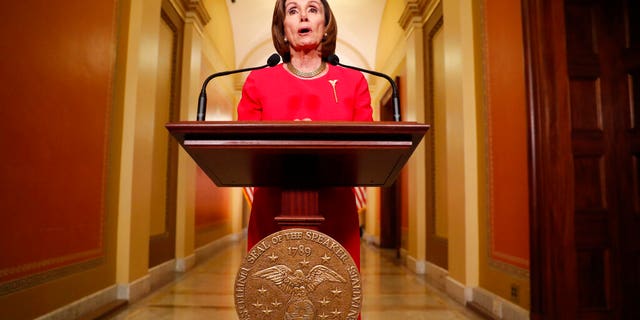
House Speaker Nancy Pelosi of Calif. speaks outside her office on
Capitol Hill, Monday, March 23, 2020. (AP Photo/Andrew Harnik, Pool)
Gone from the stimulus bill are mentions of mandatory early voting, ballot harvesting,
requirements that federal agencies review their usage of "minority
banks," and attempts to curb airlines' carbon emissions -- a Pelosi
demand that even Saikat Chakrabarti, the former chief of staff to Rep. Alexandria Ocasio-Cortez and an author of the Green New Deal, called "ridiculous." "What's
not in the Senate's bipartisan coronavirus bill: Pelosi's outrageous
wish list," wrote GOP national spokesperson Elizabeth Harrington. "0
mentions of 'diversity.' 0 mentions of 'emissions.' 0 mentions of 'early
voting.' 0 mentions of 'climate change.' Good!" But, the package still contained some wins for Pelosi. Page 524 of the bill text
indicates that many businesses that take a government loan would be
obligated to remain neutral in any "union organizing effort" during the
loan -- a major giveaway to unions. Affected businesses would have
between 500 and 10,000 employees. And, Page 781 of the bill
provides $25 million to the Democratic-controlled House of
Representatives to cover "salary and expenses." Also in the final
bill text, $25 million would still be allocated for the Kennedy Center
for the Performing Arts. Trump, speaking at the White House coronavirus
briefing earlier Wednesday, said that he understood the provision was
necessary because Democrats demanded some concessions in order to get
the stimulus bill passed, even though it galled some conservatives. Pelosi was the first to demand the Kennedy Center money in her own bill, which Republicans said was full of unseemly payouts for well-connected special interests at a time of national crisis. The Kennedy Center put out a statement Wednesday evening saying
it was "extraordinarily grateful that Congress has recognized our
institution's unique status and has included funding in its legislation
to ensure that we can reopen our doors and stages as soon as we are
able." "For an opera house, you sure are tone-deaf," responded blogger Jim Treacher, after telling the Kennedy Center where to shove its statement.
John F. Kennedy Center for Performing Arts shot at dusk across the Potomac in Georgetown
Meanwhile, House Majority Leader Steny Hoyer, D-Md.,
said the House would vote on the matter on Friday. Republican leaders
said they'd whip votes to support the bill. "Over the past few
days, the Senate has stepped into the breach," Senate Minority Leader
Chuck Schumer, D-N.Y., said in his own remarks. "We packed weeks or
perhaps months of the legislative process into five days.
Representatives from both sides of the aisle and both ends of
Pennsylvania Avenue have forged a bipartisan agreement in highly
partisan times, with very little time to spare." He added: "It’s
been a long, hard road, with a remarkable number of twists and turns,
but for the sake of millions of Americans, it will be worth it. It will
be worth it to get help to millions of small businesses and save tens of
millions of jobs." However, earlier in the day, a senior GOP source told Fox
News contributor and Townhall.com editor Guy Benson that the compromise
bill was a face-saving exercise by Schumer, and that he was trying to
"take credit" for a GOP bill that he filibustered for "small ball"
alterations. Democrats, the source said, couldn't drag the situation out
much longer; economic conditions have worsened dramatically, and
President Trump's approval rating has risen. And,
a senior Republican aide separately told Fox News: "I half expected
that the next thing I read would be the Minority Leader taking credit
for inventing fire. The reality is that almost every significant 'win'
he's taking credit for, is actually a Senate Republican idea." Republicans
had "never objected" to more hospital funding, or that oversight of the
stimulus stabilization fund "be structured almost exactly like TARP
oversight," the aide went on. And Republicans were the first to push for
three months of unemployment insurance and "did not oppose adding a
fourth." The stimulus movement came as stocks posted their first
back-to-back gains in weeks, but much of Wednesday's early rally faded
as the hitch developed in the Senate. The market is down nearly 27
percent since setting a record high a month ago. Amid the debate, presidential hopeful Sen. Bernie Sanders
said he might try to torpedo the Senate's stimulus package
as Republican senators raised objections about what they called a
"massive drafting error" related to unemployment benefits. “In my
view, it would be an outrage to prevent working-class Americans to
receive the emergency unemployment assistance included in this
legislation," Sanders said in a statement, also posted on social media. Sanders
took to the Senate floor late Wednesday at approximately 9:30 p.m. ET
to say he was concerned that the administration would be able to "expend
$500 billion in virtually any way they want" under the legislation. In
fact, the administration would not have such unilateral control. "They're
very upset that somebody who is making 10, 12 bucks an hour might end
up with a paycheck for four months more than they received last week,"
Sanders went on. "Oh, my god, the universe is collapsing!" The concern
from Sens. Lindsey Graham, Tim Scott, R-S.C., Sasse, and Rick Scott,
R-Fla., was that the the bill could pay workers more in unemployment
benefits than they'd make in salary, by sticking a $600 per week payment
on top of ordinary benefits that are calculated as a percentage of
income. Democrats and economists have countered that the point of
the new unemployment benefit is, in fact, to make peoples' salaries
whole, and that companies could simply raise wages to compete and
attract workers. "The weird thing about this hypothetical
'generous unemployment pay will discourage people from entering critical
industries' is... they could just raise wages?" Alex Godofsky wrote on
Twitter. "Amazon has already raised wages. Like, it's okay if wages -
and prices - go up for a while. It's fine." Others have noted that the unemployment benefits boost would expire in the summer.
In an article entitled "Republican Senators’ Objection to Expanded
Unemployment Benefits Makes Little Sense," Josh Barro began by noting
that "these are unemployment benefits, and you generally have to have
been laid off to claim them." "We will continue to have
virus-mitigation measures that create mass unemployment for a
significant period, and even after those measures can be relaxed through
much of the country, it will take some time for employers to re-ingest
all the previously laid-off workers," Barro wrote. "In fact, it’s likely
that the shutdowns will persist long enough that the enhanced benefits
will need to be extended. If we’re in a situation by July where all the
shutdowns are over and employers are eagerly hiring and our biggest
concern is too many people don’t want to go back to work, I will be
overjoyed and very surprised." Later Wednesday, the Republicans
agreed to drop their objections to fast-tracking the stimulus vote, as
long as there was first a vote on the Sasse amendment to cap
unemployment benefits to 100 percent of salary. Also in the
evening, Pelosi said unanimous consent was a nonstarter in the House,
and implied that quick passage in the lower chamber may be unrealistic.
Pelosi has called for members to have at least 24 hours to review the
bill text once it's available.
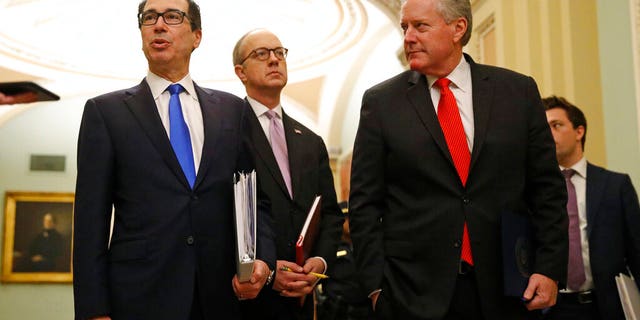
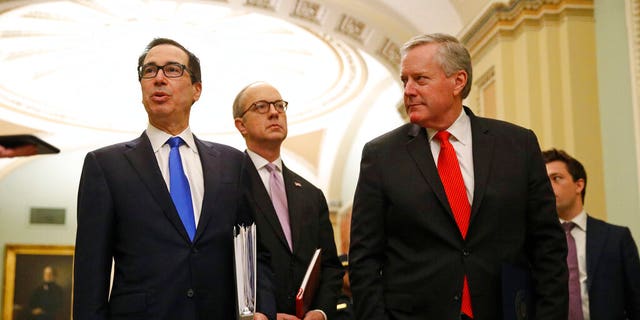
Treasury Secretary Steven Mnuchin, left, accompanied by White
House Legislative Affairs Director Eric Ueland and acting White House
chief of staff Mark Meadows, speaks with reporters as he walks to the
offices of Senate Majority Leader Mitch McConnell of Ky. on Capitol Hill
in Washington, Tuesday, March 24, 2020. (AP Photo/Patrick Semansky)
“That’s not gonna work," she told reporters shortly
after 7:30 p.m. ET, referring to unanimous consent. "Republicans have
told us that’s not possible from their said. ... What I’d like to see --
because this a $2 trillion bill -- I’d like to see a good debate on the
floor." Meanwhile, the White House projected confidence.
Insistently optimistic, President Trump said of the greatest
public-health emergency in anyone's lifetime, "I don’t think it's going
to end up being such a rough patch" and anticipated the economy soaring
“like a rocket ship” when it's over. Yet he implored Congress late in
the day to move on critical aid without further delay. The package
is intended as relief for an economy spiraling into recession or worse
and a nation facing a grim toll from an infection that's killed nearly
20,000 people worldwide. Treasury Secretary Steven Mnuchin, asked how
long the aid would keep the economy afloat, said: “We’ve anticipated
three months. Hopefully, we won’t need this for three months." Underscoring
the effort's sheer magnitude, the bill finances a response with a price
tag that equals half the size of the entire $4 trillion annual federal
budget. Fox News' Chad Pergram and Jason Donner, and Fox
Business Network's Hillary Vaughn, as well as The Associated Press,
contributed to this report.
WASHINGTON
(AP) — For most Americans alive today, the idea of shared national
sacrifice is a collective abstraction, a memory handed down from a
grandparent or passed on through a book or movie.
Not
since World War II, when people carried ration books with stamps that
allowed them to purchase meat, sugar, butter, cooking oil and gasoline,
when buying cars, firewood and nylon was restricted, when factories
converted from making automobiles to making tanks, Jeeps and torpedos,
when men were drafted and women volunteered in the war effort, has the
entire nation been asked to sacrifice for a greater good.
The
civil rights era, Vietnam, the Gulf wars, 9/11 and the financial crisis
all involved suffering, even death, but no call for universal
sacrifice. President George W. Bush encouraged people to buy things
after the terrorist attacks to help the economy — “patriots at the
mall,” some called it — before the full war effort was underway. People
lost jobs and homes in the financial crisis, but there was no summons
for community response.
Now,
with the coronavirus, it’s as though a natural disaster has taken place
in multiple places at once. Millions will likely lose their jobs.
Businesses will shutter. Schools have closed. Thousands will die.
Leaders are ordering citizens into isolation to stop the virus’ march.
Suddenly,
in the course of a few weeks, John F. Kennedy’s “ask what you can do
for your country” injunction has come to life. Will Americans step up?
“This is a new moment,” said Jon Meacham, a historian and author of “The Soul of America.”
“Prolonged
sacrifice isn’t something we’ve been asked to do, really, since World
War II,” Meacham said. “There was a kind of perpetual vigilance in the
Cold War — what President Kennedy called ‘the long twilight struggle’ —
but living with the fear of nuclear war is quite abstract compared to
living with the fear of a virus and of a possible economic depression.”
The
second world war involved a common enemy and common purpose, with clear
sides drawn across the globe. While President Donald Trump has at times
tried to summon that feeling about attacking the coronavirus, he has
abruptly changed course, suggesting Monday that restrictions he has
sought on American life may be as short-lived as his slogan about “15
days to slow the spread,” even as others are warning that most of the
country is about to be hit by a crush of new cases.
In
Congress, some talk of coming together while others excoriate their
partisan opposites. On Monday, Senate Majority Leader Mitch McConnell
(R-Ky.) laid the early blame for lack of congressional action entirely
at the feet of Democrats.
“A
request to do anything becomes a point of attack, and we are always 10
steps back from where we should be on big legislative agreements,” said
Julian Zelizer, a professor of history at Princeton. “So intense
polarization in a moment of crisis — with a president who is not
interested in time-tested forms of governance and the job of uniting —
make this much more difficult.”
That
has not been universal. Gov. Mike DeWine (R-Ohio), moved swiftly to
shut down most activity in his state and he implored Ohioans to help.
“We
have not faced an enemy like we are facing today in 102 years,” DeWine
said recently. “You have to go back to the 1918 influenza epidemic. We
are certainly at war. ... In the time of war, we must make sacrifices,
and I thank all of our Ohio citizens for what they are doing and what
they aren’t doing. You are making a huge difference, and this difference
will save lives.”
As
a nation, Americans are accustomed to seeing swaths of the country
destroyed by hurricanes, floods, wildfires and blizzards. But there is
then a season of rebuilding and renewal. The coronavirus, with its rapid
spread, is giving Americans a public-health Katrina that knows few
borders or boundaries, even though some parts of the country are
suffering far more than others.
To
date, for many, the sacrifices have been mere inconveniences. No
restaurants or movie theaters. Maybe the need to buy exercise equipment
because the gym has closed. Or to leave the cardboard box from Amazon
outside for 24 hours to make sure the virus doesn’t somehow enter the
home.
A week of
being told to work from home can resemble a working vacation. A week of
not being able to work at all is frustrating but, potentially,
eventually reversible.
But when a week bleeds into a month, or longer, how will we react?
“We
used to tax in times of crisis. Now we don’t,” Zelizer said. “We asked
people to ration in times of crisis. Now we don’t. We asked people to
serve in times of crisis. Now we don’t. So this is a sea change. The
thing is, Americans might not have a choice.”
For
many, the choices are personal and painful. Rep. Abigail Spanberger
(D-Va.) cannot see her parents or her in-laws for the foreseeable future
because she may have been exposed to the virus. But she is also seeing
the impact of the virus in many other ways that are far more harmful.
“I
think we are at the beginning stages of people understanding what the
sacrifice is,” Spanberger said. “People with loved ones in nursing homes
are told they can’t go visit their loved ones. That brings it home. For
people who have kids, trying to explain why they can’t go to school,
can’t have playdates, can’t see friends, can’t see family members.
“It
is this element of everyone needs to disrupt their lives so that other
people won’t die,” she said. “It’s different than eating less meat
because of war or working in a factory because a husband is overseas.
But you also can’t engage with the community, so it makes it harder. You
can’t lean on your social circle, church, or school. All of those
things are taken from us trying to keep people safe.”
With
people being asked to sacrifice their jobs, their children’s education,
their ability to commune with family and friends, Spanberger said, “the
depth of empathy that that should be available and the strength of
concerns over these decisions needs to be unparalleled and we do not see
that, at least not from the administration.”
What
the nation’s leaders do or don’t do will shape the course of the
pandemic and its lethality. But it will be Americans’ willingness to
sacrifice that may well matter more.
“In
the end, this presents a great and compelling test of our national
sense of ourselves as exceptional, generous and resilient,” Meacham
said. “Perhaps we are all of those things. One thing’s for sure: We’re
about to find out.”
___
Michael Tackett is deputy Washington bureau chief for The Associated Press. Follow him on Twitter at http://twitter.com/tackettdc
Stock futures turned positive and continued to move higher, as White House
and Senate leaders struck an agreement late Tuesday on a sweeping deal
on injecting nearly $2 trillion of aid into an economy ravaged by the coronavirus. Dow futures are indicating a gain of 2.6 percent, or more than 500 Dow points, when Wall Street opens for business on Wednesday. The
unprecedented economic rescue package would give direct payments to
most Americans, expand unemployment benefits and provide a $367 billion
program for small businesses to keep making payroll while workers are
forced to stay home. The final details had proved nettlesome. One
of the last issues to close concerned $500 billion for guaranteed,
subsidized loans to larger industries, including a fight over how
generous to be with the airlines. Hospitals would get significant help
as well. A vote in the Senate could come Wednesday.
On
Tuesday, the Dow Jones Industrial Average surged to its best day since
1933 as Congress and the White House neared a deal. The Dow adding 11.4
percent, rising 2,112.98 points, its biggest point gain in history.
The S&P 500 index leaped 9.4 percent. In Asia, Japan's Nikkei
jumped 8 percent, Hong Kong's Hang Seng added 3.8 percent and China's
Shanghai Composite gained 2.2 percent. Tokyo share prices were boosted by the decision to postpone the 2020 Olympics to July 2021 in view of the coronavirus pandemic. In Europe, London's FTSE added 2.7 percent, Germany's DAX gained 3.7 percent and France's CAC rose 2.9 percent. Economists
and investors expect to see some dire measures of the impact of the
virus in coming days and weeks, and few believe markets have hit bottom.
Rallies nearly as big as this have punctuated the last few weeks, and
none lasted more than a day. The Associated Press contributed to this article.
U.S. Surgeon General Dr. Jerome Adams told "Hannity" Tuesday the country has "turned the corner" on coronavirus testing and will start to collect necessary information about the trajectory of the virus as more tests become available to the public. "There
is in fact good news," Adams said. "We turned the corner on testing, we
have now done more testing in the last eight days than [South] Korea
has done in eight weeks. That will give us ... better information."
"We turned the corner on testing. We have now done more testing in the last eight days than Korea has done in eight weeks. — Dr. Jerome Adams, 'Hannity'
Adams
said the decreasing number of cases in China and Italy prove the
effectiveness of social distancing and echoed President Trump in
expressing the hope that coronavirus restrictions could be scaled
back "sooner than we thought." "We see
China is now starting to reopen," he said. "We see cases in Italy
... that gives us hope that if we lean into these mitigation efforts for
the next several days, the way the president has said, that we can be
reopening again sooner than what we thought." Adams emphasized
that different areas throughout the country will respond in accordance
with their outbreak status, and predicted that the next several weeks
will be rough for New York City, which has become the epicenter of the
outbreak in the United States. "We will continue to see cases go
up, unfortunately, likely for the next several weeks, but that's why we
are sending a team to New York City," Adams said. "That's why we have a
Navy [hospital] ship on the way to provide relief. They got 4,000
ventilators today. We are going to go all in to protect and help the
health care workers and the people of New York City." "But
in Idaho, they are in a different situation," Adams added. "So, we
want to use the data, the information to make informed decisions
about what people should be doing in different parts of the country." When asked to comment on the anti-malarial drugs touted by President Trump as a potential treatment for coronavirus patients, Adams said he is still waiting on more data before making a formal recommendation, but remains hopeful. "It
is one of those things where people don't understand that you can both
have hope, but still as a scientist or physician want to verify," he
explained. "We
are hopeful that these medications will work, we have heard some
powerful anecdotal stories, but we want to make sure we are tracking
what we are seeing right now. In New York City, doctors are prescribing
[hydroxychloroquine] off-label because at the end of the day, if your
loved one is dying, you want to be given the right to try whatever is
possible." Adams admitted that if he or a family member was given the option to take hydroxychloroquine or chloroquine on an experimental basis, he would "try anything that I could to help keep them alive." "That's what we want to get," he concluded, "is that opportunity to keep everyone's loved ones alive."
White House and Senate leaders reached a historic deal shortly
after midnight Wednesday on a massive $2 trillion coronavirus relief
package for workers and businesses, although support in the House of Representatives remained uncertain as one member openly criticized the plan. The
bipartisan breakthrough in the Senate capped days of heated
negotiations that had nearly been derailed by last-minute demands from
House Democrats. “Ladies and gentleman, we are done," White House
legislative affairs director Eric Ueland announced as he left the office
of Senate Majority Leader Mitch McConnell, R-Ky., near midnight. "We
have a deal." Ueland told reporters that "much of the work on bill
text has been completed, and I’m hopeful over the next few hours we’ll
finish what's left and we will circulate it early in the morning.” Senate
Minority Leader Chuck Schumer, D-N.Y., said the bill amounts
to “unemployment compensation on steroids," and that every American who
is laid off will have their missed salary remunerated.
That provision will enable companies to stay afloat and immediately
bring back those employees when things are safe, Schumer said. The
unprecedented economic rescue package would give direct payments to
most Americans, expand unemployment benefits and provide a $367 billion
program for small businesses to keep making payroll while workers are
forced to stay home.
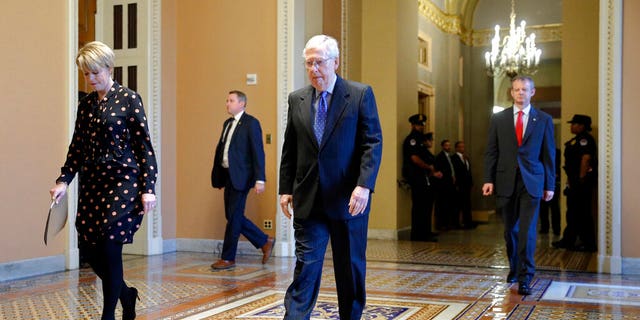
Senate Majority Leader Mitch McConnell of Ky. walks to the Senate
chamber on Capitol Hill in Washington, Tuesday, March 24, 2020. (AP
Photo/Patrick Semansky)
One of the last issues to close concerned $500
billion for guaranteed, subsidized loans to larger industries, including
a fight over how generous to be with the airlines, given that Democrats
wanted them to abide by new carbon emissions restrictions. Hospitals
would get significant help as well. In a letter to his colleagues,
Schumer remarked, “Democrats are ready to give our unanimous consent to
speed up the consideration of the bill and get the job done.“ That
means that if there are no objections from Republicans, the Senate could
clear the bill without a formal roll call vote. Parliamentarily, that
is the fastest way to move something on the floor. A senior GOP source told
Fox News contributor and Townhall.com editor Guy Benson that the move
was a face-saving exercise by Schumer, and that he was trying to "take
credit" for a GOP bill that he filibustered for "small ball"
alterations. Democrats, the source said, couldn't drag the situation out
much longer; economic conditions have worsened dramatically, and
President Trump's approval rating has risen. McConnell
said the Senate will meet at noon on Wednesday, but did not set a time
for a vote. By rule, the procedural vote to begin debate on the
coronavirus package would happen at 1 p.m. ET, unless the Senate scraps
that vote. “Democrats are finally taking ‘yes’ for an answer,"
McConnell said in his remarks on the Senate floor early Wednesday
morning. "Help is on the way.” “After days of intense discussions,
the Senate has reached a bipartisan agreement on a historic relief
package for this pandemic,” he continued. “It will rush new resources
onto the front lines of our nation's health care fight. And it will
inject trillions of dollars of cash into the economy as fast as possible
to help Americans workers, families, small businesses and industries
make it through this disruption and emerge on the other side ready to
soar." Treasury Secretary Steven Mnuchin, who was smiling after
McConnell left the floor, told reporters: "This is a very important
bipartisan piece of legislation that is going to be very important to
help American workers, American business and people across America. So,
we couldn't be more pleased. I've spoken to the president, many times
today, and he's very pleased with this legislation, and the impact that
this is going to have." Concerning
the House, Mnuchin remarked, "I can't speak for the Speaker. I hope she
takes it up and she passes as-is. We need, we need this to get working
for the American people. And, again, there are a lot of compromises.
It's terrific bill, and it was a great accomplishment on everyone." Michigan
independent Rep. Justin Amash, who recently left the Republican
Party, signaled that he might essentially delay consideration of the
bill in the House. The lower chamber may seek to pass the legislation
via unanimous consent because many members are not in Washington -- but a
single member can ruin that plan.
Treasury Secretary Steven Mnuchin, left, accompanied by White
House Legislative Affairs Director Eric Ueland and acting White House
chief of staff Mark Meadows, speaks with reporters as he walks to the
offices of Senate Majority Leader Mitch McConnell of Ky. on Capitol Hill
in Washington, Tuesday, March 24, 2020. (AP Photo/Patrick Semansky)
The House used unanimous consent during the 1918 flu pandemic as well. "This
bipartisan deal is a raw deal for the people," Amash tweeted. "It does
far too little for those who need the most help, while providing
hundreds of billions in corporate welfare, massively growing government,
inhibiting economic adaptation, and widening the gap between the rich
and the poor." The deal came hours after President Trump's top economic adviser said an unprecedented $6 trillion stimulus plan was imminent, including $4 trillion in liquidity from the Federal Reserve and $2 trillion in new money from Congress. Tensions
then abruptly ratcheted back up again on Capitol Hill Tuesday night --
with Republican Sens. Lindsey Graham and Steve Daines taking to the
Senate floor and calling for an end to negotiations because, as Graham
put it, Democrats were "nickel-and-diming at a time when people are
dying -- literally dying." Graham and Daines' late-night push for
an immediate vote on a stimulus bill came after tensions seemingly had
cooled in Congress during the day, sending the Dow Jones Industrial
Average to its highest point gain in its history as leaders from both parties signaled that an agreement could be within reach. Shares
advanced in Asia on Wednesday after the Dow Jones Industrial Average
surged to its best day since 1933 as Congress and the White House neared
a deal. Japan's Nikkei 225 index jumped 5.3 percent, while Hong Kong
added 3 percent and Sydney climbed 3.6 percent. Markets across Asia were
all up more than 2 percent.
"Ladies and gentleman, we are done. We have a deal." — White House legislative affairs director Eric Ueland
But, the Republicans said late Tuesday, Democrats were still seeking new payouts that were delaying a vote on a final bill. "In
case you're watching," Graham said in reference to the president, his
voice rising, "tell [Treasury Secretary] Steven Mnuchin to come back to
the White House and end negotiations. I think I understand the
give-and-take of life and politics, but I've been called by two good
friends on the Democratic side in the last five or six hours wanting
more money. End the negotiations." He added: "This bill is $2
trillion. There's a ton of money in this bill for people who need it,
but what we're doing now is, every special-interest group in town is trying to get a little bit more." “Listen,
we were told we are at the one-yard line last night to get this done,"
Daines, who led the colloquy with Graham, said from the Senate
floor. "All I’ve got to say is, the Senate may think it’s at the
one-yard line right now, but Montanans are getting sacked. In fact, our
unemployment claims in Montana since march 17th, we just looked it up 15
minutes ago, 14,350 Montanans have filed for unemployment in the last
week.” Shortly before Graham and Daines spoke, Trump declared at a
coronovirus task force briefing that the country was nearing "the end
of our historic battle" with "the invisible enemy" of coronavirus.
Trump's approval numbers hit their highest point ever this week, with 60 percent of Americans approving of his coronavirus response efforts. The
president also sounded an unexpectedly magnanimous note: "I also want
to thank Congress, because whether or not we're happy that they haven't
quite gotten there yet, they have been working long hours. I'm talking
Republicans and Democrats, all of them, the House, the Senate. I want to
thank Congress because they are really trying to get there, and I think
they will." Then, Director of the U.S. National Economic
Council Larry Kudlow specifically said the new coronavirus bill working
its way through congressional gridlock would
total $6 trillion: $4 trillion in liquidity from the Federal
Reserve and $2 trillion in new money. Typical annual appropriations from
Congress in a given fiscal year are around $1.2-4 trillion, with total
expenditures roughly $4.3 trillion. “This package will be the
single largest Main Street assistance program in the history of the
United States,” Kudlow said, adding that negotiations would continue
into the evening but that a vote was imminent. Meanwhile, there
was some good news inside the White House grounds. As the briefing
concluded, White House press Secretary Stephanie Grisham, who has been
quarantined since coming in contact with Brazilian officials almost two
weeks ago and working from home, revealed she has received negative
COVID-19 test results and will be back to work Wednesday. Grisham will return as the Trump administration increasingly has sought to project optimism. The president, who tweeted Sunday that "WE CANNOT LET THE CURE BE WORSE THAN THE PROBLEM ITSELF," declared at the Fox News virtual town hall that he "would love to have the country opened up and just raring to go by Easter."
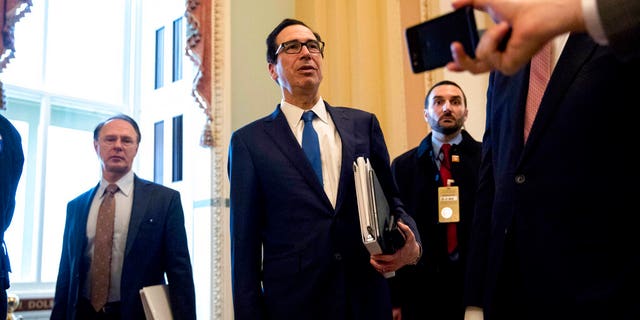
Treasury Secretary Steven Mnuchin, center, on his way to the
offices of Senate Majority Leader Mitch McConnell on Monday. (AP
Photo/Andrew Harnik)
Pressed by Fox News' John Roberts on the timeline,
Trump said at the briefing: "We'll be looking at a lot of things --
we'll also be looking at very large portions of our country, but I'll be
guided very much by Dr. [Anthony] Fauci, and by Deborah [Birx]." Fauci,
the longtime head of the National Institute of Allergy and Infectious
Diseases, whose absence from recent coronavirus briefings triggered a wave of speculation in the media, said the timeline was still "flexible." Democrats have reacted furiously to
Trump's new timeline for relaxing economic restrictions, with Hillary
Clinton suggesting people would "needlessly die," and Joe Biden accusing
Trump of spreading "misinformation." "This a--hole and his rich
friends are too stupid to get that we can only get through this
together," former Obama speechwriter Jon Favreau wrote. "Everyone is at
risk from the virus. Everyone suffers when there aren’t enough hospital
beds. Everyone struggles when millions are too sick to work." Fellow Obama communications alum Tommy Vietor, meanwhile, deleted a tweet lamenting that he was reduced to drinking red wine in the shower during the economic shutdown. Fox News' Chad Pergram, Caroline McKee, and John Roberts, as well as The Associated Press, contributed to this report.
Fox News Channel is hosting a two-hour virtual town hall with President Trump and members of the White House coronavirus task force on Tuesday, March 24, at 12 p.m. ET. The president and his team will be answering text and video questions you submit to Fox News' Twitter, Facebook and Instagram accounts, as well as email submissions for the special live event at live-blog@foxnews.com. Anchors Harris Faulkner and Bill Hemmer
will co-moderate the event, and will be joined by Dr. Mehmet Oz and Fox
News contributors Dr. Nicole Saphier and Dr. Marc Siegel. Part
One of the town hall will feature Faulkner and Hemmer interviewing
members of the coronavirus task force about the latest developments from
the pandemic. They will explain how the White House is handling
the growing crisis before President Trump joins the forum at roughly
12:30 p.m. ET to answer questions from Fox News viewers across the
country. Fox
Corporation announced last week that unlimited free access to Fox News
Channel and FOX Television Stations is available during the pandemic so
all Americans can access the latest news and information. Fox News
is available for free on FoxNews.com, the Fox News app, FOX.com and the
FOX NOW app. FOX’s 29 owned-and-operated television stations will be
available for free on FOX.com and the FOX NOW app. Faulkner has
been holding special Q&A segments related to the coronavirus on a
regular basis during “Outnumbered Overtime,” often speaking with the
nation’s top medical experts. Hemmer
has also been a leading journalist during the coronavirus crisis,
explaining the impact of the pandemic with easily digestible facts.
Hemmer also anchors a nightly three-minute live coronavirus report
weekdays at 6 p.m. ET on local FOX affiliates. Fox News recently celebrated its 18th consecutive year as the most-watched cable news network,
dating back to January 2002. FNC’s 18-year streak is for both primetime
and total-day viewers, including the key demographic of adults age
25-54.
U.S. equity futures are pointing to a higher open when Wall Street begins trading on Tuesday as congressional and White House officials emerged from grueling negotiations at the Capitol over the $2 trillion coronavirus rescue package saying they expected to reach a deal Tuesday. This comes after the Federal Reserve promised support to the struggling economy. The major futures indexes are indicating a gain of more than 4 percent or around 700 Dow points. The Fed promised to buy as many Treasurys and other assets as needed to keep financial markets functioning. That
came as Wall Street fell 3 percent after Congress failed to approve an
economic support package. It would send checks to U.S. households and
offer support for small businesses and the hard-hit travel industry, but
Democrats say it favors companies too heavily at the expense of workers
and public health. In Asia, Japan's Nikkei rose 7 percent, the
Hang Seng in Hong Kong was 4.4 percent higher and China's Shanghai
Composite rose 2.3 percent. In Europe, London's FTSE added 2.9 percent, Germany's DAX rose 4.4 percent and France's CAC was 3.3 percent higher. The Fed's promise goes beyond the $700 billion in purchases announced last week. The
central bank said it will buy a wide range of investments, including
corporate bonds for the first time, to improve trading in markets that
help home buyers purchase houses, state and local governments borrow and
businesses to get enough short-term cash to make payroll.
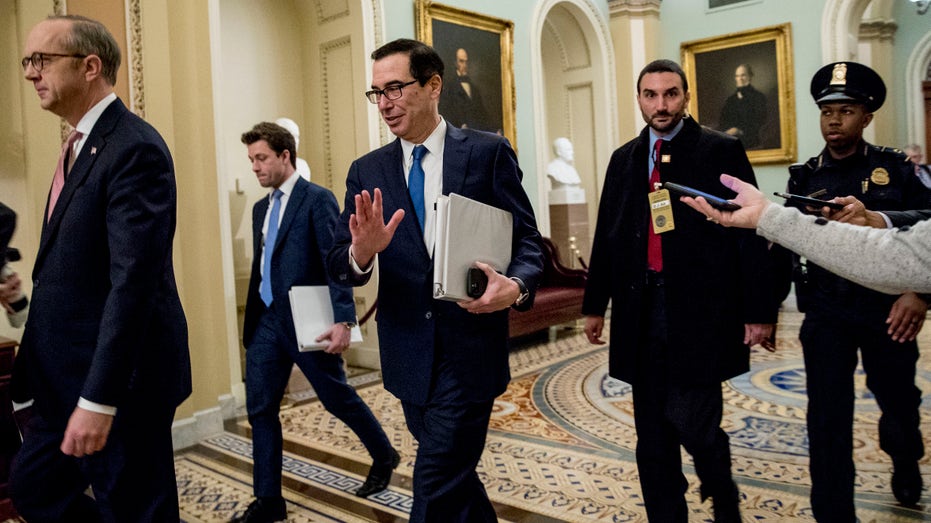
Treasury
Secretary Steven Mnuchin, third from left, and White House Legislative
Affairs Director Eric Ueland, left, walk to a meeting with Senate
Minority Leader Sen. Chuck Schumer of N.Y. in his office on Capitol
Hill, Monday, March 23, 2020, in Was
As Congress was
locked in stalemate, the number of known infections worldwide jumped
past 380,000. After just a few weeks, the United States has more than
46,000 cases and more than 600 deaths. Also Monday, trading on the
New York Stock Exchange went all-electronic for the first time after
the trading floor was temporarily closed as a precaution. The exchange
announced the move last week after two employees tested positive for the
virus. The number of floor traders had dwindled sharply in recent years
as more trading become electronic. Wall Street and some other
stock markets have lost nearly one-third of their value over the past
month as business shutdowns spread and airlines, retailers and other
industries suffer rising losses. Economists increasingly say a
recession seems inevitable. Analysts are slashing their forecasts for
upcoming corporate profits. Forecasters say they cannot project how deep
the downturn might be or how long it will last. Professional traders say investors need to see a decline in numbers of new infections before markets can find a bottom. Congress
debated through the weekend on the rescue plan, but White House
officials and congressional leaders are struggling to finalize it.
Democrats blocked a vote to advance the package Monday. They want to
steer more of the assistance to public health and workers. Even if
the two sides find a compromise, Congress may need to go through more
rounds of similar negotiations if the outbreak isn't brought under
control.
On
Wall Street, the benchmark S&P 500 fell 2.9 percent in another day
of sudden swings. It was down as much as 4.9 percent and as little as
0.2 percent earlier in the day. The Dow Jones Industrial Average
fell 3 percent. The Nasdaq, which is dominated by technology companies,
lost only 0.3 percent as tech shares held up better than the rest of the
market. In
energy markets, benchmark U.S. crude gained $1.06 to $24.43 per barrel
in electronic trading on the New York Mercantile Exchange. The contract
lost $2.59 the previous session to close at $22.63. Brent crude, used to
price international oils, added 84 cents to $27.91 per barrel in
London. It lost $1.49 the previous session to $26.98. The Associated Press contributed to this article.