Presumptuous Politics

Wednesday, April 1, 2020

Cartoons Townhall 2020


Trump salutes staff at Queens, NY, hospital near where he grew up: ‘You people are just incredible’


President Trump took time during Tuesday’s coronavirus news briefing at the White House to acknowledge the job being done by the medical staff at Elmhurst Hospital in Queens, N.Y.
The hospital, located not far from the neighborhood where Trump grew up, has been among those overwhelmed as New York City and New York state handle the greatest number of coronavirus patients in the nation.
“I watched the doctors and nurses walking into the hospital this morning and it is like military people going into battle, going into war. The bravery is incredible,” Trump told reporters. “If I were wearing a hat, I'd rip that hat off so fast and I would say, 'You people are just incredible.’”
The president also expressed shock and sadness about seeing images of bodies being loaded into refrigerated trailers outside the hospital.
Trump previously addressed the images in remarks to reporters Sunday.
“I’ve been watching that for the last week on television,” he said, according to WPIX-TV of New York. ”Body bags all over, in hallways. I’ve been watching them bring in trailer trucks — freezer trucks, they’re freezer trucks, because they can’t handle the bodies, there are so many of them.
"This is essentially in my community, in Queens -- Queens, New York,” he added. “I’ve seen things that I’ve never seen before.
On Tuesday, New York City reported its 1,000th coronavirus death, accounting for about two-thirds of the more than 1,500 deaths in New York state. That tally far surpasses the next highest U.S. total, the 267 deaths in nearby New Jersey.
Those states and the rest of the nation were bracing for higher death tolls in the coming weeks, with members of the president’s Coronavirus Task Force projecting the final U.S. total could range between 100,000 and 240,000 fatalities.
Fox News' Andrew O'Reilly and The Associated Press contributed to this story.

DOJ's FISA report contradicts claims by Dems, media figures that surveillance rules were strictly observed


New findings by the Justice Department inspector general that the FBI has repeatedly violated surveillance rules stood in stark contrast to the years of assurances from top Democrats and media commentators that bureau scrupulously handled Foreign Intelligence Surveillance Act (FISA) warrants -- and prompted Republican lawmakers to caution that the FBI seemingly believes it has "carte blanche to routinely erode the liberties of Americans without proper justification."
The DOJ watchdog identified critical errors in every FBI wiretap application that it audited as part of the fallout from the bureau's heavily flawed investigation into former Trump advisor Carter Page, who was surveilled in part because of a largely discredited dossier funded by the Hillary Clinton campaign and the Democratic National Committee (DNC). An FBI lawyer in that case even falsified a CIA email submitted to the FISA court in order to make Page's communications with Russians appear nefarious, the DOJ inspector general found; and the DOJ has concluded that the Page warrant was legally improper.
But, the DOJ's new assessment indicated that FISA problems were systemic at the bureau and extended beyond the Page probe. In four of the 29 cases the DOJ inspector general reviewed, the FBI did not have any so-called "Woods files" at all, referring to documentation demonstrating that it had independently corroborated key facts in its surveillance warrant applications. In three of those applications, the FBI couldn't confirm that Woods documentation ever existed.
The other 25 applications contained an average of 20 assertions not properly supported with Woods materials; one application contained 65 unsupported claims. The review encompassed the work of eight field offices over the past five years in several cases.
“As a result of our audit work to date and as described below, we do not have confidence that the FBI has executed its Woods procedures in compliance with FBI policy,” the DOJ IG wrote in a memo today to FBI Director Christopher Wray.
FISA COURT SLAMS FBI ... BUT LEAVES OUT LITTLE-KNOWN AGENT JOE PIENTKA, NOW SCRUBBED FROM FBI WEBSITE
Reaction on Capitol Hill, where Wray has already promised bureau-wide reforms, was scathing.
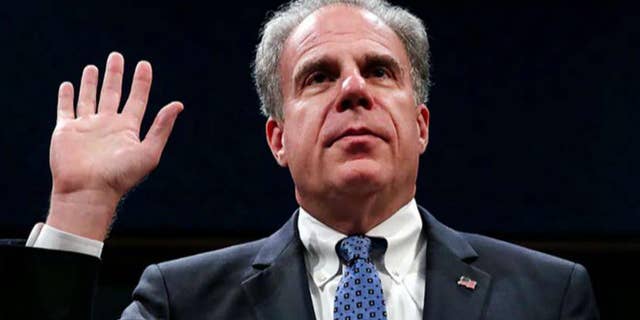
DOJ inspector general Michael Horowitz
“If the FBI is going to seek secret authority to infringe the civil liberties of an American citizen, they at least need to show their work," Senate Finance Committee Chairman Chuck Grassley, R-Iowa, said in a statement Tuesday. "FBI rules demand FISA applications be ‘scrupulously accurate’ and backed up by supporting documents to prove their accuracy. But we know that wasn’t the case when the FBI sought and received the authority to spy on Carter Page."
Grassley added: "Based on the inspector general’s audit, the flawed Page case appears to be the tip of the iceberg. Not a single application from the past five years reviewed by the inspector general was up to snuff. That’s alarming and unacceptable. The inspector general’s decision to bring these failures to the director’s attention before its audit is even completed underscores the seriousness of these findings."
"It Ain’t Easy Getting a FISA Warrant: I Was an FBI Agent and Should Know," read a 2017 article from former FBI special agent and CNN analyst Asha Rangappa, who spent most of her career as a university admissions administrator. It is unclear whether Rangappa has ever handled a FISA application.
In the piece, Rangappa credulously asserted that FISA applications, after a preliminary exhaustive review, travel "to the Justice Department where attorneys from the National Security Division comb through the application to verify all the assertions made in it. Known as 'Woods procedures' after Michael J. Woods, the FBI Special Agent attorney who developed this layer of approval, DOJ verifies the accuracy of every fact stated in the application."
FISA COURT BLOCKS FBI AGENTS LINKED TO PAGE PROBE FROM SEEKING WIRETAPS;
Rangappa, who repeated the same message on-air multiple times, was not alone in the media in propping up the FISA process. A comprehensive review by The Washington Post's Erik Wemple underscored how Politico national security reporter Natasha Bertrand launched her career in part through ultimately debunked reporting on the Steele dossier.
Bertrand, who told MSNBC that securing a FISA warrant was "extremely difficult," even claimed at one point that DOJ investigators found the dossier's author, Christopher Steele, credible.
“The interview was contentious at first, the sources added, but investigators ultimately found Steele’s testimony credible and even surprising," Bertrand wrote. "The takeaway has irked some U.S. officials interviewed as part of the probe — they argue that it shouldn’t have taken a foreign national to convince the inspector general that the FBI acted properly in 2016.”
As Wemple noted, however, DOJ inspector general Michael Horowitz found numerous problems with the FBI's reliance on Steele, including its failure to alert the FISA court to a series of apparent problems with his credibility.
STRZOK'S WIFE FOUND EVIDENCE OF HIS AFFAIR WITH LISA PAGE ... AND 'PARANOID' NEW YORK AGENT FOUND STRZOK WAS APPARENTLY SLOW-WALKING WEINER LAPTOP REVIEW
Nevertheless, for several years, Democrats and other analysts at The New York TimesThe Washington Post and CNN have repeatedly claimed that key claims in the Clinton-funded anti-Trump dossier had been corroborated and that the document was not critical to the FBI's warrant to surveil Page. Horowitz repudiated that claim, with the FBI's legal counsel even describing the warrant to surveil Page as "essentially a single source FISA" wholly dependent on the dossier.
Among the unsubstantiated claims in the dossier: that ex-Trump lawyer Michael Cohen traveled to Prague to conspire with Russian hackers; that the Trump campaign was paying hackers working out of a nonexistent Russian consulate in Miami; that a lurid blackmail tape of Trump existed and might be in Russian possession; and that Page was bribed with a 19 percent share in a Russian company.
In 2018, Vox published a piece by Zack Beauchamp titled, "The Democratic rebuttal to the Nunes memo tears it apart." That was a reference to the memo authored by Rep. Adam Schiff, D-Calif., and his intelligence panel, in rebuttal to Rep. Devin Nunes, R-Calif., and his concerns that the FISA process was heavily flawed.
"Democratic Rep. Adam Schiff brought receipts," the article declared confidently. “This is a pretty thorough demolition,” Julian Sanchez, a supposed expert on surveillance at the libertarian Cato Institute, wrote on Twitter.
"The key question in an application like this isn’t whether the source liked the target; it’s whether the specific claims they’re making are credible," Beauchamp writes. "And the Schiff memo points out that the FBI had independent reasons to believe that Steele’s arguments were credible."
FISC SLAMS FBI, SAYS 'FREQUENCY' OF ERRORS AND INACCURACIES CALLS INTO QUESTION PREVIOUS FISA WARRANT APPLICATIONS
Among those reasons, Beauchamp claimed, was that "Page had been on the bureau’s radar for some time — as he had been approached by Russian spies in the past as a potential intelligence asset. According to Schiff, the October FISA application laid out Page’s connections to the Kremlin 'in detail.' For instance, while Page was working for Trump, in July 2016, he traveled to Moscow to give a commencement speech at a Russian university, which certainly would have raised some red flags at the bureau."
Since the Vox article was published, the DOJ inspector general found that ex-FBI attorney Kevin Clinesmith doctored a CIA email to help secure the Page warrant. Specifically, the FBI reached out to the CIA and other intelligence agencies for information on Page; the CIA responded in an email by telling the FBI that Page had contacts with Russians from 2008 to 2013, but that Page had voluntarily reported the contacts to the CIA and was serving as a CIA operational contact and informant on Russian business and intelligence interests.

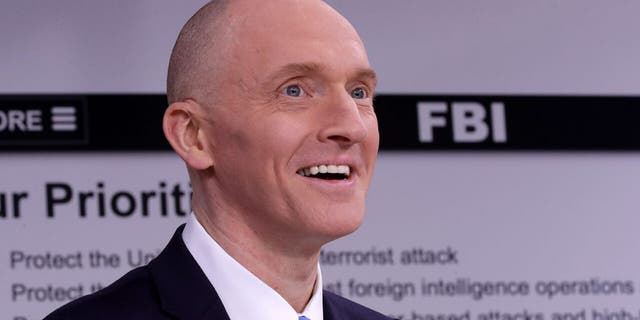
Former Trump adviser Carter Page. (Photo by Chip Somodevilla/Getty Images)

Clinesmith then doctored the CIA's email about Page to make it seem as though the agency had said only that Page was not an active source, according to Horowitz. Then, the FBI included Page's contacts with Russians in the warrant application as evidence he was a foreign "agent," without disclosing to the secret surveillance court that Page was voluntarily working with the CIA concerning those foreign contacts.

In his Vox article, Beauchamp also excuses the FBI for not fully disclosing its knowledge of Steele's apparent bias and the factual problems with his dossier because the bureau noted in a footnote to its Page FISA thaht “the FBI speculates” that Steele had been hired to find “information that could be used to discredit Candidate #1’s [Trump’s] campaign.”
That disclosure was insignificant and incomplete, Nunes alleged -- and contrary to Schiff and Beaucahmp's claims, Horowitz ultimately supported Nunes' findings.
FORMER FBI LAWYER LISA PAGE SUES FBI AND DOJ, SAYS SHE NEEDS 'COST OF THERAPY' REIMBURSED AFTER TRUMP MOCKED HER BIAS
Connecticut U.S. Attorney John Durham's criminal probe concerning the FBI's Russia probe remains ongoing. It has emerged since former National Security Adviser Michael Flynn's guilty plea that the FBI officials who interviewed Flynn, anti-Trump agent Peter Strzok and "SSA [Supervisory Special Agent] 1," have each separately been implicated by Horowitz in apparent misconduct and mismanagement in both the Flynn case and the Carter Page matter.
Strzok's misconduct and anti-Trump bias are well-documented. The identity of SSA 1 is protected in the Flynn legal proceedings by a court order, but Fox News has identified the agent as Joe Pietnka, who moved last year from the Washington, D.C., area to San Francisco. Pientka briefly appeared on the FBI's website as an "Assistant Special Agent in Charge" of the San Francisco field office late last year, according to the Internet archive Wayback Machine.
However, Pientka no longer appears on any FBI website after being removed shortly after Fox News identified him as the unnamed SSA in the IG report; Fox News is told Pientka received a promotion to a senior role in the bureau's San Francisco field office. Pientka's extensive role in handling the Page FISA has been outlined in Horowitz's report, and top Republican senators, including Sen. Lindsey Graham, R-S.C., have requested that Pientka sit for an interview to explain himself.
"The media for FOUR FU--ING YEARS propped up expert after expert to tell us that FISA warrants are different!" independent journalist Mike Cernovich wrote on Twitter on Tuesday. "If you want to know why people don't trust experts anymore, here is your latest reason."

Stock futures fall on continuing worries about economic fallout


U.S. equity futures are starting the quarter as they ended the last one, with declines.
Traders are concerned about the economic fallout from the coronavirus, plus the White House projects 100,000 to 240,000 deaths.
The major futures indexes are indicating a decline of 3 percent, or about 600 Dow points
Stocks plunged on Tuesday, to close out their worst quarter since the most harrowing days of the 2008 financial crisis.
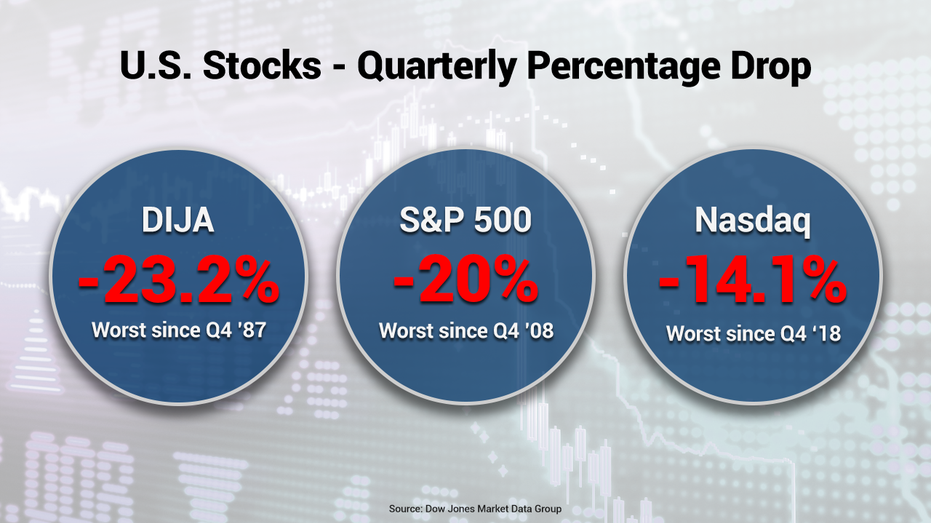
The S&P 500 dropped a final 1.6 percent, bringing its loss for the first three months of the year to 20 percent as predictions for the looming recession caused by the coronavirus outbreak got even more dire. Stocks haven’t had this bad a quarter since the last time economists were talking about the worst downturn since the Great Depression, when the S&P 500 lost 22.6 percent at the end of 2008.
The Dow Jones Industrial Average of 30 U.S. blue-chip stocks dropped 23.2 percent for its worst quarter since 1987.
The surge of coronavirus cases around the world has sent markets to breathtaking drops since mid-February, undercutting what had been a good start to the year.
In Europe, London's FTSE fell 3.9 percent, Germany's DAX was down 3.7 percent and France's CAC dropped 4.4 percent.
In Asia on Wednesday, Japan's Nikkei dropped 4.5 percent, Hong Kong's Hang Seng lost 2.5 percent and the Shanghai Composite was off 0.6 percent.
Adding to the damage was the Bank of Japan's quarterly survey of business sentiment called “tankan,” which highlighted the gloom over a likely recession. The world's third largest economy had already been lagging for months when the outbreak began taking its toll earlier this year.
Sentiment among Japan's large manufacturers fell in the January-March period, marking the fifth straight quarter of decline, according to the central bank. The tankan measures corporate sentiment by subtracting the number of companies saying business conditions are negative from those responding they are positive.
The key index, which measures sentiment among large manufacturers, fell to minus 8 from zero in October-December, the worst result in seven years. Sentiment among non-manufacturers was also dismal as the service sector, tourism and other businesses have also been hit hard by the outbreak.
The Fed has promised to buy as many Treasurys as it takes to get lending markets working smoothly after trading got snarled in markets that help companies borrow short-term cash to make payroll, homebuyers get mortgages and local governments to build infrastructure. Congress, meanwhile, approved a $2.2 trillion rescue plan for the economy, and leaders are already discussing the possibility of another round of aid.
It's impossible to know when infections will peak and the markets will reach bottom.
Among the next milestones for investors is Friday's U.S. jobs report, which will likely show a sharp drop in payrolls. Companies soon will begin reporting their earnings results for the first quarter. Analysts are looking for the steepest drop in profits since early 2016, according to FactSet.
Goldman Sachs economists said Tuesday they expect the U.S. economy to shrink 34 percent in the second quarter, but recover in the second-half of the year.
TickerSecurityLastChangeChange %
I:DJIDOW JONES AVERAGES21917.16-410.32-1.84%
SP500S&P 5002584.59-42.06-1.60%
I:COMPNASDAQ COMPOSITE INDEX7700.09798-74.05-0.95%
In Tuesday's session, the S&P 500 fell 42.06 points to 2,584.59. The Dow Jones Industrial Average lost 410.32, or 1.8 percent, to 21,917.16, and the Nasdaq was off 74.05, or 1 percent, to 7,700.10.
The number of known coronavirus cases keeps rising, and the worldwide tally has topped 850,000, according to Johns Hopkins University. The United States has the highest number in the world: more than 188,000 people.
Most people who contract COVID-19 have mild or moderate symptoms, which can include fever and cough. But others, especially older adults and people with existing health problems may get pneumonia and need to be hospitalized. More than 42,000 people have died worldwide due to COVID-19, while more than 178,000 have recovered.
The Associated Press contributed to this article.

Coronavirus deaths top 4,000 in US


The number of coronavirus related deaths topped 4,000 in the U.S. on Tuesday night, just one day after reaching the 3,000 mark.
The U.S. has now surpassed China by over 700 COVID-19 fatalities -- as the White House coronavirus task force said it projects 100,000 to 240,000 deaths from the virus and millions infected in the country.
Without any measures in place to mitigate the contagion's spread, those projections jump to between 1.5 million and 2.2 million deaths from COVID-19.

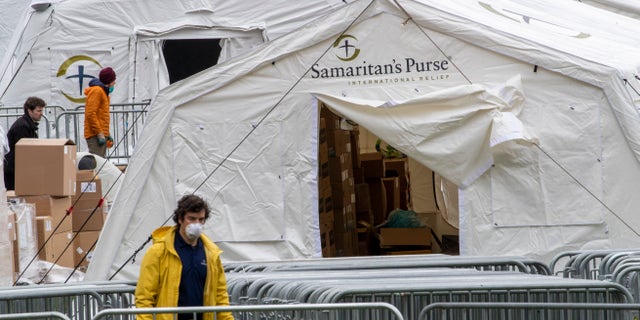
A Samaritan's Purse crew and medical personnel work on preparing to open a 68 bed emergency field hospital specially equipped with a respiratory unit in New York's Central Park on March 31 in New York.  (AP Photo/Mary Altaffer)

“This is going to be a rough two week period,” President Trump said in a press conference on Tuesday. “As a nation we’re going to have a really rough two weeks. Our strength will be tested and our endurance will be tried.”
China -- where the outbreak started -- has reported 3,310 virus-related deaths, while over 4,070 have been killed in the U.S.
Deaths surged by roughly 700 on Tuesday as infections are nearing 190,000 in the U.S. Wyoming is the only state in the country without a fatality from the virus after Hawaii announced a senior citizen with multiple medical issues had died from the pandemic, according to Hawaii News Now.
New York -- the epicenter for the virus outbreak in the U.S. -- has over 76,000 infections and more than 1,700 fatalities as of early Wednesday. Over 43,000 of the state's infections and more than half of its deaths have occurred in New York City.
In the U.S., 11 states have over 4,000 coronavirus infections -- as Michigan, Illinois, Louisiana and Massachusetts have started to become emerging hotspots for the virus. Michigan now has 7,615 cases after 1,117 infections and 75 deaths were recorded in a single day. Over 259 people in the state have died from the virus.
Illinois -- which has seen nearly 6,000 infections -- sent out an emergency alert to residents in the state on Tuesday requesting the need for additional licensed healthcare workers.
"In the COVID-19 event, Illinois is looking for medically trained individuals to join the fight," according to the website where health professionals are directed to sign up. "Individuals that register here may be potentially contacted to work in a hospital surge or alternative housing setting."
Following Mardi Gras celebrations, cases in Louisiana increased by 1,212 on Tuesday, bringing the state's total to 5,237. It was a 30 percent increase from Monday.
"Because of the sheer volume of cases, we will be sharing the updated number of clusters every day at noon," the Louisiana Department of Health said. "The Department continues to work with facilities to minimize the spread of the illness and protect residents and staff."
In Massachusetts, Gov. Charlie Baker announced that non-essential businesses must stay closed, with residents advised to stay home until at least May 4. On Tuesday, 33 new fatalities were reported, making it the deadliest day of the outbreak so far in the state. The number of cases increased by 868 to 6,620.
Worldwide, Italy and Spain remain hotspots for the virus in Europe. Italy has over 105,000 infections and 12,400 deaths -- although the country saw the lowest daily case increase in two weeks on Tuesday.
Meanwhile, Spain suffered its deadliest day during the coronavirus pandemic on Tuesday, as 849 were confirmed to have been killed by the virus. As of Wednesday morning, the country has over 95,000 infections and 8,464 coronavirus related deaths.
COVID-19 fatalities in France surpassed China on Tuesday. The European country now has over 52,000 infections and 3,532 deaths from the virus, according to data from Johns Hopkins.

Tuesday, March 31, 2020

Social Distancing Cartoons


US nears China’s virus death toll as New York calls for help


NEW YORK (AP) — The mounting death toll from the virus outbreak in the United States had it poised Tuesday to overtake China’s grim toll of 3,300 deaths, with New York Gov. Andrew Cuomo saying up to 1 million more healthcare workers were needed. “Please come help us,” he urged.
Hard-hit Italy and Spain have already overtaken China and now account for more than half of the nearly 38,000 COVID-19 deaths worldwide, according to figures from Johns Hopkins University.
But the World Health Organization warned Tuesday that while attention has shifted to epicenters in Western Europe and North America, the coronavirus pandemic was far from over in Asia.
ADVERTISEMENT
“This is going to be a long-term battle and we cannot let down our guard,” said Dr Takeshi Kasai, the WHO Regional Director for the Western Pacific. “We need every country to keep responding according to their local situation.”
In Japan, the countdown clocks were reset and ticking again for the Tokyo Olympics after organizers announced new dates following the postponement from this summer. The clocks read 479 days to go, with the games now scheduled to kick off on July 23, 2021.
In New York City, Cuomo and health officials warned Monday that the crisis unfolding there is just a preview of what other U.S. communities could soon face. New York State’s death toll climbed by more than 250 people in a day Monday to more than 1,200, most of them in the city.
“We’ve lost over one thousand New Yorkers,” Cuomo said. “To me, we’re beyond staggering already.”
Even before the governor’s appeal, close to 80,000 former nurses, doctors and other professionals were stepping up to volunteer, and a Navy hospital ship had arrived with 1,000 beds to relieve pressure on overwhelmed hospitals.
News also came of the first U.S. service member to die from the disease. Secretary of Defense Mark Esper said the death of the New Jersey Army National Guardsman strengthened their resolve to work more closely with partners to stop the spread of COVID-19.
“This is a stinging loss for our military community,” Esper said in a release.
More than 235 million people — about two of every three Americans — live in the 33 states where governors have declared statewide orders or recommendations to stay home.
In California, officials put out a similar call for medical volunteers as coronavirus hospitalizations doubled over the last four days and the number of patients in intensive care tripled.
“Challenging times are ahead for the next 30 days, and this is a very vital 30 days,” President Donald Trump told reporters Monday. “The more we dedicate ourselves today, the more quickly we will emerge on the other side of the crisis.”
In contrast, the crisis is continuing to ease in China. On Tuesday, officials in the world’s most populous nation reported just 48 new COVID-19 cases, all of them brought from overseas.
In Wuhan, people were ready to jump, cry and “revenge shop” as the Chinese city once at the center of the global virus outbreak reopened.
“I’m so excited, I want to cry,” said one woman at the Chuhe Hanjie pedestrian mall, where about 75% of the shops had reopened. Shopkeepers were limiting the number of people they were letting in, dispensing hand sanitizer and checking customers for signs of fever.
More than three-quarters of a million people worldwide have become infected and over 37,000 have died, according to Johns Hopkins.
For most people, the coronavirus causes mild or moderate symptoms, such as fever and cough. But for others, especially older adults and people with existing health problems, the virus can cause severe symptoms like pneumonia. More than 160,000 people have recovered, according to Johns Hopkins.
Italy and Spain saw their death tolls climb by more than 800 each on Monday, but the WHO’s emergency chief said cases there were “potentially stabilizing.” At the same time, he warned against letting up on tough containment measures.
“We have to now push the virus down, and that will not happen by itself,” Dr. Michael Ryan said.
Italy’s death toll climbed to nearly 11,600. But in a bit of positive news, the numbers showed a continued slowdown in the rate of new confirmed cases and a record number of people recovered.
“We are saving lives by staying at home, by maintaining social distance, by traveling less and by closing schools,” said Dr. Luca Richeldi, a lung specialist.
At least six of Spain’s 17 regions were at their limit of intensive care unit beds, and three more were close to it, authorities said. Crews of workers were frantically building more field hospitals.
Nearly 15% of all those infected in Spain, almost 13,000 people, are health care workers, hurting hospitals’ efforts to help the tsunami of people gasping for breath.
Tenor Placido Domingo said Monday he is resting at home after catching the new coronavirus.
“I feel fine,” Domingo said in a statement.
The 79-year-old was reportedly hospitalized in Mexico after publicly acknowledging on March 22 that he had tested positive for COVID-19 and said he was going into isolation. He’d suffered from a fever and a cough.
The opera singer’s illness comes after his own glittering career had recently been marred by sexual misconduct revelations.
Israel said 70-year-old Prime Minister Benjamin Netanyahu is quarantining himself after an aide tested positive for the virus. And In Britain, Prince Charles, the heir to the throne who tested positive, ended his period of isolation and is in good health, his office said.
Moscow, meanwhile, locked down its 12 million people as Russia braced for sweeping nationwide restrictions.
___
Perry reported from Wellington, New Zealand. Associated Press writers around the world contributed to this report.
___
Follow AP news coverage of the coronavirus pandemic at https://apnews.com/VirusOutbreak and https://apnews.com/UnderstandingtheOutbreak

Tucker blasts feds over medical masks, says 'stop lying to us' about why we shouldn't buy them


Tucker Carlson claimed Monday that the federal government has not been forthright about the supply of crucial N95 medical masks amid the coronavirus outbreak.
"In any crisis, trust is critical -- the government can't coordinate a national response if the public doesn't believe what it says and doesn't believe the government is looking out for its best interest," the "Tucker Carlson Tonight" host said. "That's why honesty is essential at times like this. When the government lies, people know.
"From the beginning of the Chinese coronavirus epidemic, mask shortages have been a major problem. Some people hoarded hundreds of thousands of them and manufacturers couldn't keep up."
TRUMP SHOWS OFF NEW RAPID COVID-19 TEST KIT AT PRESS CONFERENCE
According to Carlson, federal officials initially told Americans not to buy masks because they wouldn't prevent healthy people from contracting the virus, rather than simply admitting health professionals were facing critical shortages.
He cited a Feb. 29 tweet from Surgeon General Jerome Adams, who wrote: "Seriously, people -- STOP BUYING MASKS! They are NOT effective in preventing the general public from catching #Coronavirus, but if healthcare [sic] providers can't get them to care for sick patients it puts them and our communities at risk!"
Carlson added that the CDC and mainstream media backed Adams' assertion.
Quoting a CNN report from the same day as Adams' tweet, Carlson read: "The CDC says that healthy people in the U.S. should not wear them because they won't protect them from the novel coronavirus. In fact, facemasks might actually increase your risk for infection if they aren't worn properly, but medical workers who treat patients ... do need them."
The host went on to quote a March 4 Time.com headline from earlier this month that read: "Health experts are telling healthy people not to wear face masks for coronavirus. So why are so many doing it?"
"The article suggested believing in masks [is] some kind of superstition like not walking under ladders or being afraid of black cats," Carlson said. "It's insulting. It's ridiculous."
In addition, Carlson said, the claim that the masks only work for health care professionals, but not for healthy civilians is baffling, since the pandemic has no regard for people's occupation.
"So look, we understand there's a shortage of masks," Carlson concluded, addressing the federal government. "We understand only certain people should get them because it's a triage moment, we get it. But stop lying to us."

Stock futures trade higher after Monday's rally


U.S. equity futures are trading higher after the S&P 500 rose for a fourth session in the last five to begin the week.
The major futures indexes are indicating a rise of 0.9 percent when trading begins on Tuesday.
Asian shares traded mixed Tuesday after a rally in U.S. stocks.
Japan's benchmark Nikkei fell 0.8 percent, Hong Kong's Hang Seng rose 1.2 percent and China's Shanghai Composite was off 0.1 percent.
In Asia, the Monetary Authority of Singapore eased policy Monday, and the central bank of China has also cut a key interest rate.
China’s manufacturing rebounded in March as authorities relaxed anti-disease controls and allowed factories to reopen, an official survey showed Tuesday, but an industry group warned the economy has yet to fully recover.
In Europe, London's FTSE gained 1.9 percent, Germany's DAX rose 2.4 percent and France's CAC added 1.5 percent.
The Wall Street rally tacked more gains onto a recent upswing for the market, which is coming off the best week for the S&P 500 in 11 years, albeit after falling into bear market territory. Optimism is building that the worst of the selling may be approaching, but markets around the world are still wary as leaders work to nurse their economies through the pandemic. The S&P 500 remains 22.4 percent below its record set last month.
The S&P 500 rose 3.4 percent Monday. The Dow Jones Industrial Average gained 3.2 percent and the Nasdaq gained 3.6 percent.
TickerSecurityLastChangeChange %
I:DJIDOW JONES AVERAGES22327.48+690.70+3.19%
SP500S&P 5002626.65+85.18+3.35%
I:COMPNASDAQ COMPOSITE INDEX7774.151261+271.77+3.62%
A surge for health care stocks led the way at the week's open. Johnson & Johnson leaped 8 percent after saying it expects to begin human clinical studies on a vaccine candidate for COVID-19 by September. Abbott Laboratories jumped 6.4 percent after saying it has a test that can detect the new coronavirus in as little as five minutes.
TickerSecurityLastChangeChange %
JNJJOHNSON & JOHNSON133.01+9.85+8.00%
ABTABBOTT LABORATORIES79.34+4.78+6.41%
Stocks jumped last week after the Federal Reserve promised to buy as many Treasurys as it takes to get lending markets running smoothly and Capitol Hill reached a deal on a $2.2 trillion rescue package for the economy.
Forced selling by investors needing to raise cash is easing, according to Morgan Stanley strategists. They say another pullback in stocks is likely, but current levels offer some buying points for investors willing to wait six to 12 months.
Economists expect a number of weak reports on the economy to come in through the week. The lowlight will likely be Friday's jobs report, where economists expect to see the steepest drop in the nation's payrolls since the Great Recession.
The number of known infections around the world has topped 780,000, according to Johns Hopkins University. The United States has the highest number in the world, more than 160,000.
Most people who contract COVID-19 have mild or moderate symptoms, which can include fever and cough. But for others, especially older adults and people with existing health problems, the virus can cause pneumonia and require hospitalization.
More than 37,000 have died worldwide due to COVID-19, but more than 160,000 have also recovered.
The Associated Press contributed to this article.

How the House approved the coronavirus bill


So now you’re wondering exactly what in the world went on the other day on Capitol Hill. That’s when Congress struggled to adopt the coronavirus bill. What was going on with Rep. Thomas Massie (R-KY)? And why, oh why couldn’t lawmakers vote from the comfort of their living rooms – while watching Christian Laettner, Bobby Hurley and Mike Krzyzewski, of course?
So, let’s explore what happened during the coronavirus debate last week.
Let’s start with the controversy in the House about taking a “recorded vote” on the coronavirus bill.
Some suggested the House somehow “cheated” or used a shady backdoor method to approve the $2.2 trillion coronavirus package.
Under normal circumstances, lawmakers would insist on their presence to vote on the plan. The bill is the largest in U.S. history and could prove to be the most consequential piece of legislation of the modern era. The Senate voted 96-0 on the plan. Ninety-six of all 100 sitting U.S. senators were present and voted in person on the measure. The four who missed the vote either tested positive for coronavirus or were quarantined.
The House Democratic and Republican leadership teams worked together in hopes of okaying the coronavirus measure via voice vote. That’s where everyone in the chamber hollers “aye” and those opposed shout “no.” The chair judges the decibels. Thus, the loudest side prevails. Leaders on both sides hoped to approve the bill with just a skeleton crew on hand. Consider this: the House approached the coronavirus vote with 430 members. That’s 330 more members than the entire Senate. The push for a voice vote was about health and safety. The leaders - as well as U.S. Capitol Attending Physician Dr. Brian Monahan – were genuinely concerned about amplifying the health risk to the country by dragging hundreds of lawmakers back to Washington, exposing the public, exposing the lawmakers to one another, exposing Congressional staff, exposing U.S. Capitol Police officers, exposing Congressional maintenance workers and custodians, exposing the Capitol press corps…
You get the idea.
So, it would be more hygienic to pass the bill with just a few members in the chamber. And, a voice vote allowed those both for and against the issue to express their positions – albeit vocally.
However, Massie was determined to drag everyone back to Washington to vote. One could argue it may be critical for the House to take a full roll call vote on such an incredibly expensive piece of legislation – even if only a handful of lawmakers were likely to vote nay.
But this is an extraordinary time. And the very idea of lugging hundreds of lawmakers together in the same room flies in the face of every piece of public health guidance disseminated anywhere in the world over the past month.
A “voice vote” isn’t some special gambit to rig the system. The House approves bills, amendments and resolutions via one of four methods:
  1. Voice vote: Explained above.
  2. Division vote: Division votes are rare in the House these days. If the House orders a division vote - perhaps because the Speaker wasn’t certain as to which side was more boisterous on a voice vote - then those in favor rise to be counted. Then, those opposed stand and are counted, too. That’s the “division.”
  3. Unanimous consent: This is where a lawmaker on the floor asks that the House approve a given measure via “unanimous consent.” It means just that. All members in the House, and, more superficially on the floor, must be in favor of that matter. However, if any member on the floor vocally interjects “I object,” then it lacks unanimous consent. In short, all 434 members of the 435 member House (if the House was at full membership) could favor passage of a bill. But it only takes one member to object, thus blocking unanimous consent.
  4. A recorded, roll call vote: The House instituted an electronic voting system in the chamber in 1973. Each member is given a plastic voting card. They insert their card into various machines sprinkled around the chamber and press buttons reading either yea, nay or present. The House had already taken 102 roll call votes through March 14 for this calendar year. Massie wanted a roll call vote so every member was “on the record” regarding the gargantuan, $2.2 trillion package.
Here was the problem for Massie:
When debate time expires on almost every bill or amendment, the House usually conducts an automatic vote by voice. Again, all members in the chamber shout either yea or nay. Rep. Anthony Brown (D-MD) presided over the coronavirus debate. When the voice vote popped up, it was obvious there were far many more ayes than noes.
“The ayes have it,” said Brown, technically passing the bill.
But, one can contest that the House is not finished at that stage. That’s where Massie requested “a recorded vote.”
Things get tricky here. In most instances, lawmakers want to be on the record. They want a recorded vote. House Rule XX requires that only “one-fifth of those present” stand on their feet to demonstrate solidarity with the request for a recorded vote. That’s just a fraction of those in the chamber. In most instances, members rise. But not on Friday. They sat on their hands. They opposed a recorded vote.
Usually, at this stage, the presiding officer announces that “a sufficient number having arisen, members will record their vote by electronic device.”
But not Friday.
After a quick scan of the chamber, Brown determined that “a recorded vote is refused.” Hardly anyone was on their feet.
But another issue lurked for those who wanted to dispense with the coronavirus bill quickly and hygienically. A member could lodge a “point of order.” A point of order is essentially a grievance that the House isn’t operating within the rules. It wasn’t so much that Massie might order a roll call vote. The worry was that the House may lack a quorum to conduct business. Such a scenario would prompt the point of order. Article I, Section 5 of the Constitution requires a quorum be present in the House and Senate to execute business. A quorum constitutes just over half of all members. Former Rep. Mark Meadows (R-NC) is now White House Chief of Staff. So, the total population of the House declined to 429 members. But on Friday, the House had 430 members. That meant the House needed 216 members present to qualify for a quorum. Otherwise, Massie or any other member, may have been able to stymie the House from voting on the bill through making a point of order. You can’t go to a roll call vote if the House lacks a quorum.
Passage of the coronavirus bill was never in doubt. But the issue was whether the House could have a quorum on hand to validate the voice vote. That’s why so many lawmakers rushed back to Washington. The key was constituting a quorum in the House chamber. And that’s why so many lawmakers of both parties have nothing but enmity for Massie. They believe the Kentucky Republican singlehandedly jeopardized the health and safety of the House – to say nothing of the people lawmakers may have encountered just to scurry back to Capitol Hill.
In other words, it’s a healthier in today’s circumstances to pass a bill with ten people in a big room as opposed to at least 216.
So, back to the House floor on Friday.
House Speaker Nancy Pelosi (D-CA), Majority Leader Steny Hoyer (D-MD) and Minority Leader Kevin McCarthy (R-CA) signed off on a plan to throw open every door to the House chamber – both on the floor and in the public viewing gallery one level above. The doors stood open in an effort to aerate the room. Lawmakers spread out on both floors to practice social distancing.
After Brown informed Massie that not enough members stood up to require a call recall vote, Massie went the quorum route.
“I object on the basis that a quorum is not present and I make a point of order that a quorum is not present,” said Massie.
“The chair will count for a quorum,” responded Brown.
Again, the Maryland Democrat briefly surveyed the chamber.
“A quorum is present,” intoned Brown. “The motion is adopted.”
Brown then reached for the gavel and rapped it on the dais.
The bill was passed – by voice vote – two steps prior.
Not enough members rose to trigger a recorded vote. And, Brown deemed a quorum was present. Brown then quickly adjourned the House. Massie was stuck.
Was it pretty? Not really.
Much of the sausage-making in Washington is pretty ugly, frankly. Consider the verbal contretemps which erupted on the Senate floor recently as senators raged about the coronavirus bill.
This won’t be the last bill Congress approves to respond to coronavirus. But until then, you can go back to watching reruns of Duke basketball.

CartoonDems