Sunday, April 12, 2020
Trump vows to rebuild US economy to honor coronavirus victims, sees 'tremendous surge' ahead
President Trump vowed to rebuild the U.S. economy to honor those who have died as a result of the coronavirus pandemic.
"We're going to rebuild it again in honor of all those who perished today," Trump said Saturday night on Fox News' "Justice with Judge Jeanine."
Trump told host Jeanine Pirro he expects the economy to rebound like a "rocket ship" -- because of the American public's desire to get back to work and $2 trillion in coronavirus economic relief from the federal government.
"And I think the stimulus, coupled with this pent-up demand and everybody wanting to get out and go back to work," Trump said. "I think we're going to have a just a tremendous surge."
The president said Americans have combated the coronavirus the "right way," and that if the country didn't follow the safety guidelines, such as social distancing, the nation likely would have experienced far greater numbers of fatalities.
"We did it the right way. We took care of social distancing and all of the things, words that nobody ever heard before, frankly, and phrases. But if we didn't do that, we would have pulled through it," Trump said. "There were estimates, 2.2 million people. Well, if you cut that in more than half and you said a million and cut that in half. You say 500,000, it just would have been unacceptable."
Trump also looked ahead to when he will eventually reopen the economy, saying the timing of the order will represent the biggest decision of his presidency. But he assured the public that many "smart people" will advise him on the call.
"A lot of very smart people, a lot of professionals, doctors and business leaders are a lot of things that go into a decision like that," he said. "And it's going to be based on a lot of facts and a lot of instinct also. Whether we like it or not, there is a certain instinct to it.
"We're setting up a council now of some of the most distinguished leaders in virtually every field, including politics and business and medical. And we'll be making that decision fairly soon."
Saturday, April 11, 2020
Trump donates his 2019 fourth-quarter salary to help combat coronavirus Published Tue, Mar 3 2020
WASHINGTON — President Donald Trump donated his fourth-quarter 2019 salary to the Department of Health and Human Services, where it will be used to “support the efforts being undertaken to confront, contain, and combat Coronavirus,” White House press secretary Stephanie Grisham said.
This is not the first time Trump has donated his salary to an agency facing an urgent problem. Since taking office, Trump has directed his $400,000 annual salary to a different agency each quarter.
Previous donations have gone to, among others, the Office of the Surgeon General to help combat the opioid epidemic, to the Department of Homeland Security to help build a wall on the southern border, and to the National Institute on Alcohol Abuse and Alcoholism, to help combat alcoholism.
Alcoholism contributed to the death of Trump’s older brother, Fred Trump Jr.
Trump’s decision to donate his salary back to the government each quarter fulfills a campaign promise he made in 2016.
Watchdog: Treasury acted appropriately on Trump tax returns

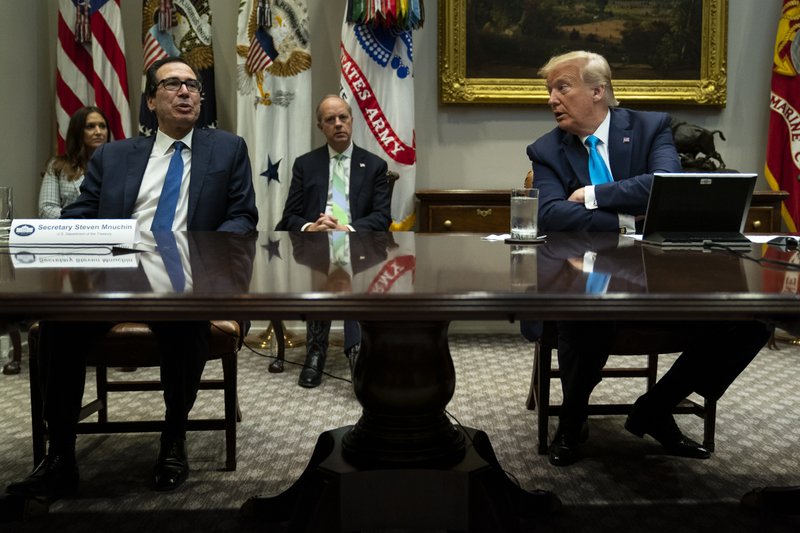
President
Donald Trump listens as Treasury Secretary Steven Mnuchin speaks during
a conference call with banks on efforts to help small businesses during
the coronavirus pandemic, at the White House, Tuesday, April 7, 2020,
in Washington. (AP Photo/Evan Vucci)
WASHINGTON
(AP) — A watchdog has found that the Treasury Department appropriately
handled Congress’ request for President Donald Trump’s tax returns,
which Treasury Secretary Steven Mnuchin has refused to provide.
But
the acting inspector general for Treasury, Rich Delmar, also said he
had no opinion on whether the advice Mnuchin followed — which came from
Justice Department attorneys — was itself well-founded. In refusing to
hand over the returns, Mnuchin decided he was legally bound to comply
with that advice, Delmar noted in a letter Wednesday to senior House
lawmakers.
The
Justice Department legal opinion backed Mnuchin’s refusal, saying that
Neal’s request lacked a legitimate legislative purpose and was an
“unprecedented” use of congressional authority.
The
argument is the same one Trump has used in refusing other demands from
Democrats in Congress for financial records from banks and accountants
that have had business with Trump and his family. Lawsuits over those
records were filed in federal courts in Washington and New York.
Rep.
Richard Neal, the Massachusetts Democrat who chairs the House Ways and
Means Committee, asked Delmar last fall to probe how Treasury received,
assessed and responded to Neal’s earlier request for six years of
Trump’s tax returns.
ADVERTISEMENT
Delmar
found that Treasury processed the request properly, sought legal
guidance from the Justice Department, determined that it was bound by
that guidance and, based on that advice, decided not to provide the tax
information.
Hie letter went to Neal and Rep. Kevin Brady of Texas, the senior Republican on the tax-writing Ways and Means panel.
In
the long-running legal battle over Trump’s records, Neal cited a 1924
law that says the Treasury secretary “shall furnish” tax returns to any
of the three congressional officers empowered to obtain them, one of
whom is the Ways and Means Committee chairman.
Neal
has said the records are needed because the committee is looking into
the effectiveness of IRS mandatory audits of all sitting presidents.
The
fight between Democrats and Trump dates back to the 2016 election
campaign, when Trump claimed that he couldn’t release them because he
was under IRS audit. The records hold the promise of information that
Trump has carefully guarded from public view, including details of his
business entanglements, relations with foreign creditors and
governments, and the value of his assets.
White House points to hopeful signs as deaths keep rising

WASHINGTON
(AP) — At the end of a week officials had warned would be this
generation’s Pearl Harbor, White House officials pointed to hopeful
signs that the spread of the coronavirus could be slowing, even as
President Donald Trump insisted he would not move to reopen the country
until it is safe.
At
the same time, Trump said he would be announcing the launch of what he
dubbed the “Opening our Country” task force, next Tuesday to work toward
that goal.
“I
want to get it open as soon as possible,” he said at a Good Friday
briefing, while adding: “The facts are going to determine what I do.”
ADVERTISEMENT
With
the economy reeling and job losses soaring, Trump has been itching to
reopen the country, drawing alarm from health experts who warn that
doing so too quickly could spark a deadly resurgence that could
undermine current distancing efforts.
But
Trump, who had once set Easter Sunday as the date he hoped people in
certain parts of the country might begin to return to work and pack
church pews, said he would continue to listen to health experts like
Drs. Anthony Fauci and Deborah Birx as he considers what he described as
the “biggest decision I’ve ever had to make.”
While
“there are both sides to every argument,” he said, “we’re not doing
anything until we know that this country is going be healthy. We don’t
want to go back and start doing it over again.”

Trump’s
comments came at the end of a week officials had warned would be a
devastating one for the country. Hours earlier, Johns Hopkins University
announced that the worldwide death toll from the coronavirus
had hit a bleak milestone: 100,000 people. That includes about 18,000
in the U.S., where about half-million people have been confirmed
infected.
More
than 40% of the deaths in the U.S so far have happened in New York
state, which reported 777 new deaths on Friday. But there were also
signs of hope. State officials reported that the number of people in
intensive care dropped for the first time there since mid-March.
Hospitalizations are also slowing, with 290 new patients admitted in a
single day versus daily increases of more than 1,000 last week.
While bemoaning the death numbers as “so horrible,” Trump said “tremendous progress” is being made.”
“In
the midst of grief and pain, we’re seeing clear signs that our
aggressive strategy is saving countless lives,” he said, pointing to
models that are now forecasting far fewer U.S. deaths than had
originally been predicted.
Health
experts have warned, however, that if the country rolls back
restrictions too quickly, case levels could once again begin to soar,
especially without widespread testing to determine who might be a
carrier of the virus. While the new coronavirus causes mild or moderate
symptoms for most people, for some, especially older adults and people
with existing health problems, it can cause more severe illness or
death. And research has shown that people can be highly infectious even
if they are not displaying symptoms.
Fauci,
the nation’s top infectious-diseases expert, told CNN that the timeline
for reopening the country would be informed by a team that has been
reviewing data day-by-day and presenting that information to the
president.
“The
virus kind of decides whether or not it’s appropriate to open it,” he
said. “The one thing you don’t want to do is you don’t want to get out
there prematurely and then wind up backtracking.”
Still, he cautioned that there will most certainly be cases when that day comes.
“When
we decide, at a proper time, when we’re going to be relaxing some of
the restrictions, there’s no doubt you’re going to see cases,” he said.
“The question is how you respond to them.”
As a clearer picture of the virus begins to emerge, data has begun to show that it is having a particularly devastating impact on an already vulnerable population — black Americans.
Of
the victims whose demographic data was publicly shared by officials —
nearly 3,300 of the nation’s 13,000 deaths thus far — about 42% were
black, according to an Associated Press analysis. African Americans
account for roughly 21% of the total population in those places. Black
adults suffer from higher rates of underlying health conditions like
obesity, diabetes and asthma, which put them at higher risk for severe
complications.
To
that end, U.S. Surgeon General Jerome Adams on Friday made a plea to
minority communities to follow social distancing guidelines — if not for
themselves, then for their family members.
“Do
it for your abuela. Do it for your granddaddy. Do it for your Big Mama.
Do it for your Pop Pop,” he said, adding that they should also avoid
alcohol, tobacco and drugs.
“We
need you to understand, especially in communities of color, we need you
to step up and help stop the spread so that we can protect those who
are most vulnerable,” he said.
Asked whether his comments could be deemed offensive for viewers, Adams, who is black, said that was not his intention.
“That’s the language that we use and that I use,” he said.
___
Associated Press writer Kevin Freking in Washington contributed to this report.
Calling Trump: When connections help steer virus supplies

FILE
- In this March 19, 2020, file photo, President Donald Trump attends a
teleconference with governors at the Federal Emergency Management Agency
headquarters, Thursday, March 19, 2020, in Washington. From left,
Department of Health and Human Services Secretary Alex Azar, Trump, Vice
President Mike Pence, Acting Secretary of Homeland Security Chad Wolf,
White House coronavirus response coordinator Dr. Deborah Birx and Adm.
Brett Giroir, assistant secretary for health. There’s the standard
process for getting urgently needed coronavirus equipment: send a
request to FEMA. Then there’s the other way: have a buddy who can pick
up the phone and call the Trump White House. Trump’s team has proudly
recounted instances where a call to the White House has produced fast
results for those who have an in with the president. (AP Photo/Evan
Vucci, Poolm, File)
WASHINGTON
(AP) — It was early on a Friday when Jared Kushner said he received a
call from his father-in-law, President Donald Trump. Trump was hearing
from friends in New York that the city’s public hospital system was
running low on critical supplies to fight the new coronavirus —
something city officials, nurses and doctors had been saying for weeks.
Kushner,
who has taken a lead role in the federal government’s response, called
Dr. Mitchell Katz, who runs the city’s hospital system, to ask what was
most needed.
And
not long after, Trump was on the phone with New York Mayor Bill de
Blasio announcing that the Federal Emergency Management Agency would be
sending a month’s worth of N-95 masks to the city’s front-line workers.
ADVERTISEMENT
“The
president’s been very, very hands-on in this,” Kushner told reporters.
“He’s really instructed us to leave no stone unturned.”
It was a happy ending to one chapter of a dreadful story: Critical supplies went to a place with critical needs.
But
the president’s intervention underscored what watchdogs say is a
troubling pattern when it comes to how the Trump administration is
doling out lifesaving resources. Despite building a data-driven triage
system in which FEMA allots supplies based on local needs, those who are
politically connected and have the president’s ear have, at times, been
able to bypass that process and move to the front of the line.
White
House officials reject the notion that the process is being
circumvented, stressing that everyone has been working to quickly get
supplies to the places that need them most. That includes navigating
complicated global supply chain issues and coordinating complementary
efforts by private companies like Apple and billionaires including New
England Patriots owner Robert Kraft, casino magnate Sheldon Adelson and
Chinese business giant Jack Ma. If state and local leaders need
assistance, they said, all they need to do is call.
“It’s
outrageous that some would even speculate that the resources being
delivered by the federal government to the states is somehow based on
politics,” said White House spokesman Judd Deere. “This is about saving
lives.”
But sometimes it helps to know those in charge.
It
was just after 8 p.m. last Saturday when Republican Rep. Lee Zeldin of
New York took to Twitter to sound the alarm about critical needs on Long
Island, a coronavirus hotspot with about 25,000 people infected.
Suffolk Count’s stockpile had run out of personal protective equipment —
PPE — needed by local hospitals, nursing homes and first responders,
including masks and gowns.
ADVERTISEMENT
“We need fellow Americans who can help to PLEASE send us PPE ASAP!” Zeldin wrote.
Minutes later, his call was answered.
“I
posted a tweet and I received a call within minutes — literally within
minutes — from Jared Kushner wanting to help,” said Zeldin. A day later,
the congressman said, 150,000 surgical masks were delivered by a
company he’d been connected with by someone close to the White House who
had also seen his message. And 250,000 N-95 masks were delivered by the
federal government days later.
“Honestly I couldn’t be happier with how quick the turnaround has been,” Zeldin said earlier this week.
While
Zeldin isn’t considered a top Democratic target, Trump has also helped
vulnerable Republicans secure supplies, raising concerns from critics
that he may be using the shipments to bolster political allies.
The
president tweeted Wednesday that he would be “immediately sending 100
Ventilators to Colorado” at the request of Sen. Cory Gardner, a
Republican who is considered among the party’s most vulnerable senators.
To Colorado Rep. Diana DeGette, a Democrat, that looked like “playing
politics w/ public health.”
On
Friday, another vulnerable GOP senator, Martha McSally, took to Twitter
to relay the “huge news” that Arizona would be getting 100 ventilators
and to thank “President Trump and @VP for hearing our call.”
Allies
of the president have intervened in other ways. Republican fundraiser
Ray Washburne helped arrange a call between Trump and high-end
restaurateurs including Wolfgang Puck and Jean-Georges Vongerichten, a
tenant of Trump International in New York. Trump quickly embraced a
proposal to restore the tax break allowing corporations to fully deduct
the costs of restaurant meals and entertainment.
“I’ll just get the president on the phone,” Washburne recalls telling the group. “He was fantastic.”
Members
of Trump’s private Mar-a-Lago club also have contacted the White House,
asking for advice about where to send supplies they had privately
procured.
Noah
Bookbinder, executive director of Citizens for Responsibility and Ethics
in Washington, a government watchdog group, said it’s always
problematic when presidents make decisions based on what they’re hearing
from friends, business associates and customers.
“But
when we’re talking about life and death decisions that will affect the
future of not just individuals but whole communities, it’s particularly
appalling that these decisions are made based on the whim of the
president and the input of the people who happen to have his phone
number,” Bookbinder said.
Billionaire
philanthropist Ken Langone, namesake of New York’s NYU Langone Medical
Center, panned the idea that anyone was receiving special treatment and
applauded the administration’s efforts to make sure everyone gets what
they need.
“I’m
very impressed with the team effort that’s going on,” he said, adding,
“I wish my having known Trump had got me special treatment.”
“There is none of that ... otherwise we wouldn’t have shortages.”
As
for Zeldin, the congressman said he had been relying on the process set
up by the White House, in which states go through FEMA to get supplies.
But “when the stockpile gets down to zero,” he said, “then you have to
find another way.”
In any case, he said, now isn’t the time to point fingers.
“There
will be an after-action report that is done here and part of what will
be done here is analyzing the process of how the federal government
communicates and works with the states and how the states communicate
and work with the counties,” he said. But for now, “Everyone’s in the
same foxhole with their rifles pointed in the same direction and that’s
the only way to get through this.”
Bill Maher blasts 'PC' uproar over 'Chinese virus' label: 'We SHOULD blame China'
"Real Time" host Bill Maher slammed the "PC police" Friday night for overreacting to the "Chinese virus" labeling controversy.
As the coronavirus outbreak continued spreading across the U.S., President Trump and others sparked a national debate by referring to the disease as the "Chinese coronavirus" or the "Wuhan virus" because it began infecting people in Wuhan, China.
But critics of the labels called them "racist" and "xenophobic," insisting such terms would incite hate crimes against Asian-Amercans.
Maher mocked the complainers, listing several other illnesses that are named after their locations of origin -- such as the West Nile virus, Spanish flu and MERS (Middle East Respiratory Syndrome).
"You can't yell at someone for breaking a rule you just made up," he said, adding, "So why should China get a pass?"
The HBO star singled out Rep. Ted Lieu, D-Calif., for condemning the term "Wuhan Virus" when he tweeted that the virus "is not constrained by country or race. Be just as stupid to call it the Milan Virus."
"No, that would be way stupider because it didn't come from Milan. And if it did, I guarantee we'd be calling it the Milan Virus," Maher reacted. "Jesus F---ing Christ, can't we even have a pandemic without getting offended?"
"Seriously, it scares me that there are people out there who would rather die from the virus than call it by the wrong name. This isn't about vilifying a culture, this is about facts. This is about life and death."
"There are people out there who would rather die from the virus than call it by the wrong name."The "Real Time" host then blasted the "PC police" for saying it's "racist" to attack another nation's cultural practice, pointing to the wet markets that remain open in China.
— Bill Maher
"It's not racist to point out that eating bats is bats--- crazy," Maher exclaimed before citing experts including Dr. Anthony Fauci who have sounded the alarm on wet markets and the consumption of exotic animals.
"So when someone says, 'What if people hear Chinese Virus and blame China?' the answer is, 'We should blame China.' Not Chinese-Americans, but we can't stop telling the truth because racists get the wrong idea. There's always going to be idiots out there who want to indulge their prejudices, but this is an emergency! Don't we have bigger tainted fish to fry?"
He continued, "Sorry Americans, we're going to have to ask you to keep two ideas in your head at the same time: This has nothing to do with Asian-Americans and it has everything to do with China. We can't afford the luxury anymore of non-judginess towards a country with habits that kill millions of people everywhere. Because this isn't the first time. SARS came from China. And the bird flu. And the Hong Kong flu. The Asian flu. Viruses come from China just like shortstops come from the Dominican Republic. If they were selling nuclear suitcases at these wet markets, would we be so non-judgmental?"
Maher observed that if the Chinese military had deliberately used the virus as a bioweapon against the U.S., "we'd be at war" and that the virus has had a bigger impact on the U.S. economy than China's alleged "currency manipulation" that politicians have complained about.
"This is a dictatorship that for decades enforced a one-child-per-family policy under penalty of forced sterilization, but you can't close down the Farmer's Market from Hell?" the "Real Time" host told viewers. "Maybe to use that iron fist and pound it down like the whole world depends on it because it kind of does. And I hope that if someone told Americans that eating Hot Pockets could cause a worldwide pandemic that we would have the good sense of stop doing it. Although I wouldn't bet on it."
Friday, April 10, 2020
White House says no ‘surprise’ bills for COVID-19 patients
WASHINGTON
(AP) — Hospitals taking money from the $2 trillion stimulus bill will
have to agree not to send “surprise” medical bills to patients treated
for COVID-19, the White House said Thursday.
Surprise
bills typically happen when a patient with health insurance gets
treated at an out-of-network emergency room, or when an out-of-network
doctor assists with a hospital procedure. They can run from hundreds of
dollars to tens of thousands. Before the coronavirus outbreak, lawmakers
in Congress had pledged to curtail the practice, but prospects for such
legislation now seem highly uncertain.
“The
Trump administration is committed to ensuring all Americans are not
surprised by the cost related to testing and treatment they need for
COVID-19,” White House spokesman Judd Deere said in a statement.
The
stimulus bill includes $100 billion for the health care system, to ease
the cash crunch created by the mass cancellation of elective procedures
in preparation to receive coronavirus patients. Release of the first
$30 billion, aimed at hospitals, is expected soon.
The
prohibition on surprise billing will protect patients covered by
government programs, employer plans or self-purchased insurance.
Hospitals
that accept the grants will have to certify that they won’t try to
collect more money than the patient would have otherwise owed if the
medical attention had been provided in network.
A group that represents large employer plans applauded the White House action.
“In
a time when nothing is certain, patients can take solace in knowing
that they will not receive outrageous, unavoidable bills weeks and
months after they have survived the virus,” Annette Guarisco Fildes,
head of the ERISA Industry Committee, said in a statement. ERISA is the
name for a federal law that sets terms and conditions for multistate
employer plans.
A
spokeswoman for the organization said it’s their understanding that the
ban on surprise billing will apply to doctors as well as hospitals.
Medical
costs for COVID-19 patients could turn into a political issue in the
presidential election, particularly since the battle against the disease
could take months and years.
So
far, the White House has secured a commitment from the health insurance
industry that patients won’t face any copays or deductibles for virus
testing. Several major insurers have also announced they’re waiving
copays for coronavirus treatment provided within their networks.
But
it’s still unclear how cost of care will be covered for uninsured
people as well as those who lose coverage because of the economic
shutdown to contain the virus.
The ban on surprise billing for COVID-19 care was first reported by Politico.
For
most people, the coronavirus causes mild or moderate symptoms, such as
fever and cough, that clear up in two to three weeks. For some,
especially older adults and people with existing health problems, it can
cause more severe illness, including pneumonia, and death.
There are over 460,000 confirmed coronavirus cases in the U.S., along with more than 16,000 deaths.
AG William Barr on the Russia investigation: 'There's something far more troubling here'
The Russia investigation into President Trump's 2016 campaign was "one of the greatest travesties in American history," Attorney General William Barr said Thursday during an appearance on "The Ingraham Angle."
Barr said he has seen troubling signs from U.S. Attorney John Durham's ongoing probe into the origins of the two-year probe, which resulted in no allegations of wrongdoing against the president.
"My own view is that the evidence shows that we're not dealing with just the mistakes or sloppiness," Barr told host Laura Ingraham. "There was something far more troubling here. We're going to get to the bottom of it. And if people broke the law and we can establish that with the evidence, they will be prosecuted."
Trump "has every right to be frustrated" by the investigation, Barr added.
"What happened to him was one of the greatest travesties in American history -- without any basis," Barr said. "They started this investigation of his campaign. And even more concerning, actually, is what happened after the campaign. A whole pattern of events while he was president ... to sabotage the presidency ... or at least have the effect of sabotaging the presidency."
Barr appointed Durham to review the events leading up to the 2016 presidential election and the origins of the Russia probe, through Trump’s Jan. 20, 2017, inauguration.
During Thursday's show Barr also addressed what he described as abuse of the Foreign Intelligence Surveillance Act (FISA), saying he believed "safeguards" would "enable us to go forward with this important tool."
" I think it's very sad and the people who abused FISA have a lot to answer for," he said, "because this was an important tool to protect the American people.
"They abused it. They undercut public confidence in FISA but also the FBI is an institution and we have to rebuild that."
Justice Department Inspector General Michael Horowitz last year said the FBI made repeated errors and misrepresentations before the FISA Court in an effort to obtain the warrants against former Trump campaign adviser Carter Page. The court later found those warrants “lacked probable cause.”
Fox News' Brooke Singman and The Associated Press contributed to this report.
Barr said he has seen troubling signs from U.S. Attorney John Durham's ongoing probe into the origins of the two-year probe, which resulted in no allegations of wrongdoing against the president.
"My own view is that the evidence shows that we're not dealing with just the mistakes or sloppiness," Barr told host Laura Ingraham. "There was something far more troubling here. We're going to get to the bottom of it. And if people broke the law and we can establish that with the evidence, they will be prosecuted."
Trump "has every right to be frustrated" by the investigation, Barr added.
"What happened to him was one of the greatest travesties in American history -- without any basis," Barr said. "They started this investigation of his campaign. And even more concerning, actually, is what happened after the campaign. A whole pattern of events while he was president ... to sabotage the presidency ... or at least have the effect of sabotaging the presidency."
Barr appointed Durham to review the events leading up to the 2016 presidential election and the origins of the Russia probe, through Trump’s Jan. 20, 2017, inauguration.
During Thursday's show Barr also addressed what he described as abuse of the Foreign Intelligence Surveillance Act (FISA), saying he believed "safeguards" would "enable us to go forward with this important tool."
" I think it's very sad and the people who abused FISA have a lot to answer for," he said, "because this was an important tool to protect the American people.
"They abused it. They undercut public confidence in FISA but also the FBI is an institution and we have to rebuild that."
Justice Department Inspector General Michael Horowitz last year said the FBI made repeated errors and misrepresentations before the FISA Court in an effort to obtain the warrants against former Trump campaign adviser Carter Page. The court later found those warrants “lacked probable cause.”
Fox News' Brooke Singman and The Associated Press contributed to this report.
Subscribe to:
Posts (Atom)
-
How many times do we need to say this? If you’re here illegally and get caught, you’re going back. It’s the la...
-
CNN’s Scott Jennings once again took liberals to the cleaners on the Abrego Garcia case, the ‘Maryland man...
-
The problem with the courts is the same as the problem with many of our other institutions. Called the Skins...