Twitter slapped a warning label on one of President Trump's tweets
for the first time on Tuesday, cautioning readers that despite the
president's claims, "fact checkers" say there is "no evidence" that
mail-in voting would increase fraud risks -- and that "experts say
mail-in ballots are very rarely linked to voter fraud."
Within minutes, Trump accused Twitter
of "interfering in the 2020 Presidential Election ... based on
fact-checking by Fake News CNN and the Amazon Washington Post." The
president added that the platform "is completely stifling FREE SPEECH"
and vowed: "I, as President, will not allow it to happen!" Twitter's
new warning label was issued even though a Twitter spokesperson
acknowledged to Fox News that Trump's tweet had not broken any of the
platform's rules, and even though severalexperts have called mail-in balloting an invitation to widespread fraud. "Absentee ballots remain the largest source of potential voter fraud," read
the conclusion of a bipartisan 2005 report authored by the Commission
on Federal Election Reform, which was chaired by former President Jimmy
Carter and former Secretary of State James Baker. The
warning label prompted conservatives to again condemn Twitter for what
they have called its apparent left-wing bias: Just two months ago,
Twitter flagged a video uploaded by the Trump campaign as "manipulated media," only to rebuff the campaign's efforts to have the platform flag a similar video uploaded by the Biden team. "We
always knew that Silicon Valley would pull out all the stops to
obstruct and interfere with President Trump getting his message through
to voters," Trump 2020 campaign manager Brad Parscale said in a
statement. "Partnering with the biased fake news media 'fact checkers'
is only a smoke screen Twitter is using to try to lend their obvious
political tactics some false credibility. There are many reasons the
Trump campaign pulled all our advertising from Twitter months ago, and
their clear political bias is one of them.“ "Twitter 'fact-checkers' really suck," wrote Dan Bongino, a Fox News contributor. He linked to a 2012 article in The New York Times
headlined, "Error and Fraud at Issue as Absentee Voting Rises." The
article states that "votes cast by mail are less likely to be counted,
more likely to be compromised and more likely to be contested than those
cast in a voting booth, statistics show."
The Wall Street Journal's James Taranto pointed out
that Twitter hadn't fact-checked Trump's charge that the platform was
interfering improperly in the election. "Hmm, no fact check on this so I
guess it must be true!" he wrote. Separately, GOP chairwoman Ronna McDaniel observed
that Alabama's secretary of state, John Merrill, told CNN earlier in
the day that five of the six voter fraud convictions during his tenure
related to absentee balloting. In a post retweeted by the Trump campaign, The Daily Caller's Logan Hall noted that Twitter has not appended a warning label on tweets from Chinese government representatives engaging in a propaganda campaign
to blame the U.S. for the spread of coronavirus. "The deeper problem:
many of the big tech companies that people hold near and dear to their
hearts have no actual allegiance to America or American values," Hall wrote. "Wow,"
wrote Michael James Coudrey, the CEO of Yuko Social, a social media
engine for politicians and organizations. "Look what Twitter is doing to
the President of the United States [sic] tweets. They are attaching a
link then saying according to CNN and Washington Post, what he is saying
is unsubstantiated. This is insane." Earlier Tuesday, Trump
wrote: There is NO WAY (ZERO!) that Mail-In Ballots will be anything
less than substantially fraudulent. Mail boxes will be robbed, ballots
will be forged & even illegally printed out & fraudulently
signed. The Governor of California is sending Ballots to millions of
people, anyone living in the state, no matter who they are or how they
got there, will get one. That will be followed up with professionals
telling all of these people, many of whom have never even thought of
voting before, how, and for whom, to vote. This will be a Rigged
Election. No way!! Within hours, Twitter then appended a label to the bottom of the tweet reading, "Get the facts about mail-in ballots."
Clicking
that label brings readers to a paragraph reading: "On Tuesday,
President Trump made a series of claims about potential voter fraud
after California Governor Gavin Newsom announced an effort to expand
mail-in voting in California during the COVID-19 pandemic. These claims
are unsubstantiated, according to CNN, Washington Post and others.
Experts say mail-in ballots are very rarely linked to voter fraud." Twitter
went on to note in a "What to Know" section that "fact-checkers say
there is no evidence that mail-in ballots are linked to voter fraud" and
that "Trump falsely claimed that California will send mail-in ballots
to 'anyone living in the state, no matter who they are or how they got
there.' In fact, only registered voters will receive ballots."
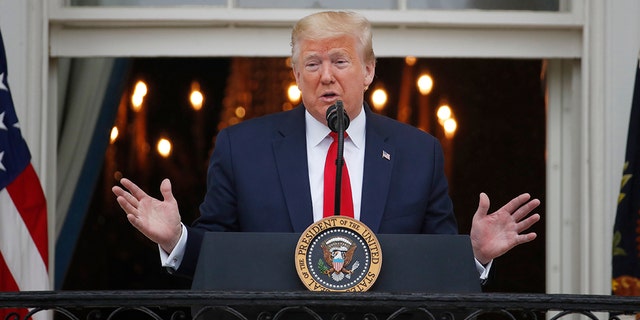
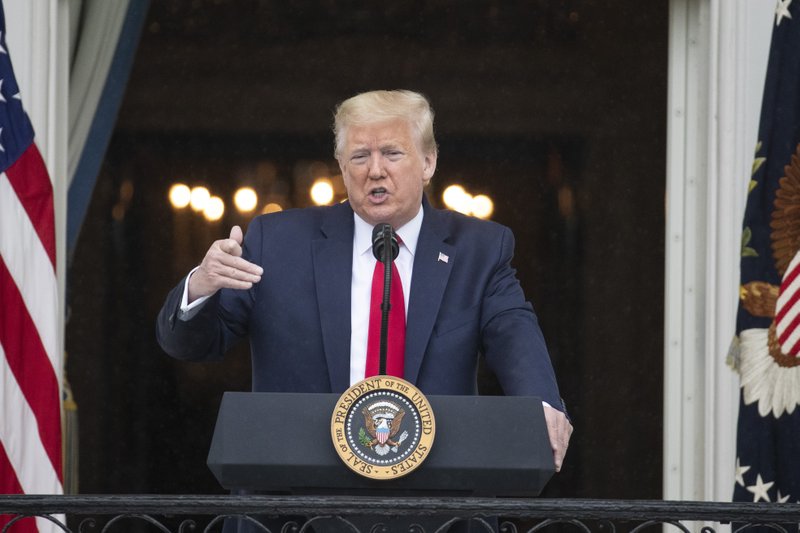
President Trump speaking last week at the White House. (AP Photo/Alex Brandon)
A Twitter spokesperson told Fox News that Trump's
tweets "contain potentially misleading information about voting
processes and have been labeled to provide additional context around
mail-in ballots," and that "this decision is in line with the approach
we shared earlier this month." Twitter
acknowledged Trump's tweet "is not in violation of the Twitter Rules as
it does not directly try to dissuade people from voting — it does,
however, contain misleading information about the voting process,
specifically mail-in ballots, and we’re offering more context to the
public." Twitter did not respond to Fox News' inquiries about
whether consideration was given for The Washington Post or CNN's
political leanings, or why its warning label appeared to be
contradictory -- saying both that there was "no evidence" that mail-in
balloting leads to fraud, and at the same time, that there was indeed
evidence that mail-in balloting had been linked to fraud, although only
"very rarely." However, Republicans have long argued that many
states fail to adequately clean up their voter rolls. Last year,
California was forced to remove 1.5 million ineligible voters after a court settlement last year when California's rolls showed a registration of 112 percent. And, data from
the U.S. Election Assistance Commission indicates that roughly 28
million mail-in ballots have disappeared in the past decade.
“Elections in 2012, 2014, 2016, and 2018 saw more than 28.3 million 'unaccounted for' mail ballots,” a report from the Public Interest Legal Foundation (PILF) recently assessed. “Putting
the election in the hands of the United States Postal Service would be a
catastrophe. Over the recent decade, there were 28 million missing and
misdirected ballots,” PILF President and General Counsel J. Christian
Adams said in a statement. “These represent 28 million opportunities for
someone to cheat. Absentee ballot fraud is the most common; the most
expensive to investigate; and can never be reversed after an election.
The status quo was already bad for mail balloting. The proposed
emergency fix is worse.” Election integrity has become one of the
upcoming election's most prominent issues. On May 20, Trump threatened
to withhold federal funds from Michigan if it pursued mail-in balloting
-- a questionably constitutional move, given general prohibitions
against the federal government forcing state action on matters
ordinarily within states' jurisdiction. "Michigan sends absentee
ballot applications to 7.7 million people ahead of Primaries and the
General Election," Trump wrote. "This was done illegally and without
authorization by a rogue Secretary of State. I will ask to hold up
funding to Michigan if they want to go down this Voter Fraud path!" The Republican National Committee (RNC) earlier this month aunched ProtectTheVote.com,
a digital platform that the GOP says is part of its all-hands-on-deck
effort to "protect against the Democrats' assault on our elections" as
progressives push for sweeping changes, including vote-by-mail and more
ballot harvesting, amid the coronavirus pandemic. The launch came after the RNC and Trump campaign doubled their legal budget to $20 million after an initial commitment of
$10 million in February, saying they wanted to "fight frivolous
Democrat lawsuits and uphold the integrity of the elections process."
That
was a message echoed by Trump in a tweet last month: "GET RID OF BALLOT
HARVESTING, IT IS RAMPANT WITH FRAUD. THE USA MUST HAVE VOTER I.D., THE
ONLY WAY TO GET AN HONEST COUNT!" Suspicion of big tech has reached a critical mass in recent months. Also on Tuesday, Oculus VR founder Palmer Luckey discovered
that YouTube was censoring comments critical of the Chinese government.
YouTube called the censorship a mistake, but offered no details;
Republicans, in turn, sought a closer look. "Is
Project Dragonfly going global?" wrote Indiana Republican Rep. Jim
Banks, referring to Google's since-scrapped search engine that would
have censored results to appease the Chinese government. "Google must
stop imitating #CCP censorship practices now. "
Twitter's "Head of Site Integrity" Yoel Roth boasts on his LinkedIn that he is in charge of "developing and enforcing Twitter’s rules," like the one that led Twitter to slap a new "misleading" warning label on two of President Trump's tweets concerning mail-in balloting on Tuesday. However,
Roth's own barrage of anti-Trump, politically charged tweets seemingly
calls into question whether he should be creating guidelines for the
president and other Twitter users, especially when Twitter is under fire for its alleged left-wing bias. Commentators have argued that Trump's tweets on the risks of mail-in voting were not misleading,
and the president accused Twitter of seeking to "interfere" in the
upcoming election under the guise of a supposedly neutral
"fact-checking" policy. Roth has previously referred to Trump and his team as "ACTUAL NAZIS," mocked Trump supporters by saying that "we fly over those states that voted for a racist tangerine for a reason," and called Senate Majority Leader Mitch McConnell, R-Ky., a "personality-free bag of farts." (Last August, Twitter suspended McConnell's Twitter account, prompting the GOP to threaten to cut off advertising on the site until Twitter relented.) In September 2016, Roth tweeted,
"I’ve never donated to a presidential campaign before, but I just gave
$100 to Hillary for America. We can’t fu-k around anymore." When Trump won the November 2016 election, Roth dejectedly chalked the development up to "[Bernie] Sanders protest voters, and racism," before sounding more optimistic notes. "I’m almost ready to stop dwelling on how my friends are complicit in the election of Donald Trump," he said on Jan. 7, 2017. "Almost." "Massive anti-Trump protest headed up Valencia St," Roth wrote on Jan. 20, 2017, followed by a "heart" emoji and the words "San Francisco." Indeed,
Roth sometimes opened up about his heart on the social media platform.
"'Every time a cute boy uses an Android phone, I die inside' is the new
'Every time a cute boy tells me he's a Republican, I die inside,'" he said in 2011. "I occasionally worry that my mother WASN'T joking all those times she told us she was voting Republican," he wrote in 2012. For the most part, though, Roth urged his followers to unite, especially after Trump's inauguration. "The
'you are not the right kind of feminist' backlash to yesterday's
marches has begun," Roth wrote on Jan. 22, 2017. "Did we learn nothing
from this election?" Also on Jan. 22, 2017, Roth compared senior Trump adviser Kellyanne Conway to Nazi propagandist Joseph Goebbels. Exacerbating
matters, Roth previously authored a slew of posts bluntly referring to
what he calls "trannies." In 2010, he wrote: "It wouldn't be a trip to
New York without at least one big scary tranny." In 2012, he tweeted: "A
10 block cab ride can seem so much longer when the driver tells you
about that time he thought a tranny hooker was a 'real girl.'" "Tranny
hookers in Birkenstocks. Philadelphia: a city of contradictions," he
mused on July 24, 2011. "All the fags took him to heart," Roth wrote on March 21, 2009, referring to Christian Siriano of "Project Runway" fame. When another user criticized his language,
Roth held his ground. "Trans is a category worth being linguistically
destabilized in the same way we did gay with 'fag,'" he wrote. "Sorry,
but I don’t subscribe to PC passing the buck. Identity politics is for
everyone." Yoel says on his personal website that
he received his PhD in Communication from the University of
Pennsylvania by "studying privacy and safety on gay social networks." "These are the kids that are fact checking the President of the United States," remarked Heather Champion, a commentator on social media. Several of Roth's tweets were first resurfaced by The New York Post's Jon Levine early Wednesday morning. Roth's most polemical and political posts, which do not carry any warning label, were under extra scrutiny as Trump accused Twitter of "interfering
in the 2020 Presidential Election" by again acting out of apparent
left-wing bias. The president vowed to take unspecified action. Earlier
Tuesday, Trump wrote: "There is NO WAY (ZERO!) that Mail-In Ballots
will be anything less than substantially fraudulent. Mailboxes will be
robbed, ballots will be forged & even illegally printed out &
fraudulently signed. The Governor of California is sending Ballots to
millions of people, anyone living in the state, no matter who they are
or how they got there, will get one. That will be followed up with
professionals telling all of these people, many of whom have never even
thought of voting before, how, and for whom, to vote. This will be a
Rigged Election. No way!!" Within hours, Twitter then appended an
unprecedented label to the bottom of the tweet reading, "Get the facts
about mail-in ballots." Clicking that label brings readers to a
paragraph reading in part: "Experts say mail-in ballots are very rarely
linked to voter fraud. ... Fact-checkers say there is no evidence that
mail-in ballots are linked to voter fraud." Twitter's
warning label was placed on Trump's tweets even though a Twitter
spokesperson acknowledged to Fox News that Trump's tweet had not broken
any of the platform's rules, and despite the fact that severalexperts have called mail-in balloting an invitation to widespread fraud, as Trump said in his tweets. Indeed, bipartisan panels of experts, as well as journalists, have found that absentee balloting increases the risk of voter fraud. "Absentee ballots remain the largest source of potential voter fraud," read the
conclusion of a bipartisan 2005 report authored by the Commission on
Federal Election Reform, which was chaired by former President Jimmy
Carter and former Secretary of State James Baker. "Twitter 'fact-checkers' really suck," wrote Dan Bongino, a Fox News contributor. He linked to a 2012 article in The New York Times headlined,
"Error and Fraud at Issue as Absentee Voting Rises." The article states
that "votes cast by mail are less likely to be counted, more likely to
be compromised and more likely to be contested than those cast in a
voting booth, statistics show." A Twitter thread
Tuesday by White House press secretary Kayleigh McEnany highlighted
numerous recent stories documenting fraud concerns over mail-in ballots
across the country, including a Fox News piece. The brouhaha erupted just two months after Twitter flagged a video uploaded by the Trump campaign as "manipulated media," only to rebuff the campaign's efforts to have the platform flag a similar video uploaded by the Biden team. Roth and Twitter did not immediately respond to Fox News' request for comment early Wednesday. In March, Roth sat for an interview with NPR, in which he emphasized that he was working to combat "election disinformation." "I
think in 2020, we're facing a particularly divisive political moment
here in the United States, and attempts to capitalize on those divisions
amongst Americans seem to be where malicious actors are headed," Roth
said. "This is a similar pattern to what we saw in 2016 and 2018, but
one of the things that we've seen from not only Russia but a wide range
of malicious actors is an attempt to capitalize on some of the major
domestic voices that are participating in these conversations and then
double down on some of those activities." On May 25, Roth took a
seemingly cavalier attitude towards criticism, tweeting, "Somehow,
regularly being told by internet strangers that I’m a soulless corporate
shill is still less harsh feedback than I got from anonymous peer
reviewers in my past academic life." The Trump campaign, however, was less amused. "We
always knew that Silicon Valley would pull out all the stops to
obstruct and interfere with President Trump getting his message through
to voters," Trump 2020 campaign manager Brad Parscale said in a
statement. "Partnering with the biased fake news media 'fact checkers'
is only a smoke screen Twitter is using to try to lend their obvious
political tactics some false credibility. There are many reasons the
Trump campaign pulled all our advertising from Twitter months ago, and
their clear political bias is one of them.“ And late Tuesday, Sen. Marco Rubio, R-Fla, noted on Twitter that "The law still protects social media companies like @Twitter
because they are considered forums not publishers. But if they have
now decided to exercise an editorial role like a publisher then they
should no longer be shielded from liability & treated as publishers
under the law." That was a reference to Section 230 of the
Communications Decency Act, which broadly protects online content
platforms from liability. For example, a defamatory comment posted by a
Twitter user would not ordinarily lead to liability for Twitter, even if
the platform allows the defamatory content to remain online after
becoming aware of it. Calls to reform the law have largely gone
unheeded in recent years, even as sites like Twitter take on a more
dominant role in national discourse. (Copyright law, which has a strong
constitutional foundation, ordinarily does require sites like Twitter to
remove offending content, or face liability.) Reaction to Twitter's actions among commentators was almost uniformly negative. The Wall Street Journal's James Taranto pointed out that
Twitter hadn't fact-checked Trump's charge that the platform was
interfering improperly in the election. "Hmm, no fact check on this so I
guess it must be true!" he wrote. Others observed
that Twitter had not fact-checked a false claim on police shooting
statistics that was shared by New York Democratic Rep. Alexandria
Ocasio-Cortez.
"It wouldn't be a trip to New York without at least one big scary tranny." — Twitter "Head of Site Integrity" Yoel Roth
Separately, GOP chairwoman Ronna McDaniel wrote that
Alabama's secretary of state, John Merrill, told CNN earlier in the day
that five of the six voter fraud convictions during his tenure related
to absentee balloting. In a post retweeted by the Trump campaign, The Daily Caller's Logan Hall noted that Twitter has not appended a warning label on tweets from Chinese government representatives engaging in a propaganda campaign to
blame the U.S. for the spread of coronavirus. "The deeper problem: many
of the big tech companies that people hold near and dear to their
hearts have no actual allegiance to America or American values," Hall wrote. "Wow,"
wrote Michael James Coudrey, the CEO of Yuko Social, a social media
engine for politicians and organizations. "Look what Twitter is doing to
the President of the United States [sic] tweets. They are attaching a
link then saying according to CNN and Washington Post, what he is saying
is unsubstantiated. This is insane."
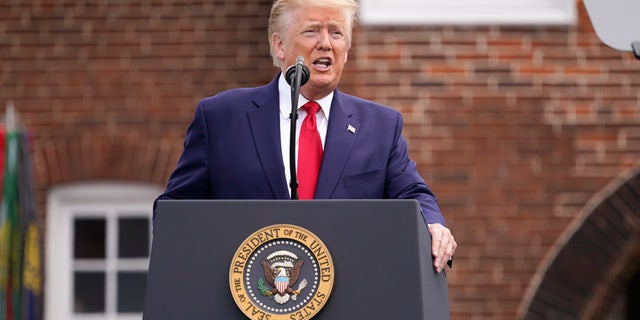
President Donald Trump speaks during a Memorial Day ceremony at
Fort McHenry National Monument and Historic Shrine, Monday, May 25,
2020, in Baltimore. (AP Photo/Evan Vucci)
A Twitter spokesperson told Fox News earlier Tuesday
that Trump's tweets "contain potentially misleading information about
voting processes and have been labeled to provide additional context
around mail-in ballots," and that "this decision is in line with the
approach we shared earlier this month." Twitter
acknowledged Trump's tweet "is not in violation of the Twitter Rules as
it does not directly try to dissuade people from voting — it does,
however, contain misleading information about the voting process,
specifically mail-in ballots, and we’re offering more context to the
public." Twitter
did not respond to Fox News' inquiries about whether consideration was
given for The Washington Post or CNN's political leanings, or why its
warning label appeared to be contradictory -- saying both that there was
"no evidence" that mail-in balloting leads to fraud, and at the same
time, that there was indeed evidence that mail-in balloting had been
linked to fraud, although only "very rarely." However, Republicans
have long argued that many states fail to adequately clean up their
voter rolls. Last year, California was forced to remove 1.5 million ineligible voters after a court settlement last year when California's rolls showed a registration of 112 percent. And, data from
the U.S. Election Assistance Commission indicates that roughly 28
million mail-in ballots have disappeared in the past decade. “Elections in 2012, 2014, 2016, and 2018 saw more than 28.3 million 'unaccounted for' mail ballots,” a report from the Public Interest Legal Foundation (PILF) recently assessed. “Putting
the election in the hands of the United States Postal Service would be a
catastrophe. Over the recent decade, there were 28 million missing and
misdirected ballots,” PILF President and General Counsel J. Christian
Adams said in a statement. “These represent 28 million opportunities for
someone to cheat. Absentee ballot fraud is the most common; the most
expensive to investigate; and can never be reversed after an election.
The status quo was already bad for mail balloting. The proposed
emergency fix is worse.” Election integrity has become one of the
upcoming election's most prominent issues. On May 20, Trump threatened
to withhold federal funds from Michigan if it pursued mail-in balloting
-- a questionably constitutional move, given general prohibitions
against the federal government forcing state action on matters
ordinarily within states' jurisdiction. "Michigan sends absentee
ballot applications to 7.7 million people ahead of Primaries and the
General Election," Trump wrote. "This was done illegally and without
authorization by a rogue Secretary of State. I will ask to hold up
funding to Michigan if they want to go down this Voter Fraud path!" The Republican National Committee (RNC) earlier this month launched ProtectTheVote.com,
a digital platform that the GOP says is part of its all-hands-on-deck
effort to "protect against the Democrats' assault on our elections" as
progressives push for sweeping changes, including vote-by-mail and more
ballot harvesting, amid the coronavirus pandemic. The launch came after the RNC and Trump campaign doubled their legal budget to $20 million after an initial commitment of
$10 million in February, saying they wanted to "fight frivolous
Democrat lawsuits and uphold the integrity of the elections process." That
was a message echoed by Trump in a tweet last month: "GET RID OF BALLOT
HARVESTING, IT IS RAMPANT WITH FRAUD. THE USA MUST HAVE VOTER I.D., THE
ONLY WAY TO GET AN HONEST COUNT!" Suspicion of big tech has reached a critical mass in recent months. Also on Tuesday, Oculus VR founder Palmer Luckey discovered that
YouTube was censoring comments critical of the Chinese government.
YouTube called the censorship a mistake, but offered no details;
Republicans, in turn, sought a closer look. "Is
Project Dragonfly going global?" wrote Indiana Republican Rep. Jim
Banks, referring to Google's since-scrapped search engine that would
have censored results to appease the Chinese government. "Google must
stop imitating #CCP censorship practices now. "
RIO
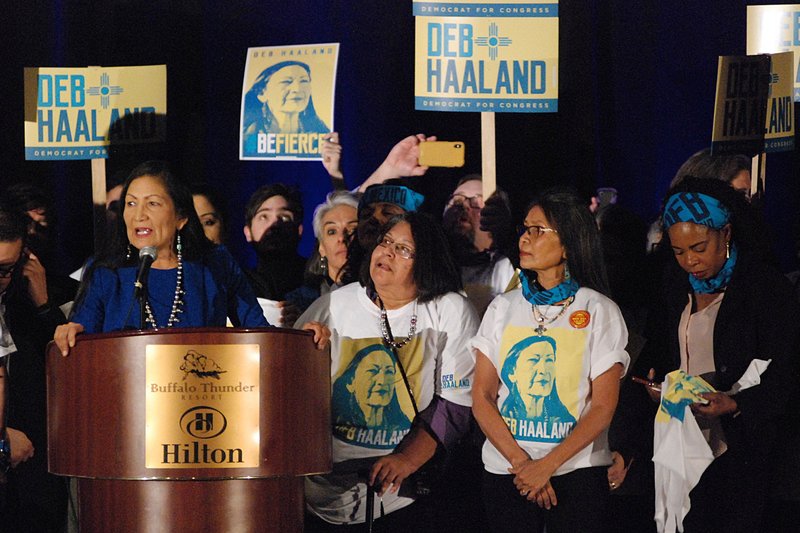
RANCHO, N.M. (AP) — New Mexico voters have a chance this year to send a
historic all-female U.S. House delegation to Congress, no matter which
party wins races.
And the state’s three congresswomen may be all women of color — another national milestone.
Women
are seeking the Democratic and Republican nominations in all six of the
state’s primary races for three congressional seats. In each of those
races, at least one Latina or one Native American woman is running in
her respective party’s primary contests in what has turned out to be
some of the most diverse political battles in the county. The women
candidates have been among the largest fundraisers in races and could be
their party’s nominees.
New
Hampshire in 2013 became the first state to have an all-female
Congressional delegation (Sens. Jeanne Shaheen and Kelly Ayotte, and
Reps. Ann McLane Kuster and Carol Shea-Porter), according to the Center
for American Women and Politics at Rutgers University. Deleware’s lone
member of the U.S. House, Democratic Rep. Lisa Blunt Rochester, who is
black, helped give the state the nation’s first all-female of color U.S.
House delegation in 2017.
But
New Mexico could wind up with the largest U.S. House delegation of
women or women of color in the nation’s history. The state’s population
of about 2 million is 49 percent Hispanic and 9 percent Native American.
“This is
unusual,” Jean Sinzdak, associate director of the Center for American
Women and Politics, said. “A record number of women are running for
House seats, so this is interesting.”
In
New Mexico’s 3rd Congressional Democratic primary, for example, Yale
University graduate and Stanford University-trained lawyer Teresa Leger
Fernandez and former CIA operative Valerie Plame are among those running
in a crowded field to represent the state’s northern region. Both are
indicative of the area’s traditional Hispanic past (Leger Fernandez is
Latina) and recent coastal liberal transplants (the Anchorage,
Alaska-born Plame is white).
On
the Republican side, Navajo Nation member and businesswomen Karen
Bedonie is waging her campaign for the GOP nomination in isolation and
amid a strict curfew aimed at stopping the spread of COVID-19. Her
campaign literature features her in traditional Navajo clothing, and she
often mentions to voters that she’s a mother of eight.
The seat is open because Democratic U.S. Rep. Ben Ray Lujan is running for U.S. Senate.
The
state’s 1st Congressional District is currently held by Democratic U.S.
Rep. Deb Haaland, who was one of the nation’s first Native American
congresswomen.
Retired
police officer Michelle Garcia Holmes, who is Hispanic, is among three
Republicans seeking the GOP nomination to challenge Haaland for the
Democratic-leaning seat representing Albuquerque.
In
the state’s southern 2nd Congressional District, oil executive Claire
Chase and former state lawmaker Yvette Herrell are locked in a nasty,
three-person contest for the GOP nomination. Chase is the first female
chair of the New Mexico Oil and Gas Association, and Herrell is an
enrolled member of the Cherokee Nation.
They
are seeking to unseat Democratic Rep. Xochitl Torres Small, the
granddaughter of Mexican immigrants and who grew up in the Church of
Jesus Christ of Latter-day Saints.
Retired
University of New Mexico political science professor Christine Marie
Sierra, who has followed women in politics for years, said this moment
has been building for decades in New Mexico.
“Women
are now seen as viable candidates, and both parties in New Mexico are
doing their part to recruit women to run for office,” Sierra said. “And
what you see here is a reflection of the state’s diversity.”
According
to the Center for American Women and Politics, 490 women have filed as
candidates for U.S. House seats nationwide in 2020, a new record high.
That
surpasses even the record-breaking 2018 midterm election, in which 476
women filed to run for House seats, the center found.
The numbers could grow because filing deadlines have yet to pass in around a dozen or so states.
Much of the surge in candidate filings is in Republican primaries across the country, the center said.
Women
also are making gains in local elections. Last year, for example,
Tucson, Arizona, voters elected Regina Romero, the daughter of farm
workers, as the first Latina mayor in the city’s history.
Leger
Fernandez said whatever happens in her election, she’s proud to be part
of a chance to make history. As a two-year-old, she was in a coma with
spinal meningitis. Doctors didn’t believe she would survive.
Her
grandmother, Abelina Romero Lucero, prayed to La Virgen de Guadalupe
and later made a pilgrimage to Mexico to ask the heavens to heal her
granddaughter.
Leger Fernandez has pictured herself having a conservation with her late grandmother after winning her race.
“I know exactly what she’d say,” Leger Fernandez said. “She’d tell me, ‘I knew there was a reason La Virgen let you live.’ ”
WASHINGTON (AP) — Congress is at a crossroads in the coronavirus
crisis, wrestling over whether to “go big,” as House Speaker Nancy
Pelosi wants for the next relief bill, or hit “pause,” as Senate
Majority Leader Mitch McConnell insists.
It’s
a defining moment for the political parties heading toward the election
and one that will affect the livelihoods of countless Americans
suddenly dependent on the federal government. Billions in state aid,
jobless benefits and health resources are at stake. As questions mount
over Washington’s proper role, it’s testing the ability of President
Donald Trump and Congress to do the right thing.
“These
are the eternal debates in American history,” said Richard Sylla, a
professor emeritus of economic and financial history at New York
University.
“It’s
a bit like what Andrew Hamilton was facing in 1790,” he said,
describing the plan to have the new federal government assume the
Revolutionary War debts of the states, despite protests of a bailout. It
was, he said, as Hamilton framed it, “the price of liberty.”
As
negotiations develop on Capitol Hill, the coronavirus response offers
Congress an opportunity to shape the country’s post-pandemic future but
also carries the risk of repeating mistakes of past crises, including
the 2008-09 recession, that history does not easily forget.
Trump
and McConnell huddled late last week on next steps after rejecting
Pelosi’s plan. The Democratic speaker set the table with passage of the sweeping $3 trillion
coronavirus relief bill, which includes $1 trillion to shore up states
and cities to avert municipal layoffs, $1,200 stipends to Americans and
other aid.
“We could have done bigger,” Pelosi told The Associated Press in a recent interview.
With more than 38 million unemployment claims, the Republican response centers on kick-starting the economy to reduce the need for more federal intervention.
Republican
priorities are to wean Americans off unemployment benefits to nudge
people back to work and provide liability protections for businesses
that reopen.
Republicans
want to eliminate the $600 weekly unemployment benefit boost, arguing
it “handcuffs” some employees with higher pay than they earn at their
jobs. McConnell also wants to protect doctors, schools and others from
COVID-19-related lawsuits — a “red line,” he says, for any deal.
“There’s a high likelihood we will do another rescue package,” McConnell said on Fox News. “We need to work smart here.”
The political and economic debate stretches beyond the halls of Congress as wary Americans await Washington’s next move.
It
was Federal Reserve Board Chairman Jerome Powell who counseled Pelosi
to rely on historically low interest rates to “go big,” while Treasury Secretary Steven Mnuchin warned of “permanent damage” to the economy unless businesses reopen.
Washington
has been here before. Staring down the 2008-09 financial crisis forced
the House and Senate into a historic debate over the size and scope of
government that still resonates today.
Then,
like now, countless Americans fell swiftly into the ranks of the newly
unemployed, while the very foundations of the American dream — home
ownership then, health now — hung in the balance. Then, banks needed a
federal lifeline; today, businesses look to Washington for help.
Pelosi
told the AP the biggest lesson learned was to be “very prescriptive” in
how the money would be spent after facing a backlash that the rescue
benefited Wall Street over Main Street.
But
perhaps another lesson from the earlier crisis was the voter revolt
against big government. The bank bailout and recovery act sparked the
rise of the tea party wing of the GOP. Pelosi lost her gavel in the 2010
election, and Republicans took control of the House.
Many of the same tea party forces
— including the deep-pocketed Koch network — are aligned with Trump’s
push to prevent state aid, reopen the country and get people back to
work.
“The
American people need to understand the choices they have,” said North
Carolina Sen. Thom Tillis, one of the most endangered Republicans
seeking reelection in the fall, during an online forum with the
Koch-backed Americans for Prosperity.
Tillis
opposes Pelosi’s “manifesto” and doesn’t expect the Senate to act
before July. He said of the GOP-held Senate, “We’re a bulkhead against
bad happening.”
Despite rare bipartisan support for earlier aid, the $2 trillion bill approved in March, neither side was particularly pleased with the outcome, the largest federal intervention in U.S. history.
Polling, however, shows Americans favoring the federal response, even as they have some concerns about spending.
An
AP-NORC poll conducted in late March found that elements of the
stimulus package were widely popular. The poll found that about 9 in 10
Americans favored the federal government providing funding to small
businesses and hospitals.
About
8 in 10 said they were in favor of suspending evictions and
foreclosures, giving lump-sum payments to Americans, increased
unemployment benefits and suspended student loan payment.
A
mid-April NBC/Wall Street Journal poll showed registered voters
somewhat more likely to say they were concerned about the federal
government spending too much on economic stimulus and driving up the
budget deficit than they were worried that too little money would be
spent, lengthening the recession, 48% to 40%. The remaining 12% said
they didn’t know.
Democratic Sen. Debbie Stabenow acknowledged the $3 trillion proposal is a “big number.”
But she said on her drive home to hard-hit Michigan, “The cost of inaction will be much higher.”
___
Associated Press Director of Public Opinion Research Emily Swanson contributed to this report.
Michigan Gov. Gretchen Whitmer faced
backlash from Republican lawmakers after a reported request from her
husband to get the family's boat out on the water before Memorial Day
weekend -- far from their home in Lansing. Whitmer, a Democrat,
famously has imposed one of the strictest lockdowns in the country,
sparking frequent protests. What's more, she's told people not living in
Northern Michigan to stay away from vacation spots there during the
holiday weekend. In Facebook posts no longer visible to the
public, NorthShore Dock LLC and its owner, Tad Dowker, focused on what
Dowker said was a request last week by Whitmer's husband, Marc Mallory.
The posts caught the attention of Republican state lawmakers, who said
the governor's family may not have wanted to follow the guidance she's
issued for the rest of the state. "This morning, I was out working
when the office called me, there was a gentleman on hold who wanted his
boat in the water before the weekend," Dowker posted. "Being Memorial
weekend and the fact that we started working three weeks late means
there is no chance this is going to happen." He
continued, "Our office personnel had explained this to the man and he
replied, 'I am the husband to the governor, will this make a
difference?'" The docking company later noted that Mallory respectfully
accepted that the accommodation would not be possible. Whitmer
spokeswoman Tiffany Brown refused to comment on the matter, saying the
administration wouldn't address "every rumor that is spread online," The Detroit News reported. Last
Monday, Whitmer announced restrictions would be lifted in some regions
of Northern Michigan, but urged those who didn't live in the region to
stay away. "If you don't live in these regions... think long and hard
before you take a trip into them," she said. "A small spike could put
the hospital system in dire straits pretty quickly. That's precisely why
we're asking everyone to continue doing their part. Don't descend on
[waterfront] Traverse City from all regions of the state." The
vacation property Whitmer and her husband have owned is about 25
minutes from Traverse City, according to The Detroit News, but the
family permanently resides in Lansing, over 150 miles away. State
Sen. Tom Barrett, R-Charlotte, said Whitmer had urged Michigan residents
not to "descend" on the city. "Yet, what did her family try and do?"
Barrett said. "In the Army, we have a tradition that the leaders
get in line for chow last behind everyone else in the unit," he
continued. "Here is the leader of our state. ... Her family is trying to
cut people in line." After rising to fame over her stringent coronavirus policy, Whitmer confirmed last week she had been in talks with the Biden campaign about a potential vice presidential candidate pick. The governor attracted the attention of President Trump when she criticized the federal government's response to the pandemic. “I
love Michigan, one of the reasons we are doing such a GREAT job for
them during this horrible Pandemic. Yet your Governor, Gretchen 'Half'
Whitmer is way in over her head, she doesn't have a clue. Likes blaming
everyone for her own ineptitude!” he tweeted after her comments.
WASHINGTON (AP) — Presidential politics move fast. What we’re watching heading into a new week on the 2020 campaign:
Days to general election: 162 ___
THE NARRATIVE
As some parts of the nation continue to ease stay-at-home orders meant to slow the spread of the coronavirus, the economy remains in free fall. And, with the U.S. death toll
now climbing toward 100,000, a conundrum is emerging: Even if people
are allowed to resume their daily routines, will they feel safe enough
to do so? President Donald Trump says that the country is anxious to get
back to work and that pent-up consumer demand can turn things around in
a hurry. Presumptive Democratic nominee Joe Biden counters by urging
caution and heeding medical and scientific experts, many of whom say
it’s much too early to return to normal. Which one is correct may
ultimately not be clear until after November’s election — but will
nonetheless almost certainly be the determining factor in who wins it.
___
THE BIG QUESTIONS
Does Biden have no choice but to choose an African American running mate?
Black leaders have for weeks argued that the former vice president picking an African American as his vice president
is the only way to reflect the Democratic Party’s deep diversity and to
repay a community that helped Biden overcome a disastrous start to
dominate in the South and win the primary. But the issue may have come
to a head on Friday when Biden endured a testy exchange with prominent
black radio personality Charlamagne Tha God before declaring, “If you’ve
got a problem figuring out whether you’re for me or for Trump, then you
ain’t black.”
He later said he shouldn’t have been so “cavalier,”
but not before sparking a social media firestorm and prompting the
president’s reelection campaign to decry it as the kind of race-baiting
it often gets accused of. “It is clear now more than ever, following
these racist and dehumanizing remarks, that Joe Biden believes black men
and women are incapable of being independent or free thinking,” Black
Voices for Trump said in a statement.
Biden
has refused to publicly discuss his running mate finalists, but they
are thought to include several prominent white women, including Sens.
Elizabeth Warren of Massachusetts and Amy Klobuchar of Minnesota. He
figures to do well with African American voters in November no matter
whom he picks, but a lack of enthusiasm in the black community hurt
Hillary Clinton in the battleground state of Michigan and elsewhere in
2016. That’s a calculation Biden may be unable to ignore, even as his
campaign insists his choice will have more to do with personal
relationships than skin color.
How much more political will science get?
Trump
has long energized his conservative base by rejecting climate change
and academic intellectualism but lately has begun suggesting the institution of science is out to undermine him. The president insisted on taking the malaria drug hydroxychloroquine
to guard against the coronavirus despite federal warnings against doing
so. He also rejected as politically motivated a study showing that
nearly 36,000 Americans’ lives might have been saved if social distancing measures had been put in place one week sooner. Polling has already shown that issues like wearing face masks in public are becoming increasingly partisan.
If science itself follows a similar path, that could hinder evolving
efforts to slow the virus — potentially producing results deadly enough
to go well beyond the political.
How much more political will voting by mail get?
Trump has intensified his opposition to expanding mail-in balloting amid the pandemic, even threatening federal funding
to the battleground states of Michigan and Nevada before later
suggesting that might not be necessary. Many Democratic-led states are
nonetheless looking to ease rules on absentee voting, saying the
coronavirus may make it a matter of life and death. With top Republicans
rallying behind Trump’s insistence that doing so is undemocratic and
federal court cases on the issue already raging in places like Texas,
how the nation votes may prove as pivotal to November’s outcome as for
whom it votes.
Are political conventions possible in the age of the coronavirus?
The
Republican National Committee marked 100 days until the scheduled start
of its convention in Charlotte, North Carolina, by proudly suggesting
last weekend that nearly 50,000 attendees would soon be descending on
that city. Its chair, Ronna McDaniel, was subsequently less committal
about the gathering going off exactly as planned and beginning Aug. 24
amid the pandemic. But she vowed that it will happen at least partly in person, saying, “We will not be holding a virtual convention.” Democrats have already delayed their convention
from July until August and have been more open to the idea of it
unfolding virtually — taking steps to grant organizers the authority to
design an event that won’t require delegates attending in person. A
bigger question than if some in-person activities remain intact for one
party or the other, though, is whether attendees will want to go —
especially given the low political stakes since the presidential nominee
on both sides isn’t in doubt.
___
THE FINAL THOUGHT
Trump’s
reelection chances likely hinge on convincing the country he built a
sustained economic boom once and can do so again, leading an equally
speedy and robust recovery after the coronavirus sparked an
unprecedented bust. Biden has taken a different approach, promising to
use the crisis to build a new economy that will embrace progressive
proposals designed to lift all Americans — but without really saying how
long that might take. Amid what may prove to be the nation’s worst
downturn, whether voters can look past the “when” to the “how” of a
recovery is an open question. Still, it’s one that can’t be answered
until a recovery actually begins to materialize.
___
2020 Watch runs every Monday and provides a look at the week ahead in the 2020 election.
___
Catch up on the 2020 election campaign with AP experts on our weekly politics podcast, “Ground Game.”
In
this Friday, May 22, 2020, photo, President Donald Trump speaks during a
"Rolling to Remember Ceremony," to honor the nation's veterans and
POW/MIA, from the Blue Room Balcony of the White House in Washington.
Trump booked back-to-back Memorial Day appearances despite the
coronavirus pandemic, at Arlington National Cemetery and at a historic
fort in Baltimore. (AP Photo/Alex Brandon)
WASHINGTON (AP) — President Donald Trump booked back-to-back Memorial Day appearances despite the coronavirus pandemic, at Arlington National Cemetery and at a historic fort in Baltimore. Trump recently called Baltimore a “rat and rodent infested mess,” and its mayor has suggested Trump stay home.
Presidents
typically honor fallen military members by laying a wreath and
delivering a speech at the hallowed burial ground in Virginia. But the
pandemic, which is expected to claim its 100,000th American this week,
has led to changes this year. Trump will only lay a wreath at the Tomb of the Unknown Soldier.
He is expected to speak later at Baltimore’s Fort McHenry National Monument and Historic Shrine.
It’s where a poem, written after a huge American flag was hoisted to
celebrate an important victory over the British during the War of 1812,
became “The Star-Spangled Banner.”
Trump
has been steadily ramping up his schedule in an effort to portray the
nation as returning to its pre-pandemic ways as it emerges from a devastating economic shutdown intended to slow the virus.
The U.S. leads the world with more than 1.6 million confirmed coronavirus cases and more than 97,000 deaths, according to a tally by Johns Hopkins University.
This month, Trump has toured factories in Arizona, Pennsylvania and Michigan that make pandemic supplies. He planned to be in Florida
on Wednesday to watch two NASA astronauts rocket into space, and he
played golf at his private club in Virginia on Saturday and Sunday.
Baltimore Mayor Bernard C. “Jack” Young has criticized Trump’s visit,
saying the trip sends the wrong message about stay-at-home directives
and that the city cannot afford the added cost of a presidential visit
at a time when it is losing $20 million a month because of the pandemic.
“That
President Trump is deciding to pursue nonessential travel sends the
wrong message to our residents,” Young, a Democrat, said in a statement
last week. He referenced the disproportionate effect the virus has had
on his city and called on Trump to “set a positive example” by not
traveling during the holiday weekend.
The White House sounded unmoved.
“The
brave men and women who have preserved our freedoms for generations did
not stay home and the president will not either as he honors their
sacrifice by visiting such a historic landmark in our nation’s history,”
White House spokesman Judd Deere said in an emailed statement Sunday.
Trump
will visit Baltimore just over a week after Maryland began to lift some
of the restrictions it had put in place for the coronavirus, though
they remain in effect in Baltimore. Baltimore and the Washington, D.C.,
area have the nation’s highest percentages of positive cases, according
to Dr. Deborah Birx, coordinator of the White House coronavirus task
force.
Trump
last summer described a congressional district that includes Baltimore
as a “disgusting, rat and rodent infested mess” where “no human being
would want to live.”
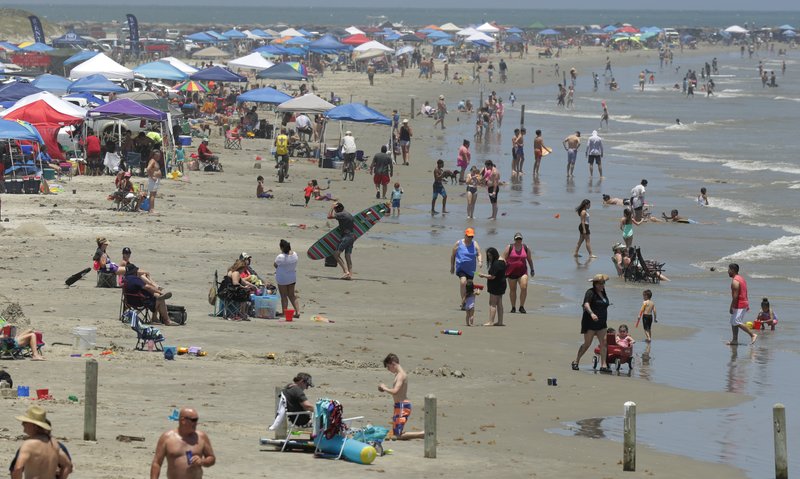
ST.
PETERSBURG, Florida. (AP) — Big crowds turned out for the Memorial Day
weekend in the U.S. amid warnings from authorities about people
disregarding the coronavirus social-distancing rules and risking a
resurgence of the scourge that has killed nearly 100,000 Americans.
On
the Navajo Nation, which sprawls across the states of Arizona, New
Mexico and Utah, the number of virus cases rose by 56 on Sunday to
4,689, according to the local health department.
Meanwhile,
the White House broadened its travel ban against countries hit hard by
the virus, saying it would deny admission to foreigners who have
recently been in Brazil.
Japan
moved further toward reopening Monday, with plans to end the state of
emergency in Tokyo and surrounding areas that has lasted for more than a
month and a half.
Millions
of Australian children returned to school as the number of coronavirus
patients across the country continues to fall. The states of New South
Wales and Queensland were the latest to resume face-to-face learning.
Queensland
Premier Annastacia Palaszczuk said Monday that students and teachers
had to observe one key message: Stay home if sick. “We’re not out of the
woods yet,” she said. “We have to take each day as it comes, each week
as it comes and we keep our fingers crossed.”
China
reported 11 new cases of the coronavirus, 10 of them among passengers
arriving from overseas in the vast Inner Mongolia region north of
Beijing, according to the National Health Commission.
China,
where the virus was first detected late last year, is holding the
annual session of its ceremonial parliament, part of efforts to show
that the country is returning to normal and shaking off the devastating
economic efforts of having locked down tens of millions of citizens in
order to contain the pandemic.
South
Korea reported 16 new cases as 2 million more children begin returning
to school this week. Thirteen of the new cases came from the densely
populated Seoul metropolitan area, where more than 200 infections have
been linked to nightclubs and other entertainment outlets. The
transmissions have raised concern as officials proceed with a phased
reopening of schools.
All
South Koreans will be required to wear masks while using public
transportation starting Tuesday, Health Ministry official Yoon Taeho
told reporters. Masks will also be required on all domestic and
international flights beginning Wednesday.
Dr.
Deborah Birx, coordinator of the White House coronavirus task force,
said she was “very concerned” about scenes of people crowding together
over the weekend.
“We
really want to be clear all the time that social distancing is
absolutely critical. And if you can’t social distance and you’re
outside, you must wear a mask,” Birx said on ABC’s “This Week.”
In Missouri, people packed bars and restaurants at the Lake of the Ozarks, a vacation spot popular with Chicagoans.
On
Georgia’s Tybee Island, the beach was filled with families, but at a
nearby grocery store, staff members handed customers gloves and a number
to keep track of how many people were inside.
In California, beaches and parks were open for swimming, running and other activities.
At
New York’s Orchard Beach in the Bronx, kids played with toys, and
people sat in folding chairs. Some wore winter coats on a cool and
breezy day, and many wore masks and sat apart from others.
“Good to be outside. Fresh air. Just good to enjoy the outdoors,” said Danovan Clacken, whose face was covered.
The
U.S. is on track to surpass 100,000 coronavirus deaths in the next few
days, while Europe has seen over 169,000 dead, according to a tally by
Johns Hopkins University that almost certainly understates the toll.
Worldwide, more than 5.4 million people have been infected and nearly
345,000 have died.
The
issue of wearing masks in public and staying several feet apart has
become fraught politically, with some Americans arguing that such rules
violate their rights.
Republican
Gov. Mike DeWine of Ohio, who has been targeted by such demonstrations,
insisted the precautions should not be a partisan issue.
“This
is not about whether you are liberal or conservative, left or right,
Republican or Democrat,” he said on NBC’s “Meet the Press.”
The
Trump administration said Sunday that it would ban foreign nationals
who have been in Brazil 14 days or less before planning to enter the
United States. The ban does not apply to U.S. citizens or legal
permanent residents or some of their relatives. Brazil is second only to
the U.S. in reported coronavirus cases.
Across
Europe, meanwhile, a mishmash of travel restrictions appears to be on
the horizon, often depending on what passports visitors carry.
Beginning
Monday, France is relaxing its border restrictions, allowing in migrant
workers and family visitors from other European countries. Italy is
only now allowing locals back to beaches in their own regions with
restrictions.
For
the first time in months, the faithful gathered in St. Peter’s Square
for the traditional Sunday papal blessing. Some 2,000 Muslims gathered
for Eid al-Fitr prayers at a sports complex in a Paris suburb, spaced 3
feet (1 meter) apart and wearing masks.
Greece
restarted regular ferry services Monday as the country accelerates
efforts to salvage its tourism season. Bars and restaurants were also
accepting customers again.
Travel
to Greece’s popular tourist islands had been generally off-limits since
a lockdown in late March, with only goods suppliers and permanent
residents allowed access.
___
Mahoney reported from New York. Associated Press writers around the world contributed to this report.


 Within minutes, Trump accused Twitter
of "interfering in the 2020 Presidential Election ... based on
fact-checking by Fake News CNN and the Amazon Washington Post." The
president added that the platform "is completely stifling FREE SPEECH"
and vowed: "I, as President, will not allow it to happen!"
Within minutes, Trump accused Twitter
of "interfering in the 2020 Presidential Election ... based on
fact-checking by Fake News CNN and the Amazon Washington Post." The
president added that the platform "is completely stifling FREE SPEECH"
and vowed: "I, as President, will not allow it to happen!"