The Texas Supreme Court ruled Wednesday that a lack of immunity to the coronavirus does not qualify as a disability under state law for requesting a mail-in ballot. The
all Republican-court agreed with Texas Attorney General Ken Paxton, who
had filed a petition to order local officials to follow state laws
regarding mail-in ballots after a Court of Appeals ruled to allow anyone
in Travis County to request a ballot, according to FOX 7 in Austin. President
Trump, who has repeatedly claimed that mail-in voting is associated
with widespread voter fraud, tweeted after the ruling. “Big win in Texas on the dangerous Mail In Voting Scam!” the president wrote. The
ruling was a loss for the Texas Democratic Party and voter rights
groups, which had sought expanding mail-in voting during the pandemic. To
receive a mail-in ballot in Texas, voters must either claim a
disability, be over 65, in jail, or away from their home county during
the election, according to the Texas Tribune. “We
agree with the State that a voter’s lack of immunity to COVID-19,
without more, is not a ‘disability’ as defined by the Election Code,”
the court’s ruling said, adding that voters must determine if they meet
the definition of "disability” and “election officials have no
responsibility to question or investigate a ballot application that is
valid on its face,” FOX 7 reported. Voters citing a disability when requesting a ballot are not required to to specify. “The
question before us is not whether voting by mail is better policy or
worse, but what the Legislature has enacted. It is purely a question of
law,” the ruling said, according to the Dallas Morning News. “Our authority and responsibility are to interpret the statutory text and give effect to the Legislature’s intent.” Having the virus, however, could entitle a voter to a mail-in ballot. Paxton,
in a statement said he applauded the court “for ruling that certain
election officials’ definition of ‘disability’ does not trump that of
the Legislature, which has determined that widespread mail-in balloting
carries unacceptable risks of corruption and fraud." “Election
officials have a duty to reject mail-in ballot applications from voters
who are not entitled to vote by mail. In-person voting is the surest
way to maintain the integrity of our elections, prevent voter fraud and
guarantee that every voter is who they claim to be," he said, according
to FOX 7.
All businesses in the state of Mississippi can reopen Monday – provided they follow guidelines for combating the coronavirus, Gov. Tate Reeves said Wednesday. “At that time, there will be no more business closures. Everyone will be allowed to operate,” Reeves said at a news briefing, according to the Clarion Ledger of Jackson. “We cannot have an endless shutdown,” the governor added.
“We cannot have an endless shutdown.” — Mississippi Gov. Tate Reeves
As
of early Thursday, the state had recorded nearly 14,000 infections from
the virus and 670 deaths, according to Johns Hopkins University. When
the pandemic began, Mississippi had scattered rules for the public and
businesses to help contain the spread of the virus but Reeves later
issued a statewide stay-at-home order, the Clarion Ledger reported. Reeves’ new guidance is titled his “Safe Return” order. The
plan calls for businesses to allow 50 people at a time indoors and 100
people at a time outdoors beginning Monday if they practice social
distancing. In cases where distancing is not possible, the capacities
will be lowered to 20 people indoors and 50 people outdoors, the newspaper reported. While the new order allows businesses to reopen, “This does not mean the threat is gone," Reeves stressed. “There
are no perfect options, but freedom with risk is better than a
prolonged shutdown,” he said, adding later, “I trust you. I trust the
people of Mississippi.” Although the number of daily cases in the
state has been on the rise, Reeves said this week that the data has been
“relatively flat.” “We
had a prolonged plateau where our cases have been relatively flat.
Again, you can go up or down a hundred cases, or two hundred cases over a
seven-day period on a rolling seven-day average, but we’ve been
relatively flat for 60 days in Mississippi," Reeves said Tuesday,
according to WLBT-TV of Jackson. At
the same briefing, state Health Officer Dr. Thomas Dobbs advised
residents to continue wearing masks and practicing social distancing,
noting that Wayne County, near the Alabama line, has seen a “remarkable
increase” in new infections.
The House of Representatives
adjourned late Wednesday without voting on whether to reauthorize
advanced surveillance tools used by law enforcement -- a measure that
had wide bipartisan support back in March, but which has drawn sudden
GOP opposition amid news of apparent FBI misconduct. President Trump threatened to
veto the bill if passed earlier on Wednesday, and House Democrats
delayed a vote three times throughout the day. Democrats can only lose
17 votes, and their failure to forge ahead indicated that they hadn't
yet whipped that minimum number. The House is set to reconvene
Thursday at 9 a.m. ET. Fox News is told that House Speaker Nancy Pelosi,
D-Calif., still wants the House to pass the bill, align it with the
Senate's version, and dare the president to veto it. "If the FISA
Bill is passed tonight on the House floor, I will quickly VETO it,"
Trump tweeted ahead of the vote. "Our Country has just suffered through
the greatest political crime in its history. The massive abuse of FISA
was a big part of it!" Earlier, Pelosi and Democratic leadership
marched forward with the scheduled vote to authorize Foreign
Intelligence Surveillance Act (FISA) provisions and said it will be up
to Trump to decide whether he wants to undo the carefully drafted
bipartisan effort. "I don't know what the president will do. This
is not the first time he's tweeted against a bill and then the next day
comes out and says he would support it," said House Rules Committee
Chairman Jim McGovern, D-Mass., of the Trump's Tuesday tweet urging
Republicans to oppose the FISA plan. "It will be in his hands." “Late night tweets are not a way to govern," McGovern added. The
House in March passed with broad bipartisan support a reauthorization
of the surveillance measures plus new privacy protections to the Foreign
Intelligence Surveillance Act (FISA) by a 278-136 vote. The Senate then
passed its version of reforms with another strong bipartisan vote of
80-16 to reauthorize expiring provisions and revise how the Justice
Department and FBI use the tools designed to fight terrorism. The House Wednesday had been slated to pass the Senate version and to send the FISA bill to Trump's desk. But
Trump put a wrench in the plan when he tweeted Tuesday night that he's
urging all Republicans to vote no on the FISA legislation "until such
time as our Country is able to determine how and why the greatest
political, criminal, and subversive scandal in USA history took place!” DOJ URGES TRUMP VETO ON FISA LEGISLATION, VOTE IN LIMBO Trump issued the warning on Twitter,
referring to his longstanding belief that the intelligence community
improperly used FISA authorities to surveil his presidential campaign
for political reasons and launch the Russia probe. Then the Department of Justice came out Wednesday morning urging Trump to veto the legislation saying it goes too far and would weaken national security tools. House
GOP Leader Kevin McCarthy, R-Calif., urged House Democrats to pull the
bill and Rep. Steve Scalise advised his members to vote "no."
Republicans argued the House should wait until they can draft
legislation that has the support of the Trump Administration. "My
support for the underlying legislation does not wane because of a
presidential tweet," said Rep. Rob Woodall, R-Ga. "My belief that the
legislation will be signed into law wanes because of a presidential
tweet." But House Majority Leader Steny Hoyer bashed Republicans
who voted in favor of the FISA bill just a few weeks and then reversed
course just now because of Trump's tweet. "Your flailing around to find a rationalization for your change of vote is sad," Hoyer said. If the legislation passes, it would go directly to Trump's desk for his signature or veto. The
surveillance tools have long been a concern for Trump who believes the
intelligence community improperly abused the FISA court to surveil his
former adviser Carter Page. A Department of Justice Inspector General
report found the FBI made repeated errors and misrepresentations before
the FISA Court in an effort to obtain the warrants against
Page. Meanwhile, progressives and libertarians also wanted more privacy
reforms to protect individual liberties. "With a FISA bill, nobody
is ever really that happy," Pelosi said about the legislation to
reauthorize and reform national security authorities in the U.S.A.
Freedom Act. "But the fact is ... we have to have a bill. If we don't
have a bill, our civil liberties are less protected." Fox News' Chad Pergram and Gregg Re contributed to this report.
Attorney General William Barr, left, has asked U.S. Attorney John
Bash to review "unmasking" before and after the 2016 election.
(File)
Attorney General Bill Barr
has asked U.S. Attorney for the Western District of Texas John Bash to
review the practice of "unmasking" before and after the 2016
presidential election, a controversy that has picked up steam after the Justice Department moved to drop charges against former National Security Adviser Michael Flynn, the DOJ told Fox News on Wednesday night. Republican
lawmakers have demanded more information about the extent of the
practice after a previously clandestine list of Obama-era officials who
sought to reveal what turned out to be the identity of Michael Flynn in
intelligence reports was released earlier the month. The DOJ had moved
to drop the Flynn case after internal memos were released raising
serious questions about the nature of the investigation that led to his
late-2017 guilty plea for lying to the FBI about his Russia contacts. DOJ spokeswoman Kerri Kupec told Fox News' "Hannity"
that U.S. Attorney John Durham, who has been reviewing the origins of
the Russia investigation, was looking into "unmasking" but Barr
determined certain aspects of the practice needed further review, and
Bash has been assigned to do so.
"Unmasking inherently isn't wrong,
but certainly, the frequency, the motivation and the reasoning behind
unmasking can be problematic, and when you're looking at unmasking as
part of a broader investigation -- like John Durham's investigation --
looking specifically at who was unmasking whom, can add a lot to our
understanding about motivation and big picture events," Kupec said.
Unmasking
is a tool frequently used during the course of intelligence work
and occurs after U.S. citizens' conversations are incidentally picked up
in conversations with foreign officials who are being monitored by the
intelligence community. The U.S. citizens' identities are supposed to be
protected if their participation is incidental and no wrongdoing is
suspected. However, officials can determine the U.S. citizens' names
through a process that is supposed to safeguard their rights. In the
typical process, when officials are requesting the unmasking of an
American, they do not necessarily know the identity of the person in
advance. Republicans
became highly suspicious of the number of unmasking requests made by
the Obama administration concerning Flynn, and have questioned whether
other Trump associates were singled out. The DOJ spokesperson also
affirmed that the D.C. Court of Appeals has invited the DOJ to weigh in
on the Flynn case, "and we will." Kupec
maintained that the DOJ had the ability to drop the case against
Flynn. "We have the prosecutorial discretion to make that decision." Fox News' Brooke Singman and Gillian Turner contributed to this report.
PARIS
(AP) — “Do as I say, but not as I do” was the message many British saw
in the behavior of Prime Minister Boris Johnson’s key aide, who traveled
hundreds of miles with coronavirus symptoms during the country’s
lockdown.
While Dominic Cummings has faced calls for his firing
but support from his boss over his journey from London to the northern
city of Durham in March, few countries seem immune to the perception
that politicians and top officials are bending the rules that their own
governments wrote during the pandemic.
From
U.S. President Donald Trump to Israeli Prime Minister Benjamin
Netanyahu, global decision-makers have frequently set bad examples,
whether it’s refusing to wear masks or breaking confinement rules aimed
at protecting their citizens from COVID-19.
Some
are punished when they’re caught, others publicly repent, while a few
just shrug off the violations during a pandemic that has claimed more
than 350,000 lives worldwide.
Here are some notable examples:
NEW ZEALAND HEALTH MINISTER CALLS HIMSELF AN “IDIOT”
In
April, New Zealand’s health minister was stripped of some of his
responsibilities after defying the country’s strict lockdown measures.
David Clark drove 19 kilometers (12 miles) to the beach to take a walk
with his family as the government was asking people to make historic
sacrifices by staying at home.
“I’ve
been an idiot, and I understand why people will be angry with me,”
Clark said. He also earlier acknowledged driving to a park near his home
to go mountain biking.
Prime
Minister Jacinda Ardern said normally she would fire Clark but that the
country couldn’t afford massive disruption in its health sector while
it was fighting the virus. Instead, she stripped Clark of his role as
associate finance minister and demoting him to the bottom of the Cabinet
rankings.
“It’s very difficult humanly,” he said. “I’m not a robot.”
AMERICA’S PANDEMIC POLITICS
The
decision to wear a mask in public is becoming a political statement in
the U.S. It’s been stoked by Trump — who didn’t wear a mask during an
appearance at a facility making them — and some other Republicans, who
have questioned the value of masks. This month, pandemic politics
shadowed Trump’s trip to Michigan as he toured a factory making lifesaving medical devices.
He did not publicly wear a face covering despite a warning from the
state’s top law enforcement officer that refusing to do so might lead to
a ban on his return.
Presumptive Democratic nominee Joe Biden, meanwhile, wore a mask along with his wife, Jill,
as they laid a wreath Monday at a Delaware veterans’ memorial — his
first public appearance since mid-March. Trump later retweeted Fox News
analyst Brit Hume’s criticism of Biden for wearing a mask in public.
Vice President Mike Pence was criticized for not wearing a mask while on a visit to the Mayo Clinic.
NETANYAHU’S PASSOVER HOLIDAY
While the rest of Israel was instructed not to gather with their extended families for traditional Passover Seder
in April, Netanyahu and President Reuven Rivlin hosted their adult
children for the festive holiday meal, drawing fierce criticism on
social media. Israeli television showed a photo of Avner Netanyahu, the
premier’s younger son, attending the Seder at his father’s official
residence.
Benjamin Netanyahu later apologized in a televised address, saying he should have adhered more closely to the regulations.
THE FRENCH EXCEPTION
French President Emmanuel Macron also has been inconsistent with masks, leaving the French public confused. Although Macron has sometimes appeared in a mask for visits at hospitals and schools,
it’s a different story in the Elysee presidential palace and for
speeches. During a visit to a Paris hospital on May 15, Macron initially
wore a mask to chat with doctors but then removed it to talk with union
workers.
Interior
Minister Christophe Castaner also faced criticism this month for
huddling with dozens of mask-makers in a factory for a photo where
everyone removed their masks.
PUTIN’S DIFFERENT APPROACH
The only time Russian President Vladimir Putin wore protective gear in public was on March 24, when he visited a top coronavirus hospital in Moscow.
Before donning a hazmat suit, Putin shook hands with Dr. Denis
Protsenko, the head of the hospital. Neither wore masks or gloves, and a
week later, Protsenko tested positive for the virus. That raised
questions about Putin’s health, but the Kremlin said he was fine.
Putin
has since held at least seven face-to-face meetings, according to the
Kremlin website. He and others didn’t wear masks during those meetings,
and Putin also didn’t cover his face for events marking Nazi Germany’s
defeat in World War II.
When
asked why Putin doesn’t wear a mask during public appearances,
spokesman Dmitry Peskov said the Kremlin has a different approach to
protecting the president’s health.
“When it comes to public events, we ask medical workers to test all the participants in advance,” Peskov told reporters.
PUERTO RICO OFFICIAL’S INCONSISTENT MESSAGE
Puerto
Rico Gov. Wanda Vázquez was criticized for not always wearing a mask
despite holding new conferences ordering people to cover their face
outside their homes and inside businesses. A member of the opposition
Popular Democratic Party also filed a police complaint last week against
members of Vázquez’s New Progressive Party, alleging they violated a
curfew by gathering to inaugurate the party’s new headquarters. Police
are investigating the incident, which angered many Puerto Ricans.
SCOTTISH MEDICAL OFFICIAL TAKES THE LOW ROAD
Scotland’s
chief medical officer, Dr. Catherine Calderwood, broke her own rules
and traveled to her second home during lockdown in April. She faced
blowback after photos emerged of her and her family visiting Earlsferry
in Fife, which is more than an hour’s drive from her main home in
Edinburgh. She apologized and resigned.
“I
did not follow the advice I’m giving to others,” Calderwood said. “I am
truly sorry for that. I’ve seen a lot of the comments from … people
calling me a hypocrite.”
JAPAN’S GAMBLING SCANDAL
A
top Japanese prosecutor was reprimanded and later resigned this month
after defying a stay-at-home recommendation in a gambling scandal.
Hiromu
Kurokawa, the country’s No. 2 prosecutor who headed the Tokyo High
Prosecutors’ Office, acknowledged that he wasn’t social distancing when
he played mahjong for money at a newspaper reporter’s home twice in May.
Japan didn’t enforce a stay-at-home recommendation, but his case
outraged the public because many were following social distancing
measures.
ITALIAN PRESS CONFERENCE CRITICISM
At
a March news conference to open a COVID-19 field hospital in Milan’s
old convention center, photographers and video journalists were pushed
into corners that did not allow proper spacing. Only text reporters were
given seating in line with regulations. The Codacons consumer
protection group announced it would file a complaint with prosecutors in
Milan.
“What
should have been a moment of great happiness and pride for Lombardy and
Italy was transformed into a surreal event, where in violation of the
anti-gathering rules, groups of crowds formed,” Codacons said.
SOUTH AFRICA’S RULE-BREAKING DINNER
In
April, Communications Minister Stella Ndabeni-Abrahams was placed on
special leave for two months and forced to apologize by President Cyril
Ramaphosa after she violated stay-at-home regulations. Ramaphosa
directed police to investigate after a photo emerged on social media of
Ndabeni-Abrahams and several others having a meal at the home of former
deputy minister of higher education Mduduzi Manana.
SPANISH HOSPITAL CEREMONY INVESTIGATED
Madrid’s
regional and city officials sparked controversy when they gathered on
May 1 for a ceremony shuttering a massive field hospital at a convention
center. Eager to appear in the final photo of a facility credited with
treating nearly 4,000 mild COVID-19 patients, dozens of officials didn’t
follow social distancing rules. Spain’s restrictions banned more than
10 people at events like the one that honored nurses and doctors. The
central government opened an investigation, and Madrid regional chief
Isabel DÃaz Ayuso apologized. She said officials “got carried away by
the uniqueness of the moment.”
Former
Prime Minister Mariano Rajoy also defied strict stay-at-home orders,
with a television station filming him power walking around in northern
Madrid. The Spanish prosecutor’s office is investigating whether Rajoy,
who was premier from 2011 to 2018, should be fined.
INDIAN CRICKET GAME CRITICIZED
In
India, a top leader of Prime Minister Narendra Modi’s Bharatiya Janata
Party drew flak last weekend after playing a game of cricket. Manoj
Tiwari, also a member of India’s parliament, said he followed social
distancing rules during the game. Videos circulating on social media
showed Tiwati without a mask. He was also seen taking selfies with
people.
LEADERS WHO FOLLOW THE RULES
Some
leaders are setting a good example, including Portuguese President
Marcelo Rebelo de Sousa. Media jokingly called him the most relaxed
politician in the world after he was photographed queuing at a
supermarket this month, wearing a mask and following social distancing
measures. The photo was widely shared on social media.
Another
rule-follower is Dutch Prime Minister Mark Rutte, who did not visit his
ill 96-year-old mother in a nursing home during the last eight weeks of
her life because of coronavirus restrictions. He only came to her
bedside during her final hours this month.
“The
prime minister has respected all guidelines,” according to a statement
read by a spokesman. “The guidelines allow for family to say goodbye to
dying family members in the final stage. And as such the prime minister
was with her during her last night.”
___
Adamson
reported from Leeds, England. Associated Press writers Dasha Litvinova
in Moscow; Ilan Ben Zion in Jerusalem; Colleen Barry in Milan, Italy;
Nick Perry in Wellington, New Zealand; Aritz Parra in Madrid; Mari
Yamaguchi in Tokyo; Sheikh Saaliq in New Delhi; and Raf Casert in
Brussels contributed.
If President Trump is seeking a high-ranking Democrat to side with him against mail-in election ballots – in a bid to build bipartisan opposition to the idea in Congress -- he could try contacting U.S. Rep. Jerry Nadler.
Although Nadler, as chairman of the House Judiciary Committee, helped lead the impeachment
fight against Trump last year, a C-SPAN video clip from 2004 shows the
New Yorker speaking out strongly against paper-based ballots during a
Capitol Hill hearing. At the hearing -- in which lawmakers
examined perceived voting problems in an Ohio election -- a member of
the public spoke in support of paper ballots, later citing research by
the Massachusetts Institute of Technology that she said showed
hand-counted paper ballots to be “among the most reliable” voting
methods. Nadler didn’t agree. “Paper
ballots are extremely susceptible to fraud,” he said. “And at least
with the old clunky voting machines that we have in New York, the
deliberate fraud is way down compared to paper.
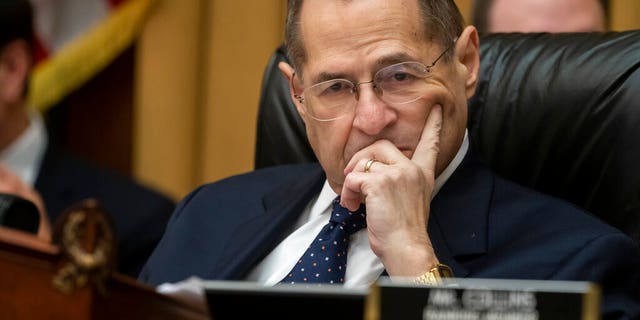
House Judiciary Committee Chairman Jerrold Nadler, D-N.Y., is seen
during a hearing on Capitol Hill in Washington, May 8, 2019.
(Associated Press)
“When the machines break down, they vote on paper – they’ve had real problems,” he added. Nadler
didn’t have a suggestion for an absolutely reliable voting method, but
said, “There’s gotta be a way of getting the best of our methodologies.”
The woman from the audience continued her support of paper ballots. “At least if there’s a miscount you can discover it,” she said. “You can’t discover miscounts with these machines.” Nadler
then pitched “optical scan with paper” as a compromise solution –
meaning paper ballots would be scanned electronically to count the
votes. But he wasn’t ready to endorse a hand-counted paper-based system. “I
want a paper trail, I want paper somewhere,” Nadler said. “But pure
paper with no machines? I can show you experience which would make your
head spin.” Earlier this month, Nadler accused President Trump of
opposing mail-in ballots because he was worried that voters "won't vote
for you." In a Tuesday morning Twitter message, President Trump
asserted that mail-in ballots would be “substantially fraudulent” if
used for the 2020 presidential election. The president’s argument
appeared in line with that of a 2005 bipartisan report prepared by a
federal election reform panel chaired by former President Jimmy Carter
and former U.S. Secretary of State James Baker.
“Absentee ballots remain the largest source of potential voter fraud,” the report concluded. But a mail-in plan has been suggested for November in a $3.6 billion proposal this month by House Speaker Nancy Pelosi. Democrats such as California Gov. Gavin Newsom have also supported mail-in voting for some remaining state primary elections. Fox News' Gregg Re contributed to this story.
Twitter slapped a warning label on one of President Trump's tweets
for the first time on Tuesday, cautioning readers that despite the
president's claims, "fact checkers" say there is "no evidence" that
mail-in voting would increase fraud risks -- and that "experts say
mail-in ballots are very rarely linked to voter fraud."
Within minutes, Trump accused Twitter
of "interfering in the 2020 Presidential Election ... based on
fact-checking by Fake News CNN and the Amazon Washington Post." The
president added that the platform "is completely stifling FREE SPEECH"
and vowed: "I, as President, will not allow it to happen!" Twitter's
new warning label was issued even though a Twitter spokesperson
acknowledged to Fox News that Trump's tweet had not broken any of the
platform's rules, and even though severalexperts have called mail-in balloting an invitation to widespread fraud. "Absentee ballots remain the largest source of potential voter fraud," read
the conclusion of a bipartisan 2005 report authored by the Commission
on Federal Election Reform, which was chaired by former President Jimmy
Carter and former Secretary of State James Baker. The
warning label prompted conservatives to again condemn Twitter for what
they have called its apparent left-wing bias: Just two months ago,
Twitter flagged a video uploaded by the Trump campaign as "manipulated media," only to rebuff the campaign's efforts to have the platform flag a similar video uploaded by the Biden team. "We
always knew that Silicon Valley would pull out all the stops to
obstruct and interfere with President Trump getting his message through
to voters," Trump 2020 campaign manager Brad Parscale said in a
statement. "Partnering with the biased fake news media 'fact checkers'
is only a smoke screen Twitter is using to try to lend their obvious
political tactics some false credibility. There are many reasons the
Trump campaign pulled all our advertising from Twitter months ago, and
their clear political bias is one of them.“ "Twitter 'fact-checkers' really suck," wrote Dan Bongino, a Fox News contributor. He linked to a 2012 article in The New York Times
headlined, "Error and Fraud at Issue as Absentee Voting Rises." The
article states that "votes cast by mail are less likely to be counted,
more likely to be compromised and more likely to be contested than those
cast in a voting booth, statistics show."
The Wall Street Journal's James Taranto pointed out
that Twitter hadn't fact-checked Trump's charge that the platform was
interfering improperly in the election. "Hmm, no fact check on this so I
guess it must be true!" he wrote. Separately, GOP chairwoman Ronna McDaniel observed
that Alabama's secretary of state, John Merrill, told CNN earlier in
the day that five of the six voter fraud convictions during his tenure
related to absentee balloting. In a post retweeted by the Trump campaign, The Daily Caller's Logan Hall noted that Twitter has not appended a warning label on tweets from Chinese government representatives engaging in a propaganda campaign
to blame the U.S. for the spread of coronavirus. "The deeper problem:
many of the big tech companies that people hold near and dear to their
hearts have no actual allegiance to America or American values," Hall wrote. "Wow,"
wrote Michael James Coudrey, the CEO of Yuko Social, a social media
engine for politicians and organizations. "Look what Twitter is doing to
the President of the United States [sic] tweets. They are attaching a
link then saying according to CNN and Washington Post, what he is saying
is unsubstantiated. This is insane." Earlier Tuesday, Trump
wrote: There is NO WAY (ZERO!) that Mail-In Ballots will be anything
less than substantially fraudulent. Mail boxes will be robbed, ballots
will be forged & even illegally printed out & fraudulently
signed. The Governor of California is sending Ballots to millions of
people, anyone living in the state, no matter who they are or how they
got there, will get one. That will be followed up with professionals
telling all of these people, many of whom have never even thought of
voting before, how, and for whom, to vote. This will be a Rigged
Election. No way!! Within hours, Twitter then appended a label to the bottom of the tweet reading, "Get the facts about mail-in ballots."
Clicking
that label brings readers to a paragraph reading: "On Tuesday,
President Trump made a series of claims about potential voter fraud
after California Governor Gavin Newsom announced an effort to expand
mail-in voting in California during the COVID-19 pandemic. These claims
are unsubstantiated, according to CNN, Washington Post and others.
Experts say mail-in ballots are very rarely linked to voter fraud." Twitter
went on to note in a "What to Know" section that "fact-checkers say
there is no evidence that mail-in ballots are linked to voter fraud" and
that "Trump falsely claimed that California will send mail-in ballots
to 'anyone living in the state, no matter who they are or how they got
there.' In fact, only registered voters will receive ballots."
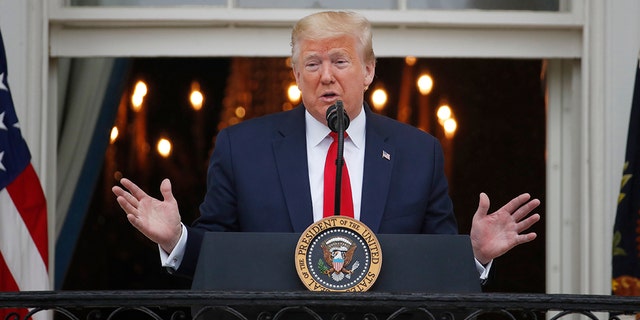
President Trump speaking last week at the White House. (AP Photo/Alex Brandon)
A Twitter spokesperson told Fox News that Trump's
tweets "contain potentially misleading information about voting
processes and have been labeled to provide additional context around
mail-in ballots," and that "this decision is in line with the approach
we shared earlier this month." Twitter
acknowledged Trump's tweet "is not in violation of the Twitter Rules as
it does not directly try to dissuade people from voting — it does,
however, contain misleading information about the voting process,
specifically mail-in ballots, and we’re offering more context to the
public." Twitter did not respond to Fox News' inquiries about
whether consideration was given for The Washington Post or CNN's
political leanings, or why its warning label appeared to be
contradictory -- saying both that there was "no evidence" that mail-in
balloting leads to fraud, and at the same time, that there was indeed
evidence that mail-in balloting had been linked to fraud, although only
"very rarely." However, Republicans have long argued that many
states fail to adequately clean up their voter rolls. Last year,
California was forced to remove 1.5 million ineligible voters after a court settlement last year when California's rolls showed a registration of 112 percent. And, data from
the U.S. Election Assistance Commission indicates that roughly 28
million mail-in ballots have disappeared in the past decade.
“Elections in 2012, 2014, 2016, and 2018 saw more than 28.3 million 'unaccounted for' mail ballots,” a report from the Public Interest Legal Foundation (PILF) recently assessed. “Putting
the election in the hands of the United States Postal Service would be a
catastrophe. Over the recent decade, there were 28 million missing and
misdirected ballots,” PILF President and General Counsel J. Christian
Adams said in a statement. “These represent 28 million opportunities for
someone to cheat. Absentee ballot fraud is the most common; the most
expensive to investigate; and can never be reversed after an election.
The status quo was already bad for mail balloting. The proposed
emergency fix is worse.” Election integrity has become one of the
upcoming election's most prominent issues. On May 20, Trump threatened
to withhold federal funds from Michigan if it pursued mail-in balloting
-- a questionably constitutional move, given general prohibitions
against the federal government forcing state action on matters
ordinarily within states' jurisdiction. "Michigan sends absentee
ballot applications to 7.7 million people ahead of Primaries and the
General Election," Trump wrote. "This was done illegally and without
authorization by a rogue Secretary of State. I will ask to hold up
funding to Michigan if they want to go down this Voter Fraud path!" The Republican National Committee (RNC) earlier this month aunched ProtectTheVote.com,
a digital platform that the GOP says is part of its all-hands-on-deck
effort to "protect against the Democrats' assault on our elections" as
progressives push for sweeping changes, including vote-by-mail and more
ballot harvesting, amid the coronavirus pandemic. The launch came after the RNC and Trump campaign doubled their legal budget to $20 million after an initial commitment of
$10 million in February, saying they wanted to "fight frivolous
Democrat lawsuits and uphold the integrity of the elections process."
That
was a message echoed by Trump in a tweet last month: "GET RID OF BALLOT
HARVESTING, IT IS RAMPANT WITH FRAUD. THE USA MUST HAVE VOTER I.D., THE
ONLY WAY TO GET AN HONEST COUNT!" Suspicion of big tech has reached a critical mass in recent months. Also on Tuesday, Oculus VR founder Palmer Luckey discovered
that YouTube was censoring comments critical of the Chinese government.
YouTube called the censorship a mistake, but offered no details;
Republicans, in turn, sought a closer look. "Is
Project Dragonfly going global?" wrote Indiana Republican Rep. Jim
Banks, referring to Google's since-scrapped search engine that would
have censored results to appease the Chinese government. "Google must
stop imitating #CCP censorship practices now. "
Twitter's "Head of Site Integrity" Yoel Roth boasts on his LinkedIn that he is in charge of "developing and enforcing Twitter’s rules," like the one that led Twitter to slap a new "misleading" warning label on two of President Trump's tweets concerning mail-in balloting on Tuesday. However,
Roth's own barrage of anti-Trump, politically charged tweets seemingly
calls into question whether he should be creating guidelines for the
president and other Twitter users, especially when Twitter is under fire for its alleged left-wing bias. Commentators have argued that Trump's tweets on the risks of mail-in voting were not misleading,
and the president accused Twitter of seeking to "interfere" in the
upcoming election under the guise of a supposedly neutral
"fact-checking" policy. Roth has previously referred to Trump and his team as "ACTUAL NAZIS," mocked Trump supporters by saying that "we fly over those states that voted for a racist tangerine for a reason," and called Senate Majority Leader Mitch McConnell, R-Ky., a "personality-free bag of farts." (Last August, Twitter suspended McConnell's Twitter account, prompting the GOP to threaten to cut off advertising on the site until Twitter relented.) In September 2016, Roth tweeted,
"I’ve never donated to a presidential campaign before, but I just gave
$100 to Hillary for America. We can’t fu-k around anymore." When Trump won the November 2016 election, Roth dejectedly chalked the development up to "[Bernie] Sanders protest voters, and racism," before sounding more optimistic notes. "I’m almost ready to stop dwelling on how my friends are complicit in the election of Donald Trump," he said on Jan. 7, 2017. "Almost." "Massive anti-Trump protest headed up Valencia St," Roth wrote on Jan. 20, 2017, followed by a "heart" emoji and the words "San Francisco." Indeed,
Roth sometimes opened up about his heart on the social media platform.
"'Every time a cute boy uses an Android phone, I die inside' is the new
'Every time a cute boy tells me he's a Republican, I die inside,'" he said in 2011. "I occasionally worry that my mother WASN'T joking all those times she told us she was voting Republican," he wrote in 2012. For the most part, though, Roth urged his followers to unite, especially after Trump's inauguration. "The
'you are not the right kind of feminist' backlash to yesterday's
marches has begun," Roth wrote on Jan. 22, 2017. "Did we learn nothing
from this election?" Also on Jan. 22, 2017, Roth compared senior Trump adviser Kellyanne Conway to Nazi propagandist Joseph Goebbels. Exacerbating
matters, Roth previously authored a slew of posts bluntly referring to
what he calls "trannies." In 2010, he wrote: "It wouldn't be a trip to
New York without at least one big scary tranny." In 2012, he tweeted: "A
10 block cab ride can seem so much longer when the driver tells you
about that time he thought a tranny hooker was a 'real girl.'" "Tranny
hookers in Birkenstocks. Philadelphia: a city of contradictions," he
mused on July 24, 2011. "All the fags took him to heart," Roth wrote on March 21, 2009, referring to Christian Siriano of "Project Runway" fame. When another user criticized his language,
Roth held his ground. "Trans is a category worth being linguistically
destabilized in the same way we did gay with 'fag,'" he wrote. "Sorry,
but I don’t subscribe to PC passing the buck. Identity politics is for
everyone." Yoel says on his personal website that
he received his PhD in Communication from the University of
Pennsylvania by "studying privacy and safety on gay social networks." "These are the kids that are fact checking the President of the United States," remarked Heather Champion, a commentator on social media. Several of Roth's tweets were first resurfaced by The New York Post's Jon Levine early Wednesday morning. Roth's most polemical and political posts, which do not carry any warning label, were under extra scrutiny as Trump accused Twitter of "interfering
in the 2020 Presidential Election" by again acting out of apparent
left-wing bias. The president vowed to take unspecified action. Earlier
Tuesday, Trump wrote: "There is NO WAY (ZERO!) that Mail-In Ballots
will be anything less than substantially fraudulent. Mailboxes will be
robbed, ballots will be forged & even illegally printed out &
fraudulently signed. The Governor of California is sending Ballots to
millions of people, anyone living in the state, no matter who they are
or how they got there, will get one. That will be followed up with
professionals telling all of these people, many of whom have never even
thought of voting before, how, and for whom, to vote. This will be a
Rigged Election. No way!!" Within hours, Twitter then appended an
unprecedented label to the bottom of the tweet reading, "Get the facts
about mail-in ballots." Clicking that label brings readers to a
paragraph reading in part: "Experts say mail-in ballots are very rarely
linked to voter fraud. ... Fact-checkers say there is no evidence that
mail-in ballots are linked to voter fraud." Twitter's
warning label was placed on Trump's tweets even though a Twitter
spokesperson acknowledged to Fox News that Trump's tweet had not broken
any of the platform's rules, and despite the fact that severalexperts have called mail-in balloting an invitation to widespread fraud, as Trump said in his tweets. Indeed, bipartisan panels of experts, as well as journalists, have found that absentee balloting increases the risk of voter fraud. "Absentee ballots remain the largest source of potential voter fraud," read the
conclusion of a bipartisan 2005 report authored by the Commission on
Federal Election Reform, which was chaired by former President Jimmy
Carter and former Secretary of State James Baker. "Twitter 'fact-checkers' really suck," wrote Dan Bongino, a Fox News contributor. He linked to a 2012 article in The New York Times headlined,
"Error and Fraud at Issue as Absentee Voting Rises." The article states
that "votes cast by mail are less likely to be counted, more likely to
be compromised and more likely to be contested than those cast in a
voting booth, statistics show." A Twitter thread
Tuesday by White House press secretary Kayleigh McEnany highlighted
numerous recent stories documenting fraud concerns over mail-in ballots
across the country, including a Fox News piece. The brouhaha erupted just two months after Twitter flagged a video uploaded by the Trump campaign as "manipulated media," only to rebuff the campaign's efforts to have the platform flag a similar video uploaded by the Biden team. Roth and Twitter did not immediately respond to Fox News' request for comment early Wednesday. In March, Roth sat for an interview with NPR, in which he emphasized that he was working to combat "election disinformation." "I
think in 2020, we're facing a particularly divisive political moment
here in the United States, and attempts to capitalize on those divisions
amongst Americans seem to be where malicious actors are headed," Roth
said. "This is a similar pattern to what we saw in 2016 and 2018, but
one of the things that we've seen from not only Russia but a wide range
of malicious actors is an attempt to capitalize on some of the major
domestic voices that are participating in these conversations and then
double down on some of those activities." On May 25, Roth took a
seemingly cavalier attitude towards criticism, tweeting, "Somehow,
regularly being told by internet strangers that I’m a soulless corporate
shill is still less harsh feedback than I got from anonymous peer
reviewers in my past academic life." The Trump campaign, however, was less amused. "We
always knew that Silicon Valley would pull out all the stops to
obstruct and interfere with President Trump getting his message through
to voters," Trump 2020 campaign manager Brad Parscale said in a
statement. "Partnering with the biased fake news media 'fact checkers'
is only a smoke screen Twitter is using to try to lend their obvious
political tactics some false credibility. There are many reasons the
Trump campaign pulled all our advertising from Twitter months ago, and
their clear political bias is one of them.“ And late Tuesday, Sen. Marco Rubio, R-Fla, noted on Twitter that "The law still protects social media companies like @Twitter
because they are considered forums not publishers. But if they have
now decided to exercise an editorial role like a publisher then they
should no longer be shielded from liability & treated as publishers
under the law." That was a reference to Section 230 of the
Communications Decency Act, which broadly protects online content
platforms from liability. For example, a defamatory comment posted by a
Twitter user would not ordinarily lead to liability for Twitter, even if
the platform allows the defamatory content to remain online after
becoming aware of it. Calls to reform the law have largely gone
unheeded in recent years, even as sites like Twitter take on a more
dominant role in national discourse. (Copyright law, which has a strong
constitutional foundation, ordinarily does require sites like Twitter to
remove offending content, or face liability.) Reaction to Twitter's actions among commentators was almost uniformly negative. The Wall Street Journal's James Taranto pointed out that
Twitter hadn't fact-checked Trump's charge that the platform was
interfering improperly in the election. "Hmm, no fact check on this so I
guess it must be true!" he wrote. Others observed
that Twitter had not fact-checked a false claim on police shooting
statistics that was shared by New York Democratic Rep. Alexandria
Ocasio-Cortez.
"It wouldn't be a trip to New York without at least one big scary tranny." — Twitter "Head of Site Integrity" Yoel Roth
Separately, GOP chairwoman Ronna McDaniel wrote that
Alabama's secretary of state, John Merrill, told CNN earlier in the day
that five of the six voter fraud convictions during his tenure related
to absentee balloting. In a post retweeted by the Trump campaign, The Daily Caller's Logan Hall noted that Twitter has not appended a warning label on tweets from Chinese government representatives engaging in a propaganda campaign to
blame the U.S. for the spread of coronavirus. "The deeper problem: many
of the big tech companies that people hold near and dear to their
hearts have no actual allegiance to America or American values," Hall wrote. "Wow,"
wrote Michael James Coudrey, the CEO of Yuko Social, a social media
engine for politicians and organizations. "Look what Twitter is doing to
the President of the United States [sic] tweets. They are attaching a
link then saying according to CNN and Washington Post, what he is saying
is unsubstantiated. This is insane."
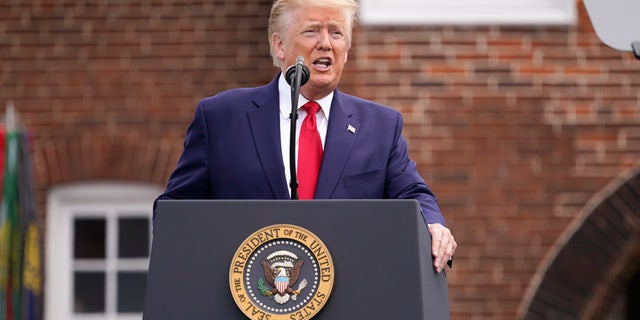
President Donald Trump speaks during a Memorial Day ceremony at
Fort McHenry National Monument and Historic Shrine, Monday, May 25,
2020, in Baltimore. (AP Photo/Evan Vucci)
A Twitter spokesperson told Fox News earlier Tuesday
that Trump's tweets "contain potentially misleading information about
voting processes and have been labeled to provide additional context
around mail-in ballots," and that "this decision is in line with the
approach we shared earlier this month." Twitter
acknowledged Trump's tweet "is not in violation of the Twitter Rules as
it does not directly try to dissuade people from voting — it does,
however, contain misleading information about the voting process,
specifically mail-in ballots, and we’re offering more context to the
public." Twitter
did not respond to Fox News' inquiries about whether consideration was
given for The Washington Post or CNN's political leanings, or why its
warning label appeared to be contradictory -- saying both that there was
"no evidence" that mail-in balloting leads to fraud, and at the same
time, that there was indeed evidence that mail-in balloting had been
linked to fraud, although only "very rarely." However, Republicans
have long argued that many states fail to adequately clean up their
voter rolls. Last year, California was forced to remove 1.5 million ineligible voters after a court settlement last year when California's rolls showed a registration of 112 percent. And, data from
the U.S. Election Assistance Commission indicates that roughly 28
million mail-in ballots have disappeared in the past decade. “Elections in 2012, 2014, 2016, and 2018 saw more than 28.3 million 'unaccounted for' mail ballots,” a report from the Public Interest Legal Foundation (PILF) recently assessed. “Putting
the election in the hands of the United States Postal Service would be a
catastrophe. Over the recent decade, there were 28 million missing and
misdirected ballots,” PILF President and General Counsel J. Christian
Adams said in a statement. “These represent 28 million opportunities for
someone to cheat. Absentee ballot fraud is the most common; the most
expensive to investigate; and can never be reversed after an election.
The status quo was already bad for mail balloting. The proposed
emergency fix is worse.” Election integrity has become one of the
upcoming election's most prominent issues. On May 20, Trump threatened
to withhold federal funds from Michigan if it pursued mail-in balloting
-- a questionably constitutional move, given general prohibitions
against the federal government forcing state action on matters
ordinarily within states' jurisdiction. "Michigan sends absentee
ballot applications to 7.7 million people ahead of Primaries and the
General Election," Trump wrote. "This was done illegally and without
authorization by a rogue Secretary of State. I will ask to hold up
funding to Michigan if they want to go down this Voter Fraud path!" The Republican National Committee (RNC) earlier this month launched ProtectTheVote.com,
a digital platform that the GOP says is part of its all-hands-on-deck
effort to "protect against the Democrats' assault on our elections" as
progressives push for sweeping changes, including vote-by-mail and more
ballot harvesting, amid the coronavirus pandemic. The launch came after the RNC and Trump campaign doubled their legal budget to $20 million after an initial commitment of
$10 million in February, saying they wanted to "fight frivolous
Democrat lawsuits and uphold the integrity of the elections process." That
was a message echoed by Trump in a tweet last month: "GET RID OF BALLOT
HARVESTING, IT IS RAMPANT WITH FRAUD. THE USA MUST HAVE VOTER I.D., THE
ONLY WAY TO GET AN HONEST COUNT!" Suspicion of big tech has reached a critical mass in recent months. Also on Tuesday, Oculus VR founder Palmer Luckey discovered that
YouTube was censoring comments critical of the Chinese government.
YouTube called the censorship a mistake, but offered no details;
Republicans, in turn, sought a closer look. "Is
Project Dragonfly going global?" wrote Indiana Republican Rep. Jim
Banks, referring to Google's since-scrapped search engine that would
have censored results to appease the Chinese government. "Google must
stop imitating #CCP censorship practices now. "