A Kentucky protester who was recently seen participating in the hanging of an effigy of Gov. Andy Beshear has lost his job, according to reports. The
protester was identified as Terry Bush, an employee of an auto dealer,
the Courier Journal of Louisville reported. The newspaper said Bush’s
wife, Patsy Bush, confirmed the firing. “He was fired because this
governor is more important than the regular Joe out in this state
trying to put food on their tables,” Patsy Bush told the newspaper.
“He
was fired because this governor is more important than the regular Joe
out in this state trying to put food on their tables.” — Patsy Bush, wife of fired protester
Meanwhile, singer Lee Greenwood said he was "furious" that one of his songs, "God Bless the USA," was played during the protest. “I
am furious that they used my song in an attempt to give strength to
their event, and do not condone their behavior and its use in
conjunction with a suggested lynching, even one that is purely
symbolic,” Greenwood said in a statement. “To be clear, I
absolutely support the right for citizens to unite in protest and public
gathering. However, my song was written solely to inspire and unite,
not further divide and distance our country, certainly as in times of
strife as we are today.”
"My song was written solely
to inspire and unite, not further divide and distance our country,
certainly as in times of strife as we are today." — Lee Greenwood
Neil
Huffman Auto Group said it terminated an employee after an internal
review, without confirming whether it was Bush, saying the company “does
not condone threats of violence in any form." “There is no place
for hate or intolerance at any of our dealerships," Shannon Huffman, the
auto dealer's human resources manager, posted on social media this
week. Beshear commented on the protest and the firing this week,
saying state Republicans shared in the blame even though they joined
Democrats in condemning the protest. "You cannot fan the flames and condemn the fire," Beshear said Tuesday, according to the Courier-Journal.
“Different
decisions have consequences and I would hope that we would all make
better decisions,” the Democrat added Wednesday, according to The
Associated Press. “But you don’t simply in the moment make a dummy with
somebody’s face on it and hang it up. I think what we saw was an act
intended to create fear and terror.”
The effigy was hanged in a
tree near the Statehouse during what was billed as a protest rally in
defense of constitutional rights, including the right to bear arms. The
rally turned into a protest against coronavirus restrictions and
Beshear’s administration, according to news reports, with protesters
chanting outside the governor’s mansion for him to come outside. Fox News' Morgan Phillips and The Associated Press contributed to this story.
Gov. Phil Murphy, the New Jersey
Democrat, said in an interview Thursday that without financial help
from the federal government, his state will likely have to cut 200,000
public employees, including police officers and firefighters. New
Jersey is among several states facing serious financial hardships after
the coronavirus outbreaks. There is debate in Washington about whether
these states should have access to the funding. Some Republicans say
poor fiscal management led them to this point. “I
don’t think there’s any amount of cuts or any amount of taxes that
begin to fill the hole,” Murphy told Bloomberg Television. He continued,
“The alternative to not getting that funding is a whole lot of
layoffs—we think as much as 200,000 or more.” Bloomberg reported that Murphy vowed to cut $5 billion, but the state’s expected to have about a $10.1 billion revenue shortfall. The
debate over the federal government bailing out states started when
Senate Majority Leader Mitch McConnell said last month that states
should be able to declare bankruptcy. “I would certainly be in
favor of allowing states to use the bankruptcy route. It saves some
cities,” he said at the time. “And there’s no good reason for it not to
be available. My guess is their first choice would be for the federal
government to borrow money from future generations to send it down to
them now so they don’t have to do that. That’s not something I’m going
to be in favor of.” There has been a debate ever since. Scott Walker, the former governor of Wisconsin, wrote in an op-ed in the New York Times that bailing out states would be the wrong decision. “This should not happen,” he wrote. “States already raise taxes on their residents.” Walker said the federal government should maintain a laser focus on small businesses. “Failure to do so will continue to hurt state economies, saddling them with insolvent balance sheets,” he wrote. The Times reported that
Democratic governors from Washington State, Nevada, Oregon and
California claimed that all 50 states would require $1 trillion. Congress
is at a crossroads on the next virus relief bill. Democrats tout their
1,800-page bill as an opening salvo in negotiations, but Senate
Republicans are wary of another round of negotiations where Democrats
and the White House call the shots. Republicans
are also split on how much aid to provide state and local governments,
as well as other parts of the Democrats’ proposal. The Associated Press contributed to this report
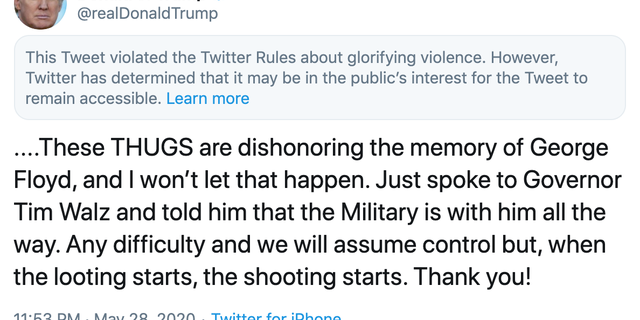
Twitter has once again taken action against President Trump, this time censoring a tweet for "glorifying violence" in his late-night response to the ongoing violence in Minneapolis. Trump said he couldn't not just watch the city be overwhelmed by the unrest over the death of George Floyd. “I
can’t stand back & watch this happen to a great American City,
Minneapolis,” Trump tweeted. “A total lack of leadership. Either the
very weak Radical Left Mayor, Jacob Frey, get his act together and bring
the City under control, or I will send in the National Guard & get
the job done right. A second tweet continued, “These THUGS are
dishonoring the memory of George Floyd, and I won’t let this
happen. Just spoke to Governor Tim Walz and told him that the Military
is with him all the way. Any difficulty and we will assume control but,
when the looting starts, the shooting starts. Thank you.” A
few hours after the president sent those tweets, Twitter added a
disclaimer onto the second tweet, which hides the message until users
click "view." "This Tweet violated the Twitter Rules about
glorifying violence. However, Twitter has determined that it may be in
the public’s interest for the Tweet to remain accessible," the
disclaimer read.
Critics
on Twitter said Trump's comments had racial undertones and said the
term "when the looting starts, the shooting starts" can be traced back
to Miami Police Chief Walter Headley in 1967 as a threat to black
protestors during the civil rights movement. When asked for comment, Twitter pointed to a thread explaining the decision. "This
Tweet violates our policies regarding the glorification of violence
based on the historical context of the last line, its connection to
violence, and the risk it could inspire similar actions today," Twitter
Comms wrote. "We've taken action in the interest of preventing others
from being inspired to commit violent acts, but have kept the Tweet on
Twitter because it is important that the public still be able to see the
Tweet given its relevance to ongoing matters of public importance." This
marks the second time Twitter has cracked down on Trump's tweets.
Earlier this week, the tech giant added a fact-checking label to the
president's tweets sounding the alarm on potential fraud from mail-in
voting. That sparked escalated tensions between him and Twitter,
prompting the president to sign an executive order on Thursday that
interprets Section 230 of the Communications Decency Act of 1996 (CDA) as not providing statutory liability protections for tech companies that engage in censorship and political conduct. Fox News' Edmund DeMarche and Gregg Re contributed to this report.
President Trump
took to Twitter early Friday to vow military support for the governor
of Minnesota after another night of violent protest in Minneapolis,
which included a police station being overrun and set on fire. “I
can’t stand back & watch this happen to a great American City,
Minneapolis,” Trump tweeted. “A total lack of leadership. Either the
very weak Radical Left Mayor, Jacob Frey, get his act together and bring
the City under control, or I will send in the National Guard & get
the job done right. A second tweet continued, “These THUGS are
dishonoring the memory of George Floyd, and I won’t let this
happen. Just spoke to Governor Tim Walz and told him that the Military
is with him all the way. Any difficulty and we will assume control but,
when the looting starts, the shooting starts. Thank you.” Mayor Jacob Frey said it was his decision to evacuate the precinct. “The
symbolism of the building cannot outweigh the importance of life, our
officers or the public,” he said. “We could not risk serious injury to
anyone. And we will continue to patrol the Third Precinct,” he said. Frey
said Trump "knows nothing about the strength of Minneapolis. We are
strong as hell. Is this a difficult time period? Yes. But you better be
damn sure we are going to get through this." Earlier in the day, Kayleigh McEnany, the White House press secretary, told reporters that the president was “very upset” when he watched the George Floyd video. Floyd,
a handcuffed black man, pleaded for air as a white police officer
kneeled on his neck and died in police custody earlier this week. It
was “egregious, appalling and tragic,” McEnany said. “He wants justice
to be served.” She said that the video prompted Trump to “pick up the
phone” while aboard Air Force One and ask the FBI to expedite its
investigation. Trump later told Buck
Sexton, the radio host, that he watched the video “like everyone else
did. That was a horrible thing that I watched. Horrible.” A police
spokesman confirmed late Thursday that staff had evacuated the 3rd
Precinct station, the focus of many of the protests, "in the interest of
the safety of our personnel" late Thursday. Livestream video showed the
protesters entering the building, where fire alarms blared and
sprinklers ran as blazes were set. Protesters could be seen setting fire to a Minneapolis Police Department jacket and cheering. More than 500 members of the National Guard were heading to the Twin Cities region, called in by Walz, the Star Tribune of Minneapolis reported. Floyd's
death has deeply shaken Minneapolis and sparked protests in cities
across the U.S. Local leaders have repeatedly urged demonstrators to
avoid violence. "Please
stay home. Please do not come here to protest. Please keep the focus on
George Floyd, on advancing our movement and on preventing this from
ever happening again," tweeted St. Paul Mayor Melvin Carter, who is
black. Fox News' Dom Calicchio, Morgan Phillips and the Associated Press contributed to this report
The Texas Supreme Court ruled Wednesday that a lack of immunity to the coronavirus does not qualify as a disability under state law for requesting a mail-in ballot. The
all Republican-court agreed with Texas Attorney General Ken Paxton, who
had filed a petition to order local officials to follow state laws
regarding mail-in ballots after a Court of Appeals ruled to allow anyone
in Travis County to request a ballot, according to FOX 7 in Austin. President
Trump, who has repeatedly claimed that mail-in voting is associated
with widespread voter fraud, tweeted after the ruling. “Big win in Texas on the dangerous Mail In Voting Scam!” the president wrote. The
ruling was a loss for the Texas Democratic Party and voter rights
groups, which had sought expanding mail-in voting during the pandemic. To
receive a mail-in ballot in Texas, voters must either claim a
disability, be over 65, in jail, or away from their home county during
the election, according to the Texas Tribune. “We
agree with the State that a voter’s lack of immunity to COVID-19,
without more, is not a ‘disability’ as defined by the Election Code,”
the court’s ruling said, adding that voters must determine if they meet
the definition of "disability” and “election officials have no
responsibility to question or investigate a ballot application that is
valid on its face,” FOX 7 reported. Voters citing a disability when requesting a ballot are not required to to specify. “The
question before us is not whether voting by mail is better policy or
worse, but what the Legislature has enacted. It is purely a question of
law,” the ruling said, according to the Dallas Morning News. “Our authority and responsibility are to interpret the statutory text and give effect to the Legislature’s intent.” Having the virus, however, could entitle a voter to a mail-in ballot. Paxton,
in a statement said he applauded the court “for ruling that certain
election officials’ definition of ‘disability’ does not trump that of
the Legislature, which has determined that widespread mail-in balloting
carries unacceptable risks of corruption and fraud." “Election
officials have a duty to reject mail-in ballot applications from voters
who are not entitled to vote by mail. In-person voting is the surest
way to maintain the integrity of our elections, prevent voter fraud and
guarantee that every voter is who they claim to be," he said, according
to FOX 7.
All businesses in the state of Mississippi can reopen Monday – provided they follow guidelines for combating the coronavirus, Gov. Tate Reeves said Wednesday. “At that time, there will be no more business closures. Everyone will be allowed to operate,” Reeves said at a news briefing, according to the Clarion Ledger of Jackson. “We cannot have an endless shutdown,” the governor added.
“We cannot have an endless shutdown.” — Mississippi Gov. Tate Reeves
As
of early Thursday, the state had recorded nearly 14,000 infections from
the virus and 670 deaths, according to Johns Hopkins University. When
the pandemic began, Mississippi had scattered rules for the public and
businesses to help contain the spread of the virus but Reeves later
issued a statewide stay-at-home order, the Clarion Ledger reported. Reeves’ new guidance is titled his “Safe Return” order. The
plan calls for businesses to allow 50 people at a time indoors and 100
people at a time outdoors beginning Monday if they practice social
distancing. In cases where distancing is not possible, the capacities
will be lowered to 20 people indoors and 50 people outdoors, the newspaper reported. While the new order allows businesses to reopen, “This does not mean the threat is gone," Reeves stressed. “There
are no perfect options, but freedom with risk is better than a
prolonged shutdown,” he said, adding later, “I trust you. I trust the
people of Mississippi.” Although the number of daily cases in the
state has been on the rise, Reeves said this week that the data has been
“relatively flat.” “We
had a prolonged plateau where our cases have been relatively flat.
Again, you can go up or down a hundred cases, or two hundred cases over a
seven-day period on a rolling seven-day average, but we’ve been
relatively flat for 60 days in Mississippi," Reeves said Tuesday,
according to WLBT-TV of Jackson. At
the same briefing, state Health Officer Dr. Thomas Dobbs advised
residents to continue wearing masks and practicing social distancing,
noting that Wayne County, near the Alabama line, has seen a “remarkable
increase” in new infections.
The House of Representatives
adjourned late Wednesday without voting on whether to reauthorize
advanced surveillance tools used by law enforcement -- a measure that
had wide bipartisan support back in March, but which has drawn sudden
GOP opposition amid news of apparent FBI misconduct. President Trump threatened to
veto the bill if passed earlier on Wednesday, and House Democrats
delayed a vote three times throughout the day. Democrats can only lose
17 votes, and their failure to forge ahead indicated that they hadn't
yet whipped that minimum number. The House is set to reconvene
Thursday at 9 a.m. ET. Fox News is told that House Speaker Nancy Pelosi,
D-Calif., still wants the House to pass the bill, align it with the
Senate's version, and dare the president to veto it. "If the FISA
Bill is passed tonight on the House floor, I will quickly VETO it,"
Trump tweeted ahead of the vote. "Our Country has just suffered through
the greatest political crime in its history. The massive abuse of FISA
was a big part of it!" Earlier, Pelosi and Democratic leadership
marched forward with the scheduled vote to authorize Foreign
Intelligence Surveillance Act (FISA) provisions and said it will be up
to Trump to decide whether he wants to undo the carefully drafted
bipartisan effort. "I don't know what the president will do. This
is not the first time he's tweeted against a bill and then the next day
comes out and says he would support it," said House Rules Committee
Chairman Jim McGovern, D-Mass., of the Trump's Tuesday tweet urging
Republicans to oppose the FISA plan. "It will be in his hands." “Late night tweets are not a way to govern," McGovern added. The
House in March passed with broad bipartisan support a reauthorization
of the surveillance measures plus new privacy protections to the Foreign
Intelligence Surveillance Act (FISA) by a 278-136 vote. The Senate then
passed its version of reforms with another strong bipartisan vote of
80-16 to reauthorize expiring provisions and revise how the Justice
Department and FBI use the tools designed to fight terrorism. The House Wednesday had been slated to pass the Senate version and to send the FISA bill to Trump's desk. But
Trump put a wrench in the plan when he tweeted Tuesday night that he's
urging all Republicans to vote no on the FISA legislation "until such
time as our Country is able to determine how and why the greatest
political, criminal, and subversive scandal in USA history took place!” DOJ URGES TRUMP VETO ON FISA LEGISLATION, VOTE IN LIMBO Trump issued the warning on Twitter,
referring to his longstanding belief that the intelligence community
improperly used FISA authorities to surveil his presidential campaign
for political reasons and launch the Russia probe. Then the Department of Justice came out Wednesday morning urging Trump to veto the legislation saying it goes too far and would weaken national security tools. House
GOP Leader Kevin McCarthy, R-Calif., urged House Democrats to pull the
bill and Rep. Steve Scalise advised his members to vote "no."
Republicans argued the House should wait until they can draft
legislation that has the support of the Trump Administration. "My
support for the underlying legislation does not wane because of a
presidential tweet," said Rep. Rob Woodall, R-Ga. "My belief that the
legislation will be signed into law wanes because of a presidential
tweet." But House Majority Leader Steny Hoyer bashed Republicans
who voted in favor of the FISA bill just a few weeks and then reversed
course just now because of Trump's tweet. "Your flailing around to find a rationalization for your change of vote is sad," Hoyer said. If the legislation passes, it would go directly to Trump's desk for his signature or veto. The
surveillance tools have long been a concern for Trump who believes the
intelligence community improperly abused the FISA court to surveil his
former adviser Carter Page. A Department of Justice Inspector General
report found the FBI made repeated errors and misrepresentations before
the FISA Court in an effort to obtain the warrants against
Page. Meanwhile, progressives and libertarians also wanted more privacy
reforms to protect individual liberties. "With a FISA bill, nobody
is ever really that happy," Pelosi said about the legislation to
reauthorize and reform national security authorities in the U.S.A.
Freedom Act. "But the fact is ... we have to have a bill. If we don't
have a bill, our civil liberties are less protected." Fox News' Chad Pergram and Gregg Re contributed to this report.
Attorney General William Barr, left, has asked U.S. Attorney John
Bash to review "unmasking" before and after the 2016 election.
(File)
Attorney General Bill Barr
has asked U.S. Attorney for the Western District of Texas John Bash to
review the practice of "unmasking" before and after the 2016
presidential election, a controversy that has picked up steam after the Justice Department moved to drop charges against former National Security Adviser Michael Flynn, the DOJ told Fox News on Wednesday night. Republican
lawmakers have demanded more information about the extent of the
practice after a previously clandestine list of Obama-era officials who
sought to reveal what turned out to be the identity of Michael Flynn in
intelligence reports was released earlier the month. The DOJ had moved
to drop the Flynn case after internal memos were released raising
serious questions about the nature of the investigation that led to his
late-2017 guilty plea for lying to the FBI about his Russia contacts. DOJ spokeswoman Kerri Kupec told Fox News' "Hannity"
that U.S. Attorney John Durham, who has been reviewing the origins of
the Russia investigation, was looking into "unmasking" but Barr
determined certain aspects of the practice needed further review, and
Bash has been assigned to do so.
"Unmasking inherently isn't wrong,
but certainly, the frequency, the motivation and the reasoning behind
unmasking can be problematic, and when you're looking at unmasking as
part of a broader investigation -- like John Durham's investigation --
looking specifically at who was unmasking whom, can add a lot to our
understanding about motivation and big picture events," Kupec said.
Unmasking
is a tool frequently used during the course of intelligence work
and occurs after U.S. citizens' conversations are incidentally picked up
in conversations with foreign officials who are being monitored by the
intelligence community. The U.S. citizens' identities are supposed to be
protected if their participation is incidental and no wrongdoing is
suspected. However, officials can determine the U.S. citizens' names
through a process that is supposed to safeguard their rights. In the
typical process, when officials are requesting the unmasking of an
American, they do not necessarily know the identity of the person in
advance. Republicans
became highly suspicious of the number of unmasking requests made by
the Obama administration concerning Flynn, and have questioned whether
other Trump associates were singled out. The DOJ spokesperson also
affirmed that the D.C. Court of Appeals has invited the DOJ to weigh in
on the Flynn case, "and we will." Kupec
maintained that the DOJ had the ability to drop the case against
Flynn. "We have the prosecutorial discretion to make that decision." Fox News' Brooke Singman and Gillian Turner contributed to this report.