Presumptuous Politics

Monday, August 24, 2020

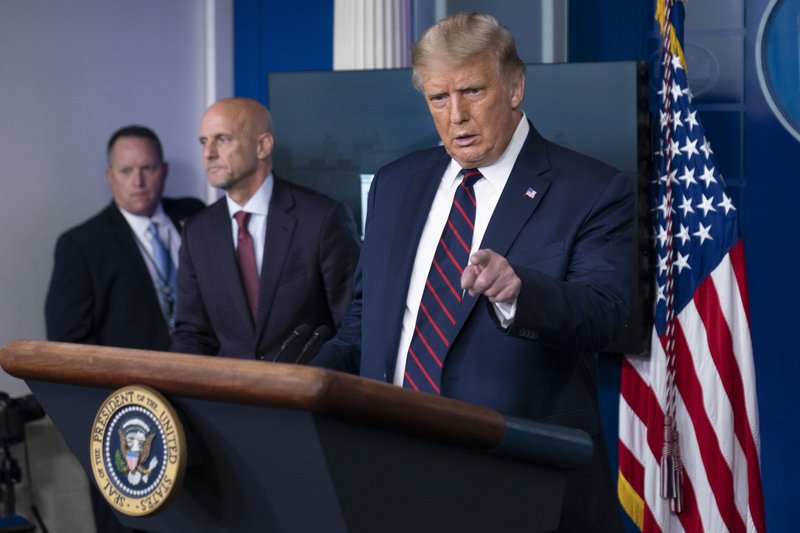
Trump announces plasma treatment authorized for COVID-19


WASHINGTON (AP) — President Donald Trump on Sunday announced emergency authorization to treat COVID-19 patients with convalescent plasma — a move he called “a breakthrough,” one of his top health officials called “promising” and other health experts said needs more study before it’s celebrated.
The announcement came after White House officials complained there were politically motivated delays by the Food and Drug Administration in approving a vaccine and therapeutics for the disease that has upended Trump’s reelection chances.
On the eve of the Republican National Convention, Trump put himself at the center of the FDA’s announcement of the authorization at a news conference Sunday evening. The authorization makes it easier for some patients to obtain the treatment but is not the same as full FDA approval.
The blood plasma, taken from patients who have recovered from the coronavirus and rich in antibodies, may provide benefits to those battling the disease. But the evidence so far has not been conclusive about whether it works, when to administer it and what dose is needed.
In a letter describing the emergency authorization, the chief scientist for the FDA, Denise Hinton, said: “COVID-19 convalescent plasma should not be considered a new standard of care for the treatment of patients with COVID-19. Additional data will be forthcoming from other analyses and ongoing, well-controlled clinical trials in the coming months.”
But Trump had made clear to aides that he was eager to showcase good news in the battle against the virus, and the timing allowed him to head into his convention with momentum. He and aides billed it as a “major” development and used the White House briefing room to make the announcement.
Trump also displayed some rare discipline in the evening news conference, sticking to his talking points, deferring to the head of the FDA, Stephen Hahn, and only taking three questions from reporters.
The White House had grown agitated with the pace of the plasma approval. The accusations of an FDA slowdown, which were presented without evidence, were just the latest assault from Trump’s team on what he refers to as the “deep state” bureaucracy. White House chief of staff Mark Meadows did not deal in specifics, but said that “we’ve looked at a number of people that are not being as diligent as they should be in terms of getting to the bottom of it.”
“This president is about cutting red tape,” Meadows said in an interview Sunday on “This Week” on ABC. “He had to make sure that they felt the heat. If they don’t see the light, they need to feel the heat because the American people are suffering.”
During Sunday’s 18-minute press conference, Trump said he thought there had been a “logjam” at the FDA over granting the emergency authorization. He alleged there are people at the FDA “that can see things being held up ... and that’s for political reasons.”
Dr. Joshua Sharfstein said the statement, and Hahn’s silence while Trump said it, “was disgraceful.”
“The FDA commissioner basically allowed the president to mischaracterize the decision and attack the integrity of FDA employees. I was horrified,” said Sharfstein, a vice dean at John Hopkins University’s school of public health who was a top FDA official during the Obama administration.
“This is a promising therapy that has not been fully established,” he said
The push on Sunday came a day after Trump tweeted sharp criticism on the process to treat the virus, which has killed more than 175,000 Americans and imperiled his reelection chances. The White House has sunk vast resources into an expedited process to develop a vaccine, and Trump aides have been banking on it being an “October surprise” that could help the president make up ground in the polls.
“The deep state, or whoever, over at the FDA is making it very difficult for drug companies to get people in order to test the vaccines and therapeutics,” Trump tweeted. “Obviously, they are hoping to delay the answer until after November 3rd. Must focus on speed, and saving lives!”
Earlier this month, Mayo Clinic researchers reported a strong hint that blood plasma from COVID-19 survivors helps other infected patients recover. But it wasn’t considered proof.
More than 70,000 patients in the U.S. have been given convalescent plasma, a century-old approach to fend off flu and measles before vaccines. It’s a go-to tactic when new diseases come along, and history suggests it works against some, but not all, infections.
The Mayo Clinic reported preliminary data from 35,000 coronavirus patients treated with plasma, and said there were fewer deaths among people given plasma within three days of diagnosis, and also among those given plasma containing the highest levels of virus-fighting antibodies.
But it wasn’t a formal study. The patients were treated in different ways in hospitals around the country as part of an FDA program designed to speed access to the experimental therapy. That “expanded access” program tracks what happens to the recipients, but it cannot prove the plasma — and not other care they received — was the real reason for improvement.
Administration officials, in a call with reporters Sunday, discussed a benefit for patients who were within three days of admission to a hospital and were not on a respirator, and were given ‘high-titer’ convalescent plasma containing higher concentrations of antibodies. They were then compared to similar patients who were given lower-titer plasma. The findings suggest deaths were 35% lower in the high-titer group.
There’s been little data on how effective it is or whether it must be administered fairly early in an illness to make a significant difference, said Dr. William Schaffner, an infectious diseases expert at Vanderbilt University.
Aiming to ward off a possible a run on convalescent plasma after the announcement, government officials have been working to obtain plasma and to team with corporate partners and nonprofit organizations to generate interest among previously infected patients to donate.
Hahn, who called the development “promising,” said Trump did not speak to him about the timing of the announcement. He said “this has been in the works for several weeks.”
But some health experts were skeptical. Benjamin Corb, of the American Society for Biochemistry and Molecular Biology, called it “conspicuous timing.”
“President Trump is once again putting his political goals ahead of the health and well-being of the American public,” Corb said.
Rigorous studies are under way around the country, comparing similar patients randomly assigned to get plasma or a dummy infusion in addition to regular care. But those studies have been difficult to finish as the virus waxes and wanes in different cities. Also, some patients have requested plasma rather than agreeing to a study that might give them a placebo instead.
Former FDA commissioner Dr. Scott Gottlieb dismissed the suggestion of a slowdown.
“I firmly reject the idea they would slow-walk anything or accelerate anything based on any political consideration or any consideration other than what is best for the public health and a real sense of mission to patients,” Gottlieb told CBS’s “Face the Nation.”
Trump, in news conferences, “has made all kinds of therapeutic suggestions” that have not proven to be supported by science — and are even dangerous, Schaffner said. That includes statements about the possible value of treating COVID-19 patients with ultraviolet light and disinfectant. Trump reportedly also recently became enthusiastic about oleandrin, a plant extract derived from a toxic shrub that scientists immediately warned against.
But the president is perhaps best known for his early and ardent embrace of the malaria drugs hydroxychloroquine and chloroquine.
Earlier this month, Hahn emphasized that routine evaluation procedures will remain in place to evaluate COVID vaccine candidates.
“I think this administration has put more pressure on the Food and Drug Administration than I can remember” ever happening in the past, Schaffner said.
“Everybody is just a little bit nervous,” he said.
___
Stobbe reported from New York.

Kellyanne Conway to leave post in the White House to focus on her family


Kellyanne Conway, the counselor to the president and one of the longest fixtures in the Trump White House, will leave her position at the end of the month to focus on her family, she tweeted late Sunday.
She posted on Twitter late Sunday that her husband, George Conway, a fierce critic of President Trump, will also make unspecified changes.
“We disagree about plenty but we are united on what matters most: the kids,” she said in a statement. “Our four children are teens and ‘tweens starting a new academic year, in middle school and high school, remotely from home for at least a few months.”
She said the decision to exit the White House—months before the election—was “completely” her choice and once again pointed out her devotion to her children and said there will be less “drama, more mama.”
Conway has been one of the most effective envoys for Trump and has seldom backed down from questions from the press and the target of criticism from Democrats. She helped him win election in 2016 as his campaign manager.
George Conway has told The Washington Post that he has had a number of conversations with Trump over the past decade. He described Trump’s presidency as “maddening to watch” and said he himself tweets so he doesn’t “end up screaming” at his wife about the president.
Trump once called him a "stone cold LOSER & husband from hell."
The couple's daughter, Claudia Conway, 15, has also been critical of Trump on social media.
Kellyanne Conway defended Trump on Fox News on Friday and accused Joe Biden, the Democrat nominee for president,  of "arrogance and ignorance" when he spoke about the coronavirus pandemic during his nomination acceptance speech.
"It’s a confounding display of the intersection of arrogance and ignorance because he doesn’t know what we’ve done on COVID-19," Conway told "The Daily Briefing".
Conway attempted to put politics aside in the statement and talked about the future of the country and struck an optimistic tone.
“For all of its political differences and cultural cleavages, this is a beautiful country filled with amazing people,” she said. “The promise of America belongs to us all.
Fox News' Sam Dorman and The Associated Press contributed to this report

Kansas Democrat, 19, dropping out of state House race after link to ‘revenge porn’

Is this the best the Democrats can come up with ?
A 19-year-old Kansas Democrat who recently defeated a seven-term incumbent by 14 votes in a state House primary election has now withdrawn from the general election, citing “recent developments in the race.”
Those developments included Aaron Coleman’s admission that, while a middle school student, he shared a nude photo of a girl online because she wouldn’t meet his demand that she provide more nude photos to him, according to reports.
Coleman followed through on the alleged threat and also admitted using online posts to harass other girls, Law & Crime reported.
Last week, the girl connected to the photo incident – who is now 20 years old – told The New York Times she didn’t know Coleman when the incident occurred. She claimed he found her photo on Snapchat and then contacted her.
“I just don’t think he needs to be in a powerful position considering what he’s done to girls,” Kati Hampton told the Times.
“I just don’t think he needs to be in a powerful position considering what he’s done to girls.”
— Kati Hampton
On Aug. 13, the Kansas City Star published an editorial that included several women’s accounts of Coleman’s alleged harassment while they were students. One woman claimed the taunts nearly caused her to kill herself.
Last Friday, The Intercept published a profile of Coleman that appeared to blame his "impoverished background" for his alleged behavior.
“After talking it over with my family and my supporters I have made the difficult decision to withdraw my name from the ballot as a Democratic nominee for House District 37,” Coleman wrote in an email Sunday, according to The Wyandotte Daily.
“My father was recently hospitalized and in combination with the recent developments in the race it has put a significant strain on my family. Their wellbeing is too important to me to continue as the nominee.”
Coleman said he planned to make his withdrawal official by submitting a letter to the Kansas secretary of state by Sept. 1, the newspaper reported.
“For me and my family, I have no choice but to use medical hardship to take my name off the ballot and allow the Democratic precinct people to choose the next nominee,” Coleman’s statement continued.
The revenge porn allegation – referring to a matter that occurred more than five years ago -- surfaced during Coleman’s primary race against state Rep. Stan Frownfelter. At the time, Coleman apologized and told reporters that the story was true -- and claimed he had changed his behavior since then, the Daily reported.
But the story gained media traction and even some officials in his own party claimed Coleman wasn’t fit to serve in public office, according to the newspaper.
Frownfelter has since disclosed his intention to run as a write-in candidate, as did Republican Kristina Smith, the Daily reported.
Kansas Gov. Laura Kelly is among state Democrats saying they support Frownfelter’s bid to retain his state House seat, The New York Times reported.
Since the revenge story became public, Coleman said he has received death threats and has had conversations with party leaders, who suggested he withdraw from the race, the newspaper reported.
“This is too much for a 19-year-old,” the Democrat said.
Coleman also drew negative reactions by saying he would “giggle” if state Rep. John Whitmer, a Republican, died of the coronavirus, Law & Crime reported.

Kim Jong Un in coma, sister set to take control, South Korean ex-diplomat alleges


A South Korean diplomat is speculating that North Korean leader Kim Jong Un has fallen into a coma and that his sister, Kim Yo Jong, is poised to take the rogue nation's reins.
Chang Song-min, a former aide to South Korea’s late president Kim Dae-jung, made the sensational claims to South Korean media, according to the New York Post.
Chang suggested that Kim is in a coma, “but his life has not ended.”
“A complete succession structure has not been formed, so Kim Yo-jong is being brought to the fore as the vacuum cannot be maintained for a prolonged period.” 

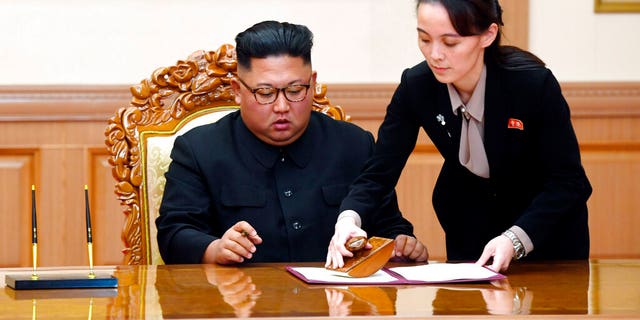
FILE: Kim Yo Jong, right, helps her brother North Korean leader Kim Jong Un sign a joint statement following the summit with South Korean President Moon Jae-in at the Paekhwawon State Guesthouse in Pyongyang, North Korea. 

FILE: Kim Yo Jong, right, helps her brother North Korean leader Kim Jong Un sign a joint statement following the summit with South Korean President Moon Jae-in at the Paekhwawon State Guesthouse in Pyongyang, North Korea.  (Pyongyang Press Corps Pool via AP)

Chang’s allegation comes just days after South Korea’s spy agency said the North’s 36-year-old leader had delegated part of his authority to his close aides, including his younger sister, the Yonhap News Agency reported.
In a private meeting with lawmakers last week, South Korea’s National Intelligence Service said that “Kim Yo-jong, the first vice department director of the Workers’ Party Central Committee, is steering overall state affairs on the delegation,” though Kim her brother still maintains “absolute authority.”
Still, doubt lingers as to the veracity of the diplomat’s claims. Nor was it the first time that Kim’s prolonged absence from the public spotlight has fueled speculation about his health.
In April, reports circulated that the leader of the Hermit Kingdom had had heart surgery after he was not seen in public for nearly three weeks. The North Korean government never explained Kim’s absence, including why he missed a commemoration that celebrated the 108th birthday of his late grandfather, North Korea founder Kim Il Sung.
After a video was released showing Kim moving around during the completion of a fertilizer factory near Pyongyang, a South Korean government official told Fox News that “our government believes” there was no indication that a medical procedure had occurred.

Sunday, August 23, 2020

Postal Service Cartoons


Trump’s vision of American greatness at center of convention


WASHINGTON (AP) — Republicans will aim to recast the story of Donald Trump’s presidency when they hold their national convention, featuring speakers drawn from everyday life as well as cable news and the White House while drawing a stark contrast with Democratic presidential nominee Joe Biden.
Trump is looking to shift his campaign away from being a referendum on a presidency ravaged by a pandemic and economic collapse and toward a choice between vastly different visions of America’s future. Reshaping the national conversation around the race has taken on greater urgency for Trump, who trails in public and private surveys as the coronavirus continues to ravage the nation’s economy and his reelection chances.
The four-day event is themed “Honoring the Great American Story,” according to four Trump campaign officials involved with the planning process but not authorized to discuss it by name. The convention will feature prominently a number of well-known Trump supporters, including members of the Trump family, but also those whom the GOP say are members of the “silent majority” of Americans who have been aided by Trump’s policies. Some have been “silenced” by a “cancel culture” pushed by Democrats, the campaign officials said.
Where Democrats highlighted Republicans who crossed party lines to back Biden as an indictment of Trump’s leadership, the GOP lineup will primarily feature figures on the conservative media circuit with the hope that they can deliver red meat for the president’s loyal supporters — though planners say they will feature some people who did not vote for Trump in 2016.
Planners insist they will put forward a more “positive” convention than Democrats’ roasting of Trump. Yet the president also appears intent on trying to seize on the nation’s cultural divides, particularly around issues of racial injustice and policing, drawing on grievances to motivate his base.
The officials outlined the campaign plans to The Associates Press on the condition of anonymity to discuss the emerging schedule.
The opening night Monday will highlight the “Land of Promise,” aiming to show how Trump helped renew the American dream. Featured speakers include South Carolina Sen. Tim Scott, who will deliver the coveted closing speech of the televised prime-time block; former Ambassador to the U.N. Nikki Haley; presidential son Donald Trump, Jr.; staunch congressional defenders Reps. Matt Gaetz of Florida and Jim Jordan of Ohio; and Republican National Committee Chairwoman Ronna McDaniel.
Tanya Weinreis, a Montana coffee shop owner who received federal loans to pay her employees during the coronavirus, will also speak, as will Andrew Pollack, whose daughter Meadow was among those killed in the 2018 school shooting in Parkland, Florida.
Tuesday’s theme is “Land of Opportunity,” which is expected to cast Biden’s plans as “socialist” and “radical left.” Speakers will highlight Trump’s actions on trade, abortion and the nation’s opioid crisis. Secretary of State Mike Pompeo will address Trump’s foreign policy record, an unusual foray into domestic politics by the nation’s top diplomat, and Trump children Eric and Tiffany Trump will also speak.
Another speaker will be Nicholas Sandmann, who as a student at a Catholic high school in Kentucky gained national attention last year for his interaction with a Native American man during demonstrations in Washington. Media commentary in the aftermath of the viral video from the interaction depicted the students as racially insensitive. Sandmann and the Native American man, Nathan Phillips, later said they were both trying to defuse tensions among conflicting groups that converged at the Lincoln Memorial.
First lady Melania Trump will deliver the marquee address of the night from a newly renovated White House Rose Garden.
Wednesday, themed “Land of Heroes,” will feature a raft of conservative personalities including South Dakota Gov. Kristi Noem, White House counselor Kellyanne Conway, former acting Director of National Intelligence Richard Grenell, Rep. Lee Zeldin of New York and presidential daughter-in-law Lara Trump.
Clarence Henderson, a civil rights figure from the 1960s, is also on deck to address the “true meaning of peaceful protest,” planners said, as Trump plans to highlight police officers amid a nationwide call for policing reform after the May death of George Floyd in police custody.
Vice President Mike Pence will deliver the keynote Wednesday from Baltimore’s Fort McHenry, which inspired “The Star-Spangled Banner” in 1814, to highlight Trump’s opposition to professional athletes who protest racial injustice by kneeling during the national anthem.
Speakers on the final night, themed “Land of Greatness, will include Alice Johnson, the criminal justice advocate whose sentence on drug crimes was commuted by Trump at the urging of celebrity Kim Kardashian; Carl and Marsha Mueller, the parents of human rights activist Kayla Mueller, who died while being held by the Islamic State group in Syria; and evangelist Rev. Franklin Graham.
Trump’s personal attorney, former New York Mayor Rudy Giuliani, whose attempts to dig up dirt in Ukraine on Biden’s family were at the center of the president’s impeachment last year, will also address the final night of the convention. Republican congressional leaders Sen. Mitch McConnell of Kentucky and Rep. Kevin McCarthy of California and Democrat turned Republican Rep. Jeff Van Drew of New Jersey are to deliver remarks, as will Ultimate Fighting Championship President Dana White.
Trump will close out the convention during an unprecedented address from the White House South Lawn. He and Ivanka Trump, his daughter and senior adviser who is set to introduce him, will speak from an elaborate stage in front of the Executive Mansion. The move has drawn criticism from Democrats and ethics groups, who argue that Trump is violating the spirit, if not the letter, of federal law by using the White House grounds to stage his convention.
While the president is not covered by the Hatch Act, his aides cannot appear at the convention in their official capacities and staffers are extremely limited in what they may do to help pull off the convention. Planners insist they are following all ethics rules.
Plans for the GOP event have rapidly come together over the last six weeks, since it became apparent to the party that Trump could not hold an in-person convention at his backup site of Jacksonville, Florida. Trump was forced to move most of the convention out of Charlotte, North Carolina, the original host city, because of restrictive state coronavirus precautions.
Republicans — and Trump himself — closely watched last week’s Democratic convention for cues on what worked and what didn’t in the virtual format, hoping that will provide an advantage in putting together their week of events.
One major difference, Republicans said, will be the emphasis on live rather than taped events — and holding events with crowds to the greatest extent practicable. Trump repeatedly criticized Democrats’ reliance on pre-taped videos, rather than live addresses, saying Tuesday, “Live, by the way, is always much more exciting.”
A small crowd was expected for Melania Trump’s speech in the Rose Garden, with a larger cohort watching in person when Pence speaks Wednesday from Fort McHenry. More than 1,000 guests are anticipated on the South Lawn when Trump delivers his acceptance speech Thursday night. The RNC has requested approval to launch fireworks from the National Mall after Trump’s speech.
Unlike Democrats, Republicans are not expected to feature a roll call of states to formally renominate the president — traditionally one of the most dramatic moments of a convention. The actual voting will be taking place in truncated format Monday morning in Charlotte with a condensed recap expected to air later during the evening.

House passes $25B in 'emergency' Postal Service funding, White House threatens veto


The House of Representatives on Saturday passed a $25 billion funding infusion to the U.S. Postal Service in a bill that also would reverse new cost-cutting measures and ban any efforts to slow down the mail until at least next year.
The vote was 257-150 with 26 Republicans joining the Democrats.
Democrats called the rare "emergency" session in the middle of the summer recess because they contend President Trump and new Postmaster General Louis DeJoy are trying to sabotage the 2020 election by delaying service that could compromise mail-in ballots during the coronavirus pandemic.
"We are experiencing a global pandemic and now our U.S. Postal Service is under attack," said Rep. Rashida Tlaib, D-Mich. "Let it be clear: This administration is waging an authoritarian campaign to sabotage this election by manipulating the Postal Service to suppress our votes ... This is not a conspiracy theory. This is fascism. We will not stand for this."
Rep. Gerald Connolly, D-Va., said DeJoy is "a crony and major donor of the president." Together, they have waged a campaign to disrupt the timeliness of mail delivery and erode public confidence in the Postal Service that -- if successful -- would be "the largest voter suppression in American history since Jim Crow," Connolly said.
Republicans dismissed the Democrats' election concerns as "conspiracy theory." GOP members said the Postal Service is not in a crisis and can handle any uptick in volume from mail-in ballots, pointing to its $14 billion in available cash and access to a $10 billion loan from the Treasury.
"Like the Russia hoax and impeachment sham, the Democrats have manufactured another scandal for political purposes," said Rep. James Comer, R-Ky.
placeholder
Rep. Debbie Lesko, R-Ariz., said Democrats are using the Postal Service to gin up "a new Trump conspiracy theory" even though the president doesn't control the postmaster general.
"Seems insane, but all too typical for the Trump-hating Democrats," Lesko said.

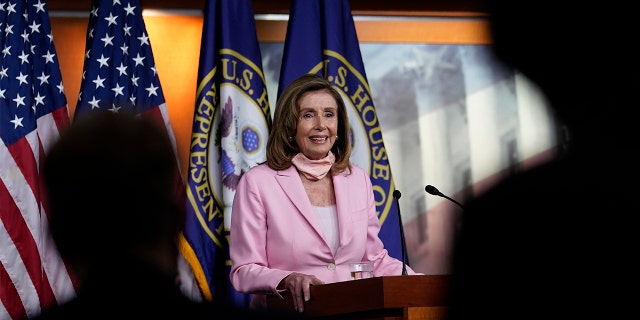
House Speaker Nancy Pelosi, D-Calif., speaks during a news conference on Capitol Hill in Washington, Aug. 22. The House is set for a rare Saturday session to pass legislation to halt changes in the Postal Service and provide $25 billion in emergency funds. (Associated Press)
Goofy

House Speaker Nancy Pelosi, D-Calif., speaks during a news conference on Capitol Hill in Washington, Aug. 22. The House is set for a rare Saturday session to pass legislation to halt changes in the Postal Service and provide $25 billion in emergency funds. (Associated Press)

The legislation is not expected to go anywhere. The GOP-led Senate has no plans to take up the bill and the White House issued a veto threat on Friday saying USPS doesn't need a $25 billion bailout.
Trump tweeted Saturday his opposition to funding for the Postal Service and linked it to his objections to universal mail-in voting.
"Vote NO to the Pelosi/ Schumer money wasting HOAX which is taking place now," Trump tweeted. "Then fight the $51 million unasked for Ballots. Only ABSENTEE BALLOTS are acceptable!"
The Delivering for America Act would infuse the post office with $25 billion, reverse the service changes that DeJoy enacted this year and prevent the Postal Service from taking any measures that could slow down the mail until after the coronavirus pandemic or Jan. 31, 2021 -- whichever is later.
The legislation specifically bans reducing service hours at postal facilities, decommissioning mail sorting machines and removing community mailboxes. The bill would prohibit any limits on overtime pay, hiring freezes, delaying mail service and treating election mail as anything less than first-class mail.
placeholder
Democrats point to growing concerns from constituents over mail delays coinciding with postal changes on DeJoy's watch. DeJoy rejected that any political motives were at play, but told a Senate panel on Friday there has been a slowdown.
“We all feel bad about the dip in our service," DeJoy said, adding that they were working to fix the problems.
Under mounting pressure, a noisy protest at his Washington home and alarm over the removal of blue collection boxes in communities, DeJoy on Tuesday announced he was putting a pause on any service changes until after the election.
"To avoid even the appearance of any impact on election mail, I am suspending these initiatives until after the election is concluded," DeJoy said.

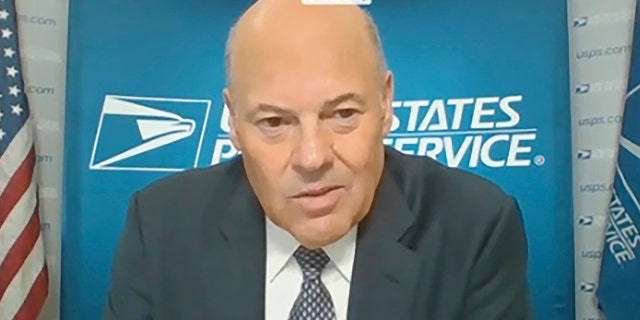
In this image from video, U.S. Postmaster General Louis DeJoy testifies during a video virtual hearing before the Senate Governmental Affairs Committee on the U.S. Postal Service during COVID-19 and the upcoming elections, Aug. 21, on Capitol Hill in Washington. (US Senate Committee on Homeland Security & Governmental Affairs via AP)

In this image from video, U.S. Postmaster General Louis DeJoy testifies during a video virtual hearing before the Senate Governmental Affairs Committee on the U.S. Postal Service during COVID-19 and the upcoming elections, Aug. 21, on Capitol Hill in Washington. (US Senate Committee on Homeland Security & Governmental Affairs via AP)

But Democrats said DeJoy paused the changes only because he "was caught red-handed" and argued the emergency legislation was needed to bar him from undermining mail delivery and the 2020 election.
Rep. Carolyn Maloney, D-N.Y., chair of the House Oversight Committee, produced a new internal Postal Service document on the House floor Saturday that she says revealed a significant drop in service standards at the Postal Service since DeJoy implemented changes. The document was a presentation prepared for DeJoy on Aug. 12.
placeholder
"To those who still claim there are ‘no delays’ and that these reports are just ‘conspiracy theories,’ I hope this new data causes them to re-think their position and support our urgent legislation today," Maloney said.
Republicans took a couple of shots at Maloney during the debate, pointing to her primary race in New York City, which took weeks to call as election officials struggled to count mail-in votes. They said her race should serve as a warning of the dangers of universal mail-in voting for the November election.
"If anyone should know, it should be the chairwoman of this committee who had to wait six weeks after the Election Day to get the results of her election," said Rep. Jim Jordan, R-Ohio, who dismissed the House legislation as a political "charade."
"Imagine what the Democrats want to do -- throw live ballots out there to everyone."
The Postal Service has lost about $80 billion since 2007 through a decline of mail volume and a congressional requirement that the Postal Service pre-fund retiree health benefits. The problems at the Postal Service have been under the spotlight especially this year with the pandemic and greater reliance on mail-in services.
The Postal Service board requested the $25 billion in funding from Congress earlier this year and Democrats agreed. The funding was initially included in the $3 trillion coronavirus relief bill the House passed in May, but the HEROES Act died in the GOP-controlled Senate.
Republicans and the White House said the $25 billion isn't needed and they took special issue with the language that blocks DeJoy from implementing any reforms at an agency that is losing money.
placeholder
White House Chief of Staff Mark Meadows said Trump "at no time has instructed or directed the Post Office to cut back on overtime, or any other operational decision that would slow things down." He said the process of removing blue mail boxes and sorting machines started back in 2011 and the Postal Service has "more than enough money in the bank account."

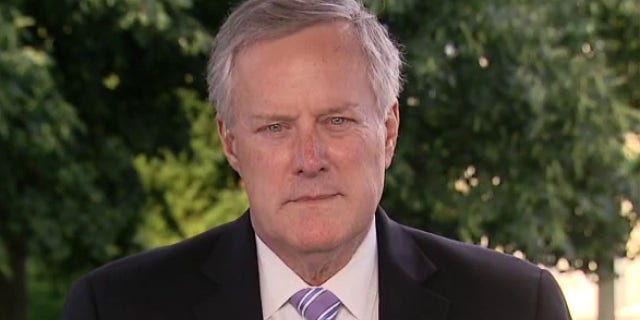
White House Chief of Staff Mark Meadows

White House Chief of Staff Mark Meadows

The vote Saturday, sandwiched between the Democratic and GOP conventions, got heated at times on the House floor.
Rep. Stephen Lynch, D-Mass., said American democracy is more endangered now than during the Sept. 11 terrorist attacks because the country is more divided and the threat is coming from within.
"Today the greatest threat to our democracy is the current administration," Lynch said of the Trump White House.
Rep. Jody Hice, R-Ga., shot back that Democrats are doing the damage to America. "The greatest threat to democracy in the country is the current majority in the House of Representatives," he said.
placeholder
House Speaker Nancy Pelosi, D-Calif., urged Senate Majority Leader Mitch McConnell, R-Ky., to respond to constituents' concerns on mail delays and take up the bill.
"Public sentiment is everything," Pelosi said. "They'll be hearing from their constituents because this hits home. Not receiving your mail in a timely fashion hits home. Not receiving your prescriptions, especially for our veterans, hits home in a way that is harmful to our country."
The 26 Republicans who joined with Democrats to approve the $25 billion funding bill were: Nebraska Reps. Don Bacon and Jeff Fortenberry; Ohio Reps. Troy Balderson, Steve Stivers, David Joyce and Mike Turner; Illinois Reps. Michael Bost and Rodney Davis; Rep. Vern Buchanan of Florida, Missouri Reps. Sam Graves and Ann Wagner; Rep. Brian Fitzpatrick of Pennsylvania; Rep. Jaime Herrera Beutler of Washington; Texas Reps. Will Hurd and Michael McCaul; Michigan Rep. Fred Upton, New Jersey Reps. Jeff Van Drew and Chris Smith; New York Reps. John Katko, Peter King, Elise Stefanik and Tom Reed; Rep. Doug LaMalfa of California; Rep. David McKinley of West Virginia; Rep. Pete Stauber of Minnesota and Rep. Don Young of Alaska.

Delaware police arrest 2 after video appears to show MAGA hat snatched from child

Olivia Winslow and Camryn Amy 
Two women have been arrested in Delaware in connection with a viral video that allegedly showed the suspects ripping up Trump signs and stealing a MAGA hat near the site of Democrat Joe Biden's acceptance speech Thursday.
The video also shows a heated confrontation between the suspects and adults coming to the defense of a 7-year-old supporter of President Trump.
The suspects, identified as Olivia Winslow, 21, and Camryn Amy, 21, were arrested by Wilmington police Friday and Saturday and charged with robbery, conspiracy and endangering the welfare of a child, according to Delaware Online. Amy was also charged with offensive touching.
“That’s somebody else’s hat,” the 7-year-old boy is heard saying in the video after the women rip up several Trump signs in the parking lot of the Chase Center in Wilmington, where portions of the Democratic Convention were held.
One of the suspects grabs a Trump hat that was lying on the ground.
“Get your hat back, baby,” an adult is heard saying to the boy as they follow the suspects, demanding the return of the hat.
Olivia Winslow, left, and Camryn Amy, both 21, face charges in connection with a Thursday incident in Wilmington, Del., authorities say. (Wilmington Police )
One of the suspects allegedly punched a man in the face after he joined the mother and son in an attempt to get the hat back, which can be seen in the video.
“You want to sucker-punch me?” the mother yells as one of the suspects throws the hat over a tall fence.
“She came after my son!” the mother alleges. One suspect then appears to approach the mother and attempt to hit her before the video ends.
Winslow and Amy were identified after police reviewed the footage, according to Delaware Online.
The altercation began when Winslow and Amy allegedly started taunting the woman and her son over their Trump signs, one of which was "forcefully” snatched out of her hands by Amy, court documents said, according to Delaware Online.
The incident was the latest of increasing clashes between the left and the right nearing presidential election.

Denver anti-police protesters burn US flag, smash windows, throw bicycle at cop: reports


Majority of Americans are sick of these anti-police rioters.

An anti-police protest in Denver outside police department headquarters escalated into violence Saturday night as rioters began smashing windows, setting small fires in the street, throwing rocks and hurling fireworks toward officers, according to reports.
placeholder
At one point, members of the crowd in what was dubbed the "Give Em Hell" protest were seen trying to tear down a fence that was surrounding the Statehouse, FOX 31 Denver's Evan Kruegel reported.
At least eight arrests were reported, according to Kruegel.
At another point, a rioter was seen throwing a bicycle at a police officer, according to a reporter from Denver's KUSA-TV.
Rioters also set fire to an American flag, Marc Sallinger posted on Twitter.
Some of the fireworks exploded close to officers, KUSA reported. One officer was reportedly injured but it's unclear how serious the injuries were.
A Reddit post that earlier publicized the "Give Em Hell" protest claimed Denver officials had not addressed activists' calls to defund the police and said that bill calling for a referendum on replacing the police with a Peace Force was vetoed, according to FOX 31.
placeholder
The post called for demonstrators to "bring your gear," according to KUSA.
A SWAT team was sent out for crowd control and several people were arrested, according to Denver's KCNC-TV. The fires were quickly extinguished. Chemical agents were reportedly used on the rioters.
A van pulled up during the unrest, with occupants handing out shields and helmets to crowd members, who were mostly dressed in black, KUSA's Sallinger reported.
At one point, a resident walking her dog confronted one of the rioters who was smashing a window with an ax.
“This is not productive,” she told the vandal, who hit the glass again and walked away.
“People are breaking every window they see,” Sallinger tweeted. “Someone came out of Quiznos with a drink in hand and said, ‘I needed a Coke.’”
placeholder
"They’re moving throughout the city without any regard for the law," he added in another tweet.

CartoonDems