President Donald Trump on Sunday defended ongoing
negotiations with Iran, insisting that any agreement reached under his
administration would protect American interests and prevent Tehran from
obtaining a nuclear weapon.
In a Truth Social post,
Trump contrasted the emerging framework with the Obama-era Iran nuclear
deal, which he has repeatedly criticized for granting sanctions relief
and financial benefits to Tehran.
"If I make a deal with Iran, it will be a good and proper one, not
like the one made by Obama, which gave Iran massive amounts of CASH, and
a clear and open path to a Nuclear Weapon," Trump wrote.
"Our deal is the exact opposite," Trump added. "But nobody has seen it, or knows what it is.
"It isn't even fully negotiated yet. So don't listen to the losers, who are critical about something they know nothing about."
Trump also said previous administrations failed to resolve concerns over Iran's nuclear program.
"Unlike those before me who should have solved this problem many years ago, I don't make bad deals!" he wrote.
The comments come as the United States and Iran appear to be moving
closer toward a broad interim agreement aimed at reducing tensions in
the Middle East while reopening key global shipping lanes and restarting
negotiations over Tehran's nuclear program.
Under the proposed memorandum of understanding, the two sides would
enter a 60-day ceasefire period that could be extended if negotiations
continue.
As part of the framework, Iran would reopen the Strait of Hormuz to
unrestricted commercial shipping and reportedly remove naval mines from
the strategic waterway, one of the world's most critical oil transit
routes.
In exchange, the United States would ease restrictions on Iranian
ports and provide sanctions waivers allowing Tehran to resume oil
exports and international commerce.
The proposed agreement would also restart negotiations over Iran's nuclear activities.
According to U.S. officials, Iran would commit to not pursuing
nuclear weapons while discussing possible limits on uranium enrichment
and reductions to its stockpile of highly enriched uranium.
Officials said Tehran has already provided verbal assurances through intermediaries regarding potential concessions.
The U.S. military presence in the region would remain unchanged
during the ceasefire period, with any significant withdrawal of American
forces tied to a future permanent agreement.
There was a time in American public education when
teachers knew their job was to form human beings. That was a time when
instructors demanded precision instead of self-expression, discipline
instead of therapeutic jargon, and excellence instead of “safe spaces.”
Yes, that was a time when a teacher could still say to a student, “Use
your head, you vegetable,” without triggering a district-wide trauma
response team armed with diversity consultants and defense attorneys.
Edwin Barlow belonged to that time, for he truly was of another time: the time of the Greatest Generation. His life story
was so extraordinary, and his methods so unorthodox, that anyone who
experienced his mathematics classes would never experience education the
same way again.
Mister Barlow taught mathematics at Horace
Greeley High School in Chappaqua, New York, for more than three decades.
He was the school’s first “Teacher of the Year.” He demanded
exactitude. He demanded attention. He demanded that we learn how to
think. His classroom was not merely an invitation to learn; it was a
command performance.
And I was his student in the 1983 - 84 school year.
In
his class, I learned more than calculus. I learned that precision
matters, that sloppiness of presentation reflects sloppiness of thought,
and that intellectual rigor strengthens the mind.
What made
Mister Barlow extraordinary was not merely that he was demanding. Plenty
of teachers are demanding. Plenty are eccentric. Plenty are feared.
What made him singular was that beneath the volcanic, drill
sergeant-inspired classroom persona existed a profound moral seriousness
about education itself.
Mister Barlow had a lifelong engagement
with Catholic thought, classical philosophy, Aquinas, and rigorous
logical systems. His methods were deeply old-world and, I came to
believe, profoundly influenced by Thomistic and Jesuit educational
traditions, even though he never once discussed his approach.
Likewise, his classroom bore the unmistakable fingerprints of Jesuit
intellectual formation. Traditional Jesuit education emphasizes rigor,
disputation, repetition, precision, self-mastery, and the training of
the entire intellect. Students were trained to think clearly under
pressure.
He would explain a concept twice “for the B students,”
then a third time “for the C students,” because he refused to abandon
weaker students to mediocrity. The students he rode hardest were
precisely the ones he believed capable of much more than they were
delivering. When he sensed unrealized potential being wasted, that’s
when he took the student to task in a manner they would never forget.
There
were students who entered his classroom convinced they were mediocre
mathematics students and emerged performing at levels they themselves
would have considered impossible months earlier. Many students who had
struggled or coasted through school suddenly found themselves forced
into genuine engagement for the first time in their lives. Some hated
him for it. Others later realized he had fundamentally altered their
standards for themselves forever.
There was unquestionably a
martial dimension to his philosophy of education. He demanded composure
under pressure. He expected students to think while uncomfortable. He
intentionally placed them at the blackboard, where anxiety,
embarrassment, uncertainty, and scrutiny had to be confronted publicly
rather than avoided. Modern educators would likely regard this as
emotionally hazardous.
I came to believe that, from his perspective, he was performing an
act of protection. After his passing, I confirmed a long-standing rumor:
Mister Barlow fought in WWII. He landed in Northern France a month
after the invasion. A generation that survives world war often develops a
very different conception of what constitutes “hardship.” Mister Barlow
lived through an historical moment where entire societies collapsed
because too many people surrendered reason, courage, vigilance, and
moral seriousness. Mister Barlow’s classroom was partially an attempt to
forge young people capable of surviving a harsh world. His terrifying
classroom persona may have concealed something unexpectedly
compassionate. He knew the world could be brutal. He simply refused to
lie to students about it.
The terrible irony is he believed that
teenage intellectual laziness could lead to the beginning of
civilizational decay itself…and it turns out that he was right.
Today’s
rotten educational establishment would diagnose Mister Barlow as a
public menace. A man who barked at inattentive students, mocked sloppy
work, and terrified teenagers into intellectual focus would be crucified
by the administrative state. He would be investigated by HR
departments. Parents would demand his firing. TikTok clips of his
classroom outbursts would circulate under hashtags about “toxic learning
environments.”
The modern public school system has become a
sprawling, self-serving, extortionate bureaucracy obsessed with identity
politics, grievance hierarchies, and ideological conditioning. Students
are taught that mathematics itself may be culturally oppressive.
Discipline is viewed as authoritarian. Standards are “inequitable.”
Failure is never the student’s responsibility because responsibility
itself has become an intolerable burden in a culture determined to
infantilize everyone forever.
The result is a colossal educational catastrophe that Mister Barlow would have looked upon with undisguised contempt.
Beyond
his educational approach, Mister Barlow was a literal man of mystery.
He erased much of his personal history. Such was his sense of humor that
he was surrounded by rumors and myths so extravagant — that he himself
stoked — that students half-believed he might literally be immortal.
Upon his death, it was discovered that he lived in near-total austerity,
possessing almost nothing, despite quietly leaving nearly half a
million dollars to the Horace Greeley Education Fund — a charity
dedicated to sending financially struggling students to college.
Americans exhausted by ideological indoctrination masquerading as education should learn his story.
Mister
Barlow’s life stands as a rebuke to the comforting lie at the heart of
contemporary education: that protecting students from discomfort
prepares them for the world.
That is why, long after the slogans
and fads of modern pedagogy have vanished into the ash heap of
educational history, people like me will still remember — and endlessly
champion — the terrifying old calculus teacher who demanded they think.
I lived about 15 miles from Fort Bragg, North Carolina from 1994 to
2012, in a rural area where many Army officers and members of the
various Special Forces groups based there made their home. After 9/11
our community was immediately impacted as Fort Bragg forces were some of
the first deployed in the War on Terror. We were reminded daily of the
sacrifices these families were making – the dad who wasn’t there to
participate in Little League with the kids or read a bedtime story or
attend awards ceremonies at the elementary school, or any of the
hundreds of little things that make up family life. Unfortunately, some
of the dads never made it home.
Tiffany and I became friends when our boys were in the same Cub Scout
pack starting in 2002. I knew it was difficult for her to keep
everything together at home while her husband, a Green Beret, was in
parts unknown for months at a time – and when there were constant
reports on the nightly news of injuries and casualties halfway around
the world. But I didn’t realize the depths of the pain and trials she
and other military wives experienced until a few years ago. That
Memorial Day she wrote about losses her husband’s small unit sustained
during one deployment, and with her permission, I am sharing it here in
full.
In the early days of the war I remember watching the
news religiously. I was always shocked at how much information the media
would give about the location of our guys. It really bothered me. And,
of course, we could find out in almost real time if we had lost another
Green Beret.
I remember a particular day when I heard a
news bulletin telling of not one but two fatalities from our very small
unit. My heart sank. The phone tree was abuzz, with all of us trying to
find out. Was it me? Would I hear the knock on the door? As every
military wife has done, I imagined my response. What I would say or do?
How would I react? Would I cry, yell, tell them to leave? Ask them in?
What would be best for my children? Step outside?
Thankfully that knock did not come for me that day. It did for two other wives.
I
knew I had to go to their memorial service. I would want other wives to
show support if it had been me, so alone I decided to go.
I
got up that morning feeling brave. I got dressed and did my makeup, yet
thought that seemed strange. I’m not sure why. I drove to the Special
Forces chapel alone. I quietly walked inside and found my seat on a pew
in the back half. I wasn’t comfortable sitting up close to the family. I
was concerned that so many seats were empty, but most of our guys were
gone, so I understood.
Looking around at the windows I
found it so strange then that the stained glass included soldiers with
guns in a church. Guns and church didn’t seem to go together.
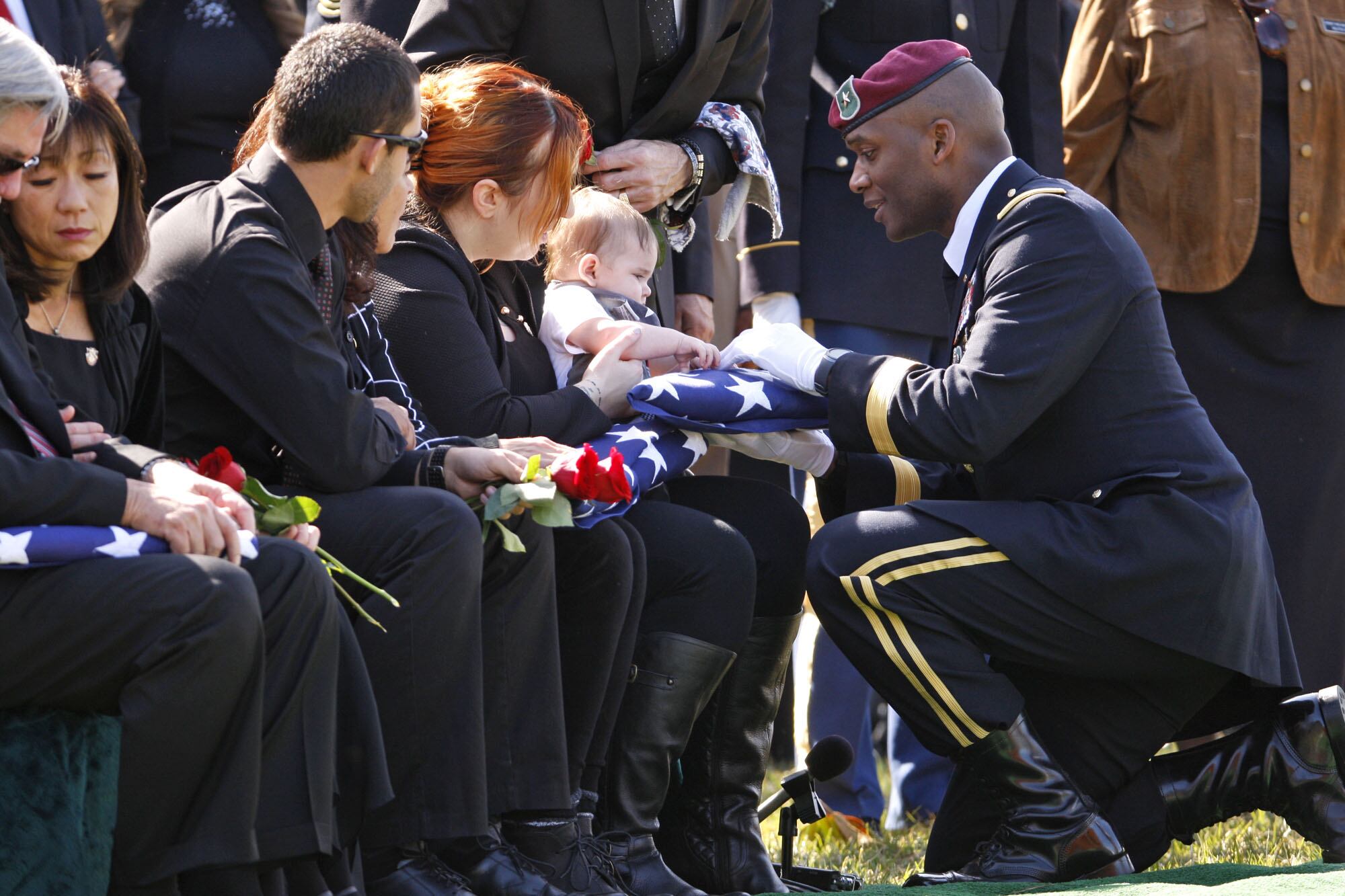
Stained glass window at the JFK Memorial Chapel, Fort Bragg, NC
Now
I understand. Those windows show the depth of man’s soul in a battle.
There is probably not a place closer to God – or seemingly further from
Him – on this earth.
Shortly before the memorial began a
very long line of young soldiers entered the chapel, filling every
available space. It was standing room only. I later found out they
pulled students from the local training unit over as a show of support. I
watched these young guys and wondered what they were thinking.
I don’t remember much of what was said that day, but I clearly
remember the final roll call. The command calls the name of each soldier
on the team. (12) Each soldier answers “Here, Sgt Major” until they get
to the fallen soldier. Their name is called, and when there is no
answer there is the volley of gunfire.
I will never
forget the agonizing wail from the wife of one soldier that day. My
heart hurt for her. I feel horrible pain inside just remembering that
sound. I realized that volley symbolized the last sound her husband
heard before he was killed. What were his last thoughts? That sound is
deafening. Did he know that was it? Did he have a chance to think of
her? Was he in pain? I figured these might be her thoughts. They were
holding her on her feet now. It was so hard to watch I closed my eyes.
I quickly walked away from that chapel, feeling a lot less brave. I got into my car and quietly sobbed.
I
wish I had never gone that day. Fear enveloped my life, fear of that
wailing pain. I tried to outrun the fear. I couldn’t run fast enough. I
tried to pray my way out of the pain. The sleeplessness clouded my mind.
I could no longer eat or drink, certain my knock would come.
Eventually
I chose to end my marriage. I couldn’t wait for this certain end. I
loved him too much. I wallowed away in a bottle, to the shock and
disgust of most I knew. My mind was twisted with the sorrow of the sound
of the wife’s cry. It haunted me, and does to this day.
Those months were the longest of my life. I know what I felt, and also knew that my pain could never amount to hers.
I
am beyond grateful that my husband made it home that deployment. Many
did not. It was a rough year for our unit. He came home, broken himself,
to a wife who could hardly hang on.
How grateful I am
that together with the blessings of our temple marriage and the power of
the atonement we were able to be healed of the wounds inflicted that
deployment. But every year on Memorial Day I remember that wife.
I remember her pain and her sacrifice. I remember her son, and the loss
he must have felt. I remember they gave all.
I
think people forget that most soldiers do not join thinking they will
fight this particular political foe. They join to protect America. They
don’t pick a side. It isn’t about that to these patriots. It’s
protecting their home and fellow citizens. Leave the politics to the
politicians and hold them accountable. But love the soldier. He loves
America.
Tiffany shared with me that the weeks around
Memorial Day are extremely difficult for many combat veterans, who are
remembering their brothers in arms who didn’t get to come back home.
Some replay battle scenes in their mind, second-guess split-second
choices or wonder why they were the ones who survived.
When we honor and remember those who gave their lives on Memorial
Day, we should also remember the parents, spouses, siblings, and
children left behind – their pain and their sacrifice for our freedoms.
Despite countless of President Donald
Trump’s so-called allies defecting to criticize the administration for
coming to a deal with the Islamic Republic of Iran, Secretary of State
Marco Rubio has set the record straight on who is actually coming out on
top.
“The idea that somehow this president, given everything
that he’s already proven that he’s willing to do, is gonna somehow agree
to a deal that ultimately winds up putting position when it comes to
nuclear ambitions is absurd,” Rubio said at a press conference during
his trip to India. “That’s just not gonna happen, but our preference is
to address this through a diplomatic means and that’s what we’re
endeavoring to do here.”
Rubio further expressed that it
has long been Trump’s preference to find global, America First
solutions through diplomatic means rather than unnecessarily put
American troops in harm's way to achieve the same goals. “The problem is
going to be solved one way or the other,” Rubio stated.
Rubio also quieted rumors that the Trump administration
would allow the Iranians to have free reign over the Strait of Hormuz,
one of the most vital shipping lanes in the world.
“If
we allowed that to become normal, we’d be normalizing an unacceptable
status quo and setting a dangerous precedent that can be replicated in
this region and around the world,” Rubio said.
The details of the negotiated deal are expected to be released soon.
The Republican National Committee has scored a major victory
in the state of North Carolina that requires election officials to
purge voter rolls of any individual who does not have U.S. citizenship
status, according to Fox News.
The judgement requires the North Carolina State Board of
Elections to cross-reference jury duty records to identify registered
voters who indicated that they do not have U.S. citizenship. Should
authorities discover that individuals cast ballots while not having
citizenship, they will be required to submit that information to the
pertinent district attorney.
Democrats mounted a defense
to oppose the move, with attorneys working with the Democrat-election
giant Marc Elias pleaded with Superior Court Judge Jennifer Bedford
against it. The decision was granted after a hearing that lasted just 19
minutes.
"This agreement is a major win for election
integrity in North Carolina," RNC Chairman Joe Gruters told Fox News.
"It’s straightforward: if someone admits they’re not a U.S. citizen
during jury duty, that information should be used to check the voter
rolls and remove anyone who doesn’t belong."
The problems with North Carolinian voter rolls have become
apparent over the past month, as over 34,000 deceased individuals were
discovered to still be eligible to cast ballots.
JUST IN: 🇺🇸 34,000 dead people found on North Carolina's voter rolls.
The
news comes as the election security SAVE Act has been sidelined in the
Senate by Republicans who refuse to implement the talking filibuster to
pass the wildly popular bill that Trump has considered a top priority.
President Donald Trump condemned critics of the current negotiations with Iran, saying that “nobody has seen” the deal.
“If I make a deal with Iran, it will be a good and proper one, not
like the one made by Obama, which gave Iran massive amounts of CASH, and
a clear and open path to a Nuclear Weapon,” Trump posted to Truth
Social on Sunday.
“Our deal is the exact opposite, but nobody has seen it, or knows
what it is. It isn’t even fully negotiated yet,” the president
continued. “So don’t listen to the losers, who are critical about
something they know nothing about. Unlike those before me who should
have solved this problem many years ago, I don’t make bad deals!”
This follows an earlier Sunday Truth Social
post in which Trump emphasized that the United States has the advantage
of time when it comes to striking a deal with the Islamic Republic.
He also claimed that the “negotiations are proceeding in an orderly
and constructive manner,” and that the U.S.-Iran relationship “is
becoming a much more professional and productive one.”
Despite the toned-down rhetoric regarding the Middle Eastern nation
in comparison with past statements, Trump maintained the key goal of
ensuring that Iran cannot develop or obtain a nuclear weapon.
California is a state caught in a paradox. It is often praised for
its innovation, diversity, and economic prowess, yet it is
simultaneously wrestling with self-inflicted woes, particularly its
taxation policies that seem to drive the very innovators it cherishes
away. California’s recent push for a wealth tax is a prime example of
how policymakers can miss the mark entirely while attempting to
redistribute wealth.
Not too long ago, Californians witnessed the
spectacle of a sprawling gubernatorial race, with many candidates vying
for the position, most notably amidst controversies surrounding the
former front-runner. The situation is reminiscent of an outlandish
reality show—one filled with drama, but where the more comedic aspects
overshadow the real stakes at hand. The current mayor of Los Angeles,
Karen Bass, is living proof of this; despite her shaky record and the
city’s growing problems, she remains a front-runner, largely due to a
weak field of challengers.
Meanwhile, Spencer Pratt, a candidate
who has raked in significant fundraising dollars, emphasizes a
fundamental issue: the disconnect between city governance and the needs
of everyday Angelenos. He pointed out how the sheer neglect led to the
Sixth Street Bridge’s temporary blackouts due to copper theft. Her
response? A plan to install solar-powered streetlights—an admirable
thought, but one that raises eyebrows given the current crime
environment. It’s almost funny, in a tragic way, to think that criminals
will somehow be deterred by lights that can’t be stolen—with cages
proposed as an actual solution.
This awkward dance continues as
California’s leadership seems bent on punishing success. Governor Gavin
Newsom, despite touting the state’s status as a hub of wealth creation,
stands against the tide of logic by opposing a referendum that could
impose a massive wealth tax. And yet, the initiative has gained
traction, with enough signatures for it to make it onto the ballot.
Advocates tout it as a means of fairness, yet it stands to exacerbate an
already concerning trend of out-migration among wealthy residents.
As
for the wealth tax itself, the proposals have drawn ire for their
potential destructive consequences. A 5% tax on billionaires, including
taxation on unrealized gains—wealth that isn’t even liquid—merely
screams of a misguided attempt at fairness. Picture this: an
entrepreneur with hefty investments but just a modest salary is faced
with a tax bill that obliterates their liquidity simply because they’ve
succeeded during their career. Instead of being a method for wealth
distribution, this tax could backfire, leading to a massive loss of jobs
and reduced revenue for the state. If all of California’s billionaires
pull their money out, who will employ the average worker?
In
wrapping up this humorously tragic lesson on economics, California seems
poised to shoot itself in the foot, all while patting itself on the
back for its noble intentions. As wealthy residents contemplate moving
out for friendlier tax environments, Californians must ask themselves
what they truly want their state to be. A trend-setting innovator or a
cautionary tale of economic mismanagement? Time will tell if the Golden
State remains golden or merely becomes a punchline in the economic
comedy of life.
Glenn Beck’s March 28, 2026 broadcast brought Jacob Savage onto the
air to do what too few in the mainstream will: name the rot eating
Hollywood from the inside out. Savage, who laid his case out in a
December essay called “The Lost Generation,” told Beck that the industry
no longer hires for talent but for ideological box‑checking, and that
story landed with listeners because it explained what people already
feel in their bones.
Savage’s essay traces the last decade’s rout
of merit in film, television, and allied institutions, showing how
hiring practices tilted away from experience toward diversity metrics
and social signaling. The result, he argues, is predictable: writers’
rooms and executive suites now choose ideological conformity over
compelling storytelling, and creativity withers when the best idea isn’t
the one that wins a diversity audit.
On Beck’s show Savage shared
a personal moment that captures the arrogance of the new gatekeepers —
he says he was told flatly they couldn’t hire him because “we already
have too many white guys on staff” — a line that sums up how DEI has
become a substitute for merit. That kind of blunt discrimination isn’t
just unfair to hardworking Americans trying to break in; it produces the
bland, repetitive entertainment Beck and Savage were rightly outraged
about.
Meanwhile the audience has noticed. Once-loyal moviegoers
aren’t coming back in the numbers studios expected, and critics and
insiders admit there’s been a growing mismatch between what executives
think audiences want and what audiences actually want. When studios
prioritize signaling over story, they pay for it at the box office and
in streaming churn — the bottom line proves what common sense already
knew: Americans want entertainment that entertains, not sermons.
The
corporate answer has been mergers, cost-cutting, and a frantic pivot to
streaming math instead of risk-taking artistry, which only deepens the
crisis. Companies like Disney and the major studio conglomerates face
structural challenges — streaming costs, franchise fatigue, and
fractured audiences — because the product stopped being about craft and
started being about compliance.
If
Hollywood wants its audiences back it must stop treating culture as a
policy platform and return to the old American idea: reward the best
work, regardless of the author’s preferred politics. Savage and Beck are
sounding an alarm that every patriot who still loves great storytelling
should heed — talent, grit, and honest work built this industry once;
it can be rebuilt again if we demand it and refuse to bankroll
propaganda dressed as entertainment.
Washington and Iran have "largely negotiated" a memorandum of
understanding on a peace deal that would reopen the Strait of Hormuz,
U.S. President Donald Trump said, as expectations rose that a turning
point might be imminent in the three-month-old war.
Trump posted on social media that the emerging agreement would reopen
the strait, the vital shipping passage whose closure has sparked a
global energy crisis since the U.S. and Israel launched the war on Iran
in February. He did not say what else would be included in an agreement.
"Final aspects and details of the Deal are currently being discussed,
and will be announced shortly," Trump wrote on Truth Social on
Saturday.
Various media in the U.S. and Iran said the memorandum that could
yield an agreement lays out a phased framework for ending months of
fighting, reopening the waterway soon and lifting a U.S. blockade on
Iran. Plans for Iran's stockpile of enriched uranium, which Washington
has insisted it give up, would be negotiated within 30 to 60 days, the
reports said.
U.S. Secretary of State Marco Rubio, on a visit to India, said more
news could come on Sunday and there was a possibility of good news on
the strait within hours. A senior Iranian source told Reuters that if
Iran's Supreme National Security Council approved the memorandum, it
would be sent to Supreme Leader Ayatollah Mojtaba Khamenei for final
approval.
But Iran's Tasnim news agency said differences remained over one or
two clauses. Tasnim cited a source as saying there would be no final
understanding if the U.S. continued to create obstacles.
IRAN'S NUCLEAR PROGRAM IN FOCUS
A deal cementing a fragile ceasefire would bring relief to markets
but would not immediately quell a global energy crisis, which has
driven up costs of fuel, fertilizer and food.
Even if the war ends now, full oil flows through the strait will not
return before the first or second quarter of 2027, the head of the
United Arab Emirates' state oil firm ADNOC said last week.
Axios reported late on Saturday that the U.S. and Iran were close to a
deal, which it said would include no tolls on ships transiting the
strait, while Iran would be able to freely sell oil.
In exchange, the U.S. would lift its blockade on Iranian ports and
waive some sanctions on Iranian oil, the U.S. news outlet said, citing a
U.S. official.
The draft agreement also includes commitments from Iran never to pursue nuclear weapons, Axios said.
Trump, while offering various war aims during the conflict, has
repeatedly said the U.S. struck Iran to prevent it from obtaining
nuclear weapons.
Iran has long denied it is pursuing such weapons and says it has a
right to enrich uranium for civilian purposes, although the purity it
has achieved far exceeds that needed for power generation.
Iran's Fars news agency said the draft also stipulates that the U.S.
and its allies will not attack Iran or its allies, and in return Iran
pledges not to launch preemptive attacks on them.
Prominent Israeli politician Benny Gantz said it would be a strategic
mistake for Israel to accept a ceasefire in Lebanon, where it is
fighting the Iranian-backed Hezbollah militia, as part of a deal with
Iran.
He posted on X that Israel had an obligation to protect residents
near the border and should reject any such proposal by the U.S.
Sources have told Reuters the proposed framework would unfold in
three stages: formally ending the war, resolving the crisis in the
Strait of Hormuz and launching a 30-day window for negotiations on a
broader agreement, which can be extended.
One of the Pakistani sources said that if the U.S. accepts the
memorandum, further talks could take place after the Muslim Eid holiday
ends on Friday.
Trump, whose approval ratings have been hit by the war's impact on
U.S. energy prices, said on Friday he would not attend his son's wedding
this weekend, citing Iran among the reasons for staying in Washington.
Tasnim said any changes in navigation through the Strait of Hormuz
were conditional on implementation of other commitments by the U.S. It
also said some Iranian funds that have been frozen globally as part of
sanctions must be released in the first phase of the deal.
'ISSUES STILL NEED TO BE DISCUSSED,' IRAN SAYS
Trump spoke on Saturday with leaders from Saudi Arabia, Qatar, the
United Arab Emirates, Jordan, Egypt, Turkey and Pakistan, who
encouraged Trump to agree to the emerging framework, Axios reported.
A call with Israeli Prime Minister Benjamin Netanyahu went "very well," Trump wrote on Truth Social.
Iranian Foreign Ministry spokesperson Esmail Baghaei said on Saturday
that "the trend this week has been towards a reduction in disputes, but
there are still issues that need to be discussed through mediators."
Baghaei said the issue of the U.S. blockade on Iran's shipping was
important, but that its priority was ending the threat of new U.S.
attacks and the conflict in Lebanon.
Iran's top negotiator Mohammad Baqer Qalibaf said Iran's armed forces
had rebuilt their capabilities during the ceasefire and that, if the
U.S. restarted the war, the consequences would be "more forceful and
bitter" than at the start of the conflict.