
 |
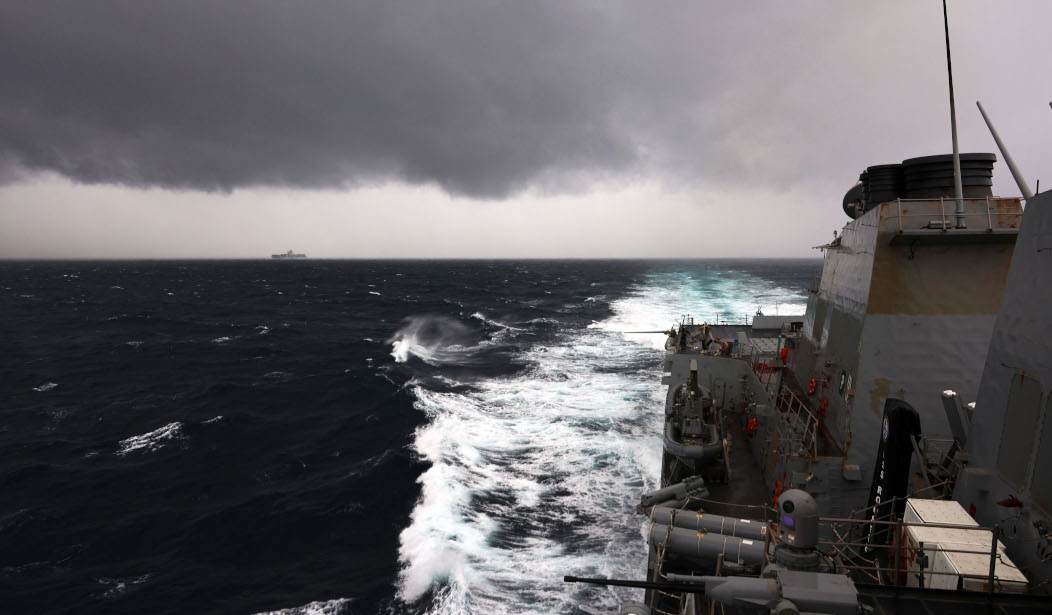
America awoke Sunday to find that President Trump had a contingency plan for the almost certain failure of Vice President JD Vance's diplomatic mission (see New: Peace Talks With Iranian Regime Have Failed, Vance Gives Details From Islamabad – RedState) to end the war with Iran on terms that are politically and militarily acceptable to the U.S. President Trump, using Truth Social as his platform, announced that the Hormuz Strait was closed:
My colleague Nick Arama covered the announcement in Here We Go: Trump Announces Major US Action in Strait to Shut Down Iran – RedState. There are moving parts to this directive, and some of them seem confusing. 1. The U.S. Navy will blockade the Strait of Hormuz and prevent any ship from entering or leaving. From the perspective of scale, there are about 1,900 ships in the Persian Gulf waiting to leave and at least 800 ships in the Arabian Sea and Gulf of Oman waiting to pass through Hormuz. 2. Closing Hormuz means blockading ports in Iraq, Kuwait, Saudi Arabia, Bahrain, Qatar, and the UAE. 3. No one seems sure how to identify which ships paid a "toll" because the required currencies, crypto or renminbi, were chosen to allow anonymity. 4. The blockade also raises questions on how the U.S. might handle a ship from a friendly nation seeking to transit the Strait of Hormuz. Sunday evening, U.S. Central Command published a public directive on how the blockade will be enforced.
This provides much-needed clarity. The Navy will enforce a blockade of Iranian ports in the "Arabian Gulf" and the Gulf of Oman starting at 10 a.m. Monday. Be aware that the U.S. Navy made the change of nomenclature, much as President Trump renamed the Gulf of Mexico, in 2010; however, it still chaps Iranian asses when they see it. The announcement indicates that friendly ships will be blocked from entering Iranian ports along with the rogue tankers trading in bootleg Iranian crude oil. The message implies that some kind of escort or patrol system will be established to coordinate passage with the U.S. Navy rather than the IRGC. There are some other parts that haven't been defined yet. For instance, will Iranian tankers at sea be fair game for seizure? Approximately 12 Iranian supertankers are filled and stationary in the Gulf of Oman awaiting dispatch. Will we leave them alone or round them up?
There is a growing consensus that Iran has not mined the Strait of Hormuz, and we'd like to keep it that way. My assumption is that we'll actively, kinetically prevent any attempt to mine the Strait, but that is not spelled out. U.S. demining efforts continue. To the best of my knowledge, that is being done by UH-60S helicopters with mine countermeasures packages being flown from destroyers in the area. President Trump has said some Gulf nations will join the demining effort, but there is no reliable information to confirm this. How, exactly, will we enforce the blockade if a Chinese tanker decides to bull its way through? I'm assuming this contingency, as well as how to handle Chinese warships if this situation persists long enough, and I wouldn't expect USCENTCOM to announce them, but this is something we should be on the lookout for. President Trump says, "Other Countries will be involved with this Blockade." At this time, the only takers seem to be the UAE and Bahrain. The UK, Germany, and Australia have refused to help, and France seems likely to join that group. An added bonus is that a third Carrier Strike Group has entered the Eastern Mediterranean. Anyway, go time is 10 a.m. Eastern Daylight Time on Monday, and we'll get answers to our questions then. For decades, former presidents have been all talk and no action. Now, Donald Trump is eliminating the threat from Iran once and for all. |


No comments:
Post a Comment