The
top Republican on the House Judiciary Committee on Tuesday accused the
panel's Democratic chairman, Rep. Jerry Nadler, of "harassment" and
unethical conduct, after Nadler moved to seek records from Supreme Court
Associate Justice Brett Kavanaugh's time in the George W. Bush administration. Nadler's request came days after a liberal lion of the high court, Associate Justice Ruth Bader Ginsburg, defended Kavanaugh as a "very decent, very smart individual," and long after progressive activists have largely moved on to other matters. Rep.
Doug Collins, R-Ga., said in a statement that Nadler's request is so
"far outside the scope of judicial ethics, it’s harassment." "Senate
Democrats spent months launching false accusations in an attempt to
smear Justice Kavanaugh’s reputation and block his confirmation to the
U.S. Supreme Court, and now House Democrats want to follow suit with yet
another fishing expedition to tarnish his good name," Collins said.
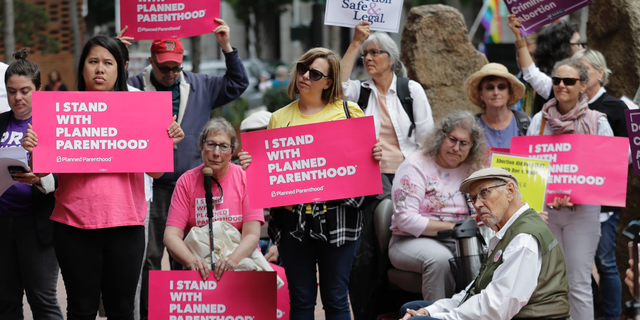
In this July 10, 2018, photo, protesters hold signs supporting
Planned Parenthood in Seattle and against Brett Kavanaugh's nomination
to the Supreme Court.
Nadler, along with Hank Johnson, D-Ga., wrote to the National Archives to seek "certain presidential records related to Justice Brett M. Kavanaugh’s service in the White House from 2001 to 2006." They
cited the Presidential Records Act, which allows congressional
committees to obtain “contain information that is needed for the conduct
of [their] business and that is not otherwise available," subject to
executive privilege and other limitations. Tens
of thousands of documents relating to Kavanaugh's time in the White
House Counsel's Office were withheld during his confirmation process,
the lawmakers said, after they were processed by a private attorney for
potential privilege issues. "As a result of this process, the
Senate Judiciary Committee received only a small fraction of Justice
Kavanaugh’s White House record before voting on his nomination," Nadler
wrote. Nevertheless, some of Kavanuagh's writings in the Bush
administration did play a central role during his confirmation process.
In a dramatic exchange during the hearings, Sen. Cory Booker, D-N.J.,
now a presidential candidate, implied that Kavanaugh had been open to
racial profiling tactics, citing an email exchange between Kavanaugh and
a colleague in the Bush White House. Booker did not provide
Kavanaugh a copy of the emails to review, and claimed Republicans had
tried to hide them. However, Senate Republicans said the documents had
been publicly released earlier in the day, even as Booker suggested he could be expelled from the Senate for releasing them. The emails released later
on during the hearings showed Kavanaugh advocating for race-neutral
security screening policies at airports after 9/11, but said that during
an "interim" period before such policies could be implemented,
administration lawyers would need to "grapple" with the possibility of
factoring in race during screenings in the interest of national
security. In his letter, Nadler sought the new documents on a
"rolling basis," and specifically asked for any "emails sent to or
received by Justice Kavanaugh, including emails on which he was a carbon
copy or blind carbon copy recipient, during the period in which Justice
Kavanaugh served as staff secretary, including any documents attached
to such emails." Additionally, the Democrat requested "the textual
records contained in Justice Kavanaugh’s office files from the period
during which he served as staff secretary." Any successful effort
to remove Kavanaugh from the bench would require a two-thirds vote of
both the House of Representatives and the Senate. Several 2020
Democratic presidential contenders -- including Elizabeth Warren, Kamala
Harris, Kirsten Gillibrand, and Pete Buttigieg -- have said they would
be open to legislation that would expand the size of the Supreme Court,
to effectively dilute the importance of conservative justices' votes.
The size of federal appeals courts, including the Supreme Court, is set
by Congress. "When
are we going to move on from the smear campaigns, and begin working on
real, bipartisan solutions to improve the lives of the Americans we were
elected to represent?” Collins asked.
Queens district attorney candidate Tiffany Cabán conceded defeat Tuesday night — six weeks after the Democratic primary election that pitted her against the establishment-backed Queens Borough President Melinda Katz. “We terrified the Democratic establishment,” Cabán told her supporters at a party in Astoria. “We
showed [that] you can run on a boldly decarceral platform,” she added
referring to her criminal justice reforms. “You don’t have to play by
the old rules.”
In this June 26 file photo, Democratic primary candidate for
Queens district attorney Tiffany Cabán responds to questions during an
interview in the Queens borough of New York. Cabán told supporters
Tuesday, Aug. 6 that she is calling it quits in her race for Queens
district attorney that gained national attention.
In a back-and-forth race that saw both
candidates declare victory, the insurgent lawyer fought to the very end
challenging dozens of invalidated affidavit ballots in court that she
said were improperly excluded. But after several attempts to claw
back — including at a judicial hearing earlier Tuesday — she bowed out
after it became clear she’d be unable to erase the 60-vote gap
separating her and Katz. “There’s still so, so much work to be done here in Queens — and you better believe I’m going to keep fighting,” Cabán said. The
Rep. Alexandria Ocasio-Cortez-backed candidate shocked the city on June
25 when she appeared to beat Katz, a veteran Queens politician, by
1,100 votes on primary night. But the tables flipped when the Board of
Elections tallied the absentee ballots and many of the provisionally
cast ballots, giving Katz the lead. Last
Monday, the Board of Elections declared Katz the victor. The certified
results showed Katz winning 34,920 votes, a razor-thin edge over Cabán’s
34,860. Katz now becomes the heavy favorite to win the job in the
November general election in the increasingly left-leaning borough.
Blowback against the New York Times over a headline about President Trump's response to recent mass shootings is a frightening precedent, according to Mollie Hemingway. The
fact several media and political figures were able to convince the
paper to change its headline after the first edition exposes the
collective outrage as a "mob," Hemingway claimed Tuesday on "Special Report." "Clearly,
the first headline was more factual and less opinion-y than the second
headline -- which was not a very well constructed headline," the
Federalist senior editor said. A headline about Trump’s remarks on
the recent mass shootings in El Paso and Dayton drew condemnation
online -- including from some Democratic presidential candidates --
and was subsequently changed late Monday. The newspaper summarized
Trump’s comments, in which he denounced hate and white supremacy, with
the headline “Trump Urges Unity vs. Racism” on the front page of its first edition. In response, several Democrats blasted the newspaper. Rep. Alexandria Ocasio-Cortez, D-N.Y.,
called the headline a: "reminder of how white supremacy is aided by --
and often relies upon -- the cowardice of mainstream institutions." Democratic presidential hopeful former Rep. Beto O'Rourke, D-Texas, called it, "unbelievable," and fellow contender Sen. Cory Booker, D-N.J., demanded the Times "do better." "Lives literally depend on you doing better. Please do," the former Newark, N.J. mayor tweeted. The paper's home-state Senator Kirsten Gillibrand, who is also running for the 2020 Democratic nomination, claimed the headline was inaccurate: "that's not what happened." On "Special Report," Hemingway appeared to disagree. "You
hear a lot of people asserting things about Donald Trump without
actually showing their work or showing evidence in support of it," she
said. "The
New York Times was bullied and pressured by an online mob -- consisting
of a lot of journalists -- to take that factual headline and change it
to something else to fit a narrative that has been promoted by a lot of
people. "It can be kind of scary to watch media companies or
corporations like the New York Times fall prey to these kinds of online
mobs." After the backlash, the Manhattan-based paper changed the top story's headline to, "Assailing hate but not guns." Fox News' Gerren Keith Gaynor contributed to this report.
President Trump issued a fiery tweet late Tuesday for 2020 presidential candidate Beto O'Rourke ahead of his visit to the Democrat's hometown of El Paso, Texas, following last weekend's shooting that left 22 dead. Over the past several days, O'Rourke has slammed the president, who he has placed blame
for the massacre. The former congressman declared that Trump is a
"racist" and compared his language to Nazi Germany's Third Reich. He
also compared Trump's North Carolina rally-- where the "send her back"
chant took place-- to "Nuremberg." "That is a leader reveling in the hatred and the racism of the people that he purports to serve and to lead," O'Rourke said Monday. Trump responded to O'Rourke and claimed the candidate is using a "phony name" in an attempt to appeal to voters. "Beto
(phony name to indicate Hispanic heritage) O’Rourke, who is embarrassed
by my last visit to the Great State of Texas, where I trounced him, and
is now even more embarrassed by polling at 1 percent in the Democrat
Primary, should respect the victims & law enforcement - & be
quiet!" Trump wrote in a late-night tweet. O'Rourke responded to Trump's tweet and double-downed on his claim that Trump is responsible. "22
people in my hometown are dead after an act of terror inspired by your
racism," he tweeted. "El Paso will not be quiet and neither will I." The
president referred to the rally he held in El Paso back in February
amid the national debate about the migration crisis and had previously
boasted his crowd size in comparison to O'Rourke, who held a competing
rally on the same night. O'Rourke responded to Trump's attack. "22
people in my hometown are dead after an act of terror inspired by your
racism. El Paso will not be quiet and neither will I," O'Rourke told the
president.
A top Chinese military official on Tuesday said Beijing
would “not stand idly by” if the U.S. goes forward with deploying
intermediate-range missiles in the Indo-Pacific region, raising new
fears an arms race.
Last weekend, Mark Esper, the U.S. defense
secretary, said that he “would like to” place these missiles in Asia,
while in Sydney. Australia's defense minister has said that country will
not be a base for the missiles.
It was not clear when these missiles would be put into place, but one senior official from the U.S. told Reuters that it would be years away.
Esper
made the comments after the U.S. withdrew from an arms control treaty
with Russia from the Cold War-era. A senior U.S. official said Russia
was in “material breach of the treaty” and made no effort to “come back
into compliance.” The 1987 Intermediate-Range Nuclear Forces treaty was
signed by President Ronald Reagan and Soviet leader Mikhail Gorbachev.
Moscow accused the U.S. of breaching the treaty and asked for evidence that it was in violation.
Fu
Cong, the chief arms control official in China, also Tuesday warned
neighboring countries not to allow the U.S. to deploy such weapons on
their territory.
Fu said China had no intention of entering a
trilateral arms control deal with the U S. and Russia but would remain
engaged in disarmament discussions.
The Pentagon has reportedly taken notice of the importance of its missile arsenal.
Defense One reported
that the Pentagon is increasing its “stealthy long-range cruise
missile” stockpile. Lockheed Martin is reportedly building an entirely
new facility in Alabama to accommodate the demand for the Joint
Air-to-Surface Standoff Missile, which were used in Syria and fired from
a B-1 bomber. The Associated Press contributed to this report
Four voters in California, along with the conservative transparency group Judicial Watch, announced Monday they have filed a federal lawsuit against the left-wing state, alleging its new law aimed at strong-arming President Trump into releasing his income tax returns is patently unconstitutional. Democratic Gov. Gavin Newsom signed the law known as the "Presidential Tax Transparency and Accountability Act" last week. Its provisions would
require Trump and other presidential primary candidates to file their
tax returns for the most recent five years to the California secretary
of state by November 26 or be excluded from the March 3,
2020 presidential primary ballot. The law does not apply to the
general election, so Trump would still appear on the November 2020
California presidential ballot if he secured the national Republican
Party nomination. "Within five days of receipt of the candidate’s
tax returns, the Secretary of State shall make redacted versions of the
tax returns available to the public on the Secretary of State’s internet
website," the law states. The measure sailed through the state's Democratic-led
legislature. Former California Gov. Jerry Brown had vetoed a similar
version of the law last year, noting that it "may not be constitutional"
and sets a "slippery slope precedent" that could lead the state to
demand all kinds of documents from candidates. "Today we require
tax returns, but what would be next?" Brown asked. "Five years of health
records? A certified birth certificate? High school report cards? And
will these requirements vary depending on which political party is in
power." But Newsom, a frequent Trump critic who declared in June that the GOP is "finished" and will devolve into a third party, disregarded those concerns. The
Constitution requires only three things of presidents: They have to be a
natural-born U.S. citizen; must be at least 35 and must have lived in
the country for at least 14 years. (Although the precise legal meaning
of the term "natural-born U.S. citizen" is debated, it generally is
taken to apply when someone is either born in the U.S. or born abroad to
a U.S. citizen.)
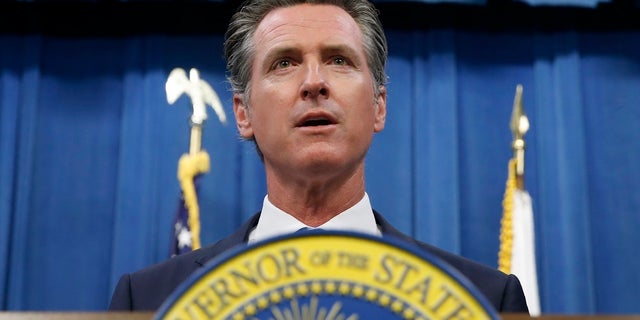
California Gov. Gavin Newsom during a news conference in
Sacramento, Calif. Newsom signed a law Tuesday, July 30, requiring
presidential candidates to release their tax returns to appear on the
state's primary ballot, a move aimed squarely at Republican President
Donald Trump. (AP Photo/Rich Pedroncelli)
The four plaintiffs are two Republicans, one Democrat and one independent. In their federal complaint, the plaintiffs call the law an unprecedented attempt by a state to add additional qualifications for the presidency. "No
state or federal law has ever mandated that presidential candidates
disclose their tax returns to qualify or appear on a ballot," the
complaint says. "The voluntary release of presidential candidates’ tax
returns is a recent, and partial, phenomenon, notwithstanding a current
media narrative suggesting otherwise." In a statement,
Judicial Watch President Tom Fitton said: "This is a nonpartisan
concern about the state running roughshod and attempting to amend the
Constitution on its own." “California politicians, in their zeal
to attack President Trump, passed a law that also unconstitutionally
victimizes California voters," Fitton added. "It is an obvious legal
issue that a state can’t amend the U.S. Constitution by adding
qualifications in order to run for president. The courts can’t stop this
abusive law fast enough.” Attorneys for Judicial Watch argue
California's law effectively alters the Constitution by adding a new
requirement for tax returns, something they say state governments don't
have the authority to do. California's
law says voters need to know details about presidential candidates'
finances to "better estimate the risks of any given Presidential
candidate engaging in corruption." But Judicial Watch argues that
rationale could lead states to demand things like medical and mental
health records and eventually things like Amazon purchases, Google
search histories and Facebook friends. Conservatives, who recognize that
Trump stands no chance of winning California's electoral votes
regardless of the outcome of this dispute, have similarly sounded the
alarm about where these restrictions might go in the future. Judicial
Watch also argues that by limiting the law to primary elections, it
does not apply to independent candidates. Judicial Watch also says the
law violates voters' constitutional rights to associate with
presidential candidates and the voters who support them, rights it says
are guaranteed under the First and 14th amendments. The lawsuit
names Secretary of State Alex Padilla as the defendant because his
office is in charge of enforcing the law. Representatives for Padilla
and Newsom declined to comment on Monday, saying they have not been
officially notified of the lawsuit. When he signed the law last week, Newsom released statements from three lawyers, including the dean of the University of California, Berkeley law school, saying the law is constitutional. "SB
27, which requires that presidential candidates disclose tax returns,
is constitutional. It does not keep any candidate from being on the
ballot so long as he or she complies with a simple requirement that is
meant to provide California voters crucial information," Berkeley
dean Erwin Chemerinsky said. "This
is the state acting to make sure that its voters have information that
might be very important to them when they cast their ballots as to who
they want to be President of the United States." Newsom contends
Congress has changed aspects of the presidency previously, including
limiting presidents to two terms after President Franklin Roosevelt was
elected to four terms, and passing anti-nepotism laws after President
John F. Kennedy appointed his brother, Robert, U.S. attorney general.
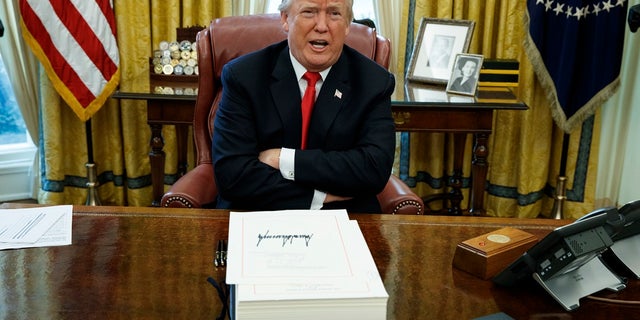
President Trump has said he will not release his tax returns as long as they are under audit. (AP Photo/Evan Vucci, File)
"If the federal government is not going to act, California needs to act. We've always done that," Newsom said in a video posted to his Twitter account. Citizens
have had to pay federal income taxes since 1913, but it wasn't until
1973 when a U.S. president made his personal tax returns public.
Republican Richard Nixon released his tax returns publicly while he was
being audited by the IRS, after an IRS employee leaked a portion of his
returns to the media. Ever
since, U.S. presidents have released at least a summary of their
personal income taxes. That includes most major candidates for
president, with some exceptions. Former California Democratic Gov. Jerry
Brown did not release his tax returns when he ran for president in
1992. In their lawsuit against California, the plaintiffs noted
that "one study found that 7 of 34 'major' candidates for president
since 1976, or about 20 percent, refused to produce their tax returns." The
complaint specifically alleges violations of the Qualifications Clause
of the Constitution, as well as the plaintiff's First Amendment rights
to express their political preferences. Additionally, because the law
only applies to party-affiliated candidates (non-party candidates do not
participate in primaries), the suit also alleges a violation of the
Constitution's Equal Protection Clause and a federal equal protection
statute. Trump has refused to release his tax returns, saying they are being audited by the IRS. Fox News' Louis Casiano and The Associated Press contributed to this report.
El
Paso, Texas, Mayor Dee Margo told reporters on Monday that President
Trump will visit the city on Wednesday, even as several prominent
Democrats indirectly blamed the president for Saturday's mass shooting there -- with some warning him, in frank terms, to stay away.
News
of Trump's planned appearance teed up a potentially bitter national
political moment just four days after suspected gunman Patrick Crusius,
21, allegedly opened fire at a Walmart and killed 22 people while
injuring more than two dozen others.
"He is president of the
United States," Margo, a Republican, told reporters. "So in that
capacity, I will fulfill my obligations as mayor of El Paso, and hope
that if we are expressing specifics that we can get him to come through
for us."
The
mayor said he anticipated "political spin" and was “already getting the
emails and the phone calls” from individuals "with lots of time on
their hands," but that his focus remains on his community, not politics.
He added that Trump had called and was "very gracious" and offered any
support necessary.
“We’re dealing with a tragedy of 22 people who
have perished by the hateful, evil act of a white supremacist,” Margo
said. “I don’t know how we deal with evil. I don’t have a textbook for
dealing with it other than the Bible.
"I’m sorry. We are going to
go through this," he continued. "The president is coming out. I will
meet with the president. I guess for people who have lots of time on
their hands, I will deal with the emails and phone calls.”
The White House has not confirmed Trump's schedule, or whether he will also visit Dayton, Ohio -- where a gunman who reportedly
supported the violent left-wing group Antifa, as well as Bernie Sanders
and Elizabeth Warren, killed nine people over the weekend. But the
Federal Aviation Administration has advised pilots of a presidential
visit Wednesday to both El Paso and Dayton.
Dayton Mayor Nan
Whaley, a Democrat, told reporters that she had "not gotten a call"
about a presidential visit as of late Monday, and didn't have more
details.
But
both before and after Margo's announcement, several
Democrats forcefully urged Trump not to visit El Paso. Rep. Veronica
Escobar, D-Texas, who represents the district that is home to the
Walmart where Saturday’s shooting took place, lashed out at the
president on Monday morning -- placing some of the blame for the
weekend’s tragedy at his feet.
“The president has made my community and my people the enemy,” she told MSNBC’s “Morning Joe.”
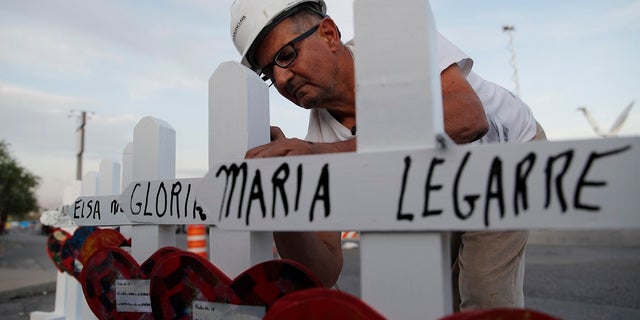
Greg Zanis prepares crosses to place at a makeshift memorial for
victims of a mass shooting at a shopping complex Monday in El Paso,
Texas. (AP Photo/John Locher)
“He has told the country that we are people to be
feared, people to be hated," Escobar continued. "From my perspective, he
is not welcome here. He should not come here while we are in mourning.”
And
Democratic presidential candidate Tim Ryan, D-Ohio, urged Margo in a
televised interview to "quietly" tell Trump that he is not "welcome" in
the city, because of his rhetoric on immigration.
Ryan has
escalated his language in the last 24 hours, as he struggles to raise
his political profile. He tweeted “Fck me” after Trump mistakenly, at
one point in his televised remarks earlier in the day, said the Ohio
shooting took place in Toledo and not Dayton.
For Ryan, the
language appeared to be part of a deliberate approach: Earlier Monday,
the longshot candidate went on CNN and tore into Senate Majority Leader
Mitch McConnell, saying, "Mitch McConnell needs to get off his a-- and
do something.” On Sunday, he tweeted: “Republicans need to get their s--- together and stop pandering to the NRA. Period.”
Sanders also
called out the president, saying "I say to President Trump, please stop
the racist anti-immigrant rhetoric. Stop the hatred in this country
which is creating the kind of violence that we see."
In 2017, a far-left Sanders supporter fired upon a Republican congressional baseball practice, critically
wounding House Majority Whip Steve Scalise, R-La., and injuring three
others before U.S. Capitol Police took him down. Kentucky Sen. Rand Paul
said the gunman was screaming, "This is for healthcare." Sanders did
not take responsibility for that episode.
Trump, for his part, on
Monday called for reforms at the intersection of mental health and gun
laws -- including so-called "red flag laws" to take guns from those
deemed a public risk -- in the wake of the back-to-back mass shootings
over the weekend, which left at least 31 people dead in total.
The Trump administration previously enacted an
unprecedented ban on firearm bump stocks that enable weapons to fire
with greater rapidity, like machine guns -- and the ban was recently upheld by the Supreme Court. The move came after a 2017 massacre in Las Vegas, Nevada killed 58 people.
In unequivocal terms, the president on Monday also condemned white supremacy,
responding to reports that the shooter in El Paso wrote a racist
manifesto ahead of the violence. The manifesto specifically said that
Trump's rhetoric was not to blame for the shooting, and said the
shooter's views "predate" Trump's presidential campaign.
However, some observers cautioned
that mass shooters are increasingly using disingenuous manifestos
primarily as a means to cause division and sow political discord, rather
than to advance a particular agenda. Crusius became the third mass shooter this
year believed to have posted to the website 8Chan, which is a haven for
both ironic trolls and racists, prior to going on a shooting rampage.
"The first mistake people are making is to assume the creep meant anything he said in his manifesto," wrote columnist Brian Cates.
"Something new has been added into the mix in the last year and we have
to recognize it: Mass shootings done for **fun** as the ultimate troll
where these [shooters] write confusing manifestos and then sit back
& watch the fun as both sides claim he belongs to the other."
Cates
pointed out that the Christchurch, New Zealand mass shooter's manifesto
contained a mixture of left-wing and right-wing rhetoric, and by its
own explicit terms, was intended to cause international political
division. The purported El Paso manifesto, like the New Zealand
shooter's manifesto, also espoused eco-fascist principles and lamented
the destruction of the environment.
Meanwhile, former Vice President Joe Biden falsely suggested after Trump's remarks that Monday was the first time the president had condemned white supremacy.
Later, McConnell – a Republican who has been lambasted by Democrats for
refusing to allow votes on gun control legislation – said Monday he is
willing to consider “bipartisan” solutions in the wake of the mass
shootings, though he emphasized that he opposes gun control policies
that infringe “on Americans’ constitutional rights.”
Democrats have been demanding McConnell recall Congress from its current recess, which is slated to run to the second week of September, to address the matter.
The
political fight over Trump's visit came amid a series of rapid-fire
developments in the investigations in both El Paso and Dayton. Crusius
was booked on capital murder charges, and authorities said Sunday that
he is under investigation for alleged domestic terrorism. Officials were also looking into whether hate crime charges are appropriate.
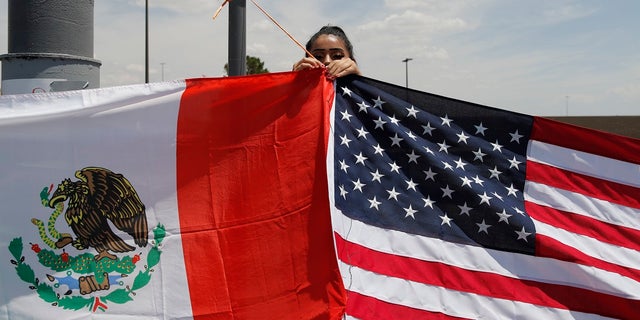
Maylin Reyes hangs a Mexican flag at a makeshift memorial near the
scene of a mass shooting at a shopping complex Monday, Aug. 5, 2019, in
El Paso, Texas. (AP Photo/John Locher)
El Paso District Attorney Jaime Esparza said his office will seek the death penalty against the suspect.
"The
loss of life is so great, we certainly have never seen this in our
community. We are a very safe community," he told reporters at a news
conference on Sunday. "We pride ourselves on the fact that we're so
safe, and certainly this community is rocked, shocked and saddened by
what has happened here yesterday."
El
Paso Police Chief Greg Allen said Monday that the gunman got lost in a
neighborhood before ending up at Walmart "because, we understand, he was
hungry." Allen didn't elaborate. Crusius' hometown is the affluent
Dallas suburb of Allen.
The police chief said the gun used in the shooting was legally purchased near the suspect's hometown.
In
his application for a public defender on Monday, Crusius said he has
been unemployed for five months, and has no income, assets or expenses.
He claimed he has been living with his grandparents.
In Ohio,
authorities revealed that the gunman in the Dayton rampage, 24-year-old
Connor Betts, opened fire outside a bar around 1 a.m. Sunday, killing
his adult sister and eight others. Police say he was fatally shot by
officers within 30 seconds, and was wearing a mask, bulletproof vest, earplugs and had at least 100 rounds.
Authorities
provided a dramatic video of officers rushing onto the scene and taking
Betts out before he could enter another packed bar.
Police had not determined a motive for the attack as of Monday evening. Reports linked him to Antifa, and showed that he supported Massachusetts Democratic Sen. Elizabeth Warren.
Betts
was armed with an AR-15-style rifle, police said. If all of the
magazines he had with him were full, which hasn't been confirmed, he
would have had a maximum of 250 rounds, said Police Chief Richard Biehl.
"It is fundamentally problematic. To have that level of weaponry in a civilian environment is problematic," Biehl added.
Of
the more than 30 people injured in Ohio, at least 14 had gunshot
wounds; others were hurt as people fled, city officials said. Eleven
remained hospitalized Monday, Fire Chief Jeffrey Payne said.
Still unknown is whether Betts targeted any of the victims, including his 22-year-old sister, Megan, the youngest of the dead.
"It
seems to just defy believability he would shoot his own sister, but
it's also hard to believe that he didn't recognize it was his sister, so
we just don't know," Biehl said.
While
the gunman was white and six of the nine killed were black, police said
the speed of the rampage made any discrimination in the shooting seem
unlikely. Fox News' Liam Quinn, Brooke Singman, and The Associated Press contributed to this report.
More than six months after the $15 minimum wage went into effect in New York City, business leaders and owners say the increased labor costs have forced them to cut staff, eliminate work shifts and raise prices. Many
business owners said these changes were unintended consequences of the
new minimum wage, which took effect at the beginning of the year. Susannah
Koteen, owner of Lido Restaurant in Harlem, said she worries about the
impact raising wages could have on her restaurant, where she employs
nearly 40 people. She hasn’t had to lay off anyone, but the increase has
forced her to cut back on shifts and be more stringent about overtime.
She said she changes her menu offerings seasonally and raises prices
more often since the wage boost. “What
it really forces you to do is make sure that nobody works more than 40
hours,” Ms. Koteen said. “You can only cut back so many people before
the service starts to suffer.” Ms. Koteen said she shelved plans
to move her restaurant to a larger location. That would require her to
hire more staff, and she isn’t willing to take the risk with the
unpredictability of her business. “You would just have no choice but to
cut people at the bottom,” she said. In June, the city’s
unemployment rate was 4.3%, compared with the state’s unemployment rate
of 4%, according to the New York State Department of Labor. Both numbers
have remained relatively steady during the past year. New York
City’s minimum wage has increased three times for employers with at
least 11 employees in the past three years. At the end of 2016, the
hourly rate rose to $11 from $9 an hour. In 2018, the minimum wage
jumped to $13 from $11 an hour. The rate will increase to $15 an hour
for employers with 10 or fewer workers at the end of 2019. The
current federally mandated minimum wage is $7.25 an hour. Other states
have passed $15-minimum-wage legislation, including Massachusetts,
California, Maryland, Illinois, New Jersey and Connecticut. Anthony
Advincula, spokesman for Restaurant Opportunities Centers United, which
advocated for the $15 minimum wage, said there are other factors beyond
higher wages that result in unsuccessful businesses, and owners
shouldn’t blame the boost for their struggles. “Increasing to $15
would reduce income inequality, and the number of individuals living in
poverty now is ridiculously high,” he said. “This is not just a business
issue, this is a race, gender, pay-equality issue.” Sarah
McNally, owner of McNally Jackson Books, employs 75 people at four shops
in Manhattan and Brooklyn. Ms. McNally said she hasn’t cut hours or
reduced the number of people she employs to mitigate the increase, but
she is working to open two more shops and scale her workload to stay
profitable. While
Ms. McNally said she always has paid her employees at least $5 above
minimum wage, January’s increase tightened that gap. “With raising
minimum wage to living wage, it feels now like we’re at the bottom of
the pay spectrum,” she said. “There’s absolutely no benefit to being a
retail business in New York.” Thomas Grech, president of the
Queens Chamber of Commerce, said he has seen an uptick in small-business
closures during the past six to nine months, and he attributed it to
the minimum-wage legislation. “They’re cutting their staff. They’re cutting their hours. They’re shutting down,” he said. “It’s not just the rent.” Lisa
Sorin, president of the Bronx Chamber of Commerce, said Manhattan
businesses and their customers can afford to pay more to compensate for
the wage increase, while those in the surrounding boroughs probably
couldn’t. “It’s almost like a whirlwind of keep up or get out,” Ms.
Sorin said. Restaurants and establishments with customer bases
with less disposable income are challenged, but all are experiencing
changes in customer habits regardless of borough, said Andrew Rigie,
executive director of the New York City Hospitality Alliance. To
mitigate the challenges restaurants face, Mr. Rigie said, local and
state government should consider providing tax incentives to owners and
preserve the tip credit, which allows restaurants to count some or all
of an employee’s tips toward its minimum-wage obligations. “Many
people working in the restaurant industry wanted to work overtime hours,
but due to the increase, many restaurants have cut back or totally
eliminated any overtime work,” he said. “There’s only so much consumers
are willing to pay for a burger or a bowl of pasta.”