At
least two of the FBI’s surveillance applications to secretly monitor
former Trump campaign adviser Carter Page lacked probable cause,
according to a newly declassified summary of a Justice Department assessment released Thursday by the Foreign Intelligence Surveillance Court (FISC). The
DOJ's admission essentially means that the Foreign Intelligence
Surveillance Act (FISA) warrant authorizations to surveil Page, when
stripped of the FBI's misinformation, did not meet the necessary legal
threshold and should never have been issued. Democrats, including
California Rep. Adam Schiff, had previously insisted the Page FISA warrants met "rigorous" standards for probable cause, and mocked Republicans for suggesting otherwise. The
June 2017 Page FISA warrant renewal, which was among the two deemed
invalid by the DOJ, was approved by then-Acting FBI Director (and now
CNN contributor) Andrew McCabe, as well as former Deputy Attorney
General Rod Rosenstein. The April 2017 warrant renewal was approved by
then-FBI Director James Comey. “Today’s unprecedented court filing
represents another step on the road to recovery for America’s deeply
damaged judicial system," Page said in a statement to Fox News. "I hope
that this latest admission of guilt for these civil rights abuses by the
Justice Department marks continued progress towards restoring justice
and remedying these reputationally ruinous injuries.” Added Iowa
GOP Sen. Chuck Grassley, who previously chaired the Judiciary Committee:
“It’s about time. It’s about time federal authorities entrusted with
our most powerful and intrusive surveillance tools begin to own up to
their failures and abuses, and take steps to restore public confidence.
... Time will tell if the department will continue working to fix its
errors and restore trust that it won’t disregard Americans’ civil
liberties. Its admission and cooperation with the FISC is a step in the
right direction." FISC Presiding Judge James Boasberg, in the Jan.
7 order that was published for the first time Thursday, further
required the government to explain in a written statement by Jan. 28 the
"FBI's handling of information" obtained through the Page warrants and
subsequent renewals. Boasberg
specifically noted the DOJ found "there was insufficient predication to
establish probable cause to believe that Page was acting as an agent of
a foreign power" because of the "material misstatements and omissions"
in the warrant applications.
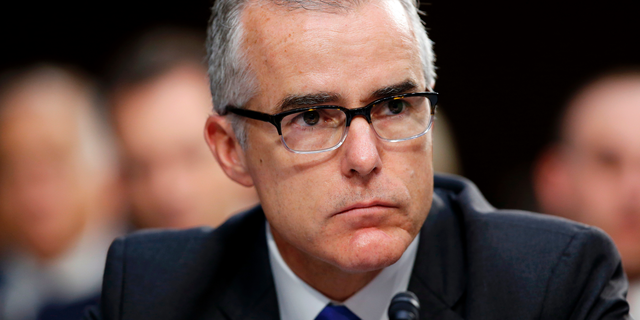
Then-FBI acting director Andrew McCabe, now a CNN contributor,
approved one of the now-discredited FISA applications. (AP Photo/Alex
Brandon, File)
Although the DOJ assessment technically only covered
two of the applications to renew the Page FISA warrant, the DOJ
"apparently does not take a position on the validity" on the first two
Page FISA applications, Boasberg said, seemingly indicating that the DOJ
seemingly did not want to defend their legality either. The
government "intends to sequester information acquired pursuant to those"
FISA applications "in the same manner as information acquired pursuant
to the subsequent dockets," the judge said, possibly indicating that
those applications are still under review. Boasberg noted that it
is illegal for the government to intentionally disclose or use
"information obtained under color of law by electronic surveillance,
knowing or having any reason to know that the information was obtained
through electronic surveillance not authorized." A lawful FISA warrant,
when approved by the FISC, allows the FBI to surveil not only the target
of the warrant, but also individuals who communicate with the target
and the target's associates. It was not clear what information, if
any, the FBI gleaned from the Page FISA and then used in subsequent
court arguments; any such evidence would likely be ruled inadmissible,
given the DOJ's admission that the underlying warrants were invalid. The revelations Thursday were yet another embarrassment for the FBI, which DOJ Inspector General Michael Horowitz has found made repeated errors and misrepresentations -- and, in one case, deliberately falsified evidence -- before the FISC as the bureau sought to surveil Page in 2016 and 2017. The
FBI's FISA applications to monitor Page heavily relied, Horowitz
confirmed, on a now-discredited dossier funded by the Hillary Clinton
campaign and Democratic National Committee (DNC), as well as on news reports that secretly relied on the dossier's author. Much of the Steele dossier has been proved unsubstantiated, including the dossier's claims that the Trump campaign was paying hackers in the United States out of a non-existent Russian
consulate in Miami, or that ex-Trump lawyer Michael Cohen traveled to
Prague to conspire with Russians. Special Counsel Robert Mueller also
was unable to substantiate the dossier's claims that Page had received a
large payment relating to the sale of a share of Rosneft, a Russian oil
giant, or that a lurid blackmail tape involving the president existed. Pursuant
to Boasberg's order, the government must also sequester relevant
information and provide further "explanations" concerning the damning
findings of bureau misconduct contained in Horowitz's recent report, as
well as "related investigations and any litigation." That
could be a reference to a variety of outstanding matters concerning the
FBI's apparent mischaracterization of evidence before the FISC. For
example, the FISC has already ordered the bureau to look at all
previous FISA applications involving ex-FBI attorney Kevin Clinesmith,
whom Horowitz found to have doctored an email from the CIA. The FBI had
reached out to the CIA and other intelligence agencies for information
on Page; the CIA responded in an email by telling the FBI that Page had
contacts with Russians from 2008 to 2013, but that Page had reported
them to the CIA and was serving as a CIA operational contact and
informant on Russian business and intelligence interests. Clinesmith
then allegedly doctored the CIA's email about Page to make it seem as
though the agency had said only that Page was not an active source. The
FBI also included Page's contacts with Russians in the warrant
application as evidence he was a foreign "agent," without disclosing to
the secret surveillance court that Page was voluntarily working with the
CIA concerning those foreign contacts.
"Today’s
unprecedented court filing represents another step on the road to
recovery for America’s deeply damaged judicial system." — Former Trump aide Carter Page
Further,
Horowitz found specific evidence of oversights and errors by several
top FBI employees as they sought to obtain a warrant to surveil Page. In
particular, an unidentified FBI supervisory special agent (SSA)
mentioned in the IG report was responsible for ensuring that
the bureau's "Woods Procedures" were followed in the Page warrant
application, but apparently didn't do so. According to the
procedures, factual assertions need to be independently verified, and
information contradicting those assertions must be presented to the
court. Horowitz found several instances in which the procedures were not
followed. Horowitz's report leaves little doubt that the unnamed SSA is Joe Pientka -- a current bureau employee. Pientka briefly appeared on the FBI's website as an "Assistant Special Agent in Charge" of the San Francisco field office late last year, according to the Internet archive Wayback Machine -- although Pientka no longer appears on any FBI website. Pientka was removed shortly after Fox News identified him as the unnamed SSA in the IG report. Twitter user Techno Fog first flagged the Wayback Machine's archive of the page. The
FBI has repeatedly refused to respond to Fox News' request for
clarification on Pientka's status, even as Republicans in Congress have sought to question him. While the FBI has promised corrective action, it apparently has not gone far enough. Earlier this month, David Kris, who has been appointed by the FISC to oversee the FBI's proposed surveillance reforms, alerted the court that the bureau's proposals are "insufficient" and must be dramatically "expanded"
-- even declaring that FBI Director Christopher Wray needs to discuss
the importance of accuracy and transparency before the FISC every time
he "visits a field office in 2020."
In December 2017, then-FBI deputy director Andrew McCabe testified
that “no surveillance warrant would have been sought” from the FISA
court “without the Steele dossier information," according to a House GOP
memo's findings. McCabe is now a CNN contributor.
The unclassified findings were a stark rebuke to Wray, who had filed assurances to
the FISC that the agency was implementing new procedures and training
programs to assure that the FBI presents accurate and thorough
information when it seeks secret warrants from FISC judges. At the same
time, Wray acknowledged the FBI's "unacceptable" failures as it pursued
FISA warrants to monitor Page. Kris is a former Obama administration attorney who has previously defended the FISA process on "The Rachel Maddow Show" and in other left-wing venues,
making his rebuke of Wray something of an unexpected redemptive moment
for Republicans who have long called for more accountability in how the
bureau obtains surveillance warrants. ("You can’t make this up!"
President Trump tweeted on Sunday. "David Kris, a highly controversial
former DOJ official, was just appointed by the FISA Court to oversee
reforms to the FBI’s surveillance procedures. Zero credibility. THE
SWAMP!”) Wray
had specifically promised to change relevant forms to "emphasize the
need to err on the side of disclosure" to the FISC, to create a new
"checklist" to be completed "during the drafting process" for
surveillance warrants that reminds agents to include "relevant
information" about the bias of sources used, and to "formalize" the role
of FBI lawyers in the legal review process of surveillance warrants. Additionally,
Wray said the FBI would now require "agents and supervisors" to confirm
with the DOJ Office of Intelligence that the DOJ has been advised of
relevant information. Wray further indicated that the FBI would
formalize requirements to "reverify facts presented in prior FISA
applications and make any necessary corrections," as well as to make
unspecified "technological improvements." But in a 15-page letter to Judge Boasberg, obtained by Fox News,
Kris declared that the proposed corrective actions "do not go far
enough to provide the Court with the necessary assurance of accuracy,
and therefore must be expanded and improved" -- and he took aim at Wray
himself. "The focus on specific forms, checklists and technology,
while appropriate, should not be allowed to eclipse the more basic need
to improve cooperation between the FBI and DOJ attorneys," Kris said,
noting that the FBI and DOJ have historically not always worked well
together. "A key method of improving organizational culture is
through improved tone at the top, particularly in a hierarchical
organization such as the FBI," Kris said, noting that Wray's public
statements on the matter, while positive, have not gone far enough.
"Director Wray and other FBI leaders, as well as relevant leaders at the
Department of Justice, should include discussions of compliance not
only in one or two messages, but in virtually every significant
communication with the workforce for the foreseeable future." Republican calls for more accountability may not go unanswered for long. Connecticut U.S. Attorney John Durham announced last year that he did not "agree" with
the IG's assessment that the FBI's probes were properly predicated,
highlighting Durham's broader criminal mandate and scope of review. Durham
is focusing on foreign actors, as well as the CIA, while Horowitz
concentrated his attention on the Justice Department and FBI. "Based
on the evidence collected to date, and while our investigation is
ongoing, last month we advised the Inspector General that we do not
agree with some of the report’s conclusions as to predication and how
the FBI case was opened," Durham said in his statement, adding that his
"investigation is not limited to developing information from within
component parts of the Justice Department" and "has included developing
information from other persons and entities, both in the U.S. and
outside of the U.S."
BEIRUT
(AP) — Iran has long sought the withdrawal of American forces from
neighboring Iraq, but the U.S. killing of an Iranian general and an
Iraqi militia commander in Baghdad has added new impetus to the effort,
stoking anti-American feelings that Tehran hopes to exploit to help
realize the goal.
The
Jan. 3 killing has led Iraq’s parliament to call for the ouster of U.S.
troops, but there are many lingering questions over whether Iran will
be able to capitalize on the sentiment.
An
early test will be a “million-man” demonstration against the American
presence, called for by influential Shiite cleric Moqtada al-Sadr and
scheduled for Friday.
It
is not clear whether the protesters will try to recreate a New Year’s
Eve attack on the U.S. Embassy compound in Baghdad by Iran-supported
militias in the wake of U.S. airstrikes that killed 25 militiamen along
the border with Syria. Iran might simply try to use the march to
telegraph its intention to keep up the pressure on U.S. troops in Iraq.
But
experts say Iran can be counted on to try to seize what it sees as an
opportunity to push its agenda in Iraq, despite an ongoing mass uprising
that is targeting government corruption as well as Iranian influence in
the country.
“Iran
is unconstrained by considerations of Iraqi sovereignty, domestic
public opinion, or legality when compared to the Western democracies,”
said David Des Roches, an expert with The Arab Gulf States Institute in
Washington. “This is Iran’s strategic advantage; they should be expected
to press it.”
A
withdrawal of U.S. troops from Iraq would be a victory for Iran, and
Tehran has long pursued a two-pronged strategy of supporting anti-U.S.
militias that carry out attacks, as well as exerting political pressure
on Iraqi lawmakers sympathetic to its cause.
Despite
usually trying to keep attacks at a level below what might provoke an
American response, Iran-backed Kataib Hezbollah fired a barrage of
rockets at a military base in Kirkuk in December, killing a U.S.
contractor and wounding several U.S. and Iraqi troops. The U.S.
responded first with deadly airstrikes on Iran-affiliated militia bases
in western Iraq and Syria, then followed with the Jan. 3 drone attack
that killed Gen. Qassem Soleimani, Iran’s most powerful military
officer, along with Iraqi militia commander Abu Mahdi al-Muhandis as
they left Baghdad’s airport.
The
severity of the U.S. response surprised Iran and others, and it had the
unanticipated result of bolstering Tehran’s political approach by
prompting the Iraqi parliament to pass the nonbinding resolution pushed
by pro-Iran political factions calling for the expulsion of all foreign
troops from the country. In response, President Donald Trump has
threatened sanctions on Iraq.
“What
they want to do is get rid of U.S. troops in what they see as a
legitimate political manner,” said Dina Esfandiary, a London-based
expert with The Century Foundation think tank. “If Iraqis themselves are
voting out U.S. troops, it looks a lot better for Iran than if Iran is a
puppet master in Iraq trying to get rid of them — and on top of that it
would be a more lasting decision.”
The
legitimacy of the resolution is a matter of dispute. Not only was the
session boycotted by Kurdish lawmakers and many Sunnis, but there also
are questions of whether Prime Minister Adel Abdul-Mahdi has the
ability to carry it out. Abdul-Mahdi resigned in November amid mass
anti-government protests but remains in a caretaker role.
U.S.
Secretary of State Mike Pompeo bluntly rejected the call for the
troops’ removal, instead saying Washington would “continue the
conversation with the Iraqis about what the right structure is.”
Abdul-Mahdi
strongly supported the resolution, but since then has said it will be
up to the next government to deal with the issue, and there are
indications he has been working behind the scenes to help keep foreign
troops in the country.
After
closed-door meetings with German diplomats last week, German Foreign
Minister Heiko Maas said the prime minister had assured them that he had
“great interest” in keeping the Bundeswehr military contingent and
others part of the anti-Islamic State coalition in Iraq.
The U.S., meantime, said it had resumed joint operations with Iraqi forces, albeit on a more limited basis than before.
Trump
met Iraqi President Barham Saleh on Wednesday on the sidelines of the
World Economic Forum in Davos Switzerland, and said Washington and
Baghdad have had “a very good relationship” and that the two countries
had a “host of very difficult things to discuss.” Saleh said they have
shared common interests including the fight against extremism, regional
stability and an independent Iraq.
Asked about the plan for U.S. troops in Iraq, Trump said, “We’ll see what happens.”
In
a sign that bodes well for NATO’s continuing mission in the country,
Iraq’s deputy foreign minister went to Brussels last week for talks with
Secretary General Jens Stoltenberg on the alliance’s presence in Iraq.
The
mixed message of publicly calling for the troops to go but privately
wanting them to stay is an indication of Iran’s strong influence,
particularly among its fellow Shiite Muslims, Des Roches said.
“For
any Iraqi politician in Baghdad — particularly a Shia politician — to
defy Iran openly is to risk political as well as physical death,” he
said. “So we shouldn’t be surprised if the public and the private lines
espoused by Iraqi politicians differ.”
American
forces withdrew from Iraq in 2011 but returned in 2014 at the
invitation of the government to help battle the Islamic State after the
extremist group seized vast areas in the north and west of the country. A
U.S.-led coalition provided crucial air support as Iraqi forces,
including Iran-backed militias, regrouped and drove IS out in a costly
three-year campaign. There are currently some 5,200 American troops in
the country.
Even
before the drone strike, there were growing calls in nationwide
protests across sectarian lines, which started in October centered in
Baghdad’s Tahrir Square, for the end of all foreign influence in the
country. The demonstrations also targeted government corruption and poor
public services.
The
rejection of Iranian influence over Iraqi state affairs has been a core
component of the movement, and pro-Iranian militias have targeted those
demonstrations along with Iraqi security forces, killing hundreds and
injuring thousands. Protesters fear that with the focus on the push for
the U.S. troop withdrawal in response to the attack that killed
Soleimani, they may be even easier targets for those forces and that
their message will be lost.
“I
think Iraq has had enough of having to deal with the Americans and the
Iranians alike,” Esfandiary said. “But the assassination of al-Muhandis,
almost more so than Solemani, was such a glaring oversight of
sovereignty and of all agreements they had signed on to with the U.S. in
terms of the U.S. presence in Iraq, that it has kind of taken some of
the attention away from Iran, to Tehran’s delight.”
Friday’s
march called for by al-Sadr is expected to redirect the focus onto the
U.S. troops. The cleric, who also leads the Sairoon bloc in parliament,
derives much of his political capital through grassroots mobilization.
The
Tahrir Square protesters initially rejected that call, saying they want
the escalating conflict between Iran and the U.S. off of Iraqi soil.
Since
then, al-Sadr has reached out to them directly, saying the
demonstrations against the government and against the American troops
are “two lights from a single lamp,” and it is not yet clear whether
that might convince them to participate in the march.
___
Associated Press writers Darlene Superville in Davos, Switzerland, and Samya Kullab in Baghdad contributed to this story.
___
This story has been corrected to show that the first name of teh Iraqi prime minister is Adel, not Abdel.
U.S. Treasury Secretary Steven Mnuchin took a shot at Greta Thunberg --
the famed teen climate activist -- on Thursday over her push at the
World Economic Forum in Davos, Switzerland, for companies to immediately
cease all investments in fossil fuels. Mnuchin was at a news
conference in the Alpine town when he was asked about Thunberg's earlier
appeal to abandon older sources of energy, according to Reuters. "Is
she the chief economist? ... After she goes to college and studies
economics in college, she can come back and explain that to us," he was
quoted saying. Thunberg, 17, from Sweden, has been embraced by
celebrities and is seen by supporters as a fierce, young voice capable
of rallying support for her cause: to clean up the environmental mess
left by previous generations. Her detractors view her as a
media-generated star who admitted that she was surprised when she was
named Time magazine's "Person of the Year." There appears to be no love lost between Thunberg and President Trump, who called Time magazine's decision "ridiculous." Thunberg
said in September that talking to Trump at the U.N. General Assembly in
New York City would have been a waste of time. In Davos, Thunberg took
part in a panel discussion hosted by The New York Times, where she told
the audience there is a real need for immediate action on climate
change. "Your inaction is fueling the flames by the hour,” she
said, according to the Times. "Let's be clear. We don’t need a 'low
carbon economy.' We don't need to 'lower emissions.' Our emissions have
to stop." Trump and Thunberg were both in Davos at the same time and "sparred indirectly," the Reuters report
said, though Trump appeared to "extend an olive branch" when he told
reporters he wished that he was able to hear her speak before he left.
Joe Biden, the 2020 Democratic presidential frontrunner, said Wednesday he wants "no part" of a witness swap reportedly being discussed by some members of his own party. Under the hypothetical deal, Democrats would reportedly offer up Biden or his son Hunter Biden to testify at President Trump's Senate impeachment trial in return for testimony from a Republican figure, such as ex-national security adviser John Bolton. The Washington Post quoted the
former vice president admitting that it was "not an irrational
question" but said Trump's trial was a "constitutional issue." He said
he does not want to see the trial turn into a "farce or some kind of political theater." Biden,
while campaigning in Iowa, denied that talks of a witness swap were
taking place. When told by a Post reporter that the topic was being
discussed, he responded, "No they're not," the paper reported. A
witness swap that would result in Hunter Biden and Bolton testifying
would be the most dramatic development in the trial thus far. At the
heart of the impeachment trial is Trump's July 25, 2019 call with
Ukraine President Volodymyr Zelensky. Trump said the call was focused on corruption in Kiev and raised Biden as an example. Hunter's
position on the board of the Ukrainian gas company Burisma while his
father was vice president has been a rallying point for Republicans as
they try to defend Trump against impeachment charges of abuse of power
and obstruction of Congress. Democrats see Bolton as a potential
witness who could provide first-hand testimony linking Trump's decision
to withhold U.S. aid from Ukraine directly to the country's willingness
to investigate the Bidens. Fiona Hill, a former top White House
expert on Russia, testified in November that Bolton shared her concern
about what she saw as a push to get Ukraine to conduct the
investigations. She testified in front of the House Intelligence
Committee and recalled Bolton expressing his own concerns about the push
and told her to tell National Security Council lawyer John Eisenberg
that he does not want to be a part of this "drug deal." "He was
saying that sarcastically, of course, I mean, just to be clear.
Actually, he was angry, but he was also sarcastic. I mean — he wasn’t
inferring that they were cooking up an actual drug deal in the
War Room," she said. Trump and Zelensky have both denied any quid
pro quo. Trump called the entire impeachment process a political witch
hunt. There is no evidence of wrongdoing by Biden or his son. The
Post reported that some of the Democrats taking part in the discussion
about a potential witness swap believe Biden could actually benefit
politically from testifying because it would give him a chance to
deliver a statesmanlike performance. Both Rep. Adam Schiff,
D-Calif., and Senate Minority Leader Chuck Schumer have spoken out
against the potential of a witness swap. "Trials aren't trades for witnesses," Schiff said. Fox News' Brooke Singman and Adam Shaw and the Associated Press contributed to this report.
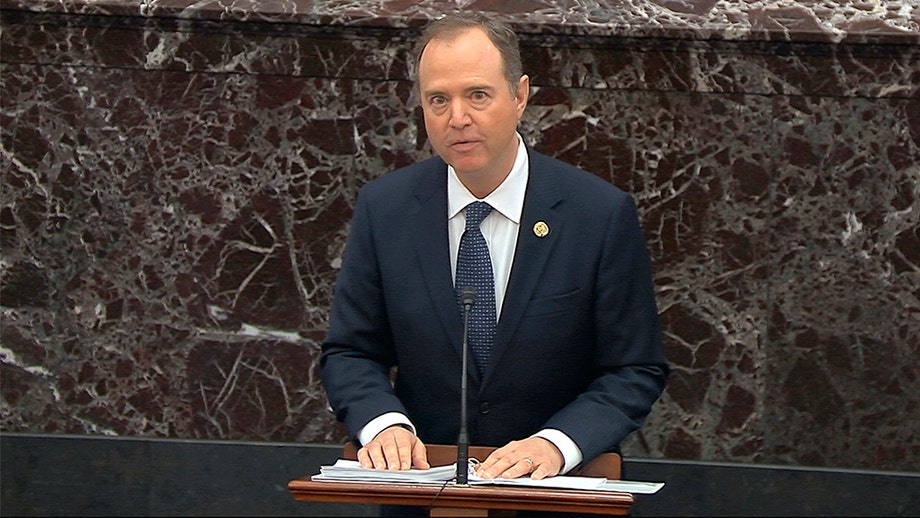
House Democrats launched into lengthy arguments that broke little ground, if any, in President Trump's impeachment trial Wednesday
-- as the head impeachment manager, California Rep. Adam Schiff,
suggested that Russians could attack the U.S. and insisted that removing
Trump from office was necessary because the integrity of the 2020
election could not be "assured." Trump's lawyers sat by, waiting
their turn, as the president blasted the proceedings from afar,
threatening jokingly to face off with the Democrats by coming to "sit
right in the front row and stare at their corrupt faces." The
challenge before the House managers has been clear. Democrats were given
24 hours over three days to prosecute the charges against Trump, trying
to win over not just fidgety senators sitting silently in the chamber
but an American public, deeply divided over the president and his
impeachment in an election year. Most senators sat at their desks
throughout the day, as the rules stipulated, though some stretched their
legs, standing behind the desks or against the back wall of the
chamber, passing the time. Visitors watched from the galleries, one
briefly interrupting in protest. Almost immediately after Chief
Justice John Roberts gaveled in Wednesday's session, bored and weary
senators started openly flouting some basic guidelines. The Associated
Press reported that a Democrat in the back row leaned on his right arm,
covered his eyes and stayed that way for nearly a half-hour, and some
lawmakers openly snickered when Schiff said he'd speak for only 10
minutes. "I
do see the members moving and taking a break," freshman Rep. Jason
Crow, D-Colo., one of the House prosecutors, said mid-speech at the
center podium. "I probably have another 15 minutes." "You just
have to stretch and you just got to stand. Those chairs, they look nice,
[but] they are not comfortable chairs," Sen. Lisa Murkowski, R-Alaska, a
key swing-vote moderate, said of the restlessness while Schiff spoke. The previous day of the trial lasted for more than 12 hours, and ended well past midnight on a testy note as Roberts admonished
both sides for their conduct. On Wednesday, Murkowski slammed
Democratic impeachment manager Rep. Jerry Nadler, D-N.Y., for arguing
the previous evening that senators who didn't vote for immediate
subpoenas were defying their oaths of office: “As one who is listening attentively and working hard to get to a fair process, I was offended," Murkowski said. Perhaps
sensing the ennui in the chamber on Day 2 of the trial, Schiff, the
chairman of the House Intelligence Committee, sought to keep the stakes
high. He suggested at one point that military aid to Ukraine was
essential so the U.S. would not have to fight Russians at home, as
soldiers did in the videogame "Call of Duty: Modern Warfare 2." "As
one witness put it during our impeachment inquiry, the United States
aids Ukraine and her people so that we can fight Russia over there, and
we don't have to fight Russia here," Schiff said, drawing rebukes from commentators across the political spectrum. "Liberals
used to mock Bush supporters when they used this jingoistic line during
the war on Iraq," wrote journalist Max Blumenthal. "Now they deploy it
to justify an imperialist proxy war against a nuclear power." Schiff attracted the most criticism,
however, for later making the head-turning argument that Trump must be
removed from office by the Senate -- rather than by voters in the 2020
election -- because it is impossible to be sure the 2020 election won't
be compromised. "The president's misconduct cannot be decided at
the ballot box, for we cannot be assured that the vote will be fairly
won," Schiff remarked. He did not elaborate. Constitutional
scholar Alan Dershowitz, who will speak against impeachment, is expected
to argue before the Senate that removing a president is a fundamentally
undemocratic remedy that requires "criminal-like" conduct -- a standard
he will argue is not met by Democrats' two articles of impeachment,
which do not allege federal crimes. But, both Republicans and
left-of-center commentators didn't wait long to deride Schiff's
incendiary arguments in more direct terms. "And right here is proof of the Democrats’ plan all along," Trump campaign director of communications Tim Murtaugh said in response. "Every
moment of the impeachment sham has been geared toward interfering with
the 2020 election. Schiff is preemptively calling into question the
results of an election that is still more than 9 months away." Aaron
Mate, a contributor at The Nation, added: "For all the talk about
Russia undermining faith in US elections, how about Russiagaters like
Schiff fear-mongering w/ hysterics like this? Let's assume Ukraine did
what Trump wanted: announce a probe of Burisma. Would that delegitimize a
2020 US election? This is a joke." And during the proceedings,
Trump retweeted a post from Kentucky GOP Sen. Rand Paul: "The more we
hear from Adam Schiff, the more the GOP is getting unified against this
partisan charade." Trump added, "True!" Meanwhile, the Republican House leader, California Rep. Kevin McCarthy, suggested during the day that Schiff should be censured by the House for constantly lying, including by apparently misrepresenting key documents from Lev Parnas, a Giuliani associate. Schiff,
though, was undeterred. Attempting to underscore the human cost of
Trump's temporary aid holdup, Schiff further asserted that the money was
"designed to help Ukraine defend itself from the Kremlin's aggression"
and that "more than 15,000 Ukrainians have died fighting Russian forces
and their proxies." Republicans
erupted when Schiff made a similar argument during last year's House
impeachment probe. Trump's lawyers were likely to fire back when it's
their turn to present arguments -- in part because former President
Obama provided less aid to Ukraine than the Trump administration has. Additionally,
Republicans have pointed out that the temporary lack of aid has not
been directly linked to any casualties, and that the U.S. cannot
reasonably be held responsible for the actions of Russian-backed
militants in Ukraine. Schiff also repeatedly made the false claim
that White House chief of staff Mick Mulvaney had said people should
"get over" the idea that Trump was tying foreign aid to political
investigations. Mulvaney, in fact, had remarked only that politics and
foreign policy sometimes overlap. Schiff, who had previously
claimed to have evidence that the Trump campaign secretly colluded with
Russia, was outlining what the Democrats contended was the president's
"corrupt scheme" to abuse his presidential power and then obstruct
Congress' investigation. He called on senators not to be "cynical"
about politics, but to draw on the intent of the nation's Founding
Fathers who provided the remedy of impeachment. "Over the coming
days, we will present to you—and to the American people—the extensive
evidence collected during the House’s impeachment inquiry into the
president's abuse of power," Schiff argued. "You will hear their
testimony at the same time as the American people. That is, if you will
allow it." The proceedings were unfolding at the start of an
election year, and there have been few signs that Republicans were
interested in calling more witnesses or going beyond a fast-track
assessment likely to bring a quick vote on charges related to Trump's
dealings with Ukraine. Some Democrats sounded a note of concern
that Republicans haven't expressed much interest in crossing the aisle
concerning witness and document requests. "I can only speak for myself:
strikingly little," Sen. Chris Coons, D-Del., said after the proceedings
adjourned, when asked how much Republican outreach he has seen. The
trial has marked just the third time the Senate has weighed whether an
American president should be removed from office. Democrats argued Trump
abused his office by asking Ukraine to investigate political rival Joe
Biden while withholding crucial military aid, and also obstructed
Congress by refusing to turn over documents or allow officials to
testify in the House probe. Republicans have defended Trump's
actions and cast the process as a politically motivated effort to weaken
the president in the midst of his reelection campaign. Specifically,
Republicans have pointed out that Ukrainian leaders said they felt no
undue pressure; that the longstanding constitutional executive privilege
shielded the White House from having to respond to comprehensive
subpoenas; and that the Democrats' case was based largely on hearsay. Trump's legal team also has argued that Democrats' impeachment case couldn't be as "open-and-shut" as advertised given the apparently urgent need for new evidence even after the House impeachment inquiry. In any event, the White House has said Trump's suggested probe into Biden was appropriate. A new poll from
The Associated Press-NORC Center for Public Affairs Research showed the
public was slightly more likely to say the Senate should convict and
remove Trump from office than to say it should not, 45 percent to 40
percent. But, a sizable percentage, 14 percent, said they didn't know
enough to have an opinion. One
question on which there was wide agreement: Trump should allow top
aides to appear as witnesses at the trial. About 7 in 10 said so,
including majorities of Republicans and Democrats, according to the
poll. The strategy of more witnesses, though, seemed all but
settled. Wrangling over rules for the trial stretched past midnight
Tuesday night, with Republicans shooting down one-by-one Democrats'
efforts to get Trump aides including former national security adviser
John Bolton, Secretary of State Mike Pompeo, and acting chief of staff
Mick Mulvaney to testify. Senators are likely to repeat those rejections next week, shutting out any chance of new testimony. One
longshot idea to pair one of Trump's preferred witnesses — Biden's son
Hunter — with Bolton or another whom Democrats wanted was swiftly
rejected. "That's off the table," Senate Minority Leader Chuck Schumer, D-N.Y., told reporters. Trump,
who was in Davos, Switzerland, attending a global economic forum,
praised his legal team and suggested he would be open to his advisers
testifying, though it seemed unlikely. He said "national security"
concerns would stand in the way. After the House prosecutors
present their case, the president's lawyers are set to follow with
another 24 hours over three days. They are expected to take only Sunday
off. "There's a lot of things I'd like to rebut," Trump lawyer Jay Sekulow said at the Capitol, "and we will rebut." Sekulow
also said that he thought it was unlikely that Democrats would meet the
threshold necessary to demonstrate the need for additional witnesses,
but that the Trump team was preparing for every contingency. Then
there will be 16 hours for senators, who must sit quietly at their
desks, no speeches or cellphones, to ask written questions, and another
four hours for deliberations. The impeachment trial is set against
the backdrop of the 2020 election. All four senators who
are presidential candidates have been off the campaign trail, seated as
jurors. Campaigning at stops in Iowa, Joe Biden also rejected
having his son testify, or even appearing himself. "I want no part of
that," he said. "People ask the question, isn't the president
going to be stronger and harder to beat if he survives this? Yes,
probably. But Congress has no choice," Biden added, saying senators must
cast their votes and "live with that in history.” Some Republicans expressed disdain for it all. Iowa
GOP Sen. Joni Ernst spoke sarcastically about how excited she was to
hear the "overwhelming evidence" the House Democrats promised against
Trump. "Once we've heard that overwhelming evidence," she added, raising
her voice mockingly, "I don't know that we'll need to see additional
witnesses, but let's hear about that overwhelming evidence." The trial began with an apparent setback
on Tuesday for Republican Senate leader Mitch McConnell, who backed off
his plans to limit each side's arguments to two days, as the White
House had preferred. But, in a strong show of Republican unity,
the GOP-led Senate repeatedly resisted Democrats' amendments to
McConnell's rules, and ultimately approved a rules package pushing off a final decision on whether to seek additional testimony until late in the trial. Schumer
bemoaned the remaining limitations, saying Wednesday the impeachment
trial "begins with a cloud hanging over it, a cloud of unfairness." Republicans
have been eager for a swift trial. Still, Trump's legal team passed on
an opportunity to file a motion to dismiss the case on Wednesday, an
acknowledgment that there were not enough Republican votes to support
it. The White House legal team, in its court filings and
presentations, has not disputed Trump's actions, but the lawyers
insisted the president did nothing wrong. Fox News' Chad Pergram, Marisa Schultz, Adam Shaw and The Associated Press contributed to this report.
WASHINGTON (AP) — The U.S. Senate plunged into President Donald Trump’s impeachment trial
with Republicans abruptly abandoning plans to cram opening arguments
into two days but solidly rejecting Democratic demands for more
witnesses to expose what they deem Trump’s “trifecta” of offenses.
The
daylong session started Tuesday with the setback for Republican Senate
leader Mitch McConnell and the president’s legal team, but it ended near
2 a.m. Wednesday with Republicans easily approving the rest of the
trial rules largely on their terms. The result is Trump’s historic
trial, unfolding amid a watchful public in an election year.
“We
have a great case,” Trump said as he began his second day at a global
economic forum in Davos, Switzerland. He said he thought his legal time
was doing a “very good job.”
The trial is now on a fast-track with almost no signs of Republican resistance to the actions that led to his impeachment.
“It’s
about time we bring this power trip in for a landing,” said White House
counsel Pat Cipollone, the president’s lead lawyer, lashing out at the
House Democrats prosecuting the case.
“It’s a farce,” he said about the impeachment proceeding, “and it should end.”
Chief Justice John Roberts
gaveled open the session, with House prosecutors on one side, Trump’s
team on the other, in the well of the Senate, as senators sat silently
at their desks, under oath to do “impartial justice.” No cellphones or
other electronics were allowed.
As
the day stretched deep into the night, lawyerly arguments gave way to
more pointedly political ones. Tempers flared and senators paced the
chamber. Democrats pursued what may be their only chance to force
senators to vote on hearing new testimony.
After
one particularly bitter post-midnight exchange, Roberts intervened,
taking the rare step of admonishing both the Democratic House managers
prosecuting the case and the White House counsel to “remember where they
are.”
“I think
it is appropriate at this point for me to admonish both the House
managers and the president’s counsel in equal terms to remember that
they are addressing the world’s greatest deliberative body,” the usually
reserved Roberts said. He told them that description of the Senate
stemmed from a 1905 trial when a senator objected to the word
“pettifogging,” because members should “avoid speaking in a manner and
using language that is not conducive to civil discourse.”
Over
and over, Republicans turned back Democratic amendments to subpoena
documents from the White House, State Department, Defense Department and
budget office. By the same 53-47 party-line, they turned away witnesses
with front-row seats to Trump’s actions including acting White House
chief of staff Mick Mulvaney and John Bolton, the former national
security adviser critical of the Ukraine policy.
Only
on one amendment, to allow more time to file motions, did a single
Republican, Sen. Susan Collins of Maine, join Democrats. But it, too,
was rejected, 52-48.
“It’s
not our job to make it easy for you,” Rep. Adam Schiff, the chairman of
the House Intelligence Committee leading the prosecution, told the
Senate. “Our job is to make it hard to deprive the American people of a
fair trial.”
As
the visitors’ gallery filled earlier with guests, actress-and-activist
Alyssa Milano among them, and Trump’s most ardent House allies lining
the back rows, the day that began as a debate over rules quickly took on
the cadence of a trial proceeding over whether the president’s actions
toward Ukraine warranted removal from office.
Cipollone
led the prosecution, scoffing that the House charges against Trump were
“ridiculous,” insisting the president “has done absolutely nothing
wrong.”
The
White House legal team did not dispute Trump’s actions, when he called
Ukraine and asked for a “favor,” which was to investigate Democrat Joe
Biden as the U.S. was withholding military aid the ally desperately
needed as it faced off with hostile Russia on its border. But the
lawyers insisted the president did nothing wrong. “Absolutely no case,”
Cipollone said.
Schiff,
the California Democrat, said America’s Founders added the remedy of
impeachment in the Constitution with “precisely this type of conduct in
mind — conduct that abuses the power of office for a personal benefit,
that undermines our national security, and that invites foreign
interference in the democratic process of an election.”
Said Schiff: “It is the trifecta of constitutional misconduct justifying impeachment.″
The
other lead lawyer on Trump’s team, Jay Sekulow, retorted, “I’ll give
you a trifecta,” outlining complaints over the House Democrats’
impeachment inquiry process.
The
impeachment trial is testing whether Trump’s actions toward Ukraine
warrant removal as voters are forming their own verdict on his White
House.
All four
senators who are presidential candidates were off the campaign trail,
seated as jurors. “My focus is going to be on impeachment,” Sen. Bernie
Sanders, the Vermont independent, told reporters.
McConnell
stunned senators and delayed the start of proceedings with his decision
to back off some of his proposed rules. He made the adjustment after
encountering resistance from Republicans during a closed-door lunch
meeting. Senators worried about the political optics of “dark of night”
sessions that could come from cramming the 24 hours of opening arguments
from each side into just two days.
Collins
and Sen. Lisa Murkowksi of Alaska, who often buck party leadership,
along with a substantial number of other Republicans, wanted to make the
changes, according to people familiar with the situation.
It
was only when the clerk started reading the dry language of the
resolution that the hand-written changes to extend debate to three days
became apparent. It also allowed the House impeachment record to be
included in the Senate.
The
turnaround was a swift lesson as White House wishes run into the
reality of the Senate. The White House wanted a session kept to a
shorter period to both expedite the trial and shift more of the
proceedings into late night, according to a person familiar with the
matter but unauthorized to discuss it in public.
“READ THE TRANSCRIPTS!” the president tweeted from overseas, at a global leaders conference in Davos, Switzerland.
That’s
the transcript of his phone call in which he asked new Ukrainian
President Volodymyr Zelenskiy for “a favor.” The Democrats cite that
transcript as solid evidence against Trump, though he repeatedly
describes it as “perfect.”
The
House impeached Trump last month on a charge of abuse of power for
pushing Ukraine to investigate Democratic rival Biden and his son Hunter
Biden as the White House was withholding military aid from Ukraine.
Trump also was impeached on a second charge, of obstruction of Congress,
in the House probe.
Trump’s
legal team, absent its TV-showcase attorneys, Alan Dershowitz and
Kenneth Starr who were not in the chamber, argued that in seeking new
evidence the House was bringing a half-baked case.
But
Rep. Zoe Lofgren of California, one of the House managers and the first
woman to argue for the prosecution in a presidential impeachment trial,
said the House wasn’t asking the Senate to do the job for them. “The
House is asking the Senate to do its job, to have a trial,” she said.
“Have you ever heard of a trial without evidence?″
The
White House had instructed officials not to testify in the House
inquiry, and refused to turn over witnesses or documents, citing what is
says is precedence in defiance of congressional subpoenas.
The
ambassadors and national security officials who did appear before the
House delivered often striking testimony, highlights that were displayed
on television screens during the Senate proceeding.
At one point, Democrat Schiff displayed video of Trump himself suggesting there should be more witnesses testifying.
One by one, the House managers made the case, drawing on their own life experiences.
Rep.
Val Demings, D-Fla., a former police chief, said she never saw anyone
take “such extreme steps to hide evidence.″ Rep. Jason Crow, a former
Army Ranger who served in Iraq and Afghanistan, seemed to capture
senators’ attention when he told them near he knew the hour was late,
but it was morning in Ukraine where soldiers were waking up to fight
Russia, depending on U.S. aid.
It
was when Rep. Jerrold Nadler, the House Judiciary Committee chairman
also leading the prosecution, said the White House lawyers “lie” that
Cipollone and Sekulow retorted that Nadler should be embarrassed and
apologize, leading to Roberts’ admonition.
No
president has ever been removed from office. With its 53-47 Republican
majority, the Senate is not expected to mount the two-thirds vote needed
for conviction.
___
Associated
Press writers Mary Clare Jalonick, Eric Tucker, Alan Fram, Laurie
Kellman, Andrew Taylor, Matthew Daly and Padmananda Rama in Washington,
Jamey Keaten in Davos, Switzerland and David Pitt in Des Moines, Iowa,
contributed to this report.
Everyone knew it would be a long day when Chuck Schumer held a morning presser to object to Mitch McConnell’s rules. And that’s precisely how the President Trump’s impeachment trial started off a couple of hours later. These
are questions that have been debated in some form for many weeks in the
court of public opinion. Now it’s before a legislative body acting as a
court. In
short, the Senate trial began Tuesday with elaborate arguments over
process. Now process is crucial in this context, in many ways the whole
ballgame. But rather than focusing on whether Trump violated his oath of
office by pressuring Ukraine to investigate a political rival, the
lawmakers spent much of their time debating procedures—and Republicans
gave a little ground. Many Democrats used the televised forum to
repeat their accusations about Trump, Ukraine and obstruction—charges
that those who have been paying attention can practically recite from
memory. With the president in Davos talking about the world
economy, McConnell took the floor to respond to the Schumer news
conference, in which the minority leader said “a trial with no evidence
is not a trial at all—it’s a coverup.” The majority leader said his
rules were “straightforward” and that pursuing witnesses could
indefinitely delay the trial. Then Schumer took the floor to respond to
McConnell’s response. And the outraged speechifying began. White
House counsel Pat Cippolone was relatively brief in his opening
statement, saying “there is absolutely no case” against Trump. But
Adam Schiff delivered a stemwinder for the Democrats, complete with
graphics and video. The House manager said Trump tried to cheat in the
election and that under the president’s approach, he “cannot be
indicted, cannot be impeached. It makes him a monarch.” Another
Trump lawyer, Jay Sekulow, said the articles contained “a vague
allegation about a non-crime…Why are we here? Are we here because of a
phone call?” Cippollone called the charges “ridiculous” and “dangerous
to our republic…A partisan impeachment is like stealing an election.” A series of Schumer amendments were defeated over the course of the day; the GOP had the votes. Yet
McConnell did back off, under pressure from Susan Collins and other
Republicans, by allowing evidence to be automatically entered into the
official record, which he had tried to bar. And after insisting that
each side use its 24 hours of debating time within two days, he
lengthened that to three—making it less likely that the sessions would
stretch into the wee hours when most of the country is asleep. For
what it’s worth, 69 percent of those in a new CNN poll say the Senate
trial should call witnesses, including a 48-44 plurality among
Republicans. But McConnell didn’t budge on that point for now. The
day was spent voting on a series of Schumer amendments. In the first
pair of tests, Republicans beat back Schumer’s bid to subpoena White
House emails and other documents and State Department documents. Both
votes -- 53-47 -- were, as expected, along party lines. There was,
of course, a certain predictability to the trial’s first day, just as
both sides fully expect Trump to be acquitted. I seriously doubt if the
lawyers and lawmakers thought they were changing a single mind in the
chamber. And yet, as they spoke under the watchful eye of Chief
Justice John Roberts, there was a sense of the gravity of the moment.
This was not another cable-news debate; this was the trial of the
president. And in some ways the senators are playing to a broader
audience, and to the verdict of history.
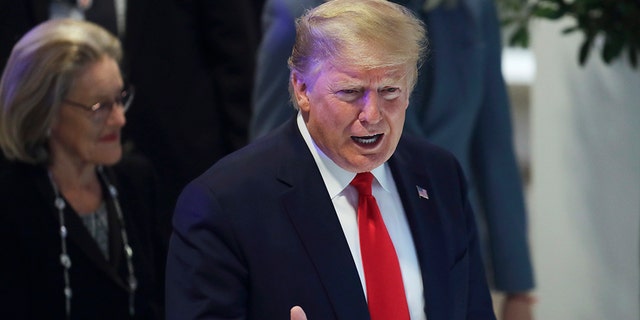
President Trump voiced optimism regarding the Senate impeachment trial as he arrived for a breakfast meeting with American CEOs and business leaders at the World Economic Forum in Davos, Switzerland, on Wednesday morning. “We
have a great case,” the president said to reporters gathered at the
Davos Congress Center after his motorcade arrived from the
Intercontinental Hotel. He added that he thought his legal team was
doing “a very good job,” according to the Associated Press. The
brief comment from Trump came just hours after a marathon first day of
the impeachment trial concluded across the Atlantic in Washington,
capped off just after midnight by a shouting match between Republicans
and Democrats that prompted Chief Justice John Roberts to admonish both sides.
President Trump flashes a thumbs-up as he arrives at the World
Economic Forum in Davos, Switzerland, Wednesday, Jan. 22, 2020.
(Associated Press)
The confrontation was sparked when Rep. Jerry Nadler,
D-N.Y., accused Senate Republicans of “voting for a cover-up” after a
series of trial-rules amendments proposed by Senate Democrats went down
in defeat in party-line votes. The amendments had called for
permitting testimony from new witnesses and the release of documents,
but were rejected 53-47 each time. While most of the Senate spent
Tuesday sitting in silence at the impeachment trial, Trump spent part of
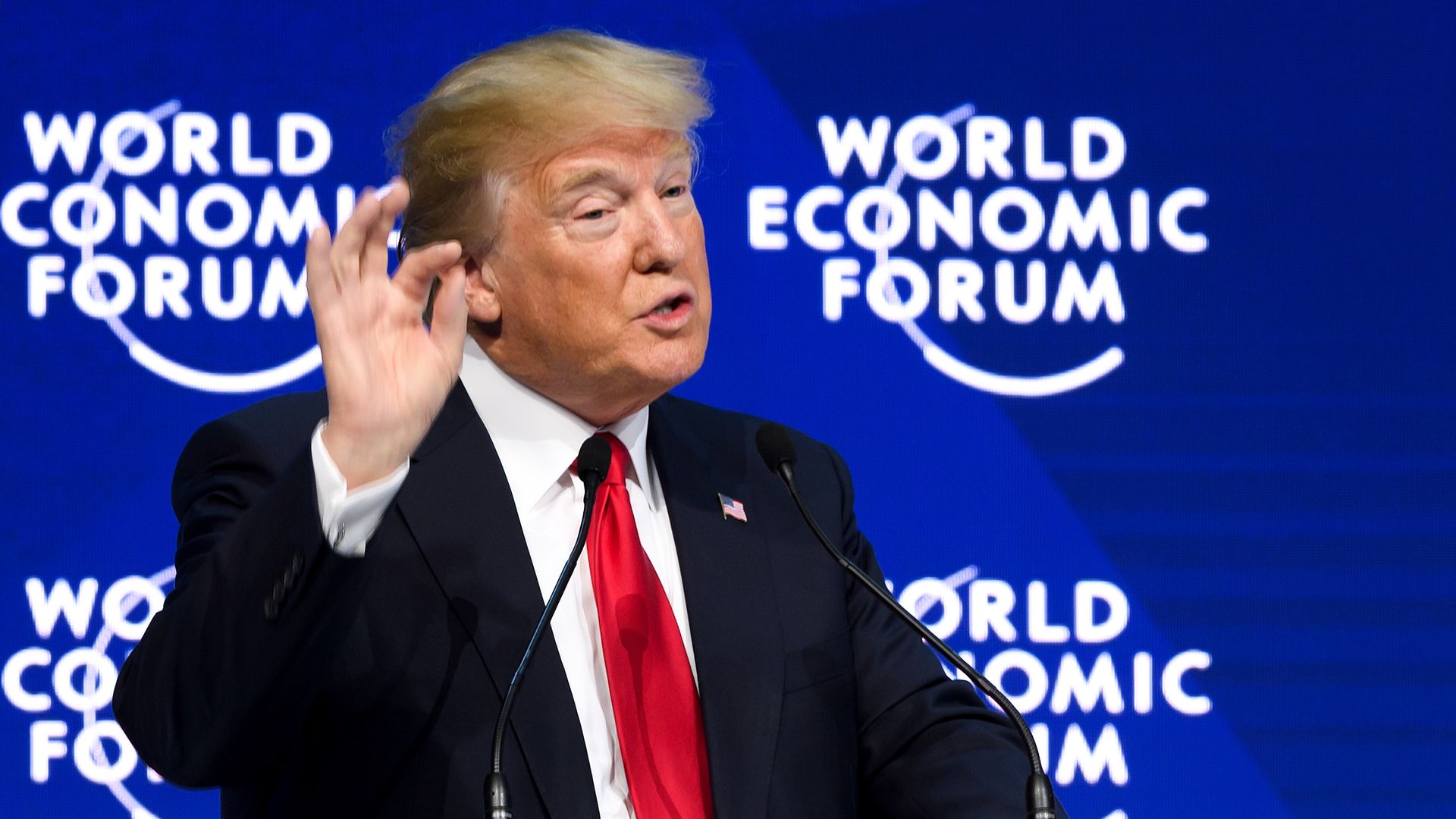
the day boasting of a robust U.S. economy in a speech to the global business community at the Switzerland gathering. “Today
I'm proud to declare the United States is in the midst of an economic
boom, the likes of which the world has never seen before,” he said,
vowing to never to let “radical socialists destroy our economy.” Trump
was expected to participate in a pair of bilateral press conferences
with leaders from Kurdistan and Iraq before returning to Washington
later Wednesday. Fox News' Rachel O'Neill and Edmund DeMarche and the Associated Press contributed to this story.


 Then-FBI acting director Andrew McCabe, now a CNN contributor,
approved one of the now-discredited FISA applications. (AP Photo/Alex
Brandon, File)
Although the DOJ assessment technically only covered
two of the applications to renew the Page FISA warrant, the DOJ
"apparently does not take a position on the validity" on the first two
Page FISA applications, Boasberg said, seemingly indicating that the DOJ
seemingly did not want to defend their legality either.
Then-FBI acting director Andrew McCabe, now a CNN contributor,
approved one of the now-discredited FISA applications. (AP Photo/Alex
Brandon, File)
Although the DOJ assessment technically only covered
two of the applications to renew the Page FISA warrant, the DOJ
"apparently does not take a position on the validity" on the first two
Page FISA applications, Boasberg said, seemingly indicating that the DOJ
seemingly did not want to defend their legality either.