Senate Republicans -- including potential swing-voters -- expressed outrage Friday after lead House Impeachment Manager Adam Schiff, D-Calif., referred in his closing remarks at President Trump's Senate impeachment trial to a report that GOP members were told they'd face dire consequences if they voted to convict the president. "CBS
News reported last night that a Trump confidant said that key senators
were warned, ‘Vote against the president and your head will be on a
pike.’ I don’t know if that’s true," Schiff said, while trying to
persuade his Senate colleagues to vote with "moral courage" rather than
in their political self-interest. Several senators went on record objecting to Schiff's comment. "I
thought he was doing fine with [talking about] moral courage until he
got to the 'head on a pike.' That's where he lost me,” Sen. Lisa
Murkowski, R-Alaska, who has said she might be open to calling witnesses
in the trial, told reporters. “He's a good orator. ... It was just
unnecessary.”
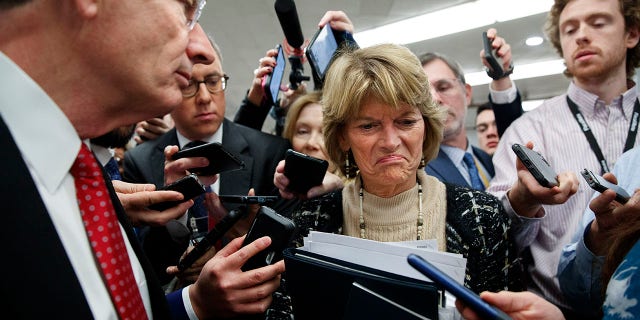
“He's a good orator. ... It was just unnecessary.” — Sen. Lisa Murkowski, R-Alaska
Sen. Lisa Murkowski, R-Alaska, center, and Sen. John Barrasso,
R-Wyo., react to the final statement of House Democratic impeachment
manager Rep. Adam Schiff, D-Calif., as they speak to the media at the
end of a day of an impeachment trial of President Donald Trump on
charges of abuse of power and obstruction of Congress, Friday, Jan. 24,
2020, on Capitol Hill in Washington. (Associated Press)
After
listening silently for most of the trial so far, several Republicans
reportedly shook their heads and could be heard saying, “That's not
true,” after Schiff made the remark. “I hope it’s not true,” Schiff responded before continuing. Sen. Susan Collins, R-Maine, considered another key Republican vote, agreed with Murkowski. “Not
only have I never heard the ‘head on the pike’ line but also I know of
no Republican senator who has been threatened in any way by anyone in
the administration," she told reporters.
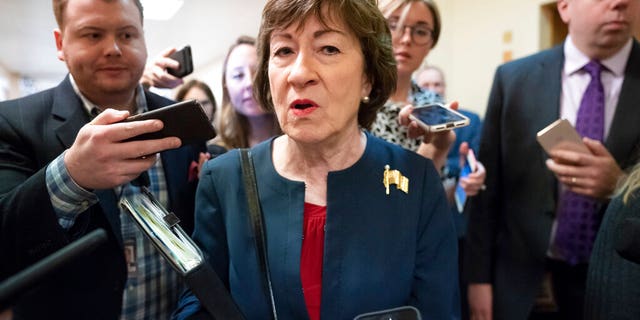
"I know of no Republican senator who has been threatened in any way by anyone in the administration." — Sen. Susan Collins, R-Maine
Sen. Susan Collins, R-Maine, speaks to reporters Nov. 6, 2019, at the Capitol in Washington. (Associated Press)
Sen. John Barrasso, R-Wyo., said, "No Republican
senator has been told that. What he has proven to all of us is, he is
capable of falsehoods and will tell it to the country. And would tell it
to us when we are sitting in the Senate chamber. When every one of us
knows it is not true." Sen. James Lankford, R-Okla., who has also said he would be open to witnesses, told reporters it’s “completely, totally false.” “None
of us have been told that,” he said. “That’s insulting and demeaning to
everyone to say that we somehow live in fear and that the president has
threatened all of us.″ Sen. Joni Ernst, R-Iowa, called the story
"baloney." She said she was listening to Schiff, "until he got to the
part where he just completely made a bunch of bullcrap up."
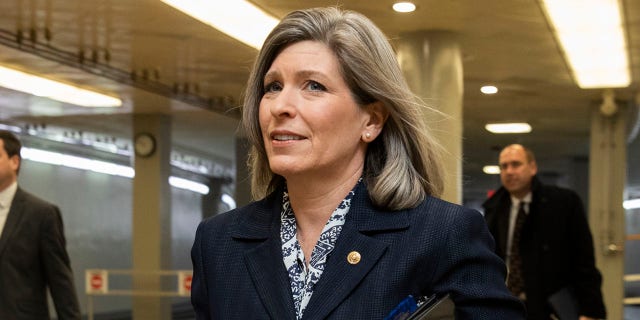
"He just completely made a bunch of bullcrap up." — Sen. Joni Ernst, R-Iowa
Sen. Joni Ernst, R-Iowa, walks in the U.S. Capitol on the first
full day of the impeachment trial of President Donald Trump on charges
of abuse of power and obstruction of Congress in Washington, Tuesday,
Jan. 21, 2020. (Associated Press)
Even some Democrats were miffed by the remark. Sen. Joe Manchin, D-W.Va., who hasn’t indicated how he plans to vote said, "That could have been left out, that's for sure." Other Democrats scoffed, suggesting the outrage was a made-up excuse to oppose calling witnesses. Minority
Leader Chuck Schumer, D-N.Y., told MSNBC, "The Republicans are so
afraid to confront the actual facts here ... they're always looking for a
diversion." Sen. Chris Coons, D-De., agreed. "If that's your reason? That he mis-cited some press article? Come on," he said, according to Politico. Trump’s defense team will begin their opening statements in the trial Saturday morning. The Associated Press contributed to this report.
Democrats' claim that the Trump administration broke America's promise to protect Ukraine from Russia by withholding military aid is just an example of the party's hypocrisy, Sen. Joni Ernst, R-Iowa, claimed Thursday. "The Democratic House Managers’ hypocrisy is on full display," Ernst wrote on Twitter on Thursday evening, after Day 3 of Trump's Senate impeachment trial. "They’ve spent most of their time lecturing the Senate on aid to Ukraine, yet four of them voted AGAINST legislation that provided the very same aid they’re lecturing us on." "What
I find very interesting now is that the House Managers are very, very
centered on the fact that Russia was invading Ukraine. And military
funding to Ukraine," she said during a break from President Trump’s
impeachment trial earlier Thursday, reminding reporters that Crimea was
invaded in 2014 during the Obama administration. Ernst told reporters the Obama administration reacted to the invasion by “sending blankets.” Her remarks came after lead House Manager Adam Schiff,
D-Calif., said the Trump administration had abused its power by
withholding $400 million in military aid allegedly on the condition of
investigating the Bidens. Ernst said that, unlike former President Obama, Trump has sent “lethal aid” to Ukraine. “These
House managers did nothing of the sort to provide that assistance to
Ukraine and yet now they are on their high horse … for President Trump
not doing enough for Ukraine," she added.
"These House
managers did nothing of the sort to provide that assistance to Ukraine
and yet now they are on their high horse … for President Trump not doing
enough for Ukraine." — U.S. Sen. Joni Ernst, R-Iowa
Republicans
criticized Obama for sanctioning Russia rather than sending arms to
Ukraine after the 2014 invasion; the Obama administration said they were
concerned that sending lethal aid could escalate the situation with
Russia. “The fact is that Ukraine, which is a non-NATO country, is
going to be vulnerable to military domination by Russia no matter what
we do,” Obama told The Atlantic at the time. Between
2014 and 2016 the Obama administration also sent more than $600 million
in assistance to Ukraine and started the Ukraine Security Assistance
Initiative that sends U.S. military equipment, Politifact reported.
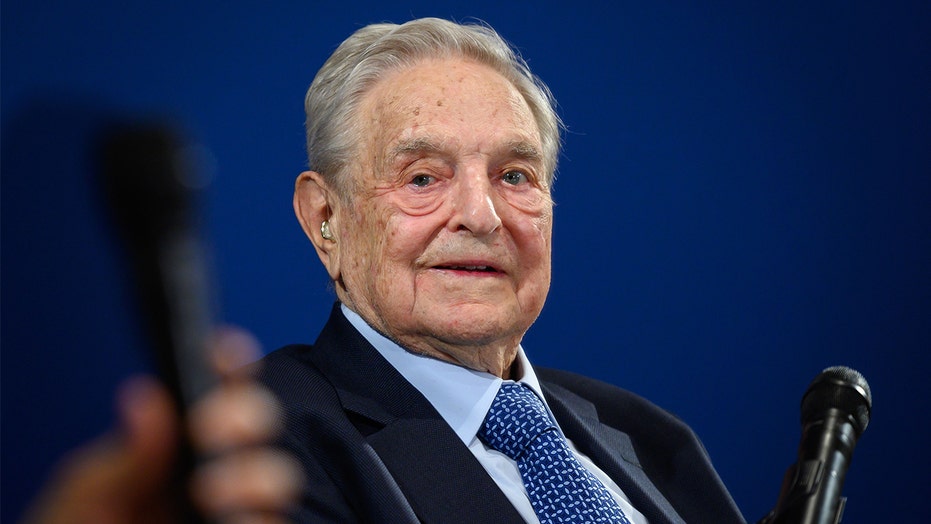
Left-wing billionaire George Soros has accused Facebook of helping to re-elect Donald Trump leading up to the 2020 election. Soros,
89, made the comments during a speech in Davos, Switzerland,
Thursday. He accused the social media giant of working to re-elect Trump
during this year's election campaign in exchange for protection. “Facebook
will work to re-elect Trump and Trump will protect Facebook,” the
Hungarian-born U.S. investor said, according to Politico. “It makes me
very concerned about the outcome of 2020.”
A Facebook company spokesman responded to Politico, saying "This is just plain wrong." On Jan. 9, Facebook
announced that it would continue to let politicians run advertisements
and would not police the truthfulness of the messages posted. "Ultimately,
we don’t think decisions about political ads should be made by private
companies," Rob Leathern, Facebook's director of product management,
said at the time. "In the absence of regulation, Facebook and
other companies are left to design their own policies. We have based
ours on the principle that people should be able to hear from those who
wish to lead them, warts and all, and that what they say should be
scrutinized and debated in public," Leathern added. Soros' speech
was made at a dinner hosted by the Open Society Foundations, an
international grantmaking network founded by the billionaire. During the
speech, he also criticized certain world leaders -- including Trump,
China's Xi Jinping, India's Narendra Modi, Brazil's Jair Bolsonaro and
Hungary's Viktor Orbán, according to Politico. Soros
said called Xi Jinping a "dictator" while exclaiming Trump was "a con
man and a narcissist, who wants the world to revolve around him.” He
also praised Greta Thunberg and other teenage climate activists for
their actions in addressing climate change, the outlet said. In
addition, Soros announced he was giving $1 billion into a
new university network, which will be built around Bard College, north
of New York City, and Soros’ Central European University. Fox News' Frank Miles contributed to the report
Senate
GOP leaders are trying to avoid defections in an anticipated vote next
week on whether or not to allow for new witnesses in President Trump's impeachment trial and remain in close talks with those potential swing votes, according to Republican aides. Allowing
new witnesses would bring a wild-card factor to the trial, lengthen the
process and potentially set up a protracted court fight over executive
privilege. GOP leaders are actively reaching out to Republican
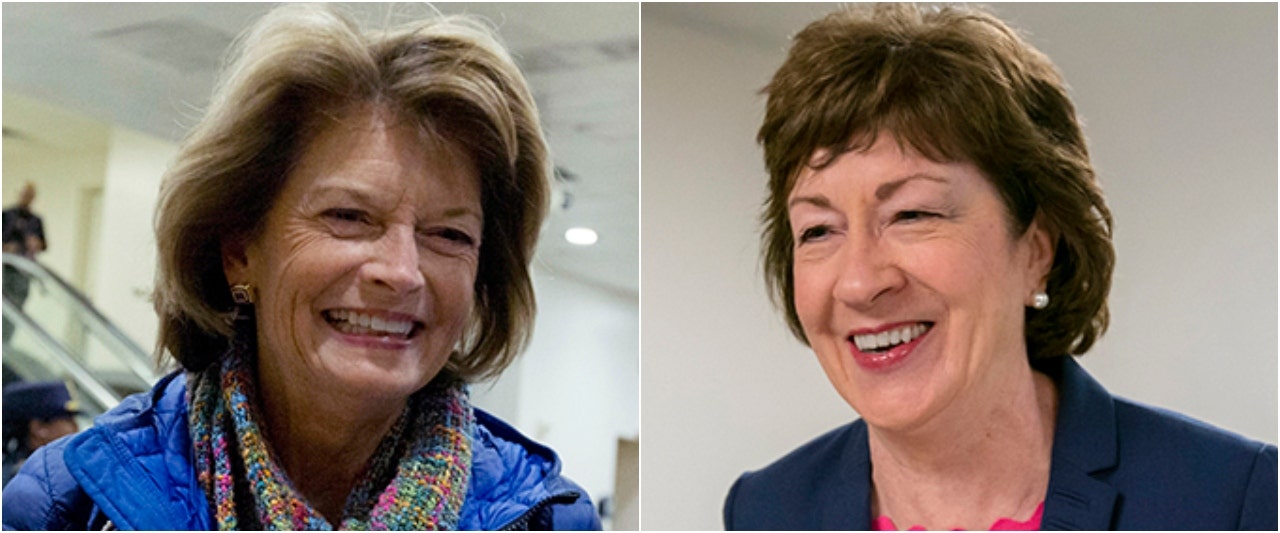
senators who could potentially defect -- Sens. Susan Collins of
Maine, Lisa Murkowski of Alaska, Lamar Alexander of Tennesse and Mitt
Romney of Utah -- and are trying to keep them in the fold, according to
two GOP aides. With all eyes on these potential swing votes, Collins was overhead Thursday evening raising concerns about the access of press. After
the trial recessed for the dinner break, Collins and Murkowski had an
animated conversation on the Senate floor and Collins pointed up at the
reporters above her in the balcony. The Maine Republican was
overheard saying she didn’t want the journalists overlooking from the
front row and thought it should be emptied. Collins continued to
look up at reporters, and Sen. John Thune, R-S.D., and Sen. Thom Tillis,
R-N.C., joined the huddle. Reporters covering the historic trial are
only allowed to bring pens and paper in the gallery, and typical tools
of the trade -- phones, cameras, computers and even smartwatches -- are
all banned. As the trial continued into the night, Democrats
re-upped their demands for new witnesses and documents to be entered
into evidence, charging that the trial would be a "cover-up" without
them. They need the help of four GOP senators to win the necessary
majority vote. But Republicans are actively trying to avoid any
GOP defections. No new witnesses would mean a speedy trial and a quicker
vote to acquit the president. The swing GOP voters are under
intense scrutiny in the Capitol as the 100 jurors weigh whether to
remove Trump from office for obstruction of congress and abuse of power. As
Murkowski was darting to get to the impeachment trial on Thursday, she
was asked if she was feeling any pressure. “Only to get upstairs,” she
quipped before the elevator door closed. Republicans argue that if
the Democratic case for impeachment is so strong, they wouldn't need
the Senate's help for extra witnesses to make their case. "We are
ready for the president's team to put their defense on," Sen. John
Barrasso, R-Wy., said Thursday. "The president didn't have a chance to
do that in the House. We have heard plenty from the House now. They say
that they've had overwhelming evidence." Trump's legal team says new witnesses aren't needed but would expect reciprocity if the Senate vote didn't go their way. “If
the other side were to get witnesses, we would have a series of
witnesses, but we are nowhere near that process yet,” Trump lawyer
Jay Sekulow said Thursday. Trump himself raised the concern
earlier this week about executive privilege and said there would be
national security concerns if his former adviser John Bolton testified. If
the Senate votes in favor of getting witnesses and Trump administration
communications related to withholding military aid to Ukraine, Trump's
legal team could assert executive privilege -- setting off an unchartered court challenge. Sekulow
said that the administration was within its constitutional rights to
withhold documents and blasted House Democrats for trying to shred the
constitution. Some GOP senators have promoted witness reciprocity
and called for Hunter Biden to testify about what he was doing on the
board of Ukrainian energy company Burisma, in exchange for Bolton
testifying. Sen. Josh Hawley, R-Mo., wouldn’t predict whether
there would be GOP defections but said the caucus is in regular talks to
keep tabs on where senators stand. “There’s an ongoing conversation, informal, on what people are thinking. We are spending a lot of time together,” Hawley said. With
the Senate GOP leadership trying to avoid going down the witness path
with Democrats, they are actively reaching out to potential defectors --
Murkowski, Collins, Alexander and Romney. The four were
"instrumental" in changing Majority Leader Mitch McConnell’s organizing
resolution on the fly to allow more days for opening statements and
avoiding middle-of-the-night arguments. There is a strategic effort to
keep these four involved in the process, an aide told Fox News. A
speedy trial and acquittal without witnesses and documents would
benefit the White House, and GOP leaders are trying to avoid a
spectacle. “There’s a bunch of people on my side that want to call
Joe Biden and Hunter Biden,” said Sen. Lindsey Graham, R-S.C. “I want
to end this thing sooner rather than later. I don’t want to turn it into
a circus." Fox News' Jason Donner contributed to this report.
At
least two of the FBI’s surveillance applications to secretly monitor
former Trump campaign adviser Carter Page lacked probable cause,
according to a newly declassified summary of a Justice Department assessment released Thursday by the Foreign Intelligence Surveillance Court (FISC). The
DOJ's admission essentially means that the Foreign Intelligence
Surveillance Act (FISA) warrant authorizations to surveil Page, when
stripped of the FBI's misinformation, did not meet the necessary legal
threshold and should never have been issued. Democrats, including
California Rep. Adam Schiff, had previously insisted the Page FISA warrants met "rigorous" standards for probable cause, and mocked Republicans for suggesting otherwise. The
June 2017 Page FISA warrant renewal, which was among the two deemed
invalid by the DOJ, was approved by then-Acting FBI Director (and now
CNN contributor) Andrew McCabe, as well as former Deputy Attorney
General Rod Rosenstein. The April 2017 warrant renewal was approved by
then-FBI Director James Comey. “Today’s unprecedented court filing
represents another step on the road to recovery for America’s deeply
damaged judicial system," Page said in a statement to Fox News. "I hope
that this latest admission of guilt for these civil rights abuses by the
Justice Department marks continued progress towards restoring justice
and remedying these reputationally ruinous injuries.” Added Iowa
GOP Sen. Chuck Grassley, who previously chaired the Judiciary Committee:
“It’s about time. It’s about time federal authorities entrusted with
our most powerful and intrusive surveillance tools begin to own up to
their failures and abuses, and take steps to restore public confidence.
... Time will tell if the department will continue working to fix its
errors and restore trust that it won’t disregard Americans’ civil
liberties. Its admission and cooperation with the FISC is a step in the
right direction." FISC Presiding Judge James Boasberg, in the Jan.
7 order that was published for the first time Thursday, further
required the government to explain in a written statement by Jan. 28 the
"FBI's handling of information" obtained through the Page warrants and
subsequent renewals. Boasberg
specifically noted the DOJ found "there was insufficient predication to
establish probable cause to believe that Page was acting as an agent of
a foreign power" because of the "material misstatements and omissions"
in the warrant applications.
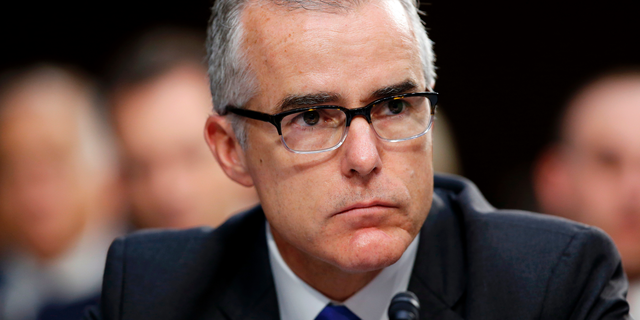
Then-FBI acting director Andrew McCabe, now a CNN contributor,
approved one of the now-discredited FISA applications. (AP Photo/Alex
Brandon, File)
Although the DOJ assessment technically only covered
two of the applications to renew the Page FISA warrant, the DOJ
"apparently does not take a position on the validity" on the first two
Page FISA applications, Boasberg said, seemingly indicating that the DOJ
seemingly did not want to defend their legality either. The
government "intends to sequester information acquired pursuant to those"
FISA applications "in the same manner as information acquired pursuant
to the subsequent dockets," the judge said, possibly indicating that
those applications are still under review. Boasberg noted that it
is illegal for the government to intentionally disclose or use
"information obtained under color of law by electronic surveillance,
knowing or having any reason to know that the information was obtained
through electronic surveillance not authorized." A lawful FISA warrant,
when approved by the FISC, allows the FBI to surveil not only the target
of the warrant, but also individuals who communicate with the target
and the target's associates. It was not clear what information, if
any, the FBI gleaned from the Page FISA and then used in subsequent
court arguments; any such evidence would likely be ruled inadmissible,
given the DOJ's admission that the underlying warrants were invalid. The revelations Thursday were yet another embarrassment for the FBI, which DOJ Inspector General Michael Horowitz has found made repeated errors and misrepresentations -- and, in one case, deliberately falsified evidence -- before the FISC as the bureau sought to surveil Page in 2016 and 2017. The
FBI's FISA applications to monitor Page heavily relied, Horowitz
confirmed, on a now-discredited dossier funded by the Hillary Clinton
campaign and Democratic National Committee (DNC), as well as on news reports that secretly relied on the dossier's author. Much of the Steele dossier has been proved unsubstantiated, including the dossier's claims that the Trump campaign was paying hackers in the United States out of a non-existent Russian
consulate in Miami, or that ex-Trump lawyer Michael Cohen traveled to
Prague to conspire with Russians. Special Counsel Robert Mueller also
was unable to substantiate the dossier's claims that Page had received a
large payment relating to the sale of a share of Rosneft, a Russian oil
giant, or that a lurid blackmail tape involving the president existed. Pursuant
to Boasberg's order, the government must also sequester relevant
information and provide further "explanations" concerning the damning
findings of bureau misconduct contained in Horowitz's recent report, as
well as "related investigations and any litigation." That
could be a reference to a variety of outstanding matters concerning the
FBI's apparent mischaracterization of evidence before the FISC. For
example, the FISC has already ordered the bureau to look at all
previous FISA applications involving ex-FBI attorney Kevin Clinesmith,
whom Horowitz found to have doctored an email from the CIA. The FBI had
reached out to the CIA and other intelligence agencies for information
on Page; the CIA responded in an email by telling the FBI that Page had
contacts with Russians from 2008 to 2013, but that Page had reported
them to the CIA and was serving as a CIA operational contact and
informant on Russian business and intelligence interests. Clinesmith
then allegedly doctored the CIA's email about Page to make it seem as
though the agency had said only that Page was not an active source. The
FBI also included Page's contacts with Russians in the warrant
application as evidence he was a foreign "agent," without disclosing to
the secret surveillance court that Page was voluntarily working with the
CIA concerning those foreign contacts.
"Today’s
unprecedented court filing represents another step on the road to
recovery for America’s deeply damaged judicial system." — Former Trump aide Carter Page
Further,
Horowitz found specific evidence of oversights and errors by several
top FBI employees as they sought to obtain a warrant to surveil Page. In
particular, an unidentified FBI supervisory special agent (SSA)
mentioned in the IG report was responsible for ensuring that
the bureau's "Woods Procedures" were followed in the Page warrant
application, but apparently didn't do so. According to the
procedures, factual assertions need to be independently verified, and
information contradicting those assertions must be presented to the
court. Horowitz found several instances in which the procedures were not
followed. Horowitz's report leaves little doubt that the unnamed SSA is Joe Pientka -- a current bureau employee. Pientka briefly appeared on the FBI's website as an "Assistant Special Agent in Charge" of the San Francisco field office late last year, according to the Internet archive Wayback Machine -- although Pientka no longer appears on any FBI website. Pientka was removed shortly after Fox News identified him as the unnamed SSA in the IG report. Twitter user Techno Fog first flagged the Wayback Machine's archive of the page. The
FBI has repeatedly refused to respond to Fox News' request for
clarification on Pientka's status, even as Republicans in Congress have sought to question him. While the FBI has promised corrective action, it apparently has not gone far enough. Earlier this month, David Kris, who has been appointed by the FISC to oversee the FBI's proposed surveillance reforms, alerted the court that the bureau's proposals are "insufficient" and must be dramatically "expanded"
-- even declaring that FBI Director Christopher Wray needs to discuss
the importance of accuracy and transparency before the FISC every time
he "visits a field office in 2020."
In December 2017, then-FBI deputy director Andrew McCabe testified
that “no surveillance warrant would have been sought” from the FISA
court “without the Steele dossier information," according to a House GOP
memo's findings. McCabe is now a CNN contributor.
The unclassified findings were a stark rebuke to Wray, who had filed assurances to
the FISC that the agency was implementing new procedures and training
programs to assure that the FBI presents accurate and thorough
information when it seeks secret warrants from FISC judges. At the same
time, Wray acknowledged the FBI's "unacceptable" failures as it pursued
FISA warrants to monitor Page. Kris is a former Obama administration attorney who has previously defended the FISA process on "The Rachel Maddow Show" and in other left-wing venues,
making his rebuke of Wray something of an unexpected redemptive moment
for Republicans who have long called for more accountability in how the
bureau obtains surveillance warrants. ("You can’t make this up!"
President Trump tweeted on Sunday. "David Kris, a highly controversial
former DOJ official, was just appointed by the FISA Court to oversee
reforms to the FBI’s surveillance procedures. Zero credibility. THE
SWAMP!”) Wray
had specifically promised to change relevant forms to "emphasize the
need to err on the side of disclosure" to the FISC, to create a new
"checklist" to be completed "during the drafting process" for
surveillance warrants that reminds agents to include "relevant
information" about the bias of sources used, and to "formalize" the role
of FBI lawyers in the legal review process of surveillance warrants. Additionally,
Wray said the FBI would now require "agents and supervisors" to confirm
with the DOJ Office of Intelligence that the DOJ has been advised of
relevant information. Wray further indicated that the FBI would
formalize requirements to "reverify facts presented in prior FISA
applications and make any necessary corrections," as well as to make
unspecified "technological improvements." But in a 15-page letter to Judge Boasberg, obtained by Fox News,
Kris declared that the proposed corrective actions "do not go far
enough to provide the Court with the necessary assurance of accuracy,
and therefore must be expanded and improved" -- and he took aim at Wray
himself. "The focus on specific forms, checklists and technology,
while appropriate, should not be allowed to eclipse the more basic need
to improve cooperation between the FBI and DOJ attorneys," Kris said,
noting that the FBI and DOJ have historically not always worked well
together. "A key method of improving organizational culture is
through improved tone at the top, particularly in a hierarchical
organization such as the FBI," Kris said, noting that Wray's public
statements on the matter, while positive, have not gone far enough.
"Director Wray and other FBI leaders, as well as relevant leaders at the
Department of Justice, should include discussions of compliance not
only in one or two messages, but in virtually every significant
communication with the workforce for the foreseeable future." Republican calls for more accountability may not go unanswered for long. Connecticut U.S. Attorney John Durham announced last year that he did not "agree" with
the IG's assessment that the FBI's probes were properly predicated,
highlighting Durham's broader criminal mandate and scope of review. Durham
is focusing on foreign actors, as well as the CIA, while Horowitz
concentrated his attention on the Justice Department and FBI. "Based
on the evidence collected to date, and while our investigation is
ongoing, last month we advised the Inspector General that we do not
agree with some of the report’s conclusions as to predication and how
the FBI case was opened," Durham said in his statement, adding that his
"investigation is not limited to developing information from within
component parts of the Justice Department" and "has included developing
information from other persons and entities, both in the U.S. and
outside of the U.S."
BEIRUT
(AP) — Iran has long sought the withdrawal of American forces from
neighboring Iraq, but the U.S. killing of an Iranian general and an
Iraqi militia commander in Baghdad has added new impetus to the effort,
stoking anti-American feelings that Tehran hopes to exploit to help
realize the goal.
The
Jan. 3 killing has led Iraq’s parliament to call for the ouster of U.S.
troops, but there are many lingering questions over whether Iran will
be able to capitalize on the sentiment.
An
early test will be a “million-man” demonstration against the American
presence, called for by influential Shiite cleric Moqtada al-Sadr and
scheduled for Friday.
It
is not clear whether the protesters will try to recreate a New Year’s
Eve attack on the U.S. Embassy compound in Baghdad by Iran-supported
militias in the wake of U.S. airstrikes that killed 25 militiamen along
the border with Syria. Iran might simply try to use the march to
telegraph its intention to keep up the pressure on U.S. troops in Iraq.
But
experts say Iran can be counted on to try to seize what it sees as an
opportunity to push its agenda in Iraq, despite an ongoing mass uprising
that is targeting government corruption as well as Iranian influence in
the country.
“Iran
is unconstrained by considerations of Iraqi sovereignty, domestic
public opinion, or legality when compared to the Western democracies,”
said David Des Roches, an expert with The Arab Gulf States Institute in
Washington. “This is Iran’s strategic advantage; they should be expected
to press it.”
A
withdrawal of U.S. troops from Iraq would be a victory for Iran, and
Tehran has long pursued a two-pronged strategy of supporting anti-U.S.
militias that carry out attacks, as well as exerting political pressure
on Iraqi lawmakers sympathetic to its cause.
Despite
usually trying to keep attacks at a level below what might provoke an
American response, Iran-backed Kataib Hezbollah fired a barrage of
rockets at a military base in Kirkuk in December, killing a U.S.
contractor and wounding several U.S. and Iraqi troops. The U.S.
responded first with deadly airstrikes on Iran-affiliated militia bases
in western Iraq and Syria, then followed with the Jan. 3 drone attack
that killed Gen. Qassem Soleimani, Iran’s most powerful military
officer, along with Iraqi militia commander Abu Mahdi al-Muhandis as
they left Baghdad’s airport.
The
severity of the U.S. response surprised Iran and others, and it had the
unanticipated result of bolstering Tehran’s political approach by
prompting the Iraqi parliament to pass the nonbinding resolution pushed
by pro-Iran political factions calling for the expulsion of all foreign
troops from the country. In response, President Donald Trump has
threatened sanctions on Iraq.
“What
they want to do is get rid of U.S. troops in what they see as a
legitimate political manner,” said Dina Esfandiary, a London-based
expert with The Century Foundation think tank. “If Iraqis themselves are
voting out U.S. troops, it looks a lot better for Iran than if Iran is a
puppet master in Iraq trying to get rid of them — and on top of that it
would be a more lasting decision.”
The
legitimacy of the resolution is a matter of dispute. Not only was the
session boycotted by Kurdish lawmakers and many Sunnis, but there also
are questions of whether Prime Minister Adel Abdul-Mahdi has the
ability to carry it out. Abdul-Mahdi resigned in November amid mass
anti-government protests but remains in a caretaker role.
U.S.
Secretary of State Mike Pompeo bluntly rejected the call for the
troops’ removal, instead saying Washington would “continue the
conversation with the Iraqis about what the right structure is.”
Abdul-Mahdi
strongly supported the resolution, but since then has said it will be
up to the next government to deal with the issue, and there are
indications he has been working behind the scenes to help keep foreign
troops in the country.
After
closed-door meetings with German diplomats last week, German Foreign
Minister Heiko Maas said the prime minister had assured them that he had
“great interest” in keeping the Bundeswehr military contingent and
others part of the anti-Islamic State coalition in Iraq.
The U.S., meantime, said it had resumed joint operations with Iraqi forces, albeit on a more limited basis than before.
Trump
met Iraqi President Barham Saleh on Wednesday on the sidelines of the
World Economic Forum in Davos Switzerland, and said Washington and
Baghdad have had “a very good relationship” and that the two countries
had a “host of very difficult things to discuss.” Saleh said they have
shared common interests including the fight against extremism, regional
stability and an independent Iraq.
Asked about the plan for U.S. troops in Iraq, Trump said, “We’ll see what happens.”
In
a sign that bodes well for NATO’s continuing mission in the country,
Iraq’s deputy foreign minister went to Brussels last week for talks with
Secretary General Jens Stoltenberg on the alliance’s presence in Iraq.
The
mixed message of publicly calling for the troops to go but privately
wanting them to stay is an indication of Iran’s strong influence,
particularly among its fellow Shiite Muslims, Des Roches said.
“For
any Iraqi politician in Baghdad — particularly a Shia politician — to
defy Iran openly is to risk political as well as physical death,” he
said. “So we shouldn’t be surprised if the public and the private lines
espoused by Iraqi politicians differ.”
American
forces withdrew from Iraq in 2011 but returned in 2014 at the
invitation of the government to help battle the Islamic State after the
extremist group seized vast areas in the north and west of the country. A
U.S.-led coalition provided crucial air support as Iraqi forces,
including Iran-backed militias, regrouped and drove IS out in a costly
three-year campaign. There are currently some 5,200 American troops in
the country.
Even
before the drone strike, there were growing calls in nationwide
protests across sectarian lines, which started in October centered in
Baghdad’s Tahrir Square, for the end of all foreign influence in the
country. The demonstrations also targeted government corruption and poor
public services.
The
rejection of Iranian influence over Iraqi state affairs has been a core
component of the movement, and pro-Iranian militias have targeted those
demonstrations along with Iraqi security forces, killing hundreds and
injuring thousands. Protesters fear that with the focus on the push for
the U.S. troop withdrawal in response to the attack that killed
Soleimani, they may be even easier targets for those forces and that
their message will be lost.
“I
think Iraq has had enough of having to deal with the Americans and the
Iranians alike,” Esfandiary said. “But the assassination of al-Muhandis,
almost more so than Solemani, was such a glaring oversight of
sovereignty and of all agreements they had signed on to with the U.S. in
terms of the U.S. presence in Iraq, that it has kind of taken some of
the attention away from Iran, to Tehran’s delight.”
Friday’s
march called for by al-Sadr is expected to redirect the focus onto the
U.S. troops. The cleric, who also leads the Sairoon bloc in parliament,
derives much of his political capital through grassroots mobilization.
The
Tahrir Square protesters initially rejected that call, saying they want
the escalating conflict between Iran and the U.S. off of Iraqi soil.
Since
then, al-Sadr has reached out to them directly, saying the
demonstrations against the government and against the American troops
are “two lights from a single lamp,” and it is not yet clear whether
that might convince them to participate in the march.
___
Associated Press writers Darlene Superville in Davos, Switzerland, and Samya Kullab in Baghdad contributed to this story.
___
This story has been corrected to show that the first name of teh Iraqi prime minister is Adel, not Abdel.
U.S. Treasury Secretary Steven Mnuchin took a shot at Greta Thunberg --
the famed teen climate activist -- on Thursday over her push at the
World Economic Forum in Davos, Switzerland, for companies to immediately
cease all investments in fossil fuels. Mnuchin was at a news
conference in the Alpine town when he was asked about Thunberg's earlier
appeal to abandon older sources of energy, according to Reuters. "Is
she the chief economist? ... After she goes to college and studies
economics in college, she can come back and explain that to us," he was
quoted saying. Thunberg, 17, from Sweden, has been embraced by
celebrities and is seen by supporters as a fierce, young voice capable
of rallying support for her cause: to clean up the environmental mess
left by previous generations. Her detractors view her as a
media-generated star who admitted that she was surprised when she was
named Time magazine's "Person of the Year." There appears to be no love lost between Thunberg and President Trump, who called Time magazine's decision "ridiculous." Thunberg
said in September that talking to Trump at the U.N. General Assembly in
New York City would have been a waste of time. In Davos, Thunberg took
part in a panel discussion hosted by The New York Times, where she told
the audience there is a real need for immediate action on climate
change. "Your inaction is fueling the flames by the hour,” she
said, according to the Times. "Let's be clear. We don’t need a 'low
carbon economy.' We don't need to 'lower emissions.' Our emissions have
to stop." Trump and Thunberg were both in Davos at the same time and "sparred indirectly," the Reuters report
said, though Trump appeared to "extend an olive branch" when he told
reporters he wished that he was able to hear her speak before he left.
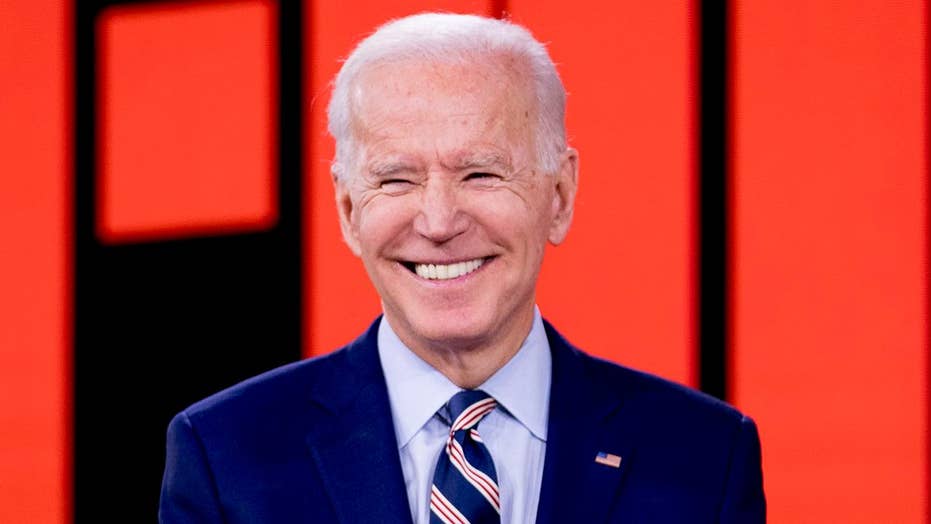
Joe Biden, the 2020 Democratic presidential frontrunner, said Wednesday he wants "no part" of a witness swap reportedly being discussed by some members of his own party. Under the hypothetical deal, Democrats would reportedly offer up Biden or his son Hunter Biden to testify at President Trump's Senate impeachment trial in return for testimony from a Republican figure, such as ex-national security adviser John Bolton. The Washington Post quoted the
former vice president admitting that it was "not an irrational
question" but said Trump's trial was a "constitutional issue." He said
he does not want to see the trial turn into a "farce or some kind of political theater." Biden,
while campaigning in Iowa, denied that talks of a witness swap were
taking place. When told by a Post reporter that the topic was being
discussed, he responded, "No they're not," the paper reported. A
witness swap that would result in Hunter Biden and Bolton testifying
would be the most dramatic development in the trial thus far. At the
heart of the impeachment trial is Trump's July 25, 2019 call with
Ukraine President Volodymyr Zelensky. Trump said the call was focused on corruption in Kiev and raised Biden as an example. Hunter's
position on the board of the Ukrainian gas company Burisma while his
father was vice president has been a rallying point for Republicans as
they try to defend Trump against impeachment charges of abuse of power
and obstruction of Congress. Democrats see Bolton as a potential
witness who could provide first-hand testimony linking Trump's decision
to withhold U.S. aid from Ukraine directly to the country's willingness
to investigate the Bidens. Fiona Hill, a former top White House
expert on Russia, testified in November that Bolton shared her concern
about what she saw as a push to get Ukraine to conduct the
investigations. She testified in front of the House Intelligence
Committee and recalled Bolton expressing his own concerns about the push
and told her to tell National Security Council lawyer John Eisenberg
that he does not want to be a part of this "drug deal." "He was
saying that sarcastically, of course, I mean, just to be clear.
Actually, he was angry, but he was also sarcastic. I mean — he wasn’t
inferring that they were cooking up an actual drug deal in the
War Room," she said. Trump and Zelensky have both denied any quid
pro quo. Trump called the entire impeachment process a political witch
hunt. There is no evidence of wrongdoing by Biden or his son. The
Post reported that some of the Democrats taking part in the discussion
about a potential witness swap believe Biden could actually benefit
politically from testifying because it would give him a chance to
deliver a statesmanlike performance. Both Rep. Adam Schiff,
D-Calif., and Senate Minority Leader Chuck Schumer have spoken out
against the potential of a witness swap. "Trials aren't trades for witnesses," Schiff said. Fox News' Brooke Singman and Adam Shaw and the Associated Press contributed to this report.


 Sen. Lisa Murkowski, R-Alaska, center, and Sen. John Barrasso,
R-Wyo., react to the final statement of House Democratic impeachment
manager Rep. Adam Schiff, D-Calif., as they speak to the media at the
end of a day of an impeachment trial of President Donald Trump on
charges of abuse of power and obstruction of Congress, Friday, Jan. 24,
2020, on Capitol Hill in Washington. (Associated Press)
Sen. Lisa Murkowski, R-Alaska, center, and Sen. John Barrasso,
R-Wyo., react to the final statement of House Democratic impeachment
manager Rep. Adam Schiff, D-Calif., as they speak to the media at the
end of a day of an impeachment trial of President Donald Trump on
charges of abuse of power and obstruction of Congress, Friday, Jan. 24,
2020, on Capitol Hill in Washington. (Associated Press)
 Sen. Susan Collins, R-Maine, speaks to reporters Nov. 6, 2019, at the Capitol in Washington. (Associated Press)
 Sen. Joni Ernst, R-Iowa, walks in the U.S. Capitol on the first
full day of the impeachment trial of President Donald Trump on charges
of abuse of power and obstruction of Congress in Washington, Tuesday,
Jan. 21, 2020. (Associated Press)
Sen. Joni Ernst, R-Iowa, walks in the U.S. Capitol on the first
full day of the impeachment trial of President Donald Trump on charges
of abuse of power and obstruction of Congress in Washington, Tuesday,
Jan. 21, 2020. (Associated Press)