Hackers believed to be linked to Iran may have
breached computerized fuel monitoring systems used at gas stations
across the United States, according to a CNN report published Friday and
cited by Newsweek.
CNN reported the suspected attacks involved "automatic tank gauge"
systems, known as ATGs, which monitor fuel levels and leak detection in
underground gas station tanks.
U.S. officials told CNN some of the systems were exposed online
without password protection, allowing intruders in some cases to
manipulate digital readings and system displays.
Officials told CNN investigators found no evidence the hackers
altered actual fuel supplies, but warned manipulated readings could hide
leaks or create broader infrastructure safety risks.
CNN reported federal investigators suspect Iranian-linked actors were
behind the intrusions, though officials had not publicly attributed the
activity to a specific Iranian government entity.
The reported breaches add to years of U.S. warnings that Iran has
built one of the world’s most aggressive state-backed cyber programs,
frequently targeting energy infrastructure, industrial control systems,
financial institutions, and transportation networks.
The U.S. Justice Department announced in 2016 that seven Iranian
hackers tied to the Islamic Revolutionary Guard Corps were charged over
cyberattacks targeting dozens of American banks between 2011 and 2013.
Federal prosecutors said the same group also infiltrated the Bowman
Avenue Dam control system in Rye Brook, New York, in what officials
described as one of the first known Iranian intrusions into U.S.
industrial infrastructure.
Cybersecurity firm Dragos warned in 2019 that Iranian hacking groups
had increasingly focused on operational technology systems used in
utilities, oil facilities, pipelines, and manufacturing plants.
The Department of Homeland Security and the FBI issued joint
advisories in multiple years warning that Iranian hackers routinely scan
for poorly secured industrial control devices connected directly to the
internet.
Cybersecurity firm Mandiant reported in 2022 that Iranian
state-linked hacking groups increasingly targeted U.S. critical
infrastructure organizations using ransomware, destructive malware, and
credential theft campaigns.
The Treasury Department said in late 2023 that hackers affiliated
with the IRGC targeted water utilities and other infrastructure
operators using internet-connected industrial devices manufactured by
Unitronics.
Federal agencies warned at the time that Iranian actors were
exploiting default passwords and weak cybersecurity protections in
operational technology systems.
The Cybersecurity and Infrastructure Security Agency has repeatedly
warned that many fuel, water, and utility systems across the United
States remain vulnerable because operators continue using legacy
industrial equipment with outdated software and inadequate network
protections.
Iranian-linked cyber operations have also repeatedly targeted energy infrastructure in the Middle East.
Cybersecurity researchers and Western officials blamed Iranian actors
for the 2012 Shamoon malware attack that wiped data from roughly 30,000
computers at Saudi Aramco, one of the largest oil companies in the
world.
Saudi officials later described the Shamoon attack as one of the most
destructive cyberattacks ever carried out against the global energy
sector.
Iran has denied involvement in many cyberattacks attributed to it by Western governments and cybersecurity researchers.
The latest reported intrusions come amid heightened tensions between
Iran, Israel, and the United States, with American officials repeatedly
warning Tehran could use cyberattacks as an asymmetric response to
military or economic pressure.
We are so lucky that Donald Trump and JD Vance defeated Kamala Harris and Tim Walz.
In
addition to all the reasons that Kamala Harris was awful, Minnesota
Gov. Walz made it all worse with what a joke he was as a candidate. If
you become known for the ridiculous things you say rather than for doing
anything consequentially good, that could be a problem.
Walz did become known for something consequential, something
consequentially bad. He dropped out of running again for governor after
the Minnesota fraud scandal exploded. He helped demonize Immigration and
Customs Enforcement (ICE) and incited radicals in his state against law
enforcement.
Can we forget this moment when he spoke wishfully about the possibility of President Trump's death?
Then,
Walz had a post on Thursday that, like the Trump post, reminded us that
he isn't just a bad politician, he is also a horrible human being.
House
Majority Leader, Republican Rep. Steve Scalise (LA-01),
and House
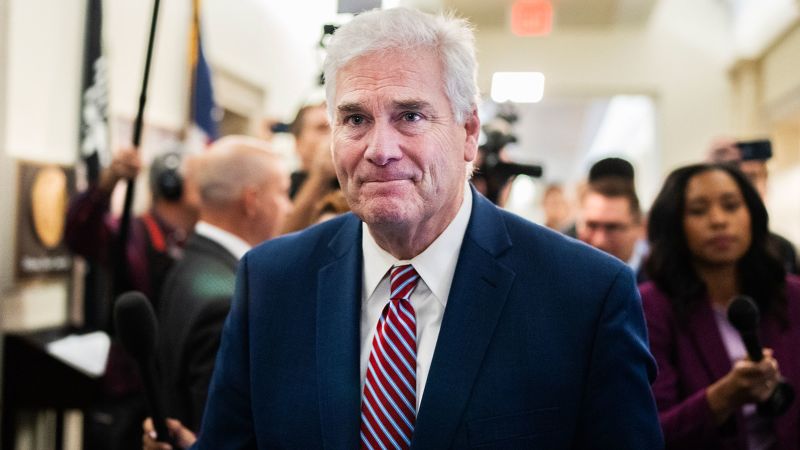
Majority Whip, Republican Rep. Tom Emmer (MN-06),
posted a picture
humorously joking about how they both had to wear medical boots on their
legs.
Standing in solidarity with @GOPMajorityWhip Emmer! The House Leadership Boot Caucus is officially up and running.
Normal
human beings would look at that and wish them a swift recovery. Because
that's what you do. Or maybe you just say nothing.
Then there's Tim Walz, who is not a normal human being and says something slimy to injured people.
"The House Boot Licker Caucus is officially up and running," he said.
That doesn't even make any sense - are they licking their own boots? But that's Walz - it doesn't make any sense.
Imagine,
too, the audacity of Tim Walz calling anyone a bootlicker. And imagine
not having the sense that God gave a gnat to say that to Scalise.
Scalise sometimes wears a medical boot because he was severely injured
when he was shot nine years ago by a rabid progressive influenced by
Democrat incitement against Republicans on healthcare.
But Scalise had the perfect response.
Hey Tim, congratulations on retirement! Looks like you’re
still bitter that Tom and I shut the door on the billions that were
going to your “Learing” centers!!
That's a brilliant
retort recalling one of the symbols of the childcare scandal story, the
sign of the "Quality Learing Center" that was missing an "n." And a nice
reminder that soon, Walz will be walking off into the political sunset,
hopefully never to hold office again.
Angelenos have been noticing something strange:
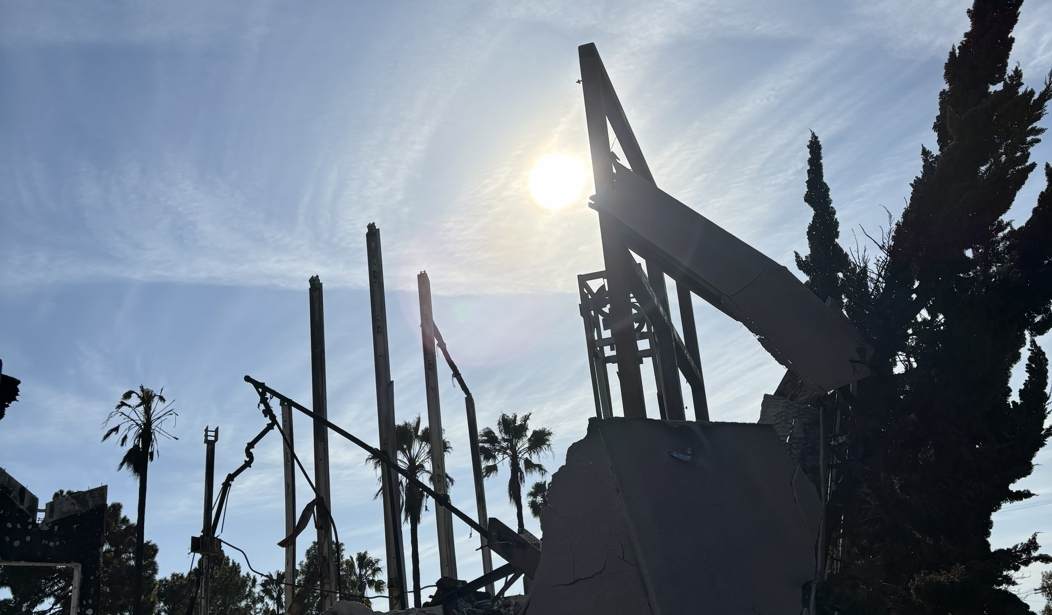
the Google Maps satellite imagery depicting the Los Angeles areas of
the Pacific Palisades and Altadena now shows pristine neighborhoods
untouched by the devastating fires of January 2025.
Of course, as we all know, those neighborhoods are in ruins. Why would Google pretend otherwise?
On Reddit, user TinyPinkSparkles asked, “Why is Google maps back to showing old satellite images of Altadena?" She continued:
Not
too long after the fire, Google updated the satellite imagery to
reflect the fire and thousands of lost structures. Now it's back to
pre-fire images of houses and businesses that are no longer there. Why?
Meanwhile, someone going by the tag Lisa S. asked Google Maps Help how to get the tech giant to respond, because the gaslighting is actually affecting people:
Obviously,
this is problematic for many reasons - navigation, recovery efforts,
and mental health among them. I've tried using the feedback form, but
would like to know if there's a more direct way to report this major
error to Google.
Now, there are a lot of internet
rumors and conspiracy theories out there. Is this just another example
of kooky folks putting on their tin-foil hats? I decided to take a look
for myself, and yep, what they’re saying appears to be correct.
RedState Managing Editor Jennifer Van Laar took note as well:
Well, the copyrights may be from
2026, but the satellite images certainly don’t appear to show the
reality that is the Palisades at any point in the current year.
Now,
let’s not get too hasty with our conclusions here. There’s nothing
really big going on in California these days, is there? Oh wait. Voters
have been weighing in on both the mayoral and gubernatorial races since
May 4 in the crucial month-long primary, which mercifully ends on June
2.
Oh.
Even though one of Google's co-founders, billionaire Sergey Brin, has shown signs in recent months of moving away from the Left, his company has been no friend to conservatives over the years and has routinely been called out for censoring Republicans and algorithmically burying their voices.
Whether any of this came into play in Google’s apparent map change is unclear, but it’s certainly noteworthy.
But hey, let’s give them the benefit of the doubt — maybe they just never updated their maps after the fire?
Google Maps’ satellite images have revealed the catastrophic scale of the Los Angeles wildfires as UCLA economists reveal that the two largest blazes may have caused up to $164 billion in property and financial loss.
Igniting in early January, the Palisades and Eaton fires,
driven by powerful Santa Ana winds, scorched through a combined total
of more than 37,000 acres. By the time the blazes were finally contained
more than three weeks later, they killed at least 29 people and ravaged
over 16,240 homes and businesses.
So why the
change? Google has not responded to users' demands for answers. I won’t
use any fire references here out of respect for the victims, so let’s
just say, when something smells, there’s often something rotten afoot.
Florida Democratic Rep. Angie Nixon is struggling
to cope with the new congressional maps. She pulled out a bullhorn when
the new districts were approved
last month. Even in mid-May, she’s still upset, staging a sit-in at
Gov. Ron DeSantis’ office.
Yes, it was about the maps. And yes, the
governor didn’t tolerate it. She was arrested over this stunt (via WESH 2):
A
Florida state representative said Friday that she was arrested in the
state's capitol during a sit-in protest at Gov. Ron DeSantis' office
against what she called illegal congressional maps.
Rep. Angie Nixon, D-Jacksonville, announced her arrest that evening via a news release.
"My
commitment has always been to the people of my district and to the
Constitution I swore to uphold, not to any political party or agenda,"
Nixon said in a statement. "I will continue to honor that commitment by
fighting against injustice, defending our democracy, and demanding
action on the issues that matter most to the people we serve."
When
WESH 2 News asked the governor's office for comment, it replied with
two screenshots of X posts that Gov. DeSantis had since made to his
profile.
In one of the screenshots, DeSantis quoted an X post made by his chief of staff, Jason Weida.
Weida
wrote, "Reprimanded and now arrested," while DeSantis replied,
"Deservedly so. Our office isn't a platform for this performative
nonsense."
In case you forgot, this is Nixon when the maps were passed:
The Supreme Court delivered a major blow to Democrats in their last-ditch effort to implement a gerrymandered map
that would have given them a 10-1 advantage. The Court rejected a
motion filed by Virginia Attorney General Jay Jones seeking to overturn
the state Supreme Court's decision invalidating the map for violations
of the state constitution. Questions about when election day begins were
the basis for bringing this case into federal court, as it concerns a
state court ruling on a state constitutional issue. It was a last
attempt—and it failed.
The application for a stay was officially denied by Chief Justice
John Roberts this afternoon. It was a laughable motion, and we’re glad
the court agreed. Democrats really are currently in the depths of hell
with this redistricting fight
The
Supreme Court on Friday turned away a long-shot effort by Virginia
Democrats to revive a new, voter-approved congressional map they wanted
to use in this year’s midterm elections.
The brief decision with
no dissents leaves in place a ruling by the Virginia Supreme Court that
found legal flaws in the process leading up to the referendum.
The
legal fight had fizzled in recent days, with Democratic Gov. Abigail
Spanberger saying Wednesday that the deadline to use a new map in
Virginia had expired anyway.
[…]
Although the Supreme Court
was unlikely to get involved, Friday’s decision confirms a setback for
Democrats not just in Virginia but also nationwide.
Most legal experts considered it DOA upon filing. The Virginia
Supreme Court's rejection caused a meltdown among Democrats, some of
whom toyed with the idea of drastically changing the Supreme Court by
lowering the retirement age to 54, invalidating the fair districting
amendment they supported, and passing any map they wanted.
Fortunately, Gov. Abigail Spanberger
and other Virginia Democratic
leaders dismissed those ideas.
And like clockwork, we're back to
court packing hysterics and Gov. Abigail Spanberger outright lying here.
You violated the state constitution, lady. Learn how things work first:
U.S. Rep. James Comer (R-KY) speaks to journalists on April 30, 2026 in the Rayburn House Office Building in Washington, DC.
Representative James Comer, a well-known Republican from Kentucky’s 1st Congressional District, signaled his intentions to run for governor of Kentucky in the upcoming 2027 election.
Comer (R-Ky.), who currently serves as the influential Chairman of
the House Committee on Oversight and Accountability, made his plans
clear during a recent community tour in Grayson, Kentucky, declaring
that he has “every intention” of seeking the state’s highest office.
This will be Comer’s second bid for the governorship, following a
razor-thin defeat in the 2015 Republican primary where he lost by just
83 votes to eventual Governor Matt Bevin.
While the formal campaign launch is not expected until December 2026,
Comer has laid out a strategy for the intervening six months to build
momentum ahead of his announcement. The veteran lawmaker stated that he
intends to visit every single one of Kentucky’s 120 counties during this
preliminary phase, aiming to meet with local elected officials,
community activists, business owners, and educators.
Comer also emphasized that a central pillar of his early efforts will
be listening to the public, particularly focusing on “public education,
economic development,” and implementing strategies to keep the state’s
“best and brightest” youth from moving away.
Comer’s entry into the gubernatorial conversation would shift the
landscape of Kentucky politics, especially as the current Democrat
incumbent, Governor Andy Beshear, is term-limited and cannot run for
reelection in 2027.
Early internal polling from Axis Research indicates that
Comer enters the arena as a formidable frontrunner, leading other
potential Republican contenders — such as Kentucky Secretary of State
Michael Adams — by a wide margin. In his address to constituents, Comer
argued that a governor who actively collaborates with the General
Assembly could unlock major progress for the commonwealth, positioning
himself as the leader capable of bridging that gap.
Before shifting full focus to the 2027 gubernatorial race, Comer must
first navigate his current responsibilities in Washington and the
ongoing 2026 election cycle. He is currently seeking reelection to his
congressional seat, with the Republican primary scheduled for mid-May
2026.
Political analysts note that his dual obligations as a powerful
congressional committee chairman and a major gubernatorial contender
will make him a central figure in both federal and state-level politics
over the next year, setting the stage for one of the most highly
anticipated political campaigns in recent Kentucky history.
On May 11, 2026, Hollywood legend Harrison Ford stood before Arizona
State University’s spring graduates and delivered a commencement address
that doubled as a political sermon. The appearance came as part of
ASU’s large graduation festivities, where thousands of students gathered
to celebrate hard-earned degrees and bright futures.
Ford did not
limit himself to patting students on the back; he urged “cultural
change,” called for extended social justice, and insisted on elevating
Indigenous peoples he said have been marginalized. Those remarks were
front and center in media write-ups and the university transcript, and
they made clear the message Ford chose to bring to a campus stage.
The
university even conferred an honorary Doctor of Arts and Humane Letters
on Ford, explicitly praising his decades of conservation work and
public advocacy when presenting the degree. It’s worth noting the
ceremony framed his celebrity as a platform for activism, rewarding
political exhortation as part of the pomp that should honor student
achievement.
Patriotic Americans should welcome environmental
stewardship, but commencement addresses are not campaign rallies for
fashionable campus ideology. Turning a graduation into a lecture on
contemporary left-wing talking points risks politicizing a solemn rite
and shortchanging the graduates who expected a message about
responsibility, work, and personal liberty.
Arizona State’s
spectacle—one of the nation’s largest graduations—illustrates a broader
trend on elite campuses where cultural and political indoctrination too
often shove aside the timeless lessons of character and civic duty.
Parents and taxpayers fund these institutions to prepare young people
for careers and citizenship, not to have celebrity figures deliver
feel-good catechisms about social engineering.
Ford’s conservation
record is real and long-standing; he has been a public voice on climate
and biodiversity for decades and has used his fame to promote
environmental causes. But sincere concern for the planet is not an
automatic license to lecture American students on social policy during
their moment of achievement, and conservatives must call out the elitist
habit of conflating fame with moral authority.
Hardworking
Americans value both stewardship of creation and the preservation of
free speech, but we also value common sense and respect for institutions
that should unite rather than divide. Let graduates be celebrated for
their accomplishments without being told their future must bow to the
latest celebrity-flavored ideology; our nation needs leaders who
champion liberty, work, and enduring American values.
Greg Kelly took aim at the left’s treatment of January 6 defendants,
arguing that Democrats have punished and dehumanized people involved in
that day far beyond what the evidence and basic decency warrant. He
framed the coverage as an overblown political crusade meant to keep a
narrative alive rather than seek justice.
For years the mainstream
narrative has insisted January 6 was a singular catastrophe — an attack
unlike any other in modern American life — and Democrats and much of
the legacy press have treated that framing as religion rather than
reporting. That insistence has made room for a prosecutorial zeal that
prioritizes symbolism over even-handed application of the law.
Republican
lawmakers and conservative outlets have pushed back, documenting what
they describe as harsh pretrial conditions and a “two-tiered” justice
system for those jailed in connection with January 6. Representatives
and activists have highlighted reports from inside the D.C. jail and
demanded congressional scrutiny of how these detainees were held and
processed.
Even some federal oversight found problems: U.S.
Marshals and watchdog reports flagged deficiencies at the D.C. jail
where January 6 defendants were housed, undercutting the tidy narrative
that every official step taken against them was routine and apolitical.
If the government wants the public to trust its actions, it must be able
to show impartial, humane treatment — not selective enforcement aimed
at humiliating political opponents.
Meanwhile, sentences for some
organized January 6 actors — particularly members of extremist groups
who assaulted police and planned violence — have been severe, while
critics argue that equivalent or worse behavior by left-wing rioters
during 2020 received far lighter consequences. That disconnect fuels a
legitimate anger about selective justice and the appearance that the law
is being wielded as a political weapon.
Conservatives are right
to demand accountability for violence and wrongdoers, but demanding
justice must not become a cover for partisan revenge or a campaign to
permanently stigmatize millions of Americans who disagree with the
current ruling coalition. The country’s legal system and its media must
be anchored to fairness, not to narratives designed to silence
opposition.
If America is to heal, we need honest reporting and
courts that apply the same standards to everyone — Democrat or
Republican, protester or bureaucrat. The instinct to weaponize justice
corrodes liberty; defending equal treatment under the law is not
softness, it is the very foundation of a free, conservative republic.
U.S. President Donald Trump wraps up his visit to Beijing on Friday
with a private meeting at Chinese leader Xi Jinping's official residence
before he departs for Washington.
During a series of meetings and events on Thursday the two discussed
divisive issues such as the Iran war, trade, technology and Taiwan.
During those meetings, Trump said Xi told him China wants to help
negotiate an end to the war and a reopening of the Strait of Hormuz.
China is the largest buyer of Iranian oil and Trump hopes Xi will use
that leverage to prod Iran into a deal on U.S. terms. Trump also said Xi
assured him that China wouldn’t provide Iran with military equipment.
Trump has taken a decidedly rosy outlook on the U.S.-China
relationship during this trip. But that has collided with some difficult
truths about the thorniest issues between the two superpowers including
Taiwan, the Iran war and trade.
In a summit marked by fanfare and flattery, Xi warned Trump that
differences over Taiwan, a self-governed island claimed by Beijing as
its own territory, could bring the U.S. and China into clashes or
conflict. Trump authorized an $11 billion arms package for Taiwan in
December, but has not moved forward with delivery. Secretary of State
Marco Rubio warned later on Thursday it would be “a terrible mistake”
for China to take Taiwan by force.
Trump also focused on trade and deals for China to buy more
agricultural products and passenger planes, setting up a board to
address their differences and avoid a repeat of the trade war ignited
last year after Trump’s tariff hikes.
Here is the latest:
Next to Beijing’s Forbidden City lies a secretive compound wrapped around two man-made lakes built for the pleasure of emperors.
Today, Zhongnanhai, or “middle and southern seas,” is synonymous with
China’s seat of power as the primary residence of Chinese President Xi
Jinping and the headquarters of the central government.
Zhongnanhai is often compared to the White House, the Kremlin or
South Korea’s Blue House. But unlike the other presidential residences,
Zhongnanhai does not serve as the main venue for diplomatic visits.
China’s top leaders reserve the highly secure grounds for only their closest allies and carefully selected dignitaries.
Russian President Vladimir Putin, whom Xi has called his closest
friend, was received at Zhongnanhai at least twice, in 2024 and 2025.
Xi also welcomed former U.S. President Barack Obama to Zhongnanhai in
2014. The two leaders took an evening stroll and had dinner.
Elon Musk’s 6-year-old son showed up Thursday at the Great Hall of
the People decked in Chinese-style clothing and wearing a tiger bag that
has since gone viral in China.
The tiny, tiger-head crossbody bag is produced by artisanal brand
YASTEE, which works with embroiderers in south China to make handcrafted
goods.
A bag like the one worn by Musk’s son takes several days to make and decorate by hand, according to local media.
The bag went viral on Chinese social media and sold out in hours on the company’s online stores.
The president said in the interview with Sean Hannity of Fox News
that he asked them to join his meeting with Xi at the Great Hall of the
People even though their participation wasn’t scheduled.
Trump said the American business executives were nearby in the building “and I said I think I can get them in five minutes.”
Trump wouldn’t identify which executives participated but said they
introduced themselves and said a few words, and seemed to impress Xi. He
said most of them had never met the president of China.
“He actually said that was very good. That was a good idea,” Trump said of Xi.
Trump, whose delegation for the trip included the CEOs of Mastercard
and Visa, said he also raised with Xi expanding access to the China
market for U.S.-based credit card companies.
“I said, ‘What about using Visa in China?’” Trump said in his Fox
News interview. “For some reason they were blackballed and maybe that’ll
come off.”
China allows foreign cards to be linked to instant pay apps such as
Alipay and WeChat Pay. But physical card usage is limited mainly to
international hotels, high-end shopping malls, and some upscale
restaurants.
Visa and Mastercard have been long pushing for inroads to Chinese
consumers and businesses in the world’s second largest economy.
Trump asked about the release of Jimmy Lai, the 78-year old former
newspaper publisher and pro-democracy activist who is serving a 20-year
sentence in Hong Kong, in his meeting with Xi, Secretary of State Marco
Rubio said in an interview with NBC News Thursday.
“We would like to see him released. We would be open to any
arrangement that would work for them, as long as he’s given his
freedom,” said Rubio.
Lai was the publisher of Apple Daily, a tabloid that was critical of Chinese and Hong Kong government authorities.
“He’s all business,” Trump told Sean Hannity of Fox News in a taped
interview that followed Thursday’s meeting with the Chinese leader.
“There’s no games. There’s no talking about how nice the weather is.”
Trump said Xi is a “very smart person” and that they have a “good relationship.”
“He’s all about China,” Trump said.
The president suggested during the Fox News interview that Irian
officials at first “said very strongly” that the U.S. could send it
teams to collect hundreds of pounds of enriched uranium believed to be
buried under nuclear sites badly damaged by U.S. military strikes last
year.
But then, he said, Iran reneged.
“They agreed to it. They take it back. They agree, you know it’s back and forth,” he said.
Whether Iran would be willing to relinquish enriched uranium is a key point in negotiations to end the war.
Trump has long insisted Tehran is willing to do so, but Iran has largely rejected such assertions.
Trump added during the interview that Iran says only the U.S. and
China had sufficient technology to remove the enriched uranium, given
that its buried deep underground.
“He’s all business,” Trump told Sean Hannity of Fox News in a taped
interview that followed Thursday’s meeting with Chinese leader Xi
Jinping. “There’s no games. There’s no talking about how nice the
weather is.”
Trump said Xi is a “very smart person” and they have a “good relationship.”
“He’s all about China,” Trump said.
Trump and Xi were scheduled to hold more talks Friday.
They are set to spend time together at Xi’s official residence in Beijing before Trump flies back to Washington.
Trump has taken a decidedly rosy outlook on the U.S.-China
relationship during this trip. But that is colliding with some difficult
truths about the thorniest issues between the two superpowers including
Taiwan, the Iran war and trade issues.
Secretary of State Marco Rubio told NBC that “there’s going to be some agricultural purchases” made as a result of this trip.
U.S. soybean farmers were hit especially hard by Trump’s trade war
with China and have urged him to persuade Beijing to buy more of their
crop.
China is on track to fulfill its commitment to buy 12 million metric
tons (13.2 million tons) of U.S. soybeans this year, although that is
well below the 25 million to 30 million metric tons (27.5 million to 33
million tons) purchased in past years.
China, the biggest foreign buyer of U.S. soybeans, stopped buying
them altogether last year after Trump hiked tariffs on all Chinese
goods. After Trump met with Xi in October, the White House said China
agreed to purchase 12 million metric tons.
The American Soybean Association hopes Trump can secure a deal for an
additional 8 million metric tons (8.8 million tons) by Aug. 31.